本研究は、第二言語としての英語学習者の L2 聴解ストラテジーとノートテ イキングが TOEFL リスニング問題の内容のリコールにどのように役立てられ ているのかを明らかにしたものである。学習者の英語熟達度レベル(中級・上級) と母語(中国語・日本語)を独立変数とした。熟達レベルが高いと、講義の中 の接続表現に着目するなど、内容理解のための工夫がなされ、また母語の影響 がノートテイキングに表れることも分かった。本研究結果はリスニングの授業 の教案作成の際に参考になり得ることから、理論的貢献に加え、教育的示唆も 提供できると考える。
The Use of Listening Comprehension
Strategies and Note-taking to Recall on
TOEFL
The Effects of Learners’
L1 Backgrounds and Proficiency
Levels
TOEFL 問題内容リコールのための
聴解ストラテジーとノートテイキングストラテジー
学習者の母語と英語熟達度が与える影響についてYunlong Liu
Doctoral Program, Graduate School of Media and Governance, Keio University リュウ・ウンリュウ
慶應義塾大学大学院政策・メディア研究科後期博士課程
The present study aimed to discover how listening comprehension strategies and note taking could be used to recall the content of passages on TOEFL. The independent variables were learners’ L1 backgrounds (Chinese and Japanese) and English proficiency levels (intermediate and advanced). The results showed that the advanced listeners were more adept at recalling the gist and complete meaning groups of a lecture, and took advantage of linkage words, notes, and the relationship between sentences to recall information.
The study also revealed differing patterns between Japanese and Chinese learners in terms of how they recalled the content of the lecture, and of the quality and the quantity of the notes they took. Specifically, the test-answerability score of the Chinese participants in the study was higher than that of the Japanese participants. The Chinese participants used more content words in their mother tongue to take notes than their Japanese counterparts, but the Japanese participants included more words in their notes. The results of the study provide both theoretical contributions to SLA and pedagogical implications for the foreign language [研究論文]
Keywords:
1 Introduction
Learning strategies, which consist of metacognitive, cognitive, and
socio-affective strategies, are intentional behaviors used by learners to facilitate their language learning (O’Malley & Chamot, 1990). Vandergrift (1997) maintained that L2 listeners can use learning strategies to process audio information, and identified specific listening comprehension strategies that belong to the metacognitive, cognitive, and socio-affective strategy groups. Different from test-taking strategies, which are only for the purpose of increasing the test score without comprehending test materials, such as guessing the answers to questions (Hughes et al., 1988), listening comprehension strategies help L2 learners solve difficulties in understanding L2 audio material. For instance, in the cognitive strategy group, making use of prior knowledge is a specific listening comprehension strategy, and listeners may use their prior knowledge to understand the gist of a lecture (Vandergrift, 1997; Chang, 2008). Previous studies discovered that listeners at different foreign language proficiency levels might use different listening comprehension strategies (Vogel, 1995; Oxford, 1996; Chang, 2008). Nowadays, the role of working memory has become increasingly salient in the field of second language acquisition (Vandergrift & Baker, 2015), and a number of researchers (e.g. Andringa et al., 2012) have verified the relationship between working memory capacity and L2 listening comprehension. Based on their findings, the recall capacity, as a crucial component in working memory capacity, is indispensable in the process of L2 listening comprehension. Therefore, it is necessary for the researcher to study what L2 listeners do after encoding the content of audio materials. More specifically, how they use listening comprehension strategies to later
listening comprehension strategies, recall, note taking 聴解ストラテジー、リコール、ノートテイキング
recall content should be further studied.
Furthermore, some English standardized tests, including TOEFL iBT
and TEM-8 1, allow test-takers to take notes while listening to the audio testing materials. This means an increasing number of researchers have studied the criteria for evaluating the quality of notes, how to improve the quality of the notes taken by test-takers, and the relationship between the quality of test-takers’ notes and their test performances (Dunkel, 1988; Song, 2011; Thorley et al., 2015). Previous studies have investigated how L1 speakers and L2 learners at different language proficiency levels take notes (e.g. Dunkel, 1988), but comparisons of notes taken by L2 learners from different L1 backgrounds are scarce. The features of the notes taken by L2 learners from different Asian cultural backgrounds should be compared, as this could shed light on how to take effective and qualified notes and thus improve Asian EFL learners’ listening comprehension competency.
2 Literature Review
2.1 The Use of Listening Comprehension Strategies to Recall the Content of a Passage
Different from short-term memory, which refers to a system for the
temporary storage of information, working memory refers to the ability to store and retrieve information actively (Goo, 2010). The present study focuses on how L2 listeners recall the content of L2 audio materials. The participants were asked to process, store, and recall the content of the two lectures used in this study, which is more closely related to working memory capacity than short-term memory. A number of researchers have studied the relationship between working memory capacity and L2 listening comprehension (e.g. Andringa et al., 2012; Vandergrift & Baker, 2015). By studying highly proficiency learners of Dutch, Andringa et al. (2012) found that L2 listeners with greater working memory capacity could be more adept at perceiving the important cues in L2 spoken discourses, and that these L2
listeners could make full use of those cues to facilitate their L2 listening comprehension process, which involves four steps: selecting, organizing, integrating, and monitoring information (Wolvin, 2010).
Although the positive relationship between working memory capacity
and L2 listening comprehension has been verified, the question of how L2 listeners recall the content they heard in the audio information has not yet been answered. At the stage of processing audio information, L2 listeners may use listening comprehension strategies to solve difficulties in audio materials (Vandergrift, 1997; Chang, 2008), so they may recall the information processed by using listening comprehension strategies to complete the corresponding comprehension tasks. Therefore, how L2 listeners make use of their working memory capacity to recall information deserves to be studied intensively. However, very few researchers have studied this issue (Vogel, 1995; Liu, 2015). Vogel (1995) concluded that in recall tests, learners who perceived themselves to be the most strategic listeners outperformed those who saw themselves as the least strategic listeners; however, he did not delve into the relationship between the learners’ proficiency levels and recall ability. How successful and less-successful listeners differ in recalling content processed by using listening comprehension strategies remains unanswered; thus, finding an answer to this question is one of the main objectives of the present study. Liu (2015) compared the differences between TOEFL test-takers at different language proficiency levels in recalling content while using listening comprehension strategies. He concluded that successful listeners are more likely to recall the gist of a lecture and its details, and then to make inferences in a lecture, compared to their less-successful counterparts. Advanced listeners are also more adept at referring to their notes to recall (Liu, 2015). Like the questionnaire in the present study, the design of the questionnaire used by Liu (2015) was also based on Vandergrift’s (1997) conclusion with regard to listening comprehension strategies. However, Liu’s (2015) questionnaire
did not distinguish between different kinds of details, which could be further classified into single words, repeated words, and complete information units (Vandergrift, 1997). Therefore, the present study improves upon the method used in Liu’s (2015) study by ameliorating the items included in the questionnaire.
2.2 The Role of Cultural Background in the Use of Listening Comprehension Strategies
A number of researchers have found some similarities in how Japanese
and Chinese learners of English adopt listening comprehension strategies (Hu, 2002; Takeuchi, 2003). Chinese learners of English tend to focus on every detail in audio materials, and when their listening comprehension competency is enhanced they can use top-down and bottom-up listening styles simultaneously and effectively (Hu, 2002). Similarly, Takeuchi (2003) discovered that Japanese learners of English adopt different listening comprehension strategies in different learning stages. More specifically, he found that Japanese students are likely to pay attention to every detail in audio materials at their initial learning stage, and then, at the intermediate stage, they are likely to decode an English audio passage in a top-down manner.
However, there are differences in how they use listening comprehension
strategies. Chang and Read (2013) found that Chinese learners of English at a high proficiency level could deal with the cognitive load posed by a test in which listening comprehension questions were raised orally, as they were trained to focus on linking words, such as but, so, and firstly. However, no Japanese researcher found this the case with Japanese learners of English. In addition, Chinese learners of English are inclined to adopt a socio-affective strategy when they listen to English materials (Oxford, 1996), while Takeuchi (2003) did not find this true of Japanese learners of English.
differences in how Japanese and Chinese learners of English use listening comprehension strategies. Nevertheless, using listening comprehension strategies for the sake of understanding the ongoing lecture is different from recalling content processed using listening comprehension strategies. Using listening comprehension strategies occurs at the stage of processing audio materials, during the playing of audio materials, while recalling the content processed using listening comprehension strategies takes place after the playing of audio materials. As the role of recall is significant, the gap in how learners of English from different L1 backgrounds recall content processed using different listening comprehension strategies should be bridged.
2.3 The Measurements for Evaluating the Quality of Notes
A number of researchers have verified the important role of note-taking
and proposed measurements for evaluating its quality (Dunkel, 1988; Song, 2011; Thorley et al., 2015). In Dunkel’s (1988) study, five measurements – the total-number-of-words score, the information-units count, the test-answerability, the completeness score, and the effective ratio – were utilized to evaluate the quality of note taking by L1 and L2 speakers of English. As an essential element for evaluating the quality of notes, the test-answerability could be defined as the number of questions that could be answered from listeners’ notes (Dunkel, 1988). In addition, test-answerability is highly correlated to the number of listening comprehension questions. Song (2011) proposed listener’s notes could be judged by how well he or she wrote down different levels of information units in an academic lecture; the format of the notes would also exert an influence on the performance of listeners (Thorley
et al., 2015).
Furthermore, Dunkel (1988) discovered that the information unit
count and total number of words relate closely to L2 students’ listening comprehension test performance, while the test-answerability score and total number of words could be predictors of the performance of native speakers.
Dunkel’s (1988) study only compared the differences in notes taken by L1 speakers and L2 learners. However, the study on discovering differences in the notes taken by L2 learners from different cultural backgrounds is scarce. Koren (1997) discovered that some L2 learners are inclined to take notes in L1 while listening to lectures in L2. However, Parks (1982) concluded that taking notes in L1 while listening to lectures in L2 requires four steps: perception, semantic analysis, semantic reconstruction, and expression, which is a rather demanding task. To avoid such a cognitive load, some L2 learners might be used to taking notes in the target language directly. L2 learners from different L1 backgrounds may take notes in different ways, so the present study intends to find their differences in note-taking.
Although a number of researchers have studied how listening
comprehension strategies are used by L2 learners at different language proficiency levels, few scholars have focused on how L2 learners use these strategies to recall content in TOEFL listening comprehension tests. Taking notes while listening is a rather challenging task for test-takers. As mentioned above, although previous studies have revealed differences in taking notes between L1 speakers and L2 learners, little attention has been paid to classifying differences in notes between L2 listeners from different cultural backgrounds. Based on the above-mentioned gaps, the study asks the following three research questions.
1) What are the differences in the advanced and intermediate learners’ self-reports of using listening strategies to recall information?
2) What are the differences in the Japanese and Chinese listeners’ self-reports of using listening strategies to recall information?
3) What are the differences in notes taken by the Japanese and Chinese learners of English?
3 Method
3.1 ParticipantsThe participants in this study were 30 native speakers of Chinese and
25 native Japanese speakers. Further characteristics of the participants are provided in Table 1, including their age, major, and language proficiency level. The participants were classified into two groups – advanced English proficiency and intermediate English proficiency – with approximately the same number of advanced and intermediate learners in the Japanese and Chinese groups. Their standardized English test scores were taken into consideration when classifying them into one of these two groups. According to standards set by the Educational Testing Service (2005), the participants whose TOEFL iBT scores were above 88, or TOEIC scores were above 785, were classified into the advanced English proficiency group, while those whose TOEFL iBT scores were between 56 and 87, or TOEIC scores were between 605 and 780, were categorized as the intermediate English proficiency group.
3.2 Materials
As the participants had different majors, the researcher chose two
academic lectures with different topics, science and art respectively, so as to control the variable of major. All participants were asked to listen to two audio lectures named “Octopus” and “Roman Sculptures” from the unpublished TOEFL iBT listening comprehension test. According
Table 1 Characteristics of the Participants
Study groups Age Major The number of advanced learners The number of intermediate learners Arts Science Chinese 19.4 25 5 13 (43%) 17 (57%) Japanese 20.8 10 15 10 (40%) 15 (60%)
to Carrell (2007), TOEFL PBT is being phased out, and TOEFL iBT is now recognized by the majority of top universities. The length of each conversation or lecture used in TOEFL iBT is longer than that of the audio materials used in TOEFL PBT, so TOEFL iBT test-takers have to take notes while listening, which aggravates their cognitive loads. Therefore, choosing materials from TOEFL iBT could solve more practical problems for L2 listeners. The biggest English training organization, the New Oriental Education Group, purchased the copyright of the test, and the researcher got permission from the group to use the two lectures to conduct academic research. There were 12 multiple-choice questions (each lecture raised six questions), and the participants were not allowed to preview the corresponding questions until they finished listening to each lecture. The two lectures lasted for 327 and 296 seconds, and the themes related to biology and history, respectively.
3.3 Instruments
A questionnaire (see Appendix A) with a design based on Vandergrift’s
classification of listening comprehension strategies (see Vandergrift, 1997) was used. It contained 13 items designed to measure how the participants recalled the content processed using different listening comprehension strategies in order to complete the corresponding listening comprehension tasks. The participants were asked to respond to each item on a six-point Likert scale, which was beneficial for conducting frequencies analysis. The researcher removed some listening comprehension strategies from Vandergrift’s original version as they could not be used to recall, such as advance organization, which means listeners should predict the topic of a lecture before they listen to it. The second part of the questionnaire asked the participants to provide personal information, such as their age, majors, and standardized English proficiency test scores.
3.4 Procedures
First, participants were introduced to the procedure of this study, and
they then had one practice session to confirm they understood what they were supposed to do. There were many linguistic terms, such as linkage words, in the questionnaire. In order to prevent the participants from misunderstanding the terms, the researcher explained in detail what they meant. After the practice session, they listened to the academic lectures used in the present study. Meanwhile, they were allowed to take notes, and were informed that the quality of their notes would later be compared to those of other participants by the researcher. Next, they were asked to complete the questionnaire described above. A post-hoc interview was provided for after the data collection, during which the participants were asked about how they learnt English before, how they recalled the content processed by using different listening comprehension strategies, and how they took notes.
3.5 Analysis
The coding methods used to evaluate the note-taking quality were
similar to those used in Dunkel’s (1988) study. First, with regard to the total number of words, two Japanese research assistants counted the total number of English words and symbols in the notes taken by the Japanese participants in this study, and two Chinese research assistants did the same with the Chinese learners’ notes. Second, the two Japanese assistants counted the total number of complete information units in the Japanese participants’ notes, and the two Chinese assistants did the same for the Chinese learners’ notes. Different single words, complete information units represent complete information. When reading complete information, note-takers could recall abundant information. Third, the two Japanese assistants counted the total number of Japanese content words in the Japanese students’ notes. Given that a proportion of Japanese characters are meaningless, the Japanese assistants did not count the number of Japanese
characters in the participants’ notes; instead, they counted the number of meaningful Japanese words in the participants’ notes. Two Chinese research assistants did the same thing for the Chinese participants’ notes. Lastly, there were 15 crucial points that could be referred to in answering the 12 comprehension questions. In order to answer the fourth question of the first lecture correctly, a note-taker needed to write “projections” and “texture,” or their synonyms. If so, he or she could earn one point. If a note-taker wrote six points, their answerability was calculated as 6/15, so his or her score was 0.4. The Japanese assistants judged how many of the 15 points existed in the Japanese participants’ notes, and the Chinese assistants judged the Chinese participants’ notes using the same method. Means comparisons were carried out using a two-way analysis of variance (ANOVA) to analyze the differences in the different groups’ average scores for the listening comprehension test. Descriptive analysis and frequency distribution were used to describe the results of the questionnaire, and two-way ANOVA was also used to answer the three research questions.
4 Results
4.1 Differences in Using Strategies to Recall Content between Advanced and Intermediate Learners
The participants’ test scores for the listening comprehension test in
this study are given in Table 2 and Table 3. The findings revealed that the participants’ proficiency level did contribute to the difference in their test scores (F = 52.305, p = .000), but their L1 background did not contribute to the difference (F = 1.360, p = .249). By conducting descriptive analysis and two-way ANOVA, five differences between the advanced and intermediate learners were identified (see Table 5). The advanced learners were more adept at recalling the gist of a lecture (F = 7.920, p = .007) and made better use of their notes (F = 6.324, p = .015). Furthermore, compared to the intermediate learners, the advanced learners were good at recalling complete
information units (F = 14.270, p = .000) and content after using linkage words (F = 9.890, p = .003). Lastly, the lower-level learners in this study were less capable of recalling content processed by analyzing the relationship between sentences than the advanced learners (F = 12.437, p = .001).
Table 2 Differences in the Listening Comprehension Test Scores between the Advanced and Intermediate Learners
Study group n. M SD df F Sig.
Intermediate Advanced 32 23 6.62 10.04 1.99 1.26 1 52.305 0.000
Dependent variable: test scores; Independent variable: language proficiency level * Alpha level was set at p < .05
Table 3 Differences in Scores of the Listening Comprehension Test between the Chinese and Japanese Participants
Study group n. M SD df F Sig.
Chinese Japanese 30 25 8.40 7.64 2.47 2.32 1 1.360 0.249
Dependent variable: test scores; Independent variable: L1 background * Alpha level was set at p < .05
Table 4 Frequencies Distribution for Listening Strategies Used by the Advanced and Intermediate Learners to Recall
Recall Proficiency n Never Hardly Sometimes Often Usually Always
1 Advanced 23 0% 0% 17.4% 26.1% 17.4% 39.1% 1 Intermediate 32 0% 12.4% 21.9% 31.3% 28.1% 6.3% 2 Advanced 23 4.4% 0% 26.1% 13.0% 34.8% 21.7% 2 Intermediate 32 6.3% 21.9% 31.3% 34.4% 6.1% 0% 5 Advanced 23 0% 0% 8.7% 34.8% 39.1% 17.4% 5 Intermediate 32 6.1% 12.5% 31.3% 18.8% 21.9% 9.4% 10 Advanced 23 0% 4.3% 21.7% 21.7% 26.2% 26.1% 10 Intermediate 32 9.4% 15.6% 15.6% 31.3% 18.7% 9.4% 12 Advanced 23 0% 8.7% 13.1% 39.1% 26.1% 13.0% 12 Intermediate 32 12.5% 21.9% 34.4% 18.8% 12.4% 0%
4.2 Differences in Using Strategies to Recall Content between the Chinese and Japanese participants
The study also revealed differing patterns in the ways in which
Japanese and Chinese learners of English recalled the content of the academic lecture (see Table 7). As mentioned above, there was no signif icant difference in the average score between the Chinese and Japanese participants (F = 1.360, p = .249); however, there were differences in how the Chinese and Japanese participants used listening comprehension strategies to recall content. The Chinese learners of
Table 5 Differences in How the Advanced and Intermediate Learners Used Strategies to Recall
How the participants
recalled Proficiency M SD F df Sig.
1. I recalled the gist of the lecture to choose my response.
Intermediate
Advanced 2.943.78 1.131.17 7.920 1 .007 2. I recalled the complete
meaning groups in the lectures to choose my response.
Intermediate
Advanced 2.133.39 1.041.34 14.270 1 .000 5. I recalled the content
after the linkage words in the lectures to choose my response.
Intermediate
Advanced 2.663.65 1.380.89 9.890 1 .003 10. I recalled the notes I
had taken to choose my response.
Intermediate
Advanced 2.633.48 1.451.24 6.324 1 .015 12. I recalled the content
processed by analyzing the relationship between sentences in the lectures to choose my response.
Intermediate
Advanced 1.973.13 1.201.33 12.437 1 .001
Dependent variable: the learners’ response to each item; Independent variable: language proficiency level
English were more inclined to recall the gist of a lecture than the Japanese participants (F = 8.145, p = .006). In addition, the Chinese participants were more likely to recall the content processed by making inferences (F = 5.544, p = .022) and by translating them into Chinese to answer questions than their Japanese counterparts (F = 4.783, p = .033). As seen in Table 8, the researcher discovered that the advanced Chinese participants were more likely to recall the content processed by referring to their prior knowledge (F = 5.005, p = .030).
Table 6 Frequencies Analysis for Listening Strategies Used by the Chinese and Japanese Participants to Recall
Recall L1 n. Never Hardly Sometimes Often Usually Always
1 Chinese 30 0% 3.4% 13.3% 23.3% 30.0% 30.0% 1 Japanese 25 0% 12.0% 28.0% 36.0% 16.0% 8.0% 11 Chinese 30 3.3% 3.4% 33.3% 40.0% 20.0% 0% 11 Japanese 25 4.0% 36.0% 32.0% 20.0% 4.0% 4.0% 13 Chinese 30 10.0% 20.0% 23.3% 26.7% 10.0% 10.0% 13 Japanese 25 12.0% 40.0% 32.0% 8.0% 8.0% 0%
Table 7 Differences in How the Chinese and Japanese Participants Used Strategies to Recall
How the participants recalled L1 M SD F df Sig.
1. I recalled the gist of the lecture
to choose my response. JapaneseChinese 3.702.80 1.151.12 8.145 1 .006 11. I recalled the content processed
by making inferences to choose my response
Chinese
Japanese 2.701.96 0.951.14 5.544 1 .022 13. I recalled the meaning groups
processed by translating into my mother language to choose my response.
Chinese
Japanese 2.371.60 1.451.08 4.783 1 .033 Dependent variable: the learners’ response to each item; Independent variable: L1 background
4.3 Differences in Notes Taken by the Chinese and Japanese Participants The study also found differing patterns in the ways in which Japanese
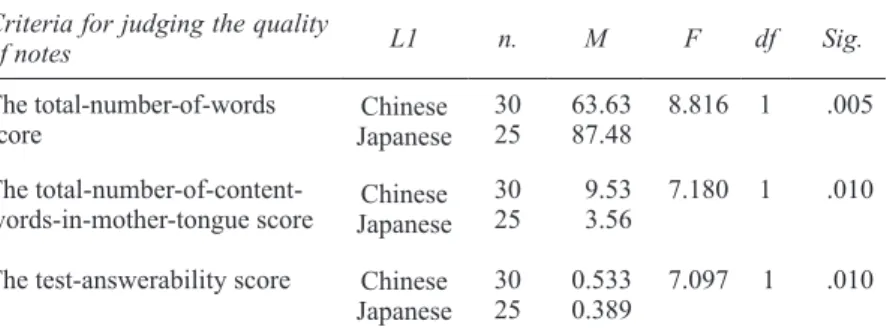
and Chinese learners of English took notes while listening to audio materials in English (see Table 9). The results revealed that the test-answerability score of the Chinese participants was higher than that of the Japanese participants (F = 7.097, p = .010). Furthermore, the Chinese participants used more words and characters in their mother tongue to take notes than their Japanese counterparts (F = 7.180, p = .010). Conversely, the Japanese students wrote more words in their notes than the Chinese students (F = 8.816, p = .005). As is evident in Table 10, the advanced Japanese participants wrote more words in their notes than their Chinese counterparts (F = 5.564, p = .022). In addition, the advanced Chinese participants wrote more Chinese content words to take notes, while the advanced Japanese participants were less likely to use their mother tongue to take notes (F = 4.260, p = .044).
5 Discussion
5.1 Differences between the Advanced and Intermediate Learners in the Use of Listening Comprehension Strategies to Recall Content In the present study, the intermediate learners were less adept at
recalling complete information units of the lectures to which they listened, which aligns with Goh’s (2002) finding that less-skilled listeners have
Table 8 How Proficiency *L1 Affected Using Listening Strategies to Recall
How the participants
recalled Proficiency *L1 n. M F df Sig.
I recalled the content proce-ssed by referring to my prior knowledge to choose my response.
Advanced Chinese
Advanced Japanese 1310 2.461.40 5.005 1 .030 Dependent variable: the learners’ response to each item. Independent variable: proficiency level *L1 background
problems in chunking and processing the stream of speech. Less-skilled listeners could not process the stream of speech in a timely and correct manner, so they might only recall single words to facilitate comprehension and recall. Furthermore, the advanced participants were more adept at recalling the gist of a lecture, which is consistent with Chang’s (2008) finding that advanced learners paid attention to the gist of the lecture more than intermediate learners, which enables them to use this gist to recall
Table 9 Differences in Notes Taken by the Chinese and Japanese Participants
Criteria for judging the quality
of notes L1 n. M F df Sig.
The total-number-of-words
score JapaneseChinese 3025 63.6387.48 8.816 1 .005 The
total-number-of-content-words-in-mother-tongue score JapaneseChinese 3025 9.533.56 7.180 1 .010 The test-answerability score Chinese
Japanese 3025 0.5330.389 7.097 1 .010 Dependent variable: mean of each criterion; Independent variable: L1 background. * Alpha level was set at p < .05
Table 10 How Proficiency *L1 Caused Differences in Notes Taken by the Chinese and Japanese Participants
Criteria for judging note
quality Proficiency *L1 n. M F df Sig.
The total-number-of-words score Advanced Chinese Advanced Japanese 1310 128.6076.15 5.564 1 .022 The total-number- of-content-words-in-mother-tongue score Advanced Chinese Advanced Japanese 1310 14.853.00 4.260 1 .044 Dependent variable: mean of each criterion; Independent variable: language proficiency level * L1 background
information.
Furthermore, the advanced learners in this study were more adept at
analyzing the relationship between sentences and recalling them to complete the corresponding comprehension tasks. Goh (2002) argued that advanced learners were better at completing cognitive tasks, such as analyzing the relationship between sentences. Highly proficient L2 learners can not only process the linguistic information on the surface level but also deduce the relationship between sentences, which might explain why they could recall this in completing the comprehension task. They can also take notes comprehensively, logically, and effectively (Carrell, 2007). Therefore, it seems reasonable to deduce that in this study the advanced learners could make better use of their notes to recall content than the intermediate participants.
Although linkage words, such as but, so, and because, could benefit
L2 listeners because they enable listeners to distinguish key information from unimportant information, these words are not easily perceived by intermediate L2 listeners (Field, 2008); advanced L2 learners find it relatively easier to notice linkage words and understand the content that comes after them, meaning they could recall more content than their intermediate counterparts.
5.2 Differences between the Chinese and Japanese Participants in the Use of Listening Comprehension Strategies to Recall Content As Table 3 shows, there was no statistical difference between the
Chinese and Japanese groups in terms of their average score in the listening comprehension test used in this study, but both groups used different listening comprehension strategies to recall content. This finding could be attributed to the pedagogical training they received in their home countries. As shown in the results section, there were three statistically significant differences in terms of how Chinese and Japanese participants recalled the
content of the passages. First, the Chinese participants were more inclined to recall the gist of a lecture and the inferences made. According to the post-hoc interview, the Chinese participants claimed they were test-oriented, and that their EFL teachers often taught them to pay attention to the gist of a lecture and make inferences. This explains why the Chinese participants were more likely to recall the gist of the lectures and the inferences.
Furthermore, in China, the teaching method of translation is still
prevalent, so Chinese learners of English are used to translating incoming audio materials into their mother tongue to facilitate their comprehension. That may explain why the Chinese participants were more inclined to recall the content processed by translating into their mother tongue. Above all, the role of mother tongue is despised in the process of learning foreign languages, but in my study, the Chinese participants took advantage of their mother tongue to recall more content and achieved high scores in the tests associated with the present study.
The finding that the advanced Chinese learners were inclined to
use their prior knowledge to help them recall aligns with Long’s (1989) discovery that prior knowledge enables listeners to make inferences and understand audio information better. Furthermore, in the post-hoc interview, the advanced Chinese participants suggested they were informed about the importance of accumulating background knowledge, which could explain why they were more likely to recall the content processed by referring to their prior background knowledge than their Japanese counterparts. Thus, it can be argued that past language-learning experiences and beliefs reflect on how they chose listening strategies to recall information.
5.3 Differences in the Content of Notes Taken by the Chinese and Japanese Participants
In the present study, the test-answerability scores of the Chinese
means the Chinese participants included in their notes more information that could be used to complete the listening comprehension task than the Japanese participants. Flowerdew and Tauroza (1995) suggested that L2 listeners could better understand a lecture with evident discourse markers, such as so, right, but, and first, than a lecture without those markers. In the post-hoc interview, the majority of the Chinese participants claimed they understood the role of linkage words and paid more attention to the content following these words. They knew the linkage words were essential to complete the corresponding listening comprehension task; therefore, they endeavored to write down the content in their notes, which increased the test-answerability of their notes.
Second, the Chinese participants in the present study were inclined
to take notes in Chinese. That the Chinese participants wrote more words in L1 in their notes aligns with the finding of Koren’s (1997) study that L2 learners take notes in L1 for the purpose of recalling information easily, and that the role of L1 in taking notes should be promoted. Liu’s (2001) study revealed that the role of note-taking is recognized by Chinese learners of English. Based on the above analysis, the Chinese participants were more inclined to take notes in L1. However, as the above mentioned, Parks (1982) concluded that taking notes in L1 while listening to lectures in L2 is a demanding task, so some learners of English might be used to taking notes in the target language directly (Parks, 1982). This finding may explain why the Japanese participants seemed to be accustomed to taking notes in the target language.
Finally, the Japanese participants wrote down more content than the
Chinese participants. Takeuchi (2003) claimed that Japanese students tend to adopt analytical strategies to acquire foreign languages and focus on the accuracy of small details, thus explaining why they wrote down as many details as possible.
6 Conclusion
Several significant differences between the two different proficiency
level groups were found. The advanced learners were good at recalling the complete information units and content following linkage words in a lecture. In addition, the lower-level learners were less capable of recalling the content processed by inferring the relationship between sentences in a lecture. Lastly, the advanced learners self-reported that they were inclined to use their notes and the gist of a lecture to recall. The study also revealed differing patterns in the ways in which Japanese and Chinese learners recalled the content of the listening passages. The Chinese learners of English in the study were more inclined to recall the gist of a lecture than the Japanese participants. Furthermore, the Chinese participants were inclined to recall inferences they made and content processed by translating into their L1.
The study also compared the quality of the notes taken by the Chinese
and Japanese participants. The results revealed that the test-answerability score of the Chinese participants was higher than that of the Japanese participants. Furthermore, the Chinese participants used more content words in L1 to take notes than their Japanese counterparts, but the Japanese participants wrote more words in their notes than the Chinese participants.
7 Pedagogical Implications
Given that the current study revealed the importance of using listening
comprehension strategies to recall information, it is advisable that EFL teachers are aware of those strategies and embed the practice of recalling when they give listening exercises. Furthermore, note taking should be recognized as an indispensable part of the traditional L2 listening comprehension class, be it in English as an L2 or in the learners’ L1. Given the importance of note taking, EFL teachers should provide their students with more tutorials about how to take qualified notes while listening to
an academic lecture. At the same time, L2 learners should be informed that taking notes does not mean they should write down all the words they hear mechanically. Lastly, the role of using L1 to take notes should not be ignored, as some L2 learners, like the Chinese participants in this study, may be accustomed to using L1 to take notes while listening to L2 audio materials. In the heyday of globalization, language teachers should be encouraged to familiarize themselves with the characteristics of international students from different cultural backgrounds, so that their faculties can be developed further.
Notes
1 TEM-8 refers to Test for English Majors Grade Eight. It is the most difficult test for Chinese English majors, and is held only once every year. The full mark of the test is 100, and only 30% of the test-takers can pass the test. The test consists of five parts: listening comprehension, reading comprehension, translation, proofreading, and composition.
References
Andringa, S., Olsthoorn, N., Van Beuningen, C., Schoonen, R., & Hulstijn, J., “Determinants of success in native and non-native listening comprehension: An individual differences approach.” Language Learning, 62(S2), 2012, pp. 49-78. Carrell, P. L., Notetaking strategies and their relationship to performance on listening
comprehension and communicative assessment tasks (TOEFL Monograph Series No.
MS-35). Princeton, NJ: Educational Testing Service, 2007.
Chang, C-S., “Listening strategies of L2 learners with varied test tasks. TESL Canada
Journal, 25, 2008, pp. 1-26.
Chang, C-S., & Read, J., “Investigating the effects of multiple-choice listening test items in the oral versus written mode on L2 listeners’ performance and perceptions.”
System, 41, 2013, pp. 575-586.
Dunkel, P., “The content of L1 and L2 students’ lecture notes and its relation to test performance.” TESOL Quarterly, 22, 1988, pp. 259-281.
Educational Testing Service (2005), TOEFL iBT test scores. Retrieved June 1, 2015, from <http://www.ets.org/toefl/ibt/scores?WT.ac=toeflhome_scores_121127>.
Field, J., “Bricks or Mortar: Which parts of the input does a second language listener rely on?” TESOL Quarterly, Vol. 42(3), 2008, pp. 411- 432.
Flowerdew, J., & Tauroza, S., “The effect of discourse markers on second language lecture comprehension.” Studies in Second Language Acquisition, 17, 1995, pp. 435-458. Goh, C., “Exploring listening comprehension tactics and their interaction patterns.”
System, 30, 2002, pp. 185-206.
Goo, J., “Working Memory and Reactivity.” Language Learning, 60, 2010, pp. 712-752. Hu, G-W., “Potential Cultural Resistance to Pedagogical Imports: The Case of
Communicative Language Teaching in China.” Language, Culture and Curriculum, 15(2), 2002, pp. 93-105.
Hughes, C. A., & Schumaker, J. B., “Test-taking strategy instruction for adolescents with learning disabilities.” Exceptionality, 2, 1991, pp. 205-221.
Koren, S., “Listening to lectures in L2; Taking notes in L1.” The Electronic Journal for
English as a Second Language, 1997, 2(4), pp. 1-10. Retrieved from <http://www.
tesl-ej.org/wordpress/issues/volume2/ej08/ej08a1/>.
Liu, Y., “A cognitive study on the functions of note-taking and the content of notes taken in a context of Chinese EFL learners.” Unpublished master’s thesis, Guangdong University of Foreign Studies, Guangdong, People’s Republic of China, 2001. Liu, Y., “The Use of Listening Comprehension Strategies to Recall on TOEFL: The Case
of Chinese and Japanese Successful and Less Successful Listeners.” The Asian EFL
Journal, 85, 2015, pp. 117-135.
Long, D., “Second language listening comprehension: A schema-theoretical perspective.”
Modern Language Journal, 73, 1989, pp. 32-41.
O’Malley, J. M., & Chamot, A. U., Learning strategies in second language acquisition. Cambridge: Cambridge University Press, 1990.
Oxford, R., & Burry, J., “Assessing the use of language learning strategies worldwide with the ESL/EFL version of the strategy inventory for language learning (SILL).”
System, 23, 1995, pp. 1-23.
Oxford, R. L., Language learning strategies around the world: Cross-cultural
perspectives. Honolulu, Hawaii: Second Language Teaching and Curriculum Centre,
1996.
Parks, G., “Notes on the use of translation in language classes.” System, 10(3), 1982, pp. 241-245.
Song, M-Y., “Note-taking quality and performance on an L2 academic listening test.”
Language Testing, 29, 2011, pp. 67-89.
Takeuchi, O., “What can we learn from good foreign language learners? A qualitative study in the Japanese foreign language context.” System, 31, 2003, pp. 385-392. Thorley, C., Baxter, R., & Lorek, J., “The impact of note taking style and note availability
at retrieval on mock juror’s recall and recognition of trial information.” Memory, 24(4), 2015, pp. 560-574.
Vandergrift, L., “The strategies of second language (French) listeners.” Foreign Language
Annals, 30, 1997, pp. 387–409.
Vandergrift, L., & Baker, S., “Learner Variables in Second Language Listening Comprehension: An Exploratory Path Analysis.” Language Learning, 65(2), 2015, pp. 390-416.
Vogel, A., “Perceived strategy use during performance on three authentic listening comprehension tasks.” The Modern Language Journal, 79(1), 1995, pp. 41-56. Wolvin, A., Listening and Human Communication in the 21st Century. UK: Blackwell
Appendix A
Questionnaire
Part One: How often did you use the following listening strategies to recall when choosing your response to each listening comprehension question? 0 1 2 3 4 5
Never Hardly Sometimes Often Usually Always
1) Directed attention: I recalled the gist of the lecture to choose my response. ____ 2) Selective attention: I recalled the complete meaning groups in the lectures to
choose my response. ____
3) Selective attention: I recalled some single words in the lectures to choose my response. ____
4) Selective attention: I recalled the repeated words in the lectures to choose my response. ____
5) Selective attention: I recalled the content after the linkage words in the lectures to choose my response (e.g. first, second, however, because). ____
6) Voice inference: I recalled the content processed by focusing on the tone of the lecturer to choose my response (e.g. fall and rise tones). ____
7) Academic elaboration: I recalled the content processed by referring to my prior background knowledge to choose my response. ____
8) Imagery: I recalled the picture depicting the content of the lectures to choose my response. ____
9) Structure: I recalled the structure of the lectures in my mind to choose my response. ____
10) Note taking: I recalled the notes I had taken to choose my response. ____ 11) Inferencing between parts: I recalled the content processed by making inferences
to choose my response. ____
12) Grouping: I recalled the content processed by analyzing the relationship between sentences in the lectures to choose my response (e.g. statement + example). ____ 13) Translation: I recalled the meaning groups processed by translating into my
mother language to choose my response. ____ Part Two: Personal information
Name: E-mail: Gender: Age: Major:
Past TOEFL score: TOEIC score: For how many years have you studied English? Have you ever studied in an English-speaking country? A. Yes B. No
Have you taken TOEFL before?
A. Yes B. No
〔受付日 2016. 4. 15〕 〔採録日 2016. 6. 21〕