鳴門教育大学学校教育実践センタ一紀要 19, 125 - 132, 2004
SECONDARV SCIENCE EDUCATION CURRICULUM
I
N
THE PHILIPPINES
フィリピンにおける中等理科教育カリキュラム
DIGNA CABARDO PANINGBATAN
,
*
TAKESHI KOZAI *¥HIROAKI OZAWA
ヘ
*
MAMORU MURATA *
*
and HIROSHI NISHIMURA *
*
*
* Graduate School of Natural Science Education (Science), Naruto University of Education * * Natural Science Education (Science), Naruto University of Education * * * Basic Human Science for Integrated Studies, 748 Takashima, Nakajima, Naruto-city 772-8502, Japan 抄録:理科は教育上重要な教科の一つである。それは,身の周りの現象や出来事に関して学び,より よく発展させることに関連するからである。一方,中学校教育は初等教育と高等教育をつなぎ,学習 者が大学に入るための準備するための側面もある。フィリピンの中等理科教育は 以前から改革がな されてきた。これらの中等理科教育における改革でフィリビンにおける様々なタイプの中等学校が創 設され,異なった理科カリキュラムが実施されている。フィリピンには,カリキュラムの異なる2つ のタイプの中等学校である普通学校と職業学校がある。職業学校は職業教育コースとしての中等カリ キュラムを実施し,普通学校は4年間の一般的な教科に基づいた中等カリキュラムを実施している。 サイエンスハイスクールでは中等教育カリキュラムに加え高度な理科数学,および英語のカリキュ ラムが実施されている。本論文ではフィリピンサイエンスハイスクール リージョナルサイエンスハ イスクール,および一般公立高校の理科カリキュラムを整理しその特徴について述べる。また,地学 の教育内容に関して整理しする。 キーワード:理科教育,中等教育,中等理科教育,地学教育,フィリピン
Abstract : Science is an integral part of education. Itis through where man leams of things around him and evolves better ways and means of doing things. Secondary Education, on the other hand, serves as a bridge between primary and higher education to prepare the leamer in entry into college and in the world of work Secondary Science Education in the Philippines has undergone transformation since its set out way back in hi且tor
y
.
This revolution in Secondary Science Education is evident on the existence of different science curricula in accordance with the creation of various types of secondary schools in the country. ln the Philippines, there are two types of secondary schools according to curricular offerings: general high school and vocational high schoo1.General high schools offer the four-year general academic secondary curriculum while vocational high schools offer the same secondary curriculum with additional vocational courses. Science high schools offer an enriched Science, Mathematics and English curriculum in addition to the requirements of the secondary education curriculum. This paper looks into the curriculum of the Philippine Science High School, Regional Science High School and General Public High Schoo.1ln addition, the Earth and Environmental Science curriculum is introduced to give the foreign readers an idea on what is taught in this subjectKeywords : Science Education, Secondary Education, Secondary Science Education, Earth and Environmental Science, Philippines
1.Introduction educators say that, the dawn of science education was marked by the onset of civilization. Science allows a child to learn knowledge and skills to hl'lp him idl'ntify and sohl'problcms of cVl'ryday lifc and c¥'ohc bcttcr ways and1l11'ans ot、 doing things. SOIl1l' Science Education in the Philippines can be traced back to thl'pre-Spanish pl'riod to thc post World War 11 pl'riod whcrl' thl' l'Il1phasis was foじllsl'don sじil'ncl'with hcalth orientation
(Ibe and Ogena, 1998). The launching of Sputnik by Russia in 1957 has totally revamped the science education curriculum in the United States. This wave of putting emphasis on science and technology reached the Philippines with the establishment of the National Science Development Board (NSDB) in the following year, 1958. In the succeeding years, the science curriculum has gone a lot of transformation to fit the need of the times.
The role of science education in Philippine development is clearly defined in Article II of the Philippine 1987 Constitution. It mandates that the state gives priority to research and development in science and technology education, to support indigenous, appropriate and self-reliance technology capabilities and their application to improve national productivity and lifestyle of the Filipino people.
It is in this regard that the Philippine Secondary Science Education aims to develop understanding of concepts and key principles of science, science processes, skills and desirable values to make the students scientifically literate, productive and effective citizens (Bureau of Secondary Education, 1998). The Secondary Education which serves as a bridge between primary and higher education is expected to prepare the learners between the age group 12-15 in entry into college and in the world of work. The Secondary Education in the Philippines is a four-year course. There is no separation of junior and senior high school like that of Japan.
With an 84 million population, 22% of the population is between 10-19 years old. However, there are only 6,077,851 enrollees in high school or about 7 percent of the population. Moreover, according to the Education for All (EFA) 2000 Assessment Report, out of every 100 Filipino schoolchildren enrolled every year, 66 will complete elementary education, 42 will finish high school but only 14 will earn a college degree (Center for Asia-Pacific Studies, 2000). There are two types of schools in the Philippines based on financing institution; private and public. Furthermore, there are two types of secondary schools according to curricular offerings: general high school and vocational high school. General high schools offer the four-year general academic secondary curriculum while vocational high schools offer the same secondary curriculum with additional vocational courses. Science high schools offer an enriched Science, Mathematics and English curriculum in addition to the requirements of the secondary education curriculum. In 1963, the first Philippine Science High School (PSHS) was established in Diliman, Quezon City which aims to develop a critical mass of feeders for Science and Technology professions. PSHS is the premier
126
secondary school in the country. At present, PSHS system has grown into eight (8) campuses scattered all over the country. In addition, Regional Science High Schools were created from the previously existing science high schools in the region for the purpose of extending the chance of exceptionally gifted Filipino children for an education highly enriched in science and mathematics. There also exist science high schools in urban areas sharing the same vision.
This paper looks into the curriculum of the Philippine Science High School, Regional Science High School and General Public High School.
IT. Objectives The objectives of this paper are to:
(1) Describe briefly the educational system of the Philippines to foreign readers;
(2) Present the salient features of the different types of secondary schools in the Philippines with focus on the Science Curriculum; and
(3) Introduce the content of the Earth Science subject of the Philippines.
III. The Philippine Educational System
The educational ladder in the Philippines has 6-4-4 structure, that is, six years of elementary or primary education (some private schools require seven years), four years of high school or secondary education, and another four years of higher education for a degree program (except for some courses like Engineering, Law and Medical Sciences which require five or more years of schooling).
Education in the Philippines is free and compulsory for children ages 6 through 12. Schools use a bilingual medium of instruction. Certain subjects are taught in English and the rest in the national language which is Filipino.
The literacy rate is 95.9 percent of the adult population. The 1987 Philippine Constitution mandates the establishment of a system of free public education in the elementary and high school levels. The entry age for elementary education is 6 years effective school year 1995-'96; for secondary education, it is 12-15 years; and for higher education, it is 16-19 years. Pre-school education is optional. Some private schools offer seven years of primary education.
In school year 2002-'03, 13 million were enrolled in elementary schools; some 6.1 million students attended secondary schools. Approximately 2.6 million students attended universities and colleges. Within the same year,
there are 41,288 elementary schools, of which 36,759 are publicly owned while 4,529, are private. For the secondary education, there are 7,890 high schools, of which 4,629 are public while 3,261 are private (not including the state universities and colleges (SUC), Commission on Higher Education (CHED) and Technical Education and Skills Development Authority (TESDA) supervised schools).
There are two types of secondary schools according to curricular offerings: the general high school and the vocational high school. General high schools offer the four-year general academic secondary curriculum while vocational high schools offer the same secondary curriculum with additional vocational courses. Science high schools offer an enriched Science, Mathematics and English curriculum in addition to the requirements of the secondary education curriculum. Higher education is divided into collegiate, masters and doctorate levels in various programs or disciplines. (Philippine Embassy in Beijing, 2004).
The responsibility of administering, supervising and regulating basic education (elementary and secondary education) is vested in the Department of Education (DepEd) while that of higher education is with the CHED. The post-secondary technical-vocational education is under the TESDA which is also in charge of skills orientation, training and development of out-of-school youths and unemployed community adults.
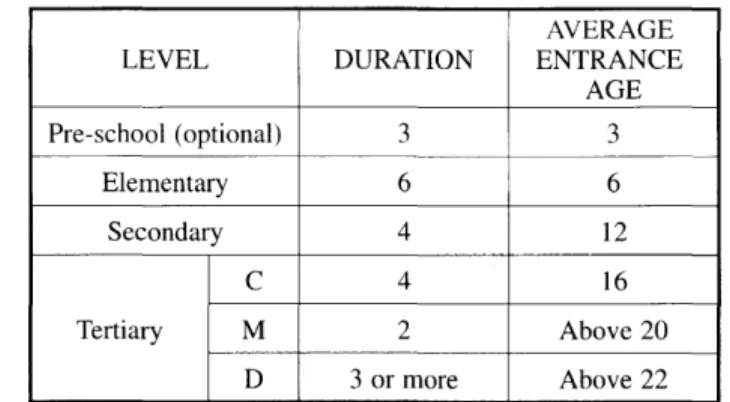
Schools open in June and close in later part of March. There is a two-week Christmas break before classes resume in January. Table 1 below shows the educational system in the Philippines.
Table1. Educational System in the Philippines i AVERAGE LEVEL DURATION ENTRANCE
AGE Pre-school (optional) 3 3 Elementary 6 6 Secondary 4 12 C 4 16 Tertiary M 2 Above 20 D 3 or more Above 22
N. 2002 Basic Education Curriculum for Secondary School
To better improve the academic performance of the Filipino students, there must be a refined curriculum aimed at developing the skills and potentials of the learners, the
outcome of which i~ a restructured. upgraded. and more
integrated curriculum where every learning competency i~
useful (Hidalgo, 2002). Thus the 2002 Basic Education Curriculum (BEC) was conceptualized. The BEC is a restructuring of the 1983 Elementary Education Curriculum and the 1989 Secondary Education Curriculum which aims at raising the quality of the Filipino learners and graduates and empowering them for lifelong learning, which requires the attainment of functional literacy.
The DepEd Curriculum stands on the conviction that functional literacy in its comprehensive meaning is the ability that is most essential for lifelong learning in this rapid and risky changing world. Filipino learners who attain functional literacy will have developed sufficient self-discipline, which can lead to sustainable accomplishments when combined with our people's innate adaptability to change. With functional literacy, Filipino learners can do self-regulated learning, and with enough motivation, they on their own can seek sources of knowledge (for example, the library or the internet), read instructional materials, and conduct explorations on other subject matters or topics that interest them.
The ideal Filipino learner in a rapidly changing world is one who is empowered for lifelong learning, an active maker of meaning and can learn whatever he needs to know in any new context. Such an empowered learner who is competent in learning how to learn and has life skills so that he becomes a self-developed person who is makabayan (patriotic), makatao (mindful of humanity), makakalikasan (respectful of nature) and maka-Diyos (godly). This is the vision of Philippine Basic Education, both formal and non-formal. Under the BEC, there are five (5) learning areas; four of which are the tool subjects and a fifth one, which is a cluster of subject areas, called Makaha)'an. This is the experiential area or the "Laboratory of Life" as shown in the table.
Table 3 shows the learning areas for basic education in high school. Note that there are only five (5) learning areas namely: Filipino, English, Science and Technology, Mathematics and Makabayan.
The science subjects are different in each year level such as Integrated Science for the First year; Biology for Second year; Chemistry for Third year and for Fourth year, Advanced Chemistry for track A while Physics for track B.
Table 4 illustrates the 2002 Basic Education Curriculum weekly time allotment. It can be noted that Science is a one-hour daily lesson along with other subjects except for Makabayan that is taught for thirteen (13) hours a week. Its experiential nature explains the reason behind the longer
contact time between the students and teachers on this subject. The 2002 Basic Education Curriculum is implemented in
all public elementary and secondary schools in the Philippines except for the science high schools that have more enriched science and mathematics curriculum that is discussed below.
v.
The Philippine Science High School CurriculumThe idea of a science high school in the Philippines came
from a Filipino mathematician, Dr. Leopoldo V. Torralba,
who was then a professor of mathematics at New York University. Patterned after the Bronx High school of Science in New York City, the envisioned science high school was
Table2. New Curriculum Structure
The Tool Subjects The Experiential Area
1. Filipino 5. Makabayan
2. English • Social Studies
3. Science • Physical Education, Music, Arts and Health
a. Science and Health (for elementary) • Edukasyong Pantahanan at Pangkabuhayan (EPP) (for elementary)
b. Science and Technology • Teknolohiya at Edukasyong Pantahanan at Pangkabuhayan (TEPP) (for secondary)
(for secondary) 4. Mathematics
Table 3. Learning Areas for Basic Education
Gradel Year Learning Learning
Learning Area 3 Learning Area 4 Learning
Level Area 1 Area 2 Area 5
1 Filipino English Mathematics Makabayan
(with Science) (with Science)
2 Filipino (with Science) English Mathematics (with Science) Makabayan
3 Filipino English Science and Health Mathematics Makabayan
4 Filipino English Science and Health Mathematics Makabayan
5 Filipino English Science and Health Mathematics Makabayan
6 Filipino English Science and Health Mathematics Makabayan
First Year Filipino English Integrated Science Elementary Algebra Makabayan
Second Year Filipino English Biology Intermediate Algebra Makabayan
Third Year Filipino English Chemistry Geometry Makabayan
Advanced
Physics Makabayan Trigonometry
Fourth Year Filipino English Chemistry
(Track B) (with Science) and Advanced Makabayan
(Track A) Algebra (Track B)
Table 4. 2002 Basic Education Curriculum Weekly Time Allotment
GradelYear
Filipino English Science Mathematics Makabayan Total No. of
Level HourslWeek
1 7 8 Integrated in English and Makabayan 7 5 27
2 7 8 Integrated in English and Makabayan 7 5 27
3 7 8 3 7 5 30 4 5 7 5 5 8 30 5 5 7 5 5 10 32 6 5 7 5 5 10 32 First Year 5 5 5 5 13 33 Second Year 5 5 5 5 13 33 Third Year 5 5 5 5 13 33 Fourth Year 5 5 5 5 13 33 128
created to created for the purpose of giving an education highly enriched in science and mathematics to exceptionally gifted Filipino children. At present, there are eight (8) Philippine Science High School (PSHS) campuses scattered all over the country with that in Diliman, Quezon City as the main campus.
The PSHS System is an attached agency of the Department of Science and Technology (DOST).
Created to develop a pool of feeders in Science and Technology professions, the PSHS has a core curriculum which aims to develop the scholar in all discipline. Students experience a common first year, with a demanding Mathematics and English curriculum, and exposure to Earth Science and Technology Preparation. Then students go through a process that allows them to follow either a science stream or a technology stream.
Table 5. First Year Table 6. Second Year Science 1 5 Biology 1 5 Math 1 5 Chemistry 1 3 Computer Science 1 3 Physics 1 3 English 1 5 Mathematics 2 3 Filipino 1 3 Mathematics 3 3 Social Science 1 3 Computer Science2 3 PEHM 1 3 English 2 3 Values Education 1 3 Filipino 2 3 ArtlDrafting 3 Social Science 2 3 Technology Preparation 2 PEHM2 3 Earth Science 3 Values Education 2 3 Elective 6 TOTAL NO. OF HOURS 38 TOTAL NO. OF HOURS 41
The streaming courses are given through electives in the second through fourth year. The core courses, however, are taken by all students. The core curriculum is packed with science and mathematics courses, allowing the student to maximize the realization of his potential intellectual skills. This is balanced by a rich humanities course which fosters full growth of each individual personality, as a responsible member of the national and global society.
Tables 5-8 show the subjects under the core courses from First to Fourth Year as well as the weekly time allotment for each subject.
In their Second Year, students undergo the streaming, as mentioned earlier. They either proceed to the Science stream or Technology stream. The following table gives us an idea on the elective subjects under each stream.
Admission to the PSHS is through the PSHS National
Table 7. Third Year Table 8. Fourth Year Biology 2 3 Biology 3 3 Chemistry 2 5 Chemistry 3 3 Physics 2 3 Physics 3 5 Research I 3 Research 2 3 Mathematics 4 4 Mathematics 5 3 Computer Science 3 3 Computer Science 4 3 English 3 3 English 4 3 Filipino 3 3 Filipino 4 3 Social Science 3 3 Social Science 4 3 PEH 3 3 PEH 4 / CAT I 3 Elective 3 Elective 3 TOTAL NO. OF HOURS 36 TOTAL NO. OF HOURS 35
Table 9. Elective Courses \" Year I Art / Drafting
Earth Science
Technology Preparation
Stream Science Technology
2nd
Year Art Education Drafting with Computer Aided Design Environmental Science Wood and Metal Craft
3'tl Year Microbiology Basic Electronics Food Science Computer Networking Microprocessing
Selected Topics in Number Theory 1 Journalism 1 (FilipinolEnglish) Selected Topics in Biology
4th Year Consumer Chemistry Advanced Electronics Industrial Chemistry Computer Networking Digital Design
Visual Communication Cell & Molecular Biology I
Selected Topics in Number Theory :2
I
Journalism 2 (Filipino/English)
Selected Topics in Biology :2 ! I
Competitive Examinations. Carefully selected among the upperlO% of the country's elementary students, applicants take the two-step screening process namely, Scholastic Aptitude Test (SAT) consisting of tests in Verbal, Abstract Reasoning and Mathematics, and the Science and Math Aptitude Test (SMAT) consisting of tests in Science and Mathematics. Then, they are ranked from highest to lowest based on their scores in these examinations. In the second year, transfer students may be admitted to fill in vacated slots after passing an accreditation test.
VI. Regional Science High School Curriculum In line with the provisions of Article XIV Section 10 of the 1986 Philippine Constitution, that, Science and Technology should be given priority in education as an important tool in shaping the country's development and progress, and in consonance with RA. 8496 (An Act to Establish the Philippine Science High School System and Providing Funds Thereof), the Regional Science High School (RSHS) was created.
Like the PSHS, curriculum of the RSHS has enhanced Science, Mathematics and English subjects.
To meet the demand, selection of the RSHS students is also rigid. Admission to the RSHS consists of three (3) phases, namely: Mental Ability Test, Proficiency Test in Science, Mathematics, English and Filipino, and finally, an interview after passing the second phase.
Furthermore, a student may qualify for the entrance examination if he belongs to the upper ten percent of the graduating class and have at least a grade of 85 in Science, Mathematics and English and 83 in all other subjects during the second grading period.
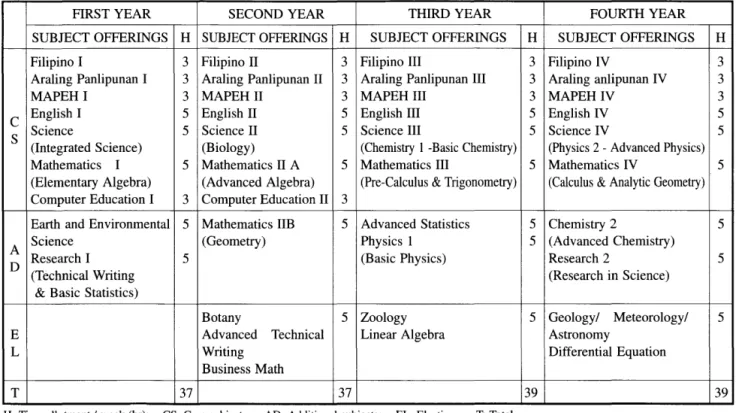
Table 10 shows the curriculum of the Regional Science High School based on DepEd Order No. 49, s. 2003.
VII. Earth and Environmental Science Curriculum The curriculum is the sum total of all that student learn both in and out of school. Students are taught with the vital skills of literacy, numeracy, science and information communication technology, enabling them to use those skills effectively to work both independently and as part of a group. At the same time the curriculum is enriched with the creative and expressive arts, humanities and moral education to ensure the holistic development of the learners. In education, curriculum is a pivot point for the learning process. It's one of the factors that determine the learning experiences and the teaching styles that will be employed by the educator to carry out the educational objectives.
For so many years now, the call for study of the Earth Science has drawn the attention of the curriculum planners. The Philippines is not an exemption to the trend of the times. Curriculum planners and educators in the Philippines had considered the varying needs of the students and the changing and challenging demands made on them. Table. 1 0
FIRST YEAR SECOND YEAR THIRD YEAR FOURTH YEAR SUBJECT OFFERINGS H SUBJECT OFFERINGS H SUBJECT OFFERINGS H SUBJECT OFFERINGS H Filipino I 3 Filipino II 3 Filipino III 3 Filipino IV 3 Araling Panlipunan I 3 Araling Panlipunan II 3 Araling Panlipunan III 3 Araling anlipunan IV 3 MAPEH I 3 MAPEH II 3 MAPEH III 3 MAPEHIV 3 C English I 5 English II 5 English III 5 English IV 5 S Science 5 Science II 5 Science III 5 Science IV 5
(Integrated Science) (Biology) (Chemistry 1 -Basic Chemistry) (Physics 2 - Advanced Physics) Mathematics I 5 Mathematics II A 5 Mathematics III 5 Mathematics IV 5 (Elementary Algebra) (Advanced Algebra) (Pre-Calculus & Trigonometry) (Calculus & Analytic Geometry) Computer Education I 3 Computer Education II 3
Earth and Environmental 5 Mathematics lIB 5 Advanced Statistics 5 Chemistry 2 5 A Science (Geometry) Physics 1 5 (Advanced Chemistry) D Research I 5 (Basic Physics) Research 2 5
(Technical Writing (Research in Science)
& Basic Statistics)
Botany 5 Zoology 5 Geology/ Meteorology/ 5 E Advanced Technical Linear Algebra Astronomy
L Writing Differential Equation
Business Math
T 37 37 39 39
H: Time allotment / week (hr); CS: Core subjects; AD: Additional subjects; EL: Electives; T: Total
Subsequently, the mandates of the 2002 Basic Education Curriculum that is attainment of quality education especially in Science Education was mulled over. Through their concerted efforts, the Earth Science is clearly realized as a vital subject in secondary education.
Reached by the wave of dynamism, the Earth Science education has gone modification recently. The inclusion of the Environmental Education that plays an integral part in man's awareness of his environment has been integrated into the subject.
The Earth and Environmental Science as a subject in Secondary School particularly of the First Year High School deals with the study of the Earth, its origin, features and the components of its environment. Environmental Science is integral to the study of the Earth as it focuses on the environment, resources, problems and issues, and how they are addressed in an interdisciplinary manner.
The inclusion of Earth and Environmental Science in the curriculum is the answer of the Department of Education to the pressing problem on continuous human activities altering the surface of the planet that results to diverse environmental changes. The course is divided into three major topics: the Earth, the Stars and the Galaxy and the Environment. Each major topic is composed of subtopics which present the interconnectedness between and among concepts related to economic, social and moral issues. Earth and Environmental Science is a one-hour daily subject and given a 1.5 unit credit in the Regional Science High School Curriculum.
Table 11 depicts the contents of Earth and Environmental Science subject in the Philippines.
Table 11 . The Earth and Environmental Science Course Outline Topics
Topics Contents
Its physical features, records of the past, The Earth lithosphere, diastrophism, volcanism, rocks and minerals, weathering, erosion, hydrosphere and atmosphere
The Stars and Solar system, life cycle of a star, the Galaxies Milky Way Galaxy, origin of the
universe and space explorations Science, technology and society, The Environment interconnectedness in the environment,
sustainability of the environment
The Earth
In this topic, students learn about the origin of the Earth as well as its physical features such as its size, shape and
motion. In the ~ame way, the effects of Earth's motion are learned. A discussion on how the ~cientists arrived at the
conclusions regarding the physical characteristics of the Earth cultivates the inquisitiveness among students.
The Earth's Past
In this sub-topic, the students learn about the patterns of the past through study of the present geological structure. Fossils, rock formation and stratification are considered in the study.
The Lithosphere
Understanding of the Earth's layers and its composition is looked into this sub-topic. To attain this, the characteristics of the crust, mantle and core as well as the activities within the Earth's interior that are related to the phenomena on the earth's surface.
The Dynamism in the Lithosphere
The irregularity in elevation (relief) of parts of the Earth's surface particularly the plains, mountains and volcanoes are taken up in this topic. This also includes the study of volcanism as well as rock formation and identification of minerals in rocks.
Weathering and Erosion
The mechanics of weathering and erosion are discussed in this sub-topic. Students are made aware of the effects of soil degradation and erosion to man then, they present possible solution to this problem.
The Hydrosphere
The study on distribution and sources of the Earth's waters are the focus of this sub-topic. In here, the students get to know about the movement of ocean waters and environment of ocean bottom as well as their significance to human life.
Discussion on water pollution is looked into with emphasis on the cause and effect of such environmental problem. The Atmo~phere
In this topic, the students get to know about the composition of the Earth's atmosphere; the weather elements such as: atmospheric pressure, humidity, air temperature, wind, rainfall and clouds, and how they determine the weather condition; difference between weather and climate and some factors that affect the climatic condition of an area. Environmental issues related to atmosphere are discussed with focus on effects of man's activities in changing the quality of air. Thus, possible solutions are raised.
The Stars and Galaxies
In this topic, the arrangement of stars and planets in the universe as well as their distances from Earth are tackled. Physical features and motion of the different heavenly bodies are also discussed.
In the same way, advantage~ and disadvantages of space
The Environment
Having had background on some of man's activities that affect the environment, in this topic, the students integrate science, technology and society together. The focus is on the relation of the totality of the environment to the quality of life and its sustainability.
vrn.
Concl usionSecondary Education as a bridge between elementary and higher degree of education has called the focus of educators. Much effort has been done in an attempt to improve it to fit the needs of the present times. One of them is the creation of different curricula to cater to the diversified nature of learners another paragraph.
Since the aim of Philippine education is to create functionally literate learners, curriculum is enriched with subjects where a learner can fully developed his skills, values and knowledge. However, learners have individual differences. It is a must then, to start from a learner's level of learning, that is, to develop their potential to the fullest. This is the rationale behind the creation of different Secondary Education curricula in the Philippines. The focal point for the different curricula is the Science Education which is considered as vehicle for development.
The three different types of Science Education curricula are made then, to cater to different levels of learners. The Philippine Science High School as the prime high school of the country caters to the exceptionally gifted Filipino children particularly in Science and Technology. The graduates of this school are envisioned as the prime movers of Science and technology related careers in the future. Furthermore, the creation of the Regional Science High School and other science high school in the country, that is under the supervision of the Department of Education as compared to the PSHS that is an attached agency of the Department of Science and Technology also shares the same vision. This is government's move to extend the chance to exceptionally gifted Filipino children an opportunity for an enriched Science Education. Moreover, since the number of students taken in to the science high schools is limited, the General Public High School is created. To provide quality education to the booming population of Filipino children, the curriculum has undergone a lot of revisions. In the same way as any other school, Science Education is given an emphasis. Despite of the many constraints to attain quality education, the government is optimistic about seeing every Filipino graduate as a functional literate.
132
Finally, to create awareness man's role in the environment and appreciation of the Earth, the Earth and Environmental Science Education was made as an integral part of Science Education. In the Secondary Education this is taken as a separate subject that is focused on the study of the Earth and the present environment and measures on how to restore its sustainability.
Acknowledgment
Digna Cabardo Paningbatan, one of the authors of this paper would like to express her profound gratitude to JICA and the Philippine government for granting her the opportunity for further studies in Japan as well as Naruto University of Education.
References:
Ibe, M. D. and Ester B. Ogena (1990). Science Education in the Philippines: An Overview. National Science Education Congress, pp.27-28
Marinas, Bella (2002) "Philippines."
http://www.ibe.unesco.orglNationallChina/NewChinaPdfIIIP-hilippines.pdf
Ong Kian Koc, Bee Ching U (2000). "Improving Academic Curriculum in Science Education Through Technology: Implication for In-Service Training."
http://www.hiceducation.orglEdu_Proceedings. pdf
The 2002 Basic Education Curriculum (2002). Department of Education, Pasig City, Metro Manila, Philippines.
http://www.ecommunity.nce.gov.ph/pshs/ "Education and Literacy in the Philippines."
http://www.asianinfo.org/asianinfo/philippines/pro-education.html.
Inclosure to DepEd Order No. 49, s. 2003. "Philippine Facts and Figures." http://www.cia.gov /cia/publicationlfactbook/ geos/rp.html
http://www.pshs.dost.gov.ph/pshs.html