
多言語述語項構造ベクトル表現の学習
7
0
0
全文
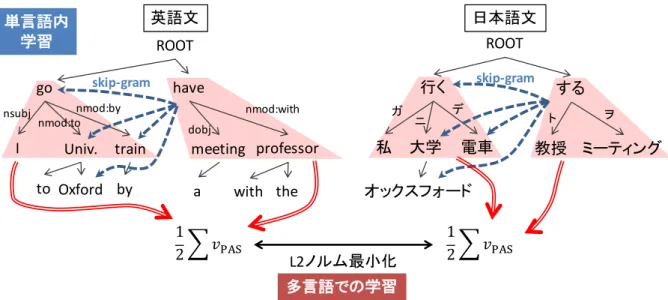
(2) Vol.2016-NL-226 No.11 Vol.2016-SLP-111 No.11 2016/5/17. 情報処理学会研究報告 IPSJ SIG Technical Report. BilBOWA を含む上記の手法は,多言語単語ベクトル表. 2. 関連研究. 現を学習するが,述語項構造のような複数単語からなる単. 単言語単語ベクトル表現の学習手法を応用し,多言語単 語ベクトル表現を同一空間上で学習する手法が提案されて いる.各手法は,学習に用いる言語リソースによって以下 のように分類できる.. • 多言語対訳辞書を用いる手法 [17], [18] 言語ごとに単語ベクトルを学習した後,対訳辞書を用 いて,一方の言語の単語ベクトルを他方の言語の単語 ベクトル空間へ写像する行列を学習する.述語項構造 に関する情報はほぼ対訳辞書に記載されていないた め,これらの手法は述語項構造ベクトルの学習に適用 することができない.. • 単語アライメント情報が自動付与された対訳コーパス を用いる手法 [13], [19], [20], [21], [22], [23] 言語ごとに単語ベクトルを学習した後,対訳コーパス の自動単語アライメント結果を用いて各言語の単語ベ クトル空間を近づける.自動アライメントの結果には ノイズが含まれており,ベクトル表現学習に悪影響を 及ぼす可能性がある.. • 対訳コーパスを用いる手法 [16], [24], [25], [26], [27] Auto Encoder を用いた方法 [24], [26] ,対訳文間の自 動単語アライメントの学習と単語ベクトルの学習を並 行して行う方法 [25],各言語の単語ベクトルを学習し ながら,多言語間で単語ベクトルを近づける学習を同 時に行う方法 [16], [27] がある.. 位でベクトル表現を学習するものではない.機械翻訳の分 野では,フレーズテーブルを用いて多言語に渡る句のベク トル表現を学習する手法がある [29], [30] が,言語的構造を もつ句を対象としていないという点で本研究とは異なる.. 3. 提案手法 本論文では対訳コーパスを利用して述語項構造のベクト ル表現を言語横断的に学習する手法を提案する.本モデル では,単言語内で,類似した述語項構造に類似したベクト ル表現が割り当てられるようにし,それと同時に,言語を 横断して,対訳関係にある述語項構造のベクトルが類似す るようにベクトル表現を学習する.述語項構造のベクトル 表現は述語と項のベクトルおよび述語と項の係り受け関係 を基に計算する. 単言語内については,Mikolov ら [2] の提案した word2vec と同様に周辺単語との共起に基づく学習を行う.多言語に ついては,BilBOWA にならい,文に含まれる述語項構造 ベクトルの平均が対訳文の間で近づくように学習する.日 英を例として,以下の対訳文に含まれる述語項構造に対す る学習の概略を図 1 に示す.. (3) a. I went to Oxford University by train and had a meeting with the professor. b. 私はオックスフォード大学に電車で行き,教授と ミーティングをした.. • コンパラブルコーパスを用いる手法 [28] 文書単位で対応付けられたコンパラブルコーパスを. 両言語ともに構文解析を行うと,図 1 に示すような構文木. 用いて,多言語間で共通の単語ベクトルを同時に学習. が得られる.単言語での学習では英語,日本語それぞれに. する.. おいて,述語項構造から周辺の単語が予測できるようにベ. 本論文で提案する述語項構造ベクトル表現を学習するモデ. クトル表現を学習する.例えば英語では述語項構造 “have. ルは,対訳コーパスを用いる手法の一つである Gouws ら [16]. meeting with professor” から周辺の単語 “go”, “Oxford”,. の BilBOWA(Fast Bilingual Distributed Representations. “University”,“train” などが予測できるように,また同様. without Word. Alignments)*1. を基にした.BilBOWA は,. に,述語項構造 “I go to University by train” から周辺の単. 2 言語の対訳コーパスおよびそれぞれの言語の単言語コー. 語 “have”, “meeting” などが予測できるようにベクトル表. パスを用いて,多言語の単語ベクトル表現を同一のベクト. 現を学習する.日本語でも同様に,述語項構造 “教授とミー. ル空間上で学習する.Giza++などによる単語アライメン. ティングをする” から周辺の単語 “行く”, “大学”, “電車”. トはコストがかかり,またノイズが含まれることから用い. などが予測できるようにベクトル表現を学習する.そして,. ない.学習は各言語の単言語学習および多言語学習に分. 多言語では,英語における述語項構造 “I go to University. かれており,それぞれの学習を同時に行う.単言語学習は. by train” のベクトルと “have meeting with professor” の. word2vec[2] と同様に行われる.BilBOWA では単語ベク. ベクトルの平均と,日本語における述語項構造 “私が大学. トル学習モデルとして skip-gram モデル,高速化手法とし. に電車で行く” のベクトルと “教授とミーティングをする”. て Negative Sampling が用いられている.多言語学習は,. のベクトルの平均が近くなるようにベクトルを学習する.. 単語アライメントを用いないことから単語の対応関係がわ からないが,文中の単語のベクトル表現を平均し,これが 対訳文同士で類似するように学習する.. 3.1 述語項構造のベクトル表現 本モデルでは Socher ら [10] や橋本ら [11] と同様に,述 語項構造のベクトル表現を,述語のベクトルおよび述語に. *1. https://github.com/gouwsmeister/bilbowa. c 2016 Information Processing Society of Japan ⃝. 2.
(3) Vol.2016-NL-226 No.11 Vol.2016-SLP-111 No.11 2016/5/17. 情報処理学会研究報告 IPSJ SIG Technical Report. DEFG (H. $%. LFM. NOFM. !""#. !""#. !"#$%&'(). -1%6:8; -4789 -1%6:*%. 0. .-,(/. -1%6:<,*&. ;. 9. :. 6%89. 1))*,-$ 2+%3)44%+. *+',-. *% "53%+6 8;. '. !"#$%&'(). !". &'(). <,*& *&). ! # $%&' ". ). '(. %&. #$ <. =. *+ ,-./01. 234567-8. =>>?@ABC. ! # $%&' ". IEFJK(H 図 1 提案モデルの概略.英語文 “I went to Oxford University by train and had a meeting. with the professor.” と日本語文 “私はオックスフォード大学に電車で行き,教授とミー ティングをした.” における学習の過程を示している.. 係る項のベクトルに述語との係り受け関係に応じた行列を. professor” の場合,周辺語として “Oxford”,“University”,. 掛けたものの和で表されると仮定する.. “train” が用いられる.このようにして,周辺語が類似す. 入力文中のある述語 p について,p に係る項の集合を A とする.述語 p の単語ベクトルを vp ∈ Rn とし,項 a ∈ A. る述語項構造のベクトルが類似するように,述語,項のベ クトルならびに各種行列を学習する.. について,単語ベクトルを va ∈ R ,述語 p との間の係り n. 受け関係を R(p, a) で表し,述語 p および項集合 A からな る述語項構造 x のベクトル vPAS (x) を次式で計算する. ( vPAS (x) = f Wpred vp + bpred ) (1) ∑[ ] + WR(p,a) va + bR(p,a) a∈A. ここで Wpred ∈ Rn×n , bpred ∈ Rn は述語ベクトルを写像す る重み行列およびバイアス項で,WR(p,a) ∈ Rn×n , bR(p,a) ∈. Rn は述語と項の係り受け関係における役割に応じて項ベク トルを写像する重み行列およびバイアス項である.R(p, a). 3.3 多言語での述語項構造ベクトルの学習 BilBOWA では,対訳文間の単語アライメントを用いず に多言語で単語ベクトルを学習している.本モデルでは. BilBOWA にならい,対訳文間の単語アライメントを用い ず,各文に含まれる述語項構造ベクトルの平均を求め,対 訳文間でこの平均ベクトル間の L2 ノルムを最小化する ことで多言語で述語項構造ベクトルを学習する.2 言語. e,f の各対訳文中の述語項構造を E = {e1 , e2 , · · · , em }, F = {f1 , f2 , · · · , fn }(m, n は各文に含まれる述語項構造の 数) とし,この対訳文に対するコスト Ω(E, F ) を次式で計 算する.. は日本語の場合,ガ,ヲ,ニなど,英語の場合,nsubj, dobj などに相当する.また f は非線形の活性化関数であり,本 研究では tanh を用いた.. 3.2 単言語内での述語項構造ベクトルの学習.
(4)
(5) 2
(6)
(7) m n ∑
(8) 1 ∑
(9) 1 Ω(E, F ) =
(10)
(11) vPAS (ei ) − vPAS (fj )
(12)
(13) n j=1
(14) m i=1
(15). (2). 単言語の単語ベクトル学習においては word2vec[2] が成 果を挙げており,特に skip-gram モデルとその高速化手法. 3.2 節で述べた単言語での学習と本節で述べた多言語で. である Negative Sampling の組み合わせが広く用いられて. の学習を行うことにより,多言語での単語ベクトルならび. いる.skip-gram モデルは,コーパス内の語 (対象語と呼. に行列を学習する.具体的には対訳コーパスを与え,k 対. ぶ) とその周辺語を与え,対象語から周辺語が予測できる. 訳文を読み,単言語,多言語それぞれでのコストを計算し,. ように単語のベクトル表現が学習される.. 誤差逆伝播法で単語ベクトルならびに行列を更新する.こ. 提案モデルでは,対象語を述語項構造に変更し,述語項. の操作を対訳コーパス全体に対して行い,これを繰り返す.. 構造から周辺語を予測する学習を行う.周辺語として,付. 本モデルは BilBOWA と同様に,学習リソースとして対訳. 属語などのストップワードを除いた前後 c 単語を用いる.. コーパスを必要とするが,さらに単言語コーパスを加えて. 例えば,例文 (3-a) の中の述語項構造 “have meeting with. 大規模な学習を行うこともできる.. c 2016 Information Processing Society of Japan ⃝. 3.
(16) Vol.2016-NL-226 No.11 Vol.2016-SLP-111 No.11 2016/5/17. 情報処理学会研究報告 IPSJ SIG Technical Report. 提案モデルは chainer*4 で実装した.単語ベクトルの次. 4. 実験. 元数は 200 次元とし,単語ベクトルの初期値として,Bil-. 提案した多言語述語項構造ベクトル表現の妥当性を確認. BOWA による上記対訳コーパスの単語ベクトル学習結果. するため,述語項構造の対訳を選択する実験を行った.本. を使用した.BilBOWA による事前学習結果がないベクト. 研究では,日英,英中の 2 つの言語ペアについて実験を. ルと各種行列は乱数で初期化した.3.2 節で述べた周辺語. 行った.. のウインドウ幅は c = 5 とした.また 3.3 節で述べたミニ バッチサイズは k = 100 とし,学習を 5 エポック行った.. 4.1 ベースラインモデル ベースラインモデルとして,BilBOWA を用いたモデル を 2 つ考える.. 4.3 多言語述語項構造ベクトルの評価 4.3.1 評価手法. 単語モデル: BilBOWA を用いて単語ベクトルを学習し,述. 提案モデルが正しく述語項構造のベクトル表現を学習で. 語項構造ベクトルを,述語項構造を構成する単語のベクト. きているかを評価する.4.2 節で用いた対訳コーパスとは. ルを平均したものとして定義する.. 別に評価用の対訳コーパスを用意し,述語項構造対を抽出. 述語項ペアモデル: 文中の項に対して述語と格の情報を付. したものを正解データとして,学習されたモデルを用いて. 与し,述語,項およびその間の格の情報を含む述語項ペア. 述語項構造の対訳を選択する実験を行った.. のベクトル表現を学習する.まず学習用コーパスに対し. 評価用のコーパスとして,日英中基本文データ *5 から. て,述語に直接係る項について「述語-項 [格]」という形へ. 日英中対訳文 5,304 文を使用した.このコーパスは,格フ. 置換する前処理を行う.この前処理を行ったコーパスを用. レームをベースに抽出された日本語の基本的な文およびこ. いて BilBOWA で学習を行うことで,述語,項,格の情報. れを人手で英語と中国語に翻訳した文からなり,述語項構. を含む述語項ペアを単語とみなし,このベクトル表現が学. 造を 1 つのみ持つ文が多く含まれている.コーパス中の対. 習される.前処理の例として,例文 (4-a) の前処理結果を. 訳文の例を表 1 に示す.評価に用いる正解述語項構造対応. (4-b) に示す.. を得るために,評価する 2 言語について,各文に述語項構. (4) a. 私は京都大学に電車で行き,昼を北部食堂で食べた.. 造 1 つのみを含む対訳文対を抽出した.このような対訳文 として,日英では 3,210 文,英中では 2,251 文を得た.こ. b. 行く-私 [ガ] は 京都 行く-大学 [ニ] に 行く-電車. の対訳文から述語項構造を抽出し,述語項構造対応の正解. [デ] で 行く , 食べる-昼 [ヲ] を 北部 食べる-食堂. データとした.実験は,日英,英日,英中,中英の 4 方向. [デ] で 食べる .. について行った. 日英方向の実験では,ある日本語述語項構造のベクトル を計算し,それと全英語述語項構造ベクトルとの cos 類似. 4.2 モデルの学習 日英モデルの学習用コーパスとして,日英新聞記事対応. 度を計算し,英語述語項構造をランキングした.評価は,. 付けデータ (JENAAD)[31] を使用した.このデータには. 正解の英語述語項構造がランキングの上位 K 位以内 (K =. 新聞記事対訳文 108 万文が含まれるが,本研究ではこの. 1, 5, 20) に含まれる割合を計算することで行った.同様の. うち対訳スコアの高い対訳文 25 万文をモデルの学習に用. 手法により,英日,英中,中英方向の実験も行った.. いた.また英中モデルの学習には,Chinese English News. 4.3.2 結果と考察 各モデルの評価結果を表 2 に示す.表の数字は TopK に. Magazine Parallel Text (LDC2005T10) [32] を用いた.こ のデータは新聞記事対訳文 28 万文を含む. 日本語については,JUMAN*2 ・KNP*3. による構文・格. 正解が含まれる精度を表す.提案モデルより得られた述語 項構造対応付けの例を表 3 に示す.. 解析結果から述語項構造を抽出した.述語の表記は KNP. 提案モデルは,ベースラインモデル 2 種に比べて高い. の用言代表表記を用い,項と係り受け関係は KNP の格. 精度を達成した.表 3 の例 (1)(2)(5)(6) は,提案モデルに. 解析結果から得た.英語と中国語については,Stanford. よって正しく対応付けられた述語項構造対の例である.例. CoreNLP[33] による構文解析結果から述語項構造を抽出し. (1)(2) は日本語では同じ動詞「入る」からなる述語項構造だ. た.ただし英語については,助動詞および子を持たない be. が,対応する英語述語項構造はそれぞれ “enter”,“reach”. 動詞は除外した.また,項は述語に直接係る語を抽出し,. と異なる動詞からなるものが得られた.また例 (5) につい. 項が固有名詞である場合は “⟨name⟩” ,項が節の主辞であ. ては,日本語動詞「受ける」に対して英語動詞 “receive” か. る場合は “⟨s⟩” という表記に汎化した. *4 *5 *2 *3. http://nlp.ist.i.kyoto-u.ac.jp/index.php?JUMAN http://nlp.ist.i.kyoto-u.ac.jp/index.php?KNP. c 2016 Information Processing Society of Japan ⃝. http://chainer.org/ http://nlp.ist.i.kyoto-u.ac.jp/index.php?%E6%97%A5% E8%8B%B1%E4%B8%AD%E5%9F%BA%E6%9C%AC%E6%96%87%E3%83% 87%E3%83%BC%E3%82%BF. 4.
(17) Vol.2016-NL-226 No.11 Vol.2016-SLP-111 No.11 2016/5/17. 情報処理学会研究報告 IPSJ SIG Technical Report. 表 1 日英中基本文データの例. 言語 英→日. モデル. 正解 順位 類似度. 0.007. 0.022. 0.045. 述語項ペア. 0.011. 0.021. 0.041. ✓. 0.160. 0.283. 0.390. 英語述語項構造. 1 0.609. he entered university. 2 0.606. he unexpectedly came across this book. 3 0.590. I will graduate from a school. 単語. 0.064. 0.135. 0.219. 述語項ペア. 0.014. 0.029. 0.048. 0.101. 0.208. 0.316. 単語. 0.019. 0.051. 0.083. 述語項ペア. 0.004. 0.014. 0.028. 0.108. 0.236. 0.368. 1 0.590. child will attend classes. 単語. 0.043. 0.095. 0.167. 2 0.567. children attended school for three years. 述語項ペア. 0.006. 0.015. 0.032. 3 0.561. students have jobs. 述語項構造 (提案手法) 0.133 表 2 実験結果. 0.268. 0.403. 述語項構造 (提案手法) 中→英. Top20. 単語. 述語項構造 (提案手法) 英→中. Top5. (1) 彼が大学に入る. 述語項構造 (提案手法) 日→英. Top1. (2) プロジェクトがいよいよ段階に入る ✓. 1 0.520. project finally reached the final stages. 2 0.504. the city will promote development. 3 0.488. promenade will be built along wetlands. (3) 学校が休みに入る. ... ✓. .... 8 0.548. ... schools have started holidays. (4) 情報がすぐに手に入る. らなる述語項構造と対応付けられた一方で,例 (6) では, 日本語で「虐待を受ける」と表層的には能動態で表される 意味が,英語で “is abused” と受動態で表されるという対. 1 0.581. he unexpectedly came across this book. 2 0.578. I know information. 3 0.575. I also gathered information. .... .... .... 応関係が得られた.このことから,提案モデルでは項によ. ✓. る述語の意味の変化をうまく学習できていると言える.. (5) 彼が給付を受ける. 表 3 の例 (3)(4) では,正解の英語述語項構造が上位 3 位. ✓. 以内に現れなかった.例 (3) の 1 位と 2 位は,日本語述語 項構造と反義の関係にある英語述語項構造となっている. 他にも例 (1) の 3 位,(5) の 2 位,(7) の 2 位に反義の英語 述語項構造が現れた.これは提案モデルの多言語での述語 項構造ベクトル学習の方法に起因すると思われる.多言語 での述語項構造ベクトルの学習では,対訳文それぞれの中. 214 0.479. information will be obtained quickly. 1 0.634. he receives benefit. 2 0.588. he pays premiums himself. 3 0.551. he takes Route (6) towards Kyoto. (6) 彼が虐待を受ける ✓. 1 0.578. he is abused. 2 0.571. he unexpectedly came across this book. 3 0.545. he respects individuality. (7) 患者が治療を受ける. の述語項構造ベクトルを平均し,これを近づけるよう学習. 1 0.671. patients are given attention by doctors. した.しかしこの時,上記の例のような意味は異なるが同. 2 0.629. he had a disease. じ文脈でよく用いられるような述語項構造の組について は,複数の対訳文に同時に出現する可能性が高く,それゆ え誤った述語項構造が対応づけられて学習される可能性が. ✓ 3 0.618 patients receive attention 表 3 提案モデルによる日 → 英述語項構造対応付け例 上位 3 位以内に正解の述語項構造が含まれなかったものにつ いては,正解の順位及び cos 類似度も合わせて示している.. 高くなると考えられる.その結果,よく同じ文脈で用いら れる述語項構造については,意味が異なっても類似度が高. 構造を抽出した元の文では “medical attention” という複. くなる場合があると思われる.. 合語であり,述語項構造を抽出する際に “medical” の意味. 例 (4) の 2 位と 3 位には,日本語述語項構造と類似した. が脱落している.これに対応する日本語の項は「治療」と. 英語述語項構造が得られた.正解の英語述語項構造は 214. なっており,項の意味に相違が生じている.このように,. 位となったが,これは態が異なることからデータスパース. 提案モデルでは述語に直接係る語のみを項としており,複. 性の影響を受けたためと思われる.. 合語を考慮していないため,述語項構造を抽出する際に項. 例 (7) の 1 位と 3 位に現れた英語述語項構造には,共に. “attention” という項が含まれているが,これらは述語項. c 2016 Information Processing Society of Japan ⃝. の修飾語の意味が脱落する問題がある.このような修飾語 の考慮は今後の検討課題である.. 5.
(18) Vol.2016-NL-226 No.11 Vol.2016-SLP-111 No.11 2016/5/17. 情報処理学会研究報告 IPSJ SIG Technical Report. 5. おわりに 本論文では,多言語述語項構造ベクトルの学習手法を提. [8]. 案した.提案モデルは,多言語述語項構造の対応付けにお いて,単語ベクトルや述語項ペアベクトルに基づくベース ラインモデルと比べて高い優位性を示した. 本研究ではモデルの学習に対訳コーパスのみを用いた が,本研究で提案したモデルはこれに単言語コーパスを加. [9]. えて学習することもできる.大規模な単言語コーパスを加 えた学習を行うことで,より広い範囲の述語項構造につい て学習できることが期待される.また,2 言語に限らず,3 言語以上について多言語述語項構造ベクトルの学習を同時 に行うことが今後の課題に挙げられる.. [10]. さらには,学習した多言語述語項構造ベクトルを言語横 断情報検索や言語横断文書分類などに適用し,その効果を 検証する予定である. [11]. 参考文献 [1]. [2]. [3]. [4]. [5]. [6]. [7]. Collobert, R., Weston, J., Bottou, L., Karlen, M., Kavukcuoglu, K. and Kuksa, P.: Natural Language Processing (Almost) from Scratch, Journal of Machine Learning Research, Vol. 12, pp. 2493–2537 (2011). Mikolov, T., Sutskever, I., Chen, K., Corrado, G. S. and Dean, J.: Distributed Representations of Words and Phrases and their Compositionality, Advances in Neural Information Processing Systems 26 (Burges, C., Bottou, L., Welling, M., Ghahramani, Z. and Weinberger, K., eds.), Curran Associates, Inc., pp. 3111–3119 (online), available from ⟨http://papers.nips.cc/paper/5021distributed-representations-of-words-and-phrases-andtheir-compositionality.pdf⟩ (2013). Pennington, J., Socher, R. and Manning, C. D.: GloVe: Global Vectors for Word Representation, Empirical Methods in Natural Language Processing (EMNLP), pp. 1532–1543 (online), available from ⟨http://www.aclweb.org/anthology/D14-1162⟩ (2014). Socher, R., Lin, C. C., Ng, A. Y. and Manning, C. D.: Parsing Natural Scenes and Natural Language with Recursive Neural Networks, Proceedings of the 26th International Conference on Machine Learning (ICML) (2011). Socher, R., Pennington, J., Huang, E. H., Ng, A. Y. and Manning, C. D.: Semi-Supervised Recursive Autoencoders for Predicting Sentiment Distributions, Proceedings of the 2011 Conference on Empirical Methods in Natural Language Processing (EMNLP) (2011). Socher, R., Huval, B., Manning, C. D. and Ng, A. Y.: Semantic Compositionality through Recursive MatrixVector Spaces, Proceedings of the 2012 Joint Conference on Empirical Methods in Natural Language Processing and Computational Natural Language Learning, Jeju Island, Korea, Association for Computational Linguistics, pp. 1201–1211 (online), available from ⟨http://www.aclweb.org/anthology/D12-1110⟩ (2012). Socher, R., Bauer, J., Manning, C. D. and Andrew Y., N.: Parsing with Compositional Vector Grammars, Proceedings of the 51st Annual Meeting of the Association for Computational Linguistics (Volume 1: Long Papers), Sofia, Bulgaria, Association for Computa-. c 2016 Information Processing Society of Japan ⃝. [12]. [13]. [14]. [15]. [16]. [17]. [18]. tional Linguistics, pp. 455–465 (online), available from ⟨http://www.aclweb.org/anthology/P13-1045⟩ (2013). Socher, R., Perelygin, A., Wu, J., Chuang, J., Manning, C. D., Ng, A. and Potts, C.: Recursive Deep Models for Semantic Compositionality Over a Sentiment Treebank, Proceedings of the 2013 Conference on Empirical Methods in Natural Language Processing, Seattle, Washington, USA, Association for Computational Linguistics, pp. 1631–1642 (online), available from ⟨http://www.aclweb.org/anthology/D13-1170⟩ (2013). Li, P., Liu, Y. and Sun, M.: Recursive Autoencoders for ITG-Based Translation, Proceedings of the 2013 Conference on Empirical Methods in Natural Language Processing, Seattle, Washington, USA, Association for Computational Linguistics, pp. 567–577 (online), available from ⟨http://www.aclweb.org/anthology/D131054⟩ (2013). Socher, R., Karpathy, A., Le, Q. V., Manning, C. D. and Ng, A. Y.: Grounded Compositional Semantics for Finding and Describing Images with Sentences, Transactions of the Association for Computational Linguistics, Vol. 2, pp. 207–218 (2014). Hashimoto, K., Stenetorp, P., Miwa, M. and Tsuruoka, Y.: Jointly Learning Word Representations and Composition Functions Using Predicate-Argument Structures, Proceedings of the 2014 Conference on Empirical Methods in Natural Language Processing (EMNLP), Doha, Qatar, Association for Computational Linguistics, pp. 1544–1555 (online), available from ⟨http://www.aclweb.org/anthology/D14-1163⟩ (2014). Liu, Y., Wei, F., Li, S., Ji, H., Zhou, M. and Wang, H.: A Dependency-Based Neural Network for Relation Classification, Proceedings of the 53rd Annual Meeting of the Association for Computational Linguistics and the 7th International Joint Conference on Natural Language Processing (Volume 2: Short Papers), Beijing, China, Association for Computational Linguistics, pp. 285–290 (online), available from ⟨http://www.aclweb.org/anthology/P15-2047⟩ (2015). Klementiev, A., Titov, I. and Bhattarai, B.: Inducing Crosslingual Distributed Representations of Words, Proceedings of COLING 2012, Mumbai, India, The COLING 2012 Organizing Committee, pp. 1459–1474 (online), available from ⟨http://www.aclweb.org/anthology/C12-1089⟩ (2012). Hermann, K. M. and Blunsom, P.: Multilingual Models for Compositional Distributed Semantics, Proceedings of the 52nd Annual Meeting of the Association for Computational Linguistics (Volume 1: Long Papers), Baltimore, Maryland, Association for Computational Linguistics, pp. 58–68 (online), available from ⟨http://www.aclweb.org/anthology/P14-1006⟩ (2014). 林 佑 明 ,酒 井 哲 也:言 語 の 分 散 表 現 に よ る 文 脈 情 報 を 利 用 し た 言 語 横 断 情 報 検 索 ,DEIM Forum 2015, ( オ ン ラ イ ン ),入 手 先 ⟨http://dbevent.jpn.org/deim2015/paper/350.pdf⟩ (2015). Gouws, S., Bengio, Y. and Corrado, G.: BilBOWA: Fast Bilingual Distributed Representations without Word Alignments, Proceedings of The 32nd International Conference on Machine Learning, pp. 748–756 (2015). Mikolov, T., Le, Q. V. and Sutskever, I.: Exploiting Similarities among Languages for Machine Translation, CoRR, Vol. abs/1309.4168 (online), available from ⟨http://arxiv.org/abs/1309.4168⟩ (2013). Ishiwatari, S., Kaji, N., Yoshinaga, N., Toyoda, M. and Kitsuregawa, M.: Accurate Cross-lingual Projec-. 6.
(19) Vol.2016-NL-226 No.11 Vol.2016-SLP-111 No.11 2016/5/17. 情報処理学会研究報告 IPSJ SIG Technical Report. [19]. [20]. [21]. [22]. [23]. [24]. [25]. [26]. [27]. tion between Count-based Word Vectors by Exploiting Translatable Context Pairs, Proceedings of the Nineteenth Conference on Computational Natural Language Learning, Beijing, China, Association for Computational Linguistics, pp. 300–304 (online), available from ⟨http://www.aclweb.org/anthology/K15-1030⟩ (2015). Zou, W. Y., Socher, R., Cer, D. and Manning, C. D.: Bilingual Word Embeddings for Phrase-Based Machine Translation, Proceedings of the 2013 Conference on Empirical Methods in Natural Language Processing, Seattle, Washington, USA, Association for Computational Linguistics, pp. 1393–1398 (online), available from ⟨http://www.aclweb.org/anthology/D13-1141⟩ (2013). Faruqui, M. and Dyer, C.: Improving Vector Space Word Representations Using Multilingual Correlation, Proceedings of the 14th Conference of the European Chapter of the Association for Computational Linguistics, Gothenburg, Sweden, Association for Computational Linguistics, pp. 462–471 (online), available from ⟨http://www.aclweb.org/anthology/E14-1049⟩ (2014). Zhao, K., Hassan, H. and Auli, M.: Learning Translation Models from Monolingual Continuous Representations, Proceedings of the 2015 Conference of the North American Chapter of the Association for Computational Linguistics: Human Language Technologies, Denver, Colorado, Association for Computational Linguistics, pp. 1527–1536 (online), available from ⟨http://www.aclweb.org/anthology/N15-1176⟩ (2015). Lu, A., Wang, W., Bansal, M., Gimpel, K. and Livescu, K.: Deep Multilingual Correlation for Improved Word Embeddings, Proceedings of the 2015 Conference of the North American Chapter of the Association for Computational Linguistics: Human Language Technologies, Denver, Colorado, Association for Computational Linguistics, pp. 250–256 (online), available from ⟨http://www.aclweb.org/anthology/N15-1028⟩ (2015). Luong, T., Pham, H. and Manning, C. D.: Bilingual Word Representations with Monolingual Quality in Mind, Proceedings of the 1st Workshop on Vector Space Modeling for Natural Language Processing, Denver, Colorado, Association for Computational Linguistics, pp. 151–159 (online), available from ⟨http://www.aclweb.org/anthology/W15-1521⟩ (2015). Lauly, S., Boulanger, A. and Larochelle, H.: Learning Multilingual Word Representations using a Bag-ofWords Autoencoder, CoRR, Vol. abs/1401.1803 (online), available from ⟨http://arxiv.org/abs/1401.1803⟩ (2014). Koˇcisk´ y, T., Hermann, K. M. and Blunsom, P.: Learning Bilingual Word Representations by Marginalizing Alignments, Proceedings of the 52nd Annual Meeting of the Association for Computational Linguistics (Volume 2: Short Papers), Baltimore, Maryland, Association for Computational Linguistics, pp. 224–229 (online), available from ⟨http://www.aclweb.org/anthology/P142037⟩ (2014). Chandar, A. P. S., Lauly, S., Larochelle, H., Khapra, M. M., Ravindran, B., Raykar, V. C. and Saha, A.: An Autoencoder Approach to Learning Bilingual Word Representations, CoRR, Vol. abs/1402.1454 (online), available from ⟨http://arxiv.org/abs/1402.1454⟩ (2014). Coulmance, J., Marty, J.-M., Wenzek, G. and Benhalloum, A.: Trans-gram, Fast Cross-lingual Wordembeddings, Proceedings of the 2015 Conference on Empirical Methods in Natural Language Processing, Lisbon, Portugal, Association for Computational Linguistics, pp. 1109–1113 (online), available from. c 2016 Information Processing Society of Japan ⃝. [28]. [29]. [30]. [31]. [32] [33]. ⟨http://aclweb.org/anthology/D15-1131⟩ (2015). Vuli´c, I. and Moens, M.-F.: Bilingual Word Embeddings from Non-Parallel Document-Aligned Data Applied to Bilingual Lexicon Induction, Proceedings of the 53rd Annual Meeting of the Association for Computational Linguistics and the 7th International Joint Conference on Natural Language Processing (Volume 2: Short Papers), Beijing, China, Association for Computational Linguistics, pp. 719–725 (online), available from ⟨http://www.aclweb.org/anthology/P15-2118⟩ (2015). Zhang, J., Liu, S., Li, M., Zhou, M. and Zong, C.: Bilingually-constrained Phrase Embeddings for Machine Translation, Proceedings of the 52nd Annual Meeting of the Association for Computational Linguistics (Volume 1: Long Papers), Baltimore, Maryland, Association for Computational Linguistics, pp. 111–121 (online), available from ⟨http://www.aclweb.org/anthology/P141011⟩ (2014). Su, J., Xiong, D., Zhang, B., Liu, Y., Yao, J. and Zhang, M.: Bilingual Correspondence Recursive Autoencoder for Statistical Machine Translation, Proceedings of the 2015 Conference on Empirical Methods in Natural Language Processing, Lisbon, Portugal, Association for Computational Linguistics, pp. 1248–1258 (online), available from ⟨http://aclweb.org/anthology/D15-1146⟩ (2015). Utiyama, M. and Isahara, H.: Reliable Measures for Aligning Japanese-English News Articles and Sentences, Proceedings of the 41st Annual Meeting of the Association for Computational Linguistics, Sapporo, Japan, Association for Computational Linguistics, pp. 72–79 (online), DOI: 10.3115/1075096.1075106 (2003). Ma, X.: Chinese English News Magazine Parallel Text LDC2005T10, Linguistic Data Consortium (2005). Manning, C. D., Surdeanu, M., Bauer, J., Finkel, J., Bethard, S. J. and McClosky, D.: The Stanford CoreNLP Natural Language Processing Toolkit, Association for Computational Linguistics (ACL) System Demonstrations, pp. 55–60 (online), available from ⟨http://www.aclweb.org/anthology/P/P14/P14-5010⟩ (2014).. 7.
(20)
図

関連したドキュメント
Standard domino tableaux have already been considered by many authors [33], [6], [34], [8], [1], but, to the best of our knowledge, the expression of the
It is suggested by our method that most of the quadratic algebras for all St¨ ackel equivalence classes of 3D second order quantum superintegrable systems on conformally flat
Keywords: continuous time random walk, Brownian motion, collision time, skew Young tableaux, tandem queue.. AMS 2000 Subject Classification: Primary:
Next, we prove bounds for the dimensions of p-adic MLV-spaces in Section 3, assuming results in Section 4, and make a conjecture about a special element in the motivic Galois group
The main problem upon which most of the geometric topology is based is that of classifying and comparing the various supplementary structures that can be imposed on a
Transirico, “Second order elliptic equations in weighted Sobolev spaces on unbounded domains,” Rendiconti della Accademia Nazionale delle Scienze detta dei XL.. Memorie di
It is evident from the results that all the measures of association considered in this study and their test procedures provide almost similar results, but the generalized linear
This paper presents an investigation into the mechanics of this specific problem and develops an analytical approach that accounts for the effects of geometrical and material data on
