Region with Fully Developed Turbulent Flow
between Parallel Plates -The Case of Uni form
Wall Heat
Flux-journal or
publication title
福井大学工学部研究報告
volume
30
number
2
page range
107-120
year
1982-09
URL
http://hdl.handle.net/10098/4362
FUKUI UNIVERSITY VOL.30 No.2 1982
Analysis of Heat Transfer in the Entrance Region with
Fully Developed Turbulent Flow between Parallel Plates
The Case of Uni form Wall Heat Flux
-Mikio SAKAKIBARA*
(Received Aug. 31, 1982)
The equation describing the turbulent Graetz problem (heat transfer to a fluid between parallel plates) was solved numerically for the first ten eigenvalues and constants in the range of both
o.
01 ~Pr ;510 and 104;::: Re
S5xlO 5 •
The latest correlations of turbulent fluid velocity, eddy diffusivity and turbulent Prandtl number were used in the calculations. The numerical solution was obtained in much the same way as was previously done for the case of uniform wall temperature. The effect of the uniform wall heat flux boundary condition on heat transfer rate is elaborated.
INTRODUCTION
A number of papers have appeared on turbulent heat transfer in the thermal entrance region between parallel plates in connection with advances of nuclear reactors and gas turbine regenerators. However, the fl'uid velocity, eddy diffusivity and turbulent Prandtl number distributions used by them have not necessarily agreed with the available experimental data. In particular, most of these papers lack in a suitable discussion of the turbulent Prandtl number. Such discussion is barely covered by Hatton et al.1
) and Larson
et al.2
) for the case of
unifo~m
wall heat flux.For example, Hatton et al. solved the eigenvalue heat transfer problem for uniform heat flux on one wall and the other wall in-sulated, but the eigenvalues and constants presented by them were
only the first four terms. In uniform wall mass flux, Larson et ale showed that the experimental results agreed well with a finite difference solution to the turbulent diffusion equation, however, they represented only the numerical example for Sc=0.62.
The purpose of present study is to obtain a more accurate solu-tion to the eigenvalue heat transfer problem between parallel plates in the case of uniform wall heat flux. For the case of uniform wall temperature, the solutions analyzed by Shibani et al.3
) and
Sakakibara et al.4) are comprehensive. In the calculations, we
review previous studies on the fluid velocity, eddy diffusivity and turbulent Prandtl number distributions, and use suitable co-rrelations for them. The equation describing the turbulent Graetz problem is solved numerically for the first ten eigenvalues and constants in the range of Pr=lO, 0.7, 0.1, 0.01 and Re=lOOOO, 50000, 100000, 500000. The boundary conditions are uniform heat flux on one wall, the other wall insulated (asymmetry) and uniform heat fluxes on each wall (symmetry). Furthermore, this numerical study is compared with the experimental data to evaluate the reasonable-ness of the results.
ANALYSIS
Basic Equation
Consider heat transfer to an incompressible fluid flowing in steady, fully developed, turbulent flow between parallel plates with their walls kept at uniform heat flux on one wall and the other wall insulated. The fluid enters the channel at a uniform and constant temperature teo If the energy dissipation is small and if the axial conduction can be neglected, then the energy equation is with 8 t 8 8 t u -
= -
[(ex. + sh) - ] the boundary x ~O t x >0 y y 8x 8y 8y conditions te 0,
8t/8y 2yo' 8t/8y -q/ko
The dimensionless variables are introduced as
+ y*
=2. =
L
Yoy;
where De = 4yo u* =~= u+v
v+ x* = X/De RePrThe solution is obtained in two parts
8 t - te qDe/ k
(1)
(4)
where 81 is the fully developed temperature profile and 8 2 is the entrance region temperature profile. At a large distance downstream of the thermal entrance, 8 2 .must approach zero.
The solution 81 from a simple heat balance is given by
81
=
2x* + H(y*)The differential equation for H(y*) is found to be
d dy* [ Y dH dy* where y 1 + pr(~) \! u* 8 subject to the boundary conditions
y*
=
0 , dH/dy* -1/4(5)
(6 )
y* = 2 , dH/dy* 0 (7)
The solution for the entrance region distribution 82 is obtained by the method of separation of variables.
00
8 2
=
m=u E C m m Y (y*)exp(-A 2X*) m (8 )where Am' Ym are mth eigenvalue and eigenfunction of Sturm-Liouville problem, respectively. The eigenfunction is given by
__ d_ [ y dYm ] + Am 2u *Ym
=
0dy* dy* 16
with the boundary conditions y* = 0
,
dYm/dy* 0 y* = 2,
dYm/dy* 0 The coefficient Cm is given byr2 (-H)u*Ym dy* Cm = 0
{2 u*Ym 2 dy*
0
The complete temperature distribution and the local Nusselt number are given by Eqs. (12) and (13), respectively.
8 = 2x* + H(y*) +
m~o
CmYm(y*)exp(-A m2X*) 1 Nu (asymmetry) (9) (10) (11) (12) (13)The local Nusselt number for uniform heat fluxes on each wall can be derived from superposition of temperature profile due to
+
a unit heat input.
1 Nu
E
Cm(-l)m+lexp(-A 2 X*)] m=o m (14) (symmetry)Fluid Velocity and Eddy Diffusivity Distributions
Figs. 1 and 2 show typical expressions and experimental values for the fluid velocity and eddy diffusivity distributions between parallel plates. In Figs. 1 and 2, the experimental values of the fluid velocity distribution are larger than the values of Deissler's expression modified by Hatton et al. s ), while those of the eddy diffusivity distribution tend to be smaller. From the available experimental works illustrated in Figs. 1 and 2, the fluid velocity and eddy diffusivity distributions due to Mizushina et al.6
) [see
Appendix I] show the best agreement over a wide range of Reynolds number. Therefore, their expressions were used to solve the energy equation in this work.
20r---~~---
15~---~---/f=
/ Re=73612f/O
/\f
::J ~1 ~--- --rif 10t---5 Experimental Hatton 7)°
Re=5590 .to -10160 o "'15140Fig.l Universal velocity profiles [ -Mizushina et a1. 6 ): - - - - Spalding 8 ) : _ - - - - Hatton et al. 5) J
9 )
ExperimE"n tal Page E"t 01.
.to RE"-6960
o -53200
Fig.2 Distributions of eddy diffusivities [ - - Mizishina et al. 6) : - - - - Spaldii.Cj 8 : - - - H a t t o n e t a l . 5 ) )
Turbulent Prandtl Number
The turbulent Prandtl number, Prt=£v/£h, is an important para-meter for turbulent flow transport, yet there has been no rigorous theory offered on this subject [see Quarmby et al. 10 )]. We have made evaluations based on the available experimental data and have used Eqs. (15)11), (16)2.) and (17)12.) which are thought to the most reasonable as far as the Prandtl number is concerned.
Pr
=
10 1 Prt = 0.1265y* + 1.064 Pr=
0.7 Prt = 0.86 Pr = 0.1 and 0.01 [ 1 + 90pr3/2.(£v/V)1/4 ] [ 35 + (£v/v) ] (15) (16) Prt = [ 0.025Pr (£v/v) + 90Pr3/2. (£v/v) 1/4 ] [ 45 + (£v/v) (17) where 0 -::::.y*;;; 1RESULTS AND DISCUSSION
Analytical Results
For the calculation in Eqs. (6) and (9), it is necessary to add the over-all heat balance equation in Eq. (6) and the condition y
= -
Hi at y*
=
0 in Eq. ( 9) .It is difficult to obtain the analytical solution for Eqs. (6) and (9), because y and u* are complicated functions of y*. Uti-lizing the method which combined the Newton-Raphson and Runge-kutta -Gill methods, the eigenvalues and constants have been found nu-merically for a wide range of both O.Ol~Pr~lO and 104
..,( Re::;5X10⁵,
and are list'ed in Appendix II.
Entrance Region Nusselt numbers
The typical examples of Nusselt number with X/De are shown in Figs. 3 and 4. The difference between the local Nusselt number
for symmetric boundary condition and that for asymmetrical boundary condition decreases with incr~asing Prandtl number. For example, the two values are nearly equal at Pr=lO, but at lower Prandtl number, the local Nusselt number for the symmetrical case in the
::J Z Boundary conditions - - - - symmflry - - asyrnrMtry ::J Z Boundary a:lf'IdiliOll$ ---- symmetry _ asymmetry bU.5~~~~~~'0~~~~~r-~~5xU,d X/De JsU'~~~UU~lO~I--~-U~~'~~~~~8~"02 x/De
Fig. 3 Local Nusselt number variation for Fig. 4 Local Nusselt number variation for various Prandtl numbers [Re=lOOOOj various Prandtl numbers [Re=lOOOOOj
fully developed region is some 10% higher than the asymmetrical case. However, these Nusselt numbers are in good agreement when the value of x/De is small.
Thermal Entry Lengths
The thermal entry length is defined in this study to be that distance downstream of the
thermal entrance necessary for the local Nusselt nu-mber to fall to within 5% of its fully developed va-lue. Calculations of this quantity were carried out for a wide range of Prandtl number and Reynolds number. and the results are shown in Fig. 5. In general, the five percent thermal entry lengths for uniform wall heat flux are slightly long-er than those for uniform wall temperature in liquid metal region. For Pr~ 0.7,
140 120 100 Q.I 80 Cl
-
)( 60 40 20 0 Fig. S Boundary conditions --- symmetry - - asymmetry 10'lcr
Re
Five percent thermal entry length
however, the entry lengths for the two cases are essentially iden-tical. Furthermore, the five percent entry lengths for asymmetrical boundary condition are longer than those for symmetrical boundary condition.
Fully Developed Nusselt Numbers
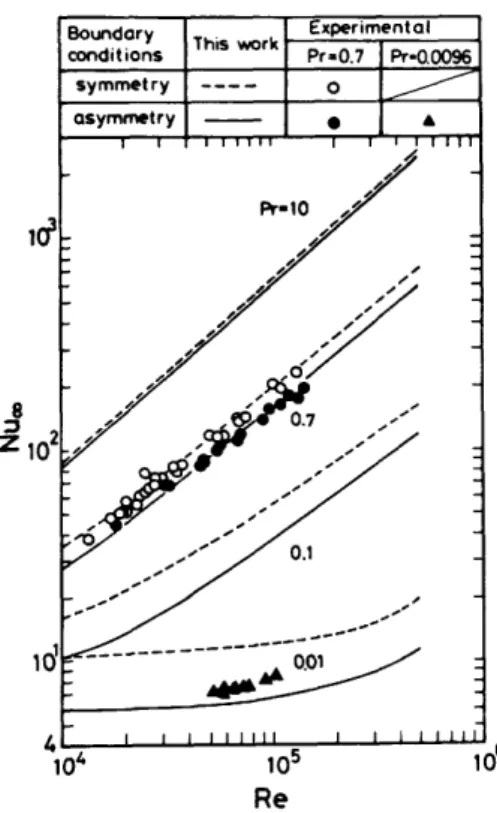
Fig. 6 summarizes the fully developed Nusselt number, and, for comparison, the experimental data of Sparrow et al.13
) and Duchatelle
et al.14
) are included. This figure shows good agreement between
this numerical results and the experimental data.
Fig. 7 is a plot of the ratio, Nuoo(Qw)/Nuoo(Tw), for various Prandtl numbers, where NUoo(Qw) shows the fully developed Nusselt number based on uniform wall heat flux and Nuoo(Tw) shows the fully developed Nusselt number based on uniform wall temperature [see Sakakibara et al.4) ] . It shows the effect of boundary condition on heat transfer rate. As shown in Fig. 7, there is a significant
lrJ Boundary conditions symmetry asymrMtry Experimental
This work t--p-r"';",.O-.-7 ""T"""Pr-.-O-.OO96--1
o
•
•
, " ------;-'
1.0 difference about 13-17% between the fully developed Nusselt numbers for uniform wall heat flux and for uni-form wall temperature when the Prandtl number is at 0.01. The difference is less than 2% when the Prandtl number is 10. Pr·O.Ol Boundary CDnditions symmetry - - asymmetry---
---~ -...~
Q7 - - - _____ _ \0 ReFig. 6 Fully developed Nusselt number for various Prandtl numb~rs [ Experime-ntal data: O,e Sparrow et al.1~) ;
Fig. 7 Ratio of fully developed Nusselt numbers for uniform wall heat flux and for uniform wall temperature
• Duchatelle et al.14 ) 1
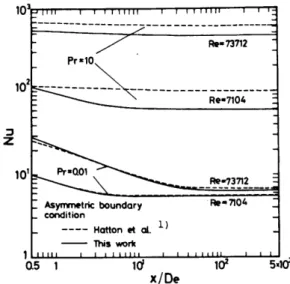
Comparison with Other Models Fig. 8 shows a comparison of the present solution with that given by Hatton et al.l
)
for asymmetrical case. For Pr=lO, this solution shows lower Nusselt number than that obtained by Hatton et al. This may be attributed to the difference of the va-lues of the fluid velocity, eddy diffusivity and turbu-lent Prandtl number distri-butions used in solving the energy equation. For Pr=
::::J Z As~tric boundary condition - - - - Hatton et ai. 1) - - This work Re-73712 ---~·7104 ~~5~--~~~wld~~~~~1~~~~5~·d x/De
Fig. 8 Comparison of present solution with Hatton et al. 's solution [ uniform heat flux on one wall, the other wall insulated I
0.01, this solution is in fairly good agreement with
Hatton et al.'s solution. In lower
Prandtl number, the variation of the local Nusselt number is less affected by the fluid velocity and eddy diffusivity distributions, because the turbulent transport assumptioffihave less importance in the calculations with fluids of low Prandtl number with dominant molecular heat transfer.
Hatton et al.'s solution is also limited to the value of x/De greater than about 1.0. The solution described here is effective to the value of x/De greater than about 0.1. The difference is due to the number of the infinite series which form the solution. This is especially true of liquid metal systems. Therefore, Hatton et al. 's solution leads to noticeable difference when the value of x/De is small.
The results calculated by Larson et al.2
) give quantize Nusselt
number than this work.
Comparison with Experimental Results
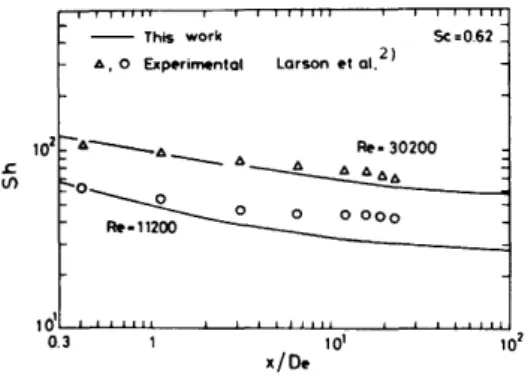
Fig. 9 shows a comparison between present solution and the ex-perimental data of Larson et al.2
) for asymmetric mass transfer.
At Re=30200, this solution is good agreement with experimental data, but at Re=11200, this solution shows lower Nusselt number than the experimental data.
- - This work Sc=O.62
A. 0 ElI~ri"",nlal Larson .1 01. 2)
Fig. 9 Comparison of present numerical solution with Larson et al.' mass trans-fer results [ uniform mass flux on one wall, the other wall insulated)
o
This work
E'xp«imental Duchatelle et al.14)
Pr-O.02 Re-SOOOO
Fig. 10 Comparison of present numerical solution with Duchatelle et al.'s heat transfer results [ uniform heat flux on one wall, the other wall insulated)
experimental data of asymmetric heat transfer obtained by Duchatelle et al. 14) in liquid metal region. The experimental data of Nu/NUoo
are conservative in comparison with this solution. The difference can be attributed to the effect of this numerical results obtained without the term of axial heat conduction, and to the experimental data which show higher Nusselt number than empirical results [see Kays et al.1S)] in the fully developed region. However, there is good agreement trend-wise.
CONCLUDING REMARKS
The numerical solution of heat transfer with turbulent flow between parallel plates has been obtained over a wide range of Prandtl number and Reynolds number for uniform heat flux on one wall, the other wall insulated and for uniform heat fluxes on each wall. In this study, the suitable correlations of the fluid velo-city, eddy diffusivity and turbulent Prandtl number have been used from a reconsideration of available experimental works.
NOMENCLATURE
em De H k Nu Nuoo (Qw) NUoo(Tw) Pr Prt q Re Sc Sh t u u+ u* V X x* Ym y Yo y+ y*coeff icient in Eq. (8)
4yo
distance variation from wall of fully developed temperature profile defined in Eq. (5)
thermal conductivity local Nusselt number
fully developed Nusselt number based on uniform wall heat flux
fully developed Nusselt number based on uniform wall temperature
Prandtl number
turbulent Prandtl number heat flux
Reynolds number (DeV/v) Schmidt number Sherwood number temperature velocity of fluid u/ITw/p u/V
=
u+/V+mean velocity of fluid
coordinate parallel to flat plate (x/De)/(RePr)
eigenfunction
coordinate normal to flat plate half wid th between parallel plates
( ylTW/p)/V y/yo
=
Y+/Yo+Greek Symbols
a thermal diffusivity y 1 + Pr(£h/v)
Eh eddy diffusivity for heat EV eddy diffusivity for momentum G dimensionless temperature v kinematic viscosity of fluid Am eigenvalue
p density of fluid
Subscripts
1 fully developed region or boundary of y+ 2 in the entrance region or boundary of y+ e entrance
i at one wall
j at the other wall w solid-liquid interface
fully developed region
REFERENCES
1) A. P. Hatton, A. Quarmby and I. Grundy: Int. J. Heat Mass
Transfer, ~, 817 (1964)
2) R. I. Larson and S. Yerazunis 16, 121 (1973)
3) A. A. Shibani and M. N. Ozisik 20, 565 (1977)
Int. J. Heat Mass Transfer,.
Int. J. Heat Mass Transfer,
4) M. Sakakibara and K. Endoh : Int. Chern. Eng., 16, 728 (1976);
Kagaku Kogaku Ronbunshu, ~, 65 (1976)
5) A. P. Hatton and A. Quarmby : Int. J. Heat Mass Transfer,
£,
903 (1963)
6) T. Mizushina and F. Ogino : J. Chern. Eng. Japan,
2,
166 (1970) 7) A. P. Hatton AppZ. Sci. Res., A12, 249 (1963-4)8) D. B. Spalding: Int. Dev. Heat Transfer, Part II, ASME, 439 (1961)
9) F. Page, W. G. Schlinger, D. K. Breaux and B. H. Sage Ind.
Eng. Chern., 44, 424 (1952)
10) A. Quarmby and R. Quirk : Int. J. Heat Mass Transfer, 15,
2309 (1972)
11) R. A. Gowen and J. W. Smith: Chern. Eng. Sci.,
£l,
1071 (1967) 12) R. H. Notter and C. A. Sleicher : Chern. Eng. Sci., ~, 2073(1972)
13) E. M. Sparrow, J. R. Lloyd and G. W. Hixon: J. Heat Transfer,
88, 170 (1966)
14) L. Duchatel1e and L. vautrey 1017 (1964)
Int. J. Heat Mass Transfer,
2,
15)
w.
M. Kays and H. C. Perkins : Handbook of Heat Transfer ( W. M. Rohsenow and J. P. Hartnett Ed. ), McGraw-Hill Inc.APPENDIX I + u u + (1) 1 1 (y++ 1/A1/3)3 1 1 (A1 / 3+_) X Z,n + (A1 / 3 _ _ )
6A 2/ 3
yt
(y+) 3+ l/A 31 / 2A2/3 Y! 2Y+- 1/Al/3 TI y.... [tan - 1 ( ) + _ 31 / 2/Al/3 6 + y -1 + + u EV v + yz + O. 07y o 2.5Zny+ + 5.5 O.07y+ 0 ++ + y yz + (1-
+ ) + 2.5z' nY 2 2yo (2) (3) (4) (5) + 5.5 (6) + +where A, Y1, Yz are described by
(7) +
C
1 - Y /Y+ + o dy+ = 2.5Zny+ + 5.5 1 + A(y+)3 1 (8) (9)Re=10000