論
説
Strategy Cascading for Regional Revitalization in Japan
*Hironao Iwata
1. Introduction
With the aim of resolving some of the problems facing Japan, including population decline, an aging population and declining local economy, the Japa-nese government is promoting “ regional revitalization ( in JapaJapa-nese Chihou Sosei),” which involves each region taking advantage of their unique character-istics to create autonomous, sustainable communities. Today, the Cabinet Sec-retariat of the Headquarters for Overcoming Population Decline and Vitalizing Local Economy in Japan(HOPDVLEJ)and the Cabinet Office of the Office for Overcoming Population Decline and Vitalizing Local Economy in Japan have started to work in tandem on policies for promoting regional revitalization. In 2014, the Act on Overcoming Population Decline and Vitalizing Local Economy in Japan(Act No.136, 2014)was enacted, and “The Long-Term Vision for Over-coming Population Decline and Vitalizing Local Economy in Japan ” (HOPDVLEJ, 2014 a)and “The Comprehensive Strategy for Overcoming Popu-lation Decline and Vitalizing Local Economy in Japan ”( HOPDVLEJ, 2014b )
were formulated. Following this, all local governments made use of the unique characteristics of their regions and formulated their own “Comprehensive Strat-egy for Overcoming Population Decline and Vitalizing Local Economy in Japan (below, “Regional Comprehensive Strategy” or RCS)”.
However, the problem seems to lie in the fact that there are little local gov-ernments that are carrying out regional revitalization successfully based on their RCSs. Because the majority of RCSs are extensions of old policies, and they may not necessarily have a management system for cascading the RCS to all levels of region and establishing the PDCA(Plan-Do-Check-Action)cycle. Furthermore, it remains an unsettled question that the alignment among lead-ers of public and private sectors executing the RCS may not be in place to be-gin with.
With the purpose of resolving some issues on the RCS implementation, we will consider the alignment among local parties involved in promoting regional revitalization by the strategic management system called the Balanced Score-card(BSC)and propose a structure for them to rotate the PDCA cycle of the RCS. It will also consider the establishment of the DMO(Destination Manage-ment Organization)as an organization for leading the secureManage-ment of the align-ment among all organizations that implealign-ment the RCS to vitalize local economy.
2. Regional Revitalization with the “Comprehensive Strategy for Overcoming Population Decline and Vitalizing Local Economy in Japan”
2.1 The Current State of the “Comprehensive Strategy for Overcoming Population Decline and Vitalizing Local Economy in Japan”
The Act on Overcoming Population Decline and Vitalizing Local Economy in Japan was enacted in 2014. Its aim was to properly respond to the declining birth rate/aging population to put a brake on population declines, while correct-ing the excessive concentration in Tokyo area and maintaincorrect-ing vitality of Japa-nese society in the future by securing a comfortable living environment in each region.
In response to this, the “Long-Term Vision for Overcoming Population De-cline and Vitalizing Local Economy in Japan”(HOPDVLEJ, 2014a)and “The Comprehensive Strategy for Overcoming Population Decline and Vitalizing Lo-cal Economy in Japan”(HOPDVLEJ, 2014b)were formulated for the nation. The long-term vision of the nation is to overcome population decline and regi-nal economic contraction. Depopulation, which began in 2008, is progressing rapidly, and it is conceivable that it will become a great burden in the near fu-ture. Furthermore, at the time, Japan’s GDP growth was as low as 0.34% , “ population stabilization ” and “ improvising productivity ” are touted with the goal of keeping a future GDP growth of 1.5% to 2%. The nation’s “Comprehen-sive Strategy for Overcoming Population Decline and Vitalizing Local Economy in Japan”(below, “National Comprehensive Strategy” or NCS)was formulated to realize this long-term vision. The basic objectives of the NCS are as follows (HOPDVLEJ, 2014b).
Objective 1 : Generate stable employment in regional areas Objective 2 : Generate a new inflow of people to regional areas
Objective 3 : Fulfill the hopes of young generation for marriage, childbirth, and parenthood
Namely, the NCS asks local governments to establish a virtuous circle where “jobs” attracts “people” and “people” attract “jobs,” and reenergize the “communities” that support this virtuous circle.
The NCS 2015 Revised Edition(HOPDVLEJ, 2015)aptly pointed out that previous policies had the following issues :(1)the structure of “silos” for each government department and system ; (2)methods that were “uniform nation-wide” and did not take regional characteristics into consideration ; (3)“pork-barrel” without inspecting effectiveness ; (4)“superficial” policies that did not penetrate into regional areas ; and(5)policies that sought “short-term” results. However, the “Five Policy Principles for Overcoming Population Decline and Vitalizing Local Economy in Japan”(HOPDVLEJ, 2015)aim to reform old poli-cies with the following principles : (1)autonomy ; (2)future prospects ; (3) regional characteristics ;(4)directness ; and(5)results-oriented.
(1)Autonomy : Dealing with structural issues and leading to autonomy of local governments, private sectors, and individuals
(2)Future prospects : Supporting regions’autonomic and proactive efforts to achieve their dreams in a forward-looking way
(3)Regional characteristics : Supporting policy planning and implementa-tion that fit the realities of each regional area.
(4)Directness : Intensively implementation of policies with direct support, to maximize results
(5)Results-oriented : Setting clear KPIs, verifying effectiveness and mak-ing improvements through the PDCA cycle.
their five-year RCSs, the national and local governments should come together to promote regional revitalization. To that end, it is essential that the national and local governments conduct analysis of regional economic and social condi-tions and establish the PDCA cycles for regional revitalization from mid- and long-term perspectives. Furthermore, by getting not only national and local gov-ernmentals, but also participants of industry, academia, financial institutions, la-bor groups, medias and representatives of community involved in formulating the RCS, it will become possible to deliver effective and efficient services with-out falling into the trap of siloed efforts(HOPDVLEJ, 2015).
According to the study by HOPDVLEJ(2016), as of April 19, 2016, only four local government(0.2%)out of 47 prefectures and 1,741 municipalities had not yet formulated the RCS. It is worth mentioning, from a standpoint of management control system, that both the NCS and the RCS position regional revitalization as “strategies” rather than as “policies” and that they advocate the necessity of “establishing national and local initiatives and the PDCA cycle” in order to implement those strategies. According to the item on “The State of Es-tablishing the PDCA Cycle, ” 43 prefectures and 1,585 municipalities(91%) conduct a PDCA cycle at least once per year. However, considering the state of regional revitalization at those local governments, the effectiveness of the PDCA cycle is doubtful.
2.2 Management Issues on the “Comprehensive Strategy for Overcom-ing Population Decline and VitalizOvercom-ing Local Economy in Japan”
measures.
However, there are several management issues on regional revitalization. The first is that there are many local governments that use subsidies for re-gional revitalization to outsource their formulation of the RCS. According to a study by the Small But Shining Municipality Forum Conference(2015),23% of local governments outsourced their RCS formulation completely, 50% outsour-ced part of it, and 27% had no plans for outsourcing. Although consulting firms, which cannot be said to be direct actor of regional revitalization, may be able to provide an objective viewpoint, they may not completely grasp the char-acteristics of the given region and its local attractions. They often emphasize the look of the RCS rather than focus on the process of strategy execution. That is, it is possible that the issues present in old policies, such as(2)meth-ods that were “uniform nationwide” and did not take regional characteristics into consideration and(4)“superficial” policies that did not penetrate regional areas, are being carried over unchanged, as management issues on the RCSs. To revitalize regional areas with each region’s characteristics, interest parties involved in regional revitalization must take the responsibility for formulating the RCS.
young people to permanently settle in rural areas. It is conceivable that this type of “siloed” approach happens often at both the national and local levels.
The third issue is that while it may be appropriate to formulate the five-year RCS in order to avoid the old policy issue of(5)policies that sought “short-term” results, local governments may not have sufficiently established a yearly(or otherwise more short-term)PDCA cycle, such as those used by many companies. “In order to guarantee the effectiveness of the PDCA cycle, improvement plans based on assessment of outcomes must be formulated ap-propriately, and these soundly reflected upon for the next development of the measures or projects. Then, to fully review the details of the measures or pro-jects, that reviewed plan must be reflected in the next year’s budgeting”(Mit-subishi UFJ Research and Consulting, 2016). However, according to the Minis-try of Internal Affairs and Communications’(2014)“Study Results Related to the State of Performance Evaluation Initiatives in Local Governments,” only about 40% of local governments reflected improvement items as a rule on the follow-ing year’s budget, and nearly 60% of local governments had not established outcome indicators. In regional revitalization, it is essential to create structures that guarantee the effectiveness of improvements through appropriate PDCA cycle. Namely, it is possible that regional revitalization is also falling into the trap of the old policy issue of(3)“pork-barrel” without inspecting effectiveness. To rotate the PDCA cycle in local governments, it is essential to establish sus-tainable structures that last through personnel changes and that do not rely on the skills of individual staff members.
3. Organizational Alignment using the Balanced Scorecard
This section will explain the basic structure of the Balanced Scorecard, a strategic management system, as well as the building of alignment through the Balanced Scorecard.
3.1 Basic Structure of the Balanced Scorecard
When it was first introduced, the Balanced Scored(BSC)was devised as a performance evaluation system that incorporates non - financial indicators to overcome the issue of short-term management that overly emphasizes financial indicators like ROI(Return on Investment)and EVA(Economic Value Added). In recent years, the BSC is seen as a strategic management system that uses not only “financial” perspective, but also comprehensive perspectives of “cus-tomer”, “internal business process” and “learning and growth”, to create a vi-sion using a Strategy Map and secure effective formulation and execution of the strategy(Sakurai, 2015). Furthermore, today, the role of the BSC is align-ing intangible assets such as human capital, information capital, and organiza-tion capital with the strategy to deliver tangible outcomes, and aligning overall organization with the strategy to create corporate synergies(Kaplan and Nor-ton, 2004 ; 2006).
can-Strategy Map Balanced Scorecard Action Plan Process: Operations Management
Theme: Ground Turnaround Objectives Measurement Target Initiative Budget
Financial Perspective ■Profitability ■Grow revenues ■Fewer planes ■Market value ■Seat revenue ■Plane lease cost
■30% CAGR ■20% CAGR ■ 5% CAGR
Customer Perspective
■Attract and retain more customers ■Flight is on time ■Lowest prices
■# repeat customers ■# customers ■FAA on-time arrival rating ■Customer ranking ■70% ■Increase 12% annually ■# 1 ■# 1 ■Implement CRM system ■Quality management ■Customer loyalty program $ xxx $ xxx $ xxx Internal Perspective ■Fast ground turnaround ■On-ground time ■On-time departure ■30 minutes ■90% ■Cycle-time optimization $ xxx Learning And Growth Perspective ■Develop the necessary skills ■Develop the support system ■Ground crew aligned with strategy
■Strategic job readiness ■info system availability ■Strategic awareness ■% ground crew stockholders ■Yr.1- 70% ■Yr.2- 90% ■Yr.3- 100% ■100% ■100% ■100%
■Ground crew training ■Crew Scheduling system rollout ■Communications program ■Employee Stock Ownership ■Plan $ xxx $ xxx $ xxx $ xxx Total Budget $ xxxx Profit and RONA
Grow revenues Fewer planes
Attract and retain more customers Lowest prices On-time service Fast ground turnaround Ground crew alignment Strategic job Ramp agent Strategic systems Crew scheduling
not be implemented. As shown in Figure 1, BSC consists of a Strategy Map that visualizes the strategy and a scorecard(BSC in the narrow sense)that measures and controls the strategy’s state of progress(Kaplan and Norton, 2004). The Strategy Map is a logical and comprehensive framework for de-scribing the strategy. By using the Strategy Map, it is possible to visualize the strategy with causal links and to verify the hypotheses of the strategy.
The BSC is developed based on the Strategy Map, and translates the strat-egy into specific KPIs(performance measurements), targets, strategic initia-tives and budgets. The strategic initiainitia-tives are a series of actions and programs for making it possible to achieve the targets that were set for all measure-ments. The implementation of the strategy is managed through the execution of these strategic initiatives.
3.2 Using the BSC to Build Alignment
In many companies, the Corporate Planning Department or Corporate Strategy Office acts as a facilitator and formulates the corporate strategy.
Figure 1 Basic Structure of the BSC
Through the budgeting process, the corporate strategy is cascaded to each business unit and support unit of the company. However, as has often been pointed out, like a dysfunctional behavior of budgeting, the strategies of each business unit and support unit are often formulated independently, based on their organizational objectives. Consequently, at times, this lacks the perspec-tive of how each unit will cooperate with one another and achieve integration and corporate synergies. Kaplan and Norton(2006)point out that the reason most companies struggle with executing strategy is that management processes are disjointed in this way and that they do not have proper organizational align-ment.
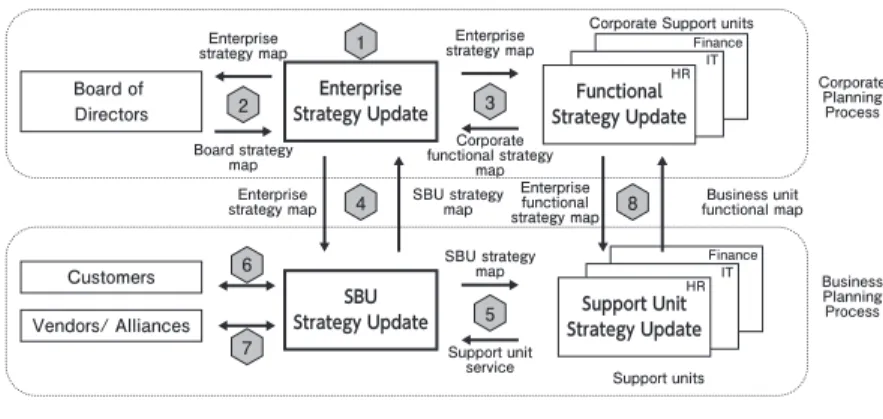
According to Kaplan and Norton(2006), a comprehensive and managed alignment process helps the enterprise to achieve corporate synergies through the integration of each unit. Figure 2 shows a typical sequence used to create enterprise-derived value and eight alignment checkpoints in the planning proc-ess.(1)The corporate office defines strategic guidelines to shape strategies at lower levels of the organization.(2)The corporation’s board of directors re-views, approves, and monitors the corporate strategy.(3)The corporate strat-egy is translated into those corporate policies that will be administered by cor-porate support units.(4)The corcor-porate priorities are cascaded into business strategies.(5)The strategic priorities of the business units are incorporated in the strategies of the functional support units.(6)The priorities of the customer value proposition are communicated to targeted customers and are reflected in specific customer feedback and measures.(7)The shared priorities for suppli-ers, outsourcsuppli-ers, and other external partners are reflected in business unit strategies.(8)The strategies of the local business support units reflect the pri-orities of the corporate support unit.
Finance IT Board of Directors Enterprise Strategy Update Functional Strategy Update HR Finance IT Customers Vendors/ Alliances SBU
Strategy Update Strategy UpdateSupport Unit
HR 6 7 2 1 4 5 X =Alignment checkpoint 8 3 Enterprise strategy map Enterprise
strategy map SBU strategymap
SBU strategy map Support unit service Support units Enterprise functional strategy map Board strategy map Enterprise strategy map
Corporate Support units
Corporate Planning Process Business Planning Process Business unit functional map Corporate functional strategy map
and cooperation of individuals from various organizational units. Thus, Kaplan and Norton(2006)advocate the establishment of the Office of Strategy Man-agement(OSM)1. The OSM facilitates the development and cascading of
Bal-anced Scorecard at different hierarchical levels of the organization. Assigning responsibility and accountability for effective organizational alignment process is a task for the OSM, which can coordinate multiple processes and ensure, at least annually, that all of the alignment checkpoints are achieved(see Figure 2).
Now, assuming that we substitute the enterprise strategy of the company with the RCS of local government, the board of directors with the municipal as-sembly, the functional strategies with the strategies of the local government’s support units, the SBU strategy with the subordinate organizations’strategies cascaded from the RCS, and vendors and alliances with citizens and parties in-volved in regional revitalization, we can appreciate the importance of building alignment not only for companies, but also for regional revitalization.
Figure 2 Building Alignment Checkpoints into the Planning Process
4. Building Alignment for the RCS
This section will propose alignment building through the BSC for formula-tion and implementaformula-tion of the RCS.
4.1 Application of the BSC for RCS
The application target of the BSC, a strategic management system ex-plained in the previous section, is not limited to companies. The BSC can be in-troduced to all organizations and inter-organizations involved in regional revi-talization. It can be used to promote the formulation and implementation of the RCS, to rotate the PDCA cycle of it, and to build alignment among all organiza-tions involved in regional revitalization. This paper will take up the town of Na-gawa, Chiisagata District, Nagano, as an example of a setting for regional revi-talization activities, and propose the BSC for regional revirevi-talization.2
The purpose of advocating for an application of the BSC to organizations involved in regional revitalization is to resolve issues that have already been ex-plained : (1)formulation of the RCSs not being carried out by the local gov-ernments themselves ;(2)no system being put in place for rotating the PDCA cycle of the RCS in the short-term ; and(3)the lack of alignment among all organizations involved in regional revitalization.
of regional areas ; (2)formulation of the original strategy with Strategy Map ; (3)introduction of the PDCA cycle using the BSC ; (4)building an alignment among all organizations involved in regional revitalization. The next section will give a detailed explanation of these four steps.
4.2 Procedure for Formulating and Executing the RCS with the BSC
(1)Region Analysis
To introduce the BSC for regional revitalization, analysis of the target re-gion is the first prerequisite. As for the methods for rere-gion analysis, according to Dentsu abc project ed.(2009),there is a “strategic zoning”3and a “diagnosis
of regional basic strengths”.
There are limits to regional revitalization in the conventional siloed form conducted at the regional level that use administrative districts as a starting point. Thus, the strategic zoning is needed ; in other words,“creating a unique experiential value for the region through reconstruction that is based on brand resources within the region, or through connections outside of the region ” (Dentsu abc project ed., 2009, p.115). Regions whose unique image factors are weak must focus on creating new experiential value through the strategic zon-ing.
The diagnosis of regional basic strengths measures a region’s basic strengths(population, industry, economics, infrastructure)and allows for the understanding of each region’s strengths and weaknesses. With this diagnosis, it is possible to conduct a value analysis of the region’s brand resources to de-termine whether the local attractions are capable of becoming the region or area’s symbol. When carrying out this diagnosis, the “Regional Economy and Society Analyzing System(RESAS)”(https://resas.go.jp/)provided by the HOPDVLEJ is useful.
Na-gawa, Chiisagata District, Nagano in Japan as an example of regional revitaliza-tion. With a population of under 7,000, we can take stock of Nagawa’s local at-tractions as Tartary buckwheat, quince, obsidian, the Utsukushigahara High-lands, the Chuo Bunsuirei trail, and post - towns of Edo - period along the Nakasendo road. In recent years, this region has earned attention for its Na-gawa Obsidian Wine Grape Project, an aquaculture of Ancient Obsidian Stur-geon, and Maison du Jambon de Himeki, a workshop where visitors can take lessons in iberian ham making, which was covered in the magazine Discover Ja-pan’s April 2016 special feature on regional revitalization, “100 Things Heating Up Japan.” However, although some of these local attractions are starting to form connections, they have not gone so far as to link Nagawa’s or the neigh-boring area’s local attractions of unique history, culture, nature, industry, life-styles, and human communities to emotional value through experiential “spaces,” nor to improve the area’s reputation by making people “want to buy,” “want to visit,” “want to network,” “want to live,” and create a regional brand that is known nationwide.
ham-making experience, for example, there may be potential for developing green tourism that gains national attention if actors engaged in regional revitali-zation coordinate beyond the boundary of districts. Visiting and touring the pro-ducers of brand-name pork in Azumino and other places, eating delicious food particular to this region by visiting local restaurants that offer cuisine that uses Jambon de Himeki’s iberian ham, and volunteering at harvests of grapes used at wineries in Shinshu area, whose wine is served in local restaurants, are but a few examples. In other words, from the perspective of “want to buy,” “want to visit,” and “want to network,” it is good to conduct regional revitalization activi-ties through the strategic zoning in a wider area, not in Nagawa area alone.
(2)Using the BSC to Formulate and Execute Strategy for Regional Revitaliza-tion
After completing the strategic zoning, the next step is to create the BSC (strategy map and scorecard)for formulating and executing the unique strat-egy for regional revitalization. There are no major differences between the BSC for regional revitalization and those used by companies.4However, as with the
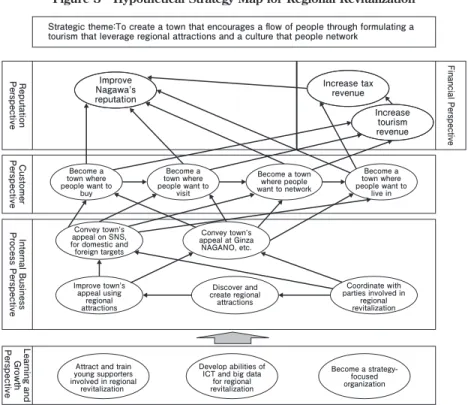
BSC of a nonprofit, the BSC for regional revitalization needs to devise items unique to itself, such as deciding how to position the financial perspective. The goal of regional revitalization is not only each region’s economic independence, but also the establishment of a virtuous circle where “jobs” attracts “people” and “people” attract “jobs,” and reenergize the “communities” that support this virtuous circle. To put it another way, improving the positive regional reputa-tion such that people “want to buy,” “want to visit,” “want to network,” and “want to live,” is also the standard of success for regional revitalization. Figure 3 shows a hypothetical example of Strategy Map for regional revitalization.
re-Improve Nagawa s reputation
Strategic theme:To create a town that encourages a flow of people through formulating a tourism that leverage regional attractions and a culture that people network
Increase tourism revenue Increase tax revenue Become a town where people want to buy Convey town s appeal on SNS, for domestic and foreign targets Improve town s appeal using regional attractions Develop abilities of ICT and big data
for regional revitalization
Become a strategy-focused organization Attract and train
young supporters involved in regional revitalization Coordinate with parties involved in regional revitalization Discover and create regional attractions Convey town s appeal at Ginza NAGANO, etc. Become a town where people want to visit Become a town where people want to live in Become a town where people want to network Reputation Perspective Financial Perspective Customer Perspective Learning and Growth Perspective Internal Business Process Perspective
vitalization in that area, they must also create the BSC. By introducing the BSC, it becomes possible for each party to define what they need to do for the RCS and for their own strategy, and to execute the strategy while rotating the PDCA cycle, based on the unique concepts of that strategically zoned area.
The advantages of the BSC for regional revitalization are its ability to visu-alize and define requirements for the RSC, and its ability to train the focus of parties involved in regional revitalization on the strategic objectives of regional revitalization. The establishment of the PDCA cycles and alignment among par-ties involved in regional revitalization, which will be mentioned later, are also big advantages. On the other hand, it is expected that lining up strategies and
Figure 3 Hypothetical Strategy Map for Regional Revitalization
recognition among all parties involved in regional revitalization may take long time.
(3)Using the BSC to Formulate the PDCA Cycle
When executing the RCS and the strategy of each party, the scorecard (BSC in the narrow sense)translate strategic objectives in the Strategy Map into KPIs, targets and initiatives, and the PDCA cycle is kept in motion with the aim of reaching the objectives using the BSC, at each organization.
When these organizations first start to execute the strategy in line with the Strategy Map, there is the potential for there to be some contradictions in some items when the environment of the region changes. However, the RCSs formulated by many local governments have KPI targets fixed in intervals of five years. If initiatives carry on unchanged, there is a strong possibility that a gap will occur between the strategy and the actual setting and that the strategy will result in failure. Therefore, when environmental changes occur, it is essen-tial to revise the Strategy Map and scorecard by single-loop and double-loop learnings, such as by changing KPI targets or changing the strategic objectives. Furthermore, in the PDCA cycle of the RCS, the C(Check)function is es-pecially important. By evaluating and testing KPIs that was set to match the ac-tual conditions of the region, it is possible to continuously execute the strategy of regional revitalization. However, if the C process in the PDCA cycle is ne-glected, it will interfere with the ensuing A(Action)and P(Plan)steps, and it will be difficult to continue.
(4)Building the Alignment among Actors of Regional Revitalization
hy-The RCS of Nagawa Maison du Jambon de Himeki (Iberian ham) Local government Chamber of commerce Tourism association Farm Trading Company Auberge Winery NPO Other region cooperation
pothetical example in Figure 4. Getting consistency of objectives from all par-ties of regional revitalization is important factor to execute regional tion strategy successfully. By building the alignment in the regional revitaliza-tion, even though each actor of regional revitalization has their own strategies, the causal links that exist between them will be made visible. Each party is then able to cooperate while making use of their own unique characteristics, takes action toward realizing the strategy for the strategically zoned area or the RCS, and produces synergistic effects. However, because it may take time and effort to develop the BSC for each organization and to build the alignment among them, the DMO(mentioned below)should lead the way to introduce the BSC.
4.3 Leveraging the DMO
When introducing the BSC to a company, sometimes management
posi-Figure 4 Hypothetical Alignment for Regional Revitalization Using the Strategy Map
tions or offices are established, such as the Office of Strategy Management, the Alignment Committee, and the Strategic Alignment Officer, to consistently align the corporate strategy with the business strategies and the functional strate-gies. As with companies, to ensure consistent alignment between the RCS of lo-cal government and the strategy of each party engaged in regional revitaliza-tion, there needs to be an organization that coordinates and integrates the whole process. Accordingly, we propose setting up a DMO(Destination Man-agement Organization)as an organization to coordinate manMan-agement control process of regional revitalization using the BSC. The DMO have been gaining attention primarily in Europe, as professional organizations responsible for des-tination management5.
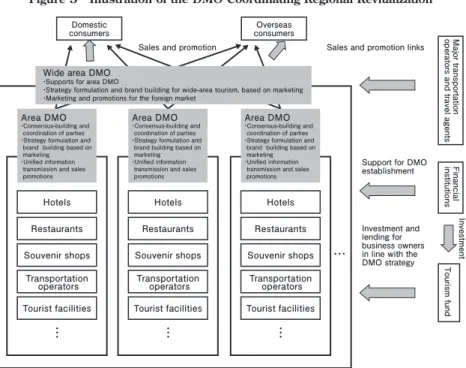
As a coordinator of regional tourism development, the DMO collaborates with various parties and formulate strategies for implementing regional tourism development based on regional concepts, while also being a corporate body in possession of coordination features for reliably executing the strategies(Sato, 2016)(see Figure 5). The organizational format of the DMO in Europe is often that of a government agency, or a nonprofit organization that acts as a link be-tween the public and private sectors. The DMO funding includes subsidies from central or regional governments, and funding diversification is planned through membership fees and independent commercial activities.
Domestic
consumers consumersOverseas
Hotels Restaurants Souvenir shops Transportation operators Tourist facilities Hotels Restaurants Souvenir shops Transportation operators Tourist facilities Hotels Restaurants Souvenir shops Transportation operators Tourist facilities … … … Area DMO ・Consensus-building and coordination of parties ・Strategy formulation and
brand building based on marketing ・Unified information
transmission and sales promotions
Area DMO
・Consensus-building and coordination of parties ・Strategy formulation and
brand building based on marketing ・Unified information
transmission and sales promotions
Area DMO
・Consensus-building and coordination of parties ・Strategy formulation and
brand building based on marketing ・Unified information
transmission and sales promotions
Sales and promotion Sales and promotion links
Support for DMO establishment
Investment and lending for business owners in line with the DMO strategy
…
Wide area DMO
・Supports for area DMO
・Strategy formulation and brand building for wide-area tourism, based on marketing ・Marketing and promotions for the foreign market
Major transportation
operators and travel agents
Financial
institutions
Tourism fund
Investment
manages the alignment process of the regional revitalization strategy using BSC, which makes the RSC execution more effective.
5. Conclusion
In this paper, after clarifying the current status and issues of regional revi-talization in Japan, we proposed the BSC for regional revirevi-talization as a means to resolve management control issues that are present in regional revitalization. With the BSC for regional revitalization, there is a high likelihood of being able to resolve the following issues : (1)the RCS of each region not being formu-lated by the parties involved in regional revitalization ; (2)the lack of manage-ment control system to keep the PDCA cycle of the RCS rotating ; and(3)the
Figure 5 Illustration of the DMO Coordinating Regional Revitalization
lack of alignment and cooperation among parties involved in regional revitaliza-tion. To that end, we believe that the BSC for regional revitalization can be ef-fectively introduced by setting up the DMO as an organization that coordinates the RCS. Some topics for future studies might include conducting action re-search that introduces the BSC for regional revitalization and inspecting the ef-fectiveness of it.
Acknowledgements
This work was supported by Senshu University Grant(FY 2017 “ A Re-search on Management Accounting System for Regional Revitalization”). Fur-thermore, the concept of study’s are owed to the helpful suggestions of many parties involved in regional revitalization of Nagawa area. We would like to ex-press our deepest thanks.
Notes
1 R. S. Kaplan and D. P. Norton(2005)discuss the Office of Strategy Management in detail in “The Office of Strategy Management,” Harvard Business Review, October, pp.72-80.
2 The authors would like to remind readers that Figures 3 and 4 are hypothetical ex-amples created by the authors.
3 The term “zoning” is a concept known in urban planning. It generally refers to sub-dividing an area by purpose or function, and deciding on positioning relationships that take mutual relationships into consideration.
4 Administrative reform had been promoted in the form of NPM(New Public Man-agement)that incorporated private management techniques into governments. This was based on the “New Guidelines for Promoting Administrative Reform in Local Governments” formulated by the former Ministry of Internal Affairs and Communi-cations. When this happened, the BSC was introduced into several governments, but it was used more as a type of performance evaluation for fulfilling accountabil-ity, rather than as a system for formulating and executing a strategy, which is the original purpose of the BSC. This is vastly different from the BSC for regional revi-talization proposed in this paper.
sometimes very separate entities for the better management of the destination.
References
Dentsu abic project ed.(2009)Area Brand Management, Yuuhikaku.
Development Bank of Japan(2016)“Nihongata DMO Keiseiniyoru Kankouchi Dukuri,” http://hokuriku.mof.go.jp/content/000132760.pdf, as of 2016/11/22.
HOPDVLEJ(2014a)“The Long-Term Vision for Overcoming Population Decline and Vitalizing Local Economy in Japan,” http://www.kantei.go.jp/jp/singi/sousei/pdf/ 20141227siryou3.pdf, as of 2016/11/20.
HOPDVLEJ(2014b)“The Comprehensive Strategy for Overcoming Population Decline and Vitalizing Local Economy in Japan,” http://www.kantei.go.jp/jp/singi/sousei/ pdf/20141227siryou5.pdf, as of 2016/11/20.
HOPDVLEJ(2015)“The Comprehensive Strategy for Overcoming Population Decline and Vitalizing Local Economy in Japan 2015, ” http://www.kantei.go.jp/jp/singi/ sousei/info/pdf/h27-12-24-siryou2.pdf, as of 2016/11/20.
HOPDVLEJ(2016)“Chihou Jinko Vision oyobi Chihouban Sogosenryaku no Sakutei-jyokyo,” http://www.kantei.go.jp/jp/singi/sousei/pdf/h28-04-19-sakuteijoukyou.pdf, as of 2016/11/20.
Kaplan, R. S. and D. P. Norton(2004)Strategy Maps : Converting Intangible Assets into
Tangible Outcomes, Harvard Business School Press.
Kaplan, R. S. and D. P. Norton(2006)Alignment : Using the Balanced Scorecard to
Create Corporate Strategy, Harvard Business School Press.
Ministry of Internal Affairs and Communications(2014)“Study Results Related to the State of Performance Evaluation Initiatives in Local Governments, ” http://www. soumu.go.jp/main_content/000280724.pdf, as of 2016/11/22.
Mitsubishi UFJ Research and Consulting(2016)“Chihousosei no Torikumi ni Motom-erareru PDCA Saikuru no Kakuritu,” http://www.murc.jp/thinktank/rc/column/ search_now/sn160510, as of 2016/11/22.
Nagawa(2016)http://www.town.nagawa.nagano.jp/, as of 2016/11/22.
Sato, Shinichi(2016)Bessatsu Discover Japan LOCAL : Chihososei no kirihuda DMO to
DMC no tsukurikata, Eisyuppan.
Small But Shining Municipality Forum Conference(2015)“What is the Aim of Re-gional Population Vision and Comprehensive Strategy?” http://www.jichiken.jp/ar-ticle_10/, as of 2016/11/22.