The Tr ans f or m
at i on of Squat t er Set t l em
ent s
i nt o U
r ban Ci t i es t hr ough t he Ef f ec t s of
Tenur e Sec ur i t y i n H
ous i ng and I nf r as t r uc t ur e
I nves t m
ent s : The Evi denc e of Thr ee Squat t er
Set t l em
ent s i n Li m
a, Per u
著者
CLAU
D
I A AN
D
REA SAKAY RO
D
RI G
U
EZ
year
2015
その他のタイトル
住宅及び都市のインフラ建設プロセスについての土
地保有の効果から見た不法滞在集落の変容に関する
研究 : ペルー・リマ市の三不法滞在集落の事例分
析
学位授与大学
筑波大学 ( U
ni ver s i t y of Ts ukuba)
学位授与年度
2014
報告番号
12102甲第7417号
博士論文
The Transformation of Squatter Settlements into Urban Cities through the Effects of Tenure Security in Housing and Infrastructure Investments
-The Evidence of Three Squatter Settlements in Lima, Peru-
住宅及び都市のインフ 建設プロセスについての土地保有の効果から見た
不法滞在集落の変容に関する研究
-ペ マ市の三不法滞在集落の事例分析-
成 26 度
筑波大学大学院人間総合科学研究科芸術専攻
SAKAY RODRIGUEZ CLAUDIA ANDREA
i
ABSTRACT
This study aims to analyze the relation between tenure security and housing investments attained in squatter settlements located in vacant lands on the periphery of city Lima, Peru. The main problem of squatter settlements is the access to housing which have left these populations to find their own solutions by illegal means to assure land rights and therefore, different forms of tenure security.
In order to achieve the objective of the study, research in the literature was made to bring assertions about tenure security and land tenure arrangements in the context squatter settlements of Lima city, Peru.
Additionally, the long history of squatter settlements and the implementation of different housing policies to improve these neighborhoods in Lima city, has led the choice to compare three communities. Each case of study represented different contexts where populations had evidenced housing investments under a combination of three types of tenure security: a) illegal tenure security when rights are attained due to land invasion; b) de facto tenure security through the implementation of basis services and c) de jure tenure security by the recognition of a local authority.
Data was collected through a semi structure interviews, observations and meeting with the each community. A total of 75 samples were gathered and analyzed by using a mixed of tools and techniques to design a unique method to track the effects of the three types of tenure security.
The study revealed that tenure security is an important perception able to encourage, increase and motivate squatter populations to invest in their house and in the land they occupy. However, as de jure tenure security can assure land rights through legal property titles; de facto tenure security contributes on faster housing and neighborhood which creates provisional licenses to access to housing to promote faster physical and social inclusion into the urban city.
ii
ACKNOWLEDGEMENTS
I have been fortunate to experience support from many sides during the course of my PhD. It would have been impossible to succeed without the support of many people. This study would not have been possible without the generous funding of the Nippon Foundation and the Japan International Cooperation Agency (JICA) to undertake my studies in Japan.
I would like to dedicate this dissertation to my parents, for their unfailing support from halfway across the world during my time at Tsukuba University. Thank you for always encouraging and pushing me towards higher academic laurels and build better world for the needy.
My deepest and sincere gratitude goes to my supervisor, Professor Hanazato Toshihiro for his never-ending confidence in my abilities, for always being approachable, and for knowing when to exert gentle pressure on me. I have been lucky to benefit from such a supportive and kind supervisor.
I would also like to express my appreciation and gratitude to Professor Yamanaka Toshimasa, Professor Uekita Yasufumi and Professor Kobayashi Hideki from Chiba University; who sharpened my Ph.D. work through their guidance, constructive remarks, suggestions and criticisms to improve this thesis.
Most importantly, my immense thanks go to the community of Nuevo Pachacutec, Manchay and Villa el Salvador and the 75 families who warmly welcomed me into their homes and stories. To Mr. Dario Carbonel president of CEC-CIMAP at Nuevo Pachacutec, the Priest Jose Chuquillanqui Yamamoto in charge of the Holy Spirit Church at Manchay, Mr. Tulio Galvez from CUAVES at Villa el Salvador and Mr. Oscar Sakay president of the NPO Amistad Peru Latino Americana and their valuable work in three squatter settlements.
vii
xiii
1
Chapter 1
Background to the Study
1.1 Introduction
The importance of this study is emphasized by the need to find a
sustainable solution to the rapid urban growth and invasion of vacant public
and private spaces into illegal accommodation by low-income population.
For the past two decades many studies of urbanization in Latin
America and development countries around the world have focused attention
upon the illegal residential expansion phenomena and access to housing for
the poor has become big concern. The majority of populations living in
developing countries live in poverty in which access to housing has become
too expensive for most of these populations.
Giving this housing gap, low-income populations are force under
2
in poor neighborhoods where land is occupy illegally and population build
their own houses named as “squatter settlements” in the world-wide
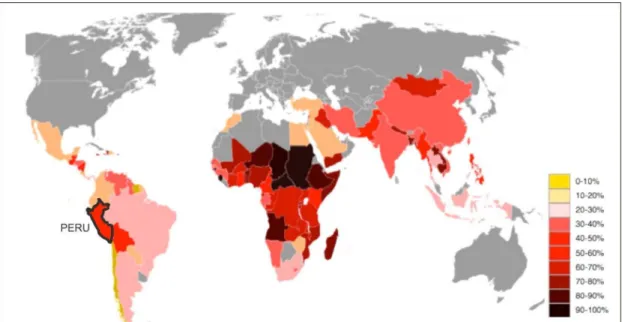
academia (see Fig. 1.1). Despite each region have their own terminology:
slums (Africa and some Asian countries), barong barong (Philippines),
colonias proletarias (Mexico), barriadas brujas (Panama), ranchos
(Venezuela), callampas (Chile), favelas (Brazil). In Peru they are locally
known as barriadas1 or pueblos jovenes2. The current existence of many
squatter settlements is world-wide reality in the urban landscape of Latin
America and most developing countries (see Fig. 1.2). However an interesting
1 Spanish expression to refer into a neighborhood living in poverty.
2 Peruvian terminology to refers into young towns and relates to the new urban formations in the
periphery of Lima city.
3
fact about millions of populations living in squatter settlements is that they
usually invest in their houses they do not officially own to provide shelter to
their families (Sakay, 2012).
In developing and Latin American countries, squatter settlements have
the same tendency and could vary due to local conditions such as weather;
geography and political context (see Fig.1.3). Past studies based on Peru’s
squatter settlements experiences have indicated that similar sequences have
occurred in other countries (Mangin, 1967; Turner, 1972). Populations arise on
vacant land, usually uncultivated and undesirable land on the outskirts of
cities. The main and common characteristics of world-wide squatter
settlements are the illegal condition (without ownership of the land) and the
physical exclusion from the urban. Therefore, unprotected by these poor
4
conditions, low-income populations need to achieve their social inclusion and
their physical spatial existence in the urban city. They need a degree of
security for their vulnerable space in order to find some form of tenure
security or property rights where no land tenure or ownership exists.
According to UN-Habitat3 (2010), the number of squatter settlements
worldwide continues to grow at the rate of 10 percent every year, hence
increasing the problem of access of housing for the poor. Therefore, future
urban development will show further expansion and straggling squatter
settlements if no action is taken in the coming years.
3 UN-Habitat, is the programme for human settlements created by United Nations in 1978. It aims to
address the issues of urban growth development processes in human settlements in different developing countries.
5
To address this global problem, new formation and expansion of
squatter settlements, many city governments as well as international
institutions have created programmes aimed at lowering the rate of squatter
settlements formation.
In the case of Peru, squatter settlements have a long history due to
migration to the urban city from the country side until these days.
Consequently, the Peruvian government has developed many programmes to
promote different socio economic development strategies through the
implementation of different housing programmes (Williams, 2000). Despite
some of these programmes had failed due to lack of budget, some of them are
still partially working, such as providing them access to basic infrastructures
such as water, drainage, electricity and land tenure legalization. In the same
way, international organizations work towards the improvement of living
conditions in squatter populations such as United Nations (UN),
Non-Governmental Organizations (NGO’s), and other stakeholders since 1960’s.
For instance, in the 1990’s, governments together with United Nations
created the Millennium Development Goals4 (MDG’s) which aims to reduce
poverty conditions of 100 million squatter settlements populations by 2015
(UN-Habitat, 2010). Nerveless, the continuum socio-economic problems of
4 The Millennium Development Goals (MDGs) created in the 1990’s has encouraged many governments
6
created squatter populations have brought the interest to target the issue of
tenure security to reduce poverty. In this way, illegal squatter settlements can
ensure land rights5 and tenure security for protection against eviction to
obtain benefits in terms of investment initiatives for housing and
neighborhood improvements.
The definition of tenure security was recently created by United
Nations in October 2002 and defined as the perception of all individual and
vulnerable populations against the evictions (Nyametso, 2012). In other
words, low-income populations could obtain tenure security when they feel
confident and gain certain legal recognition to avoid the fear of be removing
from the invaded land or house at any moment.
Whether the legal land tenure6 status provides tenure security for the
illegal squatter populations or not, many governments has adopted the land
tenure legalization mechanism to develop strategies for the implementation of
housing programmes (Varley, 1987). In this way land tenure legalization
assure full land rights and therefor, the fear of eviction7 disappears as squatter
populations achieve legal tenure security.
However, while many authors like De Soto (2000) is convinced that this
legalization of land tenure in the form of property titles is capable of altering
5 Land rights designate the ability over the land to squatter individuals and communities such as
occupancy, use, develop, inherit, and transfer as a property.
6 Land tenure is related with the legal or customary condition of a group of people or individual.
7
7
the tenure security status, others authors think that the effects are only
moderate (Gilbert, 2002; Payne, 2001; De Souza, 2011).
The main critic includes the fact that subjective perception of tenure
security about land rights not only come from land titling. Rights and tenure
security could derive from other types of land tenure arrangements and
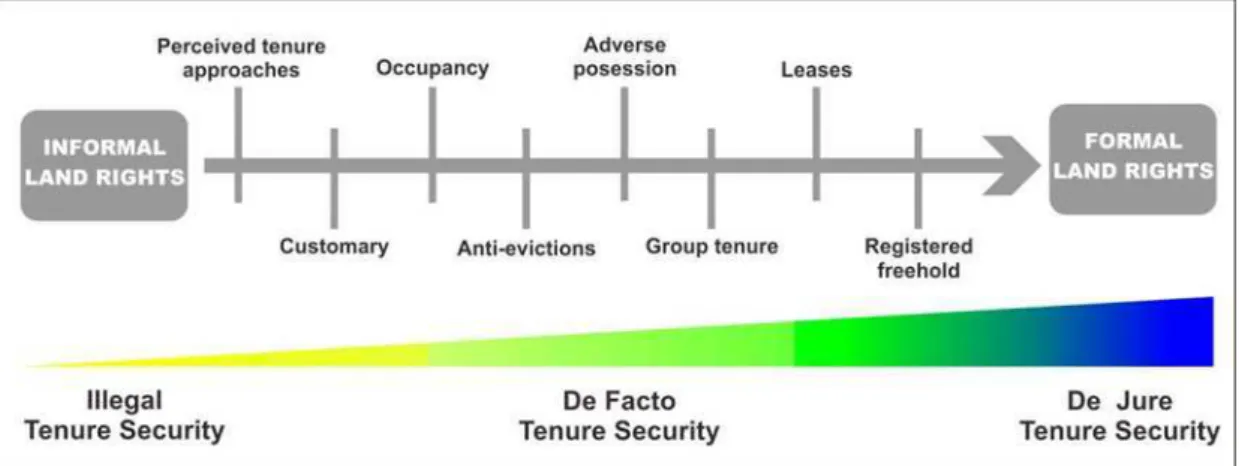
privileges among tenure continuum8 that offers satisfactory security to poor
populations wanting to improve their housing and neighborhoods
(Durand-Lasserve, 2006). This statement refers that squatter settlements are not
conditioned by their illegal or legal status as illegal or “de facto”9 land tenure
is not always insecure and legal or “de jure”10 land tenure is not secure in an
effective way to promote investments (GLTN, 2011).
In this way the evolution of different land tenure arrangements in
which most low-income populations live has set the debate about this topic
for the implementation of new strategies to reduce poverty. In order to
achieve the goal, the United Nations Millennium Development Goals
(MDG’s) committed all governments to improve poverty targeting tenure
security as a social indicator to measure and reduce world-wide poverty rates
under the following argument:
8 Tenure continuum refers to other land tenure arrangements set between the illegal and legal land
tenure.
9 De jure is meant when rights are to put on detail and recognized by an authority or institution (ibid)
10 De facto means when rights are to put on detail by an individual or a group who claim the land
8
Under this point of view, the situation in Peru is underlined by the
existence land tenure arrangements in a Lima, capital city which are operated
along principles of the two schools claims. First, the “market-based” approach
through land title registration (used as tenure security) to increase land values
and use as collateral for credit and accelerates the incorporation into the
housing market system (Abrams, 1966; Demsetz, 1967; Gough et al., 2001;
Turner et al., 1972; Jimenez, 1984; Malpezzi et al., 1987; De Soto, 2000). And
second, the “right-based” approach trough the access to land for all people,
recognizing their own rights is based on possible land arrangements that
responses to the reality of low-income populations (UNCHS, 1996; Payne,
2001; Gilbert, 2002; De Souza, 2011).
Consequently, the importance of tenure security has become stronger
because current housing policies implemented for squatter settlements in
9
tenure legalization or land titling and this issue needs more research to
confirm past studies statements.
Thus, part of the aim of the present research is to examine the land
tenure under both approaches to ascertain the best strategy to provide better
solutions to squatter settlements improvement in the context of Lima, Peru.
The importance of this undertaking is reinforced by the fact that the
market-based approach has been criticized for its social exclusion of low-income
population from owning properties (Durand-Lasserve, 2006). On the other
hand, right-based approach is supposed to address the defects of the
market-based approach providing land rights to the all people (UN-Habitat, 2003;
Payne et. al, 2007).
Since both approaches agree that tenure security has the capability of
improving the conditions of the poor, this study will confirm these assertions
and the effects of the both approaches along the de facto and de jure process.
The relevance of this study is to analyzes tenure security possibilities and
learn from squatter population experiences because most of the literature is
only limited to land tenure legalization.
Due to the complexity of the research problem, a qualitative research
design based on data collection, observations and meeting with the
communities were used to generate unique tools and techniques for the
analysis. The effects of tenure security were investigated only in squatter
10
periphery of Lima city. Three cases of study were chosen: Nuevo Pachacutec,
Manchay and Villa el Salvador.
The results of the study reveal that tenure security is not the only
precondition for the improvement of squatter settlements; it is an important
factor in enabling poor people in providing housing and motivates them to
invest in their houses and neighborhood. However, other external factors may
also directly affect squatter settlements such as the political context, housing
programmes, implementation of basic infrastructure and a well-organized
community.
Consequently, this study addresses the complexity and various ways in
which tenure security can be achieved based on Peru’s squatter settlements
experiences. This will be a valuable resource to land tenure agencies and
housing policies to improve the legal strategy on how increase tenure security
which can be applicable in Latin American countries and beyond.
This chapter is an overview of the present research. It describes what
the study is about and how it was conducted to achieve the objectives, results
11
1.2 The Objective
The study aims to build an own methodology to analyze how tenure
security can contribute for a faster social and physical inclusion of squatter
settlements into the urban city.
• To assess the relation between tenure security and access to land rights
through the evidence of housing and infrastructure investments along
the transition process of land tenure legalization of squatter settlements
in Lima city, Peru.
• To examine the literature, housing policy documents and strategies
that have been adopted in Peru to make housing accessible to all in
order to identify the shortfalls in existing approaches.
• To develop recommendations and policy guidelines to address the
problems of squatter settlements in Lima, Peru, Latin American
countries and beyond.
1.3 Hypothesis and Research Questions
The hypothesis of the study is based on the literature review in order to
12
effective way to increase and promote any kind of investment in squatter
settlements.
In addition, if tenure security for all squatter populations has various
benefits, especially for social stability, social inclusion and poverty reduction.
The study also analyses others factors that may also have effects on housing
investments (gender, housing finance, demographic growth, expectations of
infrastructures) and answer the following study guiding questions:
• Question 1: Why the lack of housing investments is directly associated
with the absence of the formal land legalization?
• Question 2: What is tenure security? What are the prevailing tenure
security forms in Lima, Peru?
• Question 3: How can tenure security affect housing and infrastructure
investments?
1.4 The Problem
In Peru, the urban model of development had experienced an
irreversible rapid urban growth from the 1950’s and getting more intense in
the 1980’s and 1990’s due to the collateral effects of political conflicts and
13
migrated from the country side in the search for urban opportunities into
Lima city (Sakay et al., 2011a) (see Fig. 1.4).
These days, the immigration from the country side to the city is still
contributing significantly to a rapid demographic growth. The majorities of
these populations are characterized by having low incomes, unstable
employment and live in poor conditions (Sakay et al., 2011a). Additionally,
the mild weather that of Lima city offers, allowed them to establish their new
homes in unauthorized lands (private or publics).
Impoverished and homeless populations start their new precarious
homes (made of straws and mats) in small camps in vacant and vulnerable
lands in the outskirts of Lima city (see Fig. 1.5). Besides food, water and
clothing; shelter or housing is the basic necessity for human existence, but
access to the land and housing markets systems due to cost exclude them.
Most of the squatter settlements have been allowed to continue to exist
because of the Peruvian government‘s inability to provide substitute housing
14
in the form of resettlement for the residents and due to pressures from local
and international human rights organizations (Sakay et. al, 2011a)
Consequently, to this problem the United Nations has declared
“housing” to be a basic human right (UN-Habitat, 2002). Since land constitutes
an important component of any housing project, the right to accommodation
and shelter is equivalent to the right to land, because houses cannot be
constructed without land (UN-Habitat, 2003). In addition, the Institute for
Liberty and Democracy11 (ILD) in 2007 outlined that Peru represented the
highest percentage of existing illegal housing (56%) versus legal housing
(44%) in Latin America, with a high rate of urbanization (see Fig. 1.6). This
11 The Institute for Liberty and Democracy (ILD) is a non-profit organization founded by the Peruvian
economist Hernando De Soto in 1981. http://www.ild.org.pe
15
situation proves that the media of the inhabitants in Peru cannot access to the
formal system of housing (mortgages, private credit sources). Probably, this is
one of the main reasons that push them to find their own solutions regarding
to housing by illegal means such as land invasions.
At the same time, in 2007, the urban population in Lima inhabitants has
reached 8.2 million inhabitants in which a quarter of this population lives in
peripheral squatter settlements of Lima city (INEI, 2007; Sakay et al., 2011a).
The problem of providing housing for the largest proportion of Peruvian has
been a challenge for successive governments of Peru. In response to the
continuing land invasion, the corresponding authorities of the government of
Peru had eventually legalized most settlements applying housing strategies
16
and combination of mechanisms such as site and services programmes, slum
upgrading programmes and land tenure legalization.
Currently, the housing policies through land legalization are the most
suitable in Peru context where the dynamics and mechanisms of the housing
system have virtually eliminated the poor from the housing sector. This
situation has resulted in a long process where squatter houses start with
temporary constructions, customary land tenure arrangement and problems
related to poor living conditions, occasional evictions, health hazards, crime
and lack of basic infrastructure such as water, electricity and sanitation.
Importantly to note that is not after the squatter settlements are legally
recognized; they have rights over the land to get basic urban services and
urban facilities to initiate the process of consolidation.
From this point forward, the lack of any housing or neighborhood
improvement is associated with the absence of land tenure until it has been
granted and authorized by the government (Sakay et al., 2014a). It is logical to
believe that the illegal settlers that occupy the piece of land may not invest
resources to improve their shelters because of their uncertain status and the
threat of eviction in which they will be removed out from the land at any
moment.
In recent decades, tenure security issues have received a considerable
17
research topic in self-help12 housing policies around the world. Many authors
justify and associate the legal recognition with the acquisition of tenure
security, which stimulates the fear of eviction disappearance and the housing
improvement (Abrams, 1966; Turner, 1972; Payne, 2001).
On the other hand, acknowledging that tenure security is not the only
condition that enables housing improvements (Angel 1983; Kagawa 2001;
Payne 1997), as there is evidence along the existence of squatter settlements in
Lima city, many physical and neighborhood improvements in living
conditions of illegal populations that have obtained their own forms of tenure
security have been observed.
The aim of this study is also to contribute ion past scholar’s efforts by
clarifying and support the little literature about the right-based approach
through exploring and comparing three cases of study with varying forms of
tenure security, physical characteristics and context within Lima city, Peru.
1.5 Rationale for the Study
Solutions to the social, economic and environmental problems of Peru’s
squatter settlements have eluded successive governments of Peru and left city
authorities perplexed about what options to look at. Previous efforts have
achieved little in terms of addressing the underlying dynamics which are
responsible for the development and sustenance of squatter settlements in the
12 Self-Help is the process by which people take control of their housing constriction with the
18
city. The fundamental factors for the formation of squatter settlements such as
inequitable land distribution, poverty and land management institutions;
generally have been ignored by the government and city authorities.
However, there is a renewed urgency to tackle these challenges now due to
the deteriorating social, environmental and political situation in some of the
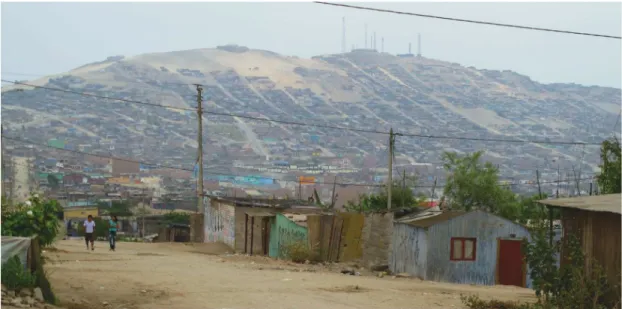
main squatter settlements in the city (see Fig. 1.7).
At this point, although the illegal-legal condition of the land in squatter
settlements, land tenure security has been promoted as an important incentive
for housing investments and reduces poverty. Therefore, this incentive
evidences the influence on how populations make and manage those housing
investments. However, most research has taken only a legal connotation
approach on how to legalize illegal settlements, but few understand the
factors that motivate housing investments when no legal land tenure exists.
Figure 1.7 Squatter Settlement of “Nuevo Pachacutec” in Lima, Peru. Source: C.Sakay, 20014.
19
The main findings of this study will provide the base for
recommendations for policy measures, to enable planners and policy makers
to make appropriate decisions about squatter settlements. Consequently, this
study contributes to improve the understanding of squatter settlements and
enhances efforts to help people living in similar conditions in other
developing countries through real study cases.
1.6 The Methodology
Due to tenure security is difficult to define precisely and difficult to
measure or monitoring, this study adopts both the qualitative and
quantitative three case study research strategy.
Three cases of the study were considered appropriate in order to
explore the kind of questions asked about the link of tenure security and
housing and infrastructure investments in the study. The cases of study are
preferred strategy to adopt in a research when “how”, “why” and “what”
questions are being asked-when the researcher has little control over the
situation and whereby the focus is a contemporary problem in a real life
situation (Zetter et al., 2000).
The qualitative approach refers to the textual or visual data gathered
from meetings with the community, group discussions, observations,
documents and records, which can be analyzed in both a statistical or
20
obtained through semi-structured interviews and measurements of housing
sizes in a complementary manner to achieve the study goals.
The study gathered the data collected for at three categories (see Table
1.1): a) people; b) settlement and c) city/country and based in three main
indicators to analyze tenure security according to UN-Habitat: a) households;
b) housing / infrastructure and c) land policies (GLTN, 2011; UN-Habitat,
2002).
1.6.1 Research Methods Adopted
The exact research methods adopted to investigate and analyze
the issues raised in the study are based on the questions and objectives
of the research outlined in this chapter. They include, first, assessing
21
secondary data to evaluate the extent to which there is a housing deficit
in Lima city and the policies and strategies adopted to make housing
accessible to all residents of Lima.
The second objective is to deduce our own concept of tenure
security, according to the experiences in squatter settlements in Lima,
Peru. In the same way, evaluate, analyze and explore the prevailing
land tenure arrangements in Lima, Peru through both secondary and
primary data (field of work and interviews), and to ascertain how the
urban context affects land tenure arrangements and tenure security.
The third objective is to explore the relation between tenure security,
access to housing, and investment that have been taken place by illegal
populations living in squatter settlements in Lima city.
Finally, the choice of methods was based on the three objectives
of the study which aims to inform, guide, identify and conclude
recommendations policy guidelines to address squatting problems in
Lima, Peru (see Table 1.2). The study has also enabled suggestions to be
made about future areas for research on squatter settlements. To fully
address the issues raised by these research questions, it was necessary
to ask other succession questions. In this way, diverse dimensions of
questions which were asked to allow new understandings regarding
the experiences of the squatter settlement conditions and the linkage to
22
1.6.2 Selecting the Cases of Study
The context of this study is located in Lima city in Peru because
of its long history and vast experience related to the existence of
squatter settlements. Peru, presents squatter settlements where the
immigration to the capital Lima city had contributed the rapid urban
growth. In addition, it was and ideal context to conduct this study
because of the actual population of 7.7 million inhabitants, the third
part live in squatter settlements. This fact proves that poor populations
in Peru cannot access to the formal house market system.
23
Additionally, to identify if tenure security forms were adopted
to enable improvements in the lives of squatter’s populations, it is
necessary to analyze how low-income populations perceive land rights
under different types of land tenure arrangements along the land
tenure continuum (between the illegal/de facto and legal/de jure land
tenure). This was a useful sampling technique in order to select three
settlements for the investigations: a squatter settlement where the
majority of its populations are still illegal in the land; a squatter
settlement that presents a mix of illegal and legal mechanisms and
finally; and a more developed squatter settlement in which populations
are current legal recognized as owners of the land. Consequently, the
three settlements were selected for the present study (see Fig. 1.8) are
“Nuevo Pachacutec (a squatter resettlement with no land tenure
security), “Manchay” (a midterm migrant settlement where residents
have customary land rights) and “Villa El Salvador” (an old traditional
settlement where the residents have formal or de jure rights to the land).
The choice of three case studies was useful to compare each case
from different locations in the following cones13 : Callao, South and
East, of Lima city. Some of these squatter settlements are now in the
transition process or have become into an ascendant city which
represented different situations according to the following criteria:
24
• The degree of local economic development (public services,
presence of stores and industries, construction and visible
poverty).
• The level of formalization (informal activities, formal
property rights and legal recognition from part of the
local authorities).
• The political and social changes (integration into the
“modern” city, popular self-governing organisms, the
sense of community and the role of the State).
25
1.6.3 Collecting Data and Field of Work
The tools for primary data collection were gathered in a field of
work in the three cases of study and it was supported by secondary
data sources from the existing literature review.
The field of work was conducted in four sessions where a total
of 75 housing samples (see Table 1.3) were collected in the following
periods: from December 2010 to January 2011, from June to August
2011, from January to February 2013 and from December 2013 to
January 2014. Its components included a semi-structured interviews,
focus group discussions, general observations and measurements.
• Semi-structured interviews
The semi-structured interviews were designed to acquire total
information of 75 families; 25 families on each case of the study who
were willing to contribute information to the study (see Fig. 1.9 & 1.10).
The interview schedule for the survey participants was partially pre-68 441
40 700
381 790
26
coded. After finishing each interview all questions in the interview
schedule were carefully reviewed to make sure that every response had
been properly documented and was clear readable, and
comprehensible. In addition, at the end of the semi-structured two
appendices sections were prepared (see Fig. 1.10).
First, family information was gathered to evidence the family
record growth since they invaded the land. This also included
information about all household members that lives or had lived with
the family through the time. And second, a sketching of the house floor
plans which included notations about building materials, function of
the spaces and rooms added through the time was prepared. After the
sketching was finished a visit to each house was made to confirm the
information.
27
• Focus Group Discussions
A total of three group discussions were held in each case of
study during the course of the present study (see Fig. 1.11 & 1.12). The
discussions were mainly interactive in nature and lasted for an average
for about one hour.
Group discussions were eased to organize because of prior
meetings and arrangements with the community leaders and were
conducted in the community center. Topics such as the problems of
basic infrastructures (water and drainage), land tenure formalization,
hazard problems and housing conditions were discussed generated
much information that served as a measure for cross-checking the
responses of the semi-structured interviews participants.
The results in the three cases of study were a highly motivated
population in which almost all households’ heads brought their family
members such as wives and children to take part in the group
discussion and share their stories for the study.
28
• Observation
General observation of the physical characteristics on each case
of study was part of the methods adopted for this study. Family
member’s observation was undertaken to improve the knowledge and
understanding of land tenure topics. This was achieved by direct
involvement and participating in some of the things the people do or
did over the time to improve their living conditions (see Fig. 1.13 &
1.14).
Observable details were taken such as the attitudes of
participants towards housing improvements, neighborhood care and
attitudes towards their reality and condition. One obvious advantage
about observations is that allowed an evaluation of the process of
physical consolidation of the houses and other features within the three
study squatter settlements. The observations were based on some of
the questions asked in the semi-structured interview schedule to
29
indicate the type of building materials used as well as the degree of
work done on houses within specific periods of time. In addition, it
was supported by photographs taken from the facades and interior
spaces on each of the 75 houses samples which were inventoried (see
Fig. 1.15 & 1.16).
1.6.4 Processing the Data
Due to the extensive information obtained from the field of work
conducted in the three squatter settlements, it was important to
understand first that any minimal housing investment symbolized a
different family story: financial, social problems, future expectations
and needs. Data obtained during the field of work from each family
represented years of rich information and was analyzed using the three
levels of household, settlement and city/country mentioned before
(GLTN, 2011).
30
All the information was gathered together and was fully
transferred into charts corresponding to each case of study. Each family
was coded from F1 to F25 and its information was classified in three
land tenure indicators of UN Habitat (2012): people, land and policies.
After each chart was concluded, diagrams of the 75 houses
samples were prepared focusing mainly in the housing, spatial
transformation to facilitate the understanding of housing investments
that have been made through the time. In this way, the diagrams
provided significant information about the house transformation,
according to the demographic growth dynamics of each family in
different land tenure arrangements and tenure security scenarios.
1.6.5 Limitations of the Study
The complexity of the present research culminated in the
difficulty of designing an appropriate methodology for the study.The
challenge involved decisions about the kinds and combinations of
methods to be adopted to acquire personal and confidential
information from vulnerable squatter populations.
Furthermore, frequent threats of eviction have placed them in a
position where they are suspicious about investigations into their lives
at the beginning of the research. In a few cases, the suspicion and
31
information was observed. Some squatter populations hesitated to
reveal how they have acquired the land on which they have built their
houses. This situation made comparison of some evidence of tenure
security and access to housing difficult to make.
Fortunately, with help from community leaders it was easy to
convince the participants that the exercise was purely academic and
that the research was not a political scam and the outcome would not
be used to victimize them. In this way, interviews and field of work
could be done through previous coordination with community leaders
and were conducted during the daytime and on weekends. This was
an ideal situation to meet many of the residents, including household
heads, wives and children who were otherwise out of the squatter
settlement during the weekday due to their work places.
Additionally, there were difficulties with contact participants in
the case of study of Villa El Salvador as it has become an integrated
district into Lima city in the recent years. Therefore the area is
governed under a municipality jurisdiction which has made difficult to
establish communication with those community organizations and
leaders. Thus, much time was spent on contacting each participant
independently. However, attempts were made to ensure that
quantitative data gathered was to a large extent representative of the
32
about the squatter settlement of Nuevo Pachacutec and scarcity
location meant that much time on searching for information and
transportation. However, through hard work and motivated
population especially in the squatter settlement of Nuevo Pachacutec
and Manchay, the study approaches have been successfully achieved.
1.7 Structure of the Thesis
The present study is divided in 7 chapters with and grouped in 3 parts
for a better comprehension: the introductory chapters, the results chapters
and finally the conclusion and recommendations chapter.
1.7.1 Introductory Chapters (chapters 1-4)
Chapter one provides a general overview of the research and
includes a definition of the research problem, research questions and
objective that aims this study. It also explains the methodology and
main issues raised by the research problem and the literature review as
a guideline on how the study was conducted.Topics under which the
research process is discussed include cases of study selection, data
collection and analysis. The limitations of the research design, and
issues relating to research ethics, are documented before concluding
33
Chapter two begins by defining and clarifying some of the
terminologies and concepts. The discussion then moves on to the
concept of tenure security and a quick review on the effects of tenure
security (particularly land tenure legalization) on squatter populations
in Lima city, Peru. The analysis and discussion culminates in the
adoption of new concepts to guide the investigations.
Chapter three presents the discussion of the literature review
about the socioeconomic and governance effects of tenure security in
squatter settlements in Lima city, Peru. Since land ownership and
security of land rights increases the social inclusion of low-income
populations, it can constitute a turning point for poor population’s
integration into the urban context.
Chapter four is primarily designed to answer issues of the
objective. It focuses on exploring and informing about the context Peru
and the issues relating to housing access in Lima city. Secondary and
primary sources of information on the policies, strategies and plans
that have been adopted to make housing accessible to squatter
settlements in Peru have been examined to ascertain whether they have
been successful. The chapter outlines the general characteristics of the
three cases of the study area, including its location, topography,
34
1.7.2 The Results Chapters (Chapters 5-6)
Chapter five is the first of the results chapters; it is a broad
overview of the profiles of the study participants and their settlements.
Issues covered under the broad topics on social, demographic,
economic and housing conditions of the participants. The chapter also
draws on the educational status, employment and the income earnings
of the participants to analyze and elucidate the potential effects land
tenure security could have on low-income people. The profiling further
facilitates the analytical process by its being utilized to blend the
arguments raised concerning the linkage between the housing
investments, ownership and demographic growth events as some of
the consequences of tenure security. Part of the evaluation is to
determine whether tenure security has any link with the existing
characteristics of the housing structures of the participants.
Chapter six evidences and supports findings of chapter 5 by
exploring different investment made to access to infrastructure such as
basic services (water and electricity).
1.7.3 Discussion, Conclusions and Recommendations Chapter
(Chapter 7)
Chapter seven focuses on the conclusions drawn from the
35
conclusion of the study. Finally, the contribution of the thesis to
academic debate the effects of tenure security in squatter settlements
are discussed to propose recommendations for further research in the
36
Chapter 2
Conceptual Framework and Guiding
Study
This chapter is the conceptual framework which evaluates concepts
and notions in order to inform the theoretical and methodological framework
within which to conduct the study. The chapter starts by defining terms
regarding squatter settlements and informal settlements in order to
understand their nature.
Chapter 2 also examines different housing policies adopted in squatter
settlements to solve the problems of poor populations in Lima, Peru.
Consequently, the concept of tenure security is introduced as a perception of
motivation able to reduce poverty on low-income populations. The discussion
37
Finally a summary and outlines how the research findings might be
applied and a conceptual framework has been developed to illustrate the
processes through which the present study is undertaken to achieve that.
2.1 Squatter Settlements Definitions
In order to facilitate the understanding of the role of these
unauthorized towns in Peru, this section explores some global concepts. From
the context of developing countries, the first idea that will come to our minds
about squatter settlements will be a place with poor housing conditions,
generally located in peripheral areas of the cities.
Importantly, the term “squatter settlement” corresponds to a western
terminology quoted by Abram14 (1966) and Turner15 (1972), was explained as
the illegal occupy of state land where the population is squatting and the
well-organized. Land invasion is done in groups that have different moments
of arrival and settled little by little which makes it difficult to remove from the
invaded land.
In the same way, the terminology of squatter settlements or informal
settlements and may vary from country to country: Slums (Africa and Asian
countries), Barong Barong (Philippines), Favelas (Brazil), Colonias Letarias
14 Abrams, Charles (1902-Feb. 1970) was a Polish legendary lawyer, urbanism and housing expert who
created the New York Housing Authority.
15 Turner, John F. C. (born in 1972) is a British architect who has written extensively on housing and
38
(Mexico). In the Peruvian terminology the so called shanty town, or slums are
understood as its Spanish literal translation as “Barriada” or “Pueblo Jóven”.
Despite the main concept is almost the same, the term “Pueblo Jóven”
is commonly used to refer to a kind of building or construction method. For
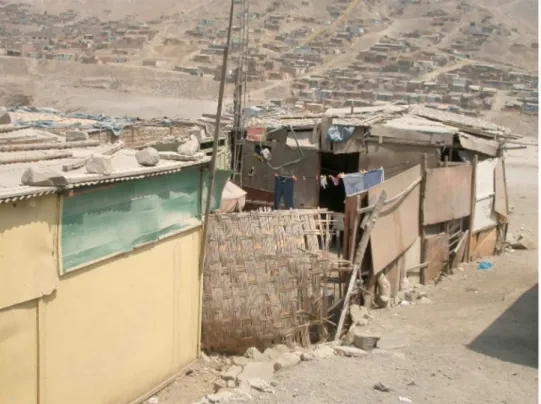
example houses made of mats, plastic, wood, or corrugated iron with limited
basic infrastructures such as water/sewage and electricity (see Fig. 2.1).
In addition, the operational and academic definition developed by
United Nations Expert Group defines squatter settlements as an illegal
neighborhood with the following of characteristics: a) no access to potable
water supply and electricity; b) inadequate infrastructures; c) poor housing
conditions and d) illegal tenure status (UN-Habitat, 2007 ; Nyametso, 2012)
39
UN-Habitat (2007) has developed these characteristics, with an especial
consideration in the insecure tenure status to reduce poverty in squatter
settlements around the world. Therefore, this study has also considered all of
these characteristics in order to evaluate the effects of tenure security within
the context of Lima city, Peru (see Fig. 2.2). At the same time, the United
Nations (1973) argues that when the land is invaded by illegal means without
the government‘s authorization, should be called a “squatter”.
In the case of Lima city, most of squatter settlements have informal
systems of land tenure (traditional or customary land tenure) and do not have
the consent of the actual landowners according to the regulations of planning
authorities but are recognized by law in Peru in some way. Therefore, these
40
populations are still living in an environment conditioned by poor quality of
housing whilst suffering social and moral risks because of delinquency, moral
neglecting and lack of common values in their families (Hall, 2002).
The world is nowadays convinced that in order to find solutions to the
problem, governments, donor agencies and non-governmental organizations
(NGO’s) must first acknowledge the existence of squatter settlements and
then investigate the reasons why people live in them and make them their
homes. This is exactly what the present research is about. That is, to
investigate whether tenure security is one of the underlying causes of the
development and growth of such settlements, in order to use the findings to
provide sustainable solutions.
2.2 Development of Squatter Settlements in Peru and Improvement
Programmes
The economic growth and livelihood opportunities generated in urban
cities have increased the migration of population from rural areas due to be
considered an attractor for country life (Berner, 2007).
In Peru, the economic inequalities plusthe collateral effects of political
conflicts and terrorism during 1980’s and 1990’s, has pushed many
populations to migrate into Lima city (Sakay met. al, 2011a). At the same time,
these populations cannot afford the costs of housing and therefore they
41
2.3, 2.4 & 2.5). This situation, generates an urban city with a vulnerable
ground for unskilled and poor populations (Berner, 2007).
In developing countries, squatter settlements could also be described as
the first step of a new way of urbanization, as the beginning of a process
against poverty and exclusion. Furthermore, urban planners consider that
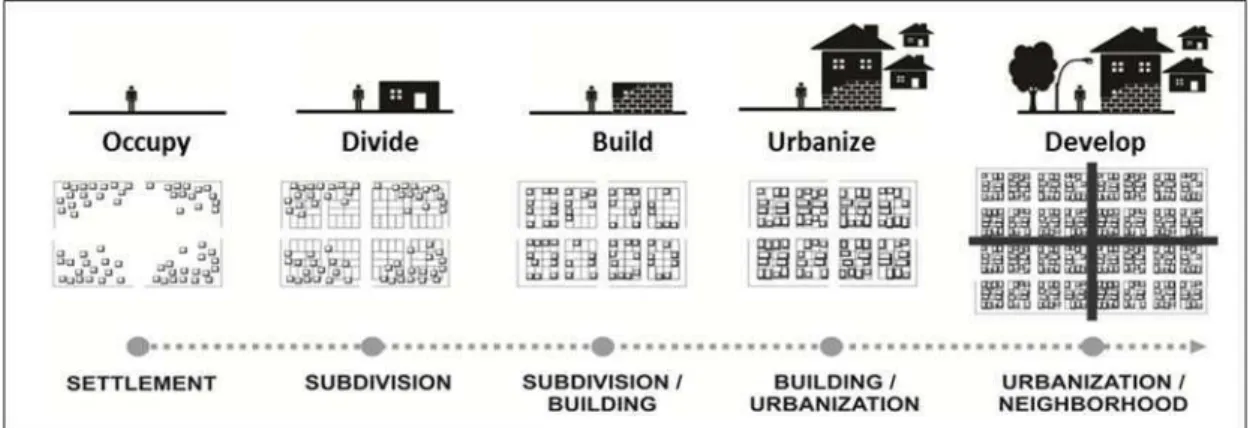
squatter settlement is an inverse process of urban development (see Fig. 2.6).
Figure 2.3 (top) Lands invasion by low-income populations. Source: Amigos de Villa. http://www.amigosdevilla.it/historia/epopeya01.html.
Figure 2.4 & 2.5 (bottom) Group of population settling their mats during the invasion process against the law. Source: La Republica, 2011.
42
In this analogy,populations have settled in the land before the urban
plan is developed and houses are built before basic services are provided
(Rodriguez, 1969).
Consequently, this inverse process of urban development (see Fig. 2.6)
could be described in the following steps: 1) populations settle in the invaded
land in smalls tents made of straws; 2) subdivide the land in groups of plots
which are designed to each family who build temporary constructions; 3)
continue the subdivisions of the land in blocks while constructions changed
for more permanent materials solutions; 4) constructions starts to replace the
temporary roof for a concrete one while the many facilities are develop such
as stores, schools, health centers and among other as the area begin its
urbanization; 5) urbanization in the area continues and becomes a
neighborhood in the effort to have all the adequate infrastructure to be
included in the urban city.
Figure 2.7 Self-Help housing development processes. Source: J. Tokeshi, 2001.
43
At the same time, households tend to improve their houses through
self-help16 activities through the replacement of more permanent materials,
the addition of room or vertical growth of the house (see Fig. 2.7) (Sakay et
al., 2011a).
In Lima city, the mild weather conditions and the lack of rain motivates
the formation of squatter settlements and permits settlers to build flimsy
homes in precarious locations with relative safety (Fernández, 2007). On the
1970’s, populations were characterized by having low income and unstable
employments which generates poor living conditions (Sakay et al., 2011a).
On the 1980’s, squatter settlements located in the periphery of Lima
city were considered as cones17: north, south and east cones. However, these
days some cones sectors are still with lack of basic services and adequate
16 Self-help is the terminology introduced by J.F Turner (1972) that refers when populations take the
decision making about their own houses: construction, management, design, and future expansions.
17 “Cones” is the translation from Spanish “conos” meaning focus of economic development.
44
infrastructures, but the south cone is considered an area of economic
prosperity resulting from the informal and micro-enterprise model expansion
(Sakay et al., 2011a).
At this point, the speed and the rapid urban expansion and growth that
in Lima city has experienced, caused troubles for the Peruvian government to
stop the formation of squatter settlements or eradicate them and the result is
translated into the continuing invasion of vacant lands (Ibid). By contrast they
had legalized most of squatter settlements through a combination of different
housing policies and implementation of programmes in order to improve
them. Since the 1990’s and up until these days, old squatter settlements have
shown a great economic growth and urban development which are totally
integrated into the urban city and housing market system.
It’s been more than 60 years since the first formations of squatter
settlements in the periphery of Lima city and these illegal neighborhoods had
provided a solution to access to housing in the urban city (Riofrio, 2003; Sakay
et al., 2011a). These days, old-term squatter settlements had legally become
part of the urban city and populations have been granted with the ownership
of the land they had once invaded (see Fig. 2.8).
The following section will introduce previous housing policies and
main programmes developed by the local authorities to improve the poor
45
2.2.1 Law of Marginal Settlements and Popular Neighborhoods
Housing schemes in Peru have been chronologically discussed
by Riofrio (1991) and Pugh (2000). The discussions focus on various
programmes undertaken by the national governments of developing
countries (including Peru) to improve living conditions and reduce
poverty in squatter settlements.
At this point, housing programmes for the poor were marked by
liberalism towards such settlements where authorities adopted housing
policies which emphasized its role as a provider of housing for the
poor (Riofrio, 1991; Farvacque et al., 1992). In addition, squatter
Figure 2.8 General view of the old squatter settlement “El Agustino”, currently considered a district in the urban city of Lima. Source: C. Sakay, 2014.
46
settlements were considered neighborhoods in the process of physical
inclusion into the urban city (Pugh, 2000).
Since 1961, many housing policies in Peru have been developed
which different approaches have taken place until these days. At the
beginning of 1961 the first approach was the official program of land
legalization and implementation of infrastructures such as water and
electricity through the Law of Marginal Settlements and Popular
Neighborhoods18 (Riofrio, 1991; Fernandez, 2007).
This law was the result of collective tension from part of squatter
populations for the legal recognition of the land they had invaded
(Fernandez, 2007). The aim was to improve squatter settlements
through “physical and legal regularization”19 (Ibid). In other words,
the law provides the beginning of the legalization whole settlement,
crucial to provide tenure security for the investment in housing. The
physical part included the delivery of basic services, while the legal
part provided property titles to each individual house as a final stage
(Pugh, 2000). Later, to avoid the formation of new squatter settlements
the government built the “Popular Urbanizations Social Interest
Programme” (UPIS)20 which consisted in low cost serviced plots and
standard houses that could be with progressive improve by squatter
18 Also known as the Barriadas Law, Law 13517 where squatter settlements were recognized by the local
authorities in Peru.
19 Translated into the Spanish as “Programa de saneamiento fisico y legal”
20 The spanish programme name is “Urbanizaciones Populares de Interes Social”. It was created under
47
populations (Riofrio, 1991). The Peruvian government reserved some
public lands, divided into plots, and provided the urban
infrastructures, in some cases, provided of housing in order to be
developed through the self-help model.
A positive result is that this program changed the situation of
the oldest squatter settlements into districts. However, due to the lack
of financial resources the government slowly abandoned the
programme and only eight (8) UPIS were built (Riofrio, 1991;
Fernandez, 2007). Furthermore, the law produced continuing invasions
in new lands in the hope of the future regularization of their sqatter
settlements. In 1968, this process was split in two, the provision of
property titles and the implementation of basic services or urban
facilities which generate the site and services programme.
2.2.2 The Site and Services Programme
The 1970’s was a period of active involvement in addressing the
housing problems in most developing countries (Sietchiping, 2005).
During this period, the role of World Bank as an international
organization which considered housing provision as a basic need
encourage many governments in the realization of programmes to
support low-income populations. Some of these programmes were
48
electricity, water and sanitation under the name of site and service
programme (World Bank, 1994).
In this way, this programme intended to recover the
implementation costs of these infrastructure projects by providing
cheap sub-divided plots in public lands (Pugh, 2000). The site and
services programme referred to property allocation projects where
urban lands are acquired, a serviced to various degrees of amenities
and infrastructures (Sakay et al., 2011a). However, the failure of the site
and services programme was due to several reasons: first, because of
the lack of budget from part of the Peruvian government for the
implementation of this programme (Calderon, 2004). And secondly,
because of the whole process was bureaucratic which brought
consequences in the delay of the implementation such infrastructures
(Ibid). Therefore, the standard to established sites and service
programme was not realistic to the Peruvian context.
Another evidence of program failure was that during the 1970’s,
the respective authorities granted 134 thousand property titles but
more than 100 thousand of them were plots without water, electricity
or sanitation (Fernandez, 2007). Thus, Peru’s government acted as a
facilitator instead of a provider, the programme could not achieve their
original purposes and failed (Calderon, 2006; Pugh, 2001; Fernandez
49
As a result, the site and services programmes became few of
success stories. In addition, it encouraged the involvement of those
affected by the projects in resettlement, housing process and depended
only on population’s aptitudes to undertake any kind of investments
by themselves (De Soto, 2000; UNCHS, 1996; Payne, 2004). Therefore,
experiences from the failure of site and services programme could give
answers for further tenure security programme that might be carried
out in order to be successful.
2.2.3 Squatter Settlement or Slum Upgrading Programme
This was yet another programme which intended to cover the
failures of earlier approaches. The squatter settlement upgrading
strategies were mostly sponsored by the World Bank during 1970’s–
1980’s and were inspired by John Turner‘s ideas. John Turner, a
renowned housing and community empowerment expert, argued that
a government‘s responsibility in supplying housing for low-income
citizens could be minimized by undertaking essential environmental
improvements in public services, thereby allowing squatter
populations to invest gradually on their houses and living conditions.
Due to the problems faced by the site and services programme,
such as unavailability of vacant land and criticism of the demolition of
50
introduced to improve basic services, such as water supplies, waste
management, electricity and infrastructure, without completely
destroying squatter settlement areas (Pugh 2000).
Squatter settlement upgrading programs (see Fig. 2.9 & 2.10)
aimed to improve living conditions through the implementation of
basic services and infrastructure (electricity, water, sanitation and
roads). It also included the construction of urban facilities such as
health centers and schools. The implementation of water supply for
example, consisted in the construction of main pipes connected to the
network system of the city (see Fig. 2.9). The Upgrading programme
helped squatter settlements to get legal recognition. Thus the theory
behind squatter settlement upgrading worked under the idea to make
51
incrementally improve their housing and livelihood conditions,
particularly when the projects are accompanied with land tenure
security (Calderon, 2006). However, most of this programme failed
because tenure security was usually not considered a prerequisite at
that time.
2.2.4 Loan and Credit Approaches
In 1979, the government established a National Housing Fund
(FONAVI), as a mandatory contribution from the salary of all workers
to meet the housing needs (Fernandez, 2010). FONAVI was used to
build houses between 1980 and 1985, but never lead to a systematic
policy for social housing construction21.
21 Argentina, for example, has a similar fund (with the same name, FONAVI) which has delivered many
housing projects for new homes for people relocated from marginal settlements through national, regional or municipal initiative
Figure 2.9 & 2.10 Samples of site and service programs in squatter settlements in Lima city, dotation of water networks (left) and pavement of main roads (right). Source: Municipalidad de Pachacamac