JSME-CMD International Computational Mechanics Symposium 2012 in Kobe (JSME-CMD ICMS2012)
1
Adhesion analysis for anisotropic materials considering surface stress and surface elasticity
against a variation of indenter radiuses*
Takao HAYASHI** and Hideo KOGUCHI***
**Department of Material Science, Graduate School of Nagaoka University of technology 1603-1, Kamitomioka, Nagaoka, Niigata, Japan
E-mail:[email protected]
*** Depatment of Mechanical Engineering University of technology 1603-1, Kamitomioka, Nagaoka, Niigata, Japan
Summary
Adhesion analysis for anisotropic materials between a rigid spherical indenter and a flat surface is performed. Van der Waals force between two surfaces is calculated using Lennard-Jones potential. Adhesion force is investigated for various values of indenter radius.
Key words: Adhesion, Surface Stress, Anisotropic, Lennard- Jones Potential
1. Introduction
In recent years, contact and adhesion phenomenon are investigated using nanoindentor and probe microscope. Contact and adhesion in micro- and nano-regions are called as micro- and nano-tribology, which are studied by many researchers. Analysis of the adhesion considering van der Waals force between two surfaces is important. The JKR theoryderived by Johnson et al. is well used in the adhesion theory. The adhesion analysis between a sphere and a flat surface was investigated by Greenwood(1) using Lennard-Jones potential.
In the present study, an adhesion analysis between a rigid sphere and a flat anisotropic half region considering surface stress and surface elasticity is investigated. Lennard-Jones potential is employed to calculate van der Waals force. Adhesion force between two surfaces is investigated for various values of the indenter radius.
2. Method for analysis
Displacement in a half anisotropic material considering surface stress and surface elasticity is calculated using the Green’s function derived by Koguchi(2). The surface force, pij, for the distance, gij, between two surfaces is given integrating the van der Waals force, σij, of Lennard-Jones potential
pij= !ijdA
"#
$
=83%& g&ij
' ( ))
* + ,,
3
- &
gij ' ( ))
* + ,, . 9
/ 00
1
2 33 dA
"#
$
(1)where ω is surface energy, ε is an atomic equilibrium distance, pij represents the value of the surface force at (iΔx, jΔy), Δx and Δy are grid spaces in the x- and y- directions, ΔΩ is a domain of a grid, and A is an area of a grid. Here, gij is assumed to be constant in ΔΩ. In the present analysis, the values of ω and ε are 2.5N/m and 0.2nm, respectively. If the distance between both surfaces is close to an atomic separation, then the surface force increases drastically. To converge the deformation due to the forces, an under-relaxation method is used in the present analysis. The surface force is obtained by summing the surface force multiplied by a coefficient α in each iteration. An iteration count of analysis is yielded the inverse number of coefficient α. In this analysis, the coefficient α is set to 5 10-4. The distribution of surface deformation under the surface force is calculated using the DC-FFT
JSME-CMD International
Computational Mechanics Symposium 2012 in Kobe (JSME-CMD ICMS2012)
2 method derived by Liu et al.(3)
3. Results
Adhesion analysis between a rigid spherical indenter and a substrate with a flat surface is performed. The spherical indenter is rigid and its radius is R. Material of the substrate is Cu, and (100) plane is a contact surface. Elastic constants are C1111=169.9GPa, C2222=122.6GPa and C1212=76.2GPa. Surface stress and surface elastic constants are obtained by molecular dynamics analysis using FS potential. The values of surface stress τij
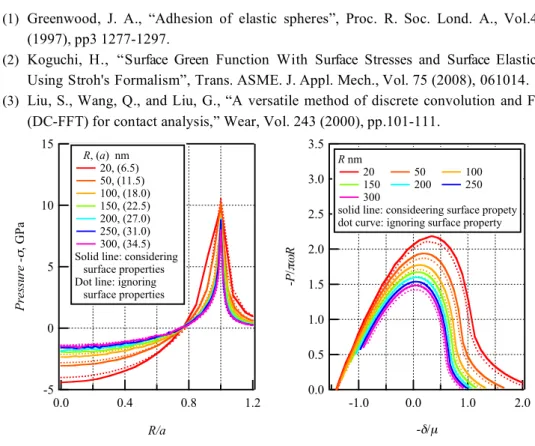
and surface elastic constant,d!"#$, are τ11= τ22=2.163N/m, and d1111=d2222=-8.460N/m, d1122=-5.896N/m, d1212=-2.150N/m. Figure 1 shows the distribution of -σ against the normalized x-coordinate when the penetration depth is 0nm. Here, a is a radius of adhesion area. In Fig. 1, the value of adhesion radius is obtained from the result considering surface property. The pressure distribution σij considering surface property is lower than that ignoring them when σij is less than 0GPa. Figure 2 shows a relationship between a normalized adhesion force and a normalized penetration depth. Here, µ =(R!2 /K2"3)1/3 and K is an indentation modulus. Adhesion force P is the summation of surface force pij. In this analysis, the value of K was calculated from the indentation analysis. The maximum normalized adhesion force considering surface property is larger than that ignoring surface property.
4. Conclusion
An adhesion analysis for a half anisotropic material considering surface stress and surface elasticity was performed for several values of radius of indenters. The result of the pressure distribution against the normalized indenter radius and the relationship between the normalized surface force and the normalized penetration depth were derived.
References
(1) Greenwood, J. A., “Adhesion of elastic spheres”, Proc. R. Soc. Lond. A., Vol.453 (1997), pp3 1277-1297.
(2) Koguchi, H., “Surface Green Function With Surface Stresses and Surface Elasticity Using Stroh's Formalism”, Trans. ASME. J. Appl. Mech., Vol. 75 (2008), 061014.
(3) Liu, S., Wang, Q., and Liu, G., “A versatile method of discrete convolution and FFT (DC-FFT) for contact analysis,” Wear, Vol. 243 (2000), pp.101-111.
15
10
5
0
-5
Pressure -!, GPa
1.2 0.8
0.4 0.0
R/a R, (a) nm
20, (6.5) 50, (11.5) 100, (18.0) 150, (22.5) 200, (27.0) 250, (31.0) 300, (34.5) Solid line: considering surface properties Dot line: ignoring surface properties
Figure 1 Pressure distribution for various radii of indenter
3.5 3.0 2.5 2.0 1.5 1.0 0.5 0.0
-P/!"R
2.0 1.0
0.0 -1.0
-#/µ R nm 20 50 100
150 200 250
300
solid line: consideering surface propety dot curve: ignoring surface property
Figure 2 Relationship between normalized adhesion force and normalized penetration
depth for various radii of indenter