Department of Applied Chemistry, Faculty of Science and Engineering, Chuo University, 1-13-27 Kasuga, Bunkyo-ku, Tokyo 112-8551, Japan. E-mail: [email protected]
Metal ion sensors based on self-assembled monolayer anchored by tetradentate 6,6’-bis(benzimidazol-2-yl)-2,2’-bipyridine phosphonic acid on indium oxide
doped-tin oxide (ITO) electrode
Yuuki Hashimoto, Miyao Inoue, Hitoshi Shindo and Masa-aki Haga*
Abstract
A novel tetradentate ligand, 6,6’-bis(1-hexylbenzimidazol-2-yl)-2,2’-bipyridine phosphonic acid (bhbbpa), was immobilized on an ITO electrode. Cyclic voltammetric measurements reveal that the anchored bhbbpa ligand can bind the metal ion such as Co
2+and Cu
2+, which can be detected by the Co(II/III) or Cu(I/II) waves in the voltammograms. Furthermore, Cu
2+ion can be selectively attached to anchored dhbbda ligand in the presence of otherwise interfering ions such as Co
2+which can be probed by electrochemical measurements.
Therefore, the bhbbpa immobilized ITO electrode can act as a metal ion selective sensor for Cu
2+ion.
1 Introduction
Organized, surface-confined monolayers are commonly produced on gold surface, which is called self-assembled monolayers (SAMs) [1]. Gold surface can be functionalized by adsorption of thiol or disulfide to produce functional monolayers, which can introduce the chemical function into the surface. These SAMs on the solid surface are of interest for applications ranging from molecular sensing materials such as DNA or endocrine disruptors to molecular electronic and nonlinear optical materials [1c, 2] . Generally speaking, the molecular design of functional SAMs can be achieved by the selection of two elements ; i.e., a surface binding group and a functional component in a terminal part, each of which can be modified independently. However, the organic compounds that can be used to functionalize gold surfaces are limited to those that contain a soft atom or functional groups, such as various sulfur-based compounds (e.g. thiols, disulfides, sulfides) [1, 3], phosphines [3a], and selenols [3c]. Organic functionalities such as carboxylic acids and hydroxyl groups, which are dominated by hard atoms and have a strong affinity for oxide surface such as ZrO
2, TiO
2, and Al
2O
3, show no (or weak) affinity for gold [4]. Furthermore, the oxidation of adsorbed thiols on gold produces sulfonates that desorb readily from the surface[5]. This oxidation process limits the lifetime and usefulness of SAMs on gold. On the other hand, SAMs using adsorbates containing hard head groups are stable against oxidation, which offer advantages for practical applications that require extended exposure to the atmosphere.
Metal phosphonates are well known compounds with layered structure, and some of them have
a practical applications as hosts in intercalation compounds, catalyst supports, and in sensing and
separation [6]. The metal-phosphonate binding interaction has also been successfully used to
deposit monolayer and multilayer thin films on the solid surface by self-assembled and LB
techniques [7]. We have studied the surface coordination chemistry using the multidentate nitrogen
donor ligands both at the air-water interface and on the solid surface [8]. The multidentate ligands
can coordinate a variety of metal ions to form the functional complexes with novel spectral, redox,
and photochemical properties. The combination of a conductive electrode as SAMs substrate with the surface coordination enabled us to apply electrochemical procedures to generate and detect a measurable signal, i.e., an electrical current, which is one of the applications for SAMs on the solid surface toward the molecular sensing of various target substances. Rubinstein et al [9]has reported the selective ion binding to monolayer comprising thiobis(thylacetoacetate) on gold electrode, however the metal ion binding strongly depends on the solution pH and the lifetime of this sensor has uncertain. In the present study, we have synthesized a novel tetradentate nitrogen donor ligand with a phosphonate anchoring group, and found its SAM film reveals the selective coordination to Cu
2+in the presence of otherwise interfering ions on the electrochemical measurements, which can be applicable to a electrochemical sensor of metal ions.
2 Experimental Section
2.1 Materials.
2,2'-Bipyridine(Tokyo Kasei), o-phenylenediamine, polyphosphoric acid (Wako), and tetramethyl ammonium hydroxide (TMAOH) in methanol solution (Nacalai tesque) were used as supplied.
6,6'-Dicyano-2,2'-bipyridine and 6,6'-bis(benzimidazolyl)-2,2'-bipyridine (bbbH
2) were prepared as reported previously [10]. Acetonitrile was purified twice by distillation over P
2O
5. Tetra-n-butylammonium tetrafluoroborate(TBABF
4) was purchased form Tokyo Kasei, and recrystallized two times from ethanol-water mixtures, and then ethylacetate/pentane, vacuum dried at 70°C for 12 h. All other supplied chemicals were of standard reagent grade quality.
2.2 Preparation.
2.2.1 Synthesis of tetradentate ligand, 6,6'-bis(1-hexylbenzimidazolyl)(2,2'-bipyridyl)-diethylpho sphonate: NaH (oil dispersion 58 %) (0.52 g, 12.9 mmol) was washed with dry n-pentane and then suspended in dried DMF (50 ml). To this suspension was added 6,6'-bis(1-octylbenzimidazolyl) -2,2'-bipyridine (2.0 g, 5.15 mmol) under nitrogen atmosphere and the mixture was heated to 80 ˚C until the evolution of H
2gas ceased. To the resulting solution 6-bromohexyl-1-diethylphosphonate (3.41 g, 11.3 mmol) in DMF (15 ml) was added dropwise and stirred at room temperature for 12 h.
The solution was poured into iced water and then extracted by CH
2Cl
2(100 ml twice). The extract was washed by water, and then brine, dried on sodium sulfate. The solvent was evaporated in vacuo. The crude product was obtained as a solid. The possible impurities are starting material and monodiethylphophonate compound, both of which are highly insoluble in CH
2Cl
2. Therefore, the extraction of the resulting solid by CH
2Cl
2gave the pure product . Yield, 2.17 g (51 %).
1H NMR (400 MHz, CDCl
3): 1.28 (t, J = 7.0 Hz, 12 H), 1.44 (m, 8H), 1.66 (m, 8H), 2.06 (m, 4H), 4.05(m, 8H), 4.96 (t, J = 7.6 Hz, 4H), 7.36(td, J = 7.0 and 1.6 Hz, 4H), 7.49(dd, J = 7.2 and !.8 Hz, 2H), 7.87 (dd, J = 6.8 and 1.6 Hz, 2H), 8.03 (t, J = 8.0 Hz, 2H), 8.44 (dd, J = 8.0 and 1.0 Hz, 2H), and 8.53 (dd, J
= 8.0 and 1.0 Hz, 2H).
2.2.2 Synthesis of tetradentate anchoring ligand, 6,6'-bis(1-hexylbenzimidazolyl)(2,2'-bipyridyl) -diphophonic acid (bhbbpa) : This bhbbpa ligand was obtained by the hydrolysis of the diethylphosphonate described above. To the diethylphosphonate ligand (2.01 g, 2.43 mmol) in DMF trimethylsilyl bromide (2.00 g, 13.1 mmol) was added. The white smoke was evolved. The solution mixture was stirred overnight at room temperature, during which time white precipitate was formed. Methanol (40 ml) was added to the resulting suspension, and heated for 8 h at 90 ˚C.
The solution was evaporated in vacuo. As a result, a white solid was obtained. The product is not so
soluble in organic solvents, except of DMF or DMSO in acidic or basic condition. Yield: 1.65 g
(95 %). ESI-TOF MS (in DMF + HClO
4): m/z =717.3159 (M
+); Calcd for M= C
36H
43N
6O
6P
2, 717.2719.
2.3 Physical Measurements.
Electronic spectra were obtained on a Hitachi U-4000 spectrophotometer from 200 to 850 nm.
Electrochemical measurements were made at 20 °C with a BAS100B/W electrochemical analyzer.
The working electrode was a modified ITO electrode and the auxiliary electrode was a platinum plate. The reference electrode was a BAS RE-1 Ag/AgCl electrode. NMR spectra were measured with a 300 MHz Varian Mercury or 400 MHz JEOL spectrometer with tetramethylsilane as an internal standard. Electrospray mass spectra was measured by the use of Micromass LCT spectrometer with a sample cone voltage of 50~60 V and desolution temperature of 120~
150 °C . The calibration of mass was made with a 2μg/μl NaI standard propan-2-ol : water (50 : 50 v/v) solution.
2.4 Preparation of immobilized ITO electrodes.
The ITO electrode (Central Glass Co, surface resistance <10Ω/cm, 0.5 x 2cm size), was cleaned by the sonication in the mixture of H
2O : H
2O
2: NH
4OH = 5 : 1: 1 v/v), washed by methanol and then water. The precleaned ITO electrode was immersed in 0.05 mM DMF/tetramethyl ammonium hydroxide(50μL) solution of ligand. Electrochemical experiments were performed on a BAS 100/B electrochemical analyzer, by using a conventional three-electrode cell. The ligand-modified electrode, Ag/AgCl electrode, and Pt wire were used as working electrode, reference electrode, and counter electrode, respectively.
3 Results and Discussion.
3.1 Preparation of anchoring ligand: The synthetic route to the anchoring ligand is summarized in Scheme 1. The anchoring ligand, 6,6'-bis(1-hexylbenzimidazolyl)(2,2'-bipyridyl)-diphophonic acid (bhbbpa), was prepared in two steps, starting from 2,6-bis(benzimidazol-2-yl)pyridine. The alkylation of 2,6-bis(benzimidazol-2-yl)pyridine with 6-bromohexyl-1-diethylphosphonate gave 6,6'-bis(1-hexylbenzimid azolyl)(2,2'-bipyridyl)-diethylphosphonate, which is soluble with CH
2Cl
2and easy to separate from the starting compound and monoalkylated ligand.
After the hydrolysis of ethylphosphonate group, the desired anchoring ligand, 6,6'-bis(1-hexylbenzi midazolyl)(2,2'-bipyridyl)-diphophonic acid, was obtained quantitatively and used for the immobilization of ITO electrode. The bhbbpa ligand was well characterized by the 1H nmr and ESI-TOF MS. The solubility of the phosphonic acid is strongly dependent on the degree of protonation on phosphonic acid groups. When the neutral state of the ligand is highly insoluble in any solvents, but the ligand becomes soluble after the addition of tetramethylammonium hydroxide,
Scheme 1. Synthetic route for the anchoring lignad.
in which the ligand has a negative charge.
3.2 Preparation of the modified ITO electrode and its electrochemistry. The modification of ITO electrode by the anchoring ligand, 6,6'-bis(1-hexylbenzimidazolyl)(2,2'-bipyridyl)-diphophonic acid (bhbbpa), was performed by immersion of an ITO electrode into the DMF/TMAOH solution of bhbbpa for 16 h. The resulting electrode was washed by DMF/methanol (1 : 1 v/v) mixture , methanol, and water and dried by N
2gas flow. This bhbbpy immobilized electrode was used for the measurements. In 0.1 M Na
2SO
4aqueous solution, this immobilized electrode reveals no response within the potential range from –0.2 V to +1.2 V vs Ag/AgCl. Once this electrode was immersed to the 0.1 M CoSO
4solution and washed with water, the immobilized electrode shows a reversible wave at E
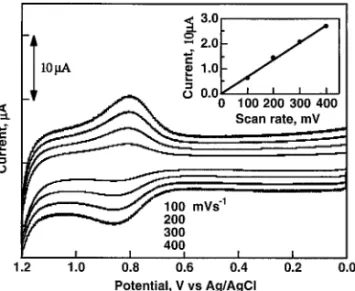
1/2= +0.83 V, which can be assigned to the Co(II/III) couple(Fig. 1). This wave was not observed when the ITO electrode without the anchoring bhbbpa ligand was used. The peak current shows a linear dependence on the scan rate, which clearly indicates the Co
2+ion was coordinated to the immobilized bhbbpa ligand.
Similarly, the bhbbpa immobilized ITO electrode was immersed into 0.1 M CuSO
4solution for 30 min and washed with water, and then measured by cyclic and differential pulse voltammetries in 0.1 M Na
2SO
4solution. The electrochemical response for the Cu(I/II) couple was observed at E
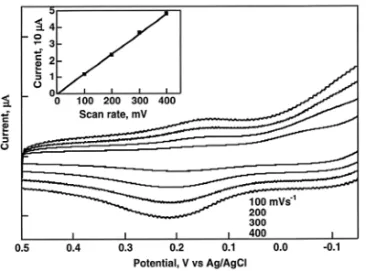
pa= +0.22 V vs Ag/AgCl at the scan rate of 400 mVs
-1(Fig. 2). A linear dependence of peak current vs scan rate reveals the immobilization of Cu ion on the ITO electrode. In order to elucidate the chemical species for the electrochemical response, we have synthesized the Co and Cu bhbbpa complexes by the reaction of bhbbpa ligand with MSO
4(M = Co and Cu) in water and characterized these complexes by electrospray -TOF MS spectra as described below.
Fig. 1. Cyclic voltammograms of bhbbpa immobilized ITO electrode after the immersion of CoSO4 solution (0.1 mM) on varying the scan rate of 100, 200, 300, and 400 mVs-1 in 0.1 M Na2SO4 solution. The plot of anodic peak current at +0.83 V vs the scan rate is shown as an inset.
3.3 Characterization of Co and Cu complexes in solution by electrospray-TOF MS spectra. The coordination of bhbbpa with metal ion was investigated by electrospray TOF mass spectroscopy (ESI-TOF MS). ESI-TOF MS is one of the powerful tools to detect the solution species such as hydrogen-bonded molecular aggregates or self-assembled polyions. Fig. 3 shows the ESI-TOF MS spectrum of bhbbpa ligand, which clearly indicates the molecular peak at m/z value of 717.3159 as a monocation and the observed mass and isotope pattern are in good agreement with the calculated ones. In order to detect the solution species between bhbbpa and CoSO
4or CuSO
4ion, the product for the reaction of bhbbpa ligand with Co
2+or Cu
2+ion was isolated , dissolved in water , and then ESI-TOF MS was measured. Fig. 4 and 5 show the ESITOF MS spectra of Co and Cu bhbbpa complexes, respectively. In Fig. 4, the molecular peak at m/z 774.1097 can be assigned to the complex of [Co(bhbbpa-H)]
+. Similarly, the isotope pattern of main peak in Fig. 5 coincides with that of [Cu(bhbbpa-H)]
+. When the change of anion from SO
42-to Cl- does not affect the MS spectra.
UV spectra of Co and Cu bhbbpa mixed solutions are shown in.
After the complex formation with Co
2+or Cu
2+ion, the ITO electrode was dipped into the solution and the electrochemical measurements was made in 0.1 M Na
2SO
4solution. The cyclic voltammograms of the immobilized Co
2+or Cu
2+complexes exhibits a similar response to those of the bhbbpa immobilized ligand ITO electrode immersed into Co
2+or Cu
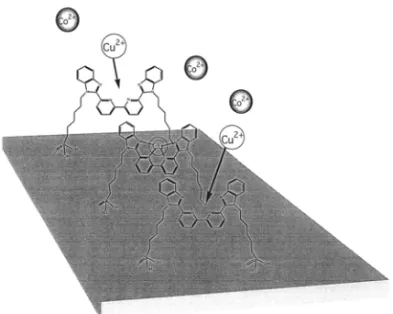
2+solution. Therefore, the coordination on ITO surface occurred in a similar manner as that in solution (Scheme 2).
Fig. 2. Cyclic voltammograms of bhbbpa immobilized ITO electrode after the immersion of CuSO4 solution (0.1 mM) on varying the scan rate of 100, 200, 300, and 400 mVs-1 in 0.1 M Na2SO4 solution. The plot of anodic peak current at +0.22 V vs the scan rate is shown as an inset.
Fig. 3. ESI-TOF MS spectra of bhbbpa ligand in aqueous solution. The inset shows the observed and calculated isotope patterns of the molecular peak.
Fig. 4. ESI-TOF MS spectra of Co- bhbbpa complex in aqueous solution. The inset shows the observed and calculated isotope patterns of the molecular peak.
Fig. 5. ESI-TOF MS spectra of Cu - bhbbpa complex in aqueous solution The inset shows the observed and calculated isotope patterns of the molecular peak.
3.4 Selective metal ion detection by the bhbbpa ligand immobilized on ITO electrode. One of the challenge in the field of immobilized electrode is the selective detection of molecules or ions from the solution. The specific binding of analytes to sensing receptor site on the electrode plays an important role for the chemical sensing. Hydrogen bonding interaction or coordination often leads to the specificity between the receptor site and the target ion (Scheme 3). The formation of the resulting redox active complexes on the electrode can be easily detected by electrochemical methods. However, in the case of redox inactive complexes, a charged electroactive ions has been used as a maker. The access of maker ion to the electrode can be facilitated or suppressed by electrostatic attraction or repulsion between the surface complexes and the makers (Scheme 3).
The latter type of chemical sensors has been developed by Umezawa et al [11], using the synthetic lipids with positive or negative charge. In this case, the additional implementation of appropriate receptors is required for the specific response. On the other hand, the use of specific interaction makes possible to detect the target ion directly. The selectivity is controlled by the formation constant between a probing molecule and an ion. We have evaluated the selectivity of metal ion for the bhbbpa immobilized ITO electrode. The immersion of the bhbbpa ITO electrode into the mixed solution of Co
2+and Cu
2+(0.05 M each) leads to the electrochemical response of only Cu
2+, as shown in Fig. 6. This selectivity is reproducible by using the different lots of the immobilized ITO electrode. Considering the coordination geometry around the metal ion, the distorted planar geometry of the free bhbbpa ligand cavity was well fitted in the Cu
2+ion coordination. Therefore, the bhbbpa ITO electrode can be strongly bound to the Cu
2+ion compared to Co
2+ion, and Cu
2+was selectively extracted from the mixture of Co
2+and Cu
2+ions.
Fig. 6. Cyclic voltammograms of the bhbbpa immobilized ITO electrode in 0.1 M Na2SO4 solution on varying the scan rate of 200, 300, and 400 mVs-1 after the immersion in an aqueous solution of Co2+ and Cu2+.
Scheme 2. Metal ion sensor based on bhbbpa immobilized ITO electrode, which can differentiates between Co2+ and Cu2+ ions
4 Acknowledgements.
M.H. gratefully acknowledges financial support from the Institute of Science and Engineering at Chuo University, the Ministry of Education, Science, Sports and Culture for a Grant-in-Aid for Scientific Research (No. 12440188), a Grant-in-Aid for Scientific Research on Priority Areas of
“Metal-assembled Complexes”, and also a support from the Promotion and Mutual Aid Corporation for Private Schools of Japan and the Iketani Science and Technology Foundation (No.0131013A).
5 References.
[1] (a) Ulman, A.: “An Introduction to Ultrathin Organic Films from Langmuir-Blodgett to Self- Assembly” Academic Press, San Diego (1991). (b) Nuzzo, R. G. and Allara, D. L.: J. Am. Chem.
Soc., 105, 4481 (1983). (c) Ulman, A.: Chem. Rev., 96, 1533 (1996). (d) Laibinis, P. E., Whitesides, G. M., Allara, D. L., Tan, Y. –T., Parikh, A. N. and Nuzzo, R. G. J. Am. Chem. Soc., 113, 7152 (1991).
[2] (a) Mirkin, C. A.: “Programming the Assembly of Two- and Three-Dimensional Architectures with DNA and Nanoscale Inorganic Building Blocks”, Inorg. Chem., 39, 2258 (2000). (b) Shipway, A. N., Katz, E., and Willner, I.: “Nanoparticle Arrays on Surface for Electronic, Optical, and Sensor Applications”, CHEMPHYSCHEM, 1, 18 (2001).
[3] (a) Bain, C. D., Evall, J., Whitesides, G. M.: J. Am. Chem. Soc., 111, 7155 (1989). (b) Bain, C. D., Biebuyck, H. A., J., Whitesides, G. M.: Langmuir, 5, 723 (1989). (c) Troughton, E. B., Bain, C. D., Whitesides, G. M., Nuzzo, R. G., Allara, D. L., Porter, M. D.: Langmuir, 4, 365, 1988.
[4] Bain, C. D., Troughton, E. B., Tao, Y. –T., Evall, J., Whitesides, G. M., Nuzzo, R. G.: J. Am. Chem.
Soc., 111, 321 (1989).
[5] (a) Li, Y., Huang, J., McIver, R. T., Jr. Hemminger, J. C.: J. Am. Chem. Soc., 114, 2428 (1992).
(b) Tarlov, M. J., Burgess, D. R. F., Jr., Gillen, G. J. Am. Chem. Soc., 115, 5305 (1993).
[6] (a) Cao, G., Hong, H. –G., Mallouk, T. E. Acc. Chem. Res., 25, 420 (1992). (b) Poojary, D. M., Zhang, B., Bellinghausen, P., Clearfield, A. Inorg. Chem., 35, 4942 (1996).
[7] Byrd, H., Whipps, S., Pike, J. K., Ma, J., Nagler, S. E., and Talham, D. R.: J. Am. Chem. Soc., 116, 295 (1994).
[8] (a) Haga, M., Kato, N., Monjushiro, H., Wang, K., and Hossain, Md. D.: “Metal coordination to amphiphilic Ru complexes at the air-water interface”, Supramol. Sci, 5, 337-342 (1998). (b) Haga, M., Hong, H.-Gi, Shiozawa, Y., Kawata, Y., Monjushiro, H., Fukuo, T., and Arakawa, R.
“Synthesis and Proton-Coupled Electron Transfer Reaction of Self-Assembled Monolayers of Ruthenium(II) Complex Containing Tridentate 2,6-Bis(benzimidazol-2-yl)-pyridine on Gold
Scheme 3. Two types of electrochemical detection modes classified by interaction between immobilized receptors and an analytes (ions/molecules).