瀑布渓流図 : 修復報告書 : 在外日本古美術品保存 修復協力事業 : No.2015‑3
著者 文化遺産国際協力センター
出版年月日 2020‑01‑31
URL http://id.nii.ac.jp/1440/00009000/
Creative Commons : 表示 ‑ 非営利 ‑ 改変禁止 http://creativecommons.org/licenses/by‑nc‑nd/3.0/deed.ja
在外日本古美術品保存修復協力事業
The Cooperative Program for the Conservation of Japanese Art Objects Overseas
瀑布渓流図 Waterfall of a Valley Stream
クラクフ国立博物館(ポーランド共和国)所蔵 中林竹洞筆 絹本墨画 掛軸装
1幅
Muzeum Narodowe w Krakowie, Poland Nakabayashi Chikutō, ink on silk, a hanging scroll
No.2015-3
平成27年度修復事業 2015 Japanese Fiscal Year
ᮾிᩥ㈈◊✲ᡤ
ᖹᡂ30ᖺᗘ
ᅾእ᪥ᮏྂ⨾⾡ရಖᏑಟ༠ຊᴗ ℛᕸὶᅗ No.2015-3 ಟሗ࿌
Ⓨ⾜᪥䠖ᖹᡂ31ᖺ3᭶29᪥
⦅㞟㈐௵䠖ᩥ㑇⏘ᅜ㝿༠ຊ䝉䞁䝍䞊
Tokyo National Research Institute for Cultural Properties
2018JFY
The Cooperative Program for the Conservation of Japanese Art Objects Overseas
Waterfall of a Valley Stream No.2015-3
クラクフ国立博物館(ポーランド共和国)所蔵 中林竹洞筆 絹本着色 掛軸装 1幅
平成27年度修復事業 The 2015 Japanese Fiscal Year
瀑布渓流図 Waterfall of a Valley Stream
Muzeum Narodowe w Krakowie, Poland Nakabayashi Chikutō, ink on silk, a hanging scroll
在外日本古美術品保存修復協力事業
The Cooperative Program for the Conservation of Japanese Art Objects Overseas
No.2015-3
1.
1.1.
1.2.
1.3.
1.4.
1.5.
1.6.
2.
1.
2.
3.
1 1 1 1 1 2 3 23
27 31 33 1.
1.1.
1.2.
1.3.
1.4.
1.5.
1.6.
2.
1.
2.
3.
Table of Contents
1. Restoration Report 1.1. Data
1.2. Restoration Data
1.3. Condition before Restoration 1.4. Restoration Policy
1.5. Restoration Process
1.6. Inscription regarding Restoration
2. Description about the Artwork
Appendices
Appendix 1. Documentation
Appendix 2. Discussion about New Mounting Fabrics Appendix 3. Conditioning
4 4 4 4 4 5 7 25
27 31 33 Table of Contents
1. Restoration Report 1.1. Data
1.2. Restoration Data
1.3. Condition before Restoration 1.4. Restoration Policy
1.5. Restoration Process
1.6. Inscription regarding Restoration
2. Description about the Artwork
Appendices
Appendix 1. Documentation
Appendix 2. Discussion about New Mounting Fabrics Appendix 3. Conditioning
1.
* * ** ** *
* **
1.1.
竹洞 1776 1853
2 1831
VI-8227
画 1
31 70 2 31 2 80 3.03 cm
1.2.
成27 12 2 成30 1 29
1.3. 㻌 Table 1.1 Table 1.3 Fig. 1.2 Fig. 1.4 Fig. A.1.1
3cm 2 Fig.
1.6 (a) Fig. 1.7 (a)
Fig. 1.8 (a)
Fig. 1.9 (a) Fig. 1.10 (a) Fig. 1.11 (a)
1.4.
1.5.
Table 1.5
(1) Fig. 1.12.1
成 1
(2) Fig. 1.12.2
(3) Fig. 1.12.3
(4) Fig. 1.12.4
(5) Fig. 1.12.5
水
(6) 水 Fig. 1.12.6
水 水
(7)
水
(8) Fig. 1.12.7
水
(9) Fig. 1.12.8
水 pH 10.5
(10)
2300 kGy
Fig. A.1.3
(11) Fig. 1.12.9
(12)
(13) Fig. 1.12.10 Fig. 1.12.11
2
(14) Fig. 1.12.12
(15) Fig. 1.12.13
(16) Fig. 1.12.14
水 pH 10.5
(17) 画
(18) Fig. 1.12.15
Fig. A.1.3 (19)
画 1
3
(20) Fig. 1.12.16
金
(21) Table 1.2 Table 1.4 Fig. 1.3 Fig. 1.5 Fig. 1.6 (b) Fig. 1.7 (b) Fig. 1.8(b) Fig. 1.9 (b) Fig. 1.10 (b) Fig. 1.11 (b)
(22) Fig. 1.12.17 Fig. 1.12.18
金
Masato KATO, Takayuki KIMISHIMA: “Karibari: The Japanese Drying Technique” Adapt & Evolve 2015: East Asian Materials and Techniques in Western Conservation, Proceedings from the International Conference of the Icon Book & Paper Group, 2015
1.6.
画
成 2018
成
1. Restoration Report
Momoko ODA*, Heejae WON*, Takayuki KIMISHIMA**, Keita SHIRAI** and Masato KATO*
*Tokyo National Research Institute for Cultural Properties, **SHUGO Co., Ltd.
1.1.Data
Title Waterfall of a Valley Stream ( )
Painter Nakabayashi Chikutō ( 竹洞, 1776 - 1853)
Period 1831 (Ten ō 2)
Owner Muzeum Narodowe w Krakowie (National Museum in Krakow), Poland
Accession no. VI-8227
Media and format (style) Ink on silk, a hanging scroll (mincho-style)
Structure of silk for the artwork Warp thread: 31 denier 70 double-strands per 3.03 cm Weft thread: 31 denier 80 double-strands per 3.03 cm
1.2.Restoration Data
Duration 2 December, 2015 - 29 January, 2018
Place Restoration Studio (Paper), Tokyo National Research Institute for Cultural Properties
Restorer SHUGO Co., Ltd.
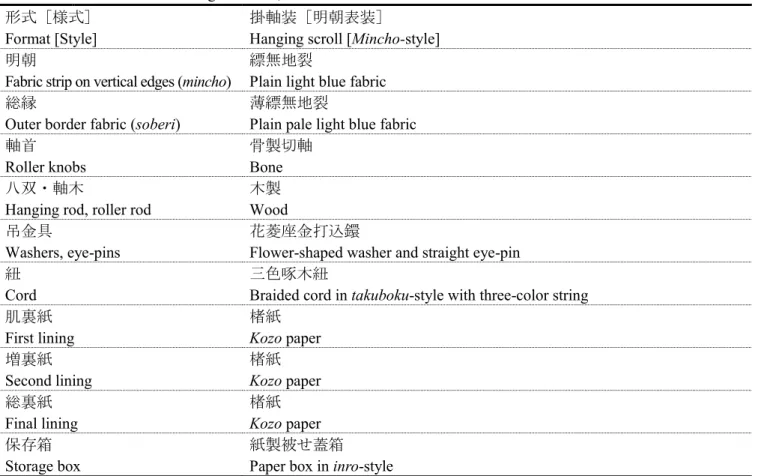
1.3.Condition before Restoration㻌(Table 1.1, Table 1.3, Fig. 1.2, Fig. 1.4, Fig. A.1.1)
On the artwork, there were 2 losses of 3 cm in diameter which were infilled and overpainted (Fig. 1.6 (a), Fig. 1.7 (a)).
Many creases ran the artwork and mounting overall (Fig. 1.8 (a)).
There were dirt and stains on the artwork and mounting overall. It was especially notable that many brown-spots stained the lower part of the artwork and mounting fabric.
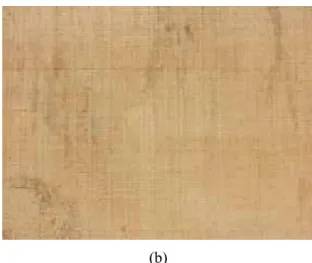
There were dirt-like white paint on the artwork (Fig. 1.9 (a), Fig. 1.10 (a)).
There were delamination of the lining paper from the artwork and separation at paste margins (Fig. 1.11 (a)).
1.4.Restoration Policy
Restoration of the artwork to its status quo ante and the maintenance of the present condition were to be the fundamental policy to be followed in restoring the artwork.
Since the lining paper was partially delaminated from the artwork, it was decided to restore the artwork including replacement of the first lining paper.
The artwork would be mounted in honbukuro-style with two-tier mounting, changing from mincho-style.
The previous mounting materials, such as lining paper and mounting fabrics, and storage equipment, such as a storage box, would be reproduced.
The previous mounting materials and storage equipment would be stored separately from the artwork and returned to the museum.
The materials would be analyzed whenever necessary.
1.5. Restoration Process
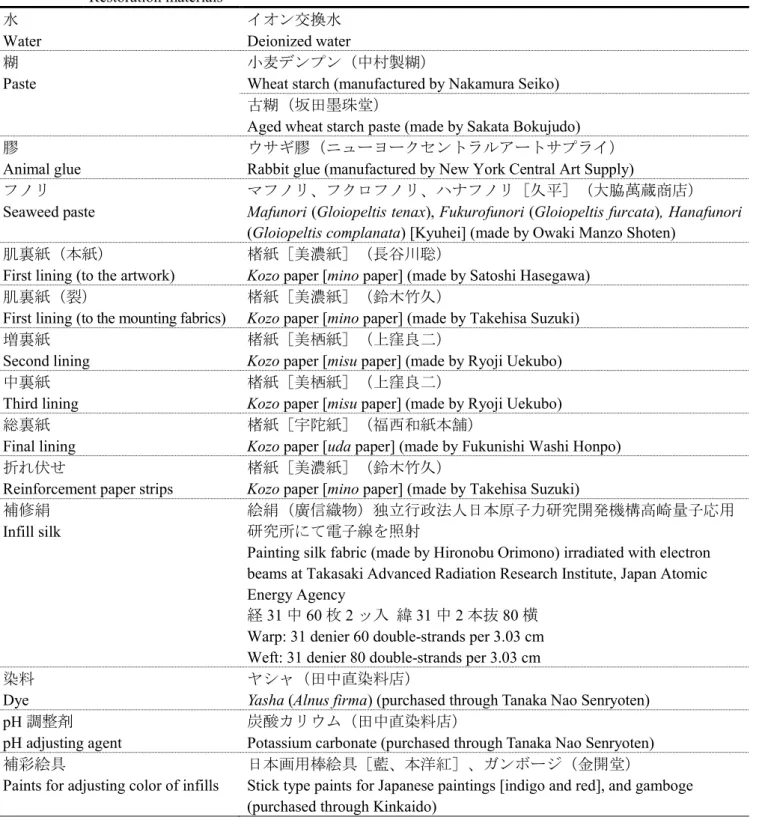
Regarding restoration materials, see Table 1.5.
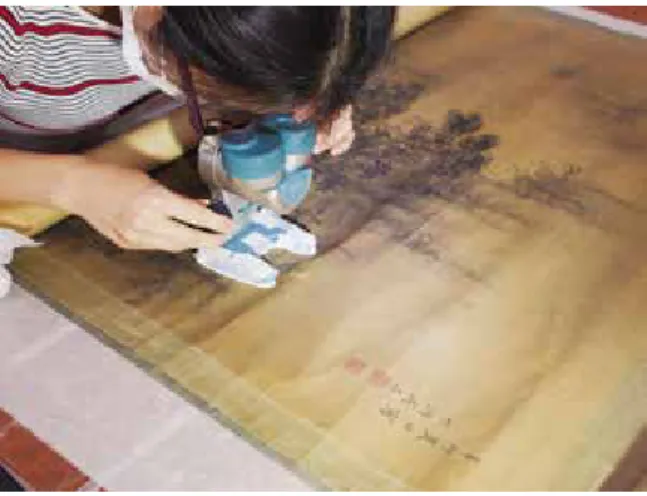
(1) Examination before restoration (Fig. 1.12.1)
The condition of the object were documented and recorded including taking photographs (Appendix 1).
(2) Disassembling (Fig. 1.12.2)
The artwork was removed from the mounting.
(3) Removing the final lining paper (Fig. 1.12.3)
Keeping the artwork and mounting dry, the final lining paper was removed.
(4) Removing dust (Fig. 1.12.4)
Dust was removed from the front side of the artwork by a brush and tissue.
(5) Removing lining paper (Fig. 1.12.5)
Layers of lining paper of the artwork, other than the first lining, were removed with moisture applied gradually from the back side of the artwork.
(6) Washing (Fig. 1.12.6)
Rayon paper was attached to the back side of the artwork with water as a temporary lining. Then, in order to remove dirt, deionized water was sprayed onto the front side of the artwork and absorbed by blotting paper placed under the artwork.
(7) Protecting
The front side of the artwork was covered with rayon paper and then kozo paper using seaweed paste extracted at room temperature.
(8) Removing the first lining paper (Fig. 1.12.7)
The first lining paper was removed gradually by applying moisture.
(9) First lining (Fig. 1.12.8)
Mino paper was colored with yasha (Alnus firma) at pH 10.5 with potassium carbonate. After removing paper for protecting the front side of the artwork, the mino paper was pasted to the artwork with wheat starch paste.
(10) Infilling silk
Silk fabric was artificially deteriorated by irradiating electron beams (2300 kGy, total amount) in order to decrease its physical strength. Then the fabric was dyed with yasha and tangara (Bruguiera conjugate) and was applied to fill the losses of the silk for the artwork (Fig. A.1.3).
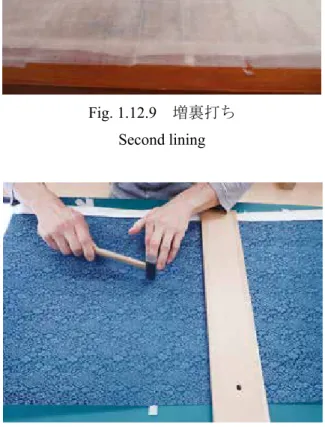
(11) Second lining (Fig. 1.12.9)
Misu paper was pasted to the artwork with first lining using aged wheat starch paste.
(12) Applying reinforcement paper strips
Using wheat starch paste, reinforcement paper strips made of mino paper were applied to creases and tear on the artwork from the back side as well as to possible creases.
(13) Preparing the mounting fabrics (Fig. 1.12.10, Fig. 1.12.11)
New fabrics for mounting were selected (Appendix 2). Then the first lining, mino paper, was applied using wheat starch paste. The second lining, misu paper, was applied using aged wheat starch paste.
(14) Assembling (Fig. 1.12.12)
The artwork and the mounting fabrics were assembled in honbukuro-style.
(15) Third lining (Fig. 1.12.13)
Misu paper was applied to the set assembled with the artwork and mounting fabrics by using aged wheat starch paste.
(16) Final lining (Fig. 1.12.14)
Uda paper was colored with yasha at pH 10.5 with an aqueous solution of potassium carbonate. Then, the uda paper and silk cover were applied with aged wheat starch paste.
(17) Drying and conditioning
The artwork with mounting was sufficiently dried on a karibari panel face up.
(18) Adjusting color of infills (Fig. 1.12.15)
Color was applied to infills of silk using stick type paints for Japanese painting and gamboge so as to match the color of the infilled parts with that of the artwork (Fig. A.1.3).
(19) Conditioning
The artwork with mounting was dried on the karibari panel face down for about a month in an environmental control chamber that had been set as shown in Appendix 3*.
(20) Finishing (Fig. 1.12.16)
After removing the artwork with mounting from the karibari panel, new mounting materials – the washers and eye-pins, cords, hanging rod, roller rod, and roller knobs – were attached.
(21) Documenting (Table 1.2, Table 1.4, Fig. 1.3, Fig. 1.5, Fig. 1.6 (b) , Fig. 1.7 (b) , Fig. 1.8(b) , Fig. 1.9 (b) , Fig. 1.10 (b) , Fig. 1.11 (b))
The finished scroll, the artwork with mounting, was measured and taken on photographs after restoration. The records were compiled.
(22) Storing the artwork (Fig. 1.12.17, Fig. 1.12.18)
The wrapping cloth, outer case, storage box, and roller clamp were made. The mounting materials and the storage equipment which had been used on the object before restoration – mounting fabrics (of outer border and strip on vertical edges), washers and eye-pins, cords, hanging rod, roller rod, roller knobs with sticker, lining paper (of first, second and final) and storage box – were returned to the museum to be stored separately.
* Masato KATO, Takayuki KIMISHIMA: “Karibari: The Japanese Drying Technique” Adapt & Evolve 2015: East Asian Materials and Techniques in Western Conservation, Proceedings from the International Conference of the Icon Book & Paper Group, 2015
1.6. Inscription regarding Restoration
The following inscription was made in sumi ink on the roller rod.
画
成 2018
成
(English translation of the inscription)
“Waterfall of a Valley Stream, ink on silk, a hanging scroll. Collection of the National Museum in Krakow Restoration completed in January 2018
As the project of the Cooperative Program for the Conservation of Japanese Art Objects Overseas 2015JFY -2017JFY, organized by the Tokyo National Research Institute for Cultural Properties, Independent Administrative Institution National Institutes for Cultural Heritage.
At the Restoration Studio (Paper) of the Tokyo National Research Institute for Cultural Properties Implemented by SHUGO Co., Ltd.”
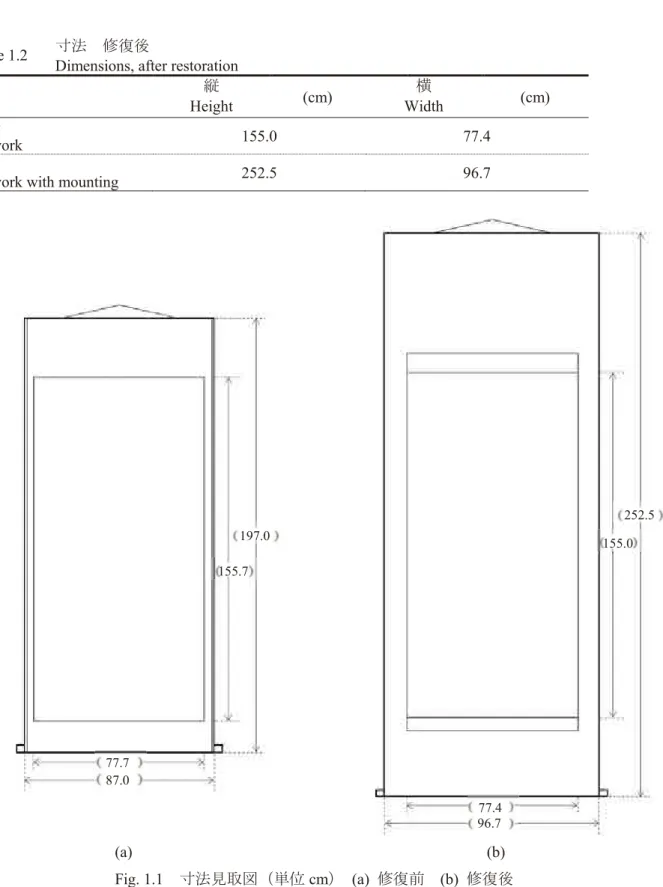
Table 1.1 Dimensions, before restoration
(cm) (cm)
Height Width
155.7 77.7
Artwork
Artwork with mounting 197.0 87.0
Table 1.2 Dimensions, after restoration
(cm) (cm)
Height Width
155.0 77.4
Artwork
Artwork with mounting 252.5 96.7
(a) (b)
Fig. 1.1㻌 㻌 cm (a) (b)
Image of dimensions (in cm) (a) before restoration (b) after restoration 77.7
77.787.0
197.0 155.7
77.4 96.7 77.4
252.5 155.0
Table 1.3 Format and mounting materials, before restoration
Format [Style] Hanging scroll [Mincho-style]
Fabric strip on vertical edges (mincho) Plain light blue fabric
Outer border fabric (soberi) Plain pale light blue fabric
Roller knobs Bone
Hanging rod, roller rod Wood 金
Washers, eye-pins
金
Flower-shaped washer and straight eye-pin
Cord Braided cord in takuboku-style with three-color string
First lining Kozo paper
Second lining Kozo paper
Final lining Kozo paper
Storage box Paper box in inro-style
Table 1.4 Format and mounting materials, after restoration Format [Style]
本
Hanging scroll [Honbukuro-style ] 字
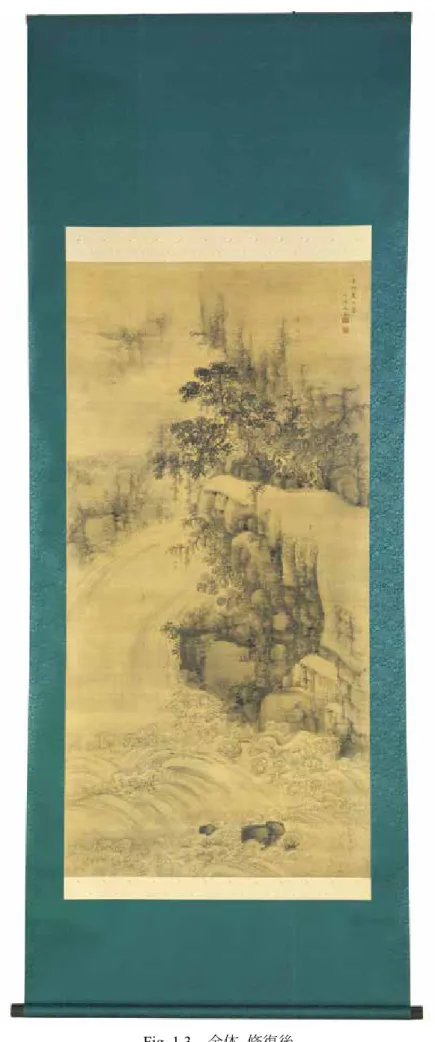
Inner border fabric (ichimonji) Kinran (gold brocade) with a crow motif and a swastika pattern on a whitish brown background (made by Hironobu Orimono)
Outer border fabric Donsu (damask) with an arabesque and a motif of Japanese melon on an indigo color background (made by Hironobu Orimono)
Cover silk Plain-woven silk fabric in indigo color (purchased through Torii) Roller knobs Wood (purchased through Hayamizu Shoten)
Hanging rod, roller rod Wood [Japanese cedar-made] (purchased through Hayamizu Shoten)
Washers, eye-pins Mokko (Japanese melon) -shaped washer and straight eye-pin (purchased through Hayamizu Shoten)
Cord Silk braided cord in takuboku-style with two-color string (purchased through Hayamizu Shoten)
Roller clamp Paulownia (Paulownia tomentosa) roller clamp (made by Kobayakawa Kiribako Seisakujo)
Wrapping cloth Lined silk wrapping cloth (purchased through Hayamizu Shoten) Storage box
印
Paulownia inro-style box (made by Kobayakawa Kiribako Seisakujo) Outer case Paper box covered with navy blue fabric (made by Kobayakawa Kiribako
Seisakujo)
Table 1.5 Restoration materials 水
Water
水 Deionized water
Paste Wheat starch (manufactured by Nakamura Seiko)
Aged wheat starch paste (made by Sakata Bokujudo)
Animal glue Rabbit glue (manufactured by New York Central Art Supply)
Seaweed paste Mafunori (Gloiopeltis tenax), Fukurofunori (Gloiopeltis furcata), Hanafunori (Gloiopeltis complanata) [Kyuhei] (made by Owaki Manzo Shoten)
First lining (to the artwork) Kozo paper [mino paper] (made by Satoshi Hasegawa) First lining (to the mounting fabrics)
竹
Kozo paper [mino paper] (made by Takehisa Suzuki)
Second lining Kozo paper [misu paper] (made by Ryoji Uekubo) Third lining Kozo paper [misu paper] (made by Ryoji Uekubo)
Final lining Kozo paper [uda paper] (made by Fukunishi Washi Honpo) Reinforcement paper strips
竹
Kozo paper [mino paper] (made by Takehisa Suzuki) Infill silk
Painting silk fabric (made by Hironobu Orimono) irradiated with electron beams at Takasaki Advanced Radiation Research Institute, Japan Atomic Energy Agency
31 60 2 31 2 80
Warp: 31 denier 60 double-strands per 3.03 cm Weft: 31 denier 80 double-strands per 3.03 cm
Dye Yasha (Alnus firma) (purchased through Tanaka Nao Senryoten) pH
pH adjusting agent Potassium carbonate (purchased through Tanaka Nao Senryoten) Paints for adjusting color of infills
画 金
Stick type paints for Japanese paintings [indigo and red], and gamboge (purchased through Kinkaido)
Fig. 1.2
Artwork with mounting before restoration (with raking light)
Fig. 1.3㻌
Artwork with mounting after restoration
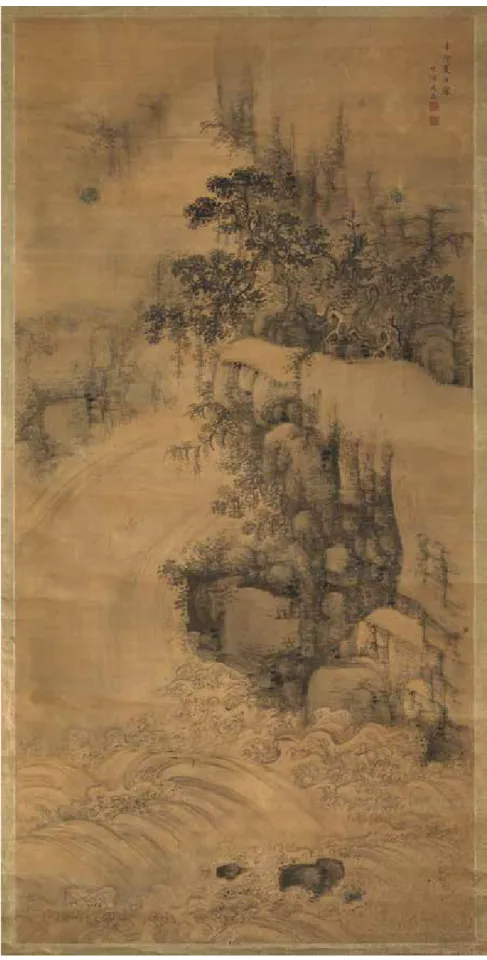
Fig. 1.4 䠄 䠅 Artwork before restoration (with raking light)
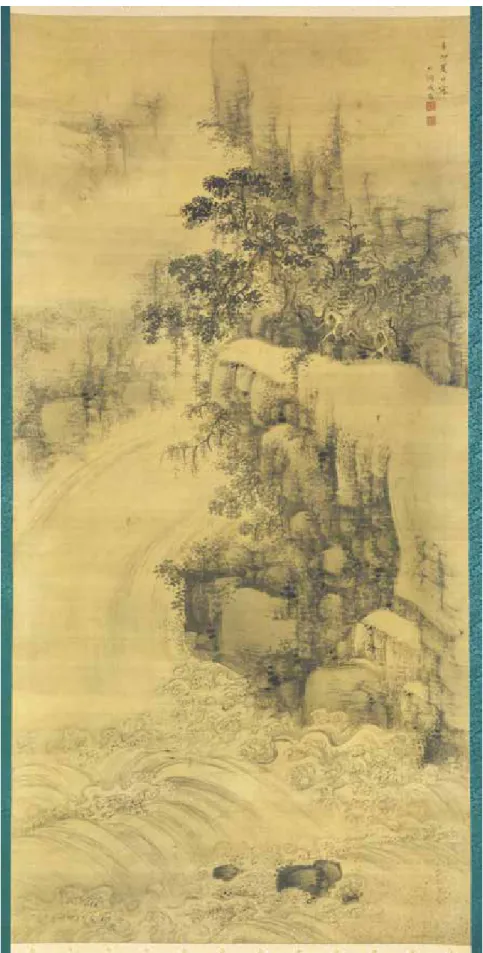
Fig. 1.5 Artwork after restoration
(a) (b)
Fig. 1.6 (a) (b)
Loss and infill with inpaint in the past restoration
(a) before restoration (with raking light) (b) after restoration (with raking light)
(a) (b)
Fig. 1.7 (a) (b)
Loss and infill with inpaint in the past restoration (a) before restoration (b) after restoration
(a) (b)
Fig. 1.8 (a) (b)
Creases (a) before restoration (with raking light) (b) after restoration (with raking light)
(a) (b)
Fig. 1.9 䠅 (a) (b)
Accretions (dirt-like white paint) (a) before restoration (b) after restoration
(a) (b)
Fig. 1.10 䠅 (a) (b)
Accretions (dirt-like white paint) (a) before restoration (b) after restoration
(a) (b)
Fig. 1.11 (a) (b)
Separation at paste margins (a) before restoration (b) after restoration
Fig. 1.12.1 䠄
Examination before restoration (microscopic observation)
Fig. 1.12.2 Disassembling
Fig. 1.12.3
Removing final lining paper
Fig. 1.12.4 Removing dust
Fig. 1.12.5
Removing lining paper (other than first lining paper)
Fig. 1.12.6 水 Washing
Fig. 1.12.7
Removing the first lining paper
Fig. 1.12.8 First lining
Fig. 1.12.9 Second lining
Fig. 1.12.10
Preparing the mounting fabrics (first lining)
Fig. 1.12.11
Preparing the mounting fabrics (joining fabrics)
Fig. 1.12.12 Assembling
Fig. 1.12.13 Third lining
Fig. 1.12.14 Final lining
Fig. 1.12.15
Adjusting color of infills
Fig. 1.12.16 Finishing
Fig. 1.12.17
Storage box (before restoration)
Fig. 1.12.18
Outer case, storage box and roller clamp (newly made)
2.
作品解説
画 水 山水
水 画
水
水 水
画
水
画 竹洞成昌 成昌
竹洞 1776 1853 2 1831 56
Fig. 2.1
竹洞 画
1803 成昌 竹洞 融斎
1789 14 画 山 1747 93
15 画 1710 1802
竹洞 画 山 1783 1856
画 8 1796 21
6 1809 34
40 7
50 画 50 60 竹
洞 70
画 画道金剛杵 竹洞画論 融斎画譜
画論 画譜
竹洞 56
融 画
竹洞
水 画 竹洞
画
竹洞
画 画
2 1831 竹洞 画 竹洞 融斎画譜
画 成
倪瓚 1301 74 黄公望 1269 1354
画 画 画
竹洞 画
山水 Chikutō 18/19 Shigemasa 18
Shigemasa XVIII Fig. 2.2 Fig. 2.3 Shigemasa
竹洞 成昌
Fig. 2.2㻌 㻌 山水 㻌
Inscription reading landscape ( “山水”) on the back side of previous mounting
Fig. 2.1 Inscription and seals Fig. 2.3㻌 㻌 Shigemasa XVIII
Sticker with a memo,“Shigemasa XVIII”
2. Description about the Artwork
Takuyo YASUNAGA Tokyo National Research Institute for Cultural Properties
At the right of the landscape painting in sumi ink is a two-level hanging cliff beyond which a torrent of water falls.
Although the water flow is depicted like a fall, the actual depth of the fall is not so large. Rather it is like a mountain stream that one might describe as flowing rapidly. To the left of the scene is a faintly depicted rock surface that stands across the mountain stream creating a unique sense of perspective. The water that flows toward the lower left side along the bank forms many reverse waves and changes its direction to the lower right side. Below the hanging cliff to the right a carved rock surface is exposed sharply carved by the waves. Also visible among the torrent water that flows to the right are three small rocks. Several trees grow on flat ground between the two-level hanging cliff and other small trees are found below the upper and lower cliffs.
The motifs are depicted with sumi ink alone. Although there is no color, the blurry effect of ink created by the brushwork on the cliff and the riverbank bring out the atmosphere of the rock surface. Different tones of sumi ink applied somewhat in a plane effect for the leaves of the trees that grow from the rock also show different touches and types of leaves providing a sense of perspective. On the other hand, the water flow and the waves are expressed in rather light ink. Brush strokes are used effectively to express the vividness of water while dark sumi ink placed at points highlight the top of waves. Slightly long spots of dark sumi ink can also be found partially on the cliffs and riverbank, effectively bringing rhythm to the painting. Although the impression is, on the whole, one of a faint, somewhat blurred touch, dark and medium sumi ink on the tress on the rocks and the surface of the rock below the cliff give a somewhat moist touch, working to bring out contrast between the hanging cliff and water flow, as well as the dimension of the scene. On the upper right corner of the painting are an inscription that reads “painted by Nakabayashi Chikutō” (1776-1853) “in summer 1831” when he was 56 years old and two stamps, a square relief seal with “the seal of Narimasa” (成昌之印) and another square relief seal with “the courtesy name Hakumei” (字伯明) (Fig. 2.1).
Chikutō is a literati artist from Owari area (present-day western part of Aichi prefecture) who was active in the late Edo period (late 18th century to middle of the 19th century). He was born as the first son of Nakabayashi Gentō (中林玄 棟,?-1803), a gynecologist at Nagoya in Owari area. His given name is Narimasa (成昌), but he is also known as Hakumei (伯明); as an artist he is known as Chikutō (竹洞), Yūsai (融斎), Chūtan (冲澹), or Chiou (痴翁). In 1789, when he was 14 years old, he began to study under Yamada Gūjō (山田宮常, 1747-1793), an artist who was active in Owari area. From about the time Chikutō was 15 years old he started to have connections with Kamiya Ten’yū (神谷天 遊 ) who was a wealthy merchant of Nagoya and a collector of Chinese paintings and calligraphies. It is said that young Chikutō had the opportunity to see, together with Yamamoto Baiitsu (山本梅逸, 1783-1856), also a literati artist from Nagoya, many of the Chinese paintings and calligraphies owned by Ten’yū and was greatly influenced.
In 1796, at the age of 21, he went to Kyoto with Baiitsu, but returned to Nagoya a few years later. In 1809, when he was about 34 he again went to Kyoto and continued to be active mainly in Kyoto afterwards. However, in his mid-40s he was afflicted with an illness of the eye and it seems that for the next 7 years or so he could not work easily. When he recovered from his illness, in his 50s, his works began to change to a more gentle and elegant style. Many of Chikutō’s works from his 50s to 60s show characteristic tranquility of Chikutō, but those from his 70s, in his late years, seem to expose his own sentiments. It appears that he continued to produce many works of art until the time of his death. He is also known for
, 1710-1802
his many theories and albums on painting, such as “Gadō kongōsho” (画道金剛杵, lit. Vajra on the way of painting),
“Chikutō garon” (竹洞画論, lit. Chikutō’s painting theory), and “Yūsai gafu” (融斎画譜, lit. Yūsai picture album).
The present painting is an example of Chikutō’s work when he was 56 years old at a time he began to acquire his characteristic expression of calmness. It is an outstanding work that fuses the simple structure making use of space and the many delicate expressions of the blurred touch of the brush. Furthermore, that the work is very large makes it impressive; of the works of hanging scroll by Chikutō, it is said to be of the largest. Perhaps, such a large work was intentionally selected to express the dynamic flow of water. Chikutō has left several works with waterfalls as the main theme, but in many cases the falls are high and fall vertically from the upper portion of the painting. An example of a fall like this one which is low and in which the water flows to the left and right is comparatively rare. Since Chikutō had contact with Chinese paintings from the time he was young, under the influence of Kamiya Ten’yū as has been pointed out, it may be possible that there is a Chinese painting that the present one had been based upon. Details need to be researched, but at the beginning of 1831, the same year in which the present painting was created, Chikutō wrote the preface to “Yūsai gafu,” an album of styles in which he modified into Chikutō style the themes found in Chinese paintings. It is clear that he intended to publish the results of his study of Chinese paintings. The blurred touch of the brush and the expression of rocks in blocks show the influence of Ní Zàn (倪瓚, 1301-1374) and Huáng Gōngwàng (黄 公望, 1269-1354), Chinese painters of the Yuan dynasty. The process by which Chikutō selected the styles of such artists and incorporated them into his own style and expression may be understood. In other words, the present painting is a valuable example also as a model that shows Chikutō’s study of Chinese paintings and its modifications.
On the back side of previous mounting are found the inscriptions reading landscape (山水) and “Chikutō”, “18/19”
and “18”. On the roller knob is a sticker with a memo with “Shigemasa XVIII” (Fig. 2.2, Fig. 2.3). Shigemasa is imagined to be the another way of reading his name, Narimasa (成昌). However, it is not clear at which point each of these inscriptions were written.
1.
Appendix 1. Documentation
Fig. A.1.1 修
Mapping of damages before restoration Loss Crease Tear Abrasion Stain Accretion Delamination of the lining paper
Appendices
所
Momoko ODA, Heejae WON, Masato KATO Tokyo National Research Institute for Cultural Properties
Fig. A.1.2 箇所 Points where detail photographs were taken
OLYMPUS DIGITAL CAMERA TG-4 4608×3072
JPEG
Apparatus Digital camera (OLYMPUS DIGITAL CAMERA TG-4, OLYMPUS CORPORATION)
Image 4608×3072
Image format JPEG
Fig. A.1.2.1 (1) Photograph of detail (1)
Fig. A.1.2.2 (2) Photograph of detail (2)
Fig. A.1.2.3 (3) Photograph of detail (3)
Fig. A.1.3 補修および補彩を施した箇所 Places infilled and infills with color adjusted
2.
Appendix 2. Discussion about New Mounting Fabrics
取り合わせ
取り合わせ
取り合わせ 取り合わせ
㘓3. ㄪ‵
Appendix 3. Conditioning
⏝ᶵჾ ᜏ ᜏ‵ᐊTBL-3HW2G2AC㸦ࢱࣂ࢚ࢫ࣌ࢵࢡ㸧 ㄪ‵ᮇ㛫 34᪥㛫
Apparatus An environmental control chamber, TBL-3HW2G2AC, TABAI ESPEC
Duration 34 days
Fig. A.3 ㄪ‵ᮇ㛫୰ࡢ ᗘ‵ᗘタᐃ
Temperature and humidity during conditioning 0
10 20 30 40 50 60 70 80 90 100
1 6 11 16 21 26 31
Relative humidity (%) Temperature (℃)
Duration (day)
温度(℃) Temp.
相対湿度(%) RH
㘓3. ㄪ‵
Appendix 3. Conditioning
⏝ᶵჾ ᜏ ᜏ‵ᐊTBL-3HW2G2AC㸦ࢱࣂ࢚ࢫ࣌ࢵࢡ㸧 ㄪ‵ᮇ㛫 34᪥㛫
Apparatus An environmental control chamber, TBL-3HW2G2AC, TABAI ESPEC
Duration 34 days
Fig. A.3 ㄪ‵ᮇ㛫୰ࡢ ᗘ‵ᗘタᐃ
Temperature and humidity during conditioning 0
10 20 30 40 50 60 70 80 90 100
1 6 11 16 21 26 31
Relative humidity (%) Temperature (℃)
Duration (day)
温度(℃) Temp.
相対湿度(%) RH
ᮾிᩥ㈈◊✲ᡤ㻌
ᅾእ᪥ᮏྂ⨾⾡ရಖᏑಟ༠ຊᴗ㻌 ᖹᡂ 㻟㻜 ᖺᗘ㻌 ℛᕸὶᅗ㻌 㻺㼛㻚㻞㻜㻝㻡㻙㻟㻌 ಟሗ࿌㻌
Ⓨ⾜᪥䠖ᖹᡂ 㻟㻝 ᖺ 㻟 ᭶ 㻞㻥 ᪥㻌
⦅㞟㈐௵䠖ᩥ㑇⏘ᅜ㝿༠ຊ䝉䞁䝍䞊㻌
㻌
㼀㼛㼗㼥㼛㻌㻺㼍㼠㼕㼛㼚㼍㼘㻌㻾㼑㼟㼑㼍㼞㼏㼔㻌㻵㼚㼟㼠㼕㼠㼡㼠㼑㻌㼒㼛㼞㻌㻯㼡㼘㼠㼡㼞㼍㼘㻌㻼㼞㼛㼜㼑㼞㼠㼕㼑㼟㻌
㼀㼔㼑㻌㻯㼛㼛㼜㼑㼞㼍㼠㼕㼢㼑㻌㻼㼞㼛㼓㼞㼍㼙㻌㼒㼛㼞㻌㼠㼔㼑㻌㻯㼛㼚㼟㼑㼞㼢㼍㼠㼕㼛㼚㻌㼛㼒㻌㻶㼍㼜㼍㼚㼑㼟㼑㻌㻭㼞㼠㻌㻻㼎㼖㼑㼏㼠㼟㻌㻻㼢㼑㼞㼟㼑㼍㼟㻌 㻞㻜㻝㻤㻶㻲㼅㻌
㼃㼍㼠㼑㼞㼒㼍㼘㼘㻌㼛㼒㻌㼍㻌㼂㼍㼘㼘㼑㼥㻌㻿㼠㼞㼑㼍㼙㻌㻺㼛㻚㻞㻜㻝㻡㻙㻟㻌
㻰㼍㼠㼑㻌㼛㼒㻌㼜㼡㼎㼘㼕㼏㼍㼠㼕㼛㼚㻦㻌㻞㻥㻌㻹㼍㼞㼏㼔㻘㻌㻞㻜㻝㻥㻌
㻱㼐㼕㼠㼛㼞㻦㻌㻶㼍㼜㼍㼚㻌㻯㼑㼚㼠㼑㼞㻌㼒㼛㼞㻌㻵㼚㼠㼑㼞㼚㼍㼠㼕㼛㼚㼍㼘㻌㻯㼛㼛㼜㼑㼞㼍㼠㼕㼛㼚㻌㼕㼚㻌㻯㼛㼚㼟㼑㼞㼢㼍㼠㼕㼛㼚㻌
![Table 1.4 Format and mounting materials, after restoration Format [Style]](https://thumb-ap.123doks.com/thumbv2/123deta/6809343.2230742/14.892.81.842.124.773/table-format-mounting-materials-restoration-format-style.webp)