Fukushima Medical University
福島県立医科大学 学術機関リポジトリ
This document is downloaded at: 2021-11-07T23:42:21Z
Title Emotional disturbance assessed by the Self-Rating Depression Scale test is associated with mortality among Japanese
Hemodialysis patients
Author(s) Kazama, Sakumi; Kazama, Junichiro James; Wakasugi,
Minako; Ito, Yumi; Narita, Ichiei; Tanaka, Motoko; Horiguchi, Fumi; Tanigawa, Koichi
Citation Fukushima Journal of Medical Science. 64(1): 23-29
Issue Date 2018
URL http://ir.fmu.ac.jp/dspace/handle/123456789/675
Rights © 2018 The Fukushima Society of Medical Science
DOI 10.5387/fms.2016-21
Text Version publisher
23 SDS test predicts mortality in dialysis patients
Fukushima J. Med. Sci., Vol. 64, No. 1, 2018
[Original Article]
Emotional disturbance assessed by the Self
-Rating Depression Scale test is associated with mortality among Japanese Hemodialysis patients Sakumi Kazama
1), Junichiro James Kazama
2), Minako Wakasugi
3), Yumi Ito
3), Ichiei Narita
3),
Motoko Tanaka
4), Fumi Horiguchi
5)and Koichi Tanigawa
1)1)
Futaba Emergency and General Medical Support Center, Fukushima Medical University, Fukushima
2)
Department of Nephrology and Hypertension, Fukushima Medical University, Fukushima
3)
Department of Clinical Nephrology and Rheumatology, Niigata University Graduate School of Medical and Dental Sciences, Niigata
4)
Department of Nephrology, Akebono Clinic, Kumamoto
5)
Department of Gynecology, Tokyo Dental College Ichikawa General Hospital, Ichikawa (Received December 26, 2016, accepted January 4, 2018)
Abstract
Emotional disturbance including depression is associated with increased mortality among dialysis patients. The Self
-Rating Depression Scale (SDS) is a simple tool for assessing emotional distur- bance. This study investigated the relationship between emotional conditions as assessed with the SDS test and mortality among 491 hemodialysis patients. At baseline, 183 (37.3%), 180 (36.7%), 108 (22.0%), and 20 (4.1%) were classified as normal, borderline depression, depression, and severe depression, respectively. During the two years of observation period, 57 of 491 (11.6%) died. The SDS scores in the non
-survivors were significantly higher than those in the survivors (p<0.0001). Logistic analyses showed that the diagnoses made by the SDS test were associated with significantly greater risks for all
-cause mortality (99%CI : 1.905
-3.698 for that without adjust- ment, 1.999
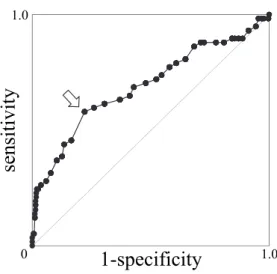
-4.382 for that with full adjustment). When the SDS score = 50 was selected as the cut off value, the test screened two
-year all cause death with sensitivity = 57.9% and the specificity = 78.1%. In conclusion, hemodialysis patients had high prevalence of emotional disturbance assessed by the SDS test, and high SDS score was significantly associated with all
-cause mortality. These findings underscore the importance of screening for emotional conditions using the SDS test among hemodialysis patients.
Key words : hemodialysis, the Self
-Rating Depression Scale (SDS) test, mortality
Introduction
Emotional disturbance is regarded as a risk fac- tor for the development of cardiovascular dis- ease
1-3). Although its direct effect on mortality is still in controversy
4), it shows significant association with unfavorable clinical outcomes in many disease conditions
5-7). For instance, depression is associat- ed with increased mortality
8-10)and risk of hospital- ization
11)among patients with end
-stage kidney dis- ease. However, since it is difficult to assess a patient’s emotional condition objectively, the impact
of emotional disturbance on dialysis medicine re- mains unclear. In addition, Japanese dialysis pa- tients had a considerably higher rate of suicide than the general population with a standardized mortality rate of 2.9 in 2009
12). This rate is unacceptably high given that the suicide rate in the Japanese general population is the eighth highest in the world and the highest among developed countries.
The Self
-Rating Depression Scale (SDS) test
13)is a tool for assessing emotional disturbance includ- ing depression that was developed in 1955.
Since the SDS is a simple tool, which can be used for Corresponding author : Junichiro James Kazama, M.D., Ph.D. E
-mail : [email protected]
https://www.jstage.jst.go.jp/browse/fms http://www.fmu.ac.jp/home/lib/F
-igaku/
23
24 S. Kazama et al.
assessment in a variety of patients. It is now cov- ered by Japanese medical insurance and therefore has become the most commonly used tool to assess emotional disturbance in daily clinical practice in this country. Nevertheless, information is lacking about prevalence of emotional disturbance assessed with the SDS test among hemodialysis patients.
The aims of this study are to investigate the re- lationship between the emotional condition assessed by the SDS test and mortality among dialysis pa- tients.
Patients and Methods
Emotional condition was assessed with the SDS test among adult patients undergoing stable mainte- nance hemodialysis therapy in Akebono Clinic, Ku- mamoto, Santo Clinic, Niigata, Kido Hospital, Niiga- ta, Takeda General Hospital, Aiduwakamatsu, Niigata Rinko Hospital, Niigata, and Suibarago Hos- pital, Agano, in order to screen depressive patients as a part of routine clinical practice in 2007. The test was performed before a regular hemodialysis session. The standard Japanese version of the SDS test (Chiba Test, Tokyo, Japan) was used. The par- ticipants received brief instructions before the test ; however, they answered the questions by themselves without any assistance once the test started. No particular time limit was set for the test. Those who answered all of the SDS questions underwent the evaluation, while those with incom- plete answers were not. Patients with SDS scores less than 40 were categorized as the normal group, those with scores between 40 and 49 were consid- ered as the border
-line depressive group, those with scores between 50 and 59 were considered as the depressive group, and those with scores more than 59 fell into the severely depressive group.
The confirmation of the survival of those re- ceived the SDS test in 2007 was made at 24 months after the test. The SDS scores among two
-year survivor and non
-survivor were compared with an unpaired t
-test. The association between diagnosis made by the SDS scores and all
-cause mortality was evaluated using logistic regression models. Three models were developed. The data were assessed without any adjustment (Model 1), adjusted for age and sex (Model 2), and finally adjusted for age, sex, dialysis vintage and diabetes mellitus (Model 3).
For these analyses, age was categorized into 4 groups ;
-54, 55
-64, 65
-74, 75
-(yo) and dialysis vintage was categorized into 5 groups ; 0, 1
-2, 3
-4, 5
-9, 10
-(y), respectively. A p value of less than
0.05 was considered significant, and all tests were two
-tailed. The usefulness of the SDS test as a screening tool for two
-year survival was evaluated by a receiver operated characteristic (ROC) analysis.
Patients with serious complications that could affect two
-year survival such as malignancy or car- diovascular diseases were excluded from the analy- ses. Before the data acquisition, the patients were duly informed the study and written consents were obtained. The study protocol was approved by each hospital committee.
Results
Seven
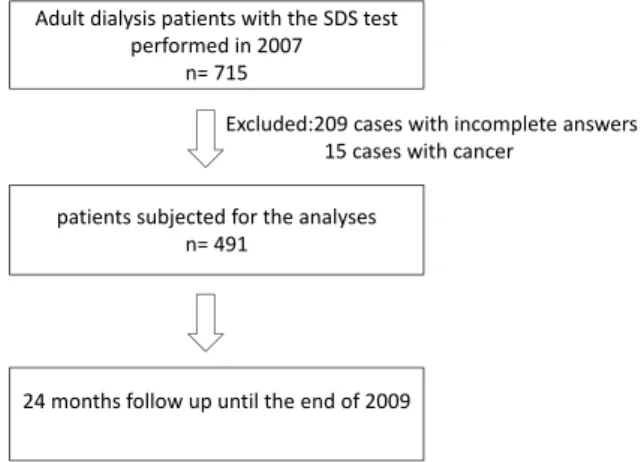
-hundred and fifteen patients underwent the SDS test ; however, 209 of those 715 provided incomplete answers to the questioners, and cancer had been found at the time of the test in 15. Thus, the remaining 491 were ultimately subjected to the analyses (Figure 1). Table 1 shows the clinical fea- tures of those 491 dialysis patients stratified by four categories of the SDS score. There were no partic- ular deviations in terms of age, gender, dialysis vin- tage, and prevalence of diabetes mellitus in these 491 patients from general features among Japanese dialysis patients.
The distribution of the SDS scores is shown in the Fig. 2. Overall, the average (SD) score was 42.8(9.8). Of the 491, 20 (4.1%) were classified with severe depression, 108 (22.0%) were with de- pression, 180 (36.7%) were as having borderline de- pression, and 183 (37.3%) were as normal, respec- tively. No significant relationship was found between the SDS score and age, vintage of dialysis therapy, sex, or complication of diabetes mellitus.
Of the 491 patients, 57 (11.6%) died during the two years of observation period due to cardiovascu- lar disease, infection, cancer, in that order. No one Figure 1
Adult dialysis patients with the SDS test performed in 2007
n= 715
patients subjected for the analyses n= 491
24 months follow up until the end of 2009
Excluded:209 cases with incomplete answers 15 cases with cancer