Fukushima Medical University
福島県立医科大学 学術機関リポジトリ
This document is downloaded at: 2021-11-08T00:12:04Z
Title
Out-of-hospital endotracheal intubation experience, confidence and confidence-associated factors among Northern Japanese emergency life-saving technicians: a population-based cross- sectional study
Author(s) Ono, Yuko; Tanigawa, Koichi; Kakamu, Takeyasu; Shinohara, Kazuaki; Iseki, Ken
Citation BMJ open. 8(7): e021858
Issue Date 2018-07-13
URL http://ir.fmu.ac.jp/dspace/handle/123456789/692
Rights © Author(s) (or their employer(s)) 2018. Re-use permitted under CC BY-NC. No commercial re-use. See rights and permissions. Published by BMJ.
DOI 10.1136/bmjopen-2018-021858
Text Version publisher
Out-of-hospital endotracheal intubation experience, confidence and confidence- associated factors among Northern
Japanese emergency life-saving
technicians: a population-based cross- sectional study
Yuko Ono,1,2,3 Koichi Tanigawa,4 Takeyasu Kakamu,5,6 Kazuaki Shinohara,3 Ken Iseki1
To cite: Ono Y, Tanigawa K, Kakamu T, et al. Out-of- hospital endotracheal intubation experience, confidence and confidence-associated factors among Northern Japanese emergency life-saving technicians: a population-based cross-sectional study. BMJ Open 2018;8:e021858. doi:10.1136/
bmjopen-2018-021858
►Prepublication history and additional material for this paper are available online. To view these files, please visit the journal online (http:// dx. doi.
org/ 10. 1136/ bmjopen- 2018- 021858).
Received 22 January 2018 Revised 2 May 2018 Accepted 6 June 2018
For numbered affiliations see end of article.
Correspondence to Dr Yuko Ono;
windmill@ fmu. ac. jp
© Author(s) (or their employer(s)) 2018. Re-use permitted under CC BY-NC. No commercial re-use. See rights and permissions. Published by BMJ.
AbstrACt
Objective Clinical procedural experience and confidence are both important when performing complex medical procedures. Since out-of-hospital endotracheal intubation (ETI) is a complex intervention, we sought to clarify clinical ETI experience among prehospital rescuers as well as their confidence in performing ETI and confidence-associated factors.
Design Population-based cross-sectional study conducted from January to September 2017.
setting Northern Japan, including eight prefectures.
Participants Emergency life-saving technicians (ELSTs) authorised to perform ETI.
Outcome measures Annual ETI exposure and confidence in performing ETI, according to a five-point Likert scale.
To determine factors associated with ETI confidence, differences between confident ELSTs (those scoring 4 or 5 on the Likert scale) and non-confident ELSTs were evaluated.
results Questionnaires were sent to 149 fire departments (FDs); 140 agreed to participate. Among the 2821 ELSTs working at responding FDs, 2620 returned the questionnaire (response rate, 92.9%); complete data sets were available for 2567 ELSTs (complete response rate, 91.0%). Of those 2567 respondents, 95.7% performed two or fewer ETI annually; 46.6% reported lack of confidence in performing ETI. Multivariable logistic regression analysis showed that years of clinical experience (adjusted OR (AOR) 1.09; 95%
CI 1.05 to 1.13), annual ETI exposure (AOR 1.79; 95% CI 1.59 to 2.03) and the availability of ETI skill retention programmes including regular simulation training (AOR 1.31; 95% CI 1.02 to 1.68) and operating room training (AOR 1.44; 95% CI 1.14 to 1.83) were independently associated with confidence in performing ETI.
Conclusions ETI is an uncommon event for most ELSTs, and nearly half of respondents did not have confidence in performing this procedure. Since confidence in ETI was independently associated with availability of regular simulation and operating room training, standardisation of ETI re-education that incorporates such methods may be useful for prehospital rescuers.
IntrODuCtIOn
Out-of-hospital cardiac arrest (OHCA) is a major public health concern worldwide.
According to data provided by the Fire and Disaster Management Agency, more than 100 000 cases of OHCA occur annually in Japan.1 Although endotracheal intubation (ETI) has long been considered the standard for definitive airway management in patients with OHCA,2 the effect of ETI during cardio- pulmonary resuscitation remains contro- versial.3–11 Several studies have identified an association between ETI and increased mortality,3–7 whereas others have found a survival benefit of ETI during cardiopulmo- nary resuscitation.9 10 A recent randomised clinical trial11 failed to demonstrate whether
strengths and limitations of this study
► To the best of our knowledge, this is the first pop- ulation-based survey to clarify the confidence level of prehospital medical rescuers in performing en- dotracheal intubation (ETI) and to investigate confi- dence-associated factors.
► The response rate was extremely high (more than 90% for all relevant analyses), minimising the non-response bias.
► As with any survey using self-administered ques- tionnaires, our study is subject to self-reporting bias, leading to a possible overestimation of clinical ETI experience and confidence among emergency life-saving technicians (ELSTs).
► Since this study was not designed to measure pa- tient outcomes, it remains to be clarified how a lack of ETI experience and low confidence among ELSTs affect outcomes of patients with out-of-hospital car- diac arrest.
on 14 July 2018 by guest. Protected by copyright.http://bmjopen.bmj.com/BMJ Open: first published as 10.1136/bmjopen-2018-021858 on 13 July 2018. Downloaded from
ETI was superior or inferior to conventional bag-valve- mask ventilation for favourable neurological outcome in the OHCA population.
The ETI experience of the laryngoscopist is known to significantly influence the outcome of patients with OHCA.12 Although healthcare professionals involved in airway management are expected to have regular clinical ETI experience, past studies have indicated limited ETI opportunities for paramedics in the USA13 and the UK.14 Emergency medical service in Japan is quite different from that in those countries,3 15 16 and little is known regarding the out-of-hospital ETI experience of Japa- nese emergency life-saving technicians (ELSTs). Previous studies on this subject in Japan have been limited to single-centre reviews.17 18 To clarify the current situation in Japan, assessment of population-based data from a broader geographical area is necessary.
Out-of-hospital ETI is a complex procedure that can be fraught with errors and severe adverse events, even for skilled laryngoscopists.19–21 Self-confidence plays an important role when performing such high-risk, diffi- cult medical interventions.22–26 For example, previous studies have shown that greater self-confidence correlates with better clinical performance.25 26 An example of this phenomenon from outside the medical field is that more confident athletes perform significantly better than less confident athletes.27 28 Therefore, it is important to understand self-perceived competency and its associated factors in performing out-of-hospital ETI. However, to date, there has been no thorough evaluation of self-con- fidence levels and associated factors related to airway management skills among prehospital rescuers.
In this study, we investigated (1) clinical ETI experi- ence and (2) self-confidence levels related to ETI and confidence-associated factors among Northern Japanese ELSTs. The findings of this population-based survey reveal areas for improvement and the need for better training programmes for ETI skill retention.
MethODs
Consent to participate
The board regarded return of the questionnaire as consent to participate.
study design, setting and subjects
This cross-sectional study was conducted from January 2017 to September 2017 (planning phase, January to June; survey phase, July to September). The emergency medical service system in Japan has been described previ- ously.3 15 16 29 Briefly, an ambulance crew typically consists of three emergency medical service personnel, including at least one ELST who has completed extensive training.
These ELSTs are permitted to insert intravenous lines, use semi-automated external defibrillators and use supra- glottic airway devices (SGAs) for patients with OHCA.
Since 2004, under the direction of online medical control, ETI can be performed in patients with OHCA
by specially trained ELSTs who have completed an addi- tional 62 hours of training and performed 30 successful supervised ETI in operating rooms. Since 2011, ELSTs have also been allowed to use rigid video laryngoscopes after completion of additional training.30 ELSTs in Japan are not permitted to perform ETI except in patients with OHCA. The indications for ETI in patients with OHCA31 include: (1) impossibility of maintaining ventilation without ETI, such as foreign-body airway obstruction, and (2) cases in which the medical control doctor judges ETI to be required.
Our target subjects were all ELSTs authorised to perform ETI (defined as advanced-level ELSTs in this study) in Northern Japan, which includes eight prefec- tures (Hokkaido, Aomori, Iwate, Akita, Miyagi, Yamagata, Fukushima and Niigata). In Northern Japan, 149 fire departments (FDs) with dispatch centres provide emer- gency medical service for roughly 16.7 million inhabitants in an area of approximately 163 000 km2.
Questionnaire development
When selecting items for the questionnaire, we referred to relevant studies that similarly assessed ETI experience, proficiency and skill development among paramedics in the USA and UK.13 14 23 32–35 We also referred to previous reports that assessed competence and confidence with airway management skills among military advanced life support providers,24 emergency physicians,36 paediatric emergency medicine fellows,37 38 medical students39 40 and general practitioners.41 We then circulated drafts among the survey team members (an epidemiologist, anaesthe- siologists, physicians specialising in emergency medicine and an ELST) before finalising the questionnaire. During the planning phase, the clarity and relevance of each survey item were checked using convenient samples from FDs in Fukushima and Koriyama. English versions of the Japanese questionnaires used in this study are included as online supplementary data S1 and S2.
survey protocol and items
To target ELSTs allowed to perform ETI, a two-phase postal approach was used. Prepaid return envelopes with preprinted addresses were used throughout the process to increase the response rate, but no incentives were offered.
Owing to the satisfactory response rate (see the Results section), no non-response follow-up techniques such as phone calls or reminder letters were used.
First, to obtain data about facility characteristics, self-administered questionnaires (see online supplemen- tary data S3) were mailed to every director of Northern Japanese FDs (149 FDs in eight prefectures) in July 2017.
These facilities were extracted from the website of the Japanese Fire Chiefs’ Association.42 A complete list of these FDs is included as online supplementary data S3.
The initial survey asked: (1) the number of ELSTs (both basic and advanced level), (2) the total number of ambu- lance dispatches and ambulance dispatches for OHCA in 2016 and (3) the availability of a rigid video laryngoscope
on 14 July 2018 by guest. Protected by copyright.http://bmjopen.bmj.com/BMJ Open: first published as 10.1136/bmjopen-2018-021858 on 13 July 2018. Downloaded from
and its product name. The definition of functional urban area of Organisation for Economic Co-operation and Development countries was used to identify urban areas.43 In brief, urban FDs were defined as those in cities with 50 000 or more inhabitants.
After completion of the initial survey, anonymous ques- tionnaires (see online supplementary data S2) were sent to each responding FD in August 2017. All FD directors were asked to distribute and collect the surveys from advanced- level ELSTs allowed to perform ETI. The secondary survey requested participants’ demographic data, including age;
sex; years of experience after achieving basic-level or advanced-level ELST status; provider or instructor status for American Heart Association-certified cardiopulmo- nary resuscitation courses, including Basic Life Support, Advanced Cardiovascular Life Support and Pediatric Advanced Life Support and provider or instructor status for the Japanese version of the cardiopulmonary resus- citation course (Immediate Cardiac Life Support) and basic trauma life support course (Japan Prehospital Trauma Evaluation and Care). The advanced-level ELSTs were also asked about their ETI procedural experience in 2016 and available ETI skill-maintenance programmes, including regular simulation training using a mannequin and re-education in the operating room. Finally, the survey queried respondents’ confidence in airway management skills (including manual bag-mask ventilation, SGA inser- tion and ETI); their anxiety about lack of clinical ETI experience, ETI skill retention and lack of proper ETI re-education programmes and the perceived importance of ETI in patients with OHCA and of ETI education on the use of a video laryngoscope. Five-point Likert scales were employed to measure confidence in performing airway-management procedures (1=not confident at all, 2=minimally confident, 3=somewhat confident, 4=confi- dent, 5=very confident) and anxiety regarding clinical ETI experience and skill retention (1=not anxious at all, 2=minimally anxious, 3=somewhat anxious, 4=anxious, 5=very anxious). Participants also indicated their degree of agreement with the following two statements: ‘ETI is an important life-saving procedure for OHCA’ and
‘Education on the use of video laryngoscopes should be strengthened’ (1=completely disagree, 2=disagree, 3=neither agree nor disagree, 4=agree, 5=completely agree).
Outcome measures and statistical analysis
Outcomes of interest in this study were: (1) annual ETI procedural experience and (2) confidence and confi- dence-associated factors in performing ETI. Annual ETI procedural experience was chosen as an outcome measure because the ELST’s experience with prehos- pital ETI can influence outcomes of patients with OHCA.12 Since greater self-confidence is correlated with better clinical performance,22–26 confidence in performing ETI was also included as an outcome measure. Responders were blinded to our outcome assessment plans.
All survey items were initially evaluated with descrip- tive statistics. To determine the factors associated with ETI confidence, differences between confident and non-confident ELSTs were compared. Confident ELSTs were defined as those who reported an ETI confidence of 4 or 5 on the Likert scale. Differences in continuous variables were compared with Student’s t-test or the Mann-Whitney U test for normally and non-normally distributed data, respectively, after application of the Shapiro-Wilk test for normality. Differences in categor- ical variables were compared with a Χ2 test. Univariable and multivariable logistic regression models were fitted to yield a crude and an adjusted OR (AOR) for confident status in performing ETI. In addition to sex, imbalanced characteristics between confident and non-confident ELSTs (variables with p<0.05 in table 1, see the Results section), such as age, years of clinical experience, certi- fication in video laryngoscope use, annual ETI experi- ence, instructor status for cardiopulmonary and trauma resuscitation courses and availability of specific ETI skill retention programmes, were included as independent variables in the logistic regressions.
In the sensitivity analyses, different definitions for confi- dence status in performing ETI were used. We repeated the multivariable analyses comparing ELSTs who scored 5 versus ≤4 and ≥3 versus ≤2 on the Likert scale for ETI confidence.
In all multivariable analyses, a variance inflation factor was used to detect multicollinearity. The models’ good- ness of fit and discrimination ability were confirmed with the Hosmer-Lemeshow test and the c statistic, respectively.
Since less than 3% of data points were missing for all anal- yses, missing observations were excluded, and complete data sets were used for all relevant analyses. The associ- ations between ETI frequency and ELST characteristics, between confidence in performing ETI and confidence in other airway management skills, and between confidence in performing ETI and anxiety about ETI skill retention were assessed with Spearman’s rank-order coefficient (rs).
All statistical analyses were performed with SPSS Statis- tics for Windows, V.22.0 (IBM Corp). A p value <0.05 was considered statistically significant.
Patient and public involvement
No patients and public were involved in the development of the research question or the outcome measures nor the design of the study.
results
Facility characteristics of the responding FDs
In the initial survey, 140 of 149 Northern Japanese FDs returned a completed questionnaire (response rate, 94.0%). Online supplementary table S1 shows the facility characteristics of the responding FDs. The median number of annual ambulance dispatches per FD was 2223 (IQR 1229–4182); the median number of annual ambu- lance dispatches for OHCA was 70 (IQR 40–152). A rigid
on 14 July 2018 by guest. Protected by copyright.http://bmjopen.bmj.com/BMJ Open: first published as 10.1136/bmjopen-2018-021858 on 13 July 2018. Downloaded from
video laryngoscope was available at 68.6% of the FDs that responded. Of the 5962 ELSTs working at a responding FD, 2821 (47.3%) were advanced-level ELSTs authorised to perform ETI.
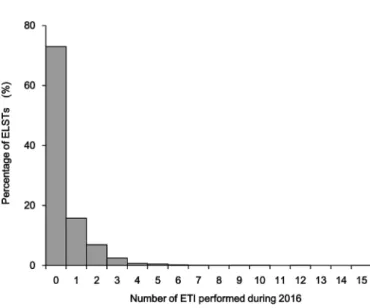
Clinical etI experience among northern Japanese elsts Of 2821 advanced-level ELSTs, 2620 returned a completed questionnaire in the second-phase survey (response rate, 92.9%). Of those respondents, complete data were avail- able for 2567 (complete response rate, 91.0%); these were included in all relevant analyses. Figure 1 shows the frequency distribution of annual ETI experience. Among the 2567 ELSTs, 1875 (73.0%) did not have any ETI opportunities, and 2457 (95.7%) were exposed to two or fewer ETI opportunities annually. The median number of ETIs performed by ELSTs was 0 (IQR 0–1; range 0–15). Even distribution of all ETI procedures among all ELSTs would result in only 0.5 ETI per capita. There were negligible correlations between ETI frequency and age (rs=−0.101, p<0.001), years of experience after achieving basic-level (rs=−0.106, p<0.001) or advanced- level (rs=−0.062, p=0.002) ELST status and annual OHCA case load per capita (rs=0.055, p=0.005). There
Figure 1 Frequency distribution of annual ETI experiences among Northern Japanese ELSTs. Based on the replies of 2567 of the 2821 ELSTs queried. Total number of ETI was 1225. ELST, emergency life-saving technician;
ETI, endotracheal intubation.
Table 1 Differences in demographic characteristics among Northern Japanese ELSTs according to confidence* in performing ETI
All (n=2567)
Confidence* in performing ETI
P values No (n=1196) Yes (n=1371)
Age, years 41 (35–46) 40 (34–46) 42 (37–47) <0.001
Male sex 2533 (98.7) 1175 (98.2) 1358 (99.1) 0.074
Years of experience after becoming basic-level ELST 12 (8–15) 11 (7–15) 12 (9–16) <0.001 Years of experience after becoming advanced-level ELST† 6 (3–9) 5 (3–8) 7 (4–10) <0.001 Allowed to use rigid video laryngoscope‡ 995 (38.8) 426 (35.6) 569 (41.5) 0.002
Working at an urban FD§ 838 (32.6) 400 (33.4) 438 (31.9) 0.423
Duration of hospital training, months¶ 1.5 (1–2) 1.4 (1–2) 1.5 (1–2) 0.910
Basic Life Support instructor 99 (3.9) 46 (3.8) 53 (3.9) 1.000
Advanced Cardiovascular Life Support instructor 17 (0.7) 5 (0.4) 12 (0.9) 0.154
Pediatric Advanced Life Support instructor 2 (0.1) 0 (0) 2 (0.1) 0.186
Immediate Cardiac Life Support** instructor 182 (7.1) 63 (5.3) 119 (8.7) 0.001 Japan Prehospital Trauma Evaluation and Care†† instructor 493 (19.2) 209 (17.5) 284 (20.7) 0.038
Annual ETI experience (ETI/year)‡‡ 0 (0–1) 0 (0–0) 0 (0–1) <0.001
Available retraining programmes for ETI skill retention
Regular simulation training using a mannequin 2192 (85.4) 999 (83.5) 1193 (87.0) 0.013
Regular training in operating room 476 (18.5) 191 (16.0) 285 (20.8) 0.002
Other training programmes 249 (9.7) 114 (9.5) 135 (9.8) 0.788
Values are presented as median (IQR) or number (%).
*Confident status is defined as a score of 4 (‘confident’) or 5 (‘very confident’) on the Likert scale for confidence.
†Specially trained ELST authorised to perform ETI for patients with OHCA.
‡In Japan, ELSTs are not allowed to use a rigid video laryngoscope before completion of additional training.
§FDs in cities with 50 000 or more inhabitants.
¶In Japan, ELSTs need to complete 30 successful supervised ETI in operating rooms to be authorised to perform ETI for patients with OHCA.
**Japanese version of cardiopulmonary resuscitation course.
††Japanese version of basic trauma life support course.
‡‡The mean number of annual ETI opportunities was 0.673 for confident ELSTs and 0.253 for non-confident ELSTs.
ELST, emergency life-saving technician; ETI, endotracheal intubation; FD, fire department; OHCA, out-of-hospital cardiac arrest.
on 14 July 2018 by guest. Protected by copyright.http://bmjopen.bmj.com/BMJ Open: first published as 10.1136/bmjopen-2018-021858 on 13 July 2018. Downloaded from
were no significant correlations between ETI frequency and other characteristics of the ELSTs, including male sex (rs=−0.022, p=0.262) and working at an urban FD (rs=−0.007, p=0.733). Although ETI was an uncommon event for most ELSTs, more than half perceived ETI as an important life-saving technique (online supplemen- tary figure S1). Nearly half of respondents believed that education on the use of a video laryngoscope should be strengthened (online supplementary figure S1).
reported etI confidence and confidence-associated factors among northern Japanese elsts
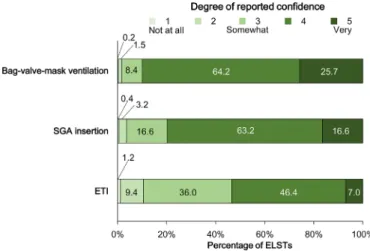
As shown in figure 2, approximately 50% of respondents reported confidence (defined as 4 or 5 on the Likert scale) in performing ETI; this percentage was relatively low compared to the percentage reporting confidence in other airway management skills. There were moderate positive correlations between confidence levels in ETI and SGA insertion (rs=0.468, p<0.001) and bag-valve- mask ventilation (rs=0.419, p<0.001; online supplemen- tary table S2).
As shown in figure 3, 87.8% of ELSTs had anxiety (defined as 4 or 5 on the Likert scale) about their lack of ETI experience; 63.5% had anxiety about ETI skill reten- tion and 44.3% about the lack of proper ETI re-education programmes. There was a moderate negative correlation between level of ETI confidence and anxiety about ETI skill retention (rs=−0.458, p<0.001; online supplementary table S2). We also observed a weak negative correlation between level of ETI confidence and anxiety about lack of ETI clinical experience (rs=−0.212, p<0.001) and anxiety about lack of proper ETI skill retention programmes (rs=−0.178, p<0.001; online supplementary table S2).
Table 1 compares the demographic characteristics of ELSTs according to their confidence in performing ETI.
Annual ETI experience, age and years of experience after achieving basic or advanced status were associated with confidence in performing ETI (p<0.001 for each). The availability of ETI skill retention programmes, including regular simulation training using a mannequin and re-ed- ucation in the operating room, was significantly greater (p=0.013 and p=0.002, respectively) for confident ELSTs.
Confident ELSTs were also more likely than non-con- fident ELSTs to be instructors of the Japanese versions of cardiopulmonary resuscitation and basic trauma life support courses (p=0.001 and p=0.038, respectively).
The results of univariable and multivariable analyses for ETI confidence are shown in table 2. After adjustment with the multivariable logistic regression model, years of experience after becoming an advanced-level ELST (AOR 1.09; 95% CI 1.05 to 1.13), annual ETI experience (AOR 1.79; 95% CI 1.59 to 2.03), availability of regular simula- tion training using a mannequin (AOR 1.31; 95% CI 1.02 to 1.68) and availability of regular operating room training (AOR 1.44; 95% CI 1.14 to 1.83) were independently asso- ciated with confidence in performing ETI. The Hosmer-Le- meshow test verified the good fit of this model (p=0.314);
the c statistic for this logistic model was 0.745 (95% CI 0.726 to 0.764), suggesting acceptable discrimination.
In sensitivity analyses, the adjusted associations between ETI confidence and years of experience as an advanced- level ELST and annual procedural ETI experience persisted with the use of two different definitions of ETI confidence (online supplementary table S3).
DIsCussIOn
This population-based cross-sectional study conducted in Northern Japan revealed that more than 95% of Figure 2 Self-reported level of confidence in airway
management skills among Northern Japanese ELSTs.
Based on the replies of 2567 of the 2821 ELSTs queried.
Confidence in performing airway management procedures was measured with a five-point Likert scale (1=not confident, 2=minimally confident, 3=somewhat confident, 4=confident, 5=very confident). ELST, emergency life-saving technician;
ETI, endotracheal intubation; SGA, supraglottic airway device.
Figure 3 Degree of reported anxiety about ETI experience, skill retention and re-education programmes among Northern Japanese ELSTs. Based on the replies of 2567 of the 2821 ELSTs queried. Anxiety was measured with a five-point Likert scale (1=not anxious at all, 2=minimally anxious, 3=somewhat anxious, 4=anxious, 5=very anxious). ELST, emergency life-saving technician;
ETI, endotracheal intubation.
on 14 July 2018 by guest. Protected by copyright.http://bmjopen.bmj.com/BMJ Open: first published as 10.1136/bmjopen-2018-021858 on 13 July 2018. Downloaded from
prehospital rescuers were involved in few or no ETI annually. Nearly half of Japanese ELSTs did not have confidence in their ability to perform ETI, and most had anxiety about their lack of clinical ETI experience and skill retention. Confidence in performing ETI was independently associated with years of clinical experi- ence, annual ETI exposure, availability of regular simu- lation training and availability of regular operating room training. Since the last two factors are modifiable, ETI re-education that incorporates these training modalities should be considered.
Consistent with prior studies from the UK and the USA13 14 and with single-centre experiences in Japan,17 18 ETI opportunities for most Northern Japanese ELSTs in this study were limited. Previous studies did not assess the associations between ETI opportunities and the demographic data of rescuers.13 14 17 18 To address this knowledge gap, we examined these relationships but found almost no correlations between ETI frequency and characteristics of the ELSTs, including age, sex, years of experience and urban versus rural setting. These data suggest that ETI opportunities are equally limited among all ELSTs in Northern Japan. The reasons for the limited ETI experiences among Japanese ELSTs are likely multi- factorial; potential explanations include strict ETI proto- cols,31 rare recommendation by medical controls for ETI, prehospital rescuers’ hesitation in performing interven- tions in which they lack confidence or some combination of these factors. With limited experience, it is difficult to
maintain proficiency in out-of-hospital ETI. Confirming this association, most ELSTs were anxious about their lack of clinical ETI experience and skill retention, and ETI confidence was associated with annual exposure. Many Japanese ELSTs are likely frustrated because more than half regarded ETI as an important life-saving technique.
Inadequate ETI procedural experience, low confi- dence and high anxiety among Japanese ELSTs might lead to poorer outcomes for patients with OHCA who need advanced airway management. In fact, a previous study indicated that ETI by Japanese ELSTs was inde- pendently associated with poorer neurological outcomes among adult patients with OHCA.3 One option to address this problem is to remove ETI from the skill set of ELSTs, as previously advocated by Wang et al.13 However, this approach disregards situations in which ETI is indicated, such as airway obstruction. Since annual ETI exposure is independently associated with ETI confidence, another option is to assure exposure by concentrating ETI in the hands of fewer skilled providers.13 However, in Japan, there is currently no agency responsible for accreditation of ETI performance among ELSTs.18 A previous study found that a rigid video laryngoscope enabled Japanese ELSTs to achieve a high ETI success rate in the operating room, regardless of previous experience with a direct laryngoscope.30 A third option to address the current situation is therefore strengthening education on the use of a video laryngoscope. Nearly half of surveyed ELSTs agreed with this idea. However, in this study, there was Table 2 Factors associated with ETI confidence* among Northern Japanese ELSTs
Univariable analysis† Multivariable analysis†‡
OR (95% CI) P values AOR (95% CI) P values
Age 1.03 (1.02 to 1.04) <0.001 1.01 (1.00 to 1.02) 0.232
Male sex 1.87 (0.93 to 3.75) 0.074 1.82 (0.85 to 3.93) 0.125
Years of experience after becoming a basic-level ELST 1.04 (1.03 to 1.06) <0.001 Years of experience after becoming an advanced-level
ELST§ 1.09 (1.07 to 1.12) <0.001 1.09 (1.05 to 1.13) <0.001
Allowed to use a rigid video laryngoscope¶ 1.28 (1.09 to 1.51) 0.002 1.04 (0.87 to 1.25) 0.659 Annual ETI experience 1.70 (1.52 to 1.90) <0.001 1.79 (1.59 to 2.03) <0.001 Immediate Cardiac Life Support** instructor 1.71 (1.25 to 2.34) 0.001 1.43 (0.98 to 2.08) 0.066 Japan Prehospital Trauma Evaluation and Care††
instructor 1.23 (1.01 to 1.50) 0.038 0.95 (0.75 to 1.20) 0.649
Availability of regular simulation training using a
mannequin 1.32 (1.06 to 1.65) 0.013 1.31 (1.02 to 1.68) 0.038
Availability of regular training in operating room 1.38 (1.13 to 1.69) 0.002 1.44 (1.14 to 1.83) 0.003
*Confident status is defined as a score of 4 (‘confident’) or 5 (‘very confident’) on the Likert scale for confidence.
†The reference set was ELSTs who were not confident in performing ETI.
‡Adjustment for all variables included in the table. Good fit was verified by the Hosmer-Lemeshow test (p=0.314). The c statistic for the model was 0.745 (95% CI 0.726 to 0.764). ‘Years of experience after becoming a basic-level ELST’ was not used as an explanatory variable because of the strong correlation with ‘Years of experience after becoming an advanced-level ELST’.
§Specially trained ELST authorised to perform ETI for patients with out-of-hospital cardiac arrest.
¶In Japan, ELSTs are not allowed to use a rigid video laryngoscope before completion of additional training.
**Japanese version of cardiopulmonary resuscitation course.
††Japanese version of basic trauma life support course.
AOR, adjusted OR; ELST, emergency life-saving technicians; ETI, endotracheal intubation.
on 14 July 2018 by guest. Protected by copyright.http://bmjopen.bmj.com/BMJ Open: first published as 10.1136/bmjopen-2018-021858 on 13 July 2018. Downloaded from
insufficient availability both of video laryngoscopes and of ELSTs permitted to use the device. Our findings reveal the current situation to policy-makers in the community and in national organisations and provide the oppor- tunity to rethink the current practical configuration of advanced prehospital airway management for the OHCA population.
In Japan, airway management skill re-education programmes for ELSTs depend on local medical controls and are not standardised.18 We believe that improving and standardising airway intervention re-education is important to provide better prehospital care. In this study, retraining in the operating room was independently associated with ETI confidence, but opportunities for this training were limited. Similarly, limited opportunities for operating room exposure for prehospital rescuers have been reported in the USA.32 Although previous research has documented that simulation training is useful for the development of critical intervention skills, data regarding how this training modality affects competency in performing ETI among prehospital rescuers are scare.44 In this population-based survey, we observed that the availability of regular simulation training was independently correlated with ETI confidence among Japanese ELSTs. Collectively, our data underscore the need for reinforcement of airway re-education methodology (eg, training in a controlled setting and the use of simulators) for inexperienced providers to improve their ETI confi- dence. Improved confidence will, in turn, improve perfor- mance. This increased confidence may also be beneficial for other airway management skills, because the level of ETI confidence was moderately associated with confidence in bag-valve-mask ventilation and SGA insertion.
Our survey also revealed that more than 40% of ELSTs were anxious about the lack of proper ETI skill reten- tion programmes currently available in Japan. Japa- nese national bureaus, professional organisations, local medical controls, anaesthesiologists and emergency physicians should work together to address this problem.
We believe that there is an enhanced opportunity to improve the quality of ETI re-education programmes, if the leadership and guidance of governmental and profes- sional agencies are strengthened.
We believe our study has several implications. For ELSTs, our observations provide a reference point regarding their ETI procedural experience, confidence and avail- able skill maintenance programmes. Additionally, for decision-makers, professional organisations and medical controls, our findings indicate room for improvement and suggest that standardisation and dissemination of appro- priate nationwide ETI re-education training are warranted.
study limitations and advantages
Our study had several limitations. First, as with any cross-sectional study that uses a self-administered ques- tionnaire, self-reporting bias (both social desirability and recall bias) was possible. Since clinicians and FD directors were involved in the survey collection process, there may also have been administration bias. If so, ETI experience
and confidence may be even poorer than those reported in this survey. To decrease the effects of social desirability and administration bias, we used anonymous question- naires in the second-phase survey. Responders were also blinded to our outcome assessment plans. To mitigate recall bias, we asked ELSTs for their most recent 1 year of ETI experience. Given these potential biases, achieving a high response rate is critical to ensure the quality of data in an epidemiological survey; one major advantage of the present study is that it had few non-responders (less than 10% for all relevant analyses).
Second, we did not design this study to measure patient outcomes or the ETI procedure itself. Nevertheless, we speculate that lack of ETI confidence might worsen the outcomes of patients with OHCA, because this study showed that ETI confidence was significantly associated with annual ETI experience, and a previous study12 demonstrated that ETI experience significantly influenced the outcomes of patients with OHCA. Further studies are required to clarify how lack of ETI confidence affects the ETI procedure and outcomes of patients with OHCA.
Third, our population-based study describes the situ- ation in Northern Japan only. A similar study with data from other areas of Japan or other countries could result in different findings. For example, while ETI is a rela- tively new skill for ELSTs in Japan, paramedics in the USA have performed ETI in clinical practice for over 30 years and may possess greater clinical exposure to and comfort with ETI.45
Despite these limitations, this study also had several strengths. In addition to the above-mentioned high-response rate, this study is the first to investigate the factors associ- ated with ETI confidence among prehospital rescuers. Our survey provides an opportunity to re-evaluate current ETI practice and re-education programmes among Northern Japanese ELSTs. We believe that the quality improvement implications of our results would be beneficial not only for our study population but also for other countries.
COnClusIOns
This population-based cross-sectional study revealed that most Northern Japanese ELSTs were involved in only a few or no ETI annually and lacked confidence in performing ETI. In addition, many had anxiety about ETI skill reten- tion and felt that proper ETI re-education programmes were lacking. ETI re-education that incorporates regular simulation training and operating room exposure may be beneficial for prehospital rescuers, because the avail- ability of those two training modalities was independently associated with ETI confidence.
Author affiliations
1Emergency and Critical Care Medical Center, Fukushima Medical University, Fukushima, Japan
2Department of Pharmacology, School of Medicine, Fukushima Medical University, Fukushima, Japan
3Department of Anesthesiology, Ohta General Hospital Foundation, Ohta Nishinouchi Hospital, Koriyama, Japan
on 14 July 2018 by guest. Protected by copyright.http://bmjopen.bmj.com/BMJ Open: first published as 10.1136/bmjopen-2018-021858 on 13 July 2018. Downloaded from
4Fukushima Global Medical Science Center, Fukushima Medical University, Fukushima, Japan
5Department of Hygiene and Preventive Medicine, School of Medicine, Fukushima Medical University, Fukushima, Japan
6Section of Environment and Radiation, International Agency for Research on Cancer, Lyon, France
Acknowledgements We thank all of the participating FDs and ELSTs for their earnest cooperation in this project. We also thank the following persons: Ms Siho Sato (Emergency and Critical Care Medical Center, Fukushima Medical University Hospital, Fukushima) and Ms Kasumi Ouchi (Office for Gender Equality Support, Fukushima Medical University, Fukushima) for their secretarial assistance; Mr Takashi Minowa (an advanced-level ELST, Fukushima FD, Fukushima) for his assistance in generating the questionnaire; Aya Goto, MD, PhD, MPH (Integrated Center for Science and Humanities, Fukushima Medical University, Fukushima) and Nozomi Ono, MD (Department of Psychiatry, Hoshigaoka Hospital, Koriyama, Japan) for their assistance in reviewing the manuscript and Rebecca Tollefson, DVM, from Edanz Group (www. edanzediting. com/ ac) for editing a draft of this manuscript.
Contributors YO conceived the study design, drafted the initial manuscript and takes primary responsibility for the paper as a whole. KS, KT and KI supervised the undertaking of the survey and data collection. YO and TK managed the data and performed the statistical analysis. All authors contributed to the construction of the questionnaire, interpreted the survey results, participated in related discussions, contributed substantially to its revision and read and approved the final version of the manuscript.
Funding This research received no specific grant from any funding agency in the public, commercial or not-for-profit sectors.
Competing interests None declared.
Patient consent Not required.
ethics approval This study was approved by the Institutional Review Board at Fukushima Medical University (no 2989) on 23 February 2017.
Provenance and peer review Not commissioned; externally peer reviewed.
Data sharing statement Extra data can be accessed via the Dryad data repository at http:// datadryad. org/ with doi: 10.5061/dryad.f1vn500.
Open access This is an open access article distributed in accordance with the Creative Commons Attribution Non Commercial (CC BY-NC 4.0) license, which permits others to distribute, remix, adapt, build upon this work non-commercially, and license their derivative works on different terms, provided the original work is properly cited, appropriate credit is given, any changes made indicated, and the use is non-commercial. See: http:// creativecommons. org/ licenses/ by- nc/ 4. 0/.
reFerenCes
1. Fire and Disaster Management Agency. http://www. fdma. go. jp/
neuter/ topics/ houdou/ h21/ 2101/ 210122- 1houdou_ h. pdf (accessed Jan 2018).
2. Wang HE, Yealy DM. Out-of-hospital endotracheal intubation: where are we? Ann Emerg Med 2006;47:532–41.
3. Hasegawa K, Hiraide A, Chang Y, et al. Association of prehospital advanced airway management with neurologic outcome and survival in patients with out-of-hospital cardiac arrest. JAMA 2013;309:257–66.
4. Hanif MA, Kaji AH, Niemann JT. Advanced airway management does not improve outcome of out-of-hospital cardiac arrest. Acad Emerg Med 2010;17:926–31.
5. Studnek JR, Thestrup L, Vandeventer S, et al. The association between prehospital endotracheal intubation attempts and survival to hospital discharge among out-of-hospital cardiac arrest patients.
Acad Emerg Med 2010;17:918–25.
6. Shin SD, Ahn KO, Song KJ, et al. Out-of-hospital airway management and cardiac arrest outcomes: a propensity score matched analysis. Resuscitation 2012;83:313–9.
7. Egly J, Custodio D, Bishop N, et al. Assessing the impact of prehospital intubation on survival in out-of-hospital cardiac arrest.
Prehosp Emerg Care 2011;15:44–9.
8. Becker TK, Berning AW, Prabhu A, et al. An assessment of ventilation and perfusion markers in out-of-hospital cardiac arrest patients receiving mechanical CPR with endotracheal or supraglottic airways.
Resuscitation 2018;122:61–4.
9. McMullan J, Gerecht R, Bonomo J, et al. Airway management and out-of-hospital cardiac arrest outcome in the CARES registry.
Resuscitation 2014;85:617–22.
10. Chiang WC, Hsieh MJ, Chu HL, et al. The effect of successful intubation on patient outcomes after out-of-hospital cardiac arrest in Taipei. Ann Emerg Med 2018;71:387–96.
11. Jabre P, Penaloza A, Pinero D, et al. Effect of bag-mask ventilation vs endotracheal intubation during cardiopulmonary resuscitation on neurological outcome after out-of-hospital cardiorespiratory arrest: a randomized clinical trial. JAMA 2018;319:779–87.
12. Wang HE, Balasubramani GK, Cook LJ, et al. Out-of-hospital endotracheal intubation experience and patient outcomes. Ann Emerg Med 2010;55:527–37.
13. Wang HE, Kupas DF, Hostler D, et al. Procedural experience with out- of-hospital endotracheal intubation. Crit Care Med 2005;33:1718–21.
14. Deakin CD, King P, Thompson F. Prehospital advanced airway management by ambulance technicians and paramedics: is clinical practice sufficient to maintain skills? Emerg Med J 2009;26:888–91.
15. Hagihara A, Hasegawa M, Abe T, et al. Prehospital epinephrine use and survival among patients with out-of-hospital cardiac arrest.
JAMA 2012;307:1161–8.
16. Kitamura T, Iwami T, Kawamura T, et al. Nationwide public-access defibrillation in Japan. N Engl J Med 2010;362:994–1004.
17. Okazaki Y, Kusunoki S, Kawamoto M. [Out-of-hospital tracheal intubation practice by advanced level ambulance crews and reeducation program for skill retention: survey of emergency life saving technicians]. Masui 2011;60:757–62.
18. Ota I, Sakata I, Maruyama K, et al. “About reeducation of tracheal intubation” for emergency medical technicians: current situation and problems viewed from questionnaire]. Journal of Japanese Association for Acute Medicine 2017;28:308–13.
19. Adnet F, Borron SW, Racine SX, et al. The intubation difficulty scale (IDS): proposal and evaluation of a new score characterizing the complexity of endotracheal intubation. Anesthesiology 1997;87:1290–7.
20. Timmermann A, Russo SG, Eich C, et al. The out-of-hospital esophageal and endobronchial intubations performed by emergency physicians. Anesth Analg 2007;104:619–23.
21. Ufberg JW, Bushra JS, Karras DJ, et al. Aspiration of gastric contents: association with prehospital intubation. Am J Emerg Med 2005;23:379–82.
22. Maibach EW, Schieber RA, Carroll MF. Self-efficacy in pediatric resuscitation: implications for education and performance. Pediatrics 1996;97:94–9.
23. Youngquist ST, Henderson DP, Gausche-Hill M, et al. Paramedic self-efficacy and skill retention in pediatric airway management. Acad Emerg Med 2008;15:1295–303.
24. Sergeev I, Lipsky AM, Ganor O, et al. Training modalities and self- confidence building in performance of life-saving procedures. Mil Med 2012;177:901–6.
25. Davis DP, Campbell CJ, Poste JC, et al. The association between operator confidence and accuracy of ultrasonography performed by novice emergency physicians. J Emerg Med 2005;29:259–64.
26. Dayal AK, Fisher N, Magrane D, et al. Simulation training improves medical students' learning experiences when performing real vaginal deliveries. Simul Healthc 2009;4:155–9.
27. Bray SR, Balaguer I, Duda JL. The relationship of task self-efficacy and role efficacy beliefs to role performance in Spanish youth soccer.
J Sports Sci 2004;22:429–37.
28. Woodman T, Hardy L. The relative impact of cognitive anxiety and self-confidence upon sport performance: a meta-analysis. J Sports Sci 2003;21:443–57.
29. Tanigawa K, Tanaka K. Emergency medical service systems in Japan:
past, present, and future. Resuscitation 2006;69:365–70.
30. Ota K, Sadamori T, Kusunoki S, et al. Influence of clinical experience of the Macintosh laryngoscope on performance with the Pentax- AWS Airway Scope(®), a rigid video-laryngoscope, by paramedics in Japan. J Anesth 2015;29:672–7.
31. Kajino K, Iwami T, Kitamura T, et al. Comparison of supraglottic airway versus endotracheal intubation for the pre-hospital treatment of out-of-hospital cardiac arrest. Crit Care 2011;15:R236.
32. Johnston BD, Seitz SR, Wang HE. Limited opportunities for paramedic student endotracheal intubation training in the operating room. Acad Emerg Med 2006;13:1051–5.
33. Wang HE, Seitz SR, Hostler D, et al. Defining the learning curve for paramedic student endotracheal intubation. Prehosp Emerg Care 2005;9:156–62.
34. Pollock MJ, Brown LH, Dunn KA. The perceived importance of paramedic skills and the emphasis they receive during EMS education programs. Prehosp Emerg Care 1997;1:263–8.
on 14 July 2018 by guest. Protected by copyright.http://bmjopen.bmj.com/BMJ Open: first published as 10.1136/bmjopen-2018-021858 on 13 July 2018. Downloaded from
35. Warner KJ, Carlbom D, Cooke CR, et al. Paramedic training for proficient prehospital endotracheal intubation. Prehosp Emerg Care 2010;14:103–8.
36. Rognås LK, Hansen TM. EMS-physicians' self reported airway management training and expertise; a descriptive study from the Central Region of Denmark. Scand J Trauma Resusc Emerg Med 2011;19:10.
37. Al-Eissa M, Chu S, Lynch T, et al. Self-reported experience and competence in core procedures among Canadian pediatric emergency medicine fellowship trainees. CJEM 2008;10:533–8.
38. Mills DM, Wu CL, Williams DC, et al. High-fidelity simulation enhances pediatric residents' retention, knowledge, procedural proficiency, group resuscitation performance, and experience in pediatric resuscitation. Hosp Pediatr 2013;3:266–75.
39. Ernst KD, Cline WL, Dannaway DC, et al. Weekly and consecutive day neonatal intubation training: comparable on a pediatrics clerkship. Acad Med 2014;89:505–10.
40. Dehmer JJ, Amos KD, Farrell TM, et al. Competence and confidence with basic procedural skills: the experience and opinions of fourth-year medical students at a single institution. Acad Med 2013;88:682–7.
41. Wisborg T, Brattebø G. Confidence and experience in emergency medicine procedures. Norwegian general practitioners. Scand J Prim Health Care 2001;19:99–100.
42. The Japanese Fire Chiefs’ Association website. https://www. fcaj. gr.
jp/ link/ (accessed Jan 2017).
43. OECD data. Urban population by city size. https:// data. oecd. org/
popregion/ urban- population- by- city- size. htm (accessed Jan 2017).
44. Davis DP, Buono C, Ford J, et al. The effectiveness of a novel, algorithm-based difficult airway curriculum for air medical crews using human patient simulators. Prehosp Emerg Care 2007;11:72–9.
45. Wang HE, Szydlo D, Stouffer JA, et al. Endotracheal intubation versus supraglottic airway insertion in out-of-hospital cardiac arrest.
Resuscitation 2012;83:1061–6.
on 14 July 2018 by guest. Protected by copyright.http://bmjopen.bmj.com/BMJ Open: first published as 10.1136/bmjopen-2018-021858 on 13 July 2018. Downloaded from
Supplementary materials
Contents
Data S1 Initial survey questionnaire ... 1 Data S2 Second phase questionnaire ... 2 Data S3 Complete list of Northern Japanese fire departments to which the questionnaire was sent ... 4 Table S1 Characteristics of responding Northern Japanese fire departments (n = 140)
... 8
Figure S1 Perceived importance of endotracheal intubation (ETI) for out-of-hospital cardiac arrest (OHCA) patients and video laryngoscope education among Northern Japanese emergency life-saving technicians (ELSTs).... 9
Table S2 Correlations between confidence in performing ETI, confidence in other airway management skills, anxiety about ETI experience, and anxiety about skill retention . 10 Table S3 Sensitivity analysis: multivariable models of factors associated with endotracheal intubation confidence among Northern Japanese emergency life-saving technicians ... 11Data S1 Initial survey questionnaire
1
Survey of airway management for advanced-level emergency life-saving technicians
(Initial survey questionnaire)
Q1 Please provide the name of your FD.
Q2 How many basic-level emergency life-saving technicians (ELSTs) work at your FD?
Q3 How many advanced-level ELSTs authorized to perform endotracheal intubation work at your FD?
Q4 How many ambulance dispatches occurred during 2016 at your FD?
Q5 How many ambulance dispatches for out-of-hospital cardiac arrest occurred during 2016 at your FD?
Q6 Is a rigid video laryngoscope available in your FD?
□Yes □No
Q7 If yes, please provide the product name. If your FD has more than one rigid video laryngoscope, please enumerate.
Thank you very much for your time and collaboration.
Note
Please fill out this form based on the situation in your fire department (FD) in July 2017, unless any annotations are provided.
Data S2 Second phase questionnaire
2
Survey of airway management for advanced-level emergency life-saving technicians (Second phase survey questionnaire)
Note
Please fill out this form based on the situation in August 2017, unless otherwise indicated.
Q1 Sex □ Male □ Female
Q2 Age
Q3 How many years of experience do you have as a basic-level emergency life-saving technician (ELST)?
Q4 How many years of experience do you have as an advanced-level ELST?
Q5 Are you authorized to use a video laryngoscope?
□ Yes □ No
Q6 How many months did it take for you to complete 30 successful supervised endotracheal intubations (ETI) in the operating room?
Q7 Do you think that 30 cases is sufficient to establish ETI skills? (Please select one.)
□ Too few □ Sufficient □ Too many
Q8 How did you feel during your training in the operating room? (Please provide comments.)
Q9 Are you a certified provider or instructor for any of the following cardiopulmonary resucitation or trauma care courses? (Please select all that apply.)
provider instructor
1) BLS □ □
2) ACLS □ □
3) PALS □ □
4) ICLS □ □
5) JPTEC □ □
Abberiviation BLS: Basic Life Support; ACLS: Advanced Cardiovascular Life Support; PALS: Pediatric Advanced Life Support; ICLS: Immediate Cardiac Life Support; JPTEC: Japan Prehospital Trauma Evaluation and Care.
Q10 Are the following ETI skill maintenance programs available? (Please select all that apply.)
□ Regular simulation training using a mannequin
□ Regular operating room training
□ Other (please specify)
Data S2 Second phase questionnaire
3
Q11 How many ETI did you perform for out-of-hospital cardiac arrest patients in 2016?
Q12 Please select your level of confidence in the following airway management skills. (Please select one.)
Not confident at all
Minimally confident
Somewhat confident
Confident Very confident
1) Bag-valve-mask ventilation □ □ □ □ □
2) Supraglottic airway device insertion □ □ □ □ □
3) ETI □ □ □ □ □
Q13 Please select your level of anxiety related to ETI experience and skill retention. (Please select one.) Not
anxious at all
Minimally anxious
Somewhat anxious
Anxious Very anxious 1) I have anxiety about my lack of clinical
ETI experience.
□ □ □ □ □
2) I have anxiety about ETI skill retention. □ □ □ □ □
3) I have anxiety about the lack of a proper ETI skill retention program.
□ □ □ □ □
Q14 What is your opinion on following items? (Please select one.) Complete
ly
disagree
Disagree Neither agree nor disagree
Agree Complete ly agree 1) ETI is an important lifesaving procedure
for out-of-hospital cardiac arrest.
□ □ □ □ □
2) Education in the use of a video laryngoscope should be strengthened.
□ □ □ □ □
3) ETI in the operating room does not reflect ETI in prehospital settings.
□ □ □ □ □
Q15 Do you have any other comments or suggestions? (Please provide free comments.)
Thank you very much for your time and collaboration.
Data S3
Complete list of Northern Japanese fire departments to which the questionnaire was sent
4 Name of fire department Prefecture
Hakodate Hokkaido
Hiyama Hokkaido
Youteisanroku Hokkaido
Iwanai・suttsu Hokkaido
Kitashiribeshi Hokkaido
Otaru Hokkaido
Minamioshima Hokkaido
Oshimaseibu Hokkaido
Mori Hokkaido
Yakumo Hokkaido
Oshamambe Hokkaido
Muroran Hokkaido
Nishiiburi Hokkaido
Tomakomai Hokkaido
Hidakaseibu Hokkaido
Hidakachubu Hokkaido
Hidakatobu Hokkaido
Noboribetsu Hokkaido
Shiraoi Hokkaido
Iburitobu Hokkaido
Kitahiroshima Hokkaido
Eniwa Hokkaido
Ishikarihokubu Hokkaido
Sapporo Hokkaido
Chitose Hokkaido
Iwamizawa Hokkaido
Yubari Hokkaido
Mikasa Hokkaido
Ebetsu Hokkaido
Minamisorachi Hokkaido
Asahikawa Hokkaido
Taisetsu Hokkaido
Furano Hokkaido
Name of fire department Prefecture
Bibai Hokkaido
Takikawa Hokkaido
Sunagawa Hokkaido
Utashinai Hokkaido
Fukagawa Hokkaido
Rumoi Hokkaido
Mashike Hokkaido
Kitarumoi Hokkaido
Tokachi Hokkaido
Kushiro Hokkaido
Nemurohokubu Hokkaido
Nemuro Hokkaido
Kushirotobu Hokkaido
Kushirohokubu Hokkaido
Kitami Hokkaido
Bihoro・tsubetsu Hokkaido
Abashiri Hokkaido
Mombetsu Hokkaido
Shibetsu Hokkaido
Kamikawahokubu Hokkaido
Wakkanai Hokkaido
Rishirirebun Hokkaido
Minamisoya Hokkaido
Engaru Hokkaido
Shari Hokkaido
Hirosaki Aomori
Aomori Aomori
Hachinohe Aomori
Gosyogawara Aomori
Towada Aomori
Misawa Aomori
Simokita Aomori
Tsugaru Aomori
Hokubukamikita Aomori
Data S3
Complete list of Northern Japanese fire departments to which the questionnaire was sent
5 Name of fire department Prefecture
Ajigasawa Aomori
Chubukamikita Aomori
Akita Akita
Omagarisenboku Akita
Yokote Akita
Yurihonjo Akita
Oga Akita
Noshiroyamamoto Akita
Yuzawaogachi Akita
Odate Akita
Kazuno Akita
Gojome Akita
Kitaakita Akita
Nikaho Akita
Kotoh Akita
Morioka Iwate
Miyako Iwate
Ichinoseki Iwate
Kamaishiotsuchi Iwate
Oshukanegasaki Iwate
Kuji Iwate
Hanamaki Iwate
Kitakami Iwate
Ofunato Iwate
Tono Iwate
Rikuzentakata Iwate
Ninohe Iwate
Mogami Yamagata
Sakata Yamagata
Tsuruoka Yamagata
Yamagata Yamagata
Okitama Yamagata
Kaminoyama Yamagata
Nishiokitama Yamagata
Nishimurayama Yamagata
Name of fire department Prefecture
Murayama Yamagata
Tendo Yamagata
Higashine Yamagata
Obanazawa Yamagata
Sendai Miyagi
Sennan Miyagi
Ishinomaki Miyagi
Shiogama Miyagi
Kesennuma・motoyoshi Miyagi
Osaki Miyagi
Iwanuma Miyagi
Natori Miyagi
Kurihara Miyagi
Watari Miyagi
Tome Miyagi
Kurokawa Miyagi
Iwaki Fukushima
Shirakawa Fukushima
Aizuwakamatsu Fukushima
Koriyama Fukushima
Fukushima Fukushima
Kitakata Fukushima
Sukagawa Fukushima
Soma Fukushima
Adachi Fukushima
Date Fukushima
Futaba Fukushima
Minamiaizu Fukushima
Niigata Nigata
Shibata Nigata
Sanjo Nigata
Kashiwazaki Nigata
Joetsu Nigata
Nagaoka Nigata
Murakami Nigata
Data S3
Complete list of Northern Japanese fire departments to which the questionnaire was sent
6 Name of fire department Prefecture
Itoigawa Nigata
Sado Nigata
Mitsuke Nigata
Ojiya Nigata
Tokamachi Nigata
Kamo Nigata
Name of fire department Prefecture
Gosen Nigata
Agano Nigata
Tsubame・yahiko Nigata
Uonuma Nigata
Minamiuonuma Nigata
Aga Nigata
Data S3
Complete list of Northern Japanese fire departments to which the questionnaire was sent
7
Dots indicate the Northern Japanese fire departments to which the questionnaire was sent.
Table S1 . Characteristics of responding Northern Japanese fire departments (n = 140)
a8
Total no. No. per FD, median (interquartile range)
ELSTs, all levels 5962 35 (23–50)
Advanced-level ELSTsb 2821 15 (8–26)
Annual ambulance dispatches 633,963 2223 (1229–4182) Annual ambulance dispatches for
OHCA
17,541 70 (40–152) No. of FDs %
Urbanc 18 12.9
Rural 122 87.1
Rigid video laryngoscope availabled 96 68.6
Airway scope® 86 61.4
King Vision® 13 9.3
Airtraq® 1 0.7
COOPDECH Video Laryngoscope® 1 0.7
aBased on the replies of 140 of 149 FDs queried.
bSpecially trained ELSTs authorized to perform endotracheal intubation for patients with OHCA.
cFDs in cities with 50,000 or more inhabitants.
dSome FDs had more than one rigid video laryngoscope.
Abbreviations: ELST, emergency life-saving technicians; FD, fire department; OHCA, out-of-hospital cardiac arrest
0% 20% 40% 60% 80% 100%
Education of video laryngoscope should be strengthened
ETI is the important life-saving procedure for OHCA
■ 1 ■ 2 ■ 3 ■ 4 ■ 5
Completely agree
Completely
disagree Neither agree nor disagree
Degree of agreement
28.5 33.2 28.5
7.9 1.9
26.5 20.9 9.7 39.6
3.4
Percentage of ELSTs ETI is an important life-
saving procedure for OHCA
Education on use of video
laryngoscopes should be strengthened
Figure S1 Perceived importance of endotracheal intubation (ETI) for out-of-hospital cardiac arrest (OHCA) patients and video laryngoscope education among Northern Japanese emergency life-saving technicians (ELSTs).
Based on the replies of 2567 of the 2821 ELSTs queried. Agreement was measured with a 5-point Likert scale (1 = completely disagree, 2 = disagree,
3 = neither agree nor disagree, 4 = agree, 5 = completely agree).
Table S2
Correlations between confidence in performing ETI, confidence in other airway management skills, anxiety about ETI experience, and anxiety about skill retention
10 Spearman’s rank-order coefficient
(rs)
Confidence level Anxiety level
ETI Bag-valve-
mask ventilation
SGA insertion
Lack of ETI experience
ETI skill retention
Lack of proper ETI reeducation
program Confidence
level
ETI rs 1.000 0.419 0.468 −0.212 −0.458 −0.178
P <0.001 <0.001 <0.001 <0.001 <0.001
Bag-valve-mask ventilation
rs 0.419 1.000 0.613 −0.05 −0.145 −0.053
P <0.001 <0.001 0.781 <0.001 0.007
SGA insertion rs 0.468 0.613 1.000 0.1 −0.175 −0.053
P <0.001 <0.001 0.605 <0.001 0.008
Anxiety level
Lack of ETI experience
rs −0.212 −0.005 0.1 1.000 0.389 0.257
P <0.001 0.781 0.605 <0.001 <0.001
ETI skill retention rs −0.458 −0.145 −0.175 0.389 1.000 0.359
P <0.001 <0.001 <0.001 <0.001 <0.001
Lack of proper ETI reeducation
program
rs −0.178 −0.053 −0.053 0.257 0.359 1.000
P <0.001 0.007 0.008 <0.001 <0.001
Abbreviations: ETI: endotracheal intubation; rs: Spearman's rank-order coefficient; SGA: supraglottic airway device.