• 検索結果がありません。

福島県立医科大学 学術機関リポジトリ

N/A
N/A
Protected

Academic year: 2021

シェア "福島県立医科大学 学術機関リポジトリ"

Copied!
49
0
0

読み込み中.... (全文を見る)

全文

(1)

Fukushima Medical University

福島県立医科大学 学術機関リポジトリ

This document is downloaded at: 2021-11-07T23:47:50Z

Title

Family with sequence similarity 83, member B is a predictor of poor prognosis and a potential therapeutic target for lung adenocarcinoma expressing wild-type epidermal growth factor receptor( 本文 )

Author(s) 山浦, 匠

Citation

Issue Date 2018-03-21

URL http://ir.fmu.ac.jp/dspace/handle/123456789/745

Rights © The Author(s). This thesis/dissertation is modified from

"Oncol Lett. 2018 Feb;15(2):1549-1558. doi:

10.3892/ol.2017.7517", used under CC BY 4.0 DOI

Text Version ETD

(2)

1

Family with sequence similarity 83, member B is a predictor of poor prognosis and a

potential therapeutic target for lung adenocarcinoma expressing wild-type

epidermal growth factor receptor

TAKUMI YAMAURA

1

, JUNJI EZAKI

2

, NAOYUKI OKABE

1

, HIRONORI TAKAGI

1

,

YUKI OZAKI

1

, TAKUYA INOUE

1

, YUZURU WATANABE

1

, MITSURO

FUKUHARA

1

, SATOSHI MUTO

1

, YUKI MATSUMURA

1

, TAKEO HASEGAWA

1

,

MIKA HOSHINO

1

, JUN OSUGI

1

, YUTAKA SHIO

1

, SATOSHI WAGURI

3

,

HIROSUMI TAMURA

2

, JUN-ICHI IMAI

2

, EMI ITO

2

, YUKA YANAGISAWA

2

,

REIKO HONMA

4

, SHINYA WATANABE

2

, and HIROYUKI SUZUKI

1

1

Department of Chest Surgery, Fukushima Medical University School of Medicine,

Fukushima 960-1295, Japan

2

Medical-Industrial Translational Research Center, Fukushima Medical University

(3)

2 School of Medicine, Fukushima 960-1295, Japan

3

Department of Anatomy and Histology, Fukushima Medical University School of

Medicine 960-1295, Fukushima, Japan

4
Nippon Gene Co., Ltd., Tokyo 101-0054, Japan

Corresponding author: Hiroyuki Suzuki

Department of Chest Surgery, Fukushima Medical University School of Medicine, 1,

Hikarigaoka, Fukushima, 960-1295, Japan

E-mail: [email protected]

Keywords: family with sequence similarity 83, member B, lung adenocarcinoma,

wild-type epidermal growth factor receptor, poor prognosis, biomarker

Running title: YAMAURA et al: FAM83B IS UPREGULATED IN WILD-TYPE

(4)

3 EGFR LUNG ADENOCARCINOMA

Abstract (241/150-300 words)

Lung adenocarcinoma (ADC) patients with tumors that harbor no targetable driver gene

mutation, such as epidermal growth factor receptor gene (EGFR) mutations, have

unfavorable prognosis, and novel therapeutic targets are needed. We have reported that

family with sequence similarity 83, member B (FAM83B) is a biomarker for squamous

cell lung cancer. FAM83B has recently been shown to play an important role in the

EGFR signaling pathway. In this study, we investigated the molecular and clinical

impact of FAM83B in lung ADC. Matched tumor and adjacent normal tissue samples

were obtained from 216 patients who underwent complete lung resection for primary

lung ADC and were examined for FAM83B expression using cDNA microarray analysis.

The relationships between FAM83B expression and clinicopathological parameters,

including patient survival, were examined. FAM83B was highly expressed in tumors

(5)

4

from males, smokers, and in tumors with wild-type EGFR. Multivariate analyses further

confirmed that wild-type EGFR tumors were significantly positively correlated with

FAM83B expression. In survival analysis, FAM83B expression correlated with poor

outcome in both disease-free survival and overall survival, especially when stratified

against tumors with wild-type EGFR. Furthermore, FAM83B knockdown was

performed to investigate its phenotypic effect on lung ADC cell lines. Gene silencing by

FAM83B RNA interference caused growth suppression of HLC-1 and H1975 lung ADC

cell lines. FAM83B may be involved in lung ADC tumor proliferation and can be a

predictor of poor survival. FAM83B is also a potential novel therapeutic target for ADC

with wild-type EGFR.

Introduction

Cancers are among the leading causes of mortality worldwide, with 8.2 million

cancer-related deaths in 2014. Among different cancers, lung cancer has the highest

(6)

5

mortality rate with 1.59 million deaths; this is more than twice the number of

hepatocellular carcinoma deaths, which is the second most fatal form of cancer (1).

Lung cancer patients have poor prognosis and at initial hospital visit are often diagnosed

at an advanced stage, beyond the possibility of surgical intervention (2).

Cytotoxic chemotherapeutic agents are usually administered for advanced

lung cancer therapy and are chosen according to histological subtype. Recently,

molecular targeted agents and immune checkpoint inhibitors have been developed and

have been in clinical use since the 2000s (3). In non-small cell lung cancer, including

adenocarcinoma (ADC), which represents 40% of all lung cancers, several types of

driver gene mutation that promote oncogenic transformation and tumor growth by

aberrant activation of proliferation signaling pathways have been identified (4). These

driver genes are proposed as novel candidates for molecular targeted therapy. Epidermal

growth factor receptor (EGFR) activating mutations lead to auto-phosphorylation and

(7)

6

promote EGFR/KRAS/MEK/ERK signaling (5). Aberrant anaplastic lymphoma kinase

(ALK) protein, produced by an ALK fusion gene, drives MEK/ERK and PI3K/Akt

pathways (6). EGFR-tyrosine kinase inhibitor (TKI) and an ALK inhibitor against the

above two aberrant signals prevent tumor progression with a high response rate of

56.0%–70.0%, while cytotoxic chemotherapy or immune checkpoint inhibition are

successful only in19.0%–34.1% of cases (7-11). Thus, these precision medicines based

on genetic or molecular features of lung ADC can provide therapy with a high response

rate and fewer adverse effects (7-11). However, 29.2%–40.0% of lung ADC patients

have no targetable genetic features (4, 12, 13). There is an urgent need to discover novel

biomarkers and therapeutic targets, and studies are ongoing to establish targeted therapy

for rare driver gene mutations of malignancy (4).

We have identified and reported family with sequence similarity 83, member B

(FAM83B) as a novel diagnostic and prognostic marker for lung squamous cell cancer

(8)

7

(SqCC) (14). Comprehensive gene expression analysis using cDNA microarray analysis

and immunohistochemistry showed lung SqCC expressed higher levels of FAM83B

compared with lung adenocarcinoma or adjacent normal lung tissue, and correlated with

patient prognosis (14). FAM83B is also overexpressed in several other types of cancer,

such as breast, ovary, bladder, and lung, and is associated with tumor proliferation (15).

Additionally, induction of FAM83B in human mammary epithelial cells resulted in

neoplastic growth by increasing mitogen-activated protein kinase (MAPK) signaling,

while induction in human breast cancer cell lines resulted in TKI resistance (15).

Aberrant EGFR signals and downstream signaling play an important role in targeted

therapy for lung ADC; therefore, we assumed that FAM83B also correlates with tumor

oncogenesis and growth in lung ADC. Here, we show an association between FAM83B

expression in lung ADC and demographics and clinicopathological features.

Materials and methods

(9)

8

Ethics statement. This study was conducted with approval of the Ethics Committee of

Fukushima Medical University (approval no. 2775). The participants’ human rights and

welfare were defended in accordance with the Declaration of Helsinki. Written

informed consent was obtained from all participants.

Case selection. We identified 216 patients who underwent lung resection at Fukushima

Medical University between January 2008 and June 2015 and who were pathologically

diagnosed as primary lung ADC. FAM83B mRNA levels were determined in matched

lung tumor and adjacent normal lung tissue and compared with clinical features and

prognosis. The data collected were; age at surgery, sex, smoking history, presence of

activating EGFR mutation in the tumor, histological ADC subtype, tumor size, lymph

node metastasis, distant metastasis, pleural invasion, lymphovascular invasion, vascular

invasion, date of surgery, date of recurrence, last confirmed survival date, and date of

death. Disease-free survival (DFS) was defined as the time from surgery to the first

(10)

9

recurrence or death. Overall survival (OS) was defined as the time from surgery to death.

To ensure a sufficient observation period, prognostic analyses were performed for

patients who underwent complete resection up to December 2013, and who were

followed up for 5 years. Patients who had an additional advanced malignant history

within 5 years before lung resection, died of postoperative complications, or who were

followed up for less than 12 months were excluded. In total, 126 patients were analyzed.

Comprehensive gene expression analysis. Matched tumor and adjacent normal lung

tissue samples, 7 mm

3

in size, were excised from surgical specimens and frozen in

liquid nitrogen. Frozen samples were processed for total RNA extraction using ISOGEN

(Nippon Gene, Tokyo, Japan). As a control, common reference RNA was prepared by

mixing equal amounts of total RNA extracted from 22 human cell lines to reduce cell

type-specific expression bias (16). Synthetic 80mer polynucleotide probes representing

14,400 human transcripts (MicroDiagnostic, Tokyo, Japan) were arrayed using a custom

(11)

10

arrayer. Labeled cDNA was synthesized from 5 μg of sample RNA using SuperScript II

(Thermo Fisher Scientific, Waltham, MA, USA) and Cyanine 5-dUTP (Perkin-Elmer,

Waltham, MA, USA), while Cyanine 3-dUTP (Perkin-Elmer)-labeled cDNA was

synthesized from 5 μg of human common reference RNA. Hybridization was performed

using a Labeling and Hybridization kit (Microdiagnostic). Signals were measured using

a GenePix 4000B Scanner (Axon instruments, Union city, CA, USA), and then

processed into primary expression ratios (ratio of Cyanine-5 intensity of each sample to

the Cyanine-3 intensity of human common reference RNA). Each ratio was normalized

by multiplication with normalization factors using GenePix Pro 3.0 software (Axon

instruments). The primary expression ratios were converted into log

2

fold changes

(designated log ratios). An expression ratio of 1 (i.e., log ratio of 0) was assigned to

spots that exhibited fluorescence intensities under detection limits, and we included

these in the calculation of signal averages. Data were processed using Microsoft Excel

(12)

11

software (Microsoft, Bellevue, WA, USA) and the MDI gene expression analysis

software package (MicroDiagnostic). mRNA expression data related to FAM83B were

extracted for this study.

Preparation of cell lines. HLC-1 cells were purchased from Riken Cell Bank (Saitama,

Japan). NCI-H2347, NCI-H1975 and MCF-7 cells were purchased from American Type

Culture Collection (Manassas, VA, USA). HLC-1 cells were grown in Ham’s F12

medium (087-08335, Wako pure chemical industries, Osaka, Japan). NCI-H2347 and

NCI-H1975 cells were grown in RPMI-1640 medium (R8758, Sigma Aldrich, St. Louis,

MO, USA), MCF-7 cells were grown in DMEM medium (Wako pure chemical

industries). All media contained 10% fetal bovine serum (Nichirei Biosciences, Tokyo,

Japan) and 1% penicillin-streptomycin (Sigma-Aldrich). Cells were cultured at 37°C in

a humidified atmosphere of 5% CO

2

.

siRNA preparation. siRNAs against FAM83B were purchased (Hs_FAM83B_8 and

(13)

12

Hs_FAM83B_9 FlexiTube siRNA, Qiagen, Hilden, Germany). Sequences of siRNAs

were: Hs_FAM83B_8 (siRNA-8): 5′-CAGGAACGAGTTTCAGACTTT-3′, and

Hs_FAM83B_9 (siRNA-9): 5′-TCCCGTTATTTGACAACTCAA-3′.

As a negative control, AllStars negative control siRNA (Qiagen) was used. As a

positive control, AllStars Hs Cell Death siRNA (Qiagen) was used.

siRNA transfection efficiency assay. For 96-well siRNA transfections, 0.3 μL of

Lipofectamine RNAiMAX (Thermo Fisher Scientific) in 10 μL of serum-free

Opti-MEM (Thermo Fisher scientific) was added to preplated siRNAs in each well and

incubated for 5 minutes at room temperature. MCF7, HLC-1, H2347, or H1975 cells

were added at 1.0×10

4

to each well. After incubation for 72 hours, 10 μL of Cell

Counting Kit-8 (Dojindo laboratories, Kumamoto, Japan) was added and absorbance at

450 nm measured 4 hours later using a Multiskan GO (Thermo Fisher scientific)

(Figure 4A-D). Each test was replicated three times.

(14)

13

RNA interference and cell proliferation assay. According to a transfection efficiency test

(Figure 4), RNA interference experiments (RNAi) were performed using siRNA-9.

siRNA-9 (final concentration of 2.5 nM) and 7.5-μL Lipofectamine RNAiMAX were

mixed in 100 μL of serum-free Opti-MEM in a microcentrifuge tube, then added within

20 minutes to cells in 6-well plates. RNAi was performed using 1×10

5

cells/well for

HLC-1, and 5×10

4

cells/well for H1975 and replicated three times. To determine the

silencing effects of siRNA against FAM83B, cell numbers were counted after

transfection using Clone select imager (Molecular devices Japan, Tokyo, Japan).

Quantitative real time-polymerase chain reaction (qRT-PCR). Total RNA was isolated

from cell lines using TRIzol reagent (Thermo Fisher Scientific) and a PureLink RNA

Mini Kit (Thermo Fisher Scientific) according to the manufacturers’ instructions. RNA

quantity was assessed using a Nanodrop UV-Vis Spectrophotometer (Thermo Fisher

Scientific), and samples with a 260/280 nm absorbance ratio of 1.8 or larger were

(15)

14

adopted as eligible for RT-PCR. Relative mRNA expression was determined by

RT-PCR. One-step qRT-PCR using a Taqman RNA-to-C

T

1-Step Kit (Thermo Fisher

Scientific) was performed according to the manufacturer’s instructions. To detect

FAM83B mRNA, Taqman gene expression assays (Hs00289694_m1, Thermo Fisher

Scientific) were used. As an endogenous control, glyceraldehyde-3-phosphate

dehydrogenase (GAPDH, Hs02758991_g1, Thermo Fisher Scientific) was used. Forty

cycles of amplification were performed for each triplicated sample. The ΔΔCq method

was applied for quantitative evaluation (17). Cycle threshold (Cq) values were

calculated by Step One Plus software version 2.3 (Thermo Fisher Scientific). ΔCq was

defined as the difference between FAM83B Cq and GAPDH Cq, and ΔΔCq was defined

as the ratio to the endogenous control sample. Signals undetected after 40 cycles were

considered to have an expression of zero.

SDS-PAGE. Cell lysates were prepared by homogenization of cells in RIPA lysis buffer

(16)

15

(SC-24948, Santa Cruz Biotechnology, Dallas, TX, USA), using a Polytron

homogenizer (Sonifier SFX250, Emerson Electric Co, St. Louis, MO, USA) at 4°C.

After centrifugation at 10,000 x g for five minutes at 4°C, supernatants were mixed with

an equal volume of Sample buffer (2× Laemmli Sample Buffer, Biorad, Hercules, CA.

USA). 2-mercaptoethanol (Biorad, 200:1) was then added and samples heated for three

minutes at 100°C. Five micrograms of each sample were then loaded on a

polyacrylamide gel (Supersep ace 5%-20%, Wako pure chemical industries) and

electrophoresis was performed to separate proteins (18).

Western Blotting. Proteins were transferred to a polyvinylidene difluoride membrane

(Immobilon, Merck Millipore corporation, Darmstadt, Germany) in Towbin transfer

buffer (25 mM Tris base, 192 mM glycine, 0.1% SDS, 20% methanol) (19). The

membranes were then blocked with 5% skimmed milk in PBS (0.137 M NaCl, 2.6 mM

KCl, 1.8 mM KH

2

PO

4

, 8.1 mM Na

2

HPO

4

/12H

2

O) and incubated overnight in primary

(17)

16

antibody solution at 4°C. Anti-FAM83B antibodies (1:1,000, PA5-28548, ThermoFisher

scientific, or 1:2,000, HPA031464, Atlas antibodies AB, Stockholm, Sweden) or an

anti-GAPDH antibody (1:2,500, no.2118, Cell Signaling Technology, Inc., Danvers,

MA, USA) were used as primary antibodies. Membranes were then incubated with

secondary antibody (anti-rabbit IgG, Horseradish Peroxidase-Linked species-specific

whole antibody (1:20,000, GE Health Care UK Ltd., Amersham, UK). The

chemiluminescent signals were captured with the ImageQuant LAS 4000 system (GE

Health Care UK Ltd.) using ECL select Western Blotting Detection Reagent (GE Health

care UK ltd.) according to the manufacturer’s instructions.

Statistical analysis. Statistical analyses were performed using SPSS 21.0 (IBM SPSS,

Chicago, Il, USA). The patient cohort was divided into two subgroups according to high

or low FAM83B expression with the log ratio of zero as the boundary. Patients were

divided into two groups according to median age. Tumor (T), Nodes (N), and Metastasis

(18)

17

(M) (TNM) factors of lung cancer were classified according to the Union for

International Cancer Control 7

th

edition. T factor was not adopted but tumor size and

pleural invasion were. Continuous variables were compared by two-tailed t-tests or

one-way ANOVA, and categorical variables were compared by the chi-square test or

Fisher’s exact test, as appropriate. Multivariate analyses using a binary logistic

regression model were performed to evaluate independent predictors of FAM83B

expression. DFS and OS were estimated using the Kaplan–Meier method, and survival

curves were compared using log-rank tests. Variables that were suitable for a Cox

proportional hazards univariate model with significance were analyzed by a multivariate

model to adjust for potential confounders. P values of less than 0.05 were considered

statistically significant.

Results

FAM83B is highly expressed in ADC with wild type-EGFR. This study included 119

(19)

18

male and 97 female patients, with a mean age of 68.5 years (range 26–87 years). Up to

111 (51.4%) were current or former smokers, and 118 (54.6%) had wild-type EGFR

ADC. FAM83B tended to be expressed at higher levels in solid subtypes while lower

FAM83B expression was observed in lepidic pattern tumors that were less aggressive.

Mean tumor size was 2.9 cm (range 0.8–14.0). The clinicopathological characteristics of

patients according to FAM83B expression in tumor tissue are summarized in Table I.

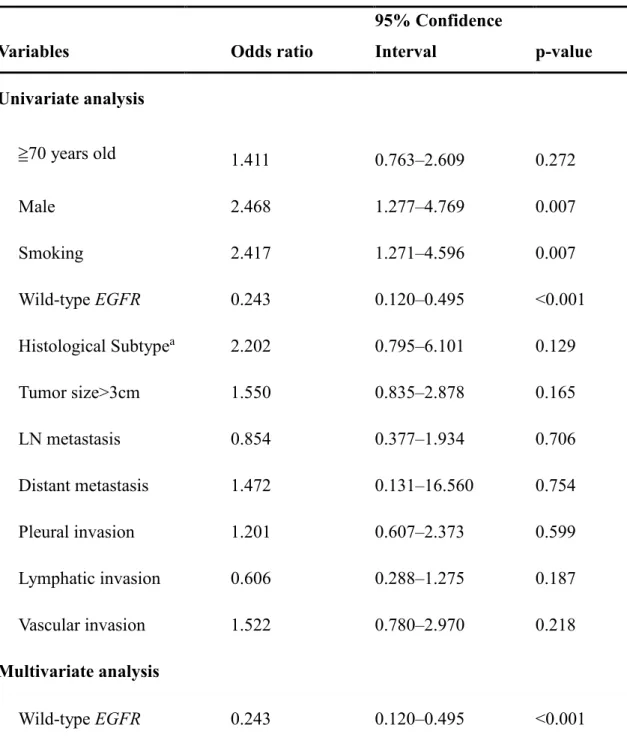
Univariate analysis showed that higher FAM83B expression correlates with males (p =

0.007), smoking history (p = 0.007), and wild-type EGFR tumors (p < 0.001).

Multivariate analysis showed wild-type EGFR tumors correlate with FAM83B

expression (p < 0.001) (Table II).

Correlation between FAM83B expression obtained from cDNA microarray analysis and EGFR mutation in lung ADC. The mean FAM83B expression in adjacent normal lung

tissue (n = 98), wild-type EGFR tumors (n = 118) and mutant EGFR tumors (n = 98)

(20)

19

was −0.190, standard deviation (SD) of 0.365, 0.877, SD of 0.689, and −0.231, SD of

0.425, respectively. Multiple comparison of these three groups showed that FAM83B

expression in wild-type EGFR tumors was higher than in adjacent normal lung tissue (p

< 0.001) or mutant EGFR tumors (p < 0.001), while there was no significant difference

between mutant EGFR tumors and adjacent normal lung tissue (p = 0.852) (Figure 1).

FAM83B is a predictor of poor lung ADC prognosis, especially for ADC with wild-type EGFR. The FAM83B high expression group showed significantly shorter survival times

both in DFS (p = 0.011) and OS (p = 0.001). Subgroup analysis showed that the

FAM83B high expression group had shorter DFS and OS with wild-type EGFR tumors

(p = 0.017, p = 0.008, Figure 2), while no significant difference was found in patients

with mutant EGFR tumors (p = 0.746, p = 0.588). Survival analysis using a Cox

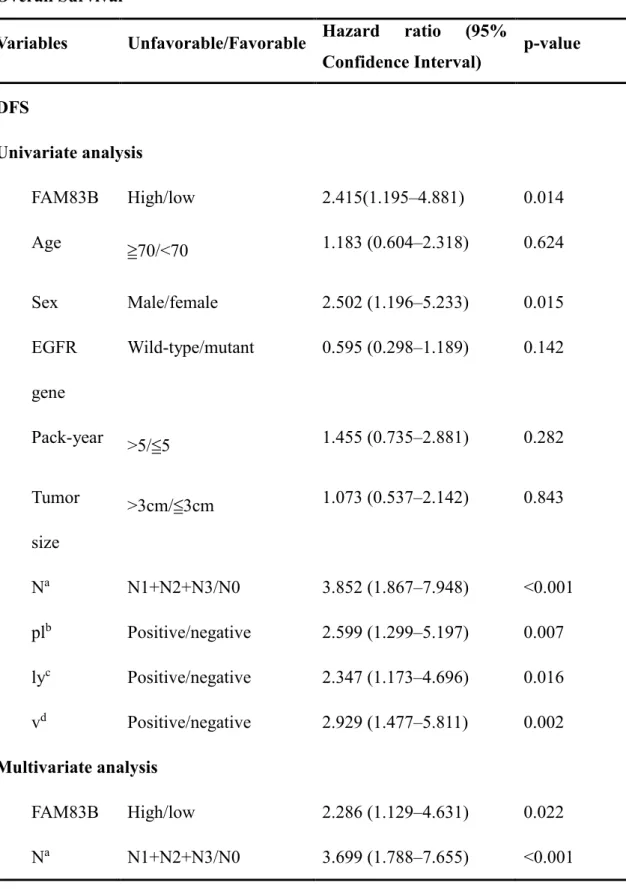
regression hazard model was then conducted. For DFS, univariate analysis showed that

high levels of FAM83B expression, male sex, lymph node metastasis, pleural invasion,

(21)

20

lymphovascular invasion, and vascular invasion were involved in poor prognosis.

Multivariate analysis identified high levels of FAM83B expression and lymph node

metastasis as independent poor prognostic factors (Table III). In OS, univariate analysis

showed high levels of FAM83B expression, male sex, wild-type EGFR tumors, lymph

node metastasis, pleural invasion, lymphovascular invasion, and vascular invasion as

poor prognostic factors. Multivariable analysis showed high levels of FAM83B

expression, pleural invasion, and vascular invasion were independent predictors of poor

prognosis (Table III).

Involvement of FAM83B in cell proliferation in several types of lung cancer cell line.

Cell lines derived from lung adenocarcinoma, including HLC-1, H2347 (both wild-type

for EGFR) and H1975 (mutant EGFR), and a positive control breast cancer cell line,

MCF7 (15) were prepared. qRT-PCR showed high levels of FAM83B expression in

HLC-1 and H2347 cells but scarcely detectable levels in H1975 cells (Figure 3A).

(22)

21

Immunoblot analysis showed levels of FAM83B that were consistent with the HLC-1,

MCF7, and H1973 qRT-PCR results (Figure 3B). In MCF7 cells, FAM83B knockdown

with siRNA-8 or siRNA-9 caused inhibition of cell proliferation (siRNA-8; p = 0.393,

siRNA-9; p = 0.061 at 6 days after knockdown), with siRNA-9 having the stronger

anti-proliferative effect (Figure 4E-G); therefore, we performed subsequent knockdown

experiments using siRNA-9. siRNA transfection efficacy assays (Figure 4A-D)

indicated FAM83B RNAi should be performed in HLC-1 and H1975 cells. Depletion of

FAM83B expression and suppression of cell proliferation were confirmed in HLC-1 and

even in H1975 cells, which expressed low levels of FAM83B (Figure 3C-H).

Discussion

In this study, we focused on comprehensive gene expression analysis of tumors from

resected lungs of Japanese ADC patients, and we showed that FAM83B expression was

higher in tumors with wild-type EGFR compared with tumors with mutant EGFR, and

(23)

22

that FAM83B expression was associated with proliferation in cell lines. Furthermore,

FAM83B expression was identified as a biomarker of poor prognosis from patient

clinical outcomes.

FAM83B expression is elevated relative to normal associated tissues in several types of

cancer, such as breast, ovary, cervical, testis, thyroid, bladder, lymphoid and lung (15).

In lung cancer, analysis of FAM83B expression confirmed that FAM83B expression was

significantly elevated in tumor specimens relative to normal tissues (15). It was also

reported that FAM83B mRNA levels were significantly higher in SqCC than in normal

lung or ADC (14). It is a novel finding that FAM83B is more highly expressed in lung

ADCs containing wild-type EGFR compared with ADCs carrying mutant EGFR.

Interestingly, in breast cancer, FAM83B is expressed at higher levels in tumors without

estrogen and progesterone receptors or human epidermal growth factor receptor-2,

compared with receptor-positive tumors (20). Furthermore, FAM83H, the paralog of

(24)

23

FAM83B, is overexpressed in androgen independent-prostate cancer (21). These

findings could indicate that FAM83B has an oncogenic role without aberrant signals

from driver gene mutations or overexpressed hormone receptors. FAM83B was first

reported by Cipriano and colleagues (15) to be correlated with anchorage-independent

growth in breast cancer cell lines using a validation-based insertion mutagenesis method.

FAM83B is a member of the FAM83 family, which includes eight members (FAM83A to H) characterized by a domain of unknown function 1669 (DUF1669) containing an N

terminal phospholipase D-like motif. The function of FAM83B remains unclear,

however, the mechanism of promote MAPK and PI3K signaling pathway through

DUF1669 was proposed (15). FAM83B may interfere with the binding of 14-3-3 protein

to CRAF, thereby promoting membrane localization of CRAF, and promoting

downstream signals to MAPK (15, 22, 23). Furthermore, FAM83B may also bind to p85

and p110 subunits of PI3K to promote PI3K/AKT signaling (24), which promotes

(25)

24

oncogenic transformation through phospholipase D activation (25), and shows

resistance against EGFR-TKI (15, 23, 26). To determine whether FAM83B promotes

cellular proliferation via ERR and/or PI3K/AKT signaling cascades, further study will

be required using the corresponding kinase inhibitors.

Our knockdown study of FAM83B showed that its expression was associated with tumor

proliferation in cell lines expressing high levels of FAM83B. H1975 cells showed that

knockdown of low levels of FAM83B also inhibited proliferation. However, we need to

exclude the possibility that FAM83B may affect the cell number in HLC-1 and H1975

cells via modulating cell death. Moreover, the gain of function of FAM83B should be

also verified in future experiments.

In normal human tissues, FAM83B is expressed at relatively higher levels in

lung, digestive tract, breast, bladder, uterus, and skin (20). Of all the FAM83 members,

only FAM83H knockout mice, which live for only 2 weeks, have been reported, and

(26)

25

FAM83H is proposed to play a role in the maintenance of cell homeostasis (21, 27).

Other FAM83 family members, including FAM83B, may also be required at certain

levels, even in normal cells to regulate cell functions.

FAM83 family members are usually associated with poor cancer prognosis

(20). Our study of lung ADC also showed that FAM83B correlates with poor prognosis;

however, our previous study reported high FAM83B expression to be a biomarker for

good DFS prognosis in lung SqCC (14). Snijders et al. conducted a meta-analysis of

several databases (28-30) and suggested that lung ADC expresses relatively high levels

of FAM83A, D, E, F, and H, but FAM83A, B, D, and F correlate with prognosis. In lung

SqCC, all FAM83 members except FAM83E are highly expressed, but only FAM83A

correlates with poor prognosis (20). These findings indicate FAM83B has separate roles

among cancers or tumor subtypes.

FAM83 family members, including FAM83B, are more highly expressed in

(27)

26

lung cancer than in normal lung tissue, and their expression is reflected in the T factor

of TNM classification (28, 31). Our study did not show a correlation between tumor

size and FAM83B expression. This contradiction was caused by the fact that the T factor

includes not only tumor size but pleural invasion. Both tumor size and pleural invasion

had no significant effect on FAM83B expression.

FAM83B RNAi suppressed proliferation of human lung cancer cell lines. This

result indicates that FAM83B could be a potential therapeutic target against EGFR-WT

malignancies, which account for 47%-88.7% of lung ADC (4, 28) and which are rarely

indicated for molecular targeted therapies.

Limitations of this study include lack of evaluation of advanced or recurrent

cancer cohorts because the patient cohort was derived from operable lung ADC cases

biased to early stages. Moreover, this study did not examine other driver mutations of

lung ADC, such as KRAS, ALK fusions. Subdivision based on other genomic or

(28)

27

molecular features could further explain the function of FAM83B in lung ADC. Further

investigation is required.

Acknowledgements

This research was partially supported by a grant for translational research programs of

Fukushima Prefecture. H. Suzuki received research support from Bristol Myers Squibb,

AstraZeneca, and Tsumura, outside the submitted work. T. Yamaura received research

support from AstraZeneca, outside the submitted work. S. Muto had been employed by

AstraZeneca, outside the submitted work. Y. Yanagisawa had been employed by Nippon

Gene Co., Ltd., outside the submitted work. R. Honma is employed by Nippon Gene

Co., Ltd., outside the submitted work. The remaining authors declare no conflict of

interest. The authors thank H I, M Otsuki, E Otomo, and Y Kikuta for their technical

supports.

References

(29)

28

1. Stewart BW, Wild CP (ed.): World Cancer Report 2014. Lyon: IARC; 2014.

2. National cancer institute: https://seer.cancer.gov. Accessed 17.10.03.

3. National Comprehensive Cancer Network:

https://www.nccn.org/professionals/physician_gls/f_guidelines.asp. Accessed

17.04.03.

4. Kohno T, Tsuta K, Tsuchihara K, Nakaoku T, Yoh K, Goto K: RET fusion gene:

translation to personalized lung cancer therapy. Cancer Sci 104: 1396-1400, 2013.

5. Rosell R, Ichinose Y, Taron M, Sarries C, Queralt C, Mendez P, Sanchez JM,

Nishiyama K, Moran T, Cirauqui B, et al: Mutations in the tyrosine kinase domain

of the EGFR gene associated with gefitinib response in non-small-cell lung cancer.

Lung cancer 50: 25-33, 2005.

6. Shaw AT and Solomon B: Targeting anaplastic lymphoma kinase in lung cancer.

Clin Cancer Res 17: 2081-6, 2011.

(30)

29

7. Mok TS, Wu YL, Thongprasert S, Yang CH, Chu DT, Saijo N, Sunpaweravong P,

Han B, Margono B, Ishinose Y, et al: Gefitinib or carboplatin–paclitaxel in

pulmonary adenocarcinoma. N Engl J Med 361: 947-957, 2009.

8. Solomon BJ, Mok T, Kim DW, Wu YL, Nakagawa K, Mekhail T, Felip E,

Cappuzzo F, Paolini J, Usari T, et al: First-line crizotinib versus chemotherapy in

ALK-positive lung cancer. N Engl J Med 371: 2167-2177, 2014.

9. Borghaei H, Paz-Ares L, Horn L, Spigel DR, Steins M, Ready NE, Chow LQ,

Vokes EE, Felip E, Holgado E, et al: Nivolumab versus docetaxel in advanced

nonsquamous non-small-cell lung cancer. N Engl J Med 373: 1627-1639, 2015.

10. Patel JD, Socinski MA, Garon EB, Reynolds CH, Spigel DR, Olsen MR, Hermann

RC, Jotte RM, Beck T, Richards DA, et al: PointBreak: a randomized phase III

study of pemetrexed plus carboplatin and bevacizumab followed by maintenance

pemetrexed and bevacizumab versus paclitaxel plus carboplatin and bevacizumab

(31)

30

followed by maintenance bevacizumab in patients with stage IIIB or IV

nonsquamous non-small-cell lung cancer. J Clin Oncol 31: 4349-4357, 2013.

11. Park K, Tan EH, O’Byrne K, Zhang L, Boyer M, Mok T, Hirsh V, Yang JC, Lee

KH, Lu S, et al: Afatinib versus gefitinib as first-line treatment of patients with

EGFR mutation-positive non-small-cell lung cancer (LUX-Lung 7): a phase 2B,

open-label, randomised controlled trial. Lancet Oncol 17: 577-589, 2016.

12. Chan BA and Hughes BG: Targeted therapy for non-small cell lung cancer: current

standards and the promise of the future. Transl Lung Cancer Res 4: 36-54, 2015.

13. Sholl LM, Aisner DL, Varella-Garcia M, Berry LD, Dias-Santagata D, Wistuba II,

Chen H, Fujimoto J, Kugler K, Franklin WA, et al: Multi-institutional oncogenic

driver mutation analysis in lung adenocarcinoma: the lung cancer mutation

consortium experience. J Thorac Oncol 10: 768-777, 2015.

14. Okabe N, Ezaki J, Yamaura T, Muto S, Osugi J, Tamura H, Imai J, Ito E,

(32)

31

Yanagisawa Y, Honma R, et al: FAM83B is a novel biomarker for diagnosis and

prognosis of lung squamous cell carcinoma. Int J Oncol 46: 999-1006, 2015.

15. Cipriano R, Graham J, Miskimen KL, Bryson BL, Bruntz RC, Scott SA, Brown

HA, Stark GR, and Jackson MW: FAM83B mediates EGFR- and RAS-driven

oncogenic transformation. J Clin Invest 122: 3197-3210, 2012.

16. Miura A, Honma R, Togashi T, Yanagisawa Y, Ito E, Imai J, Goshima N, Watanabe

S, and Nomura N: Differential responses of normal human coronary artery

endothelial cells against multiple cytokines comparatively assessed by gene

expression profiles. FEBS Lett 580: 6871-6879, 2006.

17. Livak KJ, and Schmittgen TD: Analysis of relative gene expression data using

real-time quantitative PCR and the 2-ΔΔCT method. Methods 25: 402-408, 2001.

18. Laemmli UK: Cleavage of structural proteins during the assembly of the head of

bacteriophage T4. Nature 227: 680-5, 1970.

(33)

32

19. Towbin H, Staehelin T, and Gordon J: Electrophoretic transfer of proteins from

polyacrylamide gels to nitrocellulose sheets: procedure and some applications.

Proc Natl Acad Sci USA 76: 4350-4, 1979.

20. Snijders AM, Lee SY, Hang B, Hao W, Bissell MJ, and Mao JH: FAM83 family

oncogenes are broadly involved in human cancers: an integrative multi-omics

approach. Mol Oncol 11: 167-179, 2017.

21. Bartel CA, Parameswaran N, Cipriano R, and Jackson MW: FAM83 proteins:

fostering new interactions to drive oncogenic signaling and therapeutic resistance.

Oncotarget 7: 52597-52612, 2016.

22. Tzivion G, Luo Z, and Avruch J: A dimeric 14-3-3 protein is an essential cofactor

for Raf kinase activity. Nature 394: 88-92, 1998.

23. Cipriano R, Miskimen KL, Bryson BL, Foy CR, Bartel CA, and Jackson MW:

Conserved oncogenic behavior of the FAM83 family regulates MAPK signaling in

(34)

33

human cancer. Mol Cancer Res 12: 1156-1165, 2014.

24. Cipriano R, Miskimen KL, Bryson BL, Foy CR, Bartel CA, and Jackson MW:

FAM83B-mediated activation of PI3K/AKT and MAPK signaling cooperates to

promote epithelial cell transformation and resistance to targeted therapies.

Oncotarget 4: 729-738, 2013.

25. Cipriano R, Bryson BL, Miskimen KL, Bartel CA, Hernandez-Sanchez W, Bruntz

RC, Scott SA, Lindsley CW, Brown HA, and Jackson MW: Hyperactivation of

EGFR and downstream effector phospholipase D1 by oncogenic FAM83B.

Oncogene 33: 3298-3306, 2014.

26. Grant S: FAM83A and FAM83B: candidate oncogenes and TKI resistance

mediators. J Clin Invest 122: 3048-3051, 2012.

27. Wang SK, Hu Y, Yang J, Smith CE, Richardson AS, Yamakoshi Y, Lee YL, Seymen

F, Koruyucu M, Gencay K, et al: Fam83h null mice support a neomorphic

(35)

34

mechanism for human ADHCAI. Mol Genet Genomic Med 4: 46-47, 2016.

28. The Cancer Genome Atlas Research Network: Comprehensive molecular profiling

of lung adenocarcinoma. Nature 511: 543-550, 2014.

29. Carithers LJ and Moore HM: The genotype-tissue expression (GTEx) project.

Biopreserv Biobank 13: 307-308, 2015.

30. Mele M, Ferreira PG, Reverter F, DeLuca DS, Monlong J, Sammeth M, Young TR,

Goldmann JM, Pervouchine DD, Sullivan TJ, et al: Human genomics. The human

transcriptome across tissues and individuals. Science 348: 660-665, 2015.

31. Rhodes DR, Kalyana-Sundaram S, Mahavisno V, Varambally R, Yu J, Briggs BB,

Barrette TR, Anstet MJ, Kincead-Beal C, Kulkami P, et al: Oncomine 3.0: genes,

pathways, and networks in a collection of 18,000 cancer gene expression profiles.

Neoplasia 9: 166-180, 2007.

Figure legends

(36)

35

Figure 1. Expression levels of FAM83B obtained by cDNA microarray analysis of

tumors stratified by the presence or absence of EGFR mutation, and adjacent normal

tissue. The expression of FAM83B in tumors with wild-type EGFR was significantly

higher compared with tumors with mutant EGFR (p < 0.001) or adjacent normal tissue

(p < 0.001). No significant difference in FAM83B expression was found between tumors

with mutant EGFR and adjacent normal tissue (p = 0.852). Horizontal bars represent

mean expression levels. NOTE; EGFR; epidermal growth factor receptor, FAM83B;

family with sequence similarity 83, member B, Mut; mutant, Normal; normal adjacent

lung tissue, WT; wild type.

Figure 2. Kaplan–Meier curves showing patient survival after lung resection.

(A) Disease-free survival (DFS) and (B) overall survival (OS) of all eligible participants.

(C,D) DFS and OS of the patients stratified by tumors with wild-type epidermal growth

factor receptor.

(37)

36

Figure 3. The effect of FAM83B on the proliferation of lung cancer cell lines. (A, B)

FAM83B mRNA and protein levels were examined by qRT-PCR and western blotting,

respectively, in MCF7, H1975, H2347, and HLC1 cells. The Rq ratios to MCF7 cells

were; H1975: 0.0061, H2347: 2.2103, and HLC1: 7.1968. (C-H) RNAi was performed

in HLC-1 and H1975 cells. Depletion of FAM83B mRNA and protein was confirmed by

qRT-PCR (C and F) and western blotting (D and G), respectively. Rq ratios to negative

control were; HLC-1: 0.3519 and H1975: 0.1675 for qRT-PCR. (E and H) Cell

proliferation assay in HLC-1 and H1975 cells after RNAi. Cell numbers were counted

over time. Cell growth was significantly suppressed in HLC-1 and H1975 cells. (E and

H) Original magnification x40. NOTE; FAM83B; family with sequence similarity 83,

member B, Rq ratio: relative quantification ratio, **: p < 0.01, *: p < 0.05, N/C:

negative control.

Figure 4. FAM83B siRNA transfection efficiency and RNA interference in cultured

(38)

37

cells. (A-D) Transfection of FAM83B siRNA significantly suppressed cell growth of

MCF7, HLC-1, and H1975 cells but not of H2347 cells. (E) qRT-PCR showed that both

siRNA-8 and siRNA-9 reduced the expression of FAM83B. (F) Immunoblotting analysis

showed that FAM83B signals were significantly depleted in MCF7 cells transfected

with siRNA-8 or siRNA-9. (G) Both siRNA-8 and siRNA-9 suppressed cell growth,

especially siRNA-9. NOTE; Rq: quantification relative to negative control, **: p < 0.01,

*: p < 0.05, P/C: positive control, N/C: negative control.

(39)

TABLE I. Clinicopathological and Genetic Features of Lung Adenocarcinoma

Patients According to FAM83B Expression in Tumor Tissue

FAM83B Expression

Variables High (n=55) Low (n=161) p-value

Age ≦69 years old 25 (45.5%) 87 (54.0%) 0.271

≧70 years old 30 (54.5%) 74 (46.0%)

Sex Male 39 (70.9%) 80 (49.7%) 0.006

Female 16 (29.1%) 81 (50.3%)

Smoking history Never smoker 18 (32.7%) 87 (54.0%) 0.006

Former or Current

smoker 37 (67.3%) 74 (46.0%)

EGFR gene Wild-type 43 (78.2%) 75 (46.6%) < 0.001

(40)

Mutant 12 (21.8%) 86 (53.4%)

Pathological

subtype

a

Lepidic 9 (16.4%) 36 (22.4%) < 0.001

Papillary 27 (49.1%) 99 (61.5%)

Acinar 5 (9.1%) 12 (7.5%)

Solid 7 (12.7%) 10 (6.2%)

Other variants 7 (12.7%) 4 (2.4%)

Tumor size ≦ 3cm 29 (52.7%) 102 (63.4%) 0.164

>3 cm 26 (47.3%) 59 (36.6%)

LN metastasis N0 46 (83.6%) 131 (81.4%) 0.706

N1/N2/N3 9 (16.4%) 30 (18.6%)

Distant metastasis M0 54 (98.2%) 159 (98.8%) 1.000

(41)

M1 1 (1.8%) 2 (1.2%)

Pleural invasion (-) 39 (70.9%) 120 (74.5%) 0.598

(+) 16 (29.1%) 39 (24.2%)

Lymphatic invasion (-) 44 (80.0%) 114 (70.8%) 0.184

(+) 11 (20.0%) 47(29.2%)

Vascular invasion (-) 37 (67.3%) 122 (75.7%) 0.217

(+) 18 (32.7%) 39 (24.2%)

FAM83B; family with sequence similarity 83, member B, EGFR; epidermal growth

factor receptor, LN; lymph node. NOTE:

a

IASLC/ATS/ERS adenocarcinoma

classification.

(42)

TABLE II. Correlation between Clinicopathological Characteristics of Lung Adenocarcinoma Patients and FAM83B Expression in Tumors

Variables Odds ratio

95% Confidence

Interval p-value Univariate analysis

≧70 years old 1.411 0.763–2.609 0.272

Male 2.468 1.277–4.769 0.007

Smoking 2.417 1.271–4.596 0.007

Wild-type EGFR 0.243 0.120–0.495 <0.001

Histological Subtype

a

2.202 0.795–6.101 0.129

Tumor size>3cm 1.550 0.835–2.878 0.165

LN metastasis 0.854 0.377–1.934 0.706

Distant metastasis 1.472 0.131–16.560 0.754

Pleural invasion 1.201 0.607–2.373 0.599

Lymphatic invasion 0.606 0.288–1.275 0.187

Vascular invasion 1.522 0.780–2.970 0.218

Multivariate analysis

Wild-type EGFR 0.243 0.120–0.495 <0.001

NOTE:

a

Comparison between predominantly non-solid and solid histological subtypes

EGFR; epidermal growth factor receptor, FAM83B; family with sequence similarity 83,

member B.

(43)

TABLE III. Univariate and Multivariate Predictors of Disease-Free Survival and Overall Survival

Variables Unfavorable/Favorable Hazard ratio (95%

Confidence Interval) p-value DFS

Univariate analysis

FAM83B High/low 2.415(1.195–4.881) 0.014

Age ≧70/<70 1.183 (0.604–2.318) 0.624

Sex Male/female 2.502 (1.196–5.233) 0.015

EGFR gene

Wild-type/mutant 0.595 (0.298–1.189) 0.142

Pack-year >5/ ≦5 1.455 (0.735–2.881) 0.282

Tumor size

>3cm/≦3cm 1.073 (0.537–2.142) 0.843

N

a

N1+N2+N3/N0 3.852 (1.867–7.948) <0.001 pl

b

Positive/negative 2.599 (1.299–5.197) 0.007 ly

c

Positive/negative 2.347 (1.173–4.696) 0.016 v

d

Positive/negative 2.929 (1.477–5.811) 0.002 Multivariate analysis

FAM83B High/low 2.286 (1.129–4.631) 0.022

N

a

N1+N2+N3/N0 3.699 (1.788–7.655) <0.001

(44)

NOTE:

a

Lymph node metastasis according to Union for International Cancer Control 7th edition,

b

pleural invasion,

c

lymphovascular invasion, and

d

vascular invasion.

DFS; disease-free survival, EGFR; epidermal growth factor receptor, FAM83B; family OS

Univariate analysis

FAM83B High/low 3.814 (1.619–8.989) 0.002

Age ≧70/<70 1.010 (0.429–2.380) 0.981

Sex Male/female 3.241 (1.187–8.854) 0.022

EGFR gene

Wild-type/mutant 0.297 (0.108–0.813) 0.018

Pack-year >5/≦5 2.080 (0.839–5.154) 0.114

Tumor size

>3cm/≦3cm 1.297 (0.547–3.079) 0.555

N

a

N1+N2+N3/N0 4.342 (1.798–10.483) 0.001

pl

b

Positive/negative 5.313 (2.234–12.634) <0.001 ly

c

Positive/negative 2.577 (1.085–6.117) 0.032 v

d

Positive/negative 3.338 (1.414–7.877) 0.006 Multivariate analysis

FAM83B High/low 3.723 (1.568–8.842) 0.003

pl

b

Positive/negative 5.098 (2.119–12.264) <0.001

v

d

Positive/negative 2.529 (1.066–6.001) 0.035

(45)

with sequence similarity 83, member B, N; nodes, OS; overall survival

(46)

Figure 1

(47)

Figure 2

(48)

Figure 3

(49)

Figure 4

TABLE  II.  Correlation  between  Clinicopathological  Characteristics  of  Lung  Adenocarcinoma Patients and FAM83B Expression in Tumors
TABLE III. Univariate and Multivariate Predictors of Disease-Free Survival and  Overall Survival

参照

関連したドキュメント

In [LN] we established the boundary Harnack inequality for positive p harmonic functions, 1 &lt; p &lt; ∞, vanishing on a portion of the boundary of a Lipschitz domain Ω ⊂ R n and

Hence, in the Dirichlet-type and Neumann-type cases respectively, the sets P k used here are analogous to the sets (0, ∞) × T k+1 and (0, ∞) × S k , and we see that using the sets P

[30] T. Guerin; Existence of nonnegative solutions to singular elliptic problems, a variational approach, Discrete Contin. Guerin; Multiplicity of weak solutions to subcritical

静岡大学 静岡キャンパス 静岡大学 浜松キャンパス 静岡県立大学 静岡県立大学短期大学部 東海大学 清水キャンパス

There was no significant statistical difference observed between Swimsuit X and Swimsuit C in terms of walking speed in the water, step/pace, or heart rate immediately after the

静岡大学 静岡キャンパス 静岡大学 浜松キャンパス 静岡県立大学 静岡県立大学短期大学部 東海大学 清水キャンパス

When value of &lt;StThr[3:0]&gt; is different from 0 and measured back emf signal is lower than &lt;StThr[3:0]&gt; threshold for 2 succeeding coil current zero−crossings (including