Spatially resolved metabolic distribution for unraveling the physiological change and
responses in tomato fruit using
matrix‑assisted laser desorption/ionization mass spectrometry imaging (MALDI MSI)
Author Junya Nakamura, Tomomi Morikawa‑Ichinose, Yoshinori Fujimura, Eisuke Hayakawa,
Katsutoshi Takahashi, Takanori Ishii, Daisuke Miura, Hiroyuki Wariishi
journal or
publication title
Analytical and Bioanalytical Chemistry
volume 409
number 6
page range 1697‑1706
year 2016‑12‑08
Publisher Springer Berlin Heidelberg Rights (C) 2016 The Author(s).
Author's flag publisher
URL http://id.nii.ac.jp/1394/00000362/
doi: info:doi/10.1007/s00216-016-0118-4
Creative Commons Attribution 4.0 International (http://creativecommons.org/licenses/by/4.0/)
RESEARCH PAPER
Spatially resolved metabolic distribution for unraveling
the physiological change and responses in tomato fruit using matrix-assisted laser desorption/ionization – mass spectrometry imaging (MALDI – MSI)
Junya Nakamura
1&Tomomi Morikawa-Ichinose
2&Yoshinori Fujimura
2&Eisuke Hayakawa
3&Katsutoshi Takahashi
4&Takanori Ishii
2&Daisuke Miura
2&Hiroyuki Wariishi
1,2,5,6Received: 28 October 2016 / Revised: 21 November 2016 / Accepted: 24 November 2016 / Published online: 8 December 2016
#The Author(s) 2016. This article is published with open access at Springerlink.com
Abstract Information on spatiotemporal metabolic behavior is indispensable for a precise understanding of physiological changes and responses, including those of ripening processes and wounding stress, in fruit, but such information is still limited. Here, we visualized the spatial distribution of metab- olites within tissue sections of tomato (Solanum lycopersicum L.) fruit using a matrix-assisted laser desorption/ionization–
mass spectrometry imaging (MALDI–MSI) technique com- bined with a matrix sublimation/recrystallization method.
This technique elucidated the unique distribution patterns of
more than 30 metabolite-derived ions, including primary and secondary metabolites, simultaneously. To investigate spatio- temporal metabolic alterations during physiological changes at the whole-tissue level, MALDI–MSI was performed using the different ripening phenotypes of mature green and mature red tomato fruits. Although apparent alterations in the locali- zation and intensity of many detected metabolites were not observed between the two tomatoes, the amounts of glutamate and adenosine monophosphate, umami compounds, increased in both mesocarp and locule regions during the ripening pro- cess. In contrast, malate, a sour compound, decreased in both regions. MALDI–MSI was also applied to evaluate more local metabolic responses to wounding stress. Accumulations of a glycoalkaloid, tomatine, and a low level of its glycosylated metabolite, esculeoside A, were found in the wound region where cell death had been induced. Their inverse levels were observed in non-wounded regions. Furthermore, the amounts of both compounds differed in the developmental stages.
Thus, our MALDI
–MSI technique increased the understand- ing of the physiological changes and responses of tomato fruit through the determination of spatiotemporally resolved meta- bolic alterations.
Keywords Localization . MALDI–MSI . Metabolic alterations . Physiological changes and responses . Tomato fruit (Solanum lycopersicum L.)
Introduction
Endogenous metabolites are important components related to fruit phenotypes, such as color, flavor, taste, and texture. Their concentrations will dramatically and spatiotemporally change
Electronic supplementary materialThe online version of this article(doi:10.1007/s00216-016-0118-4) contains supplementary material, which is available to authorized users.
* Daisuke Miura
* Hiroyuki Wariishi
1 Graduate School of Bioresource and Bioenvironmental Sciences, Kyushu University, 6-10-1 Hakozaki, Higashi-ku,
Fukuoka 812-8581, Japan
2 Innovation Center for Medical Redox Navigation, Kyushu University, 3-1-1 Maidashi, Higashi-ku, Fukuoka 812-8582, Japan
3 Okinawa Institute of Science and Technology Graduate University, 1919-1 Tancha, Onna-son, Kunigami-gun, Okinawa 904-0495, Japan
4 National Institute of Advanced Industrial Science and Technology, 2-41-6 Aomi, Koto-ku, Tokyo 135-0064, Japan
5 Bio-architecture Center, Kyushu University, 6-10-1 Hakozaki, Higashi-ku, Fukuoka 812-8581, Japan
6 Faculty of Arts and Sciences, Kyushu University, 744 Motooka, Nishi-ku, Fukuoka 819-0395, Japan
Anal Bioanal Chem (2017) 409:1697–1706 DOI 10.1007/s00216-016-0118-4
during growing and ripening processes [1–3]. Both biotic and abiotic stresses also trigger concentration changes, which lead to whole-tissue physiological changes, such as alterations in color and taste during the ripening process, or more local and partial responses, such as morphological changes induced by wounding and pest-associated stresses [4,
5]. These events arestrictly regulated, and alterations in metabolic dynamics occur as the result of a wide range of biochemical processes, includ- ing enzymatic or non-enzymatic reactions [6–8].
The metabolome closely represents the phenotype of an organism under a given set of conditions and is defined as the
Bcompound-level-phenotype^of the genomic informa- tion. Metabolomics is an effective approach for understanding global metabolic changes in fruit [9]. This approach allows for the quantitative determination of each metabolite and for trac- ing metabolic regulation in tissues during ripening and wounding stress. It can reveal potential relationships between metabolic signatures and phenotypes, such as physiological appearance and functional characteristics. These findings en- hance the understanding of physiological mechanisms in the fruit, and this approach is expected to contribute to plant breeding and postharvest technology, such as food preserva- tion and processing. Conventional metabolomics uses gas chromatography–mass spectrometry (GC–MS) and liquid chromatography
–MS (LC
–MS) to detect various metabolites, which appear at average levels, simultaneously in whole tis- sues. However, these methods do not address the spatial as- pects of more local physiological phenomena, such as meta- bolic responses against wounding or pest stress at tissue micro-regional levels. Information on spatiotemporal meta- bolic behavior is quite important to precisely understand phys- iological changes and responses related to the tissue micro- regions of the functional compartments in fruit.
Matrix-assisted laser desorption/ionization
–mass spec- trometry imaging (MALDI–MSI) is a new remarkable technology [10–12]. This technique determines the spatial distribution of biomolecules, such as low-molecular- weight compounds, metabolites, proteins, and peptides, in tissue at a high spatial resolution without any labeling.
Metabolite distributions were reported in several plant tis- sues, such as blueberry, cereal grains, and Arabidopsis [13–15]. However, sample preparation methods were dif- ferent among plant tissues, and no observations focused on more local physiological responses in the tissue.
Tomato (Solanum lycopersicum L.) fruit is an edible hor- ticultural crop that is highly consumed worldwide and is used as a model plant of maturation [1]. Studies of tomato fruit, focused on understanding highly resolved metabolic behavior, are expected to unravel basic mechanisms of physiological changes and responses, as well as morpho- logical alterations. However, the MALDI–MSI technique has not yet been applied in tomato fruit research. Here, we succeeded in determining the spatial distributions of
multiple primary and secondary metabolites simultaneous- ly within tissue sections of mature red (MR) tomato fruit using MALDI
–MSI technique. Their unique localizations were observed in distinctive tissue compartments, such as mesocarp and locule regions. To investigate whole phys- iological changes at the metabolite level in the tomato fruit, metabolite distributions were compared using two different samples, mature green (MG) and MR tomato fruits. Furthermore, we assessed more local metabolic changes in tomato fruit during the ripening process after wounding, using MG as a control for the beginning stage of ripening and the pink stage (P) fruit, corresponding to the mid-stage. The wounded (W) fruit was prepared by wounding MG and at ripening stage up to the P. We com- pared the difference between MG and P to determine the metabolic changes occurred from the beginning to the mid-stage of ripening. Additionally, we investigated wound-specific metabolic alterations using the two types of P fruits between non-wounded (NW) and W. The MALDI–MSI technique enabled us to investigate large- scale and more local physiological responses of tomato fruit by detecting spatiotemporally resolved metabolic behaviors.
Materials and methods Materials
Indium thin oxide (ITO)-coated slide glass was obtained from Matsunami Glass (Osaka, Japan). A matrix, 9-aminoacridine (9-AA), was purchased from Merck (Kenilworn, NJ, USA).
Another matrix, 2,5-dihydroxybenzoic acid (DHB), and the organic solvents, internal standards, and metabolite standards were also obtained from Wako Pure Chemical Industries (Osaka, Japan).
Preparation of tomato (
S. lycopersicumL.) fruit
Tomato (S. lycopersicum L. ver. Chika) fruits were produced
in Sotetsu horticultural farm (Kumamoto, Japan). We pur-
chased both the mature green (MG) and mature red (MR)
tomato fruits. MG and MR fruits were harvested at around
35 and 45 days after pollination, respectively. The wounded
(W) sample was prepared by wounding MG fruits with the
stainless blade. The wounding width was 5.0 mm and the
depth was 1.0 mm. Both W and non-wounded (NW) samples
were incubated on the room temperature for 1 week under
non-sterile condition. Both W and NW samples were the same
pink-stage fruits, corresponding to the mid-stage, in which
less than 60% of the pericarp had changed from green to red
during the ripening. All tomato fruits were stored at
−20 °C.
MALDI–MSI analysis of the tomato fruit section
The tomato fruit tissues were sectioned at 10
μm thickness using a cryomicrotome, and then the sections were thaw- mounted onto ITO-coated glass slide. In this process, we used the optical cutting temperature (O. C. T.) compound for directly mounting the whole tomato fruit on the stage of the cryomicrotome. For 9-AA-based MALDI–MSI exper- iment, matrix (9-AA) was sublimated using iMLayer (Shimadzu, Kyoto, Japan), a sample preparation device which can monitor temperature and matrix deposition thickness during the sublimation. The powder of 9-AA (600 mg) was sublimated at 220 °C under vacuum condi- tions (5 × 10
−2Pa) and the thickness of matrix was moni- tored at 0.5
μm. After sublimation, 10% methanol wasvapored to promote both extraction of metabolites from tissue and recrystallization at 60 °C for 3 min [16]. For DHB-based MALDI–MSI experiments, matrix solution ( 2 0 m g / m L D H B i n m e t h a n o l c o n t a i n i n g 0 . 1 % trifluoroacetic acid (TFA,
v/v)) was sprayed with an air-brush in draft hood under room temperature. After matrix deposition, samples were subjected to MALDI
–MSI mea- surements. MALDI–MSI was performed using single reflectron-type MALDI– time-of -flight (TOF)-M S (AXIMA Confidence, Shimadzu). Quadrupole ion-trap (QIT)-type (AXIMA QIT, Shimadzu) and TOF/TOF type (AXIMA Performance, Shimadzu) instruments were used for identification of metabolites by MS/MS analysis. These instruments were equipped with a 337-nm nitrogen laser, and all measurements were performed in both positive and negative ionization reflectron modes with 50
μm spatial resolution (ten laser shots/data point). The signals were collected between
m/z= 80–890 (negative) or between
m/z
= 1000
–1400 (positive). A number of peaks derived from metabolites were calculated by in-house script using Python (http://www.python.org). We first detected the peaks derived from the tomato fruit sample as sample peak, and non-tissue peaks on the glass plate were defined as blank peak. These peaks were exported as centroid for- mat, and then isotope peaks were deleted. Of these peaks, sample peaks with the intensity over five times stronger than that of blank peak within the same
m/zregions were considered as the net peaks derived from endogenous me- tabolites. Metabolites were identified or estimated by com- paring MS/MS spectra with standard compounds or data- bases (MassBank,
http://www.massbank.jp; METLIN, http://metlin.scripps.edu). Acquired MSI data wereprocessed with a freely available software Biomap (http://ms-imaging.org/wp/). This software was used for creation of two-dimensional ion-density maps, normaliza- tion of peak intensity, adjustment of the color scale, and quantification of the ion intensity. All data was merged between optical and ion images.
Quantitative analysis of metabolites with LC–triple quadrupole (QqQ)
–MS
The pericarp (epicarp and mesocarp) and locule fractions (100–200 mg) were homogenized in 80% methanol, including 5
μM 10-camphorsulfonic acid (10-CS) for evaluating the extraction efficiency, on ice using dounce tissue grinders.
After centrifugation at 15,000×g for 10 min, the supernatant was collected. These samples were filtered using 0.22
μmPTFE filter (EMD Millipore, Billerica, CA, USA). The fil- tered samples were analyzed by high-performance liquid chromatography with triple quadrupole (LC–QqQ)–MS (LC8040, Shimadzu, Kyoto, Japan). The instrument was fitted with a Synagi Hydro-RP column (C18, 100 mm × 2.0 mm i.d., Phenomenex, Torrance, CA, USA), ovened at 40 °C. Mobile- phase conditions were as follows: linier gradient analysis with mobile-phase A, 10 mM tributylamine (TBA)/15 mM acetic acid in ultra pure water, and mobile-phase B, methanol. After a 3-min isocratic run at 100% of eluting solvent A, the ratio of eluting solvent B was linearly increased to 40% from 3 to 5 min and to 90% from 5 to 7 min. The composition of 90%
of the eluting solvent B was maintained for 5 min. For the MS, the instrument was operating an electrospray ionization source in both positive and negative ionization modes. The ionization parameters were performed under the following conditions:
capillary voltage, 4.5 and
−3.5 kV; the nebulizer gas flow,1.5 L/min; the CDL temperature, 250 °C; and heatblock tem- perature, 400 °C. Multiple reaction monitoring mode with a dwell time of 2 s per channel were used for the targeted anal- ysis of ten metabolites. Identified metabolites were quantified using authentic standards, and then the data were expressed as the ratios (locule/epicarp) shown in Fig.
S3in the Electronic Supplementary Material (ESM).
Heat map analysis
We used heat map analysis to determine the certainty of the present 9-AA-based MALDI–MSI results by comparing MSI relative peak intensities in both locule and mesocarp regions with LC–MS-quantified data on both locule and pericarp (epi- carp and mesocarp) regions in MR tomato fruit. In the MSI experiment, we focused on both locule and mesocarp regions.
Regions of interest (ROIs), indicated in Fig.
S3B(see ESM), were established in a part of homogenous-tissue regions on the optical image of MR tomato fruit by using BioMap soft- ware. Each average intensity from averaged mass spectrum of either locule or mesocarp region determined within selected ROIs. The data was converted into the ratio of locule to me- socarp region. In LC–MS experiments, the epicarp could not be perfectly separated from the mesocarp using fresh fruit.
Therefore, we used both mesocarp and pericarp fractions as a crude mesocarp fraction, even though it includes a small amount of epicarp. The metabolite concentration data of
MALDI–MSI for visualizing localization of tomato fruit metabolite 1699
LC–MS was converted into the ratio of locule to pericarp region. We compared the ratios between MALDI–MSI and LC
–MS using the heat map analysis. The ratio of ten common metabolites was visualized with MultiExperiment Viewer (http://www.Tm4.org). In this experiment, we used three replicate data for LC
–MS analysis and four replicate data for MALDI–MSI analysis. These averaged values were subjected to the heat map analysis.
Evans Blue staining
Fresh wounding tomato fruit including wound region cut using a razor blade were stained with 0.5% (v/v) Evans Blue solution (Wako Pure Chemical Industries) partially modified from previous report [17]. After 5 min, the fruit was washed with distilled water and put on the slide glass. This sample was subjected to light microscope (AS-3100, Microadvance, Osaka, Japan). Non-viable cells had blue coloration and viable ones were not stained.
Results
MALDI
–MSI-based visualization of spatial distributions of metabolites in MR tomato fruit
To perform MALDI–MSI experiments, solid samples are thinly sectioned and mounted onto a conductive stage. In this study, we prepared the thin-sections of frozen fruit using a cryomicrotome without any embedding materials, and then the sections were mounted onto indium tin oxide (ITO)-coated glass slides using the thaw-mounting meth- od. The shape of each organ structure, including epicarp, mesocarp, locule, and seed, was maintained in the cryo- sections (Fig.
1). The choice of the matrix for MALDI–MSI is an important point for metabolite imaging. Here, we used 9-aminoacridine (9-AA) because it is a superior MALDI matrix for ionizing a broad range of negatively charged metabolites, such as nucleotides, cofactors, phos- phorylated sugars, amino acids, lipids, and carboxylic ac- id [18]. The choice of matrix deposition method is also important for achieving successful MSI results with high sensitivity and high spatial resolution. Here, we used a method of sublimation coupled with recrystallization be- cause it was highly reproducible and highly sensitive, and it eliminated the migration of analyte compounds during matrix deposition [16,
19,20]. The tissue sections of MRtomato fruit were subjected to the matrix deposition and subsequent MALDI–MSI measurement. In total, 91 peaks derived from endogenous metabolites were detected (ESM Fig.
S1), and 34 of these peaks had unique distri-butions in the MR tomato fruit (ESM Fig.
S2). Both thelocalization and intensity of the peaks were different
among the four tissue compartments (epicarp, mesocarp, locule, and seed). Among these, we successfully identi- fied ten metabolites, including primary metabolites (sour compounds and umami compounds) and secondary me- tabolite (caffeate), by comparisons with MS/MS spectra of standard compounds (Fig.
2, ESM TableS1).MALDI–MSI provides useful information on the distribu- tion of biomolecules over the two-dimensional analytical re- gions. However, the signal intensity information does not re- flect the
Babsolute^amounts but the
Brelative^amounts of biomolecules. In some cases, the resultant images do not re- flect the relative amount of an analyte in different regions of the same sample because of the differences in the matrix ef- fects, the ion suppressing or enhancing effect, between differ- ent regions [21,
22]. We determined the certainty of the pres-ent MSI results by comparing MSI relative peak intensities in both locule and mesocarp regions with LC
–MS-quantified data on both locule and pericarp (epicarp and mesocarp) re- gions in the MR tomato fruit. Although, MSI detected the metabolite distributions in the mesocarp and locule regions, but they were hardly confirmed in the epicarp and seed re- gions. In this experiment, we focused on the locule and me- socarp regions.
Each average intensity of both representative locule and
mesocarp regions determined within a selected regions of in-
terest (ROIs) (ESM Fig.
S3). The data was converted into theratio of locule to mesocarp region. In LC–MS experiments,
the epicarp could not be perfectly separated from the meso-
carp using fresh fruit; therefore, we used both locule and peri-
carp fractions as crude mesocarp fractions, even though it
Fig. 1 Thin-section of mature red (MR) tomato fruit using cryomictorome without any embedding materials. E epicarp, M mesocarp,Llocule,Sseed.Scale bar= 1.0 mmincluded a small amount of epicarp. The metabolite concen- tration data was converted into the ratio of locule to pericarp region. We compared the ratios between MALDI–MSI and LC–MS data using the heat map analysis. This analysis showed relatively similar tendencies for most metabolite levels, although the values were different in the MSI and LC–MS data (ESM Fig.
S3). These results showed, for thefirst time, that the present MALDI–MSI technique was able to visualize micro-region-specific distributions, with relatively quantitative values, of multiple metabolites simultaneously in the MR tomato fruit.
Analysis of metabolic alterations using two different ripening tomato phenotypes
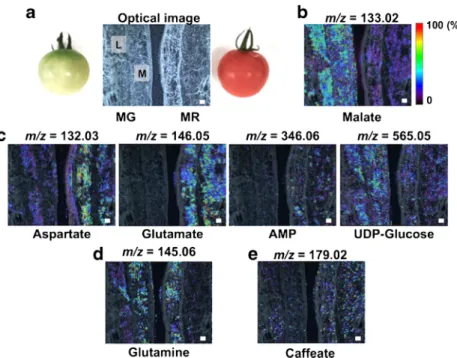
The concentrations of some taste-related metabolites, such as amino acids and organic acids, change dramatically at the whole-tissue level in tomato fruit during the ripening process [23]. Additionally, ethylene, a phytohormone, plays a key role in triggering fruit maturation [1–3]. However, the potential relationships between the presence of metabolites at the tissue micro-regional level and ethylene-induced fruit ripening still remains unclear. Here, we successfully visualized the spatial distribution of multiple metabolites in the MR tomato fruit. To further understand physiological property-related spatiotem- poral metabolic alterations, we performed MALDI–MSI ex- periments using two tomato fruits, MG and MR, of different maturity (Fig.
3). The thin-sections of MG and MR werethaw-mounted onto the same conductive glass slide to com- pare the distributions of multiple metabolites in a single run, and these samples were subject to MALDI
–MSI measure- ment. Metabolite distributions in the mesocarp and locule re- gions were observed, but they were barely seen in the epicarp and seeds. The amounts of umami compounds, glutamate (m/
z
= 146.06 [M–H]
−) and adenosine monophosphate (AMP) (m/z = 346.06 [M–H]
−), were increased in both regions of the MR fruit. Aspartate (m/z = 132.03 [M–H]
−), another uma- mi compound, was increased only in a mesocarp region. In contrast, malate (m/z = 133.02 [M–H]
−), a constituent of sour- ness in immature fruit, had decreased compared with in MG fruit. However, the intensities of a secondary metabolite, caffeate (m/z = 179.02 [M–H]
−), and other primary metabo- lite, glutamine (m/z = 145.05 [M
–H]
−), were similar in the analytical regions of both MG and MR samples (Fig.
3).Although there were differences in spatial resolutions, these local metabolic behaviors were in good accordance with the results of whole-tissue extractions from both ripening pheno- types, MG and MR, as previously reported by GC–MS and LC
–MS [24]. Using MALDI
–MSI, we succeeded in analyz- ing the spatiotemporal metabolic alterations in both mesocarp and locule regions during the ripening process of tomato fruit.
Spatiotemporal metabolic visualization of local
physiological responses to ripening and wounding stress
Plants produce ethylene during wounding stress, and it trig- gers various genetic and metabolic responses, but the details of these response mechanisms are not fully understood [4,
5].In particular, local responses near the wound region are still unknown because conventional methods have not been able to assess the cooperative behaviors of multiple biomolecules at the micro-regional level. Here, a 9-AA-based MALDI
–MSI analysis was performed to examine metabolic changes around the wound region in the tomato fruit during the ripening pro- cess after wounding. We used MG as a control for the begin- ning stage of ripening and the pink-stage (P) fruit correspond- ing to the mid-stage, in which less than 60% of the pericarp had changed from green to red during the ripening. The
Fig. 2 In situ metabolite MSimaging of the MR tomato fruit.a Optical image of thin-section of the MR tomato fruit.Eepicarp,M mesocarp,Llocule,Sseed. Ion images ofbsour compounds,c umami compounds,dprimary metabolites, andesecondary me- tabolite, respectively.Scale bar= 1.0 mm
MALDI–MSI for visualizing localization of tomato fruit metabolite 1701
wounded sample (W) was prepared by wounding the MG tomato and at ripening stages up to the P stage. The non- wounded fruit at the corresponding ripening stages were de- fined as NW. We focused on the locule and mesocarp regions among MG, NW, and W fruits. First, we compared the differ- ence between MG and P to determine the metabolic changes that occurred from the beginning to the mid-stage of matura- tion. In addition, we determined the differences in the metab- olite distributions between NW and W fruits to investigate
wound-specific metabolic alterations. As shown Fig.
4, anincrease in the amount of glutamate and AMP, umami com- pounds, in P (NW and W) was observed in the local region as compared with MG. However, clear differences between NW and W were not observed among wound-specific metabolic responses to wounding. Next, we used the spray-coating method with 2,5-dihydroxybenzoic acid (DHB) as the matrix to detect other metabolites in the positive ionization mode.
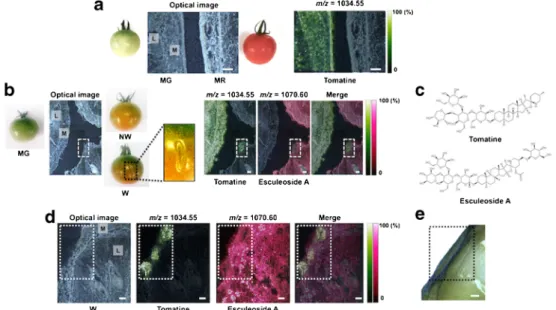
DHB-based MALDI–MSI detected tomatine (m/z = 1034.55
Fig. 3 Analysis of the metabolicchanges during the progression of ripening process using different ripening phenotypes with 9-AA- based MALDI–MSI.aOptical image of thin-sections of the mature green (MG) and MR tomato fruits.Mmesocarp,L locule. Ion images ofbsour compound,cumami compound, dprimary metabolites, ande secondary metabolite.Scale bar= 1.0 mm
Fig. 4 Analysis of metabolic alterations in the wounding stress in the tomato fruit with 9-AA-based MALDI–MSI.aOptical image of thin- sections of MG, non-wounded (NW), and wounded (W) tomato fruits.
Both NW and W fruits in pink stage, corresponding to the mid-stage of
ripening.Mmesocarp,Llocule. Thewhite squareindicates the wound region in tomato tissue Ion images ofbsour compound,cumami com- pounds, anddsecondary metabolite.Scale bar= 1.0 mm
[M + H]
+), a glycoalkaloid, in MG tissue, and it especially accumulated in both locule and mesocarp regions (Fig.
5a, c).In contrast, the same tomatine distribution was not observed in MR tissue. In addition, there was no accumulation of tomatine at the mid-stage of the ripening process, P (NW) (Fig.
5b).Thus, tomatine was lower during the ripening process. In con- trast, a putative tomatine-glycosylated metabolite, esculeoside A (m/z = 1270.60 [M + H]
+) [25], was observed in P, but there was no accumulation in MG (Fig.
5b, c). This tendency wasinversely correlated with the presence of tomatine.
Additionally, a magnified MSI data showed that, regardless of the mid-stage, tomatine accumulated in the wounded re- gions of W tissues (Fig.
5d). Esculeoside A showed an inversepresence in the same region. Evans Blue staining revealed cell death around the wound region, which was the representative physiological response against wounding stress (Fig.
5e).Thus, an alteration in the metabolism of tomatine may be caused by wound-induced cell death. These findings indicate that the MALDI
–MSI technique is an effective approach for determining the spatially resolved metabolism of a glycoalka- loid, tomatine, based on local responses to the ripening pro- cess and wounding stress.
Discussion
In plants, the production of endogenous metabolites is strictly regulated by the complicated signal transduction pathways of the various organs at each growth stage. In particular, there are
dynamic changes in the levels of primary and secondary me- tabolites during developmental processes, such as seed germi- nation, flowering, ripening, and organ abscission [26,
27]. Theclimacteric stage of fruit ripening process in tomato and ba- nana (Musa spp.) is associated with the increased production of ethylene and a brief increase in cellular respiration.
Ethylene is necessary to trigger fruit ripening and senescence processes, but the interaction of ethylene with other signaling pathways is not fully understood [28]. Thus, elucidating the potential relationships among ethylene-related events and metabolic dynamics during the maturation processes in fruit improves our understanding of the mechanisms responsible for phenotype formation, including color, flavor, taste, and morphology. Recently, the MALDI–MSI technique has re- ceived increasing attention as an attractive method to deter- mine the spatial distribution of biomolecules in plant mate- rials, such as blueberry, rice grain, and Arabidopsis leaves [13–15]. Here, we applied a 9-AA-based MALDI–MSI tech- nique to elucidate the spatial distribution of metabolites in complex tomato fruit structures (epicarp, mesocarp, locule, and seed). We were able to visualize, for the first time, the distribution of multiple primary and secondary metabolites simultaneously within tissue sections of MR tomato fruit in a single run. The concentration of an organic acid, malate, at the whole-tissue level gradually increases at the early growth stage, and then it decreases as the ripening process progresses in tomato, while another organic acid, citrate, increases during the late developmental stages [29]. However, little is known about their alterations at tissue micro-regional levels. To
Fig. 5 Visualization in more local physiological responses to ripening and wounding stress with DHB-based MALDI–MSI.aOptical image and ion image of tomatine in thin-sections of between MG and MR tomato fruits.Mmesocarp,Llocule.bOptical image and ion images derived from tomatine-related compounds among three phenotypes of tomato fruits, MG, non-wounded (NW), and wounded (W). Both NW and W fruits in pink stage, corresponding to the mid-stage of ripening.
cStructures of tomatine (m/z= 1034.55 [M + H]+) and esculeoside A (m/
z= 1270.60 [M + H]+), a glycosylated tomatine product.dOptical image and magnified ion images derived from tomatine-related compounds fo- cused on the wound region.eEvans Blue staining for viability of the cells around wound region in tomato fruit.Blue-colored area; non-viable cells.
Thebroken box; wound region.Scale bar= 1.0 mm
MALDI–MSI for visualizing localization of tomato fruit metabolite 1703
reveal metabolite spatiotemporal alterations, including those of the associated organic acids, we performed MALDI–MSI experiments using MG and MR fruits, which were at different stages of maturity. The amount of glutamate and AMP, umami-related compounds, increased in both the mesocarp and locule compartments of the fruit tissue during the ripening progression from MG to MR, while malate, a sour compound, decreased in both regions (Fig.
3). Generally, the pericarp’scolor and taste, such as sour, sweet, and umami, dramatically change during the ripening process. They are related to meta- bolic alterations, such as the accumulation of carotenoids and amino acids, and ethylene effects, such as the decrease of organic acids [1,
2]. When combined with the whole-fruitlevel findings, our data provide evidence of new relationships between such phenotypes and spatially resolved metabolic changes during the ethylene-induced progression of ripening in the tomato fruit.
The MALDI–MSI analyzed local metabolic responses against wounding stress and determined the spatial distri- butions of both tomatine and its glycolated metabolite, esculeoside A, in the tomato fruit (Fig.
5). Tomatine is aglycoalkaloid and is involved in host defenses against phytopathogens by inhibiting their activities [30]. In ad- dition, plants protect themselves by releasing phytoalexin, an antibacterial agent, when they are attacked by pests.
Immature green fruit has a high concentration of tomatine in the epicarp region, but its concentration decreases in the MG fruit [31,
32]. However, the level of tomatine wasstill unknown in the P stage, which corresponds to the mid-term of the ripening process. In this study, the local- ization of tomatine was determined in fruit at three differ- ent developmental stages (MG, P, and MR). In addition, its tomatine-glycolated product, esculeoside A, showed an inverse presence with tomatine between the MG and P.
Alterations of tomatine and esculeoside A were present in regions where cell death was induced by wounding.
This is the first report demonstrating a spatially resolved metabolic alteration of a glycoalkaloid based on physio- logical changes and responses, such as ripening and wounding, respectively. The existence of genes and pro- teins concerned with biosynthesis of tomatine in tomato fruit have been reported [33,
34], but there were few ob-servations of gene and protein expression levels associat- ed with the glycolation pathway of glycoalkaloid, even though the tomato genome has been sequenced [35].
Thus, the glycolation mechanism from tomatine to esculeoside A was still unclear. Our findings implicate cell death-related biochemical events in the alterations of tomatine and esculeoside A. A better understanding of this new relationship will shed light on the regulatory mechanisms of glycoalkaloids and their biological signif- icance in local physiological responses against wound- related stress.
In MALDI–MSI, spray-coating method with an air- brush has been used to apply the matrix solution on sam- ple tissues because it is a simple and convenient tech- nique. Thus, DHB-based MALDI–MSI was performed to visualize the distribution of tomatine-derived compounds with high sensitivity using this method (Fig.
5a–c). Inparticular, this technique determined the spatial distribu- tion of esculeoside A with a higher sensitivity than the sublimation coupled with recrystallization method (data not shown). The spray-coating technique often requires manual operation, and the quality of the resultant sample is completely dependent on the user’s skill. In some cases, this method has shown poor reproducibility [36]. Here, sublimation and its combination with recrystallization method was used as the matrix deposition strategy.
Sublimation was previously reported to be suitable for the detection of glucosinolates in Arabidopsis leaves [15]. The application of the matrix, and the monitoring of its thickness, is performed by fully automated equip- ment, which is easily operated, leading to a low human error. Furthermore, the sublimation method is suitable for the high spatial resolution imaging when compared with the spray-coating method [37]. However, the coverage and sensitivity of detectable metabolites were different in the two methods [36]. In addition to our attempts, con- sidering these circumstances, researchers must select the matrix deposition method suitable for detecting the me- tabolites of interest.
Using the method of sublimation coupled with recrys- tallization to apply 9-AA as a matrix, we detected more than 90 peaks derived from endogenous metabolites in the tomato fruit (ESM Fig.
S1). In addition, we analyzed 9-AA-deposits in tissue samples by sublimation alone, but the numbers and intensities of the peaks derived from endogenous metabolites were lower than those of subli- mation coupled with recrystallization (data not shown). In this study, most of the detected peaks could not be anno- tated (Fig.
2, ESM Table S1). The metabolites derivedfrom sample tissue sections were generally identified and/or estimated by comparing MS/MS spectra with those of standard compounds or public databases. However, it is difficult to theoretically annotate compounds for which standard MS/MS spectra or database information is not available. To overcome this problem, we are now devel- oping a methodology of standard compound-independent determinations of elemental compositions using ultrahigh- resolution MS [38,
39]. In addition, optimizing multiplefaces of the experimental conditions, including matrix se- lection, matrix synthesis, and matrix application methods, are required to improve the sensitivity and coverage of detectable metabolites using the MALDI–MSI technique.
Improving these factors may help to elucidate the com-
plex mechanisms of physiological changes and responses
by visualizing detailed metabolic alterations at tissue micro-regional levels and link them with given phenotyp- ical characteristics.
Conclusions
Conventional metabolomics approaches are effective ap- proaches for understanding global metabolic alterations in plant tissue. However, these techniques do not address the spatial aspects of more local physiological phenomena, such as meta- bolic responses against wounding or pest-associated stresses at tissue micro-regional levels. To elucidate the distribution of metabolites in the complex structures of tomato fruit, we were able to visualize, for the first time, the spatial distribution of multiple primary and secondary metabolites simultaneously within tissue sections of MR tomato fruit using 9-AA-based MALDI
–MSI combined with the matrix sublimation/
recrystallization method. Moreover, we performed a MALDI–
MSI experiment using MG and MR fruit, which are at different maturity stages, to further understand the physiological proper- ties related to spatiotemporal metabolic alterations. The amount of umami compounds was high in both locule and mesocarp regions during the ripening process. In contrast, the level of sour compounds was low in both regions. Furthermore, DHB-based MALDI–MSI was applied to evaluate micro- region-specific metabolic alterations in response to wounding stress. We succeeded in visualizing alterations between tomatine and its glycosylated product, esculeoside A, in the wound region. These new findings suggest that our MSI tech- nique will contribute to an enhanced understanding of physio- logical alterations of tomato fruits, and may lead to the creation of new plant breeding and postharvest technology.
Acknowledgments This research was supported by the Science and Technology Incubation Program in Advanced Region from the funding programBCreation of Innovation Center for Advanced Interdisciplinary Research Areas^from Japan Science and Technology Agency, commis- sioned by Ministry of Education, Culture, Sports, Science and Technology. This work was also supported in part by JSPS KAKENHI Grant 26713020 and 15K14921 (to D.M.) and 26282025 (to Y.F.), and Grant-in-Aid for JSPS fellow 16J40073 (to T.I.).
Compliance with ethical standards
Conflict of interest The authors declare that they have no conflict of interest.
Open AccessThis article is distributed under the terms of the Creative C o m m o n s A t t r i b u t i o n 4 . 0 I n t e r n a t i o n a l L i c e n s e ( h t t p : / / creativecommons.org/licenses/by/4.0/), which permits unrestricted use, distribution, and reproduction in any medium, provided you give appropriate credit to the original author(s) and the source, provide a link to the Creative Commons license, and indicate if changes were made.
References
1. Alexander L, Grierson D. Ethylene biosynthesis and action in to- mato: a model for climacteric fruit ripening. J Exp Bot. 2002;53:
2039–55.
2. McAtee P, Karim S, Schaffer R, David K. A dynamic interplay between phytohormones is required for fruit development, matura- tion, and ripening. Front Plant Sci. 2013;4:76.
3. Osorio S, Scossa F, Fernie AR. Molecular regulation of fruit ripen- ing. Front Plant Sci. 2013;4:198.
4. Saltveit ME. Wound induced changes in phenolic metabolism and tissue browning are altered by heat shock. Postharv Biol Biotechnol. 2000;21:61–9.
5. Baldassarre V, Cabassi G, Spadafora ND, Aprile A, Müller CT, Rogers HJ, et al. Wounding tomato fruit elicits ripening-stage spe- cific changes in gene expression and production of volatile com- pounds. J Exp Bot. 2015;66:1511–26.
6. Zanor MI, Rambla JL, Chaïb J, Steppa A, Medina A, Granell A, et al. Metabolic characterization of loci affecting sensory attributes in tomato allows an assessment of the influence of the levels of primary metabolites and volatile organic contents. J Exp Bot.
2009;60:2139–54.
7. Osorio S, Alba R, Damasceno CMB, Lopez-Casado G, Lohse M, Zanor MI, et al. Systems biology of tomato fruit development:
combined transcript, protein, and metabolite analysis of tomato transcription factor (nor, rin) and ethylene receptor (Nr) mutants reveals novel regulatory interactions. Plant Physiol. 2011;157:
405–25.
8. Baldina S, Picarella ME, Troise AD, Pucci A, Ruggieri V, Ferracane R, et al. Metabolite profiling of Italian tomato landraces with different fruit types. Front Plant Sci. 2016;7:664.
9. Kusano M, Redestig H, Hirai T, Oikawa A, Matsuda F, Fukushima A, et al. Covering chemical diversity of genetically-modified toma- toes using metabolomics for objective substantial equivalence as- sessment. PLoS ONE. 2011;6:e16989.
10. Caprioli RM, Farmer TB, Gile J. Molecular imaging of biological samples: localization of peptides and proteins using MALDI-TOF MS. Anal Chem. 1997;69:4751–60.
11. Stoeckli M, Chaurand P, Hallahan DE, Caprioli RM. Imaging mass spectrometry: a new technology for the analysis of protein expres- sion in mammalian tissues. Nat Med. 2001;7:493–6.
12. Miura D, Fujimura Y, Wariishi H. In situ metabolomic mass spec- trometry imaging: recent advances and difficulties. J Proteome.
2012;75:5052–60.
13. Yoshimura Y, Enomoto H, Moriyama T, Kawamura Y, Setou M, Zaima N. Visualization of anthocyanin species in rabbiteye blue- berry vaccinium ashei by matrix-assisted laser desorption/
ionization imaging mass spectrometry. Anal Bioanal Chem.
2012;403:1885–95.
14. Zaima N, Goto-Inoue N, Hayasaka T, Setou M. Application of imaging mass spectrometry for the analysis of Oryza sativa rice.
Rapid Commun Mass Spectrom. 2010;24:2723–9.
15. Shroff R, Schramm K, Jeschke V, Nemes P, Vertes A, Gershenzon J, et al. Quantification of plant surface metabolites by matrix-assisted laser desorption-ionization mass spectrometry imaging: glucosino- lates on Arabidopsis thaliana leaves. Plant J. 2015;81:961–72.
16. Yang J, Caprioli RM. Matrix sublimation/recrystallization for im- aging proteins by mass spectrometry at high spatial resolution. Anal Chem. 2011;83:5728–34.
17. Kawai M, Uchimiya H. Coleoptile senescence in rice (Oryza sativa L.). Ann Bot. 2000;86:405–14.
18. Miura D, Fujimura Y, Yamato M, Hyodo F, Utsumi H, Tachibana H, et al. Ultrahighly sensitive in situ metabolomic imaging for vi- sualizing spatiotemporal metabolic behaviors. Anal Chem.
2010;82:9789–96.
MALDI–MSI for visualizing localization of tomato fruit metabolite 1705
19. Bouschen W, Schulz O, Eikel D, Spengler B. Matrix vapor deposition/recrystallization and dedicated spray preparation for high-resolution scanning microprobe matrix-assisted laser desorption/ionization imaging mass spectrometry (SMALDI-MS) of tissue and single cells. Rapid Commun Mass Spectrom.
2010;243:355–64.
20. Shimma S, Takashima Y, Hashimoto J, Yonemori K, Tamura K, Hamada A. Alternative two-step matrix application method for im- aging mass spectrometry to avoid tissue shrinkage and improve ionization efficiency. J Mass Spectrom. 2013;48:1285–90.
21. Lou X, van Dongen JLJ, Vekemans JAJM, Meijer EW. Matrix suppression and anlalyte suppression effects of quaternary ammo- nium salts in matrix-assisted laser desorption/ionization time-of- flight mass spectrometry: an investigation of suppression mecha- nism. Rapid Commun Mass Spectrom. 2009;23:3077–82.
22. Duncan MW, Roder H, Hunsucker SW. Quantitative matrix- assisted laser desorption/ionization mass spectrometry. Brief Funct Genomic Proteomic. 2008;7:355–70.
23. Carrari F, Fernie AR. Metabolic regulation underlying tomato fruit development. J Exp Bot. 2006;57:1883–97.
24. Oruna-Concha MJ, Methven L, Blumenthal H, Young C, Mottram DS. Differences in glutamic acid and 5‘-ribonucleotide contents between flesh and pulp of tomatoes and the relationship with uma- mi taste. J Agric Food Chem. 2007;55:5776–80.
25. Iijima Y, Watanabe B, Sasaki R, Takenaka M, Ono H, Sakurai N, et al. Steroidal glycoalkaloid profiling and structures of glycoalkaloids in wild tomato fruit. Pytochem. 2013;95:145–57.
26. Oikawa A, Otsuka T, Nakabayashi R, Jikumaru Y, Isuzukawa K, Murayama H, et al. Metabolic profiling of developing pear fruits reveals dynamic variation in primary and secondary metabolites, including plant hormones. PLoS ONE. 2015;10:1371.
27. Tanou G, Minas IS, Karagiannis E, Tsikou D, Audebert S, Papadopoulou KK, et al. The impact of sodium nitroprusside and ozone in kiwifruit ripening physiology: a combined gene and pro- tein expression profiling aproach. Ann Bot. 2015;116:649–62.
28. Bouchez O, Huard C, Lorrain S, Roby D, Balagué C. Ethylene is one of the key elements for cell death and defence response control in the Arabidopsis lesion mimic mutantvad1. Plant Physiol.
2007;145:465–77.
29. Osorio S, Alba R, Nikoloski Z, Kochevenko A, Fernie AR, Giovannoni JJ. Integrative comparative analyses of transcript and metabolite profiles from pepper and tomato ripening and develop- ment stages uncovers species-secific patterns of network regulatory behavior. Plant Physiol. 2012;159:1713–29.
30. Friedman M. Anticarcinogenic, cardioprotective, and other health benefits of tomato compounds lycopene, α-tomatine, and tomatidine in pure from and in fresh and processed tomatoes. J Agric Food Chem. 2013;61:9534–50.
31. Mintz-Oron S, Mandel T, Rogachev I, Feldberg L, Lotan O, Yativ M, et al. Gene expression and metabolism in tomato fruit surface tissues. Plant Physiol. 2008;147:823–51.
32. Iijima Y, Fujiwara Y, Tokita T, Ikeda T, Nohara T, Aoki K, et al.
Involvement of ethylene in the assumulation of esculeoside A dur- ing fruit ripening of tomato (Solanum lycopersicum). J Agric Food Chem. 2008;57:3247–52.
33. Itkin M, Heinig U, Tzfadia O, Bhide AJ, Shinde B, Cardenas PD, et al. Biosynthesis of antinutritional alkaloids in solanaceous crops is mediated by clustered genes. Science. 2013;341:175–9.
34. Cárdenas PD, Sonawane PD, Pollier J, Bossche RV, Dewangan V, Weithorn E, et al. GAME9 regulates the biosynthesis of steroidal alkaloids and upstream isoprenoids in the plant mevalonate path- way. Nat Commun. 2016;7:10654.
35. The Tomato Genome Consortium. The tomato genome sequence pro- vides insights into fleshy fruit evolution. Nature. 2012;485:635–41.
36. Gemperline E, Rawson S, Li L. Optimization and comparison of multiple MALDI matrix application methods for small molecule mass spectrometric imaging. Anal Chem. 2014;86:10030–5.
37. Hankin JA, Barkley RM, Murphy RC. Sublimation as a method of matrix application for mass spectrometric imaging. J Am Soc Mass Spectrom. 2007;18:1646–52.
38. Miura D, Tsuji Y, Takahashi K, Wariishi H, Saito K. A strategy for the determination of the elemental composition by fourier transform ion cyclotron resonance mass spectrometry based on isotopic peak ratios. Anal Chem. 2010;83:5887–91.
39. Nagao T, Yukihira D, Fujimura Y, Saito K, Takahashi K, Miura D, et al. Power of isotopic fine structure for unambiguous determina- tion of metabolite elemental compositions: in silico evaluation and metabolomic application. Anal Chim Acta. 2014;27:813–6.