国士舘大学審査学位論文
「Comparison of Emergency Medical Services Education and Resuscitation Practice in Asian Countries.」
原 貴大
氏 名 原 貴大
学 位 の 種 類 博士(救急救命学)
報 告 番 号 甲 第45号
学位授与年月日 平成29年3月20日 学位授与の要件 学位規則第4条第1項該当
学 位 論 文 題 目 Comparison of Emergency Medical Services Education and Resuscitation Practice in Asian Countries.
論 文 審 査 委 員 (主査)教授 田久 浩志
(副査)教授 吉岡 耕一
(副査)准教授 西内 辰也(近畿大学医学部)
博士論文
博士論文(題目)
Comparison of Emergency Medical Services Education and Resuscitation Practice in Asian Countries.
氏 名 原 貴大
Title: Comparison of Emergency Medical Services Education and Resuscitation Practice in Asian Countries.
Author: Takahiro Hara
Graduate School of Emergency Medical System, Kokushikan University.
Key Words: EMS education, PAROS, Asian country, Resuscitation outcome, EMS practice
Corresponding Author Name: Takahiro Hara, MEMT Address: 3-7-1 Nagayama Tama-city Tokyo 206-0025 Graduate school of Emergency Medical System, Kokushikan University.
Takahiro Hara Tel/Fax: +81-42-339-7323
Abstract:
Background: Pre-hospital Emergency Medical Service (EMS) is a key element of health and safety in Asian countries. However, the operating organization for EMS and education system for EMS vary among Asian countries.
Purpose: The aim of this study was to investigate the relationship between the quantitative and qualitative contents of education for EMS providers and resuscitation practices among countries participating the Pan-Asian-Resuscitation-Outcomes-Study (PAROS).
Study design: A multination of questionnaire survey combined with retrospective, population-based observational study.
Methods: An on-line survey for quality and quantity and education for EMS providers was conducted focusing on the highest and second-levels of EMS providers in the PAROS countries (Japan, Singapore, South Korea, Taiwan, Malaysia, Philippines, Dubai, Indonesia, China, and Thailand).We defined the qualification levels of emergency medical technician (EMT) according to the WHO definitions EMT-Advanced (EMT-A) and EMT- Basic (EMT-B). Performance of EMS practice was analyzed according to the following factors: The time required from EMS arrived to start of cardio pulmonary resuscitation (CPR) (AC time) and the time required from EMS arrived to start of first defibrillation shock (AS time) and frequencies of various clinical procedures for patients of out-of-hospital cardiac arrest (OHCA). The data were obtained from the PAROS-Clinical Research Network (PAROS-CNR). A total of 66780 OHCA cases were analyzed. We excluded cases of non-EMS transfer and those less than 18 years old or more than 90 years old.
Statistical analysis: Tukey’s multiple comparisons and Pearson’s correction analysis were applied.
Results: Among 10 PAROS participating countries examined in this study, Japan South Korea, Taiwan and Singapore adopt fire-based EMS and other countries adopt hospital-based EMS. The longest education length for an EMT-A was 4740 hours for a paramedic in the Philippines, and the shortest EMT-A education time was 850 hours for a paramedic in Japan (Fire academy model). There was no EMT-Bs in hospital-based EMS countries.
EMT-Bs in fire-based EMS had about 300 hours training which is about 10 times shorter than EMT-A. Significant positive correlation was found between clinical training length and frequency of advanced life support (ALS) procedures for OHCA patients. Positive correlations were found in clinical training length and frequency of drug administration (r=0.91) and advanced-airway (r=0.83). Negative correlation was found in didactic hours with drug administration (r=-0.74) and advanced airway (r=-0.59). Fields ROSC were 19.0% for Taiwan, 15.7% for Japan, 10.6% for South Korea, and 9.0% for Singapore, respectively. There is weak correlation between Fields ROSC and clinical training time (r=0.28).
Discussion: EMS providers in the hospital-based EMS countries were only EMT-A level. One of the problems in hospital-based EMS countries was a longer response time than in fire-based EMS countries. Therefore, increasing the number of trained EMT-Bs will be necessary in hospital-based EMS countries. In the fire-based EMS countries, better EMS practice was related to the education time length, that of clinical education. However, the data also indicated that quality of EMS was not only factor to influence OHCA outcome.
Conclusion: For fire-based EMS countries, improving of the quality of continuous EMS education will be necessary. For hospital-based EMS countries, introducing of EMT-B education will be desired. In order to
improve the quality of EMS in Asian countries, developing and implementing of clinical ladder for EMS education should be made.
Introduction
Pre-hospital Emergency Medical Service (EMS) is a key element of health and safety1). Two types of EMS systems that are currently in service operated include fire-based EMS systems and hospital-based EMS systems.
Fire-based EMS systems have paramedic providers as in the United States2). Medical doctors or other health professionals provide pre-hospital care in hospital-based EMS systems as in European countries3).
In the USA, Seattle/Kings County has developed an effective EMS system based on continuous EMS education for EMS providers comprising emergency medical technician (EMT)-Basic and EMT-Paramedic. High quality pre-hospital medical education is needed for high-quality EMS practice. However, the level of education for pre-hospital health care providers varies among countries. Usually several levels of EMS providers work together in the field4.5.6).
In Asian countries, EMS developments have also varied according to their cultural background, human resources, and socio-economic conditions. Japan has a unique EMS system which is basically fire-based EMS. However, regional tertiary level emergency hospitals provide doctor ambulance or rapid car and doctor helicopter systems to cooperate with fire EMS. This kind of system has developed in a unique way for both fire-based and hospital-based EMS7). Similarly, well developed Fire-based EMS can be seen in developed countries in Asia such as Singapore, Taiwan and South Korea. Hospital-based EMS usually exists more in developing countries among the Asian countries. However, Asian EMS systems have been improving in parallel with rapid economic growth.
Criteria and education levels for pre-hospital care systems and EMS providers are in different development phases in Asian countries. This leads to difficulties in comparison of EMS outcomes in Asian countries8.9).
The Asian EMS council (currently renamed as the Asian Association for EMS) was established to share education and best practice of EMS in Asian countries in 200910). The Asian EMS council has reported results of the Pan-Asian-Resuscitation-Outcomes-Study (PAROS), which is low-cost prospective cohort study of out of hospital cardiac arrest (OHCA) in Asian countries11). PAROS has built up an OHCA database among 22 areas and 14 countries in Asia, which is key indicator of EMS performance in Asian countries12).
PAROS has reported differences of survival rate across EMS systems11). However, the relationship between education quality and the EMS provider’s practice for resuscitation and outcomes has not been verified.
Purpose
The aims of this study were to survey the quality and quantity of education of EMS providers in 10 Asian countries and examine the relationship with EMS practice outcomes using the data of Pan-Asian-Resuscitation- Outcomes-Study Clinical Research Network (PAROS-CRN).
Material and Methods
Study design:
A multinational questionnaire survey combined with a retrospective, population-based observational study.
Settings 1: EMS Educational Survey
The online survey was conducted on the quality and quantity of education for EMS providers of the highest and second levels in Asian countries belonging to PAROS and participating in the Asian Association for EMS (AAEMS) (Japan, Singapore, South Korea, Taiwan, Malaysia, Philippines, Dubai, Indonesia, China, and Thailand). We adopted classification of pre-hospital care provider into two classes EMT-B (Basis) and EMT-A (Advanced) by WHO.
The WHO has defined EMS procedures into four levels: essential, desirable, possibly required, irrelevant, and responder levels as basic first aid, advanced first aid, basic pre-hospital care, advanced pre-hospital care. The EMT-A must be able to provide advanced airway and intravenous (IV) catheter insertion, and use drugs for resuscitation such as adrenaline, lidocaine, and atropine. EMT-A also can use intramuscular injection or
subcutaneous injection
On the other hand, the EMT-B cannot provide those advanced care, except for applying defibrillation either by AED or a manual defibrillator.
Data Collection and Management: The EMS medical directors from those countries were in charge of data collection. 19 doctors from 10 countries participated in the data collection, including oral and an online electronic survey about their highest-level pre-hospital care provider’s training. The training hours and contents were extracted for comparison.
Variables for the EMS Educational Survey: EMS education contents, education length (total hours, didactic hours, in-hospital training hours, in-ambulance training, simulation training hours, and skill training hours) and scope of practice of EMS providers were compared among the countries.
Settings 2: PAROS Data registry
In 2010, the PAROS CRN established a registry to collect information on OHCA in the Asia Pacific. The network comprised of investigators from Japan, Singapore, South Korea, Malaysia, Taiwan, Thailand, and UAE-Dubai. More information about the network can be found at:
http://www.scri.edu.sg/scri/index.php/clinical-research-networks/pan-asian-resuscitation-outcomes-paros-clinical- research-network.
Data Collection and Management for PAROS Data registry
The PAROS-CRN shares a common taxonomy and case record form (see http://www.scri.edu.sg/scri/index.php/source-documents). In order to participate in PAROS, the site must be able to contribute to all the core variables (e.g. bystander CPR, pre-hospital defibrillation, etc.) of the study, including information from both EMS and participating hospitals. The PAROS-CRN in collaboration with the Cardiac Arrest Registry to Enhance Survival (CARES) developed an electronic data capture platform called the ePAROSTM.Data that were extracted from dispatch records, ambulance forms, and emergency department and in-hospital case records were integrated into the ePAROSTM. For sites with existing national cardiac arrest registries such as Taiwan, South Korea, and Japan, data were incorporated via an export field entry process, which auto-populated the PAROS registry. Each country contributed OHCA data for 1.5 to 2.5 years from January 2009 to December 2012. The definition of OHCA was absence of pulse, unresponsiveness, and apnea; patients meeting these criteria were included in the study. OHCA cases where resuscitation was not attempted and were immediately pronounced dead (due to decapitation, rigor mortis, dependent lividity and “do not attempt resuscitation’’ orders) were excluded. For Malaysia and Thailand, cases where resuscitation was attempted but were subsequently pronounced dead in the field, were also included in the study. Trauma, non-EMS, and pediatric OHCA cases were excluded from analysis as the focus of this study was on adult arrests of medical origin which could be intervened on. The detailed methodology can be found in a previously published paper (10).
Data were extracted from the ePAROSTM database and data errors, missing values as well as internal logical inconsistencies were resolved through source data verification with the corresponding sites. All cases with missing outcome values were labelled as “not survived for up to 30 days or not discharged alive from hospital” for the analysis.
Variables: Data extracted from the PAROS study.
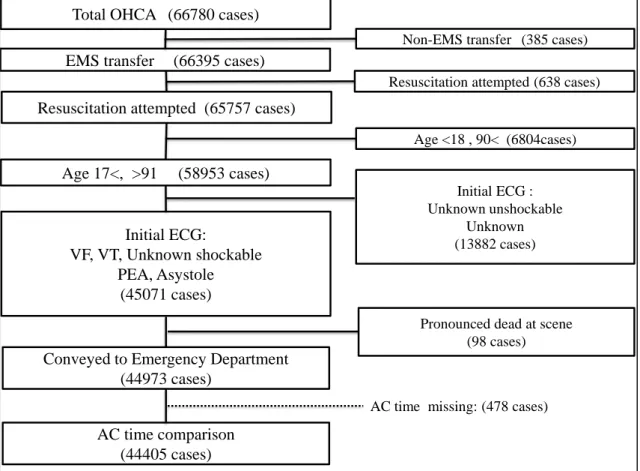
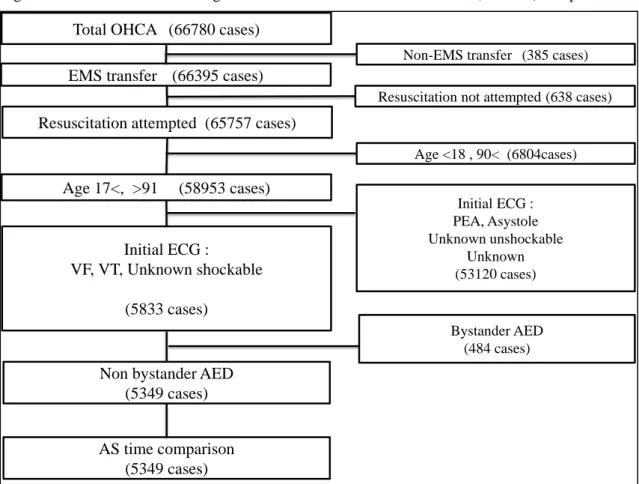
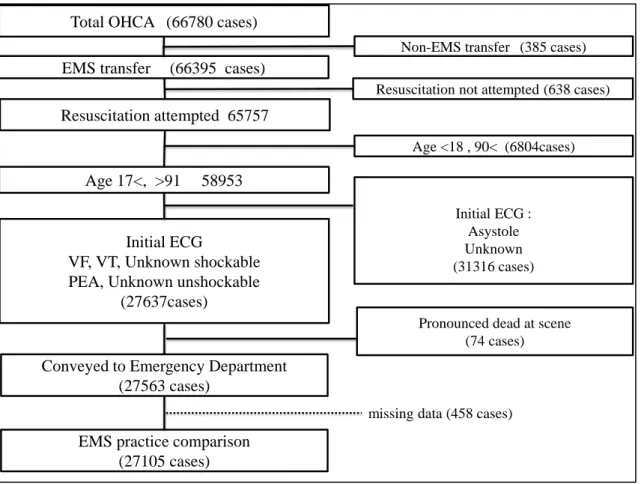
EMS practice and outcome data were extracted from the PAROS study. The time from EMS arrival at scene to CPR start (AC time), the time from EMS arrival at scene to first defibrillation shock delivered (AS time) were collected. (Figure 1-3)
A total of 66780 out of hospital cardiac arrest (OHCA) cases were registered in PAROS dataset. 44495 cases were enrolled for the comparison for AC time, 5649 for AS time, and 27195 cases for EMS practice comparison.
The inclusion criteria for the study were, a patient age was 18 to 90, resuscitations were attempted, and a patient was conveyed to Emergency department.
The data excluded in AC time comparison were those in which initial ECG was unknown or data missing timing data. (Figure 1) The data excluded in AS time comparison were those in which initial ECG was unshockable or
unknown or missing data. (Figure 2) The excluded in EMS practice comparisons were those in which initial ECG was Asystole, or unknown or missing data. (Figure 3)
Ethical Consideration
This study was approved by the local ethics committees and the PAROS Executive Committee (EXCO), each participating site was responsible for obtaining local approval to conduct the study.
Correlations between EMS practice outcomes and EMS education outcomes
The correlations between EMS practice (the frequencies of drug administration, advanced airways and Field ROSC) and EMS education hours were investigated in this study. The countries from which those data were available were Japan, Singapore, South Korea, and Taiwan. The criteria of OHCA patients were age 18 to 90, initial ECG was not asystole and resuscitation attempted. Non-public EMS transfer cases are also excluded for this study. There were total of 29048 cases.
Statistical analysis
The mean and standard deviation (SD) were used continuous variables and frequencies and proportions for categorical variables. The Tukey’s multiple comparison and Pearson’s correction analysis were applied.
Results
1. EMS classification according to WHO definitions.
The scope of practice for OHCA patients for EMS providers the highest-level and the second-level are shown in Table 1. The data were collected from 10 PAROS participating countries.
Advanced airway, intravenous (IV) infusion, and defibrillation for OHCA patients were allowed for EMS providers in all countries. Those procedures are defined by WHO as essential for advanced pre-hospital care. All the highest-level EMS providers were defined as EMT-Advanced (EMT-A) in all countries according to WHO criteria13).
The EMS providers of the second-level in Taiwan, Malaysia, The Philippines, Thailand, China, and Indonesia were also defined as EMT-A. The EMS providers of the second-level in South Korea, Singapore, and Japan were only allowed to use automated external defibrillator (AED) for advanced life support (ALS) procedure. There is no second-level EMS provider in Dubai.
2. Comparison of EMT-A education period
The average education hours for the highest-level EMS providers were 2682±1101hours (mean± S.D) in the 10 countries. The country having longest education time for EMT-A was the Philippines (4740 hours) and followed by Singapore (3081 hours), and South Korea (2960 hours). The country having shortest time was the Taiwan (for EMT-2; 280 hours).
Practical training is one of the key contents for pre-hospital care provider training. The longest practical training is in the Philippines with 2760 hours. The proportion of in-ambulance training hours to the total education was largest for Singapore’s paramedics (69.3%). On the other hand, the proportion of in-hospital training was in Taiwan (37.5%). In contrast, South Korea spends 67.6%, and Japan spends 54.0% of academic time for didactic EMT-A education. In the Philippines, the proportions of education contents were nearly equal. And also, Dubai and Thailand have 3 to 4 years for EMT-A education, but details were not disclosed. In Indonesia, the nurses are educated 27 hours to be specialized as EMS providers. (Table 3)
3. Comparison of education time for EMT-B level EMS providers.
The longest education time for EMT-B was 343 hours for South Korea’s EMT-B and the shortest education time was 250 hours for Japan (Fire-based).
The education time for EMT-B in the countries operating fire-based EMS was about 10% of that for EMT-A.
This reflects the fact in these countries EMT-B education is given to fire fighters or other non-medical persons to provide ability for BLS or limited ALS.
4. Comparison of EMS practices.
The EMS practices evaluated in this study were as follows: AC time, AS time, rate of ALS procedures to be excluded such as drug administration, and advanced-airway.
The rate of defibrillation for cases in which the initial ECG was shockable, and patient’s age was between 18 to 90 was more than 90% in all countries.
The rate of drug administration, of advanced airway were applied for 27195 OHCA cases, patient age 18 to 90 in fire-based EMS countries (Japan, South Korea, Singapore, and Taiwan).
The highest rate of drug administration was 49.8% (656cases) in Singapore, and followed by 18.6% (154cases) in Taiwan, 13.7% (3119cases) in Japan, and 1.1% (23cases) in South Korea. And also, the highest rate of advanced airway was in Singapore 83.1% (1094cases), Japan 46.6% (10607cases), Taiwan 28.9% (239cases), and South Korea 21.2% (448cases). The laryngeal mask airway (LMA) was the most common advanced airway in Singapore, Taiwan and South Korea. Whether, endotracheal intubation is common in Japan (Table 4).
5. Comparisons of EMS practice outcomes
1) Comparison of EMS arrival to CPR time (AC time) in Asian countries
The time from EMS arrived at scene to CPR start can be used for indication of EMS assessment capability on patient or situation.
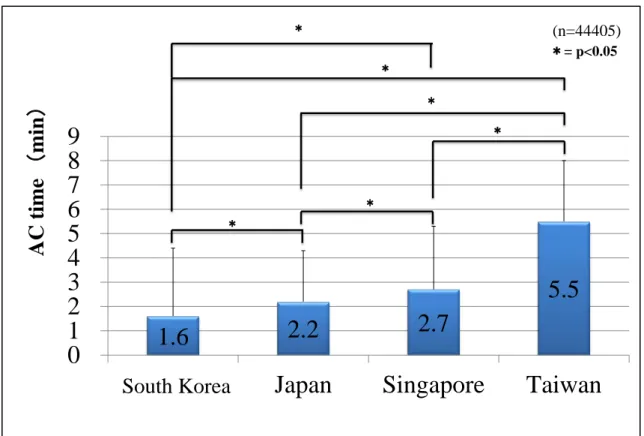
55246 OHCA cases for which resuscitation was provided from Japan, Singapore, South Korea, and Taiwan were available to analyze AC time.
The means of AC times were 1.6min for South Korea, 2.2 min for Japan, 2.7min for Singapore, 5.5min for Taiwan. The shortest AC time was 2.2min by South Korea. The Longest AC time was 5.5min by Taiwan.
Significant differences were found in between each combination of those countries (p<0.05). (Figure 4)
However the data were converted from local OHCA registries in those countries. There are differences of definition of timing data. Specially, usually EMS could not count exact timing data during resuscitation.
2) Comparison of EMS arrival to first shock time (AS time) for shockable patients.
There were 5649 cases for which the initial ECG was shockable in Japan, Singapore, South Korea, and Taiwan.
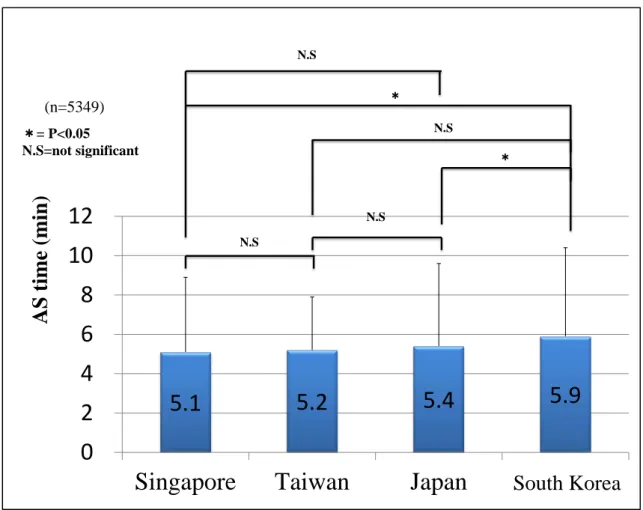
The mean of AS times were 5.1min for Singapore, 5.2min for Taiwan, 5.4min for Japan, 5.9min for South Korea.
The shortest AS time was Singapore with 5.1mins. The longest AS time was 5.9mins in South Korea.
Significant differences were found in between South Korea and Singapore South, Korea and Japan. (Figure 5) However the data were concerted from several different registries in those countries. There are differences of definition of timing data. Specially, usually EMS couldn’t count exact timing data during resuscitation.
6. Comparisons of EMS education and EMS practice in Asian countries.
The correlation relationship between EMS education time (total education hours, didactic education hours, and clinical education hours) and EMS practice outcomes (drug administration rate, advanced airway rate, and Field ROSC rate) were examined. The clinical training hours were resumed of in-hospital training hours and in-ambulance training hour.
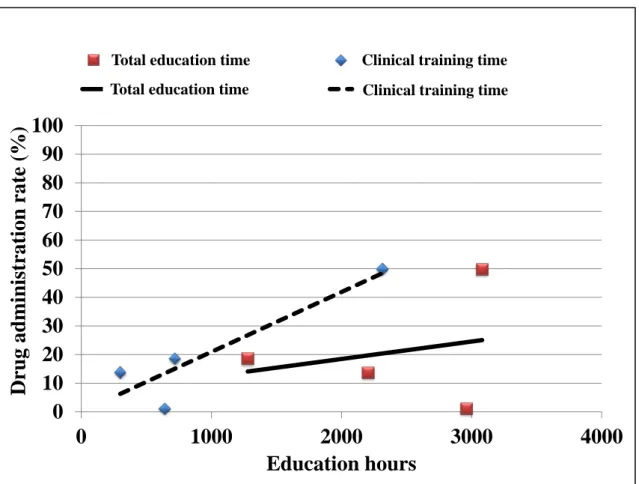
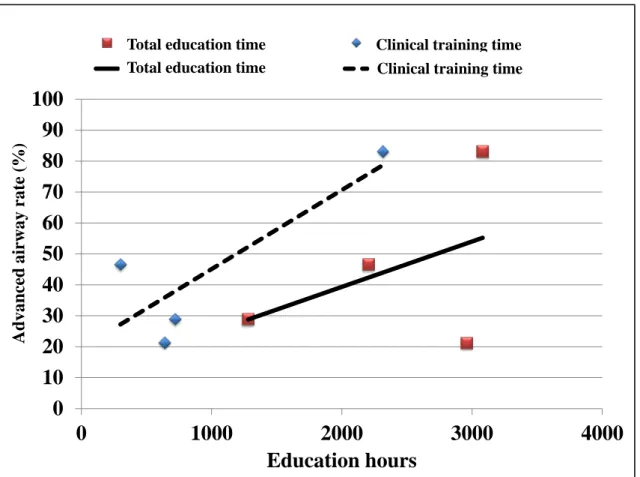
The correlation coefficient of the rate of drug administration with total education hours was 0.24, that with didactic education hours was -0.74, and that with clinical training hours was 0.91 were shown. (Figure 6) The correlation coefficient of the rate of advanced airway and total education hours was 0.44, that with didactic hours was -0.59, and that with for clinical training hours was 0.83 were shown. (Figure 7)
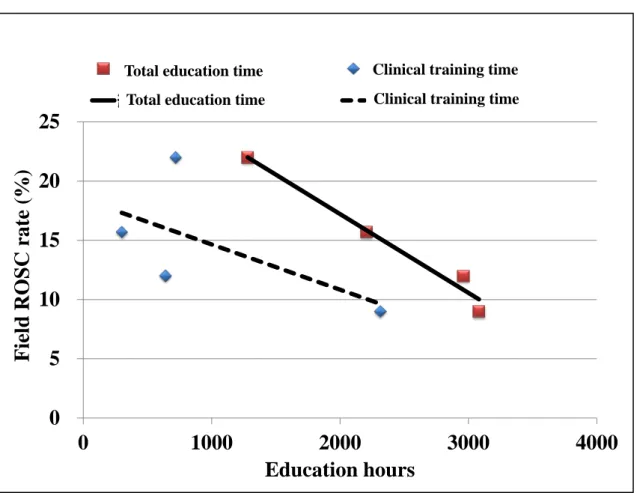
The correlation coefficient of the Field ROSC rate with total education hours was -0.99 (strong negative correlation), that with didactic hours was -0.28, and with clinical training hours was -0.61. (Figure 8)
7.Discussion
In this study, we investigated EMS provider’s education, and correlation of education and practice for highest and second level of EMS providers among 10 PAROS participating countries in this study.
Whether, hospital-based EMS countries have only EMT-A level EMS providers. In fire-based EMS countries such as Japan, South Korea, and Singapore have both of EMT-A and EMT-B level EMS providers. The mean education hours for EMT-B level EMS providers were about 300 hours which were about 10 times shorter than those for EMT-A providers. EMT-2 in Taiwan was defined as EMT-A level even through its education time was only 280 hours, because EMT-2 provides LMA for advanced airway (which may also be defined as
EMT-B+LMA).
The fire-based EMS countries such as USA often selectively use the BLS team or the ALS team, in a 2-tier response system14). In this system, the BLS team or first responder team collaborates with the ALS team according to case requiring the contents of EMS call. The BLS team usually responds to minor patients, and also many call for the ALS team to the scene for advanced clinical procedures. This system aims to reduce response time and to save ALS medical resources. In the Asian countries (Japan, South Korea and Taiwan) have also 2- tier response systems. Japanese EMS will send fire track to respond to OHCA patient or suspected OHCA patients to provide high-quality CPR, rapid AED, and to support ambulance crew according to contents of EMS call. However, the BLS teams should be well educated about patient assessment and clinical thinking to decide if they need to call the ALS team immediately and properly.
In the hospital-based EMS countries such as European countries, physicians will respond to the scene as the ALS team3). Those ALS teams will perform “Stay and Play” which is opposite idea of “Load and Go”. France also has a 2- tier response system. Their BLS teams are standby at the fire department. Their ALS team will be activated by only at the BLS team’s request15). Therefore the BLS team’s ability for patient assessment and judgement is the key to improve patient care. Those BLS teams must be well trained to use physician’s effort effectively for prehospital care.
There is a difference with concept for ALS team in 2-tire response systems between hospital-based EMS and fire-based EMS. However, both of the systems aim to minimize response time for OHCA patients, and to provide high-quality CPR and defibrillation.
Ong et al reported in the PAROS 1 study that the response time in hospital-based EMS countries were longer than that in fire-based EMS countries11). These hospital-based EMS countries usually provide single tier response systems. Increasing the number of EMT-B level EMS providers will be necessary to improve their EMS systems.
The EMS practice performance in fire-based EMS countries in Asia was also investigated in the study. The rates of proportions the both of drug administration and advanced-airway were highest in Singapore. Singapore had also longest EMT-A education hours among Asian fire-based EMS countries surveyed in this study.
Furthermore Singapore paramedics were known to provide ALS aggressively for OHCA patients according to their protocol, and the preferred advanced airway is LMA, which is an easier procedure. These factors may have resulted in an over 80% advanced airway administration rate in Singapore.
In Taiwan, the EMS education is the shortest among the fire-based EMS counties. However, the drug administration rate was second highest in the fire-based EMS countries. Taiwan and Singapore had a larger proportion of clinical education, such as in-hospital training and in-ambulance training compared to other fire-based EMS countries. The educational experiences to observe real patients in actual EMS may be desirable in providing high quality EMS.
Japan has a nationwide standard education system for EMT-A. Permitted Japanese paramedics provide ALS with endotracheal intubation. Constructing a better feedback system for paramedic and a continuous EMS education system will be desirable for Japanese EMS.
Singapore and Taiwan also have advanced continuous EMS education and/or feedback system for EMS.
Singapore has a re-certification system every two years for EMS, and an effective continuous EMS education system. Taiwan has a comprehensive and advanced feedback system by medical directors using the run sheet, CPR practice data from the defibrillator, and movies taken by ambulance cameras. These continuous EMS education and feedback systems will also be effective to improve EMS quality. The Taiwan EMS system especially, can train EMS providers with limited education hours and have a high-quality feedback system, which can be a model for Asian countries.
However, quality of EMS is not a sole factor to influence OHCA outcomes as reported in previous studies16.17.18). In prehospital settings, bystander CPR, public defibrillation and response time were major important factors. In hospital settings, therapeutic hypothermia was the main factor for neurological outcome, as previously reported (20). Therefore, a comprehensive social plan covering whole chain of survival is needed to improve OHCA outcomes19.20).
There is a common method of the clinical ladder program for nurses worldwide. These are the milestones for nurses to show the process to advance in their profession after receiving nursing certification. However, the clinical ladder for EMS providers has not been constructed globally with a few exceptional local areas such as Seattle, which has continuous EMS education programs. Making a global standard for EMS systems or even EMS providers is not easy as there are different requirements according to their social economic or cultural background in not only Asia but throughout the world. In Asia, however, the Asian association for EMS (AAEMS) which aims to improve Asian EMS has established and has set up several committees to promote the development of Asian EMS. To improve the quality of EMS education in Asian countries, standardizing the training model construction of continuous education systems, and publishing a clinical ladder will be important works for the future.
Conclusion
We surveyed the quality and quantity for EMS providers in 10 PAROS participating countries.
The hospital-based EMS countries had mainly EMS providers of EMT-A level. In the fire-based EMS countries, better EMS practice outcome were related to the education time especially clinical education time.
One of the problems for hospital-based EMS countries was longer response time. In those countries, increasing number of EMT-B level EMS provider will be benefit. In fire-based Ems countries, the implementation of effective continuous EMS medical education system and an efficient feedback system should be considered to improve the quality of EMS.
In addition, developing the clinical ladder for EMS education should be made to improve the Asian EMS
CONFLICT OF INTEREST STATEMENT Authors have no conflict of interest.
Limitations
PAROS OHCA data were mainly convert data from national or reginal registry in those countries. However, Timing data were usually not measured by device but from run sheet based on memorization of paramedic. Some timing shouldn’t be surely collect.
EMS protocols for OHCA patient, personal experience of EMS providers, quality of on the job training, or education process for EMT-A were not considered in this study.
PAROS CLINICAL RESEARCH NETWORK
Participating Site Investigators: AK Sarah and MN Julina (Hospital Sungai Buloh, Selangor, Malaysia), GY Naroo (Rashid Hospital, Dubai, United Arab Emirates), T Yagdir (Dubai Corporation for Ambulance Services, Dubai, United Arab Emirates), N Khunkhlai (Rajavithi Hospital, Bangkok, Thailand), A Monsomboon (Siriraj Hospital, Bangkok, Thailand), T Piyasuwankul (Prince of Songkla University, Hatyai, Thailand), T Nishiuchi (Kindai University Faculty of Medicine, Osaka, Japan), PCI Ko (National Taiwan University Hospital, National Taiwan University, Taipei, Taiwan), JS Kyoung (College of Medicine, Seoul National University, Seoul, South Korea), KD Wong (Hospital Pulau Pinang, Pulau Pinang, Malaysia), DRH Mao and ES Goh (Khoo Teck Puat Hospital, Singapore), LP Tham (KK Women’s & Children’s Hospital, Singapore), SO Cheah (Ng Teng Fong General Hospital, Singapore), MYC Chia (Tan Tock Seng Hospital, Singapore), L Tiah (Changi General Hospital, Singapore), BSH Leong (National University Hospital, Singapore), YY Ng (Singapore Civil Defense Force, Singapore)
Acknowledge
We would like to acknowledge the contributions of all of participating countries for PAROS and EMS studies survey. Also, Ms. Susan Yap, Ms. Shahidah Ahmad, Ms. Pek Pin Pin from the Department of Emergency Medicine, Singapore General Hospital for coordination of the PAROS study.
Authors' contribution
TH carried out the all the studies, statistical analysis, participated in the sequence alignment and drafted the manuscript. HT participated in the design of the study and performed the statistical analysis. RS and TH performed the statistical analysis and drawing figure and table. MO and SS conceived of the study and participated in its design and coordination. MM advice and assistance in the planning of this paper and MO and SS helped to revise the manuscript. All authors read and approved the final manuscript.
Competing interest
All authors declare that they have no competing interests.
References
1. Al-Shaqsi S. Models of International Emergency Medical Service (EMS) Systems. Oman Med J. 2010 Oct;
25(4):320-3
2. Kirsch TD, Holliman CJ, Hirshon JM, et al. The development of international emergency medicine: a role for U.S. emergency physicians and organizations. SAEM International Interest Group. Acad Emerg Med. 1997 Oct; 4(10):996-1001
3. Fleischmann T, Fulde G. Emergency medicine in modern Europe. Emerg Med Australas. 2007 Aug;19(4):300-2
4. Obermeyer Z, Abujaber S, Makar M Emergency care in 59 low-and middle-income countries: a systematic review. Bull World Health Organ. 2015 Aug 1;93(8):577-586G
5. Mould-Millman NK, Oteng R, Zakariah A, et al. Assessment of Emergency Medical Services in the Ashanti Region of Ghana. Ghana Med J. 2015 Sep;49(3):125-35
6. Fares S, Irfan FB, Corder RF, Emergency medicine in the United Arab Emirates. Int J Emerg Med. 2014 Jan 8;7(1):4
7. Tanigawa K, Tanaka K. Emergency medical service systems in Japan: Past, present, and future. Resuscitation.
2006 Jun;69(3)365-70
8. Shin SD, Hock Ong ME, Tanaka H, et al. Comparison of emergency medical services systems across pan-asian countries: A web-based survey. Prehosp Emerg Care. 2012;16(4):477–496
9. Ong ME, Cho J, Ma MH, Tanaka H, et al Comparison of emergency medical services systems in the pan-asian resuscitation outcomes study countries: Report from a literature review and survey. EMA. 2013;25:55–63 10. Ong ME, Shin SD, Tanaka H, et al. Pan-asian resuscitation outcomes study (PAROS): Rationale, methodology,
and implementation. Acad Emerg Med.2011;18:890–897.
11. Ong ME, Shin SD, De Souza NN, et al. Outcomes for out-of-hospital cardiac arrests across 7 countries in asia:
The Pan Asian resuscitation outcomes study (PAROS). Resuscitation. 2015;96:100–108
12. Ong ME, Shin SD, Tanaka H, et al. Rationale, methodology, and implementation of a dispatcher-assisted cardiopulmonary resuscitation trial in the asia-pacific (Pan-Asian resuscitation outcomes study phase 2).
Prehosp Emerg Care. 2015;19:87–95
13. Sasser S,Varghese M, Kellermann A, et al. Prehospital trauma care systems. Geneva,World Health
Organization, 2005
14. Stout J, Pepe PE, Mosesso VN Jr. All-advanced life support vs tiered-response ambulance systems. Prehosp Emerg Care. 2000 Jan-Mar;4(1):1-6
15. Adnet F1, Lapostolle F. International EMS systems: France. Resuscitation. 2004 Oct;63(1):7-9.
16. Malta Hansen C, Kragholm K, Pearson DA, et al. Association of bystander and first-responder intervention with survival after out-of-hospital cardiac arrest in north carolina, 2010-2013. JAMA. 2015;314:255–264.
17. Cummins RO, Eisenberg MS, Hallstrom AP, Litwin PE. Survival of out-of-hospital cardiac arrest with early initiation of cardiopulmonary resuscitation. Am J Emerg Med. 1985;3:114–119
18. Pell JP, Sirel JM, Marsden AK, Ford I, Cobbe SM. Effect of reducing ambulance response times on deaths from out of hospital cardiac arrest: Cohort study. Bmj. 2001;322:1385–1388
19. Stiell IG, Wells GA, Field B, et al. Advanced cardiac life support in out-of-hospital cardiac arrest. N Engl J Med. 2004;351:647–656
20. Frydland M, Kjaergaard J, Erlinge D, et al. Target temperature management of 33 degrees c and 36 degrees c in patients with out-of-hospital cardiac arrest with initial non-shockable rhythm - a ttm sub-study. Resuscitation.
2015;89:142–148
Figure 1. Patient flow in extracting data for EMS arrival to CPR start time (AC time) comparison.
OHCA; Out of hospital cardiac arrest, EMS; Emergency Medical services, ECG; Electrocardiogram, VF: Ventricular Fibrillation, VT; Ventricular Tachycardia, PEA: Pulseless Electrical Activity, AC time: EMS arrival to CPR start time.
This figure shows the OHCA patient flow in extracting data for AC time comparison study.
Total OHCA (66780 cases) EMS transfer (66395 cases)
Non-EMS transfer (385 cases)
Resuscitation attempted (65757 cases)
Resuscitation attempted (638 cases)
Age <18 , 90< (6804cases)
Age 17<, >91 (58953 cases)
Initial ECG:
VF, VT, Unknown shockable PEA, Asystole
(45071 cases)
Conveyed to Emergency Department (44973 cases)
AC time comparison (44405 cases)
AC time missing: (478 cases) Initial ECG : Unknown unshockable
Unknown (13882 cases)
Pronounced dead at scene (98 cases)
Figure 2. Patient flow in extracting data for EMS arrival to first shock time (AS time) comparison.
OHCA; Out of hospital cardiac arrest, EMS; Emergency Medical services, ECG; Electrocardiogram, VF; Ventricular Fibrillation, VT; Ventricular Tachycardia, PEA: Pulseless Electrical Activity, AED; Automated external defibrillator, AS time; EMS arrival to first shock time.
This figure shows the patient flow in extracting data for AS time comparison study.
Total OHCA (66780 cases) EMS transfer (66395 cases)
Non-EMS transfer (385 cases)
Resuscitation attempted (65757 cases)
Resuscitation not attempted (638 cases)
Age <18 , 90< (6804cases)
Age 17<, >91 (58953 cases)
Initial ECG :
VF, VT, Unknown shockable (5833 cases)
Non bystander AED (5349 cases) AS time comparison
(5349 cases)
Initial ECG : PEA, Asystole Unknown unshockable
Unknown (53120 cases)
Bystander AED (484 cases)
Figure 3. Patient flow in extracting data for EMS practice comparison.
OHCA; Out of hospital cardiac arrest, EMS; Emergency Medical services, ECG; Electrocardiogram, VF; Ventricular Fibrillation, VT; Ventricular Tachycardia, PEA: Pulseless Electrical Activity,
This figure shows the patient flow in extracting data for EMS practice comparison study.
Total OHCA (66780 cases) EMS transfer (66395 cases)
Non-EMS transfer (385 cases)
Resuscitation attempted 65757
Resuscitation not attempted (638 cases)
Age <18 , 90< (6804cases)
Age 17<, >91 58953
Initial ECG
VF, VT, Unknown shockable PEA, Unknown unshockable
(27637cases)
Conveyed to Emergency Department (27563 cases)
EMS practice comparison (27105 cases)
Initial ECG : Asystole Unknown (31316 cases)
Pronounced dead at scene (74 cases)
missing data (458 cases)
Table1. Classification of EMS provider and authorized EMS procedure in 10 Asian countries
IV: intravenous infusion, WHO: World health organization. EMT-I: emergency medical technician - intermediate, EMT-B: emergency medical technician - basic
*At least either intramuscular injection, subcutaneous injection or epinephrine autoinjector.
This table shows that definition of the highest and the second level of EMS provider in Asian countries into WHO definition of EMT-B and EMT-A.
All countries have EMT-A level EMS providers. However, Singapore, South Korea, and Japan have EMT-B level.
Country Characteristic Intubation Advanced
Airway IV Injection* Drug Defibrillation WHO Definition
Singapore Paramedic - Yes Yes Yes Yes Yes EMT-A
EMT-B - - - - - Yes EMT-B
Japan ELST Yes Yes Yes Yes Yes Yes EMT-A
EMT-B - - - - - AED only EMT-B
South Korea Paramedic Yes Yes Yes Yes - Yes EMT-A
EMT-B - - - - - AED only EMT-B
Taiwan Paramedic Yes Yes Yes Yes Yes Yes EMT-A
EMT-2 - Yes Yes Yes Yes Yes EMT-A
Malaysia
Medical Assistant - Yes Yes Yes Yes - EMT-A
EMT-B - Yes Yes Yes - EMT-A
Philippine Paramedic Yes Yes Yes Yes Yes Yes EMT-A
EMT-I Yes Yes Yes Yes Yes Yes EMT-A
Dubai – UAE Paramedic - Yes Yes - - - EMT-A
- - - - - - - -
Thailand Physician Yes Yes Yes Yes Yes Yes EMT-A
EMT-I - - Yes Yes Yes - EMT-A
China Physician Yes Yes Yes Yes Yes Yes EMT-A
Nurse Yes Yes Yes Yes Yes Yes EMT-A
Indonesia Physician Yes Yes Yes Yes Yes Yes EMT-A
EMT-I - - Yes Yes Yes Yes EMT-A
Table 2 Education time for EMS provider of EMT-A level in 10 Asian countires
EMT: emergency medical technician, EMT-A; emergency medical technician – advanced.
The table shows education hours and proportion.
The longest education hours is paramedic in Philippine with 4740 hours.
Those largest proportions of content were Singapore Ambulance training (69.3%), Taiwan hospital training (37.5%), and Didactic of Korea (67.6%).
Country Characteristic Total training Didactic (%) Hospital training (%) Ambulance training (%) Simulation (%) Skill (%) Philippine EMT-Paramedic 4740h 1,500h (31.6) 960h (20.3) 1600h (33.8) 240h (5.1) 440h (9.3) Philippine EMT-Intermediate 3440h 1020h (29.7) 480h (14.0) 1300h (37.8) 360h (10.5) 280h (8.1) Singapore EMT-Intermediate 3081h 385h (12.5) 180h (5.8) 2136h (69.3) 290h (9.4) 90h (2.9) South Korea EMT-Intermediate 2960h 2000h (67.6) 400h (13.5) 240h (8.1) 120h (4.1) 200h (6.8)
Malaysia Medical Assistant 2635h 385h(14.6) 180h (6.8) 1695h (64.3) 290h (11.0) 90h (3.4)
Japan (Private) EMT-Paramedic 2205h 1080h (49.0) 240h (10.9) 60h (7.7) 825h (34.7)
Taiwan EMT-Paramedic 1280h 380h (29.7) 480h (37.5) 240h (18.8) 142h (11.1) 38h (3.0)
Japan (Fire) EMT-Paramedic 1117h 597h (53.4) 120h (10.7) 60h (5.4) 340h (30.4)
Taiwan EMT-2 280h 85h (30.4) 48h (17.1) 96h (34.3) 32h (11.4) 19h(6.8)
Indonesia Nurse 27h N/A N/A 5h N/A N/A
China Physician N/A 4.5y 0.5y N/A N/A N/A
China Nurse 4.5y 4y 0.5y N/A N/A N/A
Dubai – UAE EMT-Paramedic N/A 3~4+ y N/A N/A N/A N/A
Thailand EMT-Paramedic 4y N/A N/A N/A N/A N/A
Malaysia EMT-Basic N/A N/A N/A N/A N/A N/A
Table 3. Education for EMS providers of EMT-B in 3 Asian countries.
*Orientation, including visiting to SCDF operations room and ambulance orientation.
** Taken place only after the 6-week EMT program.
EMT – emergency medical technician
The table shows education hours and proportion..
The longest education was 343hours for Korea EMT-Basic.
Country Characteristic Total training Didactic (%) Hospital training (%) Ambulance training (%) Simulation (%) Skill (%)
South
Korea EMT-Basic 343h 143h (41.7) 50h (14.6) 50h (14.6) 50h (14.6) 50h (14.6)
Singapore EMT-Basic 288h 45h(15.6) 8h(2.8)* 1-2 years tour** 172h(59.7) 63h(21.9)
Japan EMT-Basic 250h 215h (86.0) None None Totally 35h (14.0)
Table 4. EMS practices on OHCA patient in Fire-based EMS countries.
LMA: l
aryngeal mask airway CPR: cardiopulmonary resuscitation
The table shows ALS procedure practices which were provided by EMS providers in Fire-based EMS countries.
Singapore has largest proportion of drug administration and LMA.
Scene ROSC was highest in Taiwan with 19.0%.
Countries
Japan(n=22760) Korea(n=2114) Singapore(n=1316) Taiwan(n=827)Bystander CPR (n, %)
8310(36.5) 808(38.2) 314(23.9) 257(31.1)
Drug administration (n, %)
3119(13.7) 23(1.1) 656(49.8) 154(18.6)
Advanced Airway
Total (n, %)
10607(46.6) 448(21.2) 1094(83.1) 239(28.9)
Intubation (n, %)
3215(30.3) 69(15.4) 11(1.0) 108(45.2)
LMA (n, %)
1357(12.8) 186(41.5) 1082(98.9) 131(54.8)
King Airway (n, %)
1952(18.4) 55(12.3) 0(0.0) 0(0.0)
Other Airway (n, %)
4083(38.5) 138(30.8) 1(0.1) 0(0.0)
Field ROSC (n, %)
3565(15.7) 254(12.0) 118(9.0) 182(22.0)
Figure 4. Comparison of EMS arrival to CPR start time (AC time) in fire-bases EMS countries.
EMS : Emergency medical service CPR : Cardio pulmonary resuscitation
Each bar represent the mean ±SD of the AC time (time required from EMS arrived to start of CPR).
The Tukey multiple comparison was used as statistical analysis.
Statistic differences were found in each country pair.
1.6 2.2 2.7
5.5 0
1 2 3 4 5 6 7 8 9
Korea Japan Singapore Taiwan
A C time ( min )
South Korea
*= p<0.05
(n=44405)
*
*
*
*
*
*
Figure 5. Comparison of EMS arrival to first shock time (AS time) in fire-based EMS countries.
Each bar represents the mean ±SD of the AS time (time required from EMS arrival to start of first defibrillation shock).
The Tukey multiple comparison was applied for statistical analysis.
Statistic differences were found between South Korea and Japan and between South Korea and Singapore.
5.1 5.2 5.4 5.9
0 2 4 6 8 10 12
Singapore Taiwan Japan Korea
A S time (min )
(n=5349)
*= P<0.05 N.S=not significant
*
N.S
*
N.S N.S
N.S
South Korea
Figure 6. Correlation between EMS education time and drug administration rate.
The figure shows the correlation relationship between EMS education and the Drug administration rate in Singapore, Taiwan, South Korea and Japan.
r=0.24 for total education hours and drug administration rate.
r= 0.91 for clinical training hours and drug administration rate.
0 10 20 30 40 50 60 70 80 90 100
0 1000 2000 3000 4000
D ru g a d min is tr a tio n ra te (% )
Education hours
Drug administration Drug administration
線形
(Drug administration)
線形(Drug administration)
Total education timeTotal education time
Clinical training time Clinical training time
Figure 7. Correlation between EMS education time and advanced airway rate
The figure shows the correlation relationship between EMS education time and the advanced airway rate in Singapore, Taiwan, South Korea and Japan.
r=0.44 for total education hours and advanced airway rate.
r=0.83 for clinical training hours and advanced airway rate.
0 10 20 30 40 50 60 70 80 90 100
0 1000 2000 3000 4000
A d van ce d ai rw ay ra te (% )
Education hours
Advanced Airway Advanced Airway
線形(Advanced Airway) 線形(Advanced Airway) Total education time
Total education time
Clinical training time Clinical training time
Figure 8. Comparison between EMS education time and Field ROSC rate.
This figure shows the correlation relationship between EMT-A education time and Field ROSC rate in Singapore, Taiwan, South Korea and Japan.
r= -0.99 for Field ROSC rate with total education hours (strong negative correlation).
r= -0.61 for Field ROSC rate with Clinical training hours.
0 5 10 15 20 25
0 1000 2000 3000 4000
Fi el d R O SC ra te ( % )
Education hours
Field ROSC 系列 1
線形 (Field ROSC) 線形 ( 系列 1)
Total education time Total education time
Clinical training time Clinical training time