The Correlation between the Freezing Ratio and
the Viscosity of Homogenate of Thawed Mackerel
Muscle
著者
NISHIMOTO Junichi
journal or
publication title
鹿児島大学水産学部紀要=Memoirs of Faculty of
Fisheries Kagoshima University
volume
17
page range
21-28
別言語のタイトル
凍結魚肉ホモゲネイトの粘度変化と凍結率との関連
性
Vol.17,pp.21~28 (1968)
The Correlation between the Freezing Ratio and the Viscosity of Homogenate of Thawed Mackerel Muscle
Jun-ichi Nishjmoto *
Abstract
In case of the freezing and storing at—5°C, the greater the freezing ratio the
more the viscosity-level decreased, therefore, it was assumed that viscosity-level
might have some correlation with the soluble protein content in extracts.
Similarly, in case of both —10 and —20°C, the relationship between viscosity-level
and freezing ratio was similar to that obtained in case of— 5 °C, whereas the change .. in soluble protein content in extracts was not so remarkable as shown in— 5 °C.
Ice formation in muscle is causative of viscosity decrease. The decrease is mai
nly due to the dehydration with the increase of salts concentration in the tissue.
Virtually the actions are accompanied with the denaturation of protein. Neverthe less, the author dare to propose in this examination that another causative agent, physical agent like pressure, should be applied in resolving the correlations menti
oned above.
Toughness in cod tissues was studied by Love1^^ and Tanaka6) as physical
change of fish muscle during frozen storage.
According to the other study, it was ascertained that much amount of drip was excluded from thawed fish, simultaneously the toughness occurring
in the meat was observed after cooking.
Nishimoto and Ohta7) found the same toughness in the other fishes. In
this examination, the verification was devised according to the following situation. The toughness was measured by the viscosity decrease of the homo
genate which was prepared by mechanical disruption of muscle under the definite conditions. In case of the examination, the degree of toughness
was slightly varied with the species of fish.
Love considered that the phenomenon is caused by denaturation of muscle
protein in which the salts are condensed by ice forming accompanied with removal of water.
The proportion of convertion from water to ice in muscle was called for
"freezing ratio,,,8) and Gensho9) proposed an equation of the change and it is as follows:
? = 1 — (Freezing point of fish muscle°C) / (Temperature of fish
muscle°C)
* Laboratory of Food Preservation Technology, Faculty of Fisheries, Kagoshima University.
2? Mem. Fac. Fish., Kagoshima Univ. Vol.17 (1968)
where f is "freezing ratio".
The author studied on the relationship between the freezing ratio and the viscosity-level of homogenate of frozen muscle, and reported only one part of the results in this paper.
Experimental
Fresh muscle of mackerel obtained commercialy was used in the experiment.
Three pieces of minced normal muscle 10 g were prepared in the block of definite size (15x28mm0) and each of them was frozen individually at—5, —10 and —20°C, being stored successively at the same temperatures. At def inite intervals, the frozen muscle taken out from the cold room, being subje cted to experimental samples after thawing at 15°C for 30 minuts. The definite volume of 65 % sugar solution was added to definite weight of material, and the mixture was homogenized at 15000 r.p.m. for 2 minuts using the homogeni-zer (Nihon Seiki Co.) , finally viscosity of homogenate of it was measured by Brooksfield type viscosmeter at 10±1°C. The viscosity-level of homogenate was shown as (Viscosity (cp) of thawed muscle) / (Viscosity (cp) of original muscle) X100(%).
Amount of salt soluble protein in extract of 0.6M KC1 at pH 7.2 was measued by Biuret method. The precipitation (actomyosin fraction) obtained from the extract was prepared by 8 fold dilution with cold water and by keeping over
night atQ°C.
Results
In the previous paper,7' the author found that the viscosity-level of homo
genate of thawed muscle was easy to decrease as compared with that of
fresh muscle. In order to know the correlation between the freezing ratio and viscosity-level of homogenate, a lot of muscle having different freezingpoint should be adopted in this examination. Virtually, each volume of glyce
rol 5,10 and 20 ml per muscle weight 100g was added to mackerel muscle and
the freezing point of each muscle was derived from freezing curve at—25°C.
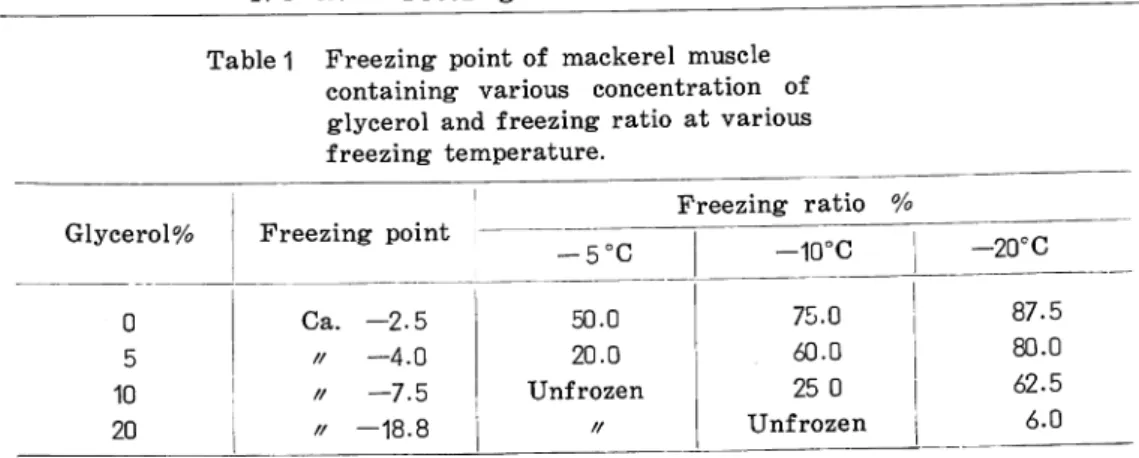
The freezing point of treated muscle are shown in Table 1 .
Table 1 Freezing point of mackerel muscle containing various concentration of glycerol and freezing ratio at various
freezing temperature. Freezing point Freezing ratio % Glycerol% -5°C -10°C —20CC 0 Ca. —2.5 50.0 75.0 87.5 5 // -4.0 20.0 60.0 80.0 10 // -7.5 Unfrozen 25 0 62.5 20 // -18.8 // Unfrozen 6.0
Freezing and keeping at -5°C
The muscle treated with glycerol showed the lower freezing point as com
pared with the untreated muscle, accordingly the low freezing ratio was obs
erved in the treated muscle. Really, the muscles containing 10 and 20% glyc
erol were able to keep under unfrozen state during storage at—5°C (Tablel).
Under the condition mentioned above, the changes of viscosity-level and
solublue protein content of extracts during frozen storage were shown in
Figs. 1 and 2. 100 -5°C. 1 50 Freezing ratio B o A Unfrozen o 100 • X 2 0% 5 0% c 90 c c £ < 80 70 0^ CQ< 10 20 30
Time of storage, clays
Fig.l. Changes of the relative viscosity of homogeneous
mackerel muscle during storage at —5°C.
B. f. \ Before freezing
A. f. ! After freezing
0 10 20 30
— Time of storage, days
Fig.2. Changes of the amount of protein present in 0.6M KCfi extracts
from mackerel muscle during storage at -5°C.
24 Mem. Fac. Fish., Kagoshima Univ. Vol.17 (1968)
After keeping overnight at — 5 °C, the decrease of viscosity-level was not clear, in unfrozen muscle, but that of frozen muscle was clear. The decrease
of viscosity-level was proportional to the increase of freezing ratio. However,
amount of the soluble protein in the extracts of thawed muscle was not ch angeable after keeping overnight at —5°C, and progressive decrease was ob served during storage.Freezing and keeping at—1Q°C
As shown in Figs. 3 and 4, both the changes of viscosity-level and the soluble protein content of extracts, in case of [unfrozen state, show a tendency to become similar compared with — 5 °C, whereas the change of soluble protein content of extracts during storage, in case of frozen state, was not so remark able compared with— 5 °C storage.
be o E o 100 Z 50 ffl< o • X 10 20 30
Time of storage , days
1 o°c Freezing ratio 1 Unfrozen I 2 5% ! 6 0% : 7 5% ^ 100 r 0) o S < 90 80 70 CQ< 10 20 30
Time of storage , days
Fig.3. Changes of the relative viscosity of homogeneous mackerel muscle during storage at -10 °C
Fig.4. Changes of the amount of protein present in 0.6M KCfi extracts from mackerel muscle during storage at —10°C«
Freezing and keeping at —20 °C
As shown in Figs. 5 and 6, in case of small freezing ratio like 6 %, even if the muscle is in frozen state, very little decrease of viscosity-level was observ
ed in the thawed muscle both in begining vf storage and immediately after
freezing. Furthermore, the remarkable decrease was not observed on the soluble protein content of extracts, nevertheless the change of viscosity-level
was rather strikingly on the post storage.
In case of various freezing ratios 62.5, 80.0 and 87.5 %, the viscosity-level decreased markedly, and it was observed that the greater the freezing ratio
the more the viscosity-level decreased, while the decrease of soluble protein in
extracts was not so remarkable.
fcfl
o
0 10 20 30
• • Time of storage , days
Fig.5. Changes of the relative viscosity of
homogeneous mackerel muscle during storage
at -2(TC. -20°C. Freezing ratio O : 6.0% A : 62.5% • : 80. 0% X : 87.5% OS 100 90 80 70 o' o £ < CQ<
=*5*
10 20 30Time of storage , days
Fig.6. Changes of the amount of protein
present in o.6M KC£ extracts from
mackerel muscle during storage at
-20°C.
Discussion
Marked decrease of viscosity-level of homogenate of thawed muscle.
When the frozen muscle was defrosted, the viscosity-level of thawed muscle
decreased markedly, while the decrease of it was not observed in either Un
frozen muscle having low freezing point or small freezing ratio. Reason why
is considered to be due to the formation of ice crystals in the fish muscle,
additionally, as shown in Plate 1 , larger crystal was produced in the out-side
of muscle fiber compared with inner side. Therefore, it was presumed that
during the process of ice crystal formation, water in the inside muscle-fiber
diffused out gradually to form the out side crystal, finally, the muscle - fiber
from which water deprived was deformed scantily, simultaneously, large ice
crystal produced in the out side might press the muscle-fiber.26 Mem. Fac. Fish., Kagoshima Univ. Vol.17 (1968)
(2) fi
(3)
Plate 1 Cross section of mackerel muscle
(l)Before freezing (fresh muscle ) (2)After freezing (at 5 °C )
Change of viscosity-level of homogenate during frozen storage
According to the previous publications,1 ),10~12) the toughness of frozen fish after
thawing was mainly due io actomyosin denaturation. It was assumed in this
examination (Figs. 1 and 2) that the decrease of viscosity-level had a proporti onal relationship to the solubility decrease of salt soluble protein. Actually the result, in freezing and keeping at— 5 °C, is identical to Love's hypothesis. However, the degree of viscosity-level was not always dependent upon denatu ration. Accordingly, the changes of viscosity-level affected by denaturation were mainly caused by both the dehydration and condensation of salts in the muscle fluid. Nevertheless, according to this examination, another causative agent e.g. a physical agent also seemed to be important on such chages
mentioned above.
According to the result mentioned above, the decrease of viscosity affected by the protein denaturation was slight either in —20°C or under high freezing ratio. Since, in this examination, glycerol was used for dropping the freezing point, it should be adopted to resolve the phenomenon that hydrophilic OH may also act protectively on the protein denaturation.
In either case, it was clear that the greater the freezing ratio the more the viscosity-level decreased, and that formation of ice and its growth give rise
to the decrease of viscosity-level.
Acknowlegement
Thanks are given to Mr. K. Tanoue and K. Tsutsui for their assistance in
the experimental work.
References
1) Love, R. M. (1962) : New factors Involved in the Denaturation of Frozen Cod Muscle Protein, J .Food Sci., 27, 544.
2) Love, R. M. and Eleanor M. Mackay (1962) : Protein Denaturation in Frozen Fish. V—Development of the Cell Fragility Method for Measuring Cold-storage Changes in the Muscle, J.Sci.Food Agric, 13, 200.
3) Love, R.M., M. M. Aref, M.K. Elerian, (the late) J. I. M. Ironside, Eleanor
M. Mackay and M. G. Varela (1965) : Protein Denaturation in Frozen Fish.
X-Changes in Cod Muscle in the Unfrozen State, with Some further Observations on the Principles underlying the Cell Fragility Method, J. Sci. Food Agric,
16, 259.
4) Love, R.M. (1966) : Freezing of Bound Water and Protein Aggregation in Fro zen Cod Muscle stored near its Melting Point, Nature, 211. 981
5) Love, R. M. (1967) : The Effect of Initial Freezing Temperature on the Beha viour of Cod Muscle Protein during Subsequent Storage : Histological Study of
28
Mem. Fac. Fish., Kagoshima Univ. Vol.17 (1968)
Homogenates, Bull. Jap. Soc. Sci. Fisheries, 33, 746.
6) Tanaka, Takeo (1965) : in "The Technology of Fish Utilization", P. 121, (Ed.R.
Kreuzer)
(Rome : FAO; London : Fishing News (Book) Ltd.).
7) Nishimoto,J. and F. Ohta (1965) : Correlation between the Fish-Tissue Pieces
Size in the Homogenate and the Homogenate-Viscosity, Mem. Fac. Fish. Kago
shima Univ., 14. 99 (in Japanese)
8) Nagaoka, J.and K. Tanaka (1962) : "Refrigeration and Cold storage", 319
(Koseisha Koseikaku, Tokyo, Japan) , (in Japanese) .
9) Gensho, I (1937) : Freezing Curve, The Refrigeration, 12, 930. (in Japanese) .
10) Love, R. m. (1962) : Protein Denaturation in Frozen Fish.\tf-Cold storage Stu
dies on Cod using the Cell Fragility Method, J. Sci. Food Agric, 13, 269.
11) Dyer, W. J. and Margaret L. Morton (1956) : Storage of Frozen Plaice Fillets,
J". Fish. Res. Bd. Canada, 13, 129.