Quantum
representation
and
dual Garside
structure
Tetsuya
Ito
Research Institute for Mathematical
Sciences,
Kyoto
University
1
Introduction
It is widely known that the quantum group $U_{q}(\mathfrak{g})$, the quantum enveloping algebra of
a
lie algebra $\mathfrak{g}$, gives rise toa
representation of the braid group$B_{n}$ called
a
quantumrepresentation. For an $U_{q}(\mathfrak{g})$-module $V$, one gets a linear representation $B_{n}arrow GL(V^{\otimes n})$
usingauniversal$R$-matrix. Suchbraid representations, especially for the
case
$\mathfrak{g}$isasimplelie algebra such
as
$\epsilon \mathfrak{l}_{2}$, have gathered much attentions since they produce topologicalinvariants of knots, links and 3-manifolds called quantum invariants.
Although quantum invariants have been actively studied, the quantum representation
themselves
are
still mysterious. In this paperwe
illustratea new
point of view in the studyofquantumbraidrepresentations. We show that “generic” quantumrepresentations nicely
behaves with respect to the dual Garside structureof the braidgroups. This suggests that
quantum representations have various nice properties than we first expected.
The dual Garside structure is a combinatorial structure of braid groups which dates
back to Garside’s solution of words and conjugacy problem for the braid groups [G]. The
dual Garside structure introduces
a
normalform of braids called $a$ (dual Garside) normalform, and
we
havea
nice length function called the dual Garside length whichcan
becomputed quite effectively.
A relationship between a linear representation of the braid groups and dual Garside
structure
was
inspired by author’s previous works [Il, IW], which establisheda
connectionbetween Homologicalrepresentations of the braid groups and the dual Garside length.
In this paper, we restrict our attention to the simplest case, $\mathfrak{g}=\epsilon \mathfrak{l}_{2}$ and we omit the
proof of the main theorem. The proof of
our
main Theorem, Theorem 4.2, consists ofseveral (tricky) calculations of the action of $B_{n}$, with
a
help of dual Garside structures.Details will be included in [I2]. We will treat the
case
where $\mathfrak{g}$ isa
general lie algebra in[I3].
2
Dual Garside structure of the braid
groups
Inthis section we summarize basicfacts
on
the dual Garside structureof the braidgroups.For details, see Birman-Ko-Lee [BKL]. [BGG, Section 1] provides a good overview of
Garside structures emphasizing the role of normal forms. See [DDKM] for general and
2.1 Dual Garside structure and normal forms For $1\leq i<j\leq n$, let $a_{i,j}$ be the braid
$a_{i,j}=(\sigma_{i+1}\cdots\sigma_{j-2}\sigma_{j-1})^{-1}\sigma_{i}(\sigma_{i+1}\cdots\sigma_{j-2}\sigma_{j-1})$ .
The generating set $\Sigma^{*}=\{a_{i,j}|1\leq i<j\leq n\}$ was introduced in [BKL]. Anelement of$\Sigma^{*}$
is called the dual Garside generators, or band generators, or Birman-Ko-Lee generators.
The dual braid monoid $B_{n}^{+*}$ is asubmonoid of $B_{n}$ generated by $\Sigma^{*}$
.
An element of$B_{n}^{+*}$
is called a dual-positive bmid. The braid $\delta=a_{1,2}a_{2,3}\cdots a_{n-1,n}$ is called the dual Garside
element.
Let $\neg\prec$ be the suffix ordering with respect to the dual Garside generators
$\Sigma^{*};\beta_{1}\neg\prec\beta_{2}$
if and only if$\beta_{2}\beta_{1}^{-1}\in B_{n}^{+*}$. This defines a lattice ordering on $B_{n}$, that is, for $s,$$t\in B_{n},$
there exists a unique least
common
multiple $s\vee t$ and aunique greatest common divisor$\mathcal{S}\wedge t.$ $A$ dual-positive braid $x$ is called a dual-simple if $x\neg\prec\delta$
.
The set of dual-simpleelement is denoted by $[$1,$\delta]$. Instead of$\Sigma^{*}$, we will often use
$[$1,$\delta]$ as a generator of $B_{n}.$
$A$ (right-greedy, dual Garside) normal
form
ofa
braid$\beta\in B_{n}$ is
a
decomposition of$\beta$as
a
product of dual simple elements of the form$\beta=x_{r}\cdots x_{1}\delta^{p}$
that is defined by
1. $p$ is the maximal integer that satisfies $\delta^{p}\neg\prec\beta.$ 2. For $i=1,$$\ldots,$$r,$ $x_{i}=(x_{r}\cdots x_{i})\wedge\delta.$
We will denote the normal form of $\beta$ by $N(\beta)$. The normal form has the following
remarkable property.
Proposition 2.1. $x_{r}\cdots x_{1}\delta^{p}$ is a normal
form if
and onlyif
$x_{1}\neq\delta$ and $x_{i+1}x_{i}\wedge\delta=x_{i}$for
each $i$ $(in$ other words, $x_{i+1}x_{i} rs a$ normal$form for each i)$.This proposition leads to an effictive way of computing anormal form. Moreover, the
normalforms induces a bi-automatic structure of the braid groups. See [ECHLPT, Deh].
The supremum$\sup(\beta)$ and the
infimum
$\inf(\beta)$ of $\beta$ are integers defined by$\{\begin{array}{l}\sup(\beta)=\min\{m\in \mathbb{Z}|\beta\prec\delta^{m}\}\inf(\beta)=\max\{M\in \mathbb{Z}|\delta^{M}\prec\beta\}\end{array}$
These values
are
closely related to the normal form of$\beta$. If $N(\beta)=x_{r}\cdots x_{1}\delta^{p}$ then$\sup(\beta)=p+r$, and $\inf(\beta)=p.$
The dual Garside length $l=l_{\Sigma^{*}}$ is the length function of $B_{n}$ with respect to the
dual-simple elements $[$1,$\delta]$
.
It is known that$l_{\Sigma}*( \beta)=\max\{0, \sup\Sigma^{*}(\beta)\}-\min\{\inf_{\Sigma^{*}}(\beta), 0\}.$
2.2 Diagrammatic expression of dual Garside
structures
Here
we
explaina
convenient expression ofdual simple elements usingconvex
polytopes.Let $D_{n}=\{z\in \mathbb{C}||z|\leq 1\}$ be the $n$-punctured disc. We put the puncture points
$p_{1},$ $\ldots,p_{n}$
on
the circle $|z|= \frac{1}{2}$,as
shown in the right of Figure 1. Then there isa
one-to-one correspondence between the set of disjoint collections of
convex
polygons in $D_{n}$whose vertices
are
puncture points, and the set ofdual-simple elements.This correspondence is given
as
follows: Firstassume
thata
convex
polygon $P$ isconnected. Let $p_{m_{1}},$ $\ldots,p_{m_{k}}(1\leq m_{1}<m_{2}<\cdots<m_{k}\leq n)$ be the vertices of $P$
.
Wedefine
a
braid $x_{P}$$x_{P}=a_{m_{1},m_{2}}a_{m2,m_{3}}\cdots a_{m_{k-1},m_{k}}.$
For adisjoint collection of
convex
polygons$\mathbb{P}=\{P_{1}, \ldots, P_{M}\}$,we
define$x_{P}=x_{P_{1}}x_{P_{2}}\cdots x_{P_{M}}.$
Then it is seen that $x_{P}$ is a dual-simple element. Conversely, every dual-simple element
can
be expressed in sucha
way. For $x\in[1, \delta]$,we
will write the correspondingconvex
polygons by $P_{x}.$
This correspondence canbe easily understood by using geometric interpretation of the
braid groups. As is well-known, the braid group $B_{n}$ is identified with the mapping class
group of$n$-punctured disc $D_{n}.$
For $1\leq i<j\leq n$, let $e_{ij}$ be the line segment that connects the i-th and the j-th
punctures. As an element of mappingclass group, the band-generator $a_{i,j}$ corresponds to
the left-handed half-Dehn twist along $e_{ij}:a_{i,j}$ interchanges the position of punctures $p_{i}$
and$p_{j}$ by rotating the small disc neighborhood of$e_{ij}$ in
a
clockwise direction (see Figure1$)$
.
Figure 1: $n$-punctured disc$D_{n}$ and action of
$a_{ij}$
By generalizing thismove ofpunctures,for acollection of
convex
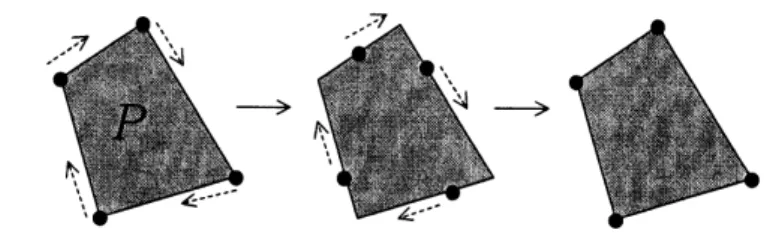
polygons weassociatea dance of the puncture points. Each puncture which belongs to
some
polygon $P$ movestothe positionofthe adjacent vertex, inthe clockwise direction along the boundary of$P,$
see
Figure 2. In particular, the dual Garside element $\delta$ acts on $D_{n}$as
rotation ofdisc byFigure2: Polygonexpressionof dual-simple elements: anactionon $D_{n}$
3
Generic
quantum
$\epsilon \mathfrak{l}_{2}$representation
In this section,
we
reviewa
construction of generic quantum$\epsilon \mathfrak{l}_{2}$-representation followingJackson-Kerler [JK]. For basics of $U_{q}(\mathfrak{s}\mathfrak{l}_{2})$
we
refer [Kas]. (Herewe
remark that to makecorrespondence between the dual Garside structure and quantum representations simple,
we slightly modified the $sign$ convention: the variable $s$ in this paper corresponds to $s^{-1}$
in [JK, Il].$)$
We define the $q$-numbers, $q$-fractionals, and $q$-binomial coefficients
as
$[n]_{q}!=[n]_{q}[n-1]_{q}\cdots[2]_{q}[1]_{q},$
$[n]_{q}= \frac{q^{n}-q^{-n}}{q-q^{-1}}, \{\begin{array}{l}nj\end{array}\}=\frac{[n]_{q}}{[n-j]_{q}[j]_{q}!}!.$
Let $\mathbb{C}[[\hslash]]$ be the algebra of the complex formal power series in one variable $\hslash.$ $A$
quantum enveloping algebra$U_{\hslash}(\epsilon \mathfrak{l}_{2})$ is a topological Hopf algebraover $\mathbb{C}[[\hslash]]$ generated by
$H,$ $E,$$F$, with relations
$\{\begin{array}{l}[H, E]=2E, [H, F]=-2F,{[}E, F]=\frac{e^{\hslash H}-e^{-\hslash H}}{e^{\hslash}-e^{-\hslash}}\end{array}$ (3.1)
The coproduct $\triangle$ :
$U_{\hslash}(\mathfrak{s}\mathfrak{l}_{2})arrow U_{\hslash}(\mathfrak{s}\mathfrak{l}_{2})\otimes U_{\hslash}(\mathfrak{s}\mathfrak{l}_{2})\sim$ (here $\otimes\sim$ denotes the topological tensor
product, the $\hslash$-adic completion of
$U_{h}(\mathfrak{s}\mathfrak{l}_{2})\otimes U_{\hslash}(\epsilon \mathfrak{l}_{2}))$, and the antipode $S$ are given by
$\{\begin{array}{l}\triangle(E)=E\otimes e^{\hslash H}+1\otimes E,\triangle(F)=F\otimes 1+e^{-\hslash H}\otimes F,\triangle(H)=H\otimes 1+1\otimes H,S(E)=-Ee^{-\hslash H}, S(F)=-e^{\hslash H}F_{i}, S(H)=-H.\end{array}$ (3.2)
$U_{\hslash}(\mathfrak{s}\mathfrak{l}_{2})$ is a quasi-triangular topological Hopf algebra. Namely,
there exists an element
$\mathcal{R}\in U_{\hslash}(\mathfrak{s}\mathfrak{l}_{m})\otimes U_{\hslash}(\mathfrak{s}\mathfrak{l}_{n})\sim$ called
a
universal $R$-matrixthat satisfies the propertieswhere
$\Delta^{op}$denotes the
oppositeof
$\triangle$.
These
propertiesshow that
$\mathcal{R}$satisfies
the
Yang-Baxter equation
$\mathcal{R}_{12}\mathcal{R}_{13}\mathcal{R}_{23}=\mathcal{R}_{23}\mathcal{R}_{13}\mathcal{R}_{12}.$
The universal $R$-matrix $\mathcal{R}$ for $U_{\hslash}(\epsilon \mathfrak{l}_{2})$ is given by
$\mathcal{R}=e^{\frac{\hslash}{2}(H\otimes H)}(\sum_{n=0}^{\infty}q^{\frac{n(n-1)}{2}}\frac{(q-q^{-1})^{n}}{[n]_{q}!}E^{n}\otimes F^{n})$ , (3.3)
where we put $q=e^{\hslash}.$
For $\lambda\in \mathbb{C}^{*}$, let $V_{\lambda}$ be theVerma module with highest weight $\lambda$, which is atopologically
free $U_{\hslash}(\epsilon \mathfrak{l}_{2})$-module generated by
a
highest weight vector$v_{0}$ that satisfies
$Hv_{0}=\lambda v_{0}$, and $Ev_{0}=0.$ If $\lambda$ is not an integer (“generic”), then
as a
$\mathbb{C}[[\hslash]]$-module, the Verma module $V_{\lambda}$ is freely
generated by $\{v_{i}\}_{i=0,1},.$. and the action of $U_{\hslash}(\epsilon \mathfrak{l}_{2})$ is given by
$\{\begin{array}{l}Hv_{i}=(\lambda-2i)v_{i}Ev_{i}=v_{i-1}Fv_{i}=[i+1]_{q}\frac{e^{\hslash(\lambda-l)}-e^{-\hslash(\lambda-l)}}{e^{\hslash}-e^{-\hslash}}v_{i+1}.\end{array}$ (3.4)
Now we treat all generic Verma modules at
one
time by regarding a weight $\lambda$ as avariable instead of treating as a complex parameter. To this end, we regard $U_{\hslash}(\mathfrak{s}\mathfrak{l}_{2})$ as
a topological Hopf algebra over the coefficient ring $\mathbb{C}[\lambda][[\hslash]]$, the polynomial ring with
coefficients in $\mathbb{C}[[\hslash]]$. We regard the formula (3.4)
as a
definition ofa
$U_{\hslash}(\mathfrak{s}\mathfrak{l}_{2})$-module$V_{\hslash}$: namely,
as
a
topological $\mathbb{C}[\lambda][[\hslash]]$-module, $V_{\hslash}$ isa
$\mathbb{C}[\lambda][[\hslash]]$-module
freely generated by $\{v_{0}, v_{1}, \ldots, \}$ and $U_{\hslash}(\epsilon \mathfrak{l}_{2})$ actson
$V_{\hslash}$ by the formula (3.4). We call $V_{\hslash}$ generic Vermamodule.
Let $\mathbb{L}=\mathbb{C}[q^{\pm 1}, s^{\pm 1}]$ be the ring of two-variable Laurent polynomial, and
we
regard $\mathbb{L}$as
a subring of $\mathbb{C}[\lambda][[\hslash]]$ via the injective homomorphism $i_{\hslash}$ : $\mathbb{L}arrow \mathbb{C}[\lambda][[\hslash]]$ defined by$i_{\hslash}(q)=e^{\hslash},$ $i_{\hslash}(s)=e^{\hslash\lambda}.$
Let $V_{\mathbb{L}}\subset V_{\hslash}$ be the free $L$-module generated by basis vectors $\{v_{0}, v_{1}, \ldots, \}$ of $V_{\hslash}$, and
let $R=e^{-\frac{\hslash}{2}0\lambda^{2}}o\mathcal{R}oT:V_{L}^{\otimes 2}arrow V_{\mathbb{L}}^{\otimes 2}.$
Then by (3.3), the action of $R$ is written as
$R(v_{i} \otimes v_{j})=s^{(i+j)}\sum_{n=0}^{i}F_{i,j,n}(q)\prod_{k=0}^{n-1}(s^{-1}q^{-k-j}-sq^{k+j})v_{j+n}\otimes v_{i-n}$, (3.5)
where $F_{i,j,n}(q)=q^{2(i-n)(j+n)\frac{n(n-1)}{2}}q\{\begin{array}{l}n+jj\end{array}\}$
Similarly, the action of $R^{-1}$ is written
as
where $F_{i,j,n}’(q)=q^{-2ij}q\overline{2}$$-n(n-1)\{\begin{array}{ll}n +i i\end{array}\}$
Thus $R(V_{\mathbb{L}}^{\otimes 2})=V_{\mathbb{L}}^{\otimes 2}$,
so we
get $a$ (infinite dimensional) linear representation$\rho$ : $B_{n}arrow GL(V_{\mathbb{L}}^{\otimes n})$, $\rho(\sigma_{i})=$ id$\otimes(i-1)\otimes R\otimes id^{\otimes(n-i-1)}$
which we call a generic quantum$\mathfrak{s}\mathfrak{l}_{2}$-representation.
To deduce finite dimensional reprsentation, we take
a
weight decomposition of $\rho$. For$m\geq 0$, let $V_{n,m}=\{v\in V_{\mathbb{L}}^{\otimes n}|e^{\hslash H}v=s^{-n}q^{-2m}v\}$be the weight space corresponding to the weight $s^{-n}q^{-2m}$. ($e^{\Gamma\iota H}$ is often denoted by $K$
in a literature). It is directly checked that
$V_{\mathbb{L}}^{\otimes n}$, as a $\mathbb{C}B_{n}$-module, decomposes as $V_{\mathbb{L}}^{\otimes n}=\oplus_{m=0}^{\infty}V_{n,m}.$
The set $\{v_{k_{1}}\otimes\cdots\otimes v_{k_{n}}|k_{i}\geq 0, k_{1}+\cdots+k_{n}=m\}$ forms a basis of$V_{n,m}$. To relate the
representation $V_{n,m}$ and the dual Garside structure, we usethe following slightly modified
basis of$V_{n,m}$, obtainedby shifting the degree of the variable $s$. For $k=(k_{1}, k_{2}, \ldots, k_{n})\in$
$\mathbb{Z}_{\geq 0}^{n}$
we
define$| k|=\sum_{i=1}^{n}k_{i}$, and $w_{k}=s^{-\Sigma_{i=1}^{n}ik_{i}}v_{k_{1}}\otimes v_{k_{2}}\otimes\cdots\otimesv_{k_{n}}\in V^{\otimes n}.$
Then the set
$\mathcal{B}=\mathcal{B}(m)=\{w_{k}||k|=m\}$
form a basis of $V_{n,m}$. The cardinal of $\mathcal{B}(m)$ is $(^{n+m-1})$
.
By using this basis $\mathcal{B}(m)$, weexpress the braid group representation $V_{n,m}$
as an
$e^{m}$xplicit matrix$\rho_{m,n}:B_{n}arrow GL((\begin{array}{ll}n+m -1m \end{array});\mathbb{L})$ .
We call this representation a generic quantum$\epsilon \mathfrak{l}_{2}$ representation.
4
Main Theorem
From nowon, we fix $m>1$, and we put $V=V_{n,m}$ and $\mathcal{B}=\mathcal{B}(m)$. By abuse ofnotation,
we
may often identify the basis vector $w_{k}\in \mathcal{B}$ and its corresponding sequence of integers$k=(k_{1}, \ldots, k_{n})$. To make notation simple, for $\beta\in B_{n}$ and $w\in V$,
we
will write $\beta(w)$ to imply $\rho_{m,n}(\beta)(w)$.
4.1
Statement
of Main theoremFor monomials $s^{i}q^{j}$ and $s^{i’}q^{j’}$ of $\mathbb{L}=\mathbb{Z}[s^{\pm 1}, q^{\pm 1}]$, we define the lexicographical ordering
$\leq_{s,q}$ by
$s^{i}q^{j}\leq_{s,q}s^{i’}q^{j’}$ if$i<i’$, or if$i=i’$ and $j\leq j’.$
For $a\in \mathbb{L}$, we will concentrate our attention to the
$<_{s,q}$-maximal monomial. We
denote the maximal and the minimum degree of the variable $s$ in $a$ by $M_{s}(a)$ and $m_{s}(a)$,
sign $\epsilon(a)\in\{\pm 1\}$ is defined
as
the $sign$ of the coefficient of the $<_{s,q}$-maximal monomial $s^{M}q^{N}$ in $a.$For $i=1,$$\ldots,$$n$, let $k_{i}\in \mathcal{B}$be
a
basis vector$k(i)=(O, \ldots, 0,\check{m}, 0, \ldots, 0)i.$
and define $w\in V$ by
$w= \sum_{i=1}^{n}w_{k(i)}.$
$w$ and $w_{k(i)}$ plays
an
important role in computations in quantum representations.For $v= \sum_{w_{k}\in \mathcal{B}}a_{k}(s, q)w_{k}\in V$,
we
define$M_{s}(v)= \max\{M_{S}(a_{k})|k\in \mathcal{B}\}.$
By looking at the $<_{s,q}$-maximal monomials of $a_{k}$,
we
assigna
graph $\Gamma(v)$ in $D_{n}$ in thefollowing
manner:
The vertices of $\Gamma(v)$ is
a
subset of the puncture points of $D_{n}$.
The i-th puncture$p_{t}$ is
a vertex of $\Gamma(v)$ if and only if
(V) $M_{s}(a_{k(i)})=M_{s}(v)$
holds.
Now
assume
that for $1\leq i<j\leq n$, both $p_{i}$ and $p_{j}$are
vertices of $\Gamma(v)$. For $e=$$0,$
$\ldots,$$m$, let
us
put$k(e;i,j)=(o, \ldots, o_{\check{e}}^{i}, o, \ldots, o_{m^{\vee}-e,0,\ldots,0)}^{j}\in \mathcal{B}.$
We connect two vertices $p_{i}$ and $p_{j}$ by an edge if and only if
(E) The $<_{s,q}$-maximal monomial part of$a_{k(e,i,j)}$ is
$(-1)^{e}\epsilon(a_{k(0)})\cdot c\cdot s^{M_{s}(v)}q^{N_{q}(a_{k(0)})}q^{2em-e^{2}-e}.$
where $c>0$ is the absolute value ofthe coefficient of the $<_{s,q}$-maximal monomial.
holds.
Finally we assign a graph $\Gamma(x)$ for each dual simple element $x.$
Definition 4.1. For adual simple element $x\in[1, \delta]$ we define the graph $\Gamma(x)$ by $\Gamma(x)=$
$\Gamma(x(w))$
.
At first glance, the definition of the graph $\Gamma$
seems
to be artificial. Herewe
explainthe background motivation ofthe definition of$\Gamma.$
Let us rewrite a formulaof the $R$-action on $V\otimes V$ in terms of
our
modified $(s$-degreeshifted) basis $\{w_{i,j}=s^{i+2j}v_{i}\otimes v_{j}\}$ of $V\otimes V$, and concentrate our attention to the $<_{s,q^{-}}$
maximal monomials. Then the $<_{s,q}$-maximal monomial is given by
$R(w_{i,j})= \sum_{n=0}^{i}sqq2i-n2(i-n)(j+n)\frac{n(n-1)}{2}\{\begin{array}{l}n+ii\end{array}\}\prod_{k=0}^{n-1}(sq^{-k-j}-s^{-1}q^{k+j})w_{j+n,i-n}$
This formula says that $M_{s}(R(w_{i,j}))=2i\leq 2m$
.
Sincewe are
interested in thecase
$s$-degree maximal part, let us consider the case $i=m$ and$j=0$. Then we get
$R(w_{m,0}) = \sum_{n=0}^{m}((-1)^{m}s^{2m}q^{2nm-n^{2}-n}+\cdots)w_{n,m-n}$
This shows that the graph $\Gamma(a_{i,i+1}(w_{k(i)}))$ coincides with the convexpolygon $e_{i,i+1}$ (an
edge connecting$p_{i}$ and $p_{i+1}$).
More generally by using the above formula of $R$,
one can
check that for $i\leq k<j,$$\Gamma(a_{i,j}(w_{k(k)}))$ coincides with the
convex
polygon$e_{i,j}$ (an edge connecting$p_{i}$ and$p_{j}$). Thus,
the graph $\Gamma$ was defined so that
it captures the behaviour of the $<_{s,q}$-maximal part of
$a_{i,j}(w)$ or $a_{i,j}(w_{k(k)})$.
For ageneral dual simple element $x$, like $x=a_{i,j}$ case, its graph $\Gamma(x)$ is closely related
to the corresponding
convex
polygon $P_{x}$ although the relations are more complicated(especially when $P_{x}$ is not connected): Figure 3 shows several examples of the graph
$\Gamma(x)$. As $\Gamma(a_{1,4}a_{2,3})$ suggests, not all edges of $\Gamma(x)$ is contained in the corresponding
convex
polygon $P_{x}$.
It is checked that $\Gamma(x)$ does not dependon
$m$, and for $x,$$y\in[1, \delta],$$\Gamma(x)\neq\Gamma(y)$ if $x\neq y.$
Figure3: (1) $\Gamma(a_{1,2}a_{2,3}a_{3,4}),$$P_{a_{1,2}a_{2,3}a_{3,4}}$ and (2) $\Gamma(a_{1,4}a_{2,3}),$$P_{a_{1,4}a_{2,3}}$
Now we are ready to state the main theorem.
Theorem 4.2 (Dual Garside normal form and generic quantum $\epsilon \mathfrak{l}_{2}$-representation). Let
$N(\beta)=x_{r}\cdots x_{1}\delta^{p}$ be the normal
form of
$\beta\in B_{n}$.
Then1. $M_{s}( \beta w)=2m\sup(\beta)$.
2. $m_{S}( \beta w)=2m\inf(\beta)$
.
3. $\Gamma(\beta w)=\Gamma(x_{r})$
.
This theorem shows that, the maximal $<_{s,q}$-maximal part ofageneric quantum$\mathfrak{s}\mathfrak{l}_{2}$
rep-resentation nicely reflects the dual Garside normal form. In particular, one can compute
the normal from of the braid $\beta$ by looking at the single vector $\beta(w)$.
Recall that the variable $s$ in a generic quantum representation $\rho_{m,n}$ comes from the
weight of the Verma module. Thus we may view the maximal $s$-degree part of $\beta(w)$
as
“highest weight” parts. Thus or main theorem suggests that there is an unexpectedrelationship between representation theory of lie algebras and quantum groups (highest
4.2 Several
consequences
ofmain
theoremWe close the paper by presenting several consequences of
our
main theorem.First we observe that as a corollary of our main theorem, we provide an alternative,
algebraic proofof the mainresults in [Il]. For
an
$N\cross N$-matrix of$\mathbb{L}$ coefficient $A=(a_{ij})$,we denote the maximal and the minimal degree of$s$in$A,$ $\max_{i,j}M_{s}(a_{ij})$ and$\min_{i,j}m_{s}(a_{ij})$,
by $M_{s}(A)$ and $m_{s}(A)$, respectively.
Corollary 4.3 (Dual Garside length formula [Il]). Let$\beta\in B_{n}.$
1. $M_{S}( \rho_{m,n}(\beta))=2m\sup(\beta)$.
2. $m_{s}( \rho_{m,n}(\beta))=-2m\inf(\beta)$
.
3. $l( \beta)=2m(\max\{0, M_{s}(\rho_{m,n}(\beta))\}-\min\{O, m_{s}(\rho_{m,n}(\beta))\})$.
Our argument provides aremarkable restriction for an image of generic quantum
rep-resentation $\rho_{n,m}.$
Theorem 4.4 (Image ofquantum representation). Let $A\in GL((\begin{array}{l}n+m-1m\end{array});\mathbb{L})$
.
1.
If
A liesin the imageof
the genenc quantumrepresentation$\rho_{n,m}$, thenfor
$1\leq i\leq n,$$\Gamma(A_{i})=\Gamma(x)$
for
some $x\in[1, \delta]$.
Here $A_{i}$ denotes the lowof
$A$ that corresponds tothe basis vector$k(i)$
.
2. There is
an
effective
algo$r\cdot\iota thm$ to determine whetherA lies in the imageof
the genericquantum representation $\rho_{n,m}$
or
not.We also remark that Theorem 4.2 gives anew, quantum-group theoretical proof ofthe
faithfulness of the Lawrence-Krammer-Bigelow representation and its natural
generaliza-tions called Lawrence’s representation $L_{n,m},$
$L_{n,m}:B_{n}arrow GL((\begin{array}{ll}n+m -2m \end{array});\mathbb{Z}[q^{\pm 1}, t^{\pm 1}])$
.
Lawrence’s representations
are
obtained by considering the action of the braidgroups on
the homology group (of local system coefficients) of the configuration space of $m$-points
in $n$-punctured disc $D_{n}$. For details,
see
[Il, Law]. $L_{n,1}$ is identical with the reducedBurau representation, and $L_{n,2}$ is called the Lawrence-Krammer-Bigelow representation.
It is known that generic quantum representation decomposes as $\rho_{n,m}=\oplus_{i=0}^{m}L_{n,i}.$
Theorem 4.5 (Dual Garside length formula [Il]). For $\beta\in B_{n},$
1. $M_{s}(L_{n,m}( \beta))=m\sup(\beta)$
.
2. $m_{s}(L_{n,m}( \beta))=-m\inf(\beta)$.
3. $l( \beta)=m(\max\{0, M_{S}(L_{n,m}(\beta))\}-\min\{O, m_{s}(L_{n,m}(\beta))\})$.
In particular, $L_{n,m}$ is
faithful.
It is already known that $L_{n,m}$ is faithful ([I2] for details). However, the knownproofof
the faithfulness for $m>2$ is based
on
a topological argument due to Bigelow [Big]. OurReferences
[Big] S. Bigelow, Bmid groups
are
linear, J.Amer.
Math. Soc. 14, (2000), 471-486.[BGG] J. Birman, V. Gebhardt, and J. Gonz\’alez-Meneses Conjugacy in Garside groups.
I. Cyclings, powers and rigidity, Groups Geom. Dyn. 1 (2007), 221-279.
[BKL] J. Birman, K.H. Ko, and S.J. Lee, A
new
approach to the word problem in thebmid groups, Adv. Math. 139 (1998), 322-353.
[Deh] P. Dehornoy, Groupes de Garside, Ann. Sci. Ec. Norm. Sup., 35 (2002) 267-306.
[DDKM] F. Digne, P. Dehornoy, E. Godelle, D. Krammer, and J. Michel Garside Theory,
Draft of book, available at http:$//www$
.
math.unicaen.fr$/\sim garside/$Garside. html[ECHLPT] D. Epstein, J. Cannon, D. Holt, S. Levy, M. Paterson, andW. Thurston Word
processing in groups, Jones and Bartlett Publisher, Boston, MA, 1992
[G] F. Garside, The braid group and other groups, Quart. J. Math 20 (1969) 235-254
[Il] T. Ito, Reading the dual Garside length
of
bmidsfrom
homological and quantumrepresentations, arXiv:1205.5245
[I2] T. Ito, Quantum representation
of
braid groups and dual Garside structure I:$\mathfrak{s}\mathfrak{l}_{2}$ case,In preparation.
[I3] T. Ito, Quantum representation
of
bmid groups and dual Garside structure$\Pi$: Generic$U_{q}(\mathfrak{g})$ representations, In preparation.
[IW] T. Ito and B. Wiest, Lawrence-Krammer-Bigelow representation and dual Garside
length
of
bmids, arXiv:1201.0957vl[JK] C. Jackson and T. Kerler, The Lawrence-Kmmmer-Bigelow representations
of
thebmid groups via $U_{q}(\mathfrak{s}\mathfrak{l}2,$ Adv. Math, 228, (2011), 1689-1717.
[Kas] C. Kassel, Quantum groups, Graduate Texts in Mathematics 155. Springer-Verlag,
New York, 1995.
[Law] R. Lawrence, Homologicalrepresentations
of
the Hecke algebra, Comm. Math. Phys.135, (1990), 141-191.
Research Institute for Mathematical Sciences Kyoto University
Kyoto 606-8502
JAPAN
$E$-mail address: tet itoh@kurims. kyoto-u.ac.jp