A fast numerical method for
generalized
shifted
linear
systems
with
complex symmetric
matrices
(
複素対称行列を係数に持つ一般化シフト線形方程式の高速数値解法
)愛知県立大学 曽我部知広 (Tomohiro Sogabe)
Aichi Prefectural University
鳥取大学 星健夫 (Takeo Hoshi)
Tottori University
名古屋大学 張紹良 (Shao-Liang Zhang)
Nagoya University
東京大学 藤原毅夫 (Takeo Fujiwara)
The University of Tokyo
Abstract
We consider the solution of generalized shifted linear systems with complex
symmetric matrices. We present a numerical method for solving the linear systems
basedontheshiftedCOCG method withasuitable bilinear form. The methodcan
be attractive when the inner linear systems can efficiently be solved.
1
Introduction
We consider the solution of generalized shifted linear systems with complex symmetric
(non-Hermitian) matrices of the form:
$(A+\sigma_{\ell}B)x^{(t)}=b$, $P=1,2,$
$\ldots,$$m$, (1.1)
wherethecoefficient matrices$L(\sigma_{l})$ $:=A+\sigma_{\ell}B$ arenonsingular$N\cross N$complex symmetric
sparse matrices, i.e., $L(\sigma_{p})=L(\sigma_{\ell})^{T}\neq\overline{L}(\sigma_{1})^{T}$, with scalar shifts $\sigma_{l}\in C,$ $I$ is the
$N\cross N$ identity matrix, and $x^{(\ell)},$$b$
are
complex vectors of length $N$. Matrices $A$ and $B$are
assumed to be nonsingular. The linear systems (1.1) arise in large scale electronicstructure theory, and there is
a
strong need for fast solution of the linear systems.When the coefficient matrices $L(\sigma_{p})$ of the linear systems (1.1)
are
real symmetricmatrices, the linear systems
are
knownas
parametrized (real) symmetric linear systems.An efficient numerical method for solving the linear systemshas been proposed by
Meer-bergen [6]. For studies
on
other parametrized linear systems, see, e.g.,an
excellent surveyby Simoncini
&
Szyld [8].When thematrix $B$ is the identitymatrix, the linear systems (1.1) reduce to standard
shifted linear systems with complex symmetric matrices. Efficient numericalmethods for
this class of shifted linear systems have been studied based on Krylov subspace methods
such
as
the shifted QMR method [3], the shifted WQMR method [9], and the shiftedCOCG method [10].
In this paper,
we
extend the shiftedCOCG
method in order to solve the generalizedinto standard shifted linear systems and (ii) using
a
suitable bilinear form in order tomake
use
ofproperties of thematrices $L(\sigma_{l})$.This paperis organized
as
follows. The algorithm and apropertyof the shiftedCOCGmethod for solvingshifted linear systems with complexsymmetric matrices are described
in the next section. Then, in Section 3, an extension of the shifted COCG method is
proposed for solving the generalized shifted linear systems. Results
on
some numericalexperiments
are
reported in Section 4. Finally,some
concluding remarksare
made inSection 5.
2
The shifted
COCG
method
Theshifted COCGmethod [10] is
a
powerfulsolverfor shifted linear systems with complexsymmetric matrices of the form:
$(A+\sigma_{f}I)x^{(l)}=b$, $P=1,2,$
$\ldots,$$m$. (2.1)
Let $x_{0}^{(\ell)}$ be the initial approximate solutions for the linear systems (2.1) so that the
corresponding initialresidual vectors$r_{0}^{(\ell)}$ $:=b-(A+\sigma_{\ell}I)x_{0}^{(\ell)},$ $P=1,2,$
$\ldots,$$m$arecollinear,
i.e., thereexist $c_{2},$$c_{3},$
$\ldots,$$c_{m}\in C$ such that
$r_{0}^{(1)}=c_{2}r_{0}^{(2)}=$ . . . $=c_{m}r_{0}^{(m)}$.
Then, the shifted COCG method finds approximate solutions of (2.1) over the following
affine space:
$x_{n}^{(l)}\in x_{0}^{(\ell)}+K_{n}(A+\sigma_{\ell}I, r_{0}^{(p)})$ (2.2)
so
that the nth residual vector $r_{n}^{(\ell)}$ $:=b-(A+\sigma_{\ell}I)x_{n}^{(l)}$ satisfies$r_{n}^{(\ell)}\in K_{n+1}(A+\sigma_{l}I, r_{0}^{(p)})\perp K_{n}(\overline{A+\sigma_{\ell}I}, \overline{r}_{0}^{(l)})$. (2.3)
Here $K_{n}(A, b)$ is n-dimensional Krylov subspace given by span$\{b, Ab, . . . , A^{n-1}b\}$. Since
$r_{0}^{(l)\prime}s$ are collinear, it is widely known that shift-invariance property of Krylov subspaces
holds, i.e.,
$K_{n}(A+\sigma_{i}I, r_{0}^{(i)})$ $=$ $K_{n}(A+\sigma_{j}I, r_{0}^{(j)})$,
$K_{n}(\overline{A+\sigma_{i}I}, \overline{r}_{0}^{(i)})$ $=$ $K_{n}(\overline{A+\sigma_{j}I}, \overline{r}_{0}^{(j)})$
for all $i,j=1,2,$$\ldots,$$m$. This
means
that it is enough to generate onlyone
Krylov$f\circ rsimp1icityx_{0^{p}}^{(\ovalbox{\tt\small REJECT}_{=0,isdescribedasfo11ows:}^{tocostefficienta1gorithm.T}}Subspace,1eadin$ healgorithm of the shiftedCOCG
Algorithm 1: Shifted COCG
$x_{0}^{(\ell)}=p_{-1}^{(\ell)}=0,$ $r_{0}=b$,
$\beta_{-1}=0_{\dot{}}\pi_{0}^{(s,\ell)}=\pi_{-}^{(s}i^{l)}=\alpha_{-1}=1$,
for $n=0,1,$$\ldots$ until $\Vert r_{n}\Vert_{2}\leq\epsilon\Vert b\Vert_{2}$ do:
$p_{n}=r_{n}+\beta_{n-1}p_{n-1}$,
$\alpha_{n}=\frac{(r_{n},r_{n})}{(p_{n},(A+\sigma_{s}I)p_{n})}$,
$x_{n+1}=x_{n}+\alpha_{n}p_{n}$,
(begin shifted system)
for $P(\neq s)=1,$$\ldots,$$m$ if$\Vert r_{n}^{(l)}\Vert_{2}>\epsilon\Vert b\Vert_{2}$ then,
$\pi_{n}^{(s}\dotplus_{1}^{\ell)}=R_{n+1}^{(s)}(\sigma_{s}-\sigma_{\ell})arrow(2.4)$ $\beta_{n-1}^{(\ell)}=(\frac{\pi_{n-1}^{(s,\ell)}}{\pi_{n}^{(s,\ell)}})^{2}\beta_{n-1}$, $\alpha_{n}^{(l)}=\frac{\pi_{n}^{(s,l)}}{\pi_{n}^{(s}\dotplus_{1}^{\ell)}}\alpha_{n}$, $p_{n}^{(l)}= \frac{1}{\pi_{n}^{(s,\ell)}}r_{n}+l^{i_{n-1}^{(p)}p_{n-1}^{(\ell)}}$, $x_{n+1}^{(\ell)}=x_{n}^{(\ell)}+\alpha_{n}^{(\ell)}p_{n}^{(\ell)}$ , end if end
(end shifted system)
$r_{n+1}=r_{n}-\alpha_{n}(A+\sigma_{s}I)p_{n}$,
$\beta_{n}=\frac{(r_{n+1},r_{n+1})}{(r_{n},r_{n})}$
.
end
Herethe symbol $(x, y)$ bethebilinear formgiven by$x^{T}y$, which isdifferent from standard
dot product $x^{H}y$
.
In Algorithm 1, the computational formula for $\pi_{n}^{(s}\dotplus^{p_{1}}$) is given below.$R_{n}^{(s)}( \lambda)=(1-\alpha_{n-1}^{(s)}\lambda)R_{n-1}^{(s)}(\lambda)+\frac{\beta_{n-2}^{(s)}}{\alpha_{n-2}^{(s)}}\alpha_{n-1}^{(s)}(R_{n-1}^{(s)}(\lambda)-R_{n-2}^{(s)}(\lambda)),$$n=2,3,$
$\ldots$, (2.4)
3
An
extension
of the
shifted
COCG
method
to
the
generalized shifted linear
systems
In this section,
we
extend the shiftedCOCG
method for solving the generalized shiftedlinear systems (1.1). We first transform the generalized shifted linear systems (1.1) into
the following form:
$(B^{-1}A+\sigma_{l}I)x^{(\ell)}=B^{-1}b$, $\ell=1,2,$$\ldots,$$m$
.
(3.1)The above linear systems
are
well-known (standard) shifted linearsystems. It istherefore
natural to
use
Krylov subspace methodsfor non-Hermitian shifted linear systems suchas
the shiftedGMRES method by Datta
&
Saad [1] and the shifted BiCGStab$(\ell)$ method by Frommer [4]. For other methods to solve non-Hermitian shifted linear systems, see, e.g.,[8]. These methods however does not
use
the property of $L(\sigma_{\ell})$, i,e, complex symmetricmatrices. This motivates
us
to find algorithm that makesuse
of the property, andwe
will show that the algorithm has nice properties: short-term
recurrence
relation andno
requirement of restarting.
We
now
extend the shifted COCG method to the generalized shifted linear systems(1.1). We consider finding approximate solutions over the following affine space:
$x_{n}^{(l)}\in x_{0}^{(l)}+K_{n}(B^{-1}A+\sigma_{\ell}I, B^{-1}r_{0}^{(\ell)})$ (3.2)
so that the nth residual vector $r_{n}^{(\ell)}$ $:=b-(B^{-1}A+\sigma_{\ell}I)x_{n}^{(p)}$ satisfies
$r_{n}^{(\ell)}\in K_{n+1}(B^{-1}A+\sigma_{l}I, B^{-1}r_{0}^{(\ell)})\perp\overline{B}K_{n}(\overline{B^{-1}A+\sigma_{\ell}I},\overline{B}\overline{r}_{0}^{(l)})1$ . (3.3)
It is easy to
see
that the strategy $(3.2)-(3.3)$ is equivalent to the strategy $(2.2)-(2.3)$ ofthe shifted COCG method when the matrix $B$ is the identity matrix.
This strategy corresponds to applying the shifted COCG method with the following
bilinear form:
$(x, y)_{B}:=x^{T}By$
.
(3.4)tothe shifted linear systems (3.1). The resulting algorithm, referred to
as
the generalizedshifted COCG method, is given next.
$x_{0}^{(l)}=p_{-1}^{(\ell)}=0,$ $r_{0}=b$,
$\beta_{-1}=0,$ $\pi_{0}^{(s,\ell)}=\pi_{-}^{(s}i^{l)}=\alpha_{-1}=1$,
for $n=0,1,$$\ldots$ until $\Vert r_{n}\Vert_{2}\leq\epsilon\Vert b\Vert_{2}$ do:
$p_{n}=B^{-1}r_{n}+\beta_{n-1}p_{n-1}$,
$x_{n+1}.arrow-\backslash x_{n}\cdot+\alpha_{n}p_{n}$,
(beginshifted system)
For $\ell(\neq s)=1,$$\ldots,$$m$
if $\Vert r_{n}^{(\ell)}\Vert_{2}>\epsilon\Vert b\Vert_{2}$ then,
$\pi_{n+1}^{(s,\ell)}=R_{n+1}^{(s)}(\sigma_{s}-\sigma_{\ell})arrow(2.4)$ $\beta_{n-1}^{(\ell)}=(\frac{\pi_{n-1}^{(s,\ell)}}{\pi_{n}^{(s,\ell)}})^{2}\beta_{n-1}$, $\alpha_{n}^{(p)}=\frac{\pi_{n}^{(,p)}s}{(s,p)}\alpha_{n}$ , $\pi_{n+1}$ $p_{n}^{(\ell)}= \frac{1}{\pi_{n}^{(s,\ell)}}B^{-1}r_{n}+\beta_{n-1}^{(\ell)}p_{n-1}^{(\ell)}$, $x_{n+1}^{(\ell)}=x_{n}^{(\ell)}+\alpha_{n}^{(\ell)}p_{n}^{(\ell)}$, end if end
(end shifted system)
$r_{n+1}=r_{n}-\alpha_{n}(A+\sigma_{\delta}B)p_{n}$,
$\beta_{n}=\frac{r_{n+1}^{T}B^{-1}r_{n+1}}{r_{n}^{T}B^{-1}r_{n}}$
.
end
It is worth mentioning that Algorithm 2 generates original residual vectors, i.e., $r_{n}=$
$b-(A+\sigma_{s}B)x_{n}$. In Algorithm 2, the computational formulafor $\pi_{n}^{(s}\dotplus^{\ell_{1}}$) is given below.
$R_{n}^{(s)}( \lambda):=(1-\alpha_{n-1}^{(s)}\lambda)R_{n-1}^{(s)}(\lambda)+\frac{\beta_{n-2}^{(s)}}{\alpha_{n-2}^{(s)}}\alpha_{n-1}^{(s)}(R_{n-1}^{(s)}(\lambda)-R_{n-2}^{(s)}(\lambda))$, (3.5)
where $R_{t}^{(s)}(\lambda)=1,$ $R_{1}^{(s)}(\lambda)=(1-\alpha_{0}\lambda)R_{0}^{(s)}(\lambda)$
.
Herewe
note that in Algorithm 2,we
need to compute $B^{-1}r_{n}$ that is equivalent to finding the solution$y_{n}$ of the linear systems
of the form:
$By_{n}=r_{n}$ (3.6)
at each iteration step. Since thematrix $B$is real symmetric positive definite, the systems
could be solved by the CG method with
a
suitable preconditioner.In what follows, the linear systems (3.6) and the solutions
are
referredtoas
innerlinearsystems and inner solutions, respectively. The linear systems (1.1) and the solutions $x_{n}$
are
referred toas
outer linear systems and outer solutions, respectively.On
a
derivation of the generalized shifted COCG methodBi-CG method [4]. Applying theshifted Bi-CG method to the linear systems (3.1) yields
$x_{n}^{(1)}\in x_{0}^{(\ell)}+K_{n}(B^{-1}A+\sigma_{l}I, B^{-1}r_{0}^{(l)})$, (3.7) $r_{n}^{(\ell)}\in K_{n+1}(B^{-1}A+\sigma_{\ell}I, B^{-1}r_{0}^{(\ell)})\perp K_{n}((B^{-1}A+\sigma_{\ell}I)^{H}, r_{0}^{*(\ell)})$, (3.8)
where $r_{0}^{*(\ell)}$
are
so-called shadow vectors. Ifwe
choose $r_{0}^{*(l)}=\overline{r}_{0}^{(l)}$, then it followsthat$K_{n}((B^{-1}A+\sigma_{p}I)^{H}, r_{0}^{*(l)})$ $=$ $K_{n}((B^{-1}A+\sigma_{\ell}I)^{H}, (\overline{B})(\overline{B})^{-1}\overline{r}_{0}^{(\ell)})$
$=$ $K_{n}((\overline{AB^{-1}+\sigma_{l}I}), (\overline{B})(\overline{B})^{-1}\overline{r}_{0}^{(\ell)})$
$=$ $K_{n}(\overline{AB}1, (\overline{B})(\overline{B})^{-1}\overline{r}_{0}^{(p)})$ $=\overline{B}K_{n}(\overline{B}\overline{A},\overline{B}\overline{r}_{0}^{(1)})$
$=\overline{B}K_{n}(\overline{B^{-1}A+\sigma_{l}I}, \overline{B}\overline{r}_{0}^{(l)})1$.
From which, we see that the strategy $(3.7)-(3.8)$ of the shifted Bi-CG method with the
choice $r_{0}^{*(l)}=\overline{r}_{0}^{(\ell)}$is equivalent to the strategy $(3.2)-(3.3)$ ofthe generalized shiftedCOCG
method. This result
means
that the generalized shifted COCGmethod is asimplificationof the shifted Bi-CG method applied to the linear systems (3.1).
This relationessentiallygoes back to the relation between the
Bi-CG method
and theCOCG
method that has elegantly been shown by Freund [2].A seed switching technique for the generalized shifted COCG method
From the property $r_{n}^{(s)}=\pi_{n}^{(s,\ell)}r_{n}^{(\ell)}$ it follows that $\Vert r_{n}^{(l)}\Vert\leq\Vert r_{n}^{(s)}\Vert$ if $|\pi_{n}^{(s,\ell)}|=|R_{n}^{(s)}(\sigma_{s}-$
$\sigma_{l})|\geq 1$
.
Hence, if one could find a seed system such that $|R_{n}^{(s)}(\sigma_{s}-\sigma_{\ell})|\geq 1$ for all$\ell$, then all shifted systems could be solved. In practice, it is generally hard to find
such linear system in advance because it
means
to find the system with the slowestconvergence behavior. For the generalized shifted COCG method,
we
have developedthe seed switching technique in order to avoid the problem [7]. See also [11] for
one
ofthe applications. This technique can also be applied to the generalized shifted COCG
method, and the resulting technique is summarized
as
follows:1. Choose
a
seed system, and then start Algorithm 2;2. If the seedsystem
was
solved at nth iteration, then find the new one;3. Start Algorithm 2 from $(n+1)$th iteration using the new seed system.
In II, as oneofcriteriaforchoosingthenewseed system$\overline{s}$, weadopt $\tilde{s}=\arg\max_{i\in S}\{\Vert r_{n}^{(\ell)}\Vert\}$,
where $S$ denotes an index set of unsolved systems. In III,
we
need two steps to switchthe old seed system to the new one. First, compute
$\pi_{n}^{(s}\dotplus^{\overline{s}_{1})}=R_{n+1}^{(s)}(\sigma_{s}-\sigma_{\tilde{s}})$, $\beta_{n}^{(\tilde{s})}=(\pi_{n}^{(s,\tilde{s})}/\pi_{n}^{(s}\dotplus^{\tilde{s}_{1})})^{2}\beta_{n}$
for obtaining $r_{n+1}^{(\tilde{s})}$ and $\beta_{n}^{(\tilde{s})}p_{n}^{(\tilde{s})}$, and then
we
have $p_{n+1}^{(\tilde{s})}(=B^{-1}r_{n+1}^{(\tilde{s})}+\beta_{n}^{(\tilde{s})}p_{n}^{(\tilde{s})})$.
Now,$(B^{-1}A+\sigma_{\tilde{s}}I)x^{(\tilde{s})}=B^{-1}b$ from $(n+1)$th iteration step. Second, to solve the rest of
systems by using the
new
seed $\tilde{s}$, it requires generating $\alpha_{n+1}^{(\ell)},$ $\beta_{n}^{(\ell)}$ from thenew
seed.They
can
be readily generated by the following polynomial:$\pi_{n}^{(\tilde{s}}\dotplus_{1}^{\ell)}=R_{n+1}^{(\tilde{s})}(\sigma_{\tilde{S}}-\sigma_{\ell})$ for all $p\in S$
.
To obtain the above polynomial,
we
need to compute$\alpha_{i}^{(\tilde{s})}=(\pi_{i}^{(s,\tilde{s})}/\pi_{i+1}^{(s,\tilde{s})})\alpha_{\ell_{arrow}}$. $\beta_{j}^{(\tilde{\epsilon})}=(\pi_{j}^{(\epsilon,\tilde{s})}/\pi_{j+1}^{(s,\tilde{s})})^{2}\beta_{j}$
for $i=0,$$\ldots,$$n,$ $j=0,$ $\ldots,$$n-1$
.
Hence, the switching strategy requires only scalaroperations, and
moreover
wesee
that if breakdown does not occur, iteratingthe processfrom (II) to (III) enables
us
to keep solving the systems without losing the dimension ofthe Krylov subspace that has been generated until thelast switching.
The results of
some
numerical experiments will be reported in order to show thepractical efficiency of the generalized shifted COCG method.
4
Numerical
examples
In thissection, we report on
some
numerical examples concerning the generalized shiftedCOCG method (Algorithm 2). Alltests
were
performedon a
workstation witha
2.$6GHz$AMD Opteron(tm) processor 252 using double precision arithmetic. Codes
were
writtenin Fortran 77 and compiled with g77-O3. In all
cases
the stopping criteriawere
setas
$\epsilon=10^{-12}$.
The inner linear systems (3.6)was
solved by the CG method withoutpreconditioner that is
more
efficient than IC(0) inour
problems. TheCG
methodwas
stopped when its relative residua12-norm becomes less than
or
equal to the given value$\epsilon_{CG}$, and in
our
numerical examplewe
used $\epsilon_{CG}=10^{-6},10^{-8},10^{-10},10^{-12}$.
4.1
Example
1
Thefirst problem
comes
from theelectronic structurecomputationofAu
with256
atoms,which is written.as follows:
$(\sigma_{f}S-H)x^{(l)}=e_{1}$, $P=1,2,$
$\ldots$, 1001,
where $\sigma_{p}=0.400+(P-1+i)/1000,$ $S,$ $H\in R^{2304\cross 2304}$
are
asymmetric positive definitematrix and
a
symmetric matrix with 1,059,584 entries, $e_{1}=(1,0, \ldots, 0)^{T}$.
Since thegeneralized shifted COCG method requires the choice ofa seed system,
we
have chosenthe optimal seed $(\ell=174)$ in this problem; otherwise
some
linear systems would remain$\frac{\simeq=\Phiarrow\varpi 0\subset\omega}{\tilde{\vec{\supseteqq\in}\Phi}\circ}$
$O$ $2OO$ $4OO$ $6OO$ SOO $100O$ Index of the shifted linear systems(1)
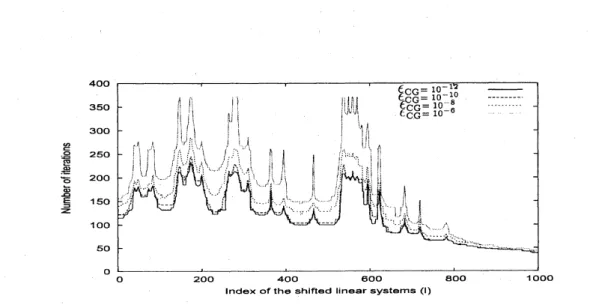
Figure 1: Number of iterations for the generalized shifted COCG method
versus
theindexof the shifted linear systems for example 1.
$O$ $2OO$ $4OO$ $6O0$ SOO $1OOO$
lndex of the shifted linear systemS(1)
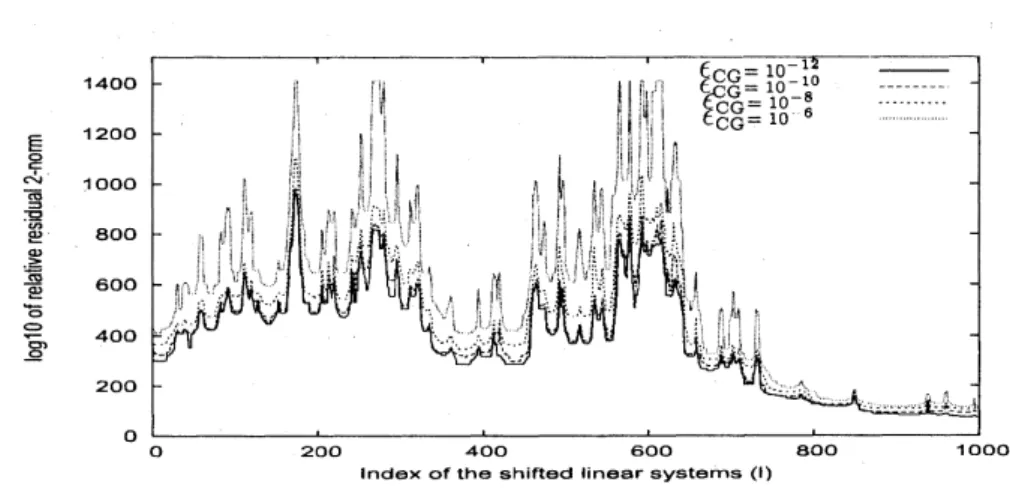
Figure 2: The dependence of the true relative residua12-norm
on
the accuracy of theFigure 1 shows the dependency of required number of iterations for the generalized
shifted COCG method on the accuracy of inner solutions (3.6). From Fig.1, the
more
accurate
we
solve the inner linear systems, the less number of iterationswere
required.Since
the inner linear systemsare
solved roughly,we
need to check the loss ofaccuracy
of the outer solutions. So,
we
next show the dependency of theaccuracy
for the outersolutions of (1.1) on the accuracy of inner solutions of (3.6) in Fig.2. We
see
in Fig. 2that the accuracy is almost the
same
orderas
that of the inner solutions. This exampleimplies how robust the present algorithm is
even
ifwe
solve the inner solutions roughly.The CPU time of the generalized shifted COCG method is given in Table 1. From
Table 1, we see that roughly solving inner linear systems does not always lead to
time-efficient, this is because total number of iterations for tlie seed systelntended to increase,
see
Fig. 1.The results using the seed switching technique
are
described in Table 2. In Table 2,470 linear systems remained unsolved after the generalized shifted COCG method with
the initial seed $0.400+0.001i$
was
solved, whichcan
be a practical issue. Using the seedswitching technique, it automatically chose thesecond seed$0.573+0.001i$, and
as
a
resultall linear systems
were
solved. Next,we
chose the initial seed $1.400+0.001i$.
Then, theswitchrequiredthree times. Intwocases, the last seedvalues
were same.
We have checkedthat when
we
used the last seed value,no
switch occured during the iterations for solvingall linear systems. In
our
numericalexperiments, the number of switching actions was, atmost, three. In terms of CPU time, the generalized shifted COCG using seed switching
technique required 33.70
sec.
with the initial seed $0.400+0.001i$ and34.30
sec.
withthe initial seed $1.400+0.001i$, where $\epsilon_{CG}=10^{-12}$
.
Finally, the CPU time oftheCOCG
method applied to all shifted linear systems
was
1217.3
sec.
We also used theCOCG
method with IC(0)-type preconditioner, but it did not improve the performance due to
large number of incompletefactorizations.
Table 1. CPU time required for solving generalized shifted linear systems for example 1.
Table 2. Results on the generalized shifted COCG method
4.2
Example
2
The second problem is larger than the first problem, which
comes
from the electronicstructure computation of Au with 864 atoms:
$(\sigma_{\ell}S-H)x^{(\ell)}=e_{1\dot{)}}$ $\ell=1,2,$
$\ldots$, 1001,
where $\sigma_{\ell}=0.400+(P-1+i)/1000,$ $S,$ $H\in R^{7776\cross 7776}$
are a
symmetric positive definitematrix and asymmetric matrixwith 3,619,104 entries. Other conditions are the
same
asin example 1. From Figs. 3 and 4, we
see
similar tendency to that shown in example 1.$\frac{rightarrow\overline{\approx\varpi\supset}}{arrow\infty\omega}\Subset\subset 0$
’
$\underline{\frac{\Leftrightarrow}{rightarrow 0}\frac{=\varpi}{arrow\sim\omega}\Phi\circ>}$
Figure
3:
Number of iterations for the generalized shifted COCG methodversus
theindexof the shifted linear systems for example 2.
Figure 4: The dependence of the true relative residua12-norm on the accuracy of the
The
CPU
time of the generalizedshifted COCG
method is given in Table3. From
Table 3, the most time-consuming part
was
to solve the seed system. So, it is worthreducingthe CG iterations by
a
sophisticated preconditioner. In the case, it alsofoundtobe better to
use
more
accurate criterion for the inner solutions. The number ofswitchingactions was, atmost,two. In termsofCPUtimeinTable 4, The generalized shiftedCOCG
usingseed switching technique required522.0
sec.
with the initial seed $0.400+0.001i$and525.7
sec.
with the initial seed $1.400+0.001i$, where $\epsilon_{CG}=10^{-12}$.
Finally,
we
note that the CPU time of theCOCG
method without preconditioning,which was better than IC(0)-type preconditioning, applied to all shifted linear systems
was
16867.8sec.
Table 3.
CPU
time required for solving generalized shifted linear systems for example 2.Table 4. Results
on
the generalized shiftedCOCG
methodusing seed switching technique for example 2.
5
Conclusion
In this paper, the shifted
COCG
methodwas
extended to solving generalized shiftedlinear systems with complex symmetric matrices. The resulting algorithm, the generalized
shifted COCG method, was derived from two different ways: (1) the shifted COCG
method with a bilinear form and (2) a simplification of the shifted Bi-CG method. We
have learned that in
our
numericalexamples,we can use
iterativemethods for solving theinner linear systems, and the accuracyof the solutions depends linearlyonthe accuracyof
the solutions for the inner linear systems. From numerical examples, the algorithm found
to be highly attractive when the inner linear systems canefficiently be solved. Since the
present strategy
can
also be applied to the shifted QMR method and the shifted WQMRmethod, the comparison among them will be
our
future work.The generalizedshifted
COCG
methodhas already been implemented in the quantummechanical nanomaterial simulation code ‘ELSES’ $($http:$//www.elses.jp)$ and willbe
ap-plied to various nanomaterials
as
interdisciplinary research between applied mathematicsAcknowledgement
This work
was
partially supported by KAKENHI (Grant No. 21760058).References
[1] B. N. Datta and Y. Saad, Arnoldi methods for large Sylvester-like observer matrix
equations, and
an
associated algorithm for partial spectrum assignment, LinearAl-gebra Appl., 154-156 (1991), pp. 225-244.
[2] R. W. Freund, Conjugate gradient-type methods for linear systems with complex
symmetric coefficient matrices, SIAM J. Sci. Stat. Comput., 13 (1992), pp. 425-448.
[3] R. W. Freund, Solution of shifted linear systems by quasi-minimal residual
itera-tions, Numerical Linear Algebra, L. Reichel, A. Ruttan, and R. S. Varga eds., W. de
Gruyter, (1993), pp. 101-121.
[4] A. Frommer, BiCGStab$(\ell)$ for families of shifted linear systems, Computing, 70
(2003), pp. 87-109.
[5] T. Fujiwara, S. Yamamot$0$, T. Hoshi, S. Nishino, H.Teng, T. Sogab$e$,
S.-L.
Zhang,M. Ikeda, M. Nakashima, N. Watanabe, Large-scale Electronic
Structure
CalculationTheory and Applications, Preprint; http:$//arxiv.org/abs/1002.1202$
[6] K. Meerbergen, The solution of parametrized symmetric linear systems, SIAM J.
Matrix Anal. Appl., 24 (2003), pp. 1038-1059.
[7] T. Sogabe, T. Hoshi, S.-L. Zhang, and T. Fujiwara, A numerical method for
cal-culating the Green$s$ function arising from electronic structure theory, in: Frontiers
of Computational Science, eds. Y. Kaneda, H. Kawamura and M. Sasai,
Springer-Verlag, Berlin/Heidelberg, 2007, pp. 189-195.
[8] V. Simoncini and D. B. Szyld, Recent computationaldevelopments in Krylov
Sub-space Methods for linear systems, Numer. Linear Algebra Appl., 14 (2007), pp. 1-59.
[9] T. Sogabe, T. Hoshi, S.-L. Zhang, and T. Fujiwara, On
a
weighted quasi-residualminimization strategy of the QMR method for solving complex symmetric shifted
linear systems, Electron. Trans. Numer. Anal., 31 (2008), pp. 126-140.
[10] R. Takayama, T. Hoshi, T. Sogabe, S.-L. Zhang, and T. Fujiwara, Linear algebraic
calculation ofGreen$s$ function for large-scale electronic structure theory, Phys. Rev.
$B73$, 165108 (2006), pp. 1-9.
[11] S. Yamamoto, T. Sogabe, T. Hoshi, S.-L. Zhang, and T. Fujiwara, Shifted COCG
method and its application to double orbital extended Hubbardmodel, J. Phys. Soc.