http://internmed.jp
【 CASE REPORT 】
Lambda Light Chain Non-crystalline Proximal Tubulopathy
with IgD Lambda Myeloma
Seiji Kishi
1, Fumiaki Obata
1, Hirokazu Miki
2, Motokazu Matsuura
3, Kenji Nishimura
1,
Masanori Tamaki
1, Fumi Kishi
1, Taichi Murakami
1, Hideharu Abe
1, Kojiro Nagai
1,
Masahiro Abe
4and Toshio Doi
1Abstract:
Light Chain Proximal Tubulopathy (LCPT) is a rare form of paraprotein-related kidney disease in which monoclonal free light chains damage the proximal renal tubular epithelial cells. We herein report the case of a 78-year-old woman who presented with anemia and kidney dysfunction. Serum and urine protein electro-phoresis analyses revealed a monoclonal IgD and λ free light chains. Proximal tubular injury and the accu-mulation ofλ light chains were found by kidney biopsy. Electron microscopy revealed no organized structure suggestive of crystals. LCPT was caused by IgD lambda myeloma and bortezomib and dexamethasone ther-apy led to very good partial response (VGPR) without a worsening of the kidney function.
Key words:Light Chain Proximal Tubulopathy (LCPT), IgDλ myeloma, paraprotein related kidney disease
(Intern Med 57: 3597-3602, 2018) (DOI: 10.2169/internalmedicine.1323-18)
Introduction
An abnormal immunoglobulin produced from B lympho-cytes/plasma cells causes renal impairment. Patients with paraprotein-related kidney disease present with various manifestations, including light chain cast nephropathy, mon-oclonal Ig deposition disease, light chain amyloidosis, light chain proximal tubulopathy (LCPT), and tubulointerstitial nephritis (1). LCPT is a rare condition in which monoclonal free light chains damage the proximal renal tubular epithe-lial cells. The accumulated light chains frequently form crystals and LCPT is classified into crystalline or non-crystalline LCPT, based on the presence or absence of a crystal structure in the tubular cytoplasm. The latter is even rarer (2). Although the prognosis of LCPT is not well known because of the small number of cases, there are re-ports of patients who have developed end-stage kidney dis-ease (2). It is considered very important to accumulate cases in order to establish the definition of the disease entity and
determine the appropriate therapy. In this report, we present a case of non-crystalline LCPT that was successfully man-aged with bortezomib and dexamethasone therapy.
Case Report
A 78-year-old woman was referred to our nephrology clinic for the evaluation of an elevated serum creatinine level and anemia. She had been followed by her primary care physician because of reflux esophagitis and dyslipide-mia for approximately 20 years. She had been undergoing regular checks; however, no urinalysis abnormalities or kid-ney dysfunction had ever been pointed out. Her care was in-terrupted after her husband died. At approximately three months before her referral, she noticed a loss of appetite and general malaise. She then visited her primary physician for the first time in eight months. At that visit, anemia and kid-ney dysfunction were detected.
At the patient’s first visit to our department, a physical examination revealed pale conjunctiva and hypertension
1Department of Nephrology, Graduate School of Biomedical Sciences, Tokushima University, Japan,2Division of Transfusion Medicine and Cell
Therapy, Tokushima University Hospital, Japan,3Department of Nephrology, Tokushima Red Cross Hospital, Komatsushima, Japan and4
Depart-ment of Hematology, Endocrinology and Metabolism, Graduate School of Biomedical Sciences, Tokushima University, Japan Received: April 3, 2018; Accepted: May 6, 2018; Advance Publication by J-STAGE: August 10, 2018
Table. Laboratory Data before Kidney Biopsy.
Urinalysis Reference range Chemistry Reference range
specific gravity 1.014 BUN 41 8-20 mg/dL
pH 5.5 Cre 2.61 0.4-0.9 mg/dL
protein 1+ UA 6.8 2.0-7.0 mg/dL
protein/Creatinine 7.034 g/gCre eGFR 14.32 mL/min/1.73m2
glucose - Na 144 135-146 mEq/L
occult Blood - K 4.4 3.5-4.8 mEq/L
RBC 0-1 /HPF Cl 109 98-108 mEq/L
WBC 0-1 /HPF Ca 8.9 8.8-10.1 mg/dL
Hyaline Cast 0-1 /HPF P 4.1 2.4-4.6 mg/dL
Granular Cast 0-1 /HPF Mg 2.5 1.6-2.3 mg/dL
T.prot 6.9 6.5-8.2 g/dL
CBC Reference range Alb 4 3.9-4.9 g/dL
WBC 5.6 4.0-9.0 ×10³/μL alpha1 3.9 1.9-2.9 % neutro 66.2 % alpha2 10.5 5.1-8.9 % eosino 1.2 % beta 11.8 6.5-10.8 % lympho 27.1 % gamma 14.5 10.6-20.9 % mono 4.4 % T-Cho 235 130-220 mg/dL RBC 2.46 3.9-4.9 ×10⁶/μL TG 243 35-150 mg/dL Hb 8.3 11.5-14.5 g/dL HDL-C 45 40-100 mg/dL Ht 25 34-43 % GOT 21 10-35 IU/L Plt 395 150-350 ×103/μL GPT 14 5-40 IU/L
Blood coagulation test LDH 230 110-220 IU/L
PT-INR 0.94 0.85-1.15 ALP 309 100-340 IU/L
APTT 30.6 24.3-35.0 sec γ-GT 45 0-30 IU/L
Fib 443 174-404 mg/dL Glucose 105 <126 mg/dL Serology CRP 0.48 <0.3 mg/dL RF <10 <10 IU/mL ANA - -IgG 695 870-1,700 mg/dL IgA 94 110-410 mg/dL IgM 22 46-260 mg/dL IgD 415 <9 mg/dL IgE 239.7 <170 IU/dL C3 118 65-135 mg/dL C4 59 13-35 mg/dL CH50 67 32-49 mg/dL HBs Ag - -HCV Ab -
-(161/74 mmHg). Peripheral edema was not observed and there were no signs of fluid overload. No abnormalities were detected in the lungs, heart, abdomen, or extremities. A urinalysis showed proteinuria (7.03 g/gCre) without he-maturia (0-1/HPF), without glycosuria. Laboratory data re-vealed anemia (hemoglobin: 9.8 g/dL), elevated blood urea nitrogen [from 19.8 mg/dL (15 months before referral) to 41 mg/dL] and creatinine [from 0.44 mg/dL (15 months before referral) to 2.61 mg/dl], low IgG [695 mg/dL, reference range (870-1,100 mg/dL)], IgA [94 mg/dL (110-410 mg/ dL)] and IgM levels [22 mg/dL, (46-210 mg/dL)]. Her IgD level was elevated [415 mg/dL, (<9 mg/dL)]. Neither hypo-phosphatemia nor hypouricemia were detected. Serum elec-trophoresis and immunofixation revealed a monoclonal IgD
and monoclonal λ free light chains and urine protein elec-trophoresis revealed monoclonal λ free light chains. A labo-ratory analysis showed that the patient’s serum free λ light chain level was remarkably elevated, [4,500 mg/L, (3.3-19.4 mg/L)] and that her freeκ light chain level was slightly ele-vated [42.6 mg/L, (5.7- 26.3 mg/L)]. Theκ/λ ratio was 0.01 [reference range, 0.26-1.65]. The patient’s urinary N-acetyl-β-D-glucosaminidase [115.7 U/I, (<11.2 U/I)] and β2 mi-croglobulin [19,723 μg/L, (<360 μg/L)] levels were elevated and Gallium 67 scintigraphy showed weak uptake in the bi-lateral kidneys, suggesting an active inflammation process in the kidneys. To determine the cause of kidney dysfunction, kidney biopsy was performed. The laboratory data before the renal biopsy are shown in Table.
Kidney biopsy
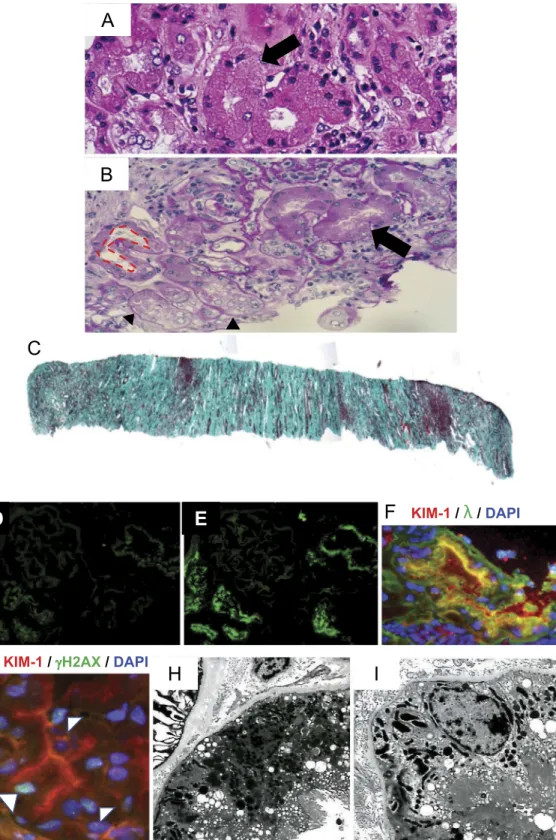
Two kidney tissue cores were obtained. Light microscopy revealed no major glomerular abnormalities. In the tubules and interstitium, we observed both enlarged tubules and atrophic tubules. The enlarged proximal tubules showed swelling (arrow), loss of brush border (surrounded by a dot-ted line), and detachment from the basement membrane (ar-rowhead). Lymphocytic infiltration was also observed in part of the interstitium (Fig. 1A and B). Casts were noted in the distal tubules. However, the burden of the casts was not so extensive and inflammatory cell infiltration was mild. Severe (>50%) tubular atrophy and interstitial fibrosis (Masson’s trichrome-positive) were observed (Fig. 1C), along with ar-terial and arteriolar thickening (not shown in the figure) sug-gesting some chronicity of the disease process.
Immunofluorescence microscopy revealed no immune de-posits in the glomeruli, while the tubules were found to be filled with droplets in which λ light chains were brightly stained; κ light chains were not detected (Fig. 1D and E). We found that the proximal tubules, which reabsorbed the λ light chains, were injured (KIM-1-positive) (Fig. 1F). DNA damage (γH2AX positive) (3) was found in the injured (KIM-1 positive) proximal tubules (Fig. 1G). No crystalline structures were found and vacuolar degeneration was seen in the proximal tubular cytoplasm under an electron micro-scope (Fig. 1H and I). No amyloid deposits were seen in the kidney. We concluded that the proximal tubular injury was the main etiology of the kidney dysfunction in this case; however, both LCPT and mild cast nephropathy in the distal tubules might have contributed to the pathophysiology.
Diagnosis
Non-crystalline Light Chain Proximal Tubulopathy
Clinical follow up
The bone marrow biopsy findings were compatible with multiple myeloma with >10% of the plasma cells (34.6%) being positive for monoclonal λ light chains. Imaging stud-ies showed evidence of lytic lesions in the lumbar spine. She was diagnosed with multiple myeloma (IgD-λ type: Durie and Salmon IIB, ISS III) based on the fulfillment of the following criteria: clonal bone marrow plasma cells ! 10%, anemia, renal insufficiency and bone lesions (4). She was treated with bortezomib and dexamethasone. After two courses of treatment, her urinary N-acetyl- β-D-glucosaminidase (115.7 U/L to 3.1 U/L) andβ2 microglobu-lin (19,723 μg/L to 8,055 μg/L) levels were decreased, which suggested the improvement of her active tubular inju-ries. Bortezomib and dexamethasone treatment resulted in a very good partial response (VGPR). Her kidney function re-mained stable, with her estimated glomerular filtration rate (eGFR) remaining approximately 15 mL/min/1.73 m2
; her urinary protein excretion also decreased to <0.5 g/gCre (Fig. 2).
Discussion
LCPT is a rare form of paraprotein-related kidney disease in which inclusion bodies consisting of free light chains (FLCs) accumulate in the cytoplasm of the proximal tu-bules (2). FLCs are low molecular-weight proteins that are normally produced by lymphoid tissues. Under normal cir-cumstances, approximately 500 mg are produced per day and the FLCs are reabsorbed and hydrolyzed very efficiently in the proximal tubules by the megalin/cubilin receptor sys-tem after glomerular filtration. As a result, only 1-10 mg/day are excreted in the urine (5). In addition to the overproduc-tion of FLCs, the uptake of FLCs by endocytosis affects the pathogenesis of LCPT. Active reabsorption in the proximal tubules is sometimes strongly associated with the onset of disease and the nature of the substance reabsorbed in the proximal tubule is largely related to the development of kid-ney injury (6).
Monoclonal FLCs are cytotoxic and redox signaling fol-lowing the endocytosis of FLCs causes increased oxidative stress and inflammatory cytokine production, which leads to apoptosis in the proximal tubular cells (7). On the other hand, there is an optimal environment for coprecipitation of FLCs with Tamm-Horsfall glycoprotein (THP) in the distal tubules. Excessive FLCs form casts, obstruct the tubular lu-men and may lead to rupture and secondary inflamma-tion (1, 5, 6, 8) (Fig. 3). Although crystalline deposits are classified based on the presence or absence of a crystal structure, the significance of crystalline versus non-crystalline LCPT remains unknown.
While cast nephropathy tends to cause AKI in myeloma, LCPT shows a wide variety of disease phenotype, ranging from subtle tubule transport disorders to tubule cell death (apoptosis or necrosis). LCPT is mainly caused byκ chain, rarely byλ chain and λ type FLCs often display acute tubu-lar injury. The presence or severity of acute tubutubu-lar injury did not correlate with kidney function at presentation or the prognosis. As seen in our case, non-crystalline LCPT usu-ally does not develop Fanconi syndrome, though it is com-mon in crystalline LCPT. The incidence of Fanconi syn-drome in crystalline LCPT is approximately 43% (1, 2).
The optimal treatment of paraprotein-related kidney dis-eases, including LCPT, when the bone marrow findings are associated with low-mass multiple myeloma, monoclonal gammopathy of undetermined significance (MGUS), and has not been determined (9, 10). In recent years, the concept of monoclonal gammopathy of renal significance (MGRS) with bone marrow plasma cells <10% and evidence of renal or-gan damage, has been recognized (11, 12). Patients with MGRS develop proteinuria and renal dysfunction without progressing to myeloma. It has become clear that in addition to the amount of M-protein, the quality of M-protein affects different parts of the kidney. Even small B-cell clones with small amounts of M-protein [i.e., dangerous small B cell clones (11)] damage various parts of the kidney. The
preva-Figure 1. The kidney biopsy findings: Hematoxylin and Eosin staining (A) and Periodic acid-Schiff staining showed (B) swelling (arrow), loss of brush boarder (surrounded by a dotted line) and detach-ment from the basedetach-ment membrane (arrowhead) in the proximal tubular cells. (original magnifica-tion ×200). (C) Masson trichrome staining showed severe interstitial fibrosis (original magnificamagnifica-tion, ×40). (D, E) Immunofluorescence microscopy showed negative staining for κ light chains (D) and positive staining for λ light chains in the proximal tubules (E) (original magnification ×200). (F) Im-munofluorescence microscopy showed that the λ light chain-positive proximal tubule became KIM-1 positive (original magnification, ×600). (G) Immunofluorescence microscopy showed DNA damage (arrowhead) in the KIM-1-positive injured proximal tubule (original magnification, ×600). (H, I) Electron microscopy revealed the absence of crystal formation in the proximal tubules. (original mag-nification, ×3,000 and ×4,000, respectively).
Figure 2. The clinical course. eGFR (mL/min/1.73m2), IgD (mg/dL), urine protein (g/gCre) and free λ light chains (mg/L) are shown in blue, green, red and orange lines, respectively. Days indicates the
number of days after the first visit to our department.
Figure 3. The mechanism of free light chain-related tubular disease. THP: Tamm-Horsfall glyco-protein, FLCs: free light chains
lence of MGRS and the prognosis of the kidney and sur-vival after treatment remain to be clarified and studies have indicated the benefits of aggressive therapy in selected pa-tients with LCPT (2). Future prospective clinical research studies are necessary (11, 12).
In summary, we herein described a case of light chain proximal tubulopathy, a rare form of paraprotein-related kid-ney disease in an elderly woman who presented with a loss of appetite and general fatigue. Treatment with bortezomib and dexamethasone led to a VGPR, without a worsening of her kidney function. The prevalence of chronic kidney dis-ease (CKD) and plasma cell dyscrasia is high in the elderly. Because CKD will increase and be a greater burden in aging societies, it is important for physicians to consider parapro-tein related kidney disease in the differential diagnosis of elderly patients with kidney dysfunction. An early diagnosis and treatment of paraprotein-related kidney disease can help to prevent end-stage renal failure.
The authors state that they have no Conflict of Interest (COI).
Acknowledgement
We would like to thank Dr. George Meyer, MD, MACP, Clini-cal Professor of Medicine at the University of California at Davis and Dr. Naoka Murakami, MD, PhD, Renal Division at Brigham and Women’s Hospital for their critical reading and English lan-guage editing of our manuscript.
References
1. Doshi M, Lahoti A, Danesh FR, Batuman V, Sanders PW;
Ameri-can Society of Nephrology Onco-Nephrology F. Paraprotein-related kidney disease: kidney injury from paraproteins-what deter-mines the site of injury? Clin J Am Soc Nephrol 11: 2288-2294, 2016.
2. Stokes MB, Valeri AM, Herlitz L, et al. Light chain proximal
tu-bulopathy: clinical and pathologic characteristics in the modern treatment era. J Am Soc Nephrol 27: 1555-1565, 2016.
3. Rogakou EP, Pilch DR, Orr AH, Ivanova VS, Bonner WM. DNA
double-stranded breaks induce histone H2AX phosphorylation on serine 139. J Biol Chem 273: 5858-5868, 1998.
4. Rajkumar SV, Dimopoulos MA, Palumbo A, et al. International
Myeloma Working Group updated criteria for the diagnosis of multiple myeloma. The Lancet. Oncology 15: e538-e548, 2014.
5. Basnayake K, Stringer SJ, Hutchison CA, Cockwell P. The
biol-ogy of immunoglobulin free light chains and kidney injury. Kid-ney Int 79: 1289-1301, 2011.
6. Khan S, Cabral PD, Schilling WP, et al. Kidney proximal tubule
lipoapoptosis is regulated by fatty acid transporter-2 (FATP2). J Am Soc Nephrol 29: 81-91, 2018.
7. Sanders PW. Mechanisms of light chain injury along the tubular
nephron. J Am Soc Nephrol 23: 1777-1781, 2012.
8. Leung N. Treating myeloma cast nephropathy without treating
myeloma. J Clin Invest 122: 1605-1608, 2012.
9. Messiaen T, Deret S, Mougenot B, et al. Adult Fanconi syndrome
secondary to light chain gammopathy. Clinicopathologic heteroge-neity and unusual features in 11 patients. Medicine 79: 135-154, 2000.
10. Ma CX, Lacy MQ, Rompala JF, et al. Acquired Fanconi syndrome
is an indolent disorder in the absence of overt multiple myeloma. Blood 104: 40-42, 2004.
11. Merlini G, Stone MJ. Dangerous small B-cell clones. Blood 108:
2520-2530, 2006.
12. Leung N, Bridoux F, Hutchison CA, et al. Monoclonal
gammopa-thy of renal significance: when MGUS is no longer undetermined or insignificant. Blood 120: 4292-4295, 2012.
The Internal Medicine is an Open Access journal distributed under the Creative Commons Attribution-NonCommercial-NoDerivatives 4.0 International License. To view the details of this license, please visit (https://creativecommons.org/licenses/ by-nc-nd/4.0/).
Ⓒ 2018 The Japanese Society of Internal Medicine