This document is downloaded at: 2018-12-31T13:52:20Z
Title
東支那海及び南支那海産の魚類に寄生するAnisakidae幼線虫の種類
と分布
Author(s)
坂口, 祐二; 片峰, 大助
Citation
熱帯医学 Tropical medicine 13(4). p159-169, 1971
Issue Date
1971-12-30
URL
http://hdl.handle.net/10069/4100
Right
NAOSITE: Nagasaki University's Academic Output SITE
熱帯医学 第13巻 第4号159-169頁, 1971年]2月 159
東支那海及び南支那海産の魚類に寄生する
Anisakidae幼線虫の種類と分布
坂口祐二・片峰大助
長崎大学熱帯医学研究所寄生虫学部門(主任:片峰大助教授〕
(Received for Publi亡ationNovember20,1971〕
Survey of Anisakid Larvae in Marine Fishes Caught from the East China Sea and the South China Sea
Yuji SAKAGUCHI and Daisuke KATAMINE Department of Parasitology, Institute for Tropical Medicine,
Nagasaki University
(Director : Prof. Daisuke KATAMINE)
Abstract
Geographical
distribution
of
nematoda
larva
was investigated
for 4 years
from
1967
to 1970 on 1825
marine
fishes
of 68 species
caught
in the
sea around
Nagasaki,
in the
East China
Sea,
and in the
South
China
Sea.
The last group was brought
back on the Nagasaki-maru,
a training
ship
owned by Nagasaki
University
School
of
Fishery,
and all others
were obtained
at the Nagasaki
Fish
Market.
Results
of the
study
were as follows;
1.
In regard
to the distribution
in
sea areas,
a far greater
number and variety
of nematoda
larva
were found
in the
East
China
Sea and the South
China Sea as
compared with
the water
around Nagasaki.
There were found nematoda larvae
in 38
fishes
of 5 species
among 393 of 20 species
caught
in the
sea around Nagasaki,
1 to
10 larvae
per fish,
19 of 20 species
or 405 of 688 fishes,
1 to 137 larvae
in the
East
China Sea,
and 22 of 28 species
or 449 of 744 fishes,
1 to 320 per
fish
in the
South
China
Sea respectively.
Parasitic
rate
was 100 per cent in the following
species
of fish;
Saurida
tumbil,
160 坂 口 祐 二・片 峰 大 助
Muraenesox cinereus,
Argyrosomus argentatus,
Decapterus
maruadsi,
Pseudosciaena
crocea
in
the
East
China
Sea,
and
Nemipterus
virgatus,
Lutjanus
sebae,
Saurida
tumbil,
Rachycentron
canadum in the
South
China
Sea.
Amount of the larva
per fish
was
extremely
high
in
Saurida
tumbil
and
Muraenesox cinereus,
85.5
and 65.9
larvae
in
the averege
respectively.
2.
The types
of nematoda
larva
discovered
were four genuses
and 6 species
in
total;
Anisakis
sp.
(Type
I),
Contracaecum
sp.
(Type
A,
Type
B and
Type
F),
Terranova sp.
(Type
B)
and Raphidascaris
sp.
3.
Anisakis
sp.
(Type
I) has
the highest
incidence
in each sea area,
and
Contra-caecumsp. (Type
E) has the
second
highest
incidence
in the
East
china
Sea
and
South
China
Sea.
Although
Contracaecum sp.
(Type
F)
has
never been described
near
the
Japanese
coast,
it
was
found
in
the
South
China
Sea.
Relatively
high
incidence
of Terranova sp.
(Type
B) was also found in the South
China
Sea.
4.
Species
of fish
having
significantly
high
incidence
of
Anisakis
sp.
(Type
I)
were;
Muraenesox cinereus
(100
per
cent),
Saurida
tumbil
(100
per cent),
Argyrosomus
argentatus
(100
per cent),
Pseudosciaena
crocae
(100
per cent),
Decapterus
maruadsi
(100
per cent),
Zeus japonicus
(80.0
pes cent)
in the
South
China
Sea,
Saurida
tumbil
(100
per
cent),
Rachycentron
canadum (100
per cent),
Nemipterus
virgatus
(100
per
cent),
Priacanthus
sp.
(95.0
per cent),
Abalistes
stellatus
(88.5
per
cent),
Lutjanus
basmira
(86.7
per cent),
Pristipomoides
sieboldi
(84.0
per
cent),
Decapterus
maruadsi
(82.0
per cent),
Megalospis
cordyla
(80.0
per cent),
Epinephelus
septemfasciatus
(80.0
per cent)
caught
in the
South
China
Sea.
High
incidence
of Contraceecum sp.
(Type
E) was found
in Argyrosomus argentatus
(100
per cent)
of
the
East
China
Sea,
and
Nemipterus
virgatus
(100
per
cent)
and
Priacanthus
sp.
(75.0
per cent)
of the South
China
Sea.
Terranova sp. (Type
B) is common in Lutjanus
sebae
(100
per cent)
and
Carcarrhinus
menisorrah
(90.0
per
cent).
Contracaecum sp. (Type
F)
was discovered
in Saurida
tumbil,
Pseudorhombus
dupliciocellatus
and
Abalistes
stellatus
in the
South
China
Sea.
5.
There
seem to be two
courses
of
migration
of the
nematoda-susceptible
fishes,
such as Muraenosox cinereus,
Argyrosomus argentatus,
Saurida
tumbil,
Pseudos-ciaena crocea,
Nemipterus
virgatus
and
Lutjanus
sebae
in the
East
China
Sea and the
South
China
Sea.
One runs toward
North
and
South
along
the coast
of China,
and
the
other
from
shallow
sea to deeper
sea or toward
East.
They
move, however,
within
the East
China
Sea
and the
South
China
Sea,
where
is
the
main sea area
having
high
incidence
of anisakis
worm.
緒言
Van Thiel et all (1960, 1962〕ほオランダに於い て海産晴乳動物を固有宿主とする Anisakis属幼線虫 の人体感染例を報告し世の注目をあびた.その後我国
に於いても消化器系の好酸球性肉芽腫を主病変とする 所謂アニサキス症の症例が多数(浅見1964,大鶴ら 1965,西村1966,吉村1966,石倉1966等)報告さ
東支那海及び南京那海産の魚類に寄生するAnisakidae助線虫の種類と分布 161 れるに及んで海産魚類を多く生食している本邦ではに わかに大きな閑J亡Jをもたれるようになった.現在でほ 過去に於いて報告された好酸球性肉芽腫症もその大半 がAnisakis属幼虫の感染に起困するものであろうとい うのがほぼ定説となっている.病巣部内での虫体の証 明更にほ種の同定ほ必ずLも容易でない.一方海産の 魚類には Anisakis以外にも数種類の近縁属の助線虫 がみられ,これらの分布,形態及び人-の病害等が全 て明かにされているとほいえない.そこで著者らほ先 づ海産の魚ヨ段に寄生している幼線虫の種類とその分布 状況を更に汎く知るために長崎近海の他に広く東支那 海及び南支那海産の魚類uについて Anisakisとその近 縁種とみられる虫体の寄生状況及びその形態を観察L, 在来報告されている日本近海のものと比較Lた. 材 料 及 び 方 法 材料となったのは1967年から1970年空での4ケ年 間に長崎の魚市に陸揚げされた長崎近海及び東支部海 のものと,長大水産学部の練習船,長崎九の遠洋航海 実習で捕獲された南支那海の魚類及びイカ類,合計 68種1,825尾である.虫体の検索ほ主としてこれらの 腹腔及び内臓について行ったが一部の魚種では更に筋 肉をふくめて精査Lた.採集された助線虫ほ魚種別 に寄生数をチェックLた後直ちに10%ホルマリン液 に入れて固定した後グリセリソ・アルコール混液によ る透化処置を行い内部構造を観察同定を行った.更 に一部の無作為的にとりだLた一定数の虫体につい て計測を行い記載Lた.尚計測値の指数ほ Faust 〔1933), Punt (1941〕及にJに.部小山〔1966)に従い, 排他系については Hartwich の分類体系を参考にし た. 成 績 1.幼線虫の寄生状況 長崎近海,東支那海及び南支那海産の魚類合計68 種1,825尾のうち幼線虫の寄生が確認されたのは46 種892尾で, -尾当りの平均寄生数ほ最低1豊から最 高85.5隻におよんでいる.これを捕獲された海域別 にみると,近海でとれた20種393尾では 5種38尾 (-尾当りの平均寄生数は最低1隻,最高3.6隻〕,東 支那海のもの20種688尾でほ19種405尾(最低1隻, 最高65.9隻)又南支那海のもの 28種744尾でほ22 種449尾(最低1隻,最高57.0隻)で幼線虫の寄生 は近海でとれた魚類Uに比べ遠洋ものとして陸揚げされ る東支那海及び南支那海産のものにその率が高く,氏 俸数もはるかに多いにとが確認された. 魚種別に寄生率の高いものからあげると東支那海の ワニエソ(寄生率100%〕, -モ〔100%〕,イシモチ (100%),てルア (100鬼■〕,フウセイ〔100%), トウダイ(100%〕,カイワリ〔84.0%〕,南支那海の イトヨリ〔100兄■〕,セソネソダイ(100%〕, ワニエ ソ(100鬼■〕,スギ(100%),キントキダイの近縁種 (95.0%),マレイザメ(90.0%〕,オキ-辛(88.5 %〕,スジフユダイ(86.7%〕,ヒメダイ(84.0%〕, マルアジ〔82.0%),オニアジ(80.0%〕,マ-♂ (80.0%〕等の魚額があげられる.殊にワニエソ, -モでほ-尾当りの平均寄生数ほ夫々 85.5隻, 65.9隻 で極めて多い. 2.幼線虫の種類と分布 採集された幼線虫を小山ら(1969, 1970)の分類方 段にLたがって分けてみるとAnisaMs sp.〔Type I〕, Contracaecum sp. 〔TypeA, Type E及びType F),
Terranova sp.(Type B), Raphidascaris sp.の4属 6種となる.これを捕獲地別にみると夫々Table 1. 2及び3に示した通りで,長崎近海では Anisakis sp. 〔Type I〕 Contracaecum sp. 〔Type A)及び Haphidascaris sp.の3属3種,京菜那海でほこれに ContTo.caecum sp. (Type E〕とIerTanova sp. (TypeB〕を加えた4属5種,段に南支那海ではCon-tracaecum sp. (Type F〕が発見されて都合4属6種 となり,長崎近海に比べて東支那海及び南支那海でそ の種額が多くなっている.
これらの種類のうち Contrcaeeumほ従来から知ら れているType A (Yamaguti-Type I, Koyama et alトType A, Kikuchi et all-TypeB)及びTypeE の他日本近海では未記載の幼虫Type Fが含まれて
162 坂 口 祐 二・片 峰 大 助
Table 1. Incidence of nematode larvae in marine fishes and squids caught in the sea near Nagasaki
Species name (Japanese name)
Coryphaena hipp附・比S (シイラ〕 Sitlago japonica けスJ Todarodes pacificus スルメイ]J) Pneumatophorus tapeinocephalus ( -f**'*)-バ) Decapterus kuroides けi] s。に}) Mustelus ホシザメ〕 Dasyatis akajeiけ-}]エイ) Kunosirus punctatus (コノシロ) Seriola quinqueradiata {ブリ) Chrysophrys major O7ダイ) Mylio macrocephalus 〔グロダイ) Nemiplerus virgainsりトヨリ) Par叩ristipoma trilineatum (イサキ)
Sebastiscus marmoratus (ij-tf-^} Sardc 叩s melanosticta 〔マイワシ〕 Engraulis japonica (カタクチイ「)シ) Spralelloides japonicus (キビナゴ) Etrumeus micr叩uS (ウルメイ「Jシ〕 Dorytenthis bleekeri (ヤ1]イカ) Sepiella japonica (シ.]アケイカ)
Total No. of fish
exam, posit. % 10 50 37 27 15 5 9 27 1 3 1 5 10 20 27 50 51 27 5 13 7 15 9 6 1 0 0 0 0 0 0 0 0 0 0 0 0 0 0 0 70.0 30.0 24.3 22.2 6.7 0.0 0.0 0.0 0.0 0.0 0.0 0.0 0.0 0.0 0.0 0.0 0.0 0.0 0.0 0.0
Details for positive case
Number of fish (%}
Anisakis (I) Contracaecum (A) RankIdascaris sr>. (70.0) ( 6.0) (24.3) ( 0.0) ( 6.7) ( 0.0) ( 0.0) Co.o) ( o.o) ( 0.0) ( 0.0) ( o.o) ( 0.0) ( 0.0) ( 0.0) ( o.o) ( 0.0) ( 0.0) ( 0.0) ( o.o) (0.0) (6.0) (0.0) (0.0) (0.0) (0.0) (0.0) (0.0) (0.0) (0.0) (0.0) (0.0) (0.0) (0.0) (0.0) (0.0) (0.0) (0.0) (0.0) (0.0) 0 (0.0) 12 (24.0) 0 (0.0) 6 (22.0) 0 (0.0) 0 (0.0) 0 (0.0) 0 (0.0) 0 (0.0) 0 (0.0) 0 (0.0) 0 (0.0) 0 (0.0) 0 (0.0) 0 (0.0) 0 (0.0) 0 (0.0) 0 (0.0) 0 (0.0) 0 (0.0) T otal 393 38 20 3 18
Table 2. Incidence of nematode larvaelin marinelfishes caught from the East China Sea
Species name (Japanese name)
Sauridatumbil(「J二→ソ) ハモ) イシモチ-) Decaple.てル フ・)-ヒ†J Zeusj叩onicus¥マトウタ1) Caratぱeauula(;',イワリ) Fuguvermicularisvermicularis(ショウ1)-イ〕 Uranoscpusj叩ミシマIiコ Inegociami-己〔メコ1-1 Rhinoplaeusiaj叩onicaC?ロ・ンシノシタj Upeneusbensasi(ヒメシ) Track祉rusjaponicus(マL,。}) Pleura耶ihthgsす11血s(メイタカレ1) Taiustumifrons(キダイ) Lepidotrigtaかナ7}/シラ〕 Trichiuruslepturus(タナ-I)汁) け h->'マブイ Bembrasjap細けカゴーl-i Lagoccphalバ7ケ〕
Total No. of fish exam. posit, % 50 10 30 75 20 30 50 21 20 20 40 30 50 40 50 50 30 30 22 20 50 10 30 75 20 28 42 15 13 13 24 16 26 13 16 8 3 2 1 0 100.0 100.0 100.0 100.0 100.0 93.3 84.0 71.4 65.0 65.0 60.0 53.3 52.0 32.5 32.5 16.0 10.0 6.7 4-5 0.0
Details for cositive case
Number of fish (9i一o〕
Anisakis (I) \Canlracaecum (A] Terranova (B) Ravhidascaris $n.
50 (100.0) 10 (100.0) 30 (100.0) 1 ( 2.2) 20 (100.0) 24 (80.0) 4 ( 8.0) 14 (66.7) 13 (65.0) 12 ( 60.0) 0 ( 0.0) 7 {23.0) 1 ( 2.0) 0 ( 0.0) 14 (28.0) 5 (10.0) 0 ( 0.0) 2 ( 6.7) 1 ( 4.5) 0 ( 0.0) 0 (0,0) 0 ( 0.0) 1 (3.3) 0 ( 0.0) 0 (0.0) 0 ( 0.0) 0 (0.0) 0 { 0.0) 2 (10.0) 0 (0.0) 24 (60.0) 3 (10.0) 0 (0.0) 2 (5.0) 0 (0.0) 0 (0.0) 0 (0.0) 0 (0.0) 0 (0.0) 0 (0.0) 34 ( 68.6) 0 ( 0.0) 30 (100.0) 0 ( 0.0) 0 ( 0.0) 17 ( 56.7) 0 ( 0.0) 8 (38.2) 1 ( 5.0) 2 (10.0) 0 ( 0.0) 15 t50.0) 0 ( 0.0) 13 (32.5) 2 ( 4.0) 5 (10.0) 0 ( 0.0) 1 ( 3.3) 0 ( 0.0) 0 ( 0.0) 0 (0.0) 0 (0.0) 0 (0.0) "0 (0.0) 0 (0.0) 1 (0.2) 0 (0.0) 0 (0.0) 0 (0.0) 0 (0.0) 0 (0.0) 0 (0.0) 0 (0.0) 0 (0.0) 0 (0.0) 0 (0.0) 0 (0.0) 0 (0.0) 0 (0.0) 0 (0.0) 0 ( 0.0) 0 ( 0.0) 0 t 0.0) 75 (100.0) 0 ( 0.0) 0 ( 0.0) 40 (80.0) 0 ( 0.0) 0 ( 0.0) 0 ( 0.0) 0 ( 0.0) 0 ( 0.0) 25 (50.0) 0 ( 0.0) 0 t 0.0) 1 ( 2.0) 3 ( 10.0) 0 ( 0.0) 0 ( 0.0) 0 ( 0.0) Total 688 405 208 32 128 1 144
Table 3. Incidence of nematode larvae in marine fishes caught from the South China Sea
Species name (Japans iVemiptcriis virgalus (イトヨリ) Luti叫us sebae ',セン不ンデイ) saurida lumbit (^--エソ) Rachycentron亡anαdum しスキ〕 Priacanlhus叩. (午-/卜1一ダイの灼〕 メソlIサメ) Abalistes stellatus り-キハ-i-) Lvtjanus basmira (スシーJエyイ) Prisdpomo上des sieboldi U-メタイ; Decapterus mαruadsi (-?ルアソ) Megalo叩is cordylaりニr!'ジ、・ Epinephelus septc仇 しマハタ〕 Upeneus bensasi (ヒメシ) Clidaderma asperimum 〔メJJレイ) Plectorkvnckus pictus (コロブイ) Pseudalvtorius nas己 ハナノノハギ〕 Ilisha elonsata (ヒラ) Letkr川us haemal叩 エフキダ∼) Tackusurus falcarius ('?ミ丁半1 Carom equula (カイワリ) >>"ig一(Z†川サ/usぐぐ 1し一i,一J'L Lepidotus drama (Vロマj; Rexea solandriけキカマス) カカミディ] Calotomus j岬 デイ) .41叩Z's仇TVS borealis (ミズウオl legeli (トンガリ) Pristip( に_ Jゲ1■ ∴jtfi一. Total Total No. exam, posi 18 18 10 1 20 10 52 15 50 50 30 65 90 10 22 5 50 8 8 80 77 30 4 4 8 4 4 1 18 18 10 1 19 9 46 13 42 41 24 52 68 7 14 2 19 3 3 24 13 3 0 0 0 0 0 0 100.0 100.0 100,0 100.0 95.0 90.0 88.5 86.7 84.0 82.0 80.0 80.0 75.6 70.0 63.6 40.0 38.0 37.5 37.5 30.0 16.9 10.0 0 0 0 0 0 744 449
Dpfails for nositivp rasfi Numhpr nf fish (%>
Ardsakis-d) m(A)| C~ontracaecum' ( E}
5n]
Terranova (R) Ravhidascaris sp. 18 (100.0) 10 ( 55.6) 10 (100.0) 1 (100.0) 19 { 95.0) 0 ( 0,0) 46 ( 88.5) 13 ( 86.7) 42 ( 84.0) 41 ( 82.0) 24 ( 80.0) 52 ( 80.0) 68 ( 75.6) 3 ( 30.0) 10 ( 45.5) 0 ( 0.0) 19 ( 38.0) 2 ( 25.0) 1 ( 12.5) 24 ( 30.0) 13 ( 16.9) 3 ( 10.0) 0 ( 0.0) O f 0.0) 0 ( 0.0) 0 ( 0.0) 0 ( 0.0) o t o.o) 1 (5.6) 0 (0.0) 0 (0.0) 0 (0.0) 0 (0.0) 0 (0.0) 0 (0.0) 0 (0-0) 0 (0.0) 0 (0.0) 0 (0.0) 0 (0.0) 0 (0.0) 0 (0.0) 0 (0.0) 0 (0.0) 0 (0.0) 0 (0.0) 0 (0.0) 0 (0.0) 0 (0.0) 0 (0.0) 0 (0.0) 0 (0.0) 0 (0.0) 0 (0.0) 0 (0.0) 0 (0.0) 18 (100.0) 0 ( 0.0) 0 ( 0.0} 0 ( 0.0) 15 (75.0) 0 ( 0.0) 24 (48.1) 3 {20.0) 12 (24.0) 0 ( 0.0) 0 ( 0.0) 5 ( 7.8) 9 (10.0) 2 (20.0) 1 ( 4.6) 2 (40.0) 4 ( 8.0) 1 (12.5) 2 (25.0) 5 ( 6.3) 0 ( 0.0) 0 ( 0.0) 0 ( 0.0) 0 ( 0.0) 0 ( 0.0) 0 ( 0.0) 0 ( 0.0) 0 ( 0.0) 0 0 0 (0.0) 6 (ll.6) 0 ( 0.0) 0 { 0.0) 0 (0.0) 0 (0.0) 0 (0.0) 0 ( 0,0) 2 (20.0) 0 (0.0) 0 (0.0) 0 (0.0) 0 (0.0) 0 (0.0) 0 (0.0) 0 (0.0) 0 (0.0) 0 (0.0) 0 (0.0) 0 (0.0) 0 (0.0) 0 (0.0) 0 (0,0) 10 (55,6) 18 (100.0) 5 (50.0) 0 ( 0.0) 0 ( 0.0) 9 {90.0) 10 (19.2) 2 ( 13-3) 1 t 2.0) 0 ( 0.0) 0 ( 0.0) 16 (24.6) 0 ( 0.0) 3 (30.0) 6 (27.3) 0 ( 0.0) 0 ( 0.0) 2 (25,0) 0 ( 0.0) 6 ( 7.5) 0 ( 0,0) 0 ( 0.0) 0 ( 0.0) 0 ( 0.0) 0 { 0.0) 0 ( 0.0) 0 ( 0.0) 0 ( 0.0) 0 (0.0) 1 (5.6) 0 (0.0) 0 (0.0) 0 ( 0,0) 0 (0.0) 10 (19.2) 0 (0.0) 0 ( 0.0) 0 (0.0) 2 (6.7) 0 (0.0) à"0 (0.0) 0 (0.0) 2 (9,1) 0 (0.0) 0 (0.0) 0 (0.0) 0 (0.0) 0 (0.0) 0'(0.0) 0 ( 0.0) 0 ( 0.0) 0 (0.0) 0 (0.0) 0 (0.0) 0 (0.0) 0 ( 0.0) Ul9 1 104 ll 88 15
東支那海及び南支那海産の魚段に寄生するAnisakidae助線虫の種額と分布 163
いる.殊にType E に属するものは束支那海及び南 支那海ではAnisa.kis sp. 〔Type I〕に次いで寄生率が 高い.翼長崎近海でほみられなかったTerranova sp, (Type B〕が東支那海と南支那の魚類から比較的高率 に検出された.尚Contracaecum sp. (Type E〕ほ著 者ら(坂口ら1970,影井ら1970〕が先にnew type として報告したものであるが,その後の精査によって yamaguti 〔1935〕のContracaecum (Type V〕と同 一種であることを確認L訂正,報告(Kagei et all 1970〕した.
次に前記4属6種の助線虫の寄生状況を捕獲海域別, 魚種別にみると下記の如くである.
Anisakis sp. (Type I〕 Table 1, 2及び3に示 Lた通りでその寄生が確認された魚禁則ま近海もの4種 20尾,東支那海16種208尾及び南支那海20種419 尾で三海域を通じて最も寄生魚数が多く,その革も高 い.特に寄生率の高い魚種として東支那海の-モ 〔寄生率100%〕,イシモチ(100%),ワニエソ〔100 %〕,フウセイ(100%〕,マトウダイ(80.0鬼■),南 支那海のワニエソ(100%〕,スギ(100%〕,イトヨリ 〔100%〕,キントキダイの近縁種(95.0%〕,オキ -ギ〔3.5馬■〕,スジフユダイ〔5.7%),ヒメダイ 〔84.0%〕,マルアジ〔82.0%〕,オニアジ(80.0%〕 及びマ-タ〔80.0%〕等があげられる.このうち 100%に幼線虫の寄生が確認された-モ,イシモチ, ワニエソ,フウセイ,スギ及びイトヨリでは-尾当り の平均寄生数(最低5.5豊,最高71.6隻〕が極めて 多い.
Contracaecum sp. 〔Type A〕 :近海もの1種3尾, 東支那海 5種32尾及び南支那海の1種1尾から検出 された.このうち東支那海のタロウシノシタでは寄生 寧60.0%を示し -尾当りの平均寄生数ほ4.5隻で
あった.
Contraecum sp. 〔Type E〕 (Yamaguti-Type V〕 :
束支那海11種128尾,南支那海14種104尾の魚類か ら検出されたもので,両海域ではAnisakis sj9.(Type I)に次いで寄生率が高い.その主な魚種とLて東支 那海のイシモチ〔寄生率100鬼一〕,ワニエソ〔68.6%〕, 南支那寝ではイトヨ!> (100%),キソトキダイの近縁 檀(75.0%)等があげられる.にのうち-尾当りの平 均寄生数はイトヨリ(7.f隻)で最も多い. Contracaecum sp. (Type F〕 :南支那海のワニエ ソ,メガレイ及びオキ-ギから合計11隻が発見され た.文一尾当りの平埼寄生数〔最低1隻,最高2.7隻 は他の幼線虫に比べて少い. Terran。va sp. 〔Type B〕 ・・東支那海の1種1尾, 南支那海の12種88尾から検出されたもので南支那海 のものにその率が高い.寄生率の高い魚種ほ南支那海 のセソネソダイ(寄生率10鴫`〕,マレイザメ〔90.0 %〕,イトヨリ(55.昭〕及びワニエソ(50.哨〕等 があげられるが,セソネイダイ,マレイザメでは-尾 当りの寄生数が夫々7.5隻, 46.6隻で極めて多い・ Raphidascaris sp.近海もの2種18尾,京菜那 海5種144尾及び南支那海4種15尾から検出された・ 特に寄生率の高い魚種として束支那海のマルアジ(育 生率100%〕,カイワi; (so.0%〕及びマアジ(50.0 %〕の3種があげられ, -尾当りの平均寄生段ま夫々 4.2笠, 4.3隻及び4.8隻であった. 3.各種幼線虫の形態並びに計測値 各種幼線虫の外部形態の諸特徴並びに内部構造の計 測値をTable 4に示した.以下種類別にその特徴を 記載する.
Anisakis sp. 〔Type I〕 :虫体151段についてみる と体長ほ平均17.Omm 〔12.6-25.1mm〕で穿歯 (boring tooth〕を有し,尾端にほ1本の小棟〔muc-ron〕がみられる.生殖器ほ未発達でいずれの生殖原基 も認められない.又排惟孔〔excretory pore)ほ2杖 の東旗側口眉の間に開口し,排牌器官〔renette cell Hyman (1951〕〕ほ腹側の左側に位置Lている.体 長/胃長-22.6 (19.2-30.2〕,体長/尾長-165.1 (95.3-291.4〕で体長に比Lて胃部が長く尾部が短 Hi
contracaecum sp. 〔Type A〕 :虫体13隻の平均体 長は13.9mm 〔6.2-24.5mm〕で被段には穿歯と尾 端に小棟が認められる.文個有虫体の尾部には15-20本の微小疎がみられる.排滑孔は神経輪の直段に関 口し,排世器官は腹側の左側にある.胃吉嚢の長さほ 1.07mm 〔0.81-1.46mm〕,腸胃嚢長 0.23mm (o.12-0.38mm)で胃盲糞が極めて長い.胃胃嚢 義/腸吉嚢長-4.6,更生殖器はかなり発達しラセソ 状に走行しているのが観察される.
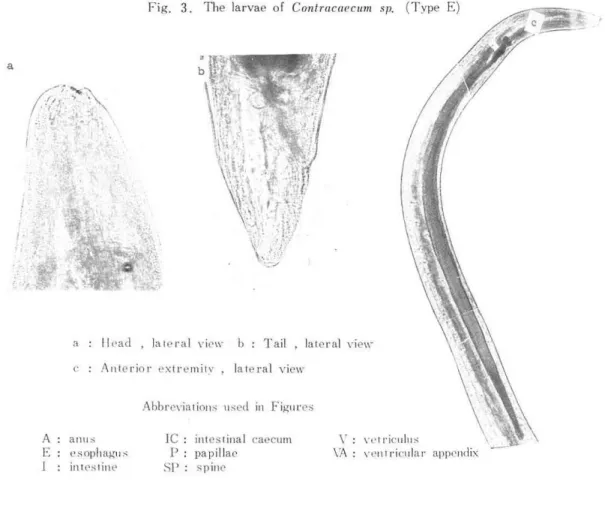
contracaeeum sp. (Type E) (Yamaguti-Tye V) :東支那海及び南支那海ではAnisakis sp. (Type I〕 に次いで寄生率が高い. 54隻の虫体についてその特徴 をみると体はやや黄褐色を程し生殖器の発育がみられ ない.体長ほ15.6mm (12.1-19.2 mm〕で頭端に穿 歯をそなえ,尾部は円錐形で先端に小林がみられる. 排他孔ほ神経輪の後方に開口する.叉木種の最も著し
164 坂 口 祐 二・片 峰 大 助
Table 4. Dimension and index of Anisakid larvae found in various marine fishes Anisakis (Type I) Contracaecum (Type A) Cont racaecum (Type E) Contr acaecum (Type F) Terranova (Type B) Rap h idaeca ris SP.
Body length
(mm)
Body width
(mm)|
Oesophagus
(mm)
Muscular
Ventriculus
Vent.
Appendix (mm)
Intest.
Caecum (mm)
Tail
(mm)
01 02 03 7 X Y Z 151 *17.0 (12.6-25.1) 0.41 (0.30-0.65) 2.28 (1.57-3.05) 1.53 (1.02-1.79) 0.75 (0.55-1.26) 0.10 (0.07-0.19) 41.8 (37.4-56.7) 7.5 (6*9-9.8) ll.1 (10.1-13.1) 22.6 (19.2-30.2) 165.1 ;95.3-291.4) 13 13.9 (6.2-24.5) 0.37 (0.22-0.55) 1.14 (0.78- 1.54) 1.03 (0.71-1.38) 0.ll (0.07-0.16) 1.07 (0.81-1.46) 0.23 (0.12-0.38) 0.14 (0.ll-0.23) 37.6 (33.8-47.5) 123 (10.5-19.5) 13.5 (ll.5-22.3) 131.1 (112.0-158.0) 96.5 (54.0-222.7) 13.0 (9.0-25.8) 59.7 (47.0-102.8) 4.6 (3.7-5.2) 54 15.6 (12.1-19.2) 0.50 (0.44-0.65) 1.16 (1.02-1.80) 1.04 (0.94-1.02) 0.12 (0.08-0.18) 5.16 (4.01-7.81) 0.21 (0.04-0.37) 0.17 (0.05-0.23) 31.4 (25.3.37.6) 13.5 (8.5-15.9) 15.0 (9.3-18*2) 130.0 (105.0-176.0) 92.3 (63.9-118.5) 3.0 (2.7-3.6) 73.6 (43.9-111.5) 24.4 (15.7-36.1) 7.3 (5.9-8.6) 0.22 (0.22) 0.63 (0.58-0.69) 0.55 (0.51-0.60) 0.08 (0.07-0.09) 0.51 (0.50-0.53) 0.16 (0.15-0.18) 0.14 (0.ll-0.22) 32.6 (26.3-38.4) ll.6 (10.3-12.6) 13.2 (ll.6 l'l4.5) 94.8 (90.8-97.7) 52.5 (40.0-54.6) 14.3 (ll.8-16.3) 45.3 (33.7-58.9) 3.2 (2.9-3.9) 10 8.1 (6.7-ll.1) 0. 1.7 (0.14-0.21) 1.34 (0.92-2.07) 0.88 (0.63-1.03) 0.46 (0.29-1.04) 0.80 (0.49-1.10) 0.13 (0.10-0.16) 47.9 (28.5-58.7) 6.1 (4.3-6.8) 9.2 (7.7-ll.1) 17.6 (8.7-24.4) 60.4 (38.0-110.0) 10.1 (7.8-12.6) 22 7.7 (6.2-9.1) 0.29 (2.05-0.36) 0.94 (0.90-1.08) 0.88 (0.84-0.94) 0.06 (0.06-0.14) 0.54 (0.40-0.61) 0.21 (0.16-0.24) 26.6 (22.1-31.9) 8.2 (6.5-10.4) 8.8 (7.0-ll.2) 120.3 (63.3-149.0) 37.2 (29.5-50.0) 14.4 (12.9-17.1)Legend for table : a
__.Body length Body width 03 = Body length Ventriculus (3 = Body length Oesophagus _Body length 7 Tail
Q
Body length
Muscular part
of oesophagus
X _ _ Bodylength
Ventricular
appendix
mean, ( ; : range Y =Boy^ length
Intestinal
caecum
~束支那海及び南支那海産の魚類に寄生する Anisakidae助線虫の種額と分布 165 い特徴として腸吉葉が極めて短く(平均0.21 mm (0.04-0.37mm)〕,胃胃嚢ほ道にどのTypeより も長い〔平均5.16mm (4.01-7.81mm)〕. Lたが って指数Z 〔胃肯嚢長/腸告嚢長)ほ24.4で最も大 きい. Contracaecum sp. (Type F〕 :南支那海から発見 されたもので同属のなかで最も小さい.虫体2隻を計 測Lてみると,体長7.3mm (5.9-8.6mm),胃青 嚢長 0.51mm 〔0.50-0.53mm〕,腸旨嚢長 0.16 mm (0,15-0.18 mm〕で指数z (胃古壷長/腸盲嚢 長〕は3.2 〔2.9-3.6〕を示す.又固有虫体の尾部に は極めて小さい1本の小嫌がみられ,生殖器の発達が 著しい.排壮孔は神経輪の後方に開口している等から 他のType と区別出来る. Terranova sp. 〔Type B〕 :東支那海及び南支那海 から比較的高率に検出された.虫体10隻についてみ ると,体長8.1mm 〔6.7-ll.1mm)で小さい.腸 告嚢長は0.80mm (0.49-1.10mm)で長く,排他 孔は2枚の亜腹側口眉の間に開いている.尾の長さは o.13mm 〔0.10-0.16mm〕で体長/尾長は60.4 を示す.又生殖原基ほ認められない. Raphidascaris sp. : 22隻の平均体長は7.7 mm (6.2-9.1 mm)で被鞘には頭部に穿歯と尾端に小味 がみられる.叉固有虫体の尾部には15-20個の微小 練がみられる.胃百嚢長0.54mm 〔0.4-0.61mm〕 排壮孔は神経輪の後方に開口する.生殖器はかなりよ く発達している. 考 察 日本近海に於けるAnisakidae幼線虫の種類とその 分布状況については今まで多くの調査報告がなされて いる.そのなかから特に人の消化器系に於ける好酸球 性肉芽腫症の起因虫体と考えられている Anisakis属 幼虫の感染魚輯を過去の報告にもとづいてIist up 〔Kagei 1970〕してみると, Anisakis sp. (Type I〕 幼虫ほ我国近海では122種の魚類とスルメイカから報 告され,海外での報告を含めると150種をはるかに上 まわる種煩が中間宿主となり得るようである.これに 比べAnisakis sp. 〔Typ己II〕でほ25種の魚類とス ルメイカ及びヤリイカから報告されているにすぎない. しかも Type Iに比べて一段に寄生数が少ないこと から本邦人にみられる症例の大半は Type Iの感染 によるものであろうと推定(影井・大島1967,小林 1967,大鶴ら1967等〕されている.その分布状況を みると北日本海域を中心として生槙する魚額又はその ような海域に季節的に北上してくる群に多いことが明 かにされている. 一方これらの海産魚額や軟体額にほAnisakis 属の 幼虫の他に数種類の近縁属の幼線虫がみられるが,そ の種額や分布状況についてほ充分明かにされたとほい えない.著者らは近海の他に広く東支那海及び南支那 海の Anisakidae 幼線虫の感染調査と得られた虫体 について観察L従来の日本海のものと比較Lてみた. 先づ幼線虫の寄生状況を捕獲海域別にみると長崎近 海でとれた魚段に比べ東支那海及び南支那海の所謂遠 洋もので格段に高く, -尾当りの寄生数も多い.特に 寄生率のMい魚種として東支那海のワニエソ,イシモ チ,てルアジ,フウセイ,てトウダイ,カイワリ南支 那海でほイトヨリ,センネイダイ,ワニエソ,スギ, キントンダイの近縁種,マレイザメ,オキ-辛,スジ フユダイ,ヒメダイ,てルアジ,オニアジ,マ-タ, ヒメジ等があげられる.殊uにワニエソ,イシモチ,マ ルアジ,フウセイ,イトヨl),セソネンダイ及びスギ でほ100鬼′の寄生が認められ -尾当りの寄生数(最 低5.5隻,最高65.9隻〕が極めて多い. 採集された Anisakidae 幼線虫は外部形態の特徴 や内部構造の観察,計測からAnisakis sp. (Type I〕, Contracaecum sp. (Type A, Type E及びType F〕, Terranova sp.(Type B〕及びRaphidascaris sp.の 4属6種に分別される.その分布を捕獲海域別にみる と長崎近海ではAnisakis sp. (Type I〕Contracaecum sp. 〔Type A〕及びRaphidascaris sp.の3属3種 であるが,東支那海及び商量那海では更に2種の Contracaecum sp. (Type E, Type F〕及びTerranva sn. (Type B〕が検出され その種額が多くなってい る.このうち Contracaecum sp. (Type E〕及び Type F は著者ら〔坂口ら1970,影井ら1970〕が new typeの幼虫として報告したものであるが,その 後の精査によってType EほYamaguti (1935〕の Type Vと同一種であることを確認し訂正,報告した (Kagei et all 1970〕叉Type F も虫体の大きさ, 胃盲嚢及び腸告嚢の長さ等の値はYamaguti(1935)の Type IIIのそれに一致する. LかLながらその他詳
166 坂 口 祐 二・片 峰 大 助 細な特徴の記載がないので本種と同一種のものかどう
か判定し難く,しかも今迄報告されている虫種(小山 らType A-D,大鶴らType A-B及び菊地らType A-F にも該当Lないので本報では new type と Lて報告した.その他Terronova sp. 〔Type B)が 東支部海及び南支部海から比較的高率に検出されてい ることが注目される.
各種幼線虫について特に寄生率の高い魚種をあげる と,先づ Anisakis sp. (Type I〕でほ東支部海の -モ(寄生率100%〕,イシモチ〔100%〕,ワニエソ 〔100%〕,フウセイ(100%〕.マトウダイ〔80.0 %〕,南支部海のワニエソ〔寄生率100鬼′〕, スギ (100%) イトヨリ(100%〕,キントキダイ近縁種 (95.0%〕,オキ-ギ(88.5%〕,ス.}フユダイ 〔86.7%〕,ヒメダイ〔84.0%〕,マルアジ(82.0%〕, オニ7ジ(80.0%),マ-メ(80.0%〕,ヒメジ(75.6 %〕 Terrcaiova, sp. 〔Type B〕でほ南支部海のセソ ネンダイ(寄生寧100%〕,マL/イザメ(90.0%〕, イトヨリ(55.6%〕,ワニエソ(50.6%〕があげられ る.叉Con加caecum sp.(Type A〕は東支部海のタ ロウシノシタ(寄生率60.0%〕, Type Eでほ東支部 海のイシモチ(寄生率100%〕,ワニエソ(68.6鬼′〕, 南支部海のイトヨリ〔寄生率100%〕,キントキダイ の近縁種(75.0鬼′)等があげられる Type F は南 支部海のワニエソ,オキ-ギ,オキ-辛,メガレイか ら発見されたものである. これらの魚類のうち特に東支部海及び南京郡海で寄 生率の高い-モ,イシモチ,ワニエソ,フウセイ,ス ギ及びイトヨリについてその回遊状況をみると概ね大 陸沿岸に沿って南北に上下するものと,大陸沿岸の浅 所から深所(東西) -移動する群に分けられる.いづ れの場合も東支部海及び南支部海での回遊にとどまる ことからこれまで多数の研究者によって報告されてい る日本海北部又ほ北太平洋とほ別に東支部海及び南支 那海方面に Anisakidae 幼線虫の感染をうける海域 が存在することが想象される. 主として東支那海及び南支那海及で得られた4属6 種の幼線虫について計測した値をYamaguti (1935-1941〕,小山ら(1969〕,白木(1969〕,菊地ら(1970〕 等のそれと比較してみた Anisakis sp. 〔Type I)で ほ在来の日本近海のものに比べて全体的に多少小さい 値を示Lたが,その他のTerram柑a sp. 〔Type B〕, Raphidascaris sp ,及びContmcaecum sp.(Type E〕 では殆んど諸家の成績と一致した.又Contracaecum 叩. (Type F〕ほ同属の中で最も小さく,尾端に1本 の微小嫌がみられ,生殖器がかなりよく発達Lている 等が最大の特徴である.文胃青嚢の長さを2豊平均で みると 0.51mm (0.50-0.53mm〕,腸音義の長さ 0.16mm (0.15-0.18mm),指数z (胃旨嚢長/腸 音嚢長)は3.2 (2.9-3.6〕を示す.
摘要
1967年から1970年までの4ケ年間に長崎に陸揚げさ れた長崎近海及び東支那海のものと長大水産学部長崎 丸の遠洋航海実習で捕獲された南支那海の魚類,合計 68種1,825尾についてAnisakidae幼線虫の感染調 査とその形態を観察し次のような成績を得た. 1)幼線虫の寄生率は近海のものに比べて東支那海 及び南支那海の所謂遠洋もので格段に高く,その寄生 数及び種類も多い.2)幼線虫はAnisakis sp. (Type I) Contracaecum sp. (Type A, Type E及びType F), Terranova sp. (Type B)及びRaphidascaris sp.の4属6種に分別
される.
3) Anisakis sp. (Type I)は各海域で最も高い寄生 率を示し,東支那海及び南支那海ではContracaecum sp. (Type E)がこれに次いで多い.又Terranova sp. (Type B)が南支那海で比較的高率に検出され, 日本近海では未記載のContracaecum sp. (Type F) が南支那海のワニエソ,メガレイ及びオキハギから発 見された. 4)東支那海及び南支那海で特に重要な魚種として
Anisakis sp. (Type I)ではハモ,イシモチ,ワニエ ソ,フウセイContracaecum sp. (Type E)ではイシ モチ,イトヨリ又Terranova sp. (Type B)ではセン ネンダイ等があげられる. その回遊状況をみると概ね大陸沿岸にそって南北に 上下するものと,同沿岸の浅所から深所(東西)へ移 動する群に分けられる.いづれの場合も東支那海及び 南支那海内での回遊にとどまることからこの方面に Anisakidae感染海域が存在することが想象される. (本論文の要旨は第39回日本寄生虫学会総会に於いて発表した)
東支那砧及び南友w海産の魚矧こ寄*.するAnisakidae助線虫の椎葉鍔と分布 167 稿を終るに当り虫件の鑑別に御協力いただいた国立公衆衛生院寄生虫部影井昇博士に謝意を蓑Lま チ.文相料の採集に便宮をはかylていただいた]Jに)車学刑F_に同学部練剤f牌崎丸船長阿部茂夫助教鳳 長崎魚市の方利二感謝致L至す.
文 献
1〕 Berlanピ. B. : Nemato二es from some Nor-¥¥egian marine fishes. Sarsiユ, 2 : 1-50, 1961.
2) Fans書,町 Experimental studies on human a二d primate species of Strcngyloides, II
The development of Strongyloide三in the
experi-mental host. Am. J. Hyg.柑: 114-832, 1933.
3) Hartwich, G. : Zur Systematik der Nema-toden Superfamihe Ascandoidea. Zoologische Jahrbucher, 85 : 211-252, 1957。 4〕石倉 肇:アニサキス症の発生状況とその臨嵐 最新医学24 (2∋ : 357-365, 1969. 5:ぎ 影井 昇,大島智夫,小林昭夫,態田三由,小 山 九 小宮義孝,竹村 喝:各種海産哨乳動物に 寄生するAnisakis属線虫類の調査.寄生虫誌16 〔6〕 : 427-435, 967, 63 菊地 蓋,小林国雄,平林春雄,林 滋生:海 産魚韓より検出したContracaecum属幼線虫6種類の 形態学的観察.横浜医学21純: 421-427, 1970. 7〕小林昭夫:アニサキスの分類と形態.医学のあ ゆみ; 16:247-252, 1967. 8〕小山 九 小林昭夫,態田三E5,小宮義教 大 島智夫,影井 昇,万井俊雄,町田昌昭:海産魚窺 およぴスルメイカより見出される Anisakidae 幼線 虫の形態学的および分類学的検討.寄生虫誌18 (5〕 : 466-487, 1969,
9〕 Noboru KAGEI : List of the larvae of Anisrkis spp. Recorded from Marine Fishes and Squids Caught off the Japan and its offshore Islands. Bull. Inst. Publ. Health, 19 〔1〕 : 76-85, 1970.
loョ Noboru KAGEI, Yuji SAKAGUCHI, Daisul亡e 旺ATAMINE & Yukio I荘EDA : Studies on Am-sakid Nematoda (Anisakinae〕 II。 Contracaecum sp- (type-v of Yamaguti〕 found in marine fishes
し二Appen王ix : list ani maine features of the
larvae of C-:j.rbtrucaecit,rn sp. reported from
marine fishes ard squids cau主ht off the Jap:n
and its offshoreう Bull. Inst. Publ. Health 19 〔A〕, 1970.
ll)大鶴正満,白木 公,監物 実:北日本近海産 魚介類におけるAnisakinae幼虫の別象形態および 感染実験.寄生虫誌18 (4〕 : 105-106, 1969.
12〕 Punt, A∴ Recherches sur quelques nemtodes parasites de poissons de la Mer du Nord. Me肌 Mus. Roy. Hist. Nat Belgique, 98: 1-110, 1941, 13)白木 丑:消化管幼線虫移行症(:主とLてアニ サ車7t症)の病理組織学的診断に:x--て.最新医学
24 (2) :378-389, 1969.
14〕 Van Thiel. P. H. Kuippers, F. C. and
Roskam, R.臥 A nematode parasitic to
herring causing acute abdominal syndrome in
man, Trop. Geogr甘M巳d. 2 : 97-113, 1960.
15〕 Van Thiel, P.札 Anisakiasis Parasit,
52 :ユ6-17, 1962.
16) Yamaguti, S. : Studies on the helminth
fauna of Japan申 9. Nematories of fishe占I. Jap.
J. Zool. 6 : 337-396, 1935.
1T〕 Yamaguti, S. : Studies on the helminth fauna of Japan. 33, Namatodes of fishes II. Jap. J. Zool. 9 : 343-396, 1941.
1郎 Yam昭uti, S. : Systema Helminthum III♯ The nematodes of vertebrates. I & II. Inters-cience publ.ユ961.
19二 York W申& Maplestone P.A. : Nematode
parasites of vertebrates・ Hafner Publ Comp, New York. 1962.
20j 吉村裕之:アニサキス症の臨床病理と発生機序 医学のあゅみ61 (5) :252-25乳1967,
168
Fig. J., The larvae of Tn rallova sp. (Type B)
a b c
a Head, latera! view b : Tail, lateral vicw c Anterior extremity . lateral view
Fi~. 2. The lan'ae of ConlraClll'ClI1II sp.(Type F)
a b c
"
I.e
v
V.A- I,
a 1-1 cad, lateral vicw b : Tail, latel'al view (' Allterior extremity, latera! vicw
a
Fig, 3. The larvae of COllfrac(lf'cllm Sll. (Type E)
f.
/~;
~J:"'
">~
' • . t· · ". L "l,;! ~. / ',
,
,
'.
...
a Ill'ad , lateral \'il~\\' b: Tail, lateral \"jew
A
E I
e /\nleriol' extremit.v , lateral vicw
anllS
esophagll . ...;
intestine
Abbrc\'intion:-: u:-ied ill Figure,;
I
e
:
i11lcl:;linal caecum[) : papillae
SP spin£'
\' \·L'friculu . ...;
\1\ \'('llll'i('III[\I" apPC'lldix