DISCUSSION PAPER No.156
博士人材の学位取得から労働市場への移行:
フランスと日本の比較研究
The Transition between Thesis to Labor Market in France and Japan:
a Comparative Exploration
2018 年 4 月
文部科学省 科学技術・学術政策研究所 第1調査研究グループ
Julien Calmand 小林淑恵 野原博淳
本 DISCUSSION PAPER は、所内での討論に用いるとともに、関係の方々からの御意見を頂く ことを目的に作成したものである。
また、本 DISCUSSION PAPER の内容は、執筆者の見解に基づいてまとめられたものであり、
必ずしも機関の公式の見解を示すものではないことに留意されたい。
The DISCUSSION PAPER series is published for discussion within the National Institute of Science and Technology Policy (NISTEP) as well as receiving comments from the community.
It should be noticed that the opinions in this DISCUSSION PAPER are the sole responsibility of the author(s) and do not necessarily reflect the official views of NISTEP.
【執筆者】
Julien Calmand フランス国立 Cereq 研究所 DEEVA 調査研究部 高等教育 主任 文部科学省科学技術・学術政策研究所 国際客員研究官
小林淑恵 文部科学省科学技術・学術政策研究所第1調査研究グループ 上席研究官
野原博淳 山梨学院大学 現代ビジネス学部現代ビジネス学科 教授
文部科学省科学技術・学術政策研究所 客員研究官
【Authors】
Julien CALMAND Head of Studies and Research, expert in higher education graduates school to work transition, Céreq, DEEVA, Marseille
Affiliated Fellow, National Institute of Science and Technology Policy (NISTEP), MEXT
Yoshie KOBAYASHI Senior Researcher
1st Policy-Oriented Research Group, National Institute of Science and Technology Policy (NISTEP), MEXT
Hiroatsu NOHARA Professor, Faculty of Business Yamanashigakuin University
Affiliated Fellow, National Institute of Science and Technology Policy (NISTEP), MEXT
本報告書の引用を行う際には、以下を参考に出典を明記願います。
Please specify reference as the following example when citing this paper.
Julien KALMAND・小林淑恵・野原博淳 (2018) 「博士人材の学位取得から労働市場への移行:
フランスと日本の比較研究」,NISTEP DISCUSSION PAPER,No.156,文部科学省科学技術・学 術政策研究所.
DOI: http://doi.org/10.15108/dp156
Julien KALMAND, Yoshie KOBAYASHI and Hiroatsu NOHARA (2018) “The Transition between Thesis to Labor Market in France and Japan: Comparative Exploration,” NISTEP DISCUSSION PAPER, No.156, National Institute of Science and Technology Policy, Tokyo.
DOI: http://doi.org/10.15108/dp156
博士人材の学位取得から労働市場への移行:フランスと日本の比較研究
フランス国立 Cereq 研究所 DEEVA 調査研究部 高等教育 Julien Calmand 文部科学省科学技術・学術政策研究所第1調査研究グループ 小林 淑恵 山梨学院大学 現代ビジネス学部現代ビジネス学科 野原 博淳
要旨
現在、博士学位取得後の労働市場への移行は、先進国で大きな課題となっている。歴史的に は、これらの高度な資格を持つ労働者の主要な労働生産はアカデミア部門であり、一般的には 高等教育であった。国家間の競争、世界中の知識社会の発展は博士号の役割を変え、博士課程 教育に新たな課題を与えている。実際、現代の社会は博士号取得者が高等教育において吸収さ れるだけでなく、民間セクターや企業においても活用されることが期待されている。このよう な目標は、アカデミアにおけるパーマネントポジションの獲得が国際的な激しい競争下にあり、
博士課程から労働市場への混沌とした専門性の移行であることによって強化されている。
NISTEP と CEREQ の研究者は、フランスと日本、両国のデータを用いて、エビデンスベースの国 際比較の視点を示す。日本の博士がフランスの博士よりも就職が困難かどうか、早期キャリア における任期制雇用率、民間部門での就業率の視点で明らかにしている。
Title
The Transition between Thesis to Labor Market in France and Japan: Comparative Exploration ABSTRACT
Nowadays, PhDs transition from thesis to labor market is a great issue in major developed countries. Historically, the main labor output of these high qualified workers used to be academic sector and more generally Higher Education. Competition between countries, development of knowledge society all around the world have change the role of PhDs and give new challenges to doctoral education.
In fact, now, society expects that PhDs integrate Higher Education but also private sector and firms.
This goal is also enhance by the fact that there is now a high and international competition in access to permanent positions in academic sector leading to chaotic professional transition from doctorate to labor market. Comparing two national experiences in France and in Japan and using two original statistic dataset, researchers from NISTEP and CEREQ demonstrate these evidences in an international perspective. If Japanese PhDs have fewer difficulties find a job than those from France, both graduates are concerned with fixed terms contracts in their early career and low penetration in private organizations.
概要 ... ⅰ~ⅳ 本編 ...
Introduction ... 1
France-Japan scientific labor market, what are the differences? ... 2
France ... 2
Japan ... 4
Generation Survey from Cereq ... 8
Japan Doctoral Human Resource Profiling ... 9
A comparative observation of PhD transition to labor market: methodological issues ... 10
Methodological approach ...11
Exploratory results ... 12
Employment/Unemployment ... 12
Job Contract ... 13
Sector repartition ... 13
Conclusion ... 16
Bibliography ... 17
参考:人材セミナーの記録 ... 19
概要
OECD や EUROSTAT などの国際機関は、国別の PhD のプロダクトや労働市場状況に関する いくつかの指標を提供している。OECD による KNOWINNO プロジェクト(Auriol 2012)では、
労働市場における PhD の状況を国際比較することを試みたが、国際比較可能なデータを持 つ国は限られていた。
その後、科学技術・学術政策研究所(以下、NISTEP)では、国際比較研究が可能な日本 のデータの構築を目指し、「博士人材追跡調査」(Japan Doctoral Human Resource Profiling , 以下、JD-Pro)を 2014 年に開始した。フランスでは Centre d'Etudes et de Recherche sur les les Qualifications (以下、CEREQ)が 1990 年代初頭から大規模な教育から社会への 移行調査「Generation」を実施しており、日本の「博士人材追跡調査」はこういった諸外 国の調査を参考に設計したものである。
今回、日本とフランスの双方のナショナルデータである、NISTEP「博士人材追跡調査」
と CEREQ「Generation」を用い、博士人材の置かれている状況についての比較研究を試み た。NISTEP が実施する「博士人材追跡調査」は、2012 年度に博士課程を修了した者(以下
「2012 年コホート」という)について、博士課程修了 1.5 年後、3.5 年後に調査を行って いる。また 2015 年度に日本の大学院の博士課程を修了した者(以下「2015 年コホート」
という)については、博士課程修了 0.5 年後調査を実施した。2016 年度に実施した、最新 調査の 2012 年コホート 3.5 年後調査で、調査依頼数 5,044 名、回答数 2,661 名、有効回答 数 2,614 名 (回答率:52.8%、有効回答率 51.8%)であった。また、2015 年コホート 0.5 年後調査では、大学からの依頼数 13,517 名(依頼率 87.8%)、有効回答数 4,922 名(有効回 答率 36.4%)であった。CEREQ の Generation 調査は 1992 年に開始し、近年では 3 年おきに 新しいコホートを開始している。現在までに 7 つのコホートがあり、教育機関を離れてか ら 3 年後のみの短期で終えるコホートと、3 年後、5 年後、7 年後と続く長期コホートがあ る。最新の Generation2013 では、対象者は全教育課程で 693,000 人、うち、博士は 1,600 人を超える。
国際比較の方法
「Generation」の 2013 年コホートと「博士人材追跡調査」の 2012 年コホートの博士課程 修了 1.5 年後調査(JD-Pro2012)から、以下のように条件を統一し、比較可能なサンプル を抽出している。その結果、日本の JD-Pro2012 では 1,059 サンプル、フランスの
Generation2013 では 1,641 サンプルとなった。
1)2012 年に博士号を取得した修了者
2)調査時点(修了 1.5 年後)に日本に在住している者 3)卒業の時に 35 才以下の者
4)分野が保健系以外の者
日仏比較の博士の属性
研究分野の構成を見ると、数学、物理、化学系はフランス 25%に対し、日本で 31%とや や多く、生物系は日本でやや少ない。日本で女性比率が 21%と少ないのは特徴的である。
概要図表1 日仏の博士の属性
a. 研究分野
b. 性別
セクター分類
博士の雇用先セクターは、日本で公的部門 47%/私的部門 53%、フランスでは公的部 門 54%/私的部門 46%となっている。フランスのアカデミアは公的部門が大半で、そこに 集中していることが分かる。
博士の雇用先セクターについては、通常の 4 分類(公的部門の研究開発、公的部門の非 研究開発、民間の R&D、私大等の教育研究)で見る。しかし日本では多数の私立大学があ ることから、「私大等の教育研究」を追加した 5 分類で見ている。日仏とも公的部門の研究 開発職が 39%、民間の研究開発は約 2 割とほぼ同じである。日本独自の私大等の教育研究 職は 18%となっており、私立の教育機関で博士人材を多く雇用する日本では、アカデミア
(公的部門の研究開発+私大等の教育研究)で働く PhD の比率はフランスよりも大きくなっ ている(日本 57%、フランス 39%)。
他方、公的部門の非研究開発職はフランスで 15%、日本で 8%、民間部門の非研究開発 職はフランスで 23%、日本で 14%と、日本が少ない結果となっている。
概要図表2 日仏博士の雇用先セクター分類
雇用状況の日仏比較
・失業率
博士課程修了の 3 年後(3.5 年後)の労働市場における最も重要な指標として、失業率 を見ている。フランスの 2016 年の労働市場において、博士の失業率は 10%と非常に高い 水準である。特に生物学系の失業率が 14%と高い。また女性の失業率が男性に比べ高い。
このような労働市場の困難は、日本ではあまり見られず、失業率は 2015 年に 2%と非常に 低く、研究分野や男女差がない。
概要図表3 日仏博士の卒業 3 年後(3.5 年後)の失業率
・任期制雇用
全体で、日本では 34%、フランスでは 33%が任期制雇用で、両国とも生物系でその割 合が最も高く、次いで数学、物理、化学系である。日本では女性で任期制雇用が多いが、
フランスでは男女差は認められない。
概要図表4 日仏博士の卒業 3 年後(3.5 年後)の任期制雇用率
・任期制雇用(セクター別)
博士の労働市場への移行を検討する際に、パーマネントの雇用であるかどうかは重要な 問題である。日本、フランスとも、任期制雇用率は公的な研究開発分野と私大等の教育研 究(いわゆるアカデミア)で高く、民間の研究開発、民間の非研究開発で低い。公的部門の 非研究開発はフランスでの任期制雇用率が高い。
概要図表5 日仏博士の卒業 3 年後(3.5 年後)任期制雇用率(セクター別)
なお、巻末に参考として、筆者のジュリアン・カルマンによる NISTEP 所内人材セミナ ーの記録と資料を掲載している(平成 29 年 2 月実施)
本編
The Transition between Thesis to Labor Market in France and Japan: a Comparative Exploration
Julien Calmand (Céreq1), Yoshie Kobayashi (NISTEP2), Hiroastsu Nohara (LEST3)
Introduction
The doctorate is recognized as one of the most international diploma (Noble 1994; Park 2007) around the world. In fact, compared to other level of study, doctorate is common to every educational system. In every country, doctoral education is the most prestigious diploma and it is linked with high degree of scientific expertise. All around the word, PhD is traditionally a key entry to academia. Nowadays, role of doctoral education changes and there are new challenges for academics who are in charge of doctoral education and also for young PhDs who enter on the labor market. With the development of the knowledge society (Foray 2009), there is a need of high qualified workers in every area on the economy. PhD should be capable to hold positions in academia but also in private companies.
PhD transition and their situation on the labor market are very different under countries. In some of them there is an underproduction of PhD which is dramatic to meet the demands of knowledge economy. In some countries there is a huge production of doctoral degree holders but national state are not capable to keep them on their national labor market. Finally, in some countries PhD holders have difficulties on the labor market, more than graduates with lower education. Despite all this differences, there is a common point; there is a huge competition in access to academic permanent positions, PhDs experience non stable job period in their early working career (Ma and Stephan 2005). Queue line for academic permanent positions depends of the level of the competition.
Such international differences need to be investigated and it is a crucial purpose for scientific researchers in social sciences. International organization such OECD or EUROSTAT give information on PHD production by countries and some indicators on labor market situations. Few years ago, OECD developed the KNOWINNO (Auriol 2012) project in order to compare PhDs situations on the labor market in an international way, but results are constructed on national database. In fact, there is no international survey mainly because researchers face difficulties to construct international and comparable databases. There are some initiatives. In 2018, the National Research University in Moscow4 launches a study in order to compare doctoral education all around the world. In order to enhance knowledge on this transition process NISTEP (National Institute of Sciences and Technologies Policy) in Tokyo and CEREQ (Centre d’Etudes et de Recherche sur les Qualifications) in Marseille have decided in 2017 to compare PhD transition on the labor market in Japan and France.
1 CEREQ: Centre d’Etudes et de Recherche sur les Qualifications, Marseille, France
2 NISTEP: National Institute of Science and Technology Policy, Tokyo, Japan
3 LEST: Laboratoire d’Economie et de Sociologie du Travail, Aix en Provence, France
4 Trends and Issues in Doctoral Education Worldwide: An International Research Inquiry : https://cinst.hse.ru/en/docedu
This article presents results of this cooperation between Japan and France. In order to compare PhD transition on the labor market, researchers have exploited two quantitative surveys: the Japan Doctoral Human Resource Profiling and the Generation survey from CEREQ. In the first part of the article we briefly present each national scientific labor market in Japan in France. In the second part, we will focus on the methodological aspects of the statistical comparison of the two surveys.
Finally, we will present main results regarding the entrance and the situation of Japanese and French PhD on the labor market.
We investigate some crucial research questions. Are there difficulties in labor market entrance? Are PhD employed mainly in academic sector or in private companies? In academic sector, is there a more or less waiting queue in access to permanent positions? According to different sector access, are there job situations differences in term of job contract or job situations?
France-Japan scientific labor market, what are the differences?
The aim of this part is to present the reality of the scientific labor market in the two countries. Two points are tackled the transition on the labor market of young PhD and the presentation of statistical surveys which permit to observe this process.
France
In France, the morphology of "doctorate" audiences evolved over the last 10 years. Thus, the number of PhDs has increased significantly as a result of the massification of higher education and the general rise in the level of education. Compared to OECD countries, as a percentage of an age group, most OECD countries train more doctors than France (Harfi and Auriol 2010) . Administrative data show that the number of doctorates awarded increased from 9,200 in 2004 to more than 9,100 in 2014. However, it is mainly the share of foreign graduates which increased the most from 27% to 44% (2500 to 5500). This data may reflect a stronger internationalization of the degree, less attractiveness of French students for the doctorate course often explained by a disaffection of young people for scientific careers. Distribution by discipline has changed over the same period; the share of graduates in engineering sciences has increased from 10% to 17%.
Finally, even if women's share has increased from 41% to 45%, they remain in the minority and are more represented in Humanities.
PhD transition from thesis to labor market used to be described as “difficult” compared to other graduates from French Higher Education. Results from longitudinal statistical survey “Génération”
from CEREQ show that, in the early 2000s, three years after their thesis defense, the unemployment rate for PhDs, although low (6.5% for Generation 98 graduates), was higher than that of graduates from “Grandes Ecoles” or than that of the university Master (Calmand 2017).
Gradually, this trend reversed, the three-year unemployment rate of PhD increased but stabilized at around 9% in 2013, while under the effects of the economic situation, at the same time, that of university graduates reach 11%. If we witness a reversal, it does not concern all PhDs, there are strong disciplinary disparities and the advantage of graduates from “Grandes Ecole” persists. In addition, the beginnings of PhDs careers are marked by the pregnancy of fixed-term jobs in professional trajectories.
Fixed-terms jobs experiences in early careers can be explained by the regulation of the academic sector which is traditionally the main opportunity for PhDs. In fact, administrative data from National Education Ministry show that permanent positions such as professor assistant (first permanent position in academic) increase drastically over the last fifteen years. As the graphic (1) demonstrates this trend is common to all fields of studies. This reduction of permanent possibility in academic sector has a repercussion on transition on the labor market through higher competition between doctorate and an extent of the access queue line to permanent position. If this phenomenon can be explained by the state regulation of jobs in academic sector, we assume that it also reflects an international science modus operandi with the development of “postdoctoral” experiences (Recotillet 2007). These jobs allow PhD to enhance their thesis (publications, skills development etc.) but especially to wait until new recruitment sessions for permanent positions. From employer side, it allows during a longer period to test the competences of young PhDs (Giret 2011).
Figure 1 : Professor Assistant position evolution in France from 1998 to 2014
Source : Bilan des recrutements au postes de Maitres de Conférences, MENESR, 1998-2014, Calmand, 2017 PhDs difficulties on the labor market are also enhanced by their low integration in the private sector. In France, highly skilled jobs in the private sector, and more specifically in R&D, are traditionally fueled by engineering school graduates. While a large literature explains the preference of doctors for academicism (Merton 1973; Menger 1989), very few materials focus on demonstrating the lack of interest of private recruiters for doctoral graduates. The existing one
insists, on the one hand, on a lack of knowledge on the part of employers of PhDs and doctoral training (d’Agostino et al. 2009) and on the other hand on a preference for graduates of “Grandes Ecoles” who would have a more developed culture of the company and more transferable skills acquired by their training (Mason, Beltramo, and Paul 2004). PhDs are therefore poorly represented in companies and especially in R&D jobs. The administrative data of the MENESR / DGRI (Perrain and Boinet 2017; Perrain 2016) show that over the period 97-2013, the share of researchers in companies with a doctorate as the highest degree has decreased.
In order to face these difficulties, French public authorities have launched a large set of reforms since the middle of the 2000’s. Lots of them are related to doctoral education. The ministerial order of August 2006 marked a turning point in the history of doctoral education in France. First, it made an explicit reference to professional integration of the graduates as a central issue of doctoral education. The point had never been mentioned in the numerous regulations passed on the subject since the 1970s. Second, it stated clearly the doctoral programs do not prepare exclusively for careers in the public sector of academic research, as it was traditionally considered, but also for employment in the private sector. Consequently, doctoral schools were assigned the new mission of fostering the integration of new PhDs on the labor market. Nowadays, doctoral studies does not have much to do with what in was twenty years ago. Now doctoral students should prepare and secure their professional entrance in the labor market in addition to thesis writing. On the other side, doctoral schools have emphasized student supervision in order to avoid chaotic scholarship and professional pathways.
One of the initiatives settled by French Public Authorities is related to higher observation of the PhD transition to the labor market. Recently, in an article (Calmand 2016), we demonstrate that there are more than thirties devices (at local or national level) that gives information on PhDs’
professional pathways. Data used in this article from Génération national survey plays a great role in this environment.
Japan
Before the description of the Japanese labor market for PhD graduates, we may have to refer to the Graduate School reforms and the evolution of PhD students in recent years.
In accordance with the emergence of knowledge economy, Japanese policymakers in charge of the higher education system projected to reform the educational and professional pathway constituted by PhDs, with a common aim of speeding up scientific knowledge production and innovation.
While PhD programs are highly valued within the Japanese university system, they remained traditionally under the hierarchical control of the ‘chair system.’ In the early 2000s, the Ministry of Education tried to radically reform the system by introducing a greater degree of competitiveness into it. The national universities became autonomous agency in 2004: teaching staff and researchers, previously civil servants, were then employed on private open-ended contracts. At the same time, academic research institutions and Graduate Schools were required to undergo competitive tendering procedures before their research program could be funded.
Subsequently, around 30 world-class university ‘centers of excellence’ were to be created: these
benefit from substantial financial resources, which are distributed to fund equipment and provide financial support for PhD students and post-docs. This increasingly selective funding is reinforcing the existing university hierarchy and creating a marked split between research universities, regarded as producers of scientific excellence, and the teaching universities. Consequently, the conditions under which PhD students are working are diversifying further, depending on whether or not they belong to doctoral schools that are beneficiaries of the ‘center of excellence’ programs.
The PhD training remains very heterogeneous: the reforms have not completely dislocated the ‘chair system,’ even though it has been replaced by an American-style ‘principal investigator system. Graduate schools continue to be governed by the professors in charge of the research institutes, in such domains as the organizational structure of courses and, primarily, the future careers of PhD students themselves. As a result, the PhD qualification has a high symbolic profile in academy, but a low profile among private employers who are not part of the academic establishment.
As far as the conditions of doctoral study are concerned, we must mention the fundamental difference, when one compare the two countries Japan-France. In fact, Japanese PhD students are considered fundamentally as ‘students in training’, whereas their French counterparts are virtually ‘research workers’ remunerated either by academic grants, fellowships or research contracts. It’s why there are few PhDs recipients of fellowships in Japan (25%: Mext, 2012), and a part of them ought to often fund their studies through casual works and/or by bank loans.
Consequently, more than half of young primo-students (who go directly to the doctoral courses after Master degree) carry about, on average, 4.4 million yen of student loan, when they achieve their courses. So, we must keep in mind such difference of ‘status’ between France and Japan.
Figure 2 General Information of Doctoral Course
Source : Developed based on the School Basic Survey, Ministry of Education, Culture, Sports, Science and Technology, and other MEXT survey.
http://www.mext.go.jp/b_menu/shingi/chukyo/chukyo4/004/gijiroku/__icsFiles/afieldfile/2010/09/27/1297248_04.
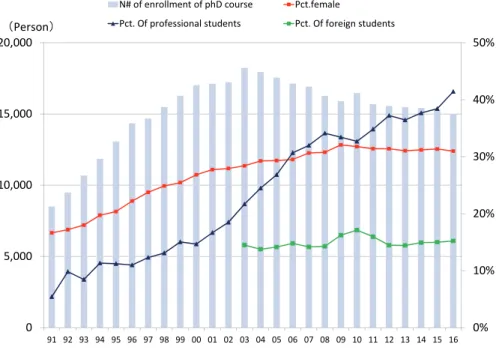
As to the evolution of PhD students, they are by definition the holders having cutting-edge knowledge and skill who may have to play a central role in the creation of new knowledge and promote the innovation through the development of science and technology. Yet the PhDs production is declining in Japan for a decade, which means a certain falloff of reservoir of talented young people.
According to the figure 2, the number of young students enrolled in Japanese doctoral courses increases up to the early 2000s and starts to decline afterwards. In 2016, they account for 14,972 persons, while they reached a peak in 2003 where 18,232 students were registered in the different graduate schools all over the nation.
This means that they dropped off under the 15,000 line for the first time in 19 years since 1997. Between the two moments, the number of young PhD students has declined by more than 3,000. In terms of PhDs density as to the population, Japan is also one of the nations which produce the fewest doctors among the OECD countries.
From this point of view, Japan is left behind the main European and American competitors.
The composition of PhD students is also changing. This category experiences a great diversification:
In recent years, PhD students constitute a more and more heterogenic category composed of different groups. Also, they have various motives for engaging in a
0%
10%
20%
30%
40%
50%
0 5,000 10,000 15,000 20,000
91 92 93 94 95 96 97 98 99 00 01 02 03 04 05 06 07 08 09 10 11 12 13 14 15 16 N# of enrollment of phD course Pct.female
Pct. Of professional students Pct. Of foreign students
Year
(Person)
doctoral course. We can distinguish three groups: young primo-students, mature adult students -who have returned to university after some years of professional experience - and foreign students.
The most striking phenomenon is that the proportion of mature adult PhD students is steadily increasing, while the primo-students is decreasing. The former has grown up rapidly to represent up to 40% of all category in 2016. The latter is highly interested in research itself and much more academy-orientated, while the mature adult students are rather applied science-orientated and sometimes recommended by their employers. Their behaviors during the study and the professional choices after graduation are quit logically very different. As to the foreign students, who account for less than 20%, their number remains relatively stable. Many foreign students come to Japan from Asian countries nearby -China, Korea, Vietnam, Indonesia etc., as they usually receive a fellowship program or tuition fee exemption. However, after graduating from the doctoral course, more than half of foreign students are said to return to their home countries. Japan is expected to use them more effectively to provide the domestic industry or the research institutes with highly skilled people, in order to fill the gap between demand and supply. Finally, the number of female PhD students is also increasing, but the percentage of around 30% is still under the average rate of the OECD countries. This talent pool and its effective use are one of big challenges Japan must address in the near future.
Back to the labor market situation for the young PhD graduates, supply-demand equilibrium is becoming less and less favorable for them. Mainly the academic tenure jobs are reducing, as the universities don’t offer any more stable posts due to the declining demographic problems (shortcoming of young teenagers). The government also tends to reduce the budget and posts destined to the national institutes of research. This phenomenon however has happened not only in Japan but also all over the world (Cyranoski et al. 2011). Thus, increasing numbers of young PhDs are often obliged to pass through an intermediate and ‘precarious’ stage in their careers before gaining stable jobs in academia. The transition between graduate school and academic job becomes tortuous and difficult. Equally, the efforts of governments to interest large Japanese companies in the skills of PhD graduates have seemed to meet with only small success.
The fact is that in the late 1990s, the Japanese government put in motion a policy to triple the number of postdoc positions with non-permanent contract up to ten thousand and stepped up PhD recruitment to meet that goal. This policy aimed at bringing Japan’s science capacity up to match that of the American and European countries, by providing the universities and research institutes with the talented but flexible labor force. But this measure became quickly disapproved because, although the objective attained, it lacked a long-term consideration about where all those postdoc young researchers were going to end up. Universities don’t need more academic staff, as the number of young students entering higher education has been
reducing. Japanese industries, which have traditionally preferred master’s graduates who can be trained on the job, continue to hesitate the recruitment of PhDs graduates.
This means that fewer jobs -particularly stable jobs- remain for the current generations of PhD students. A great majority of them have to get through the post-doc position which means that their jobs are maintained only on the basis of ‘soft money’. The main characteristics of such precarious jobs are uncertainty, instability, and insecurity which directly reflect on the work-life balance of postdocs.
Such discouraging prospects may have triggered the drop-off of number of young students entering PhD programs after the year 2008.In an era of knowledge economy, the volume of talent pool and its distribution remain of high importance for the society, as it is an essential producer and diffusor of knowledge.
Generation Survey from Cereq
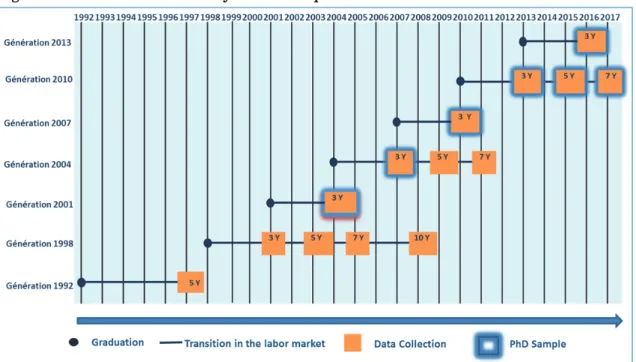
The Generation survey is labelled as a national statistic system. The longitudinal aspect of Generation is one of the best advantage. Since 1992, the Céreq has launched 7 waves of the Génération survey. Since the 1998, there are data collection about transition from school to work of young people who enter on the labor market three years before. As the graph shows, the Génération device is structured around a regular entanglement of surveys at 3 years, but also at 5, 7 and sometimes 10 years. The young people who came out in 1998 were, for example, re-interviewed in 2001, 2003, 2005 and 2008 in order to be able to study career developments and mobilities and thus enrich the analyzes carried out on entering the workforce. The presence of regular surveys every three years makes it possible to take into account the effects of the economic situation on school to work transition..
Figure 3 The Generation survey from Cereq
Source : Calmand, 2016
The Génération system is based on the concept of first-time outgoing students in a given year. This definition, which has changed somewhat since 1998, allows the comparability of the surveyed populations and is based on the following criterias:
• To have been enrolled in a training establishment in France during a given school year n.
• Leaving the education system between October n-1 and October n.
• Have not interrupted studies for one year or more before year n (except for health reasons).
• Not returning to school during the school year following entry into the labor market.
• 35 years old or younger in year n.
• To be located in France (Metropolitan + DomDOM) at the time of the survey.
The last survey Génération 2013 is used in this research. From April to July 2016, Céreq surveyed a representative sample of the 693,000 young people who left the education system for the first time in France during or at the end of the academic year 2012-2013. Some 19,500 young people of all levels of education responded to this telephone survey; the average interview duration was 30 minutes. As a basis for investigating the differences in the conditions of access to employment depending on the initial education completed and various individual characteristics (gender, social background, national origin), the survey gathered information on each respondent’s educational trajectory and its specific characteristics (such as time spent abroad, for example) but more particularly on their month-by-month employment situation from the time they left the education system to the spring of 2016.
The “Génération” survey is a great device when once wants to address the question of PhD transition from thesis to labor market. In fact, since 2001 there is a “PhD module”, it means that there are some specific questions addresses to PhD and this population is overweighed in the
“Génération” sample. In 2016, more than 1600 PhDs5 who have finished their doctoral training in 2013 have been interviewed about their scholarship and their first three years on the labor market.
Japan Doctoral Human Resource Profiling
In view of that, the National Institute of Science and Technology Policy (NISTEP) has been conducting the Japan Doctoral Human Resource Profiling (JD-Pro) survey since 2014 with the aim of capturing information concerning the status of doctoral course graduates prior to their enrollment in doctoral courses, their experiences during the period of the course, and their current employment status and status of their research activities. Through this survey, NISTEP aims to continuously capture information about the career path of doctoral course graduates, and to build evidence toward the realization of policy formulation that is based on objective grounds.
5 PhDs from Health, Pharmacy are excluded in the Generation sample
Figure4: Implementation of the Japan Doctoral Human Resource Profiling Survey
Source : NISTEP, Kobayashi, 2018
In 2016, the survey was conducted on graduates who had completed their doctoral courses at graduate schools in Japan in FY2012 (hereafter, “the 2012 cohort”) 3.5 years after the completion of their doctoral courses, and on graduates who had completed their doctoral courses at graduate schools in Japan in FY2015 (hereafter, “the 2015 cohort”) 0.5 years after the completion of their doctoral courses (Figure4). The contents of the survey include the following: reasons for pursuing a doctoral course, educational/research experience during the doctoral course, financial support during the doctoral course, status of obtaining the doctoral degree, employment status, career consciousness, status of research, and state of households. With regard to the response status, in the 2012 cohort survey conducted 3.5 years after the completion of the doctoral courses, the number of subjects to whom surveys were sent was 5,044; 2,661 responses were received, of which 2,614 were valid responses (Response rate: 52.8%, Effective response rate: 51.8%). In the 2015 cohort survey conducted 0.5 years after the completion of the doctoral courses, the number of subjects to whom surveys were sent from universities was 13,517 (Request rate: 87.8%), and 4,922 valid responses were received (Effective response rate: 36.4%).
A comparative observation of PhD transition to labor market: methodological issues This explanatory incentive between CEREQ and NISTEP stands on the comparison between two surveys: the “Generation 2013 cohort, interrogation 3 years later of leavers from French Educational System in 2013” in France and the “Japan Doctoral Human Resource Profiling (FY 2012 doctoral course graduates_3 years later)” in Japan. The aim of this part is to present the two surveys and to explain how we make them comparable.
Methodological approach
The previous sections show that there are some differences in the database that we are using in this report. As a consequence we need to adjust fields of the two samples in order to make them comparable. In fact, as the field of the Japan survey seems to be wider we need to restrict it on special aspects:
PhDs who are graduated in 2012
PhDs who live in Japan at time of data collection in 2015
PhDs who are aged under 35 years old at time of graduation
PhDs who are not been graduated in Health.
Table 1: JD-Pro 2012 sample evolution
Initial JD‐Pro 2012 Data
Graduated in 2012
Live in Japan in 2015
Under 35 years old
Not graduated in Health
n n n n n
Sample
size 5052 4371 2061 1434 1059
Source : JD-Pro 2012, Calmand, Kobayashi, Nohara, 2018
Table2 shows the decrease of Japan Doctoral Human Resource Profiling sample after restrictions.
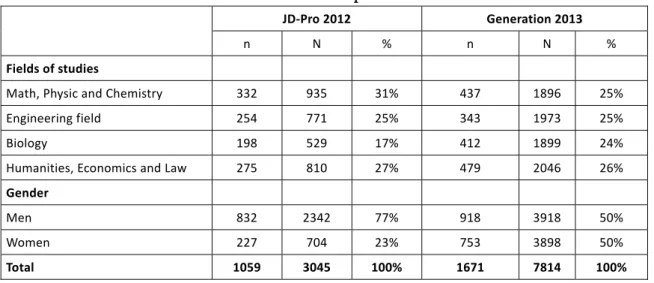
As a final sample, we retain 1059 individuals in the Japan database; it means that only 21% of the overall initial Japan sample is used in our exploitations. Using weights, the Japan sample is around 3045 individuals and the French sample is around 7814 individuals. The table () shows the repartition by fields of studies for each sample. There are some differences, PhDs from Math, Physic and Chemistry is more represented (31% against 25%) and those from Biology is less represented (17% against 24%) in the Japan database. One major difference between the two databases affects the repartition between men and women. Women are underrepresented in the Japanese sample, only 23% of the sample against 50% in the French sample.
Table 2 :JD-Pro 2012 and Generation 2013 comparable structure
JD‐Pro 2012 Generation 2013
n N % n N %
Fields of studies
Math, Physic and Chemistry 332 935 31% 437 1896 25%
Engineering field 254 771 25% 343 1973 25%
Biology 198 529 17% 412 1899 24%
Humanities, Economics and Law 275 810 27% 479 2046 26%
Gender
Men 832 2342 77% 918 3918 50%
Women 227 704 23% 753 3898 50%
Total 1059 3045 100% 1671 7814 100%
Source : JD-Pro 2012 & Generation 2013 , Calmand, Kobayashi, Nohara, 2018
Exploratory results
The aim of this section is to present exploratory results about PhDs transition from thesis to labor market in Japan and in France. Before starting, we have to precise that in Japan data PhD from 2012 are interviewed in 2015 and in the French survey they are interviewed in 2016. We only focus our analyses at time of interviews, which means that we do not consider professional trajectories during the first years on the labor market. We will present main indicators that are important when once need to consider PhDs transition on the labor market process.
Employment/Unemployment
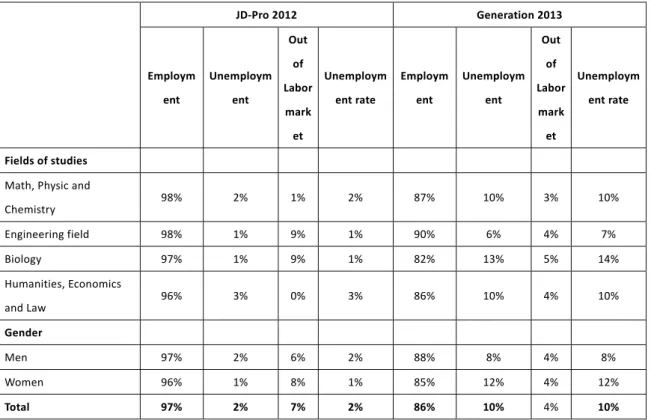
PhD situation on the labor market three years after graduation is fundamentally opposed in France and in Japan. French PhD situation on the labor market in 2016 is characterized by a high level of unemployment rate. In fact, the unemployment rate is 10% in 2016. PhDs in Biology, Math, Physics and Chemistry, Humanities, Economics and Law are those who are the most unemployed at time of data collection. Men are more often employed than women in France. These labor market difficulties do not exist in Japan. The unemployment rate is very low in 2015 and there are no fields of studies or gender differences.
Table 3 : Labor market situation three years after graduation
JD‐Pro 2012 Generation 2013
Employm ent
Unemploym ent
Out of Labor
mark et
Unemploym ent rate
Employm ent
Unemploym ent
Out of Labor mark
et
Unemploym ent rate
Fields of studies Math, Physic and
Chemistry 98% 2% 1% 2% 87% 10% 3% 10%
Engineering field 98% 1% 9% 1% 90% 6% 4% 7%
Biology 97% 1% 9% 1% 82% 13% 5% 14%
Humanities, Economics
and Law 96% 3% 0% 3% 86% 10% 4% 10%
Gender
Men 97% 2% 6% 2% 88% 8% 4% 8%
Women 96% 1% 8% 1% 85% 12% 4% 12%
Total 97% 2% 7% 2% 86% 10% 4% 10%
Source : JD-Pro 2012 & Generation 2013 , Calmand, Kobayashi, Nohara, 2018
Job Contract
As we wrote in introduction, access to permanent position is one major difficulties of PhD.
Comparison between Japan and France seems to confirm this trend. In these two countries, a third of a cohort does not have a permanent contract at the time of the survey. PhDs from Biology and Humanities, Economics and Laws are the most concerned by non-stable positions three years after their graduation. The situation of PhDs graduated in Biology in Japan and in France suggests that there is an international type of labor market regulation in these particular fields of studies. Our results show that there are more gender differences in Japan than in France.
Table 4 : Job contract among PhDs who are in employment three years after graduation
JD‐Pro 2012 Generation 2013
Long term Fixed term Other Long term Fixed term Other Fields of studies
Math, Physic and Chemistry 68% 30% 2% 64% 34% 2%
Engineering field 74% 25% 2% 81% 18% 2%
Biology 50% 47% 3% 50% 49% 2%
Humanities, Economics and Law 58% 39% 3% 62% 32% 6%
Gender
Men 66% 32% 2% 67% 31% 3%
Women 54% 43% 3% 62% 35% 3%
Total 64% 34% 2% 64% 33% 3%
Source : JD-Pro 2012 & Generation 2013 , Calmand, Kobayashi, Nohara, 2018
Sector repartition
One major point of the PhD transition on the labor market is to consider sector repartition at time of data collection. Two results need to be identified: the repartition between public and private sector and the repartition between the academic and R&D activities.
Public/Private repartition
In France, PhD integrates more often the public sector than in Japan (54% in France against 47% in Japan). There are some interesting differences. In both countries, PhDs in Biology and in Humanities, Economics and Law are those who are working in the public sector three years after graduation. Graduates from engineering fields in France are working are more recruited in the private sector than in Japan (34% in France against 45% in Japan). Do we can conclude that PhDs in France have more difficulties to integrate firms? It is not simple to respond to this question as far as we know that in Japan there are a large number of private universities, it means that among the 53% of PhDs who are working in the private sector a large number of them are not working in firms but rather in Higher Education.
Table 5 : Sector repartition among PhDs who are in employment three years after graduation
JD‐Pro 2012 Generation 2013
Public Private Public Private
Fields of studies
Math, Physic and Chemistry 45% 55% 52% 48%
Engineering field 45% 55% 34% 66%
Biology 51% 49% 61% 40%
Humanities, Economics and Law 48% 53% 71% 29%
Gender
Men 46% 54% 50% 50%
Women 52% 48% 59% 41%
Total 47% 53% 54% 46%
Source : JD-Pro 2012 & Generation 2013 , Calmand, Kobayashi, Nohara, 2018
Academic, R&D activities repartition
The aim of the next exploitation is to figure the repartition between research activities and type of organization. Generally we can split into four categories: public research, public non research, R&D and private non research. We cross the nature of the organization of the job activities in order to have this classification. For Japan, activities such as Researcher (natural sciences, humanities, and social sciences), Manufacturing engineers (development) and Schoolteacher (university, graduate school) are considered as research activities. For France, we use the Frascatti classification in order to have the research/non research repartition. Considering Japan Higher Education specificities (a great importance of the private educational sector) we decide to add one more category for this case which is private educational research. This category is not relevant for France because there is a few PhD who are working as a research in private schools.
Table 6 : Sector, activities repartition among PhDs who are in employment three years after graduation
JD‐Pro 2012
Public Research
Public Non Research
Private Educational
Research
R&D Private Non Research
Fields of studies
Math, Physic and Chemistry 39% 6% 9% 34% 12%
Engineering field 37% 9% 12% 25% 18%
Biology 45% 6% 12% 20% 18%
Humanities, Economics and Law 36% 11% 39% 2% 11%
Gender
Men 38% 8% 16% 24% 15%
Women 42% 10% 24% 12% 13%
Total 39% 8% 18% 21% 14%
Génération 2013
Public Research
Public Non Research
Private Educational
Research
R&D Private Non Research
Fields of studies
Math, Physic and Chemistry 42% 10% N.S 28% 20%
Engineering field 28% 6% N.S 36% 30%
Biology 38% 22% N.S 19% 21%
Humanities, Economics and Law 47% 24% N.S 6% 22%
Gender
Men 39% 11% N.S 24% 26%
Women 39% 20% N.S 21% 20%
Total 39% 15% N.S 22% 23%
Source : JD-Pro 2012 & Generation 2013 , Calmand, Kobayashi, Nohara, 2018
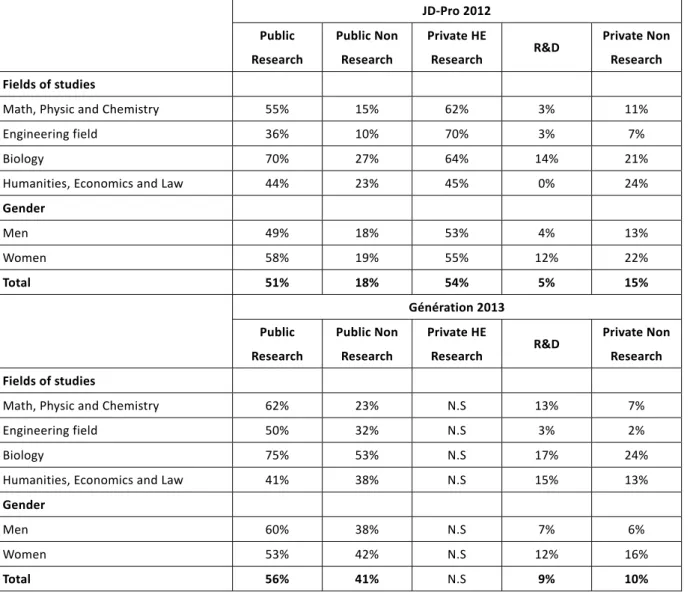
Results exposed before are really different than those before which only consider a public/private repartition. In fact, in Japan as in France, there is the same figure of PhDs who are working as a researcher in a private company (around 20%). In Japan, PhDs from Math, Physic and Chemistry as those who are working in this sector, in France it is PhDs from Engineering field. In France; a larger PhDs are employed in private sector without doing research activities (23% in France against 14% in Japan), the same result appear when we consider employment in public sector. If we consider that in Japan, a lot of PhDs can be employed in private educational organization, then PhD who work as an educational researcher is greater than in France (57% in Japan against 39% in France). In Japan PhDs from Humanities, Economics and Law are more recruited as researcher in private educational organization. As the final result, we can assert that recruitment in academic sector (public or private) is maybe higher in Japan than in France.
Fixed-terms contract by sector repartition
Access to permanent position is a crucial issue when we consider PhDs transition on the labor market. In France as in Japan, part of fixed terms contract is higher in academic sector than in private sector. Considering PhDs who have research activities in both countries, non-stable positions are lower in the private sector than in academic (private or public in Japan). Graduates who work in private R&D have the smallest part of fixed terms contracts in France or in Japan. For Japan is especially low around 5%.
Table 7 : Fixed terms contract by sector, activities repartition among PhDs who are in employment three years after graduation
JD‐Pro 2012 Public
Research
Public Non Research
Private HE
Research R&D Private Non Research Fields of studies
Math, Physic and Chemistry 55% 15% 62% 3% 11%
Engineering field 36% 10% 70% 3% 7%
Biology 70% 27% 64% 14% 21%
Humanities, Economics and Law 44% 23% 45% 0% 24%
Gender
Men 49% 18% 53% 4% 13%
Women 58% 19% 55% 12% 22%
Total 51% 18% 54% 5% 15%
Génération 2013 Public
Research
Public Non Research
Private HE
Research R&D Private Non Research Fields of studies
Math, Physic and Chemistry 62% 23% N.S 13% 7%
Engineering field 50% 32% N.S 3% 2%
Biology 75% 53% N.S 17% 24%
Humanities, Economics and Law 41% 38% N.S 15% 13%
Gender
Men 60% 38% N.S 7% 6%
Women 53% 42% N.S 12% 16%
Total 56% 41% N.S 9% 10%
Source : JD-Pro 2012 & Generation 2013 , Calmand, Kobayashi, Nohara, 2018
In academic sector, in both countries, we find a high share of non-permanent positions three years after graduation. In Japan, in public academic sector, more than half of PhDs are not employed as a permanent researcher. In the private academic sector, this share is equivalent. In France, 56% of the PhDs who have left the educational system in 2013 and who are employed in academic sector have a fixed terms contract in 2016. In France as in Japan, graduates from Biology and Mathematics, Physic and Chemistry are those who are the most concerned by non-stable positions in public academic sector.
Conclusion
Exploratory comparison of Japan and French PhDs transition from thesis to labor market is a fruitful exercise for researchers that want to understand this process in an international perspective.