Fukushima Medical University
福島県立医科大学 学術機関リポジトリ
This document is downloaded at: 2021-11-07T23:27:02Z
Title Communication between health professionals and community residents in Fukushima: A focus on the feedback loop( 本文 )
Author(s) 弓屋, 結
Citation
Issue Date 2019-09-30
URL http://ir.fmu.ac.jp/dspace/handle/123456789/1044
Rights
Fulltext: This was made revisions to an Accepted Manuscript of an article published by Taylor & Francis Group in Health Communication on June 2019, available online:
https://www.tandfonline.com/doi/full/10.1080/10410236.2019.
1625004 DOI
Text Version ETD
1
学 位 論 文
学位論文名
Communication between Health Professionals and Community Residents in Fukushima:
A focus on the feedback loop
(福島県における保健従事者と地域住民間のコミュニケーション:
フィードバックループに焦点を当てて)
福島県立医科大学大学院医学研究科 疫学・社会健康医学分野 疫学講座
弓屋 結
2
Abstract
Interactive communication and the ability to consider feedback are critical for linking health professionals and the community. Goto and colleagues developed and conducted health literacy training workshops for public health nurses after the 2011 nuclear accident in Fukushima to improve their communication skills. The present study aimed to examine the association between past workshop attendance and nurses’ attitudes toward feedback from community residents. We conducted a questionnaire survey with 723 public health nurses in Fukushima and analyzed differences in feedback acceptance, work environment, basic characteristics, and health literacy levels between health literacy workshop attendees and non-attendees. Among 582 respondents, 19.4% were past attendees and showed a higher likelihood of accepting feedback from community residents (amount: adjusted odds ratio [aOR]=1.87, 95% confidence interval [CI]: 1.21–2.88; specificity: aOR=1.69, 95%CI: 1.09–
2.61; satisfaction: aOR=2.34, 95%CI: 1.50–3.65) than did non-attendees after adjusting for other variables. Furthermore, work engagement was associated with positive feedback acceptance (amount: aOR=1.43, 95%CI: 1.03–1.98; specificity: aOR=1.57, 95%CI: 1.12–
2.20; satisfaction: aOR=1.97, 95%CI: 1.38–2.81). We note the importance of creating a better work environment as well as a training system at the organizational level that encourages public health nurses to learn about health literacy and to improve their communication skills.
This could improve professional/community relationships, increase the accessibility of health information for the public, and ultimately improve community health.
3
Introduction
This study focuses on feedback, an important element of communication and a basis for improvements in the exchange of ideas and information. Openness to feedback from health service users, including patients and community residents, can enhance professionals’
communication skills and thereby support the goals of health services, and better promote healthy communities (Rollnick, Miller, & Butler, 2007). Thus, it is important to consider how health professionals react to and accept feedback. According to a recent study conducted by Payne et al. (2016) in a hospital setting in the U.S., feedback acceptance affects both the performance of health care professionals and the health outcomes of patients. Moreover, Payne and colleagues reported that the work environment can influence feedback receptivity among health care professionals (Payne et al., 2016). Insights from that study spurred our interest in the iterative nature of the communication exchange and the value of focusing on the feedback loop.
Communicating with local residents and transferring their opinions to health promotion activities is a source of professional confidence and job satisfaction among public health nurses (PHNs) in Japan ( Iguchi, 2014;Ogawa & Nakatani, 2012). Japanese PHNs working in municipal and prefectural health centers are the key persons and first contacts in community health services. The prefectural health centers supervise municipal health centers, which provide direct health services to local residents, such as child health checkups. Most PHNs work in the public sector, assess individual, family, and community health needs, and design and implement health promotion programs to promote healthy communities. Such health promotion programs include lifestyle instructions, health information, and access to health services. As a result, PHNs are known for the trust and reciprocity they establish with the community. According to Matsui and colleagues, good “communicators” should consist of local experts that can bridge the gap between community knowledge and scientific evidence
4
(Murakami et al., 2017); thus, PHNs are considered ideal communicators. However,
communication efforts in times of crises are especially challenging (Rudd, Comings, & Hyde, 2003).
After the Fukushima nuclear power accident in 2011, the public’s distrust of
governmental organizations eroded the positive reciprocity that had been established between health professionals and their community. Uncoordinated and incorrect information about the health risks associated with radiation exposure were widely disseminated to the public through various channels. As a result, members of the public were confused. For example, people did not know whether to evacuate, how to avoid radiation exposure, or how much radiation exposure would result in adverse health effects. In addition, they did not know who they could trust. Yamashita (2014) described this situation as an “information disaster”; this led to a sense of fear among community residents regarding regional radiation contamination.
At the same time, health professionals faced difficulties in their efforts to explain the health risks associated with radiation exposure. For example, many health professionals did not know which information was most reliable. In addition, they became targets of
residents’ negative emotions. As a result, PHNs in Fukushima lost self-confidence with regard to their ability to provide residents with useful information (Kayama et al., 2014). Both PHNs and hospital nurses in the region expressed anxiety related to a lack of knowledge and to the paucity of teaching materials about radiation and radiation programs for nurses (Nukui, Midorikawa, Murakami, Maeda, & Ohtsuru, 2018; Veenema, Lavin, Bender, Thornton, &
Schneider-Firestone, 2019; Yoshida et al., 2016).
Consequently, after the disaster, the communication exchange and the positive reciprocity between health professionals and community residents became corrupted. Due to distrust of the government, community residents were confused by the dissemination of uncoordinated and incorrect information, while health professionals lost their confidence in
5
their ability to provide community residents with accurate information.
Project background
As a result of the erosion of trust and confidence, Goto and colleagues planned and
implemented health literacy (HL) training programs for PHNs working in all three regions of Fukushima Prefecture. The training was implemented in collaboration with the prefectural office, and prefectural and municipal PHNs were invited to participate in these HL workshops as mandatory training. The goal was to improve communication with the public in the face of a major regional health crisis ( Goto, Rudd, Lai, & Yoshida-Komiya, 2014; Rudd et al., 2003).
The contents of the HL workshops were based on Rudd’s “Eliminating Barriers Increasing Access Workshop” and adapted to a Japanese context (Rudd, 2010). In brief, the training raised awareness about the population’s literacy and numeracy skills and focused on building skills that enables health professionals to make health information more accessible.
Participants learned to use material assessment tools such as a readability calculator, a numeracy level list, and indexes to score the accessibility of written materials and learned techniques to improve texts, graphics, and discussions about risk. A glossary of terms and an index for scoring the written materials (“Health Literacy Toolkit”) were developed for the workshop participants and used as a textbook (Goto et al., 2018). The workshop exercises included hands-on experience with the assessment tools and discussions on how to improve the assessed materials. The workshops were implemented in all regions of Fukushima Prefecture after the disaster and were highly evaluated among the participants. The more distal evaluations revealed PHNs’ application of the newly gained skills in daily practice (Goto, Lai, & Rudd, 2015). However, the evaluations focused solely on the nurses’
achievements toward training goals and did not include their attitudes toward interaction with the community.
6
This study focuses on feedback, an important component of the communication exchange. We confirmed the workshop attendance rate and investigated the level of feedback acceptance among PHNs working in Fukushima Prefecture with the aim of promoting better health communication at the organizational and community levels. This examination of the relationship between PHNs and their community and specifically communication interactions focus on times fraught with regional health crises. Findings can offer insight into factors that can strengthen important health communication through HL workshops. As is noted above, feedback acceptance has influenced the performance of health professionals and patient outcomes (Payne et al., 2016). Therefore, we measured the amount, specificity, satisfaction, and attitudes toward positive and negative feedback using items designed by Jensen and colleagues (Jensen, Wright, Kim, Horvath, & Calhoun, 2012). We hypothesized that HL workshop attendees would have improved communication skills, and thus, positively receive feedback from community residents. As potential confounding factors and based on previous studies of feedback acceptance, we considered individual attributes and work environments (Eva et al., 2012; Payne et al., 2016).
Methods
Following Jensen’s 2012 study (Jensen et al., 2012), feedback acceptance was captured in terms of amount, specificity, satisfaction, and attitudes toward positive and negative feedback.
Comparisons of each of these measures were made between nurses who had and had not attended the HL workshop. Further analyses explored the contributions of work environment factors and individual attributes such as sex, age, employment, HL level, and mental health (depressive tendency) (Figure 1).
7
Study design and participants
This cross-sectional study focused on all PHNs working at municipal and prefectural health centers in Fukushima Prefecture [n=723]. In collaboration with the prefectural office, we sent out anonymous self-administration questionnaires along with request letters and sealed envelopes for privacy and data protection. A separate sheet to report the number of questionnaires distributed and collected was sent to the chief nurse at each municipal and prefectural health center. The names and affiliations of the chief nurses were obtained from the prefectural office. In total, questionnaires were sent to 723 nurses, and answers were collected between October and November 2017.
The protocol of this study was reviewed and approved by the ethics committee of Fukushima Medical University (No. 29116).
Survey items
The questionnaire was composed of 47 items covering the following four main domains:
feedback acceptance (main outcome), HL workshop attendance (main individual variable), components of the work environment, and individual attributes.
Feedback acceptance (main outcome)
We asked PHNs about their acceptance of feedback from community residents regarding their activities. The scale items were constructed by referring to a clinical study byJensen et al.
(2012). We translated their original questions into Japanese and further revised the survey to adapt to the public health setting after a discussion among the authors. Next, an independent researcher blinded to the original English version back-translated the first revised Japanese version into English, and the original and back-translated versions were then compared to address inconsistencies.
8
The participants were asked to rate five statements about feedback. The first two items focused on amount and specificity of feedback: (1) “I have received a sufficient amount of feedback that is relevant for my work from community residents”; (2) “I have received adequately specific feedback that is relevant for my work from community residents”. The remaining three statements focused on attitudes towards the feedback: (3) “I am satisfied with the feedback that I am receiving from community residents” (satisfaction); (4) “It is important for me to receive positive feedback from community residents” (attitudes toward positive feedback); and (5) “It is important for me to receive negative feedback (aimed at
improvement) from community residents” (attitudes toward negative feedback). Each item was rated on a 7-point Likert scale ranging from 1, “strongly disagree” to 7, “strongly agree”.
HL workshop attendance (main independent variable)
The HL workshops (either 1 or 2 days with field application) were conducted as a part of official prefectural training and were basically compulsory unless someone had an assigned duty at the time of the workshop. The contents of the HL workshops have been previously reported (Goto et al., 2018), and explained briefly above. Those who had participated in an HL workshop were asked to rate statements about possible gains, items extracted from a previously reported evaluation study of an HL workshop (Goto et al., 2015). For this study, we asked participants about their experience by rating their level of agreement with two statements. These statements were: “I gained confidence in assessing and revising written materials” and “I applied learned skills in practice”. Each item was rated on a 5-point Likert scale ranging from 1, “strongly disagree” to 5, “strongly agree”.
Work environment
The PHN’s work environments were assessed through the use of a short version (Iguchi,
9
2014) of the New Brief Job Stress Questionnaire (New BJSQ), which is commonly used in Japan to assess and improve the work environment (Inoue et al., 2014). The short version of the New BJSQ is composed of 43 subscales comprising a total of 80 items. We selected 10 subscales from this version. Two of the subscales relate to job demand. “Job demands” refers to the physical or psychological effort and skills required for the work. Job demands included quantitative measures (3 items as one subscale) and qualitative job overload (3 items as one subscale). Next, we included the subscale items from “Job resources” which refer to the physical, psychological, social, or organizational resources needed to achieve work goals.
These work goals are divided into the three levels of task, workgroup, and organizational (Inoue et al., 2014). Next, we included the subscales for task-level job resources which included job control (3 items as one subscale) and skill utilization (people utilize specific job skills, knowledge, and qualifications in the working process) (1 item as one subscale). Work group-level job resources included leadership (1 item as one subscale) and complement focused on the extent to which people at work complement each other (1 item as one subscale), as well as on mistake acceptance (workplace where mistakes are acceptable) (1 item as one subscale). Finally, outcomes included job satisfaction (1 item as one subscale), workplace social capital (1 item as one subscale), and work engagement (1 item as one subscale). A total of 16 items were used to assess the work environment. Each item was rated on a 4-point Likert scale ranging from 1, “agree” to 4, “disagree”, and then the mean score was calculated.
Individual attributes
The HL skills of PHNs were evaluated at an individual level through the use of the Communicative and Critical Health Literacy (CCHL) scale, composed of three
communicative and two critical HL items (Ishikawa, Nomura, Sato, & Yano, 2008). The three
10
communicative HL statements participants were asked to rate included: “collect health-related information from various sources”, “extract the desired information”, and “understand and communicate the obtained information”. The two critical HL items were “consider the credibility of the information” and “make decisions based on the information, specifically in the context of health-related issues”. Each item was rated on a 5-point Likert scale ranging from 1, “strongly disagree” to 5, “strongly agree”, and the sum of the two sections yielded a CCHL total score ranging from 5 to 25.
The depression screening items consisted of a two-question case-finding instrument, which had a sensitivity of 96% and a specificity of 57% (Whooley, Avins, Miranda, &
Browner, 1997). The measurement asks about depressed mood and anhedonia during the past month: (1) “During the past month, have you often felt down, depressed, or hopeless?”, and (2) “During the past month, have you often found little interest or pleasure in doing things?”
PHNs who answered yes to either or both of the questions were classified as “positive” for depressive symptoms.
Statistical analysis
The respondents were divided into two groups based on HL workshop attendance, and compared (chi-squared test) in terms of demographic characteristics and mental health.
Differences in the mean scores for work environment and HL level between the two groups were estimated using the t-test. In addition, the means for feedback acceptance were
compared between the two groups using the Mann–Whitney U test.
Factors showing a significant difference (p<0.05) in univariate analysis were further analyzed in multivariable analysis (logistic regression analysis) to estimate odds ratios (ORs) and 95% confidence intervals (95%CIs). Feedback acceptance was divided into two groups at the median (lower and higher feedback acceptance), and the ORs for higher feedback
11
acceptance were calculated in the multivariable analysis. Additionally, because an interaction was observed between mental health status and workshop attendance, subgroup analyses were conducted to explore factors associated with higher feedback acceptance stratified by mental health status (with or without depressive symptoms).
As a supplemental analysis, we explored factors associated with depressive
tendencies, which were prevalent among our surveyed nurses. First, we compared groups with and without depressive tendencies for the items listed in Tables 1 and 2 (chi-squared test and t-test). Factors showing a significant difference (p<0.05) in the univariate analysis were further analyzed in a multivariable analysis (logistic regression analysis) to estimate ORs and 95%CIs.
All analyses were performed using SPSS statistical software (version 25; IBM, Armonk, NY, USA).
Results
Descriptive findings
Of the 723 PHNs, 587 agreed to participate in the present study (response rate=81.2%).
Among these, five were excluded because they did not answer over half of the questions.
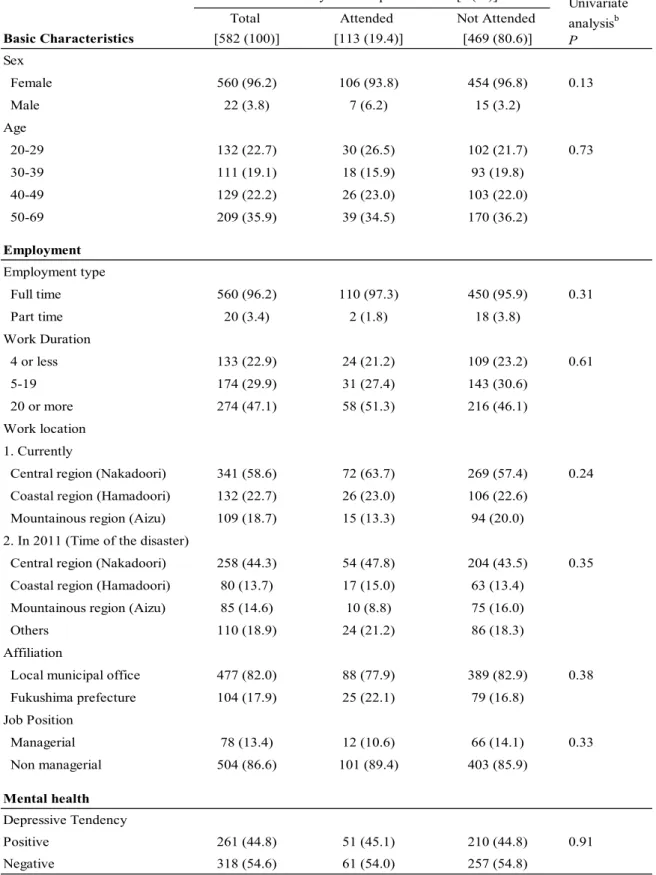
Basic characteristics are listed in Table 1. Noticeably, we found that 113 participants (19.4%) had attended an HL workshop.
In terms of feedback acceptance in total, the median score of the amount, specificity and satisfaction was 4 (Neutral) out of 7, whereas that of attitudes toward positive and
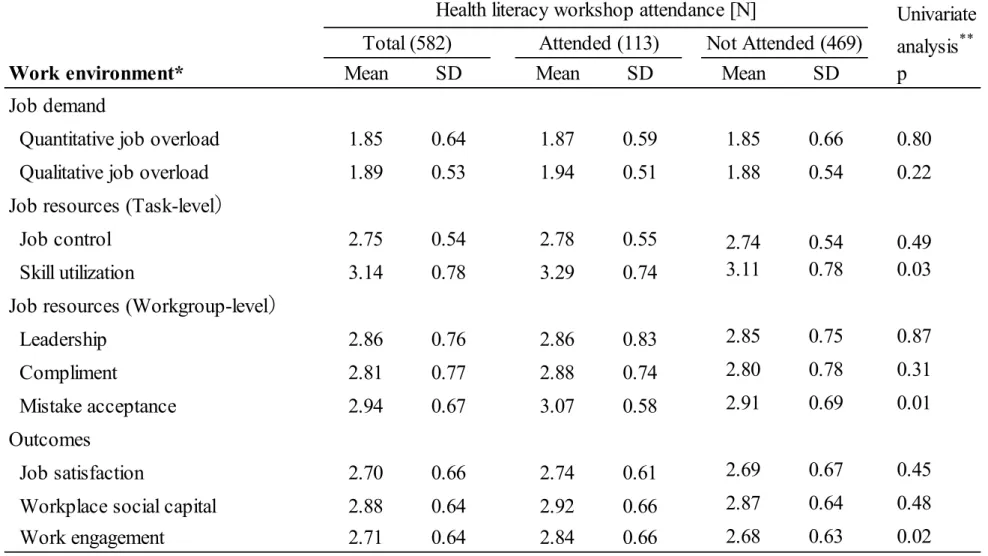
negative feedback was 6 (Agree) out of 7. The maximum and minimum score of all items were 7 (Strongly Agree) and 1 (Strongly Disagree), respectively. As for work environment, the means of quantitative and qualitative job overload were lower than the other eight items for work environment (higher scores indicate better working status.) (Table 2).
12
Analytical findings
No significant differences in basic characteristics were observed between those who attended and did not attend an HL workshop (Table 1). In terms of the HL level of the respondents, workshop attendees had a higher communicative HL level than did non-attendees (Table 3).
With regard to the work environment (Table 2), workshop attendees showed significantly higher scores for skill utilization, mistake acceptance, and work engagement than did non-attendees.
Regarding the distribution of feedback measures, amount (p<0.01), specificity (p<0.01), and satisfaction (p<0.001) were significantly higher among attendees than they were among non-attendees (Figure 2). No significant differences in attitudes toward positive and negative feedback were observed between the two groups (Figure 2). In a supplementary analysis, we found that attendees of multiple workshops had significantly higher levels of positive attitudes toward three of five feedback indicators (amount, p<0.05; specificity, p=0.16; satisfaction, p=0.66; attitudes toward positive feedback, p<0.05; attitudes toward negative feedback, p<0.05). The multivariable analysis that was conducted to examine factors associated with higher scores for the three feedback items revealed significant associations between workshop attendance (amount: aOR=1.87, 95%CI: 1.21–2.88;specificity: aOR=1.69, 95%CI: 1.09–2.61; satisfaction: aOR=2.34, 95%CI: 1.50–3.65) and work engagement
(amount: aOR=1.43, 95%CI: 1.03–1.98;specificity: aOR=1.57, 95%CI: 1.12–2.20;
satisfaction: aOR=1.97, 95%CI: 1.38–2.81) in all models (Table 4).
Since depressive tendencies were found to be prevalent, we entered an interaction term between workshop attendance and depressive tendencies into the multivariable analysis, and found that the statistical significance of the term was <0.1 for two of the three feedback items (amount and specificity). We then repeated the multivariable analyses stratified by depressive tendencies (Supplementary table 1). Among those screening positive for
13
depressive tendencies, HL workshop attendance (amount: aOR=2.90, 95%CI: 1.52–5.53;
specificity: aOR=2.67, 95%CI: 1.38–5.14; satisfaction: aOR=3.13, 95%CI: 1.60–6.15) was associated with feedback acceptance. On the contrary, these significant associations were not observed among those without depressive tendencies.
As a supplemental analysis, the respondents with positive depressive trends were associated with employment type and work location. Compared with PHNs with negative depressive tendencies, those with positive depressive tendencies showed significantly lower scores for all items regarding the work environment. Furthermore, a multivariable analysis exploring factors associated with depressive tendencies (Supplementary table 2) revealed significant associations between coastal region (aOR=2.22, 95%CI: 1.37–3.59), quantitative job overload (aOR=0.53, 95%CI: 0.35–0.81), job control (aOR=0.60, 95%CI: 0.39–0.93), job satisfaction (aOR=0.61, 95%CI: 0.43–0.88), and work engagement (aOR=0.55, 95%CI: 0.37–
0.83).
Discussion
The results of this study revealed that one in five PHNs had attended the HL workshop initiated after the nuclear disaster in 2011, and that those who attended the workshop reported that they accepted feedback from community residents positively compared with
non-attendees. This difference remained statistically significant even after controlling for work environment, and was especially apparent among those with depressive symptoms.
Notably, no significant differences in basic characteristics or job overload were found between the attendees and non-attendees. We note that this was likely due in part to the fact that the HL workshops were conducted as compulsory training and attendance was not decided individually. This could be considered one of the methodological strengths of the present study, leading to the minimal participation bias. Furthermore, no significant
14
differences in attitudes toward residents’ feedback were observed between the two groups, possibly because PHNs understand the importance of partnership and collaboration with residents through health promotion activities as their daily duties (Japanese Nursing Association, 2016).
Most importantly, this study revealed a positive association between HL workshop attendance and feedback acceptance from community residents, with a possible dose-response association between the number of workshops attended and the level of the acceptance.
Previous studies from outside Japan have reported finding associations between professional confidence and positive feedback acceptance (Curtis & O’Sullivan, 2014; Eva et al., 2012).
Likewise, our data showed that satisfaction and attitudes toward positive feedback were significantly higher among attendees who gained confidence in assessing and revising written materials than among those who did not (amount, p=0.31; specificity, p=0.32; satisfaction, p<0.05; attitudes toward positive feedback, p<0.05; attitudes toward negative feedback, p=0.23). For Japanese PHNs, assessing community needs through communication with residents and reflecting these in their community activities is a source of professional confidence (Ogawa & Nakatani, 2012). Training encourages PHNs to embrace an HL perspective and enables them to collaborate and communicate with residents to respond to community needs more effectively (Goto, 2016). Taking this evidence together, a possible mechanism through which HL workshops appeared to have a positive influence on PHNs’
positive feedback acceptance could be the resultant improved communication skills and professional confidence.
Nearly 50% of the respondents showed depressive tendencies. This is consistent with the results of previous studies indicating that more than half of PHNs experience burnout (Imai et al., 2006; Imai, Nakao, Tsuchiya, Kuroda, & Katoh, 2004). Additionally, we found that depressive tendencies were associated with the workplace location and environment. Our
15
survey respondents appeared to have a higher job load than those from a nationally representative survey of employees in Japan (Inoue et al., 2014). The quantitative job overload (mean ± standard deviation) in the present study was 1.85 ± 0.64, compared with 2.14 ± 0.76 in the national survey, while the qualitative job overload in the present study was 1.89 ± 0.53 compared with 2.16 ± 0.71 in the national survey. The obtained results suggest that the training course could provide an opportunity for PHNs with depressive tendencies to be motivated to interact positively with local residents.
As for the mechanism underpinning the result that HL workshop attendees reported having better work engagement than non-attendees, despite their heavy workloads and high prevalence of depressive tendencies, we considered neuroticism (a tendency to experience negative emotional states) as a component of depressive disorder (Kotov, Gamez, Schmidt, &
Watson, 2010). Although neurotic individuals tend to struggle with tasks, receiving feedback on a “playful task” (i.e., enjoyable and easy) gives them more motivation (Swift & Peterson, 2018). It has been reported that health professionals perceive providing services to clients as rewarding and even as stress buffers, which is a basis of their better responsiveness to clients’
needs. Therefore, when communicating with local residents through a playful task, PHNs with depressive tendencies might be more motivated to accept positive feedback from local residents (Arnetz, Zhdanova, & Arnetz, 2017).
Limitations and implications
This study did have some methodological limitations. For example, because this was a cross-sectional study, we could not determine the causality between HL workshop attendance and the participants’ positive feedback attitudes. Besides, PHNs attended a variety of training workshops after the disaster, and the observed positive influences of the HL workshop might have resulted from other training opportunities. In addition, there might have been a potential
16
recall bias because we asked the respondents about workshop attendance retrospectively. On the other hand, a noticeable advantage was the high response rate. A possible explanation is two-fold. First, this survey was conducted in collaboration with the prefectural office, and thus, a request letter from the prefectural office was sent along with the questionnaire. Second, health literacy training workshops for PHNs were conducted in collaboration with the
prefectural and municipal offices in all three regions of Fukushima Prefecture after the disaster, through which Fukushima Medical University has established a good relationship with PHNs. In future research, a prospectively designed intervention study will be needed to confirm the improvements seen in bilateral communication between nurses and residents after attending an HL workshop.
There are several implications for further study and for policy analysis. First, the study highlights the need for attention to the work load and to tenure. The public health system reform in the late 1990s may have contributed to the PHNs’ workload assessment. In 1997, the enforcement of the Community Health Act changed the work system from being region-specific to service-specific. This newly revised work system hindered the public health point of view in terms of how the PHNs identified the needs of the community. The reform exposed them to various types of stress, including a wider range of tasks, a higher amount of office work, role conflicts between PHNs and other professionals, and gaps between assigned tasks and actual community needs (Iguchi, 2014; Ogawa & Nakatani, 2012). The work stress was more obvious among younger and inexperienced nurses (Nukui et al., 2018; Yoshida et al., 2016) when facing the above mentioned community distrust toward the government and a lack of knowledge about radiation (Kayama et al., 2014). According to government statistics on the employment of nursing personnel (Fukushima Ministry of Health and Welfare, 2016), 9.6% of all PHNs in the public sector were newly hired nurses with less than 1 year of
working experience. For capacity building among these new PHNs, Goto and colleagues plan
17
to integrate mandatory HL training at the prefectural level.
Second, the study has implications for policy change in professional education and training. Change at the national level might draw from an example from the U.S. The U.S.
National Plan to Improve Health Literacy of 2010 asserts that organizations and professionals must collaborate with public and private sectors and suggested countermeasures to achieve the goal of improving HL for all people (U.S. Department of Health and Human Services, 2010). As a practical strategy, Brach and colleagues (2012) stated that a key contribution to the development of health-literate organizations was HL training for every staff member in their respective organization. This study illustrates the possible value of including HL workshops in the current educational system for not only PHNs, but also other professionals to promote HL at the prefectural organizational level (Lai & Rudd, 2015).
At the individual level, but with an important policy implication, health literacy training may reduce stressors of PHNs working in fields. Health literacy is not only about improving communication skills, but also a way to open the door for more flexible service provision by working with the community (Goto, 2016). Such training is particularly
important when a health crisis occurs and public health needs and priorities suddenly change.
The project presented here serves as a model of local government efforts to integrate health literacy promotion in order to strengthen the post-disaster health care system.
Conclusions
One of the reasons for the drastic improvement in Japan’s health status since World War II is that PHNs and midwives actively communicated with community residents to find their needs, to plan, and then to offer appropriate health services (Igarashi & Kinoshita, 1987). However, the well-documented and positive professional/community communication was affected by the Fukushima nuclear accident in 2011. These events and the subsequent communication
18
issues drastically changed residents’ health needs, perceptions of their community-based health professionals, and views toward the government. Part of the problem, documented in an evaluation of PHN’s experiences (Kayama et al., 2014), was that the PHNs did not quite understand information they were given about radiation and did not/could not appropriately translate such information for the public being served. Consequently, in the post-disaster restoration, PHNs in Fukushima were required to communicate more carefully and more thoroughly with residents to reestablish a relationship of trust and reciprocity with both the community and the health care system (Henning, Goto, Chi, & Rudd, 2015). These and other components of the communication exchange are increasingly being documented (Goto et al., 2014; Kayama et al., 2014; Murakami et al., 2017; Yoshida et al., 2016).
This study focused on an aspect of the communication exchange that has not received quite as much attention: the feedback loop and more specifically, the openness to feedback which can support and enhance communication. A strong and respectful feedback loop has the potential to improve communication and, when there are troublesome events, redress a breakdown in communication. In such instances, feedback from the community to health professionals may carry the seeds of problem solving by providing key information that professionals can use for strategic planning as well as a wealth of ideas for change.
Acknowledgments
This survey was supported by the Fukushima Ministry of Welfare and Health. We wish to thank all the participants. The HL workshop was conducted as part of the Fukushima Prefectural Training Program for PHNs.
This was made revisions to an Accepted Manuscript of an article published by Taylor &
Francis Group in Health Communication on June 2019, available online:
https://www.tandfonline.com/doi/full/10.1080/10410236.2019.1625004
19
Funding
This work was supported by the Japan Society for the Promotion of Science (PI: AG, Grants-in-Aid for Scientific Research [16K09135]).
References
Arnetz, J. E., Zhdanova, L., & Arnetz, B. B. (2017). Patient involvement: A new source of stress in healthcare work? Health Communication, 31, 1566-1572.
doi:10.1080/10410236.2015.1052872.
Brach, C., Keller, D., Hernandez, L. M., Baur, C., Parker, R., Dreyer, B., … Schillinger, D.
(2012). Ten attributes of health literate health care organizations. Retrieved from National Academy of Medicine website:
https://nam.edu/perspectives-2012-ten-attributes-of-health-literate-health-care-organizati ons/ doi:10.1094/PDIS-11-11-0999-PDN
Curtis, D. A., & O’Sullivan, P. (2014). Does trainee confidence influence acceptance of feedback? Medical Education, 48, 943-945. doi:10.1111/medu.12541
Eva, K. W., Armson, H., Holmboe, E., Lockyer, J., Loney, E., Mann, K., & Sargeant, J.
(2012). Factors influencing responsiveness to feedback: On the interplay between fear, confidence, and reasoning processes. Advances in Health Sciences Education, 17, 15-26.
doi:10.1007/s10459-011-9290-7
Fukushima Ministry of Health and Welfare. (2016). Employment status of nursing personnel.
Retrieved from https://www.pref.fukushima.lg.jp/uploaded/attachment/218341.pdf (in Japanese.).
Goto, A. (2016). Thinking, talking, and working with professional community workers after the Fukushima nuclear accident. Annals of the ICRP, 45(Suppl. 2), 37-40.
doi:10.1177/0146645316666494
20
Goto, A., Lai, A. Y., Kumagai, A., Koizumi, S., Yoshida, K., Yamawaki, K., & Rudd, R. E.
(2018). Collaborative processes of developing a health literacy toolkit: A case from Fukushima after the nuclear accident. Journal of Health Communication, 23, 200-206.
doi:10.1080/10810730.2018.1423650
Goto, A., Lai, A. Y., & Rudd, R. E. (2015). Health literacy training for public health nurses in Fukushima: A multi-site program evaluation. Japan Medical Association Journal, 58, 69-77.
Goto, A., Rudd, R. E., Lai, A. Y., & Yoshida-Komiya, H. (2014). Health literacy training for public health nurses in Fukushima: A case-study of program adaptation, implementation and evaluation. Japan Medical Association Journal, 57, 146-153.
Henning, M., Goto, A., Chi, C., & Rudd, R. E. (2015). Community health workers as critical building blocks to strengthen health systems: A two-case study of innovative CHWs in Zambia and Japan. Journal of Communication in Healthcare, 8, 241-249.
doi:10.1080/17538068.2015.1107309
Igarashi, M., & Kinoshita, Y. (1987). Reporting history of public health nurses. [Hokenfu Zasshi] the Japanese Journal for Public Health Nurse, 43(7), 552-567. (in Japanese.).
Iguchi, A. (2014). Clarification of the concepts of “Job demands” and “Job resources” among public health nurses. Japanese Journal of Public Health Nursing, 3, 11-21. (in Japanese with an English abstract.). doi:10.15078/jjphn.3.1_11
Imai, H., Nakao, H., Nakagi, Y., Niwata, S., Sugioka, Y., Itoh, T., & Yoshida, T. (2006).
Prevalence of burnout among public health nurses in charge of mental health services and emergency care systems in Japan. Environmental Health and Preventive Medicine, 11, 286-291. doi:10.1007/BF02898018
Imai, H., Nakao, H., Tsuchiya, M., Kuroda, Y., & Katoh, T. (2004). Burnout and work environments of public health nurses involved in mental health care. Occupational and
21
Environmental Medicine, 61, 764-768. doi:10.1136/oem.2003.009134
Inoue, A., Kawakami, N., Shimomitsu, T., Tsutsumi, A., Haratani, T., Yoshikawa, T., … Odagiri, Y. (2014). Development of a short version of the new brief job stress questionnaire. Industrial Health, 52, 535-540. doi:10.2486/indhealth.2014-0114 Ishikawa, H., Nomura, K., Sato, M., & Yano, E. (2008). Developing a measure of
communicative and critical health literacy: A pilot study of Japanese office workers.
Health Promotion International, 23, 269-274. doi:10.1093/heapro/dan017 Japanese Nursing Association. (2016). Nursing in Japan 2016. Retrieved from
https://www.nurse.or.jp/jna/english/pdf/nursing-in-japan2016.pdf (in Japanese.).
Jensen, A. R., Wright, A. S., Kim, S., Horvath, K. D., & Calhoun, K. E. (2012). Educational feedback in the operating room: A gap between resident and faculty perceptions.
American Journal of Surgery, 204, 248-255. doi:10.1016/j.amjsurg.2011.08.019
Kayama, M., Akiyama, T., Ohashi, A., Horikoshi, N., Kido, Y., Murakata, T., & Kawakami, N. (2014). Experiences of municipal public health nurses following Japan’s earthquake, tsunami, and nuclear disaster. Public Health Nursing, 31, 517-525.
doi:10.1111/phn.12140
Kotov, R., Gamez, W., Schmidt, F., & Watson, D. (2010). Linking “Big” personality traits to anxiety, depressive, and substance use disorders: A meta-analysis. Psychological
Bulletin, 136, 768–821. doi:10.1037/a0020327
Lai, A. Y., Goto, A., & Rudd, R. E. (2015). Advancing health literacy from a system perspective : Health literacy training for healthcare professionals. Bulletin of the European Health Psychologist, 17, 281-285.
Murakami, M., Sato, A., Matsui, S., Goto, A., Kumagai, A., Tsubokura, M., … Ochi, S.
(2017). Communicating with residents about risks following the Fukushima nuclear accident. Asia-Pacific Journal of Public Health, 29(Suppl. 2), 74S-89S.
22
doi:10.1177/1010539516681841
Nukui, H., Midorikawa, S., Murakami, M., Maeda, M., & Ohtsuru, A. (2018). Mental health of nurses after the Fukushima complex disaster: A narrative review. Journal of Radiation Research, 59(Suppl. 2), ii108-ii113. doi:10.1093/jrr/rry023
Ogawa, T., & Nakatani, H. (2012). Professional confidence of public health nurses and related factors.[Nihon Koshu Eisei Zasshi] Japanese Journal of Public Health, 59, 457-465.(in Japanese with an English abstract.).
Payne, V. L., Hysong, S. J., Hattie, J., Timperley, H., Hysong, S., Hysong, S., … Petersen, L.
(2016). Model depicting aspects of audit and feedback that impact physicians’
acceptance of clinical performance feedback. BMC Health Services Research, 16, 260.
doi:10.1186/s12913-016-1486-3
Rollnick, S., Miller, W. R., & Butler, C. C. (2007). Motivational interviewing in health care:Helping patients change behavior. New York, NY: The Guilford Press.
Rudd, R. E. (2010). Assessing health materials: Eliminating barriers – Increasing access.
Retrieved from https://www.hsph.harvard.edu/healthliteracy/
Rudd, R. E., Comings, J. P., & Hyde, J. N. (2003). Leave no one behind : Improving health and risk communication through attention to literacy. Journal of Health Communication, 8(Suppl. 1), 104-115. doi:10.1080/10810730390224947
Swift, V., & Peterson, J. B. (2018). Improving the effectiveness of performance feedback by considering personality traits and task demands. PLoS ONE, 13, e0197810.
doi:10.1371/journal.pone.0197810
U.S. Department of Health and Human Services, Office of Disease Prevention and Health Promotion. (2010). National action plan to improve health literacy. Retrieved from https://health.gov/communication/hlactionplan/pdf/Health_Literacy_Action_Plan.pdf Veenema, T. G., Lavin, R. P., Bender, A., Thornton, C. P., & Schneider-firestone, S. (2019).
23
National nurse readiness for radiation emergencies and nuclear events: A systematic review of the literature. Nursing Outlook, 67, 54-88. doi:10.1016/j.outlook.2018.10.005 Whooley, M. A., Avins, A. L., Miranda, J., & Browner, W. S. (1997). Case-finding
instruments for depression: Two questions are as good as many. Journal of General Internal Medicine, 12, 439-445. doi:10.1046/j.1525-1497.1997.00076.x
Yamashita, S. (2014). Fukushima nuclear power plant accident and comprehensive health risk management – Global radiocontamination and information disaster. Tropical Medicine and Health, 42(Suppl. 2), S93-S107. doi:10.2149/tmh.2014-S14
Yoshida, K., Orita, M., Goto, A., Kumagai, A., Yasui, K., Ohtsuru, A., … Takamura, N.
(2016). Radiation-related anxiety among public health nurses in the Fukushima Prefecture after the accident at the Fukushima Daiichi Nuclear Power Station: A cross-sectional study. BMJ Open, 6, e013564. doi:10.1136/bmjopen-2016-013564
24
25
X axis:
7-point Likert scale ranging from
1 “strongly disagree” to 7 “strongly agree”.
Y axis:
Percentage of respondents choosing each number
26
Table 1. Characteristics of respondents
Total Attended Not Attended
Basic Characteristics [582 (100)] [113 (19.4)] [469 (80.6)]
Sex
Female 560 (96.2) 106 (93.8) 454 (96.8) 0.13
Male 22 (3.8) 7 (6.2) 15 (3.2)
Age
20-29 132 (22.7) 30 (26.5) 102 (21.7) 0.73
30-39 111 (19.1) 18 (15.9) 93 (19.8)
40-49 129 (22.2) 26 (23.0) 103 (22.0)
50-69 209 (35.9) 39 (34.5) 170 (36.2)
Employment Employment type
Full time 560 (96.2) 110 (97.3) 450 (95.9) 0.31
Part time 20 (3.4) 2 (1.8) 18 (3.8)
Work Duration
4 or less 133 (22.9) 24 (21.2) 109 (23.2) 0.61
5-19 174 (29.9) 31 (27.4) 143 (30.6)
20 or more 274 (47.1) 58 (51.3) 216 (46.1)
Work location 1. Currently
Central region (Nakadoori) 341 (58.6) 72 (63.7) 269 (57.4) 0.24 Coastal region (Hamadoori) 132 (22.7) 26 (23.0) 106 (22.6)
Mountainous region (Aizu) 109 (18.7) 15 (13.3) 94 (20.0) 2. In 2011 (Time of the disaster)
Central region (Nakadoori) 258 (44.3) 54 (47.8) 204 (43.5) 0.35 Coastal region (Hamadoori) 80 (13.7) 17 (15.0) 63 (13.4)
Mountainous region (Aizu) 85 (14.6) 10 (8.8) 75 (16.0)
Others 110 (18.9) 24 (21.2) 86 (18.3)
Affiliation
Local municipal office 477 (82.0) 88 (77.9) 389 (82.9) 0.38
Fukushima prefecture 104 (17.9) 25 (22.1) 79 (16.8)
Job Position
Managerial 78 (13.4) 12 (10.6) 66 (14.1) 0.33
Non managerial 504 (86.6) 101 (89.4) 403 (85.9)
Mental health Depressive Tendency
Positive 261 (44.8) 51 (45.1) 210 (44.8) 0.91
Negative 318 (54.6) 61 (54.0) 257 (54.8)
a Due to missing answers, the number(percentage) of participants in some items may not add up to the sum (100%) shown in the column header.
bChi-squared test.
Health literacy workshop attendance [N(%)]a Univariate analysisb P
27
Table 2. Work environment of respondents
Work environment*
Mean SD Mean SD Mean SD
Job demand
Quantitative job overload 1.85 0.64 1.87 0.59 1.85 0.66 0.80
Qualitative job overload 1.89 0.53 1.94 0.51 1.88 0.54 0.22
Job resources (Task-level
)Job control 2.75 0.54 2.78 0.55 2.74 0.54 0.49
Skill utilization 3.14 0.78 3.29 0.74 3.11 0.78 0.03
Job resources (Workgroup-level
)Leadership 2.86 0.76 2.86 0.83 2.85 0.75 0.87
Compliment 2.81 0.77 2.88 0.74 2.80 0.78 0.31
Mistake acceptance 2.94 0.67 3.07 0.58 2.91 0.69 0.01
Outcomes
Job satisfaction 2.70 0.66 2.74 0.61 2.69 0.67 0.45
Workplace social capital 2.88 0.64 2.92 0.66 2.87 0.64 0.48
Work engagement 2.71 0.64 2.84 0.66 2.68 0.63 0.02
*Higher scores of all items indicate better working status.
**t- test.
Total (582) Attended (113) Not Attended (469)
Health literacy workshop attendance [N] Univariate analysis
**p
28
Table3. Health literacy level of respondents
Health literacy level*
Mean SD Mean SD Mean SD
Total HL 3.75 0.50 3.80 0.36 3.73 0.52 0.12
Communicative HL 3.88 0.51 3.95 0.37 3.87 0.54 0.05
Critical HL 3.54 0.61 3.57 0.51 3.53 0.63 0.51
*
Higher scores of all items indicate higher health literacy level.
**t- test.
Health literacy workshop attendance [N]
Univariate analysis
**p
Total (582) Attended (113) Not Attended (469)
29
Table4. Factors associated with higher* feedback acceptance
aOR** 95%CI p*** aOR** 95%CI p*** aOR** 95%CI p***
HL Workshop experience
Not Attended
1.00 1.00 1.00
Attended
1.87 1.21-2.88 0.01 1.69 1.09-2.61 0.02 2.34 1.50-3.65 <0.001
Job resources (Task-level)
Skill Utilization
0.98 0.77-1.25 0.87 1.19 0.92-1.53 0.19 0.91 0.70-1.19 0.50
Job resources (Workgroup-level)
Mistake acceptance
1.43 1.05-1.96 0.02 1.27 0.93-1.73 0.14 0.99 0.72-1.37 0.95
Outcomes
Work engagement
1.43 1.03-1.98 0.03 1.57 1.12-2.20 0.01 1.97 1.38-2.81 <0.001
*A seven-point scale ranging from 1,'strongly disagree', to 7, 'strongly agree' was used. Choice of 5, 6 or 7 ( higher feedback acceptance)=1
**Adjusted Odds ratio (aOR)>1 : higher feedback acceptance
***Multivariable logistic regression
Amount* Specificity* Satisfaction*
30
Supplementary Table 1. Factors associated with higher* feedback acceptance by mental screen
Depressive tendency (-) aOR** 95%CI p*** aOR** 95%CI p*** aOR** 95%CI p***
HL Workshop experience 【N=318】
Not Attended 【N=257】 1.00 1.00 1.00
Attended 【N=61】 1.25 0.69-2.26 0.47 1.16 0.63-2.11 0.64 1.85 1.01-3.38 0.045
Job resources (Task-level)
Skill Utilization 1.15 0.80-1.65 0.46 1.21 0.84-1.74 0.31 1.09 0.74-1.61 0.65
Job resources (Workgroup-level)
Mistake acceptance 1.72 1.05-2.81 0.03 1.58 0.97-2.57 0.07 1.32 0.79-2.22 0.29
Outcomes
Work engagement 1.75 1.04-2.92 0.03 1.58 0.95-2.65 0.08 1.87 1.08-3.22 0.02
Depressive tendency (+) aOR** 95%CI p*** aOR** 95%CI p*** aOR** 95%CI p***
HL Workshop Experience 【N=261】
Not Attended 【N=210】 1.00 1.00 1.00
Attended 【N=51】 2.90 1.52-5.53 <0.01 2.67 1.38-5.14 <0.01 3.13 1.60-6.15 <0.001
Job resources (Task-level)
Skill Utilization 0.87 0.62-1.23 0.43 1.21 0.84-1.74 0.30 0.80 0.56-1.16 0.24
Job resources (Workgroup-level)
Mistake acceptance 1.27 0.84-1.91 0.26 1.08 0.71-1.63 0.72 0.83 0.54-1.27 0.39
Outcomes
Work engagement 1.26 0.80-1.98 0.32 1.65 1.03-2.64 0.04 2.14 1.30-3.52 <0.01
*A seven-point scale ranging from 1,'strongly disagree', to 7, 'strongly agree' was used. Choice of 5, 6 or 7 ( higher feedback acceptance)=1
**Adjusted Odds ratio (aOR)>1 : higher feedback acceptance
***Multivariable logistic regression
Amount* Specificity* Satisfaction*
Amount* Specificity* Satisfaction*
31
Supplementary Table 2. Factors associated with depressive tendency
aOR (95% CI)b Depressive tendency (+)
N = 261 Depressive tendency (-)
N = 318 Employment type
Full time 257 (98.5) 300 (94.3) 1.0
Part time 4 (1.5) 16 (5.0) 0.5 (0.2-2.0)
Work location Currently
Central region (Nakadoori) 139 (58.5) 200 (62.9) 1.0
Coastal region (Hamadoori) 73 (28.0) 59 (18.6) 2.22 (1.37-3.59)**
Mountainous region (Aizu) 49 (18.8) 59 (18.6) 1.42 (0.86-2.36)
Job demand#
Quantitative job overload 1.69±0.61 2.00±0.64 0.53 (0.35-0.81)**
Qualitative job overload 1.78±0.51 1.99±0.54 0.74 (0.46-1.20)
Job resources (Task-level)#
Job control 2.57±0.57 2.89±0.48 0.60 (0.39-0.93)*
Skill utilization 2.99±0.81 3.27±0.72 0.81 (0.62-1.06)
Job resources (Workgroup-level)#
Leadership 2.73±0.81 2.95±0.71 1.31 (0.92-1.87)
Compliment 2.66±0.82 2.93±0.70 0.95 (0.63-1.42)
Mistake acceptance 2.77±0.72 3.07±0.60 0.83 (0.54-1.28)
Outcomes#
Job satisfaction 2.47±0.70 2.88±0.56 0.61 (0.43-0.88)*
Workplace social capital 2.72±0.70 3.02±0.57 0.82 (0.56-1.20)
Work engagement 2.50±0.65 2.89±0.58 0.55 (0.37-0.83)**
a Totals across columns for some items do not add up to the total number indicated in the top row because of missing data
b Significant items in the univariate analyses were entered into a multivariate analysis.
SD = standard deviation, aOR = adjusted odds ratio, CI = confidence interval. *p<0.05, **p<0.01
# Lower scores indicate worse working status.
Mean ± SD or N (%)a