Social Accounting for Nonprofit Organizations:
Visualizing the Invisible Value of Social Impacts
著者 Baba Hideaki, Ishida Yu, Aoki Takahiro journal or
publication title
Kansai University review of business and commerce
volume 16
page range 1‑22
year 2015‑03
URL http://hdl.handle.net/10112/9537
1
* Associate Professor, Kansai University
** Assistant Professor, National Institute of Technology, Akashi College
*** Lecturer, The University of Aizu, Junior College Division
Social Accounting for Nonprofi t Organizations:
Visualizing the Invisible Value of Social Impacts
Hideaki BABA*, Yu ISHIDA**, Takahiro AOKI***
Traditionally, fi nancial accounting records revenue and expense based on present or future income and expenditure. Nonprofi t organizations have not been able to accurately inform stakeholders of their social activities because of the limited nature of fi nancial reporting. To address this issue we focus on social accounting methods to calculate invisible social costs and benefi ts using the
‘social value’ concept. In our case study, experimental analysis of a social value statement found total inputs, including volunteer activities and out-of-pocket expenses, were fi ve times higher than actual expenditure. Furthermore, fi ndings indicate the social value statement expands social accounting methods and verifi es invisible community contributions by nonprofi t organizations.
Key words: social accounting, social value statement, social value index, accounting for volunteer contributions, social return on investment (SROI)
1. Introduction
In ordinary fi nancial accounting, records are made based on present or future income and expenditure. However, nonprofi t organizations often provide free or low of cost support for the socially vulnerable, while trustees and staff work as volunteers. Therefore traditional accounting methods do not accurately capture nonprofi t organizations’ work, and fi nancial statements do not give a true picture of nonprofi ts’ activities to stakeholders.
In annual reports, activity outcome information is generally included in non-
fi nancial information. It is diffi cult to quantify the value of these activities.
Therefore vague descriptions remain in practice. However, stakeholders expect to know the general ‘social value’ created, through quantitative measures evaluating achievements and accomplishments. This paper discusses the ‘social accounting’
measurement method advanced via traditional fi nancial accounting which converts
‘social value’ into a monetary form.
2. Historical background of social value measurement
Financial accounting records revenue and expense created by organization, either in the present or future. ‘Social accounting’ as referred to above, deviates from ordinary accounting in the following ways: (1) it is not limited to a particular organization but rather targets the welfare of the whole society, and (2) social benefi ts and costs outreach monetary revenue and expense.
Commercial and nonprofi t organizations have risen to the challenge of measuring social value for around fi fty years. During this time environmental accounting has, to some extent, become accepted practice within traditional accounting operations. Before examining a social accounting case study, we review the historical background of social value measures.
2.1. Commercial enterprise socially-related accounting
Traditional fi nancial accounting mainly targets profi t-making enterprises, aiming to calculate the profi t or loss for owners and/or shareholders. The concept of ‘socially-related accounting’, including environmental accounting, originated in the mid-1960s accompanying the expansion of corporate activities into areas significantly affecting society and environment. By the mid-1970s ‘social accounting’ theory and practice had spread, and the concept of public and social accountability, based upon a social contract, was applying to practice.
In the late 1960s some social accounting systems were established by Estes, Abt, and Linowes (Blake et al., 1976; Gray et al., 1987; Gray et al., 1996). This responded to explorations of corporate social responsibility, concerning pollution and product liability issues. The social accounting method aims to clearly identify social benefi ts and costs, converting external economies and diseconomies (for example, health, safety, vocational training, and environmental pollution) into a monetary basis. Social accounting also extends traditional accounting from calcu- lating profi t distribution to recognizing social value.
In the 1970s Abt, Estes, and Seidler tried to add external economies and disec-
onomies into fi nancial statements. This severely challenged traditional accounting.
During the mid-1970s, social accounting practices generally diminished, as interest in corporate social responsibility declined as an increasingly severe depression took hold. Furthermore, social accounting had not overcome a number of issues including information capture and practical costs involved with calcu- lating social value.
It should be noted that many companies disclose socially related information in corporate social responsibility (CSR) reports. This features descriptive rather than monetary information. Some efforts have been made by European fi rms to replace quantitative fi gures with monetary amounts, but this reporting remains a small proportion of overall corporate fi nancial reporting.
2.2. Social impact evaluation of nonprofi t organizations
Accounting for businesses aims to calculate distributable profi t. Therefore the external economy, which does not contain an increase or decrease in net assets, has no relevant meaning, and a combination of fi nancial accounting and measuring social value is unsuccessful. However, nonprofi t organizations actively try to create social value. Therefore information concerning social value confi rms and highlights the raison d’être of the organization.
In the 1990s, European nonprofi t organizations, in particular, attempted measuring social impact through triple bottom line reporting of social, economic, and environmental activities and outcomes (Gonella et al., 1998). However, this approach remained merely a supplement to fi nancial statements (Richmond et al., 2003). In the early twenty-fi rst century however, social value measurement tech- niques had a breakthrough on the American West coast.
Social Return on Investment (SROI), invented by Roberts Enterprise Development Fund (REDF), measures and evaluates social value monetarily. It was developed in the late 1990s, focusing on social enterprises of the San Francisco Bay Area. According to the REDF, SROI measures the return on invest- ment by calculating blended value, which is the sum of enterprise and social purpose value, as shown in the following formula (Roberts Enterprise Development Fund, 2001):
Blended value = Enterprise value + Social purpose value
1)-Long-term debt
1 ) A social purpose value is measured, for example through the reduced expenditure of government and increased income of benefi ciaries.
Index of return = Blended value created in the future / Investment to date
From 2002, the New Economics Foundation in the United Kingdom committed to the practical use of SROI with the cooperation of REDF. In 2005, SROI was adopted as an offi cial framework of the SROI Network International (Lawlor et al., 2008). Additionally, from 2008 a joint research project, co-funded by the Offi ce of the Third Sector within the United Kingdom’s Cabinet Offi ce and the Scottish Government, also adopted this framework to clarify and standardize social value measures (Offi ce of the Third Sector, 2009). Furthermore, a Canadian research group proposed an expanded value-added statement incorporating volunteer value into fi nancial statements while simultaneously applying SROI to nonprofi t organi- zations working on vocational computer technology training (Quarter &
Richmond, 2001; Quarter et al., 2002; Richmond et al., 2003; Mook et al., 2003).
3. Research method
As discussed, the development of social value measures have been undertaken intermittently and establishing a standard method has been diffi cult. Thus, measuring social value using the common SROI formula requires appropriate proxy variables to be selected considering each organization’s situation.
As a practical case study, we investigate the ‘Community Youth Bank Momo’
(hereafter referred to as Momo). Momo is a nonprofi t fi nancial institution in Nagoya, Japan. Initially, Momo’s trustees were interviewed about the youth bank’s activities. We then examined a social accounting framework that visualizes social value in monetary terms.
3.1. Interview results
Momo is a nonprofi t bank, established by young people, mainly in their 20s and 30s, in October 2005. It fi nances sustainable and environmentally-friendly foods and energy projects while promoting employment and human development. Momo aims to provide a sustainable community for future generations.
As of 21 October 2009, Momo had 352 funders and approximately 386,000 US dollars fund, with cumulative fi nancing for 11 projects of 300,000 dollars towards its fi rst four years work. Momo’s fi nancial capacity is small compared with ordi- nary fi nancial institutions, such as commercial banks. Additionally, Momo’s small scale makes it diffi cult to employ fulltime staff or rent offi ces.
Although Momo’s business model is yet to be established, the board believes
Momo plays an important role in supplying funding for community activities.
Commercial banks do not fund this type of community work or activity, therefore highlighting Momo’s social signifi cance. Momo promotes interchange between project funders and recipients. Projects are visited and toured by funding bodies while the funders also receive news and updates of project activities. This inter- action has positive spin offs. Some funders have established voluntary connec- tions with fi nanced projects providing plans to remodel traditional houses for community use, or assuming interest payments on behalf of an organic farmer.
Many student volunteers and business people undertake some secretarial work.
They write newsletters, and plan and manage tours to fi nanced projects. Momo also hosts the Social Finance Research Group, where participants discuss new ways to fund community projects. Therefore Momo plays a prominent role in enlightening and developing human resources for citizens and volunteers.
Momo provides volunteer opportunities for about 30 young people. They are able to gain a range of skills and experiences including: enabling community action, addressing environmental issues, undertaking activities that existing commercial banks do not, and launching community organizations with links to Momo’s activities. Each volunteer assumes responsibility and manages the work they do. The funding available through Momo is very small compared with commercial banks. Therefore the trustees are concerned that Momo’s perfor- mance is not understood by citizens, governments, and businesses. The board believes social accounting more clearly communicates Momo’s achievements, in monetary terms, to stakeholders.
3.2. Social accounting framework
Nonprofi t organizations do not necessarily seek business revenues, rather they pursue social benefi ts. Traditional fi nancial accounting is therefore insuffi cient for measuring social good. Including social value in fi nancial statements may assist an organization to clearly indicate its aims and achievements and thus increase its public appeal.
Value-added statement presented by Canadian research group is unfamiliar as
fi nancial statement in Japan so we created a ‘social value statement’. This statement
is based on the reported revenue and expense statement and supplemented with
social costs and benefi ts. Social value statement is not traditional accounting
practice, therefore this paper includes an experimental case study. Social value
statement signifi cantly expands the accountability of organizations, extending
reporting from solely monetary aspects to presenting the social impact of activi-
ties.
Quarter et al. (2002) indicate the following three features of nonprofi t organi- zations: (1) “they operate for purposes other than earning a profi t”, (2) “their effi ciency and effectiveness cannot be determined by means of income measures”, (3) “they may receive large amounts of resources from donors who do not expect monetary benefi ts in return”. Quarter et al. (2002) also highlight that social accounting is “a systematic analysis of the effects of an organization on its communities of interest or stakeholders, with stakeholder input as part of the data that are analyzed for the accounting statement”. That is, nonprofi ts’
expenses include labor and travel costs, and a variety of social resources that do not appear in fi nancial records. These include volunteer labor, expenses paid by volunteers, imputed rent and exempted payments for water, electricity and heating.
Nonprofi t organizations often provide free or low cost services for the socially vulnerable. Further, their services often enhance community education and assist general social cohesion. Thus, to make a social value statement, the revenue and expense statement requires additional information.
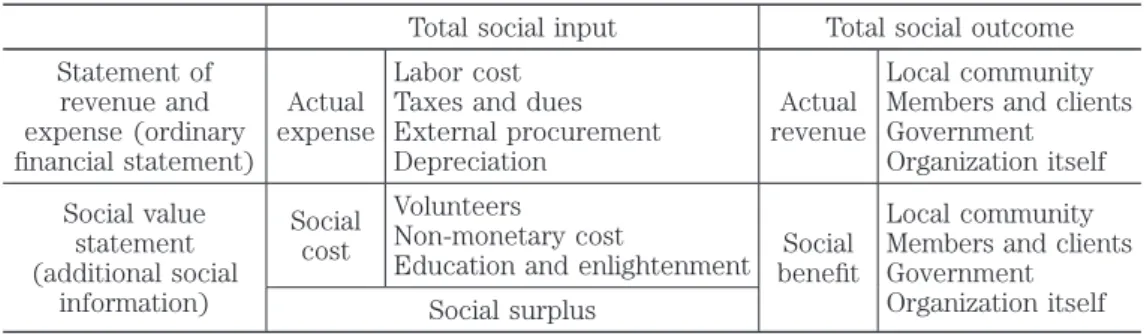
Table 1 shows the structure of our suggested social value statement. ‘Total social input’ includes ‘actual expense’ and ‘social cost’ without disbursement.
Actual expenses include labor costs, taxes and dues (value-added and generated within the organization), external procurement costs and depreciation (attribut- able outside of the organization). Social costs include volunteer labor, other non- monetary costs, and estimated education costs.
‘Total social outcome’ consists of ‘actual revenue’ and ‘social benefi t’ without earnings. In this case, if a market price is obtained as a unit price of social benefi t, the social benefi t can be calculated using the relevant price. If market price is unavailable, the equivalent volunteer input costs could be used as an
Table 1: Structure of Social Value Statement
Total social input Total social outcome Statement of
revenue and expense (ordinary fi nancial statement)
Actual expense
Labor cost Taxes and dues External procurement Depreciation
Actual revenue
Local community Members and clients Government Organization itself Social value
statement (additional social
information)
Social cost
Volunteers
Non-monetary cost
Education and enlightenment Social benefi t
Local community Members and clients Government Organization itself Social surplus
approximate benefi t amount.
Subsequently, ‘total social outcome’ is re-aggregated to the local community, members and clients, the government, and the nonprofi t organization. If member- ship fees or charitable giving is allocated to projects, the results are attributable to clients or the local community whereas if fees or giving is allocated to adminis- trative costs, the results are attributable to the organization itself. Generally, project revenue is attributable to members or clients, but results from govern- ment commissioning are sometimes attributed to the local community or govern- ment. Subsidy attribution varies depending on the purpose and use of the funds.
Therefore, by focusing on the organization’s mission the social value statement should express which stakeholders should be attributed for each achievement.
3.3. Creating the social value statement
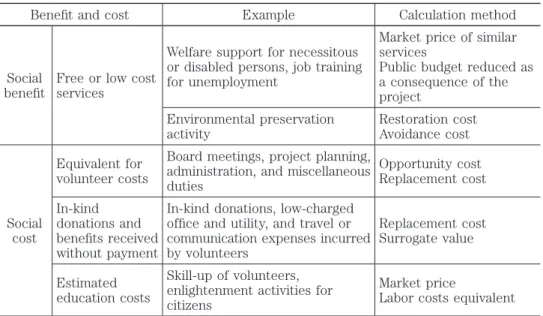
To convert the statement of revenue and expense, based on traditional fi nancial accounting, into the social value statement, including social benefi ts and social costs, requires the following fi ve steps: (1) clarify the organization’s activities, (2) measure the social benefi ts of free or low cost services, (3) calculate an equiva- lent for volunteer costs, (4) understand in-kind donations or benefi ts received without payment, and (5) estimate education costs. Table 2 indicates the methods used to measure social benefi ts and costs.
Table 2: Calculation Methods to Measure Social Benefi ts and Costs
Benefi t and cost Example Calculation method
Social benefi t
Free or low cost services
Welfare support for necessitous or disabled persons, job training for unemployment
Market price of similar services
Public budget reduced as a consequence of the project
Environmental preservation activity
Restoration cost Avoidance cost
Social cost
Equivalent for volunteer costs
Board meetings, project planning, administration, and miscellaneous duties
Opportunity cost Replacement cost In-kind
donations and benefi ts received without payment
In-kind donations, low-charged offi ce and utility, and travel or communication expenses incurred by volunteers
Replacement cost Surrogate value
Estimated education costs
Skill-up of volunteers, enlightenment activities for citizens
Market price
Labor costs equivalent
Step 1: Clarify the organization’s activity
The social value of nonprofi t organizations mainly comprises three activities.
These are: (1) a direct benefi t to their members or clients, (2) an indirect benefi t to their members or clients, and (3) a benefi t to the local community excluding their members or clients (Richmond et al., 2003). A preliminary step in estab- lishing the social value statement is clarifying activity content and social value sources.
Three categories help establish which activities of the nonprofi t organization include social value. These categories are ‘social usefulness’, ‘citizen participation’, and ‘impossibility of substitute’. Social usefulness includes activities that meet the needs of society or activities that address social issues. Citizen participation includes accepting donations and volunteers, and enhancing public consciousness.
Impossibility of substitution includes those activities or services that cannot be supplied by government or business.
Step 2: Measure the social benefi t of free or low cost services
Following a clarifi cation of the nonprofi ts’ activities, it is necessary to measure the social benefi t of activities from monetary perspective. Nonprofi t organizations do not generally collect suffi cient fees to cover their services. Although nonprofi t organizations may provide free or low cost services, their social value is not necessarily inferior to services provided commercially. Thus, by applying the market price of similar commercially available services, the approximate social value can be feasibly measured.
If the activities of nonprofi t organizations reduce social disadvantage or envi- ronmental destruction, public and social costs should reduce. In this situation the environmental or social costs can be estimated as social benefi ts generated by the nonprofi t organization. These costs need to avoid or restrict social or environ- mental damage. For example, if farmland can be saved from deforestation by tree planting, future restoration costs can be saved. Therefore the relevant effects are considered a social benefi t. Moreover, some future agricultural products produced on the preserved farmland could be recognized as additional social benefi ts
2).
Step 3: Calculate an equivalent for volunteer costs
Some countries have introduced a rational and feasible range of expenses to
2 ) Future agricultural goods are primarily attributed to producers. However, Richmond et al. (2003) mention the social value of an organization providing job training. This value may include the annual starting sala- ries of benefi ciaries gaining jobs following training.
account for volunteer costs. The American Financial Accounting Standards Board (FASB) recognizes volunteer costs in two situations (Financial Accounting Standards Board, 1993). The fi rst is when they create or enhance nonfi nancial assets, and the second when specialized skills are required and these skills would typically need to be purchased if not donated
3).
Canada has introduced similar accounting for volunteer costs. A survey conducted by Mook et al. (2005), found that although 37% of nonprofi t organiza- tions prepare volunteer records, only 3% of the organizations account for volun- teer costs in their fi nancial statements.
The purpose of this paper is to disclose the social value, therefore the volunteer costs should not be limited as American and Canadian accounting standards.
Generally, the equivalent for volunteer costs is calculated using opportunity or replacement cost (Quarter et al., 2002). Opportunity cost evaluates the amount a person could earn if not volunteering. However, potential earnings differ between volunteers depending upon their skills and experience. Replacement cost evalu- ates expenses using a labor market wage if a volunteer is replaced by a paid worker. The diffi culty can be that appropriate labor market wages may not be found for particular nonprofi t activities.
Establishing appropriate volunteer costs is diffi cult. Brown (1999) highlights volunteer productivity can be lower than paid staff because of different incen- tives. Yet volunteers are also potentially more motivated because they often have higher education levels and social awareness. Additionally, paid workers in Japanese nonprofi t organizations receive very low wages compared with those in commercial fi rms, therefore a wage adjustment should be considered.
Step 4: Understand in-kind donations and benefi ts received without payment Nonprofi t organizations sometimes receive in-kind donations, offi ce rent, and utility cost exemptions. Trustees and staff also incur travel, communication, and other expenses that they pay themselves on behalf of the organization. The full activity costs are calculated by applying replacement costs or surrogate value in the social value statement. The surrogate value is the cost of similar goods and services when replacement costs cannot be established. For example, there is an established method to estimate the value of offi ce rent when an organization has low rent.
3 ) Specialized skills include accountants, architects, carpenters, doctors, electricians, lawyers, nurses, plumbers, teachers, other professionals, and craftsmen.
Baba (2007) indicates Japanese nonprofi t organizations often have few indirect costs. These costs include offi ce related expenses, planning and meeting costs, and technical fees. To fully evaluate the true cost of nonprofi t activity, these hidden costs need to be exposed in the social value statement.
Step 5: Estimate education costs
A key role of nonprofi t organizations is the education of society generally. This is sometimes provided directly through seminar or training. Often the most mean- ingful way people are educated is through participation in nonprofi t organization activities.
In commercial fi rms, education is generally recognized as a labor cost. This includes time spent training employees and external lecturers fees. Education within nonprofi t organizations has a wider focus. Nonprofi ts aim to educate staff, volunteers, donors, members, and clients, but these costs are often not actual- ized. Thus, education costs should be identifi ed in the social value statement.
It is rational to use the market price of existing educational services within the social value measures. For example, Quarter et al. (2002) show the average cost of a community college course for personal growth and development is available as a surrogate value. However, it is diffi cult to fi nd equivalent market prices in Japan, so labor cost equivalents are used to estimate the social value of educa- tion.
4. Case study
Using the fi ve steps for social accounting discussed in the previous section, we create the social value statement. To measure the social value generated by Momo, we conducted some additional interviews with trustees, members, and volunteers. We also sent questionnaires to all Momo volunteers
4).
4.1. Measurement of social value
Social accounting is feasible for Momo and its activities because it has the following features: (1) funding for civil activities which have society wide effects, (2) a broad range of stakeholders including many small funders, (3) education activities infl uence a wide variety of people and includes the promotion of socially
4 ) In this questionnaire, we asked about the amount of time spent volunteering for Momo, the activities under- taken, expenses incurred on behalf of the organization along with any skills obtained. The questionnaire related to activities from June to November 2008.
responsible activities and environmental issues, (4) volunteers include fi nancial professions, company employees, and university students, (5) training opportuni- ties are provided for volunteers.
Steps 1 & 2: Clarify and measure social benefi t
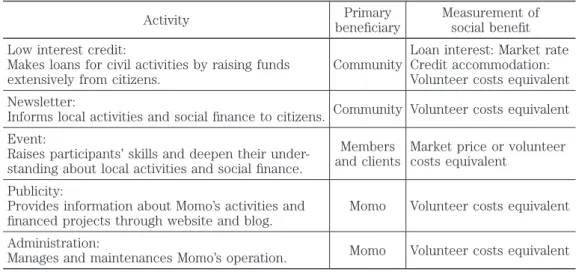
Table 3 provides a brief summary of Momo’s activities. Momo’s most important activity is making available low interest credit to civil activities. This function makes loans available for civil activities from funds raised extensively from local citizens.
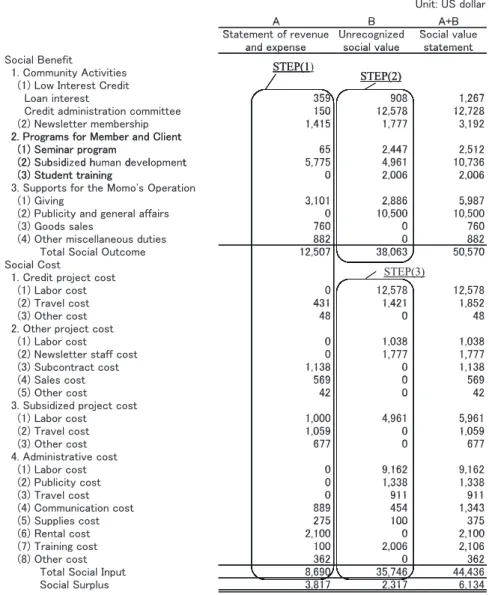
Momo applies 2% interest (a general loan) or 2.5% interest (a bridge loan) to its loans. Japanese law regards any loan with interest above 7.5% as a loan from a for-profi t institution. Therefore using an interest rate of 7.5% we estimate the market value of loan interest to be 1,267 US dollars. A deduction of actually received interest, recognized on Momo’s statement of revenue and expense, of 359 dollars is made. Finally, we add 908 dollars of ‘unrecognized social value’ to the social value statement.
Groups and individuals receiving Momo’s fi nance produce signifi cant positive results for the local community, yet there is no adequate market price to measure these effects. Some proportion of the revenue generated from the loans is tangible, but it is somewhat inaccurate. Therefore, on the outcome side of the credit committee it is diffi cult to measure social benefi t, so we use the volunteer cost equivalent of 12,578 dollars as the social benefi t from the input side.
Table 3: Activities of Community Youth Bank Momo
Activity Primary
benefi ciary
Measurement of social benefi t Low interest credit:
Makes loans for civil activities by raising funds extensively from citizens.
Community
Loan interest: Market rate Credit accommodation:
Volunteer costs equivalent Newsletter:
Informs local activities and social fi nance to citizens. Community Volunteer costs equivalent Event:
Raises participants’ skills and deepen their under- standing about local activities and social fi nance.
Members and clients
Market price or volunteer costs equivalent
Publicity:
Provides information about Momo’s activities and fi nanced projects through website and blog.
Momo Volunteer costs equivalent Administration:
Manages and maintenances Momo’s operation. Momo Volunteer costs equivalent
Momo also publishes newsletters and provides information to the wider local community through its website and blogs. These activities enhance community cohesion. The social benefi t from promotion and community education is diffi cult to ascertain. Instead we use volunteer inputs of 1,777 dollars as the social benefi t.
The social benefi t of the Social Finance Study Group held at Momo is compar- atively measurable. In this study group fi nancial professions and researchers provide the latest information concerning social fi nance. We estimate the benefi t of these classes using the market example of university seminars. The Momo’s study classes are estimated to cost 60 dollars, per three hour lecture, per person.
The social benefi t for 30 participants is therefore 1,800 dollars. Following a deduction of 65 dollars for fees received from participants, we add an ‘unrecog- nized social value’ of 1,735 dollars to the social value statement with equivalent volunteer costs of 712 dollars
5).
Many volunteers participate in Momo’s operational affairs including board meetings, accounting and other general administration. These activities are essen- tial for the continuing operation of Momo, so the social benefi t is measured using the equivalent volunteer cost.
Steps 3 & 4: Volunteer cost equivalent and in-kind donations
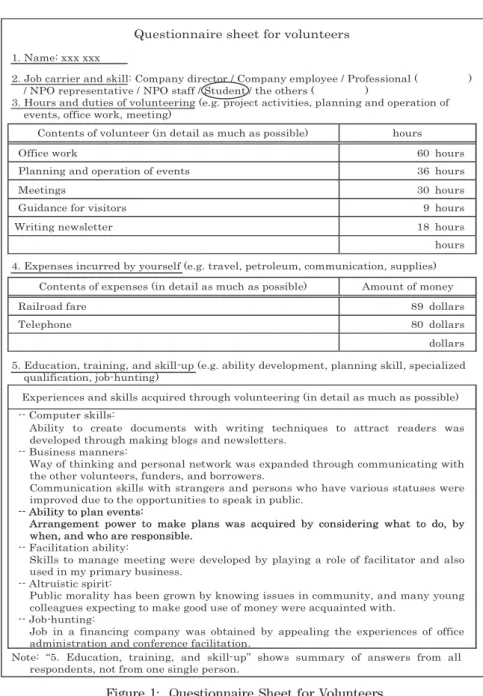
To calculate the equivalent for volunteer costs, a survey of all Momo’s 30 volun- teers was conducted
6). Figure 1 shows the questionnaire. The survey aims to ratio- nally estimate the broad effects of volunteers rather than strictly calculating market value. Equivalent volunteer hours and costs, sorted by position and duty, are shown in Table 4. Volunteer hours totaled 1,717 during the half year exam- ined. Equivalent volunteer costs were approximately 32,860 dollars.
Among them we used equivalent volunteer costs of 12,578 dollars (low interest credit), 1,777 dollars (newsletter), 4,961 dollars (subsidized human development program), and 10,500 dollars (publicity and administration) as the proxy of social benefi ts. And also the expenses incurred by Momo’s volunteers amounted to 2,886 dollars. It is considered as a kind of giving revenue.
Coincide with above social benefi ts, the equivalent volunteer costs of 32,860 and the expenses incurred by volunteers of 2,886 are also used as social costs.
5 ) Briefi ng session of volunteers (144 dollars) and exhibition of booths (568 dollars). Volunteer cost of social fi nance study group is eliminated because it is refl ected by the market value.
6 ) The volunteers include seven advisors, seven trustees, three professionals, nine working people, and four students. The advisors’ role is to provide counsel for the credit administration committee.
Questionnaire sheet for volunteers 1. Name: xxx xxx
2. Job carrier and skill: Company director / Company employee / Professional ( ) / NPO representative / NPO staff / Student / the others ( )
3. Hours and duties of volunteering (e.g. project activities, planning and operation of events, office work, meeting)
Contents of volunteer (in detail as much as possible) hours s r u o h 0 6 k
r o w e c i f f O
s r u o h 6 3 s
t n e v e f o n o i t a r e p o d n a g n i n n a l P
s r u o h 0 3 s
g n i t e e M
s r u o h 9 s
r o t i s i v r o f e c n a d i u G
s r u o h 8 1 r
e t t e l s w e n g n i t i r W
hours 4. Expenses incurred by yourself (e.g. travel, petroleum, communication, supplies)
Contents of expenses (in detail as much as possible) Amount of money s r a l l o d 9 8 e
r a f d a o r l i a R
s r a l l o d 0 8 e
n o h p e l e T
dollars 5. Education, training, and skill-up (e.g. ability development, planning skill, specialized
qualification, job-hunting)
Experiences and skills acquired through volunteering (in detail as much as possible) -- Computer skills:
Ability to create documents with writing techniques to attract readers was developed through making blogs and newsletters.
-- Business manners:
Way of thinking and personal network was expanded through communicating with the other volunteers, funders, and borrowers.
Communication skills with strangers and persons who have various statuses were improved due to the opportunities to speak in public.
-- Ability to plan events:
Arrangement power to make plans was acquired by considering what to do, by when, and who are responsible.
-- Ability to plan events:
Arrangement power to make plans was acquired by considering what to do, by when, and who are responsible.
-- Facilitation ability:
Skills to manage meeting were developed by playing a role of facilitator and also used in my primary business.
-- Altruistic spirit:
Public morality has been grown by knowing issues in community, and many young colleagues expecting to make good use of money were acquainted with.
-- Job-hunting:
Job in a financing company was obtained by appealing the experiences of office administration and conference facilitation.
Note: “5. Education, training, and skill-up” shows summary of answers from all respondents, not from one single person.
Figure 1: Questionnaire Sheet for Volunteers
They are re-classifi ed into appropriate expense items.
Step 5: Estimate education cost
One of Momo’s signifi cant missions is the education of young people interested
in community activities. Therefore Momo intentionally entrusts some operations
and events to student volunteers. The volunteer hours of students are therefore
Table 4: Equivalent Volunteer Hours and Costs Volunteer duties Position Volunteer costs equivalent Subtotal
Position Training effect Subtotal
Volunteer social value Total
AdvisorTrusteeProfessionalOtherStudent Estimated wage rateEstimated wage rate Financial profession and company director $43.28 NPO representa- tive $37.14 Project manager $24.00 Other professional such as advertising $43.28
General volunteer $12.10
Training and education $7.14 HeadsHoursAmountHeadsHoursAmountHeadsHoursAmountHeadsHoursAmountHeadsHoursAmountHeadsHoursAmount Low interest credit
Briefi ng session of credit application149696096 Credit accommodation committee4401,7323301,1147581,3922121454,38304,383 Correspondence to credit applicants4163843840384 Offi ce work and mailing63007,20011437394727,7154715065068,221 Sub total12,578 Newsletter
Having interview14961143214170309396464373 Writing and lay out manuscripts4194561287214169712275050762 Proofreading and posting116384131303202427562128686842 Sub total1,777 Planning and operation of events Briefi ng session for volunteers161441440144 Exhibition of booths16144435424568215107107675 Social fi nance study group26144315182326264343369 Sub total1,038 Subsidized human development program
Inspection tours to fi nanced projects4721,7285769202,6482402862862,934 Skill-up training5511,2247901,0892,3133483433432,656 Sub total4,961 Publicity
Renewal of website1182182180218 Writing and placing in blog244848048 Creating fl yer1125191101216400640 Writing mail magazine1184324320432 Sub total1,338 Administration
Board meeting71353,2403,2401643433,283 General members’ meeting41433613130514169635264343678 Volunteers’ meeting4681,6321417391231,4883,2935523713713,664 Correspondence to be interviewed19216216196464280 Accounting1122881251,0821,37001,370 Other general affairs1174084080408 Sub total9,162 Total4401,7323301,114783119,9443512,20794845,85730,85442812,0062,00632,860 Expenses incurred by volunteers Travel expense (credit accommodation)4−1603−1207−1,1411,42101,421 Travel expense (others)1−2002−958−4937884−123123911 Communication expense2−3122−221−203542−100100454 Supplies expense1−1001000100 Total4−1603−1207−1,7533−1179−5132,6634−2232232,886
counted as an education and training cost in the social value statement. Students’
equivalent volunteer cost of 2,006 dollars is simultaneously used as social benefi t and social cost.
4.2. Social value statement
To create the social value statement, the following three steps are required, as shown in Figure 2: (1) reconcile the ‘statement of revenue and expense’ column, sorted by benefi ciaries, (2) transcribe the social benefi ts of the ‘unrecognized social value’ column and (3) transcribe the social costs of the ‘unrecognized social
Figure 2: Steps to Create Social Value Statement
㼁㼚㼕㼠㻦㻌㼁㻿㻌㼐㼛㼘㼘㼍㼞
㻭 㻮 㻭㻗㻮
㻭 㻮 㻭㻗㻮
㻿㼠 㼠 㼠 㼒 㼁 㼕 㼐 㻿 㼕 㼘 㼘
㻿㼠㼍㼠㼑㼙㼑㼚㼠㻌㼛㼒㻌㼞㼑㼢㼑㼚㼡㼑 㼁㼚㼞㼑㼏㼛㼓㼚㼕㼦㼑㼐 㻿㼛㼏㼕㼍㼘㻌㼢㼍㼘㼡㼑 㼍㼚㼐 㼑㼤㼜㼑㼚㼟㼑
㼓
㼟㼛㼏㼕㼍㼘 㼢㼍㼘㼡㼑 㼟㼠㼍㼠㼑㼙㼑㼚㼠 㼍㼚㼐㻌㼑㼤㼜㼑㼚㼟㼑 㼟㼛㼏㼕㼍㼘㻌㼢㼍㼘㼡㼑 㼟㼠㼍㼠㼑㼙㼑㼚㼠 㻿㼛㼏㼕㼍㼘㻌㻮㼑㼚㼑㼒㼕㼠㻝㻚㻌㻯㼛㼙㼙㼡㼚㼕㼠㼥㻌㻭㼏㼠㼕㼢㼕㼠㼕㼑㼟 STEP(1STEP(1
㻔㻝㻕 㻸㼛㼣 㻵㼚㼠㼑㼞㼑㼟㼠 㻯㼞㼑㼐㼕㼠 STEP(1) STEP(2)
㻟㻡㻥 㻥㻜㻤 㻝 㻞㻢㻣
STEP(2)
㻸㼛㼍㼚㻌㼕㼚㼠㼑㼞㼑㼟㼠 㻟㻡㻥 㻥㻜㻤 㻝㻘㻞㻢㻣
STEP(2)
㻘 㻯㼞㼑㼐㼕㼠 㼍㼐㼙㼕㼚㼕㼟㼠㼞㼍㼠㼕㼛㼚 㼏㼛㼙㼙㼕㼠㼠㼑㼑 㻝㻡㻜㻝㻡㻜 㻝㻞㻘㻡㻣㻤㻝㻞㻘㻡㻣㻤 㻝㻞㻘㻣㻞㻤㻝㻞㻘㻣㻞㻤
㻝 㻠㻝㻡 㻝 㻣㻣㻣
㻔㻞㻕㻌㻺㼑㼣㼟㼘㼑㼠㼠㼑㼞㻌㼙㼑㼙㼎㼑㼞㼟㼔㼕㼜 㻝㻘㻠㻝㻡 㻝㻘㻣㻣㻣 㻟㻘㻝㻥㻞
㻞㻚㻌㻼㼞㼛㼓㼞㼍㼙㼟㻌㼒㼛㼞㻌㻹㼑㼙㼎㼑㼞㻌㼍㼚㼐㻌㻯㼘㼕㼑㼚㼠 㻞㻚㻌㻼㼞㼛㼓㼞㼍㼙㼟㻌㼒㼛㼞㻌㻹㼑㼙㼎㼑㼞㻌㼍㼚㼐㻌㻯㼘㼕㼑㼚㼠
㻔㻝㻕 㻿㼑㼙㼕㼚㼍㼞 㼜㼞㼛㼓㼞㼍㼙 㻢㻡 㻞 㻠㻠㻣 㻞 㻡㻝㻞
㻔㻝㻕㻌㻿㼑㼙㼕㼚㼍㼞㻌㼜㼞㼛㼓㼞㼍㼙 㻢㻡 㻞㻘㻠㻠㻣 㻞㻘㻡㻝㻞
㻔㻞㻕 㻿 㼎 㼕㼐㼕 㼐 㼔 㼐 㼘 㼠 㻡 㻣㻣㻡 㻠 㻥㻢㻝 㻝㻜 㻣㻟㻢
㻔㻞㻕㻌㻿㼡㼎㼟㼕㼐㼕㼦㼑㼐㻌㼔㼡㼙㼍㼚㻌㼐㼑㼢㼑㼘㼛㼜㼙㼑㼚㼠 㻡㻘㻣㻣㻡㻘 㻠㻘㻥㻢㻝㻘 㻝㻜㻘㻣㻟㻢㻘
㻔㻟㻕 㻿㼠㼡㼐㼑㼚㼠 㼠㼞㼍㼕㼚㼕㼚㼓 㻜 㻞㻘㻜㻜㻢 㻞㻘㻜㻜㻢
㻔㻟㻕㻌㻿㼠㼡㼐㼑㼚㼠㻌㼠㼞㼍㼕㼚㼕㼚㼓 㻜 㻞㻘㻜㻜㻢 㻞㻘㻜㻜㻢
㻟㻚㻌㻿㼡㼜㼜㼛㼞㼠㼟㻌㼒㼛㼞㻌㼠㼔㼑㻌㻹㼛㼙㼛㻓㼟㻌㻻㼜㼑㼞㼍㼠㼕㼛㼚
㻟㻘㻝㻜㻝 㻞㻘㻤㻤㻢 㻡㻘㻥㻤㻣
㻔㻝㻕㻌㻳㼕㼢㼕㼚㼓 㻟㻘㻝㻜㻝 㻞㻘㻤㻤㻢 㻡㻘㻥㻤㻣
㻔㻞㻕 㻼㼡㼎㼘㼕㼏㼕㼠㼥 㼍㼚㼐 㼓㼑㼚㼑㼞㼍㼘 㼍㼒㼒㼍㼕㼞㼟 㻜㻜 㻝㻜 㻡㻜㻜㻝㻜㻘㻡㻜㻜 㻝㻜㻘㻡㻜㻜
㻣㻢㻜 㻜 㻣㻢㻜
㻔㻟㻕㻌㻳㼛㼛㼐㼟㻌㼟㼍㼘㼑㼟 㻣㻢㻜 㻜 㻣㻢㻜
㻔㻠㻕 㻻㼠㼔㼑㼞 㼙㼕㼟㼏㼑㼘㼘㼍㼚㼑㼛㼡㼟 㼐㼡㼠㼕㼑㼟 㻤㻤㻞㻤㻤㻞 㻜㻜 㻤㻤㻞㻤㻤㻞
㻝㻞 㻡㻜㻣 㻟㻤 㻜㻢㻟 㻡㻜 㻡㻣㻜
䚷䚷㼀㼛㼠㼍㼘㻌㻿㼛㼏㼕㼍㼘㻌㻻㼡㼠㼏㼛㼙㼑 㻝㻞㻘㻡㻜㻣 㻟㻤㻘㻜㻢㻟 㻡㻜㻘㻡㻣㻜
STEP(3)
㻿㼛㼏㼕㼍㼘㻌㻯㼛㼟㼠㻝㻚㻌㻯㼞㼑㼐㼕㼠㻌㼜㼞㼛㼖㼑㼏㼠㻌㼏㼛㼟㼠 STEP(3)STEP(3)
㻜 㻝㻞 㻡㻣㻤 㻝㻞 㻡㻣㻤
STEP(3)
㻔㻝㻕㻌㻸㼍㼎㼛㼞㻌㼏㼛㼟㼠 㻜 㻝㻞㻘㻡㻣㻤 㻝㻞㻘㻡㻣㻤
STEP(3)
㻘㻡 㻤 㻘㻡 㻤
㻠㻟㻝 㻝 㻠㻞㻝 㻝 㻤㻡㻞
㻔㻞㻕㻌㼀㼞㼍㼢㼑㼘㻌㼏㼛㼟㼠 㻠㻟㻝 㻝㻘㻠㻞㻝 㻝㻘㻤㻡㻞
㻠㻤 㻜 㻠㻤
㻔㻟㻕㻌㻻㼠㼔㼑㼞㻌㼏㼛㼟㼠 㻠㻤 㻜 㻠㻤
㻞㻚㻌㻻㼠㼔㼑㼞㻌㼜㼞㼛㼖㼑㼏㼠㻌㼏㼛㼟㼠
㻜 㻝 㻜㻟㻤 㻝 㻜㻟㻤
㻔㻝㻕㻌㻸㼍㼎㼛㼞㻌㼏㼛㼟㼠 㻜 㻝㻘㻜㻟㻤 㻝㻘㻜㻟㻤
㻜 㻝 㻣㻣㻣 㻝 㻣㻣㻣
㻔㻞㻕㻌㻺㼑㼣㼟㼘㼑㼠㼠㼑㼞㻌㼟㼠㼍㼒㼒㻌㼏㼛㼟㼠 㻜㻜 㻝㻘㻣㻣㻣㻝㻘㻣㻣㻣 㻝㻘㻣㻣㻣㻝㻘㻣㻣㻣
㻝 㻝㻟㻤 㻜 㻝 㻝㻟㻤
㻔㻟㻕㻌㻿㼡㼎㼏㼛㼚㼠㼞㼍㼏㼠㻌㼏㼛㼟㼠 㻝㻘㻝㻟㻤 㻜 㻝㻘㻝㻟㻤
㻡㻢㻥 㻜 㻡㻢㻥
㻔㻠㻕㻌㻿㼍㼘㼑㼟㻌㼏㼛㼟㼠 㻡㻢㻥 㻜 㻡㻢㻥
㻠㻞 㻜 㻠㻞
㻔㻡㻕㻌㻻㼠㼔㼑㼞㻌㼏㼛㼟㼠 㻠㻞 㻜 㻠㻞
㻟㻚㻌㻿㼡㼎㼟㼕㼐㼕㼦㼑㼐㻌㼜㼞㼛㼖㼑㼏㼠㻌㼏㼛㼟㼠
㻝 㻜㻜㻜 㻠 㻥㻢㻝 㻡 㻥㻢㻝
㻔㻝㻕㻌㻸㼍㼎㼛㼞㻌㼏㼛㼟㼠 㻝㻘㻜㻜㻜㻝㻘㻜㻜㻜 㻠㻘㻥㻢㻝㻠㻘㻥㻢㻝 㻡㻘㻥㻢㻝㻡㻘㻥㻢㻝
㻔㻞㻕㼀㼞㼍㼢㼑㼘 㼏㼛㼟㼠 㻝 㻜㻡㻥㻝㻘㻜㻡㻥 㻜㻜 㻝 㻜㻡㻥㻝㻘㻜㻡㻥
㻢㻣㻣 㻜 㻢㻣㻣
㻔㻟㻕㻌㻻㼠㼔㼑㼞㻌㼏㼛㼟㼠 㻢㻣㻣 㻜 㻢㻣㻣
㻠㻚㻌㻭㼐㼙㼕㼚㼕㼟㼠㼞㼍㼠㼕㼢㼑㻌㼏㼛㼟㼠
㻔㻝㻕 㻸㼍㼎㼛㼞 㼏㼛㼟㼠 㻜㻜 㻥 㻝㻢㻞㻥㻘㻝㻢㻞 㻥㻘㻝㻢㻞
㻜 㻝 㻟㻟㻤 㻝 㻟㻟㻤
㻔㻞㻕㻌㻼㼡㼎㼘㼕㼏㼕㼠㼥㻌㼏㼛㼟㼠 㻜㻜 㻝㻘㻟㻟㻤㻝㻘㻟㻟㻤 㻝㻘㻟㻟㻥
㻜 㻥㻝㻝 㻥㻝㻝
㻔㻟㻕㻌㼀㼞㼍㼢㼑㼘㻌㼏㼛㼟㼠 㻜 㻥㻝㻝 㻥㻝㻝
㻤㻤㻥 㻠㻡㻠 㻝 㻟㻠㻟
㻔㻠㻕㻌㻯㼛㼙㼙㼡㼚㼕㼏㼍㼠㼕㼛㼚㻌㼏㼛㼟㼠 㻤㻤㻥 㻠㻡㻠 㻝㻘㻟㻠㻟㻘
㻔㻡㻕 㻿㼡㼜㼜㼘㼕㼑㼟 㼏㼛㼟㼠 㻞㻣㻡㻞㻣㻡 㻝㻜㻜㻝㻜㻜 㻟㻣㻡㻟㻣㻡
㻞 㻝㻜㻜 㻜 㻞 㻝㻜㻜
㻔㻢㻕㻌㻾㼑㼚㼠㼍㼘㻌㼏㼛㼟㼠 㻞㻘㻝㻜㻜 㻜 㻞㻘㻝㻜㻜
㻔㻣㻕㻌㼀㼞㼍㼕㼚㼕㼚㼓㻌㼏㼛㼟㼠 㻝㻜㻜㻝㻜㻜 㻞㻘㻜㻜㻢㻞㻘㻜㻜㻢 㻞㻘㻝㻜㻢㻞㻘㻝㻜㻢
㻟㻢㻞 㻜 㻟㻢㻞
㻔㻤㻕㻌㻻㼠㼔㼑㼞㻌㼏㼛㼟㼠 㻟㻢㻞 㻜 㻟㻢㻞
㻤 㻢㻥㻜 㻟㻡 㻣㻠㻢
䚷䚷㼀㼛㼠㼍㼘㻌㻿㼛㼏㼕㼍㼘㻌㻵㼚㼜㼡㼠 㻤㻘㻢㻥㻜㻘 㻟㻡㻘㻣㻠㻢㻘 㻠㻠㻘㻠㻟㻢
㻿㼛㼏㼕㼍㼘 㻿㼡㼞㼜㼘㼡㼟 㻟㻘㻤㻝㻣㻟㻘㻤㻝㻣 㻞㻘㻟㻝㻣㻞㻘㻟㻝㻣 㻢㻘㻝㻟㻠
value’ column.
The sum of the ‘statement of revenue and expense’ and ‘unrecognized social value’ is then consistent with the ‘social value statement’. This results in stake- holders being able to fully understand how social value is generated from mone- tary or nonmonetary activities.
4.3. Usefulness of social accounting
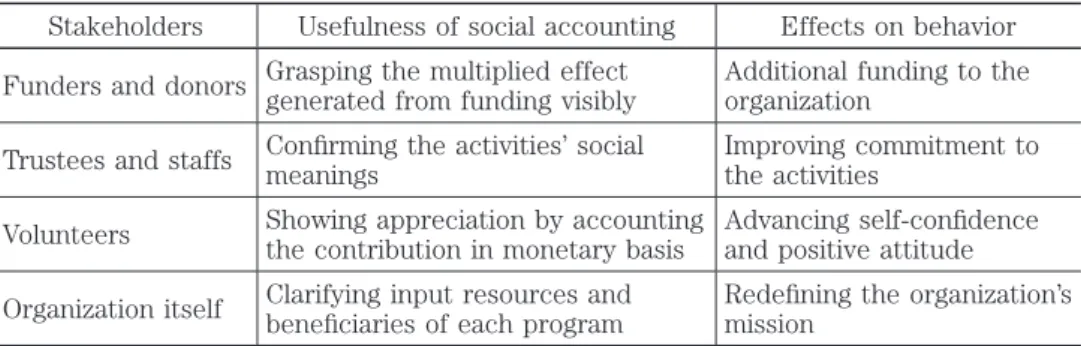
As Table 5 indicates, the social value statement leads to changes in stakeholder awareness and thinking. This change of attitude affects funders, donors, trustees, staff, and volunteers. Further, the statement also assists the organization revisit its own behaviors.
The social value statement is useful for funders and donors, to more fully understand the multifaceted gains made thanks to their funding. For example, when funders and donors note revenue is 12,507 dollars, and social value is 50,570 dollars, they are likely to understand that Momo produces social value four times that of the revenue received. Highlighting this positive result may lead to additional funding and contributions.
The social value statement confi rms for trustees and staff that their activities possess social meaning, not self-satisfaction. This could potentially deepen their commitment to Momo’s activities and services.
For volunteers the social value statement can be a tool to assess their role.
Haski-Leventhal et al. (2011) indicate the signifi cance of multidimensional evalua- tions for volunteers. Although a nonprofi t organization may not be able to compensate volunteers’ work financially, it can show its appreciation by accounting for their contribution on a monetary basis. Indeed, some young volun- teers mentioned their self-confi dence and attitude towards Momo’s activities grew
Table 5: Usefulness of Social Accounting for Stakeholders
Stakeholders Usefulness of social accounting Effects on behavior Funders and donors Grasping the multiplied effect
generated from funding visibly
Additional funding to the organization
Trustees and staffs Confi rming the activities’ social meanings
Improving commitment to the activities
Volunteers Showing appreciation by accounting the contribution in monetary basis
Advancing self-confi dence and positive attitude Organization itself Clarifying input resources and
benefi ciaries of each program
Redefi ning the organization’s mission
positively, or their jobs improved, through the questionnaire process.
Finally, for the organization itself, the social value statement clarifi es and confi rms that volunteers are vital to sustain the organization’s activities and services. This volunteer validation leads to modifi cations in management policy.
The statement also redefi nes the organization’s mission by clearly establishing the benefi ciaries of each program.
5. Social impact index
The social value statement is not for public disclosure, so revisions are neces- sary for future practical use. The critical issue is the precise measurement of social value. Rational and comparable social value information is essential so nonprofi t organizations can negotiate with government or commercial enterprises on an equal footing. Therefore we argue for the refi nement of fi nancial indices used by commercial enterprises. This would also enable the development of quan- titative indices to evaluate social impacts for nonprofi t organizations.
Currently, social businesses are increasingly gaining attention. Some European countries are discussing the assessment of social projects’ outcomes. By refer- encing these studies’ fi ndings, we examine the ‘social impact index’ to evaluate the invisible social value of nonprofi t organizations.
5.1. Defi ning criteria for social enterprises
According to Defourny & Nyssens (2006), research on social enterprises began in 1993 at The Social Enterprise Initiative at Harvard Business School. Dees (1998) characterizes social enterprises as hybrids of the social and economic spectrum, operating between being ‘purely philanthropic’ and ‘purely commercial’.
Borzaga & Defourny (2001) published a report derived from research on Italian cooperatives. It was based on investigations of 15 European Union member coun- tries and executed by the EMES European Research Network. The defi nition of social enterprise proposed by EMES is used as a guideline for many social enter- prise studies (Heckl et al., 2007).
EMES provides nine social enterprise criteria, of which four are economic and
fi ve are social. The economic criteria are: (1) “a continuous activity producing
goods and/or selling services”, (2) “a high degree of autonomy”, (3) “a signifi cant
level of economic risk”, (4) “a minimum amount of paid work”. The fi ve social
criteria are: (5) “an explicit aim to benefi t the community”, (6) “an initiative
launched by a group of citizens”, (7) “a decision-making power not based on
Table 6: Social Impact Index Social impact indexMeasurement targetDescriptionFormulaResult (Unit: US dollar)EMES criteria Project revenue ratioFinancial autonomyPercent of autonomous revenue sources by total revenuesProject revenues/Total revenues4.6 % =(359+150+65)/12,507(1)(2) Revenue concentration indexRevenue diversifi cationConcentration or diversifi cation of revenue resources Σ(ri/R)^2 (r: Individual revenues such as giving, membership, project, subsidy, and other, R: Total revenues) 0.31 point =(3,101/12,507)^2 +(1,415/12,507)^2 +(574/12,507)^2 +(5,775/12,507)^2 +(1,642/12,507)^2
(2)(3) Margin ratioSurplus funds securementPercent of margin by total revenuesAnnual margin/Total revenues30.5 % =3,817/12,507(1)(2)(3) Financial recoverable rate of social benefi tsFinancial collectability
Percent of revenues monetarily recovered by generated social outcome Total revenues/Total social outcomes24.7 % =12,507/50,570(1)(4) Project input ratioMission compatibility
Percent of input resources including volunteers used for project activities (Project costs+Social costs used for project)/Total social input60.2 % =(4,964+21,775)/44,436(5) Social cost-benefi t effectivenessSocial effi ciency
Multiplier effect of generated social outcome to input resources including volunteers Total social outcome/Total social input1.14 times =50,570/44,436(5) Community contribution ratioCommunity usefulnessPercent of activities produced for society and community
(Revenues and social benefi ts generated from community activities)/Total social outcome 34.0 % =(1,924+15,263)/50,570(5) Social support revenue ratioCommunity penetrance
Percent of revenues funded from local residents and philanthropy
Revenues of giving, membership and subsidy/Total revenues82.3 % =(3,101+1,415+5,775)/12,507(5)(8) Volunteer leverage effect of human resourcesVolunteer utilization
Multiplier effect of volunteer labor to salaried human resources (Labor expenses + Volunteer costs equivalent)/Labor expenses33.9 times =(1,000+32,860)/1,000 (4)(8) Volunteer leverage effect of total resources
Multiplier effect of volunteer labor to total input resourcesTotal social input/Total expenses5.1 times =44,436/8,690 EMES criteria: (1) a continuous activity producing goods and/or selling services, (2) a high degree of autonomy, (3) a signifi cant level of economic risk, (4) a minimum amount of paid work, (5) an explicit aim to benefi t the community, (8) a participatory nature, which involves the persons affected by the activity
capital ownership”, (8) “a participatory nature, which involves the persons affected by the activity”, and (9) “limited profi t distribution” (Borzaga &
Defourny, 2001).
As yet a method to evaluate the social impact of nonprofi t organizations is not established. Thus, we discuss the social impact index using the economic and social criteria established by the EMES European Research Network. We exclude three of the nine EMES criteria because they are regulated by the law of Japanese nonprofi t corporations. The excluded criteria are: (6) an initiative launched by a group of citizens, (7) a decision-making power not based on capital ownership, and (9) limited profi t distribution. Table 6 indicates the remaining six criteria which make up the social impact index.
5.2. Discussion
Despite the incomplete social impact index, discussions were held with some of Momo’s trustees and volunteers regarding the organization’s social value using the index. We also examined the utility of the index. The social impact index has considerable limitations and implications for its practical use, these implications are discussed below.
Generally, project revenues represent an autonomous and relatively stable fi nancial resource. The nonprofi t organization is free to use these funds to action their stated mission. In the Momo case, the project revenue ratio is just 4.6%, indicating the organization faces signifi cant issues regarding receipt of autono- mous revenue.
However, when using the revenue concentration index
7), Momo’s fi nancial resources are relatively diversifi ed, and the margin ratio is high. As a result, Momo’s fi nancial viability is not immediately threatened.
When examining social aspects the fi nancial recoverable rate of social benefi ts are 24.7%. This indicates a quarter of social benefi ts are monetarily fi nanced.
Additionally, the project input ratio is 60.2%. This indicates that major resources are invested in projects realizing Momo’s missions. However, the social cost- benefi t effectiveness (a similar notion to SROI) is only 1.14 times. It means 1 unit of social input generates 1.14 times social outcome. This results from the inability to measure appropriate market value for the program providing low interest credit to civil activities.
7 ) This index applies the Herfi ndahl-Hirschman index. It represents a concentration or diversifi cation of fi nan- cial resources. The higher the index, the more concentrated fi nancial resources become, while the lower the index, the more diversifi ed the resources are.
Community contributions ratio is 34.0%. This means the major portion of Momo’s activities contributes to community. In contrast, a high percentage of Momo’s fi nancial resource comes from philanthropy, including citizens’ donations, membership, subsidies and grants. This social support revenue ratio is 82.3% of Momo’s total revenues.
Finally, the volunteer leverage effect represents the human or total resources multiplied by volunteer participation
8). Referring to Momo’s social value statement, the volunteer labors generate 33.9 times input of labor expenses, while generate 5.1 times input of total expenses. Thus, volunteer participation is crucial in main- taining Momo’s activities.
6. Conclusion
Traditional accounting’s statement of revenue and expense achieves narrow accountability to show fi nancial expenditure. The application of social accounting methods establishes the social value statement. This extends public accountability and enables organizations’ ‘invisible’ community contributions to be verifi ed.
However, while stakeholders familiar with the organization may empathize and understand the meaning of the social value statement, it is diffi cult to use the social value statement for public disclosure. It is particularly diffi cult to establish rational market prices to estimate free or low cost services. This is a signifi cant disincentive for nonprofi t organizations to use the social value statement.
In the case of the Community Youth Bank Momo, appropriate market prices for low interest credit provision services and its educational effects could not be obtained. A credible and appropriate measure remains undeveloped.
Indeed, it is diffi cult to establish a standard social accounting method because the activities of nonprofi t organizations are diverse in the range of activities and the type volunteers (Cnaan et al., 1996). A ‘social audit’ may be also required.
This provides an objective and rational check, and assurance on social value infor- mation exercised by an authorized third party (Blake et al., 1976; Gray et al., 1987; Gray et al., 1996). Multifaceted challenges require persuasive social value statements for nonprofi t organizations.
8 ) Generally, ‘leverage’ is to multiply fi nancial gains or losses using debt. We apply this concept to volunteers, as a multiplier of input resources available to nonprofi t organizations.
References
Baba, H. (2007). Funding of contracts between the government and NPOs: Based on the view- point of full cost recovery. The Nonprofi t Review, 7(2), 83–95 (in Japanese).
Blake, D. H., Frederick, W. C., & Meyers, M. S. (1976). Social Auditing: Evaluating the Impact of Corporate Programs. Praeger.
Borzaga, C., & Defourny, J. (ed.) (2001). The Emergence of Social Enterprise. Routledge.
Brown, E. (1999). Assessing the value of volunteer activity. Nonprofi t and Voluntary Sector Quarterly, 28(1), 3–17.
Cnaan, R. A., Handy, F., & Wadsworth, M. (1996). Defi ning who is a volunteer: Conceptual and empirical considerations. Nonprofi t and Voluntary Sector Quarterly, 25(3), 364–383.
Dees, G. J. (1998). Enterprising nonprofi ts. Harvard Business Review, Jan.-Feb., 55–67.
Defourny, J., & Nyssens, M. (2006). Defi ning social enterprise. In M. Nyssens, S. Adam, & T.
Johnson (Ed.), Social Enterprise: At the Crossroads of Market, Public Policies and Civil Society, 3–26. Routledge.
Financial Accounting Standards Board (1993). Statement of fi nancial accounting standards No.116: Accounting for contributions received and contributions made.
Gonella, C., Pilling, A., & Zadek, S. (1998). Making Values Count: Contemporary Experience in Social and Ethical Accounting, Auditing, and Reporting. Association of Chartered Certifi ed Accountants.
Gray, R., Owen, D., & Adams, C. (1996). Accounting and Accountability: Changes and Challenges in Corporate Social and Environmental Reporting. Prentice Hall.
Gray, R., Owen, D., & Maunders, K. (1987). Corporate Social Reporting: Accounting and Accountability. Prentice Hall.
Haski-Leventhal, D., Hustinx, L., & Handy, F. (2011). What money cannot buy: The distinctive and multidimensional impact of volunteers. Journal of Community Practice, 19, 138–158.
Heckl, E., Pecher, I., Aaltonen, S., & Stenholm, P. (2007). Study on Practices and Policies in the Social Enterprise Sector in Europe. Austrian Institute for SME Research.
Lawlor, E., Neitzert, E., & Nicholls, J. (2008). Measuring Value: A guide to Social Return on Investment (SROI), second edition. New Economics Foundation.
Mook, L., Richmond, B. J., & Quarter, J. (2003). Integrated social accounting for nonprofi ts: A case from Canada. Voluntas, 14(3), 283–297.
Mook, L., Sousa, J., Elgie, S., & Quarter, J. (2005). Accounting for the value of volunteer contributions. Nonprofi t Management and Leadership, 15(4), 401–415.
Offi ce of the Third Sector (2009). A Guide to Social Return on Investment.
Quarter, J., Mook, L., & Richmond, B. J. (2002). What Counts: Social Accounting for Nonprofi ts and Cooperatives, Prentice Hall.
Quarter, J., & Richmond, B. J. (2001). Accounting for social value in nonprofi ts and for-profi ts.
Nonprofi t Management and Leadership, 12(1), 75–85.
Richmond, B. J., Mook, L., & Quarter, J. (2003). Social accounting for nonprofi ts: Two models.
Nonprofi t Management and Leadership, 13(4), 308–324.
Roberts Enterprise Development Fund (2001). SROI Methodology Paper Reports.
Acknowledge: This paper is based on the discussion of Hideaki Baba, Takahiro Aoki and Masaki Kimura, “Social Value Accounting for Nonprofi t Organizations: Visualizing the Invisible Value by Using the Social Accounting Method”, The Nonprofi t Review, 2009, 9(1&2), 1–13 (in Japanese), and improved for overseas readers. This work was supported partially by JSPS KAKENHI Grant Number (25380486), Grant-in-Aid for Scientifi c Research (C).