Health Related Quality of Life in Japanese Patients with Localized Prostate Cancer:
Comparative Retrospective Study of Robot-Assisted Laparoscopic Radical
Prostatectomy Versus Radiation Therapy
Yoko Miyoshi,* Shuichi Morizane,† Masashi Honda, ‡ Katsuya Hikita,† Hideto Iwamoto,‡ Tetsuya Yumioka,§ Yusuke Kimura,‡ Shin-ichi Yoshioka‖ and Atsushi Takenaka‡
*Department of Adult and Elderly Nursing, School of Health Science, Tottori University Faculty of Medicine, Yonago 683-8503, Japan, †Department of Urology, Tottori University Hospital, Yonago 683-8504, Japan, ‡Division of Urology, Department of Surgery, School of Medicine, Tottori University Faculty of Medicine, Yonago 683-8503, Japan, §Department of Urology, Matsue City Hospital, Matsue 690-8509, Japan, and ‖Department of Nursing Care Environment and Mental Health, School of Health Science, Tottori University Faculty of Medicine, Yonago 683-8503, Japan
ABSTRACT
Background Radical prostatectomy and radiotherapy are standard treatments for localized prostate cancer. When making decisions about treatment, it is important to not only consider medical information such as the pa-tient’s age, performance status, and complications, but also the impact on quality of life (QOL) after treatment. Our purpose was to compare health related quality of life (HRQOL) after robot-assisted laparoscopic radi-cal prostatectomy (RARP) versus radiation therapy in Japanese patients with localized prostate cancer retrospectively.
Methods Patients with localized prostate cancer receiving RARP or radiotherapy at Tottori University Hospital between October 2010 and December 2014 were enrolled in a retrospective observational study with follow-up for 24 months to December 2016. The Medical Outcome Study 8-Item Short-Form Health Survey was performed before treatment and 1, 3, 6, 12, and 24 months post-treatment.
Results Complete responses to the questionnaire were obtained from 154/227 patients receiving RARP, 41/67 patients receiving intensity-modulated radiation therapy, 35/82 patients receiving low dose rate brachytherapy, and 18/28 patients given low dose rate brachytherapy plus external beam radiation therapy. The median physical component summary score of the Medical Outcome Study 8-Item Short-Form Health Survey was significantly lower at 1 month after prostatectomy than radiotherapy, but was similar for both treatments at 3 months, and was significantly higher at 6, 12 and 24 months after prostatectomy. The median mental compo-nent summary score was also significantly lower in the prostatectomy group at 1 month, but not from 3 months onwards.
Conclusion Our study suggested that HRQOL was inferior at 1 month after RARP, however, recovered at 3 months after RARP and was better than after radio-therapy at 6, 12, and 24 months.
Key words health related quality of life; Medical Out-come Study 8-Item Short Form Health Survey; prostate cancer; prostatectomy; radiation therapy
Radical prostatectomy and radiotherapy are standard treatments for localized prostate cancer. When making decisions about treatment, it is important to not only consider medical information such as the patient’s age, performance status, and complications, but also the im-pact on quality of life (QOL) after treatment. It has been reported that patient’s satisfaction after robot-assisted laparoscopic radical prostatectomy (RARP) is associ-ated with a high degree to a preoperative education.1 It
is desirable for the patient, family members and health-care professionals to engage in adequate consultation before a decision is made, but choosing among different treatment modalities is complicated.
In Japan, RARP was approved for national health insurance coverage in 2012, after which it rapidly be-came popular,2 and has been established as a new
stan-dard therapy for localized prostate cancer. Regarding differences of therapeutic outcomes between RARP, laparoscopic radical prostatectomy (LRP), and retropu-bic radical prostatectomy (RRP), the Japanese clinical
Corresponding author: Yoko Miyoshi, RN, PhD [email protected]
Received 2019 November 22 Accepted 2020 January 17 Online published 2020 January 30
Abbreviations: BCR, biological recurrence; EBRT, external beam radiation therapy; HRQOL, health related quality of life; IMRT, intensity-modulated radiation therapy; LDR, low dose rate brachytherapy; LRP, laparoscopic radical prostatectomy; MCS, mental component summary; NCCN, National Comprehensive Cancer Network; PCS, physical component summary; PSA, prostate-specific antigen; QOL, quality of life; RARP, robot-assisted laparoscopic radical prostatectomy; RPR, radical peri-neal prostatectomy; RRP, retropubic radical prostatectomy; RP, role physical; SF-8, Medical Outcome Study 8-Item Short Form Health Survey; SF-36, Medical Outcome Study 36-Item Short Form Health Survey
practice guideline indicates that RARP and LRP have the same oncological effect as RRP, while being less invasive, causing less blood loss, and achieving more rapid postoperative improvement of QOL (e.g., restora-tion of urinary continence and sexual funcrestora-tion).3
Previous studies have shown that health related quality of life (HRQOL) declines temporarily after laparoscopic or radical prostatectomy, but recovers within 1 year,4 and that postoperative QOL does not
differ between RARP and open radical prostatectomy.5
In Japanese patients, HRQOL may not show marked deterioration following RARP,6 and systematic reviews
have found significantly better recovery of urinary con-tinence7 and erectile function8 after RARP compared
with both RRP and LRP.
Radiotherapy has adverse effects on the bladder, urethra, and rectum in the radiation field.9 Acute adverse
events include urinary tract symptoms and defecation problems, while late events include urethral and rectal bleeding, ulceration, pain, urethral stenosis, and erectile dysfunction. Dysuria is the most common chronic tox-icity of low dose rate brachytherapy (LDR),10, 11 while
rectal bleeding is most frequently used as a functional endpoint in patients receiving external beam radiation therapy (EBRT).12 The risk of secondary cancer also
cannot be ignored.13 Some studies have already
com-pared radical prostatectomy with radiotherapy, but there have been few comparisons of RARP with radiotherapy and most of the previous studies were not done in Japan. Thus, many points are unclear regarding the long-term HRQOL of Japanese patients after RARP.
Accordingly, we performed a comparative retrospective study of HRQOL after RARP versus radiotherapy in Japanese patients with localized prostate cancer.
SUBJECTS AND METHODS Patients
This retrospective observational study enrolled patients with a diagnosis of localized prostate cancer who received RARP or radiotherapy at Tottori University Hospital between October 2010 and December 2014 with follow-up for 24 months to the end of December 2016. The number of patients receiving RARP, intensi-ty-modulated radiation therapy (IMRT), LDR, and LDR combined with EBRT (LDR+EBRT) was 227, 67, 82, and 28, respectively.
Data collection
HRQOL was investigated before treatment and 1, 3, 6, 12, and 24 months after treatment using the Japanese version of the SF-8 Health Survey (SF-8),14 which is a
simplified version of the 36-Item Short-Form Health Survey (SF-36).15 The Japanese versions of both
questionnaires have previously been validated. SF-8 comprehensively measures health concepts in eight domains. The eight subscales are weighted to generate two summary scores, the physical component summary (PCS) and mental component summary (MCS). The cut-off value of the SF-8 is set at 50, with higher scores indicating better QOL. We obtained a license to use the SF-8 from iHope International (Kyoto, Japan).
Statistical analysis
Internal consistency of the SF-8 was assessed by calcu-lating Cronbach’s α coefficient. When performing statis-tical analysis, the Shapiro-Wilk test was initially carried out to assess the normality of data. Descriptive statistics were calculated for demographic characteristics. For comparison of characteristics between the patients receiving RARP or radiotherapy, age and prostate-specific antigen (PSA) were compared by the Kruskal-Wallis test, while the clinical stage, Gleason score, and nerve-sparing surgery were compared by Cramér’s coefficient of association. We explored the relation-ship between pretreatment pathological stage as the independent variable and the treatment modality as the dependent variable by using multiple logistic regression analysis (partial method) in order to check the degree of influence of HRQOL. The median and interquartile range were calculated for HRQOL scores, and differ-ences of the HRQOL score between RARP and radio-therapy patients at each time point were tested by using the general linear model (repeated measures) followed by Scheffe’s multiple comparison test. Spearman’s rank correlation analysis was used to investigate correlations between SF-8 scores and the age or pretreatment PSA. A P value < 0.05 (two-sided) was considered significant. IBM SPSS Statistics for Windows (Version 25) was used for all analyses.
Informed consent
Informed consent was obtained from all individual par-ticipants included in the study. Candidate parpar-ticipants were given a detailed explanation about the purpose and methods of the study, the expected benefits of par-ticipation, a guarantee of anonymity, and the voluntary nature of participation. Written informed content was obtained from all participants before enrollment and anonymity of personal information was protected by de-identification.
Ethical approval
All procedures performed in studies involving hu-man participants were in accordance with the ethical standards of the Tottori University Faculty of Medicine Ethics Committee (approval no. 18A069) and with the 1964 Helsinki declaration and its later amendments (as revised in Brazil 2013).
RESULTS
Patient characteristics
The percentage of patients providing complete respons-es to the qurespons-estionnairrespons-es was 67.8% (154/227) in the RARP group, while it was 61.2% (41/67) for patients re-ceiving IMRT, 42.7% (35/82) for those treated by LDR, and 64.3% (18/28) for those treated with LDR+EBRT. The clinical characteristics of the study population are outlined in Table 1. In patients receiving RARP, IMRT,
LDR, or LDR+EBRT, the mean age before treatment was 65.0, 71.6, 68.2, and 70.1 years, respectively. The mean pretreatment PSA level was 9.7, 27.1, 7.5, and 24.7 mg/dL, respectively, and PSA was significantly lower in the RARP group than in patients receiving IMRT or LDR+EBRT. When Cramér’s V was calculated for the relation between clinical stage or the Gleason score and each treatment group, it was 0.37 for the clinical stage and 0.35 for the Gleason score, showing a weak relation with the disease stage.
As shown in Table 2, there was no correlation between pretreatment age or PSA and the mean SF-8 score. Regarding National Comprehensive Cancer Network (NCCN) clinical risk, the risk classification ratios varied among the four groups. However, NCCN clinical risk had no strong influence on the treatment modalities (odds ratio: 0.61).
Table 1. Characteristics of the patients
Variable n = 154RARP IMRT n = 41 n = 35LDR LDR+EBRT n = 18
Pretreatment age (years)
Mean ± SD 65.0 ± 6.4 71.6 ± 5.5** 68.2 ± 7.8 70.1 ± 6.7* Range 48–76 60–80 44–81 57–80 Pretreatment PSA (mg/dL) Mean ± SD 9.7 ± 6.6 27.1 ± 28.2** 7.5 ± 2.7 24.7 ± 20.9** Range 1.2–39.2 4.1–122.5 4.4–14.0 4.7–86.9 Clinical stage, n (%) T1c 32 (20.8) 1 (2.4) 8 (22.9) 2 (11.1) T2a 72 (46.8) 10 (24.4) 22 (62.9) 6 (33.3) T2b 6 (3.9) 5 (12.2) 0 4 (22.2) T2c 31 (20.1) 0 5 (14.3) 2 (11.1) T3a 12 (7.8) 18 (43.9) 0 4 (22.2) T3b 1 (0.6) 7 (17.1) 0 0 Gleason score, n (%) ≤ 6 33 (21.4) 2 (4.9) 14 (40.0) 0 7 68 (44.2) 6 (14.6) 20 (57.1) 5 (27.8) ≥ 8 53 (34.4) 33 (80.5) 1 (2.9) 13 (72.2) NCCN clinical risk, n (%) Low 18 (11.7) 1 (2.4) 7 (20.1) 0 Intermediate 74 (48.1) 12 (29.3) 28 (80.3) 3 (16.7) High 62 (40.3) 28 (68.3) 0 15 (83.3)
Kruskal-Wallis test with Bonferroni's correction: ** P < 0.01, * P < 0.05 (two-sided)
Significant differences between the RARP group and other groups were assessed by the Kruskal-Wallis test for age and prostate-specific antigen, or by Cramér's coefficient of association for clinical stage and Gleason score.
EBRT, external beam radiation therapy; IMRT, intensity-modulated radiation therapy; LDR, low dose rate brachytherapy; NCCN, National Comprehensive Cancer Network; PSA, prostate-specific antigen; RARP, robot-assisted laparoscopic radical prostatectomy; SD, standard deviation.
HRQOL as determined by the SF-8
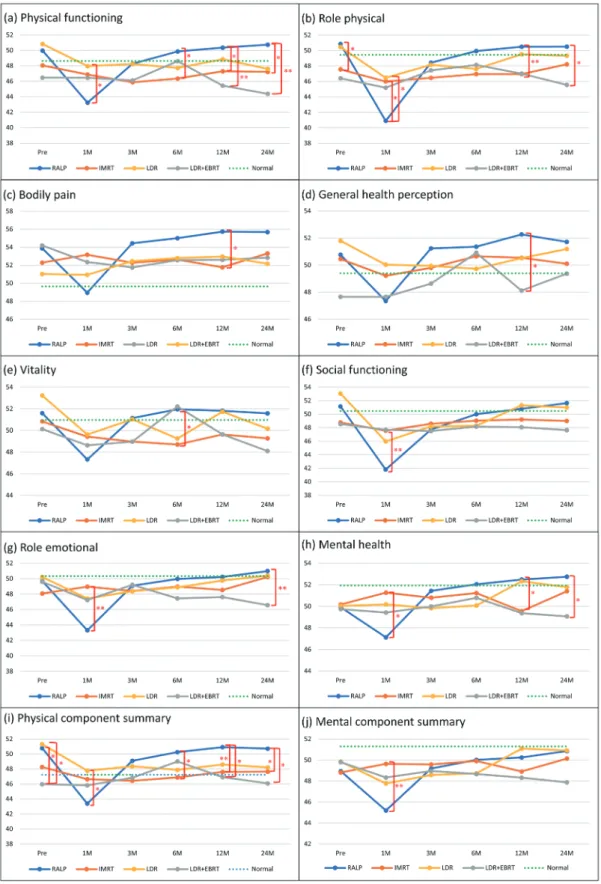
When internal consistency of the SF-8 was assessed for all subscales, Cronbach’s alpha was 0.9. Figure 1 shows changes of the SF-8 scores (mean and standard deviation) for each treatment group during the follow-up period, including the scores for each domain and the summary scores (PCS and MCS). The mean values for 240 Japanese men aged 60–69 years (national standard value determined in 2007) are also displayed for comparison. Pretreatment scores showed no significant differences between the groups, except the scores for role physical (RP) and PCS. The results obtained during the follow-up period are described below, presented as the median value (interquartile range).
Physical functioning
The score for this domain was significantly lower in the RARP group than the LDR group at 1 month after treatment [41.5 (16.7–53.5] vs. 53.5 (27.6–53.5), P < 0.05]. There were no significant differences among the groups at 3 months after treatment. At 6, 12, and 24 months, the score was significantly higher in the RARP group than the IMRT group [53.5 (27.6–53.5) vs. 47.8 (27.6–53.5), 53.5 (41.5–53.5) vs. 47.8 (27.6–53.5), and 53.5 (27.6–53.5) vs. 47.8 (27.6–53.5), respectively, all P < 0.05]. Also, the score was significantly higher in the RARP group than the LDR+EBRT group at 12 and 24 months after treatment [53.5 (41.5–53.5) vs. 44.6 (27.6–53.5) and 53.5 (27.6–53.5) vs. 44.6 (16.7–53.5), respectively, both P < 0.01].
Role physical
Before treatment, the score for this domain was sig-nificantly higher in the RARP group than the IMRT group [54.1 (21.8–54.1) vs. 47.4 (27.9–54.1), P < 0.05]. Conversely, it was significantly lower in the RARP group than in the IMRT and LDR groups at 1 month after treatment [40.7 (21.8–54.1) vs. 47.4 (27.9–54.1) and 40.7 (21.8–54.1) vs. 47.4 (21.8–54.1), respectively, both P < 0.05]. There were no significant differences among the groups at 3 and 6 months. However, the RARP group had a significantly higher score than the IMRT group at
12 months [54.1 (27.9–54.1) vs. 47.4 (27.9–54.1), P < 0.01] and a significantly higher score than the LDR+EBRT group at 24 months [54.1 (27.9–54.1) vs. 44.0 (27.9–54.1),
P < 0.05]. Bodily pain
The RARP group had a significantly lower score than the IMRT group at 1 month after treatment [52.5 (21.7–60.4) vs. 52.5 (31.6–60.4), P < 0.05], but there were no between-group differences at 3 and 6 months after treatment. The RARP group showed a signifi-cantly higher score than the IMRT group at 12 months [60.4 (38.2–60.4) vs. 52.5 (31.6–60.4), P < 0.05], while there were no significant between-group differences at 24 months.
General health perception
There were no significant differences of the scores among the groups at 1, 3 and 6 months after treatment. The RARP group had a significantly higher score than the LDR+EBRT group at 12 months [50.3 (40.4–63.4) vs. 50.3 (34.4–58.5), P < 0.05), while there were no significant between-group differences at 24 months.
Vitality
There were no significant differences among the groups at 1 and 3 months after treatment. The RARP group had a significantly higher score than the IMRT group at 6 months [53.7 (38.5–60.0) vs. 53.7 (28.7–60.0), P < 0.05], but there were no significant between-group differences at the other times.
Social functioning
The RARP group had a significantly lower score than the IMRT group at 1 month after treatment [37.7 (26.0–55.1) vs. 55.1 (29.2–55.1), P < 0.01], but there were no significant between-group differences at the other times.
Role emotional
The RARP group had a significantly lower score than the IMRT group at 1 month after treatment [45.1
Table 2. Correlations between age or preoperative PSA and the baseline SF-8 scores
N = 248 PF RP BP GH VT SF RE MH PCS MCS
Age –0.068 –0.045 0.029 0.049 0.023 0.039 0.010 0.046 –0.047 0.078
Pretreatment PSA 0.056 0.095 0.006 –0.004 0.018 0.033 0.137 0.087 0.021 0.104
Spearman's rank correlation coefficients are shown.
BP, bodily pain; GH, general health perception; MCS, mental component summary; MH, mental health; PCS, Physical component summary; PF, physical functioning, RE, role emotional; RP, role physical; SF, social functioning, VT vitality.
Fig. 1. Mean SF-8 scores in each group. Error bars represent the standard deviation. RARP group: blue line; IMRT group: orange line; LDR group: yellow line; LDR+EBRT group: gray line; dashed green: national standard value. Although box-and-whisker plots are most frequently used for such data, a line graph has been employed here to facilitate comparison of multiple changes over time. Significant differences determined using the general linear model with Scheffe’s test: *P < 0.05, **P < 0.01 (two-sided).
1M, 1 month after treatment; 3M, 3 months after treatment; 6M, 6 months after treatment; 12M, 12 months after treatment; 24M, 24 months after treatment; Normal, national standard value; Pre, pretreatment.
(20.0–54.2) vs. 48.0 (31.4–54.2), P < 0.01], but there were no significant differences among the groups at 3, 6, and 12 months. While the RARP group showed a significantly higher score than the LDR+EBRT group at 24 months [54.2 (31.4–54.2) vs. 48.0 (31.4–54.2), P < 0.01].
Mental health
The score was significantly lower in the RARP group than the IMRT group at 1 month after treatment [50.7 (27.6–56.9) vs. 50.7 (36.3–56.9), P < 0.05], but there were no significant differences among the groups at 3 and 6 months. The RARP group had a significantly higher score than the IMRT group at 12 months [50.7 (27.6–56.9) vs. 50.7 (36.3–56.9), P < 0.05) and a signifi-cantly higher score than the LDR+EBRT group at 24 months [56.9 (36.3–56.9) vs. 47.8 (36.3–56.9), P < 0.05].
Physical component summary
The pretreatment PCS score was significantly lower in the LDR+EBRT group than the RARP and LDR groups [47.6 (34.3–55.8) vs. 52.4 (21.6–63.7) and 47.6 (34.3–55.8) vs. 52.6 (39.6–58.2), respectively, both P < 0.05], while the score was significantly lower in the RARP group than the LDR group at 1 month after treatment [43.4 (19.7–58.5) vs. 50.0 (25.7–56.7), P < 0.05]. There were no significant differences among the groups at 3 months. Scores were significantly higher in the RARP group than in the IMRT group at 6, 12, and 24 months [52.1 (23.6–57.8) vs. 48.1 (25.4–56.6), P < 0.05; 52.1 (37.1–59.1) vs. 48.5 (25.4–58.9), P < 0.01; and 52.7 (28.4–58.5) vs. 47.9 (30.5–56.3), P < 0.05, respectively), as well as in the LDR+EBRT group at 12 and 24 months [52.1 (37.1–59.1) vs. 47.7 (34.0–56.6) and 52.7 (28.4–58.5) vs. 45.3 (28.3–56.6), respectively, both P < 0.05].
Mental component summary
While the RARP group had a significantly lower MCS score than the IMRT group at 1 month after treatment [46.5 (26.3–58.5) vs. 52.5 (29.7–57.2), P < 0.01], there were no significant differences among the groups at other times.
DISCUSSION
This retrospective study identified differences of HRQOL between patients receiving RARP and radio-therapy who were followed for 24 months. The HRQOL was inferior at 1 month after RARP, and recovered at 3 months after RARP and was better than after radio-therapy at 6, 12, and 24 months. Treatment for prostate cancer is selected from among various options, such as surgery and radiotherapy, with QOL being an important
consideration.16, 17 Several previous cross-sectional
stud-ies of HRQOL in prostate cancer patients have found no differences of HRQOL among treatment modali-ties,18–20 but other studies have shown that QOL differs
between radical prostatectomy (excluding RARP) and radiotherapy.21–23 Since no baseline data were provided
in these reports, it is unclear whether the differences of HRQOL were actually related to treatment. In contrast, we obtained pretreatment data and we could properly assess the impact of treatment on HRQOL.
At 1 month after RARP, physical health was worse than at 1 month after radiotherapy, suggesting the influence of surgical invasion, such as pain or post-prostatectomy urinary incontinence,2 on HRQOL,
but the physical health of both groups was similar at 3 months. By 6 months, HRQOL was better with RARP than radiotherapy, similar to the results of a previous study comparing HRQOL at 6 months between RRP and radiotherapy.24 At 12 months, physical health was
worse in the LDR+EBRT group than the RARP group, and it tended to be below the national standard from 3 months onward in patients receiving radiotherapy, sug-gesting the influence of late adverse events.
At 1 month after RARP, mental health was also worse than at 1 month after radiotherapy, indicating that the postoperative state influenced HRQOL. No other between-group differences were detected, but scores for each group tended to be lower than the national standard.
The median life expectancy of prostate cancer patients undergoing radical prostatectomy was reported to be 13.8 years,25 so it is important to maintain
long-term QOL. Previous studies have found no significant difference of HRQOL at two years after surgery or external beam radiation.26, 27 A Japanese study showed
that HRQOL was better after external radiotherapy than RRP,28 with higher scores for several SF-8 domains
in patients receiving radiotherapy.23 However, the
surgical patients did not undergo RARP and various radiotherapy modalities were included. Investigation of postoperative incontinence after RARP, RPR, RRP, and LRP has shown a superior recovery rate with RARP.2, 29 Taken together with the present results, we
stress that HRQOL recovered at 3 months after RARP and was better than after radiotherapy at 6 months. The prevalence of urinary incontinence is influenced by surgical technique.7 RARP potentially reduces the risk
of urinary incontinence, because significantly better recovery of continence after RARP has been reported.7
It has already been reported that in terms of urinary incontinence, HRQOL remains worse at 24 months after RARP compared to other methods of prostate
cancer treatment30: Our results contrast with this, and
the difference in results may be because Chien et al.’s study included patients who did not complete or had incomplete surveys. In our study, the radiation group included many high-risk patients, and none dropped out. However, it is difficult to simply compare the outcomes because the populations are different. To our knowledge, the present study was the first comparative retrospec-tive study of post-treatment SF-8 scores among RARP, IMRT, LDR, and LDR EBRT without dropout cases. These findings could assist healthcare professionals to give patients information about the influence of treat-ment on HRQOL.
Regarding the clinical characteristics of the study population, the IMRT and LDR+EBRT groups were older than the RARP group, while mean pretreat-ment PSA was lower in the RARP group than the IMRT group and higher in the RARP group than the LDR+EBRT group. Although such differences could potentially influence HRQOL, there were no differences of pretreatment SF-8 scores, except for role physical and PCS. Also, age and PSA showed no relation with the SF-8 scores. Accordingly, we did not investigate the influence of age, PSA, clinical stage, and Gleason score at diagnosis on HRQOL, however no consensus has been reached.
This study had several limitations. First, the influ-ence of neoadjuvant or adjuvant therapy on HRQOL was not considered.
Second, the LDR+EBRT group included many high-risk patients, and we cannot deny that this may have affected the quality of life after treatment in this group. Although there was no difference in the baseline of HRQOL score between groups, it was difficult to determine the influence of some bias where the RARP group had a better HRQOL score after treatment than the radiotherapy group.
In addition, in our study, the survival rate of pros-tate cancer patients was 100% during the observation period, but regarding to the biological recurrence (BCR) was not evaluated. The BCR after radical treatment for prostate cancer is a major challenge for medical profes-sionals. Also, disease-targeted QOL should be evaluated as well as HRQOL. Further studies are needed to sup-port our findings, and required to examine the various effectiveness of these treatments with a greater number of patients and a longer follow-up period.
Despite such limitations, HRQOL after RARP was superior half a year up to 2 years compared with radiotherapy. It is possible that these results could help to select treatment for prostate cancer and provide information to support decision-making by patients
and healthcare professionals. However, case risk bias and BCR should always be kept in mind, and this issue requires a separate study. From the perspective of pur-suing further investigation, we have been continuing to accumulate cases and long-term follow-up data and plan to give a detailed report separately.
In conclusion, we demonstrated that the HRQOL after RARP was inferior at 1 month compared with radiotherapy, however, the HRQOL subsequently im-proved, and was better than in radiotherapy patients’ 6, 12, and 24 months. These findings could help to select treatment for localized prostate cancer and provide information to support decision-making by patients and healthcare professionals.
Acknowledgments: The authors would like to thank the patients involved in this study.
This study was supported by a Grant-in-Aid for Scientific Research from the Japan Society for the Promotion of Science (grant number 15K11622).
The authors declare no conflict of interest. REFERENCES
1 Douaihy YE, Sooriakumaran P, Agarwal M, Srivastava A, Grover S, Mudaliar K, et al. A cohort study investigating patient expectations and satisfaction outcomes in men undergoing robotic assisted radical prostatectomy. Int Urol Nephrol. 2011;43:405-15. DOI: 10.1007/s11255-010-9817-5, PMID: 20700654
2 The Japanese Urological Association. Clinical practice guide-line for prostate cancer, Japanese Urological Association 2016 ed. Tokyo: Medical Review Co., Ltd; 2016.
3 Kakehi Y, Sugimoto M, Taoka R; committee for establish-ment of the evidenced-based clinical practice guideline for prostate cancer of the Japanese Urological Association. Evidenced-based clinical practice guideline for prostate cancer (summary: Japanese Urological Association, 2016 edition). Int J Urol. 2017;24:648-66. DOI: 10.1111/iju.13380, PMID: 28667698
4 Namiki S, Egawa S, Baba S, Usui Y, Terachi T, Yoshimura K, et al. Quality of life after laparoscopic or open radical pros-tatectomy: interim report on multi-institutional longitudinal study in Japan. Japanese Journal of Endourology and ESWL. 2004;17:211-5.
5 Wallerstedt A, Nyberg T, Carlsson S, Thorsteinsdottir T, Stranne J, Tyritzis SI, et al. Quality of life after open radical prostatectomy compared with robot-assisted radical prostatectomy. Eur Urol Focus. 2019;5:389-98. DOI: 10.1016/ j.euf.2017.12.010, PMID: 29366855
6 Miyake H, Miyazaki A, Furukawa J, Hinata N, Fujisawa M. Prospective assessment of time-dependent changes in quality of life of Japanese patients with prostate cancer following ro-bot-assisted radical prostatectomy. J Robot Surg. 2016;10:201-7. DOI: 10.1007/s11701-016-0565-0, PMID: 26885662
7 Ficarra V, Novara G, Rosen RC, Artibani W, Carroll PR, Costello A, et al. Systematic review and meta-analysis of studies reporting urinary continence recovery after robot-assisted radical prostatectomy. Eur Urol. 2012;62:405-17. DOI: 10.1016/j.eururo.2012.05.045, PMID: 22749852
8 Ficarra V, Novara G, Ahlering TE, Costello A, Eastham JA, Graefen M, et al. Systematic review and meta-analysis of studies reporting potency rates after robot-assisted radical prostatectomy. Eur Urol. 2012;62:418-30. DOI: 10.1016/ j.eururo.2012.05.046, PMID: 22749850
9 Sato M, Mori T, Shirai S, Kishi K, Inagaki T, Hara I. High-dose-rate brachytherapy of a single implant with two fractions combined with external beam radiotherapy for hormone-naive prostate cancer. Int J Radiat Oncol Biol Phys. 2008;72:1002-9. DOI: 10.1016/j.ijrobp.2008.02.055, PMID: 18448272
10 Ghilezan M, Martinez A, Gustason G, Krauss D, Antonucci JV, Chen P, et al. High-dose-rate brachytherapy as monother-apy delivered in two fractions within one day for favorable/ intermediate-risk prostate cancer: preliminary toxicity data. Int J Radiat Oncol Biol Phys. 2012;83:927-32. DOI: 10.1016/ j.ijrobp.2011.05.001, PMID: 22197086
11 Ohashi T, Yorozu A, Saito S, Tanaka N, Katayama N, Kojima S, et al. Urinary and rectal toxicity profiles after permanent iodine-125 implant brachytherapy in Japanese men: nation-wide J-POPS multi-institutional prospective cohort study. Int J Radiat Oncol Biol Phys. 2015;93:141-9. DOI: 10.1016/ j.ijrobp.2015.05.014, PMID: 26279031
12 Budäus L, Bolla M, Bossi A, Cozzarini C, Crook J, Widmark A, et al. Functional outcomes and complications following radiation therapy for prostate cancer: a critical analysis of the literature. Eur Urol. 2012;61:112-27. DOI: 10.1016/ j.eururo.2011.09.027, PMID: 22001105
13 Murray L, Henry A, Hoskin P, Siebert FA, Venselaar J; PROBATE group of GEC ESTRO. Second primary cancers after radiation for prostate cancer: A systematic review of the clinical data and impact of treatment technique. Radiother Oncol. 2014;110:213-28. DOI: 10.1016/j.radonc.2013.12.012, PMID: 24485765
14 Fukuhara S, Suzukamo Y. Manual of the SF-8 Japanese Version. Kyoto: Institute for Health Outcomes and Process Evaluation Research; 2004.
15 Fukuhara S, Ware JE Jr, Kosinski M, Wada S, Gandek B. Psychometric and clinical tests of validity of the Japanese SF-36 Health Survey. J Clin Epidemiol. 1998;51:1045-53. DOI: 10.1016/S0895-4356(98)00096-1, PMID: 9817122 16 Zeliadt SB, Moinpour CM, Blough DK, Penson DF, Hall IJ,
Smith JL, et al. Preliminary treatment considerations among men with newly diagnosed prostate cancer. Am J Manag Care. 2010;16:e121-30. PMID: 20455638
17 Song L, Chen RC, Bensen JT, Knafl GJ, Nielsen ME, Farnan L, et al. Who makes the decision regarding the treatment of clinically localized prostate cancer--the patient or physician?: results from a population-based study. Cancer. 2013;119:421-8. DOI: 10.1002/cncr.27738, PMID: 22786794
18 Litwin MS, Hays RD, Fink A, Ganz PA, Leake B, Leach GE, et al. Quality-of-life outcomes in men treated for localized prostate cancer. JAMA. 1995;273:129-35. DOI: 10.1001/ jama.1995.03520260051032, PMID: 7799493
19 Shrader-Bogen CL, Kjellberg JL, McPherson CP, Murray CL. Quality of life and treatment outcomes: prostate carcinoma patients’ perspectives after prostatectomy or radiation therapy. Cancer. 1997;79:1977-86. DOI: 10.1002/(SICI)1097-0142(19970515)79:10<1977::AID-CNCR20>3.0.CO;2-R, PMID: 9149026
20 McCammon KA, Kolm P, Main B, Schellhammer PF. Com-parative quality-of-life analysis after radical prostatectomy or external beam radiation for localized prostate cancer. Urol-ogy. 1999;54:509-16. DOI: 10.1016/S0090-4295(99)00163-6, PMID: 10475363
21 Lubeck DP, Litwin MS, Henning JM, Stoddard ML, Flanders SC, Carroll PR. Changes in health-related quality of life in the first year after treatment for prostate cancer: results from CaPSURE. Urology. 1999;53:180-6. DOI: 10.1016/S0090-4295(98)00408-7, PMID: 9886609
22 Davis JW, Kuban DA, Lynch DF, Schellhammer PF. Quality of life after treatment for localized prostate cancer: differ-ences based on treatment modality. J Urol. 2001;166:947-52. DOI: 10.1016/S0022-5347(05)65870-3, PMID: 11490252 23 Hashine K, Numata K, Koizumi T, Azuma K, Sumiyoshi Y.
Health-related quality of life after radical prostatectomy or radiotherapy. The Japanese Journal of Urology. 2005;96:495-502. DOI: 10.5980/jpnjurol1989.96.495, PMID: 15948410 24 Yoshida K, Hiratsuka J, Jo Y, Imajo Y. Evaluation of
short-term changes in the health-related quality of life of patients with localized prostate cancer receiving high-dose-rate brachytherapy with or without external beam radiotherapy: comparison with patients receiving radical retropubic pros-tatectomy. Jpn Soc Ther Radiol Oncol. 2006;18:99-106. DOI: 10.11182/jastro.18.99 Japanese with English abstract.
25 Walz J, Gallina A, Saad F, Montorsi F, Perrotte P, Shariat SF, et al. A nomogram predicting 10-year life expectancy in candidates for radical prostatectomy or radiotherapy for prostate cancer. J Clin Oncol. 2007;25:3576-81. DOI: 10.1200/ JCO.2006.10.3820, PMID: 17704404
26 Potosky AL, Legler J, Albertsen PC, Stanford JL, Gilliland FD, Hamilton AS, et al. Health outcomes after prostatectomy or radiotherapy for prostate cancer: results from the Prostate Cancer Outcomes Study. J Natl Cancer Inst. 2000;92:1582-92. DOI: 10.1093/jnci/92.19.1582, PMID: 11018094
27 Chen RC, Basak R, Meyer AM, Kuo TM, Carpenter WR, Agans RP, et al. Association between choice of radical prostatectomy, external beam radiotherapy, brachytherapy, or active surveillance and patient-reported quality of life among men with localized prostate cancer. JAMA. 2017;317:1141-50. DOI: 10.1001/jama.2017.1652, PMID: 28324092
28 Akakura K, Isaka S, Akimoto S, Ito H, Okada K, Hachiya T, et al. Long-term results of a randomized trial for the treatment of stages B2 and C prostate cancer: radical prostatectomy versus external beam radiation therapy with a common endocrine therapy in both modalities. Urology. 1999;54:313-8. DOI: 10.1016/S0090-4295(99)00106-5, PMID: 10443731 29 Jafri SM, Nguyen LN, Sirls LT; S. Mohammad J. Recovery
of urinary function after robotic-assisted laparoscopic prostatectomy versus radical perineal prostatectomy for early-stage prostate cancer. Int Urol Nephrol. 2018;50:2187-91. DOI: 10.1007/s11255-018-2013-8, PMID: 30328088
30 Chien GW, Slezak JM, Harrison TN, Jung H, Gelfond JS, Zheng C, et al. Health-related quality of life outcomes from a contemporary prostate cancer registry in a large diverse population. BJU Int. 2017;120:520-9. DOI: 10.1111/bju.13843, PMID: 28425193