INVITED PAPER
Special Section on Frontiers of Internet of ThingsA Hybrid Trust Management Framework for Wireless Sensor and Actuator Networks in Cyber-Physical Systems
Ruidong LI†a),Member, Jie LI††,Nonmember,andHitoshi ASAEDA†,Senior Member
SUMMARY To secure a wireless sensor and actuator network (WSAN) in cyber-physical systems, trust management framework copes with mis- behavior problem of nodes and stimulate nodes to cooperate with each other. The existing trust management frameworks can be classified into reputation-based framework and trust establishment framework. There, however, are still many problems with these existing trust management frameworks, which remain unsolved, such as frangibility under possible attacks. To design a robust trust management framework, we identify the attacks to the existing frameworks, present the countermeasures to them, and propose a hybrid trust management framework (HTMF) to construct trust environment for WSANs in the paper. HTMF includes second-hand information and confidence value into trustworthiness evaluation and inte- grates the countermeasures into the trust formation. We preform extensive performance evaluations, which show that the proposed HTMF is more ro- bust and reliable than the existing frameworks.
key words:cyber-physical systems, wireless sensor actuator network, trust management framework, security
1. Introduction
Cyber-Physical Systems (CPS) [11] are the integrations of computation, networking, and physical processes. Recently the researchers identify that trust plays important role to se- cure CPS [6], [31], [32]. In this paper, we investigate trust management for one of the main components of CPS, wire- less sensor and actuator networks (WSANs) [8], [26], which consist of a large number of typically small devices, each incorporating sensing, processing, and wireless communi- cations capabilities.
WSANs [8], [26] are multi-hop wireless networks char- acterized by absence of any infrastructure, dynamic topol- ogy, wireless links, and constrained resources, which have great needs to be enabled to be trustworthy [3], [31], [32].
WSANs have interesting applications for information shar- ing, and opportunistic communications in various domains, such as agriculture, industry, and environment.
We focus on one of the most important parts to con- struct trust environment for WSANs, trust management framework[7], [25], [31], [32]. It is intended to cope with misbehaviorproblem of nodes and stimulate nodes to co- operate. Trust management framework has a wide range of applications including public key authentication [12], [24], [28], peer-to-peer networks [29], [30], and mobile ad hoc
Manuscript received January 15, 2014.
†The authors are with NICT, Koganei-shi, 184–8795 Japan.
††The author is with the Faculty of Engineering, Informa- tion and Systems, University of Tsukuba, Tsukuba-shi, 305–8573 Japan.
a) E-mail: [email protected] DOI: 10.1587/transinf.2013THP0010
networks [22]. Because WSAN can be treated as a special case for ad hoc network with constrained resources, we also take the trust management framework for ad hoc network as the design references. Currently trust management be- comes the foundation for many cryptography-based security mechanisms in WSANs [32]. Also detailed analysis on trust management framework using game theory has also been performed [1], [16], [25].
Herein, the trust is defined as the belief level that one node can put on another node for a specific action based on direct or indirect observations on behaviors of that node, similarly to [13]. Trust management framework is the framework to manage this kind of trust relations. Cur- rently there are two categories of trust management frame- works for WSANs. One is thereputation-based framework (RBF) [7], [9], [20]. The other is the trust establishment framework (TEF) [4], [21], [22], [27]. It is noticeable that different names may be utilized for the final evaluatedtrust in different trust management frameworks, for example, rep- utation in RBF. In this paper, we use trustworthiness value as the final evaluatedtrust. By the RBF, trusts of other nodes are evaluated objectively based on direct observations and second-hand information. In contrast with RBF, for a TEF, trusts between nodes with direct interactions are evaluated based on direct observations and trusts between nodes with- out direct interaction are established through combination of the trusts of intermediate nodes.
Recently research attentions have been put on the intrinsic problems with trust management framework it- self [2], [21]. The attacker not only can perform misbehav- iors on forwarding packets, but can perform misbehaviors to make trust management framework malfunction. In [2], the false rating attack has been identified for RBF. But there are still some other unsolved problems with the method pro- posed in [2], for example, absence of considerations on an- other important parameter confidence value, vulnerability under on-offattack and conflicting behavior attack. In [21], a TEF was presented, by which some attacks can be handled.
However, we discover two novel attacks that the frame- work in [21] cannot cope with. These two novel attacks are denoted byselective misbehavior attack andlocation- dependent attack.
To design a robust trust management framework, we firstly investigate the intrinsic problems with the exist- ing trust management frameworks including the above two novel attacks. These problems cannot be solved by any sin- gle existing framework. After the corresponding counter- Copyright c2014 The Institute of Electronics, Information and Communication Engineers
measures are identified, we propose a hybrid trust manage- ment framework (HTMF) for WSANs, which combines the merits of RBF and TEF while removing the problems as- sociated with each of the two categories of frameworks. In the HTMF, trust is formed based not only on direct obser- vations but second-hand information compared to TEF, and confidence value has been included into the trust evaluation in contrast with RBF. By HTMF, the observations are ex- pired by influence exponential decrease method and the trust for the provider of the second-hand information is employed when evaluating trust. We perform performance evaluations for the HTMF. From the results, we can see that the pro- posed HTMF can obtain the more reliable trust compared with the existing RBF and it can inhibit the selective misbe- havior attack and location-dependent attack more effectively compared with the existing TEF.
The remainder of the paper is organized as follows. In Sect. 2, the intrinsic problems of existing frameworks will be provided. Then, we provide the countermeasures to the intrinsic problems and integrate them into HTMF in Sect. 3.
In Sect. 4, we introduce the proposed HTMF, which is de- signed based on a novel modified Bayesian approach. In Sect. 5, we provide performance evaluations to compare the proposed HTMF with the existing frameworks. Finally, we conclude our work in Sect. 6.
2. Attacks to the Existing Frameworks
A WSAN is composed of many sensor and actuator nodes that have responsibility to forward packets for other nodes besides their own communications. The existing trust man- agement frameworks themselves are vulnerable under var- ious attacks, which will be identified in this section. We identify that these attacks still cannot be solved by any sin- gle existing framework till now.
2.1 Selective Misbehavior Attack
Consider that an attacker performs misbehaviors to victim nodes who it wants to attack and normal behaviors to the nodes that play crucial role to provide network service. We call this attack selective misbehavior attack. It is an attack similar to packet drop attack in [18]. This attack is harmful to TEF.
As for the TEF, trust from one node to another node is evaluated subjectively only based on direct observations ob- tained by watchdog mechanism. Watchdog mechanism [14]
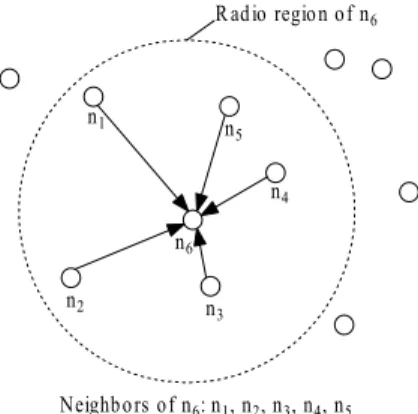
is implemented by comparing the sent packets with the over- heard packets to see if there is a match. Take the topology in Fig. 1 as an example. Here,n6is assumed to be an attacker.
The attacker, n6, forwards the packets fromn2 with drop ratio 90%, but the packets from other neighbors with drop ratio 10%. By the TEF, the behaviors fromn6ton2only can be reflected in the evaluated trust fromn2ton6. However, they cannot influence the trusts from nodesn1,n3,n4,n5 to n6. Thus,n6performs misbehavior ton2, but is contradicto- rily thought as a good guy by other nodes.
Fig. 1 A topology for descriptions of possible attacks.
Fig. 2 Location-dependent attack.
2.2 Location-Dependent Attack
Consider that an attacker misbehaves at one location and behaves normally at another location. We call this attack location-dependent attack. This attack is harmful to TEF, which also roots in the subjective characteristic, because the behaviors at one location cannot influence the trust evalua- tion of nodes at another location.
An example for location-dependent attack is shown in Fig. 2. In Fig. 2,n11 is assumed to be an attacker. At loca- tion 1,n11forwards the packets from all the neighbors with high drop ratio 90%, which makes its trust low. But when it is desired to send packets, it moves to location 2. Here it forwards the packets for these new neighbors with drop ra- tio 10%, which makes its trust high. At location 2, the trusts from nodesn6,n7,n8,n9,n10ton11have not been influenced by the misbehavior ofn11at location 1. Thus,n11can obtain normal service at location 2 in spite of its misbehaviors at location 1.
2.3 Other Attacks
We also consider other attacks identified in [2], [21]. By on-offattack [21], attack nodes perform normal behaviors at one time period and then perform misbehaviors at an- other time period. Since thetrustof attack node in existing frameworks does not decrease sharply, the attack node can perform many misbehaviors before it is stopped. This attack is harmful for both RBF and TEF.
Malicious nodes can attack the framework by provid- ing false recommendations including false accusation and false praise, which is referred to as bad mouthing attack [21]
and false ratings [2]. This attack is harmful for the RBF in form of false reports on the observed behaviors. Also this at- tack can put effect on the TEF to provide deliberate or bias recommendations.
By the conflicting behavior attack, attack nodes will behave differently to the nodes in different groups to make the opinions from different good groups to the attacker con- flicting, and then make them be unable to trust each other.
This attack is harmful for both the RBF and TEF, when they are equipped with recommendation generation system.
By sybil attack [15], [19], [21], attacker uses the faked IDs to cooperate with each other to make the trust system run out. New comer attack [10], [21] means that attacker can remove their bad history by registering as a new user.
Both these two attacks can be inhibited by the usage of au- thentication scheme, which is beyond the topic of this paper.
2.4 Other Problems with RBF
To describe the trust for a node accurately, there are two im- portant parameters,trust valueandconfidence value. Trust value corresponds to the estimation of a node’s trust on a specific action. Confidence value is another indispensable parameter which characterizes the statistical reliability of the computed trust value. For the RBF, however, confidence value has not been involved, which makes the evaluated trust value sceptical. Moreover, the detailed second-hand infor- mation distribution method has not been provided in RBF.
3. Countermeasures of the Attacks
We firstly address selective misbehavior attack and location- dependent attack. Both two attacks root in the subjective characteristic of TEF. Therefore, it is necessary to design an objective trust management framework, by which the trust is formed based on not only direct observations but also second-hand information.
As for on-off attack, we propose the exponential de- crease method with the adaptive discount factor. That is, only if a node performs normal behavior continuously for long time period, it can be put on high trust. However, if few misbehaviors of a node are observed, its trust will decrease sharply. Also, if few observations of normal behaviors are collected after many observations of misbehavior, its trust can be raised sharply to encourage such behavior.
The solution to deal with bad mouthing attack and con- flicting behavior attack consists of two parts, detection part and process part. In the detection part, deviation test and the check on trust level of information provider are used to dis- cover these two attacks. Deviation test is based on the statis- tical characteristic of observations [2]. After deviation test, recommendation generation systemis proposed as a frame- work to manage the trust levels of these recommendations issued by different nodes, which is used to differentiate these
two attacks. In the process part, if bad mouthing attack is de- tected, recommendation generation system is used to punish the attacker by lowering the trust level. Otherwise, the at- tacker is punished by including this second-hand informa- tion into trust evaluation for the attacker.
For other newly discovered problems with existing RBF, the confidence value will be included into the pro- posed trust management framework and a second-hand in- formation distribution method in more detailed form will be presented.
To design a robust trust management framework, we combine the merits of the existing frameworks while remov- ing the problems of them. All these proposed countermea- sures are integrated into a hybrid framework, HTMF. Within HTMF, trusts for nodes in the network are evaluated based on both direct observations and second-hand information.
Deviation test and the recommendation generation system are included into second-hand information processing pro- cedure. Also, influence exponential decrease method with adaptive discount factor is integrated into trust evaluation.
Moreover, trust value and confidence value are evaluated and combined into a whole metric, trustworthiness. Here, trustworthiness is the whole metric to show the trust levels of nodes in this paper.
4. Proposed Hybrid Trust Management Framework The proposed hybrid trust management framework (HTMF) is designed based on a novel modified Bayesian approach.
Here, we firstly introduce standard Bayesian approach [2], [7], [22]. Assume that subject node believes object node be- haves normally with probability θ, which can also be de- scribed as p(B). HereB will bebelief. Also we simplify Observationto beO. Similarly to [7], the formula for stan- dard Bayesian approach is provided as follows.
p(B|O)= p(O|B)∗p(B)
NormalizingConstant (1)
where p(B) is the prior probability,p(O|B) is the likelihood function, andp(B|O) is the posterior distribution.
Beta distribution is the most promising distribution to representp(B), since it is flexible and simple and its conju- gate is also a Beta distribution [2], [7], [9], [22]. Therefore, θin HTMF is assumed to follow Beta distribution [5] as fol- lows.
Beta(θ, α, β)= Γ(α+β)
Γ(α)Γ(β)θα−1(1−θ)β−1
∀0≤θ≤1, α≥0, β≥0 (2) From Eq. (2), we can see that there are two parameters to characterize a Beta distribution,αandβ, which is very suitable for trust management. Within HTMF,αandβare used to denote magnitude of normal behaviors and misbe- haviors, respectively.
In this paper, the notation,{sub ject : ob ject,action}, is used to denote the trust relation from a subject node to an object node on a specific action. We useIT F to denote
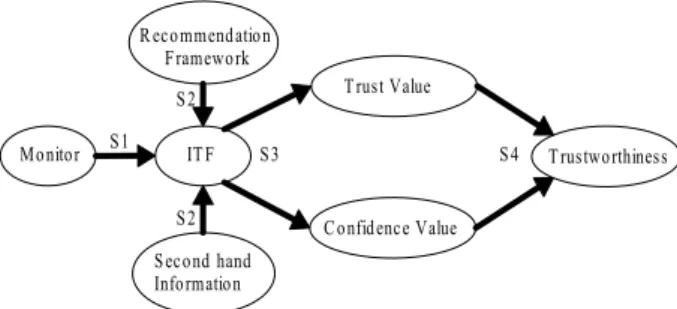
Fig. 3 HTMF: Hybrid trust management framework.
initial trust formthat is formed by the collected data.IT F{i: j,action}, the initial trust form from nodei to node j on a specific action, action, is defined as (αi j, βi j). Here αi j
andβi jare the number of normal behaviors and the number of misbehaviors of node jobserved by nodei, respectively.
At the same time, second-hand informationSk jis similarly defined as the pair (αk j, βk j).
The utility of standard Bayesian approach is provided as follows. Initially, θis uniformly distributed between 0 and 1, which is described asBeta(θ,1,1). Then if there are s observations with normal behaviors and f observations with misbehaviors, the posterior distribution is updated by α = α+sandβ = β+ f. After training by a large num- ber of observations,θwill be close to αα+β, with high prob- ability. It can be concluded that if one node performs more normal behaviors,θwill converge to 1 and this node is more trustable [2], [13].
By the standard Bayesian approach, the same weight is given to each observation, regardless of the time of occur- rence or who the provider is. Here to integrate all the coun- termeasures proposed in Sect. 3 into our framework, we de- velop a novel modified Bayesian approach. Firstly, to expire old observations and defense against on-offattack, influence exponential decrease method is used. Whensobservations with normal behaviors and f observations with misbehav- iors are collected during time periodtd,αandβare updated byα=wt1d∗(α−1)+1+sandβ=wt1d∗(β−1)+1+f, wherew1 is the discount factor. To defense against on-off attack, w1 should be an adaptive value. Secondly, to pun- ish nodes performing bad mouthing attack, we use the trust- worthiness of the information provider in recommendation generation system as the weight for the second-hand infor- mation it published.
4.1 HTMF Overview
We provide the skeleton for the HTMF as in Fig. 3, which consists of four steps,S1, S2, S3, S4 as below.
Step S1: Update ITF through Direct Information. Each node in the network monitors the behavior of its neigh- bors using watchdog mechanism [14]. In this step, the influence exponential decrease method with adaptive discount factor is used to expire old observations and defend against on-offattack.
Step S2: Distribute and process second-hand informa- tion. The direct observations obtained by one node k about a neighboring node, node j, can be used by another node i as second-hand information about the behaviors of node j. The second-hand information is flooded in the network. The nodes receiving these information check them by deviation test and other checks and then use the trustworthiness of informa- tion provider in the recommendation generation system (see Sect. 4.6) as the weight. This is used to inhibit bad mouthing attack and conflicting behavior attack. Due to the watchdog mechanism, the behaviors (of node j) observed by any two neighbors of node j will never overlap each other.
Step S3: Evaluatetrustandconfidence valueevaluation.
One node forms the elementary opinion for another node,trust valueandconfidence value, based on ITF obtained through steps S1 and S2. A hightrust value means that the subject node trusts that the object node can perform an action well. The confidence value means the accuracy of the calculated trust value. A highconfidence valuerepresents that the object node has passed a large number of tests which have been given by the subject and other nodes. Obviously opin- ions with a high confidence are more useful in making decisions. Here the vulnerability for absence ofconfi- dence valuehas been solved by including this parame- ter into opinion formation.
Step S4: Evaluate trustworthiness. Since two parameters are difficult for trust comparison [22], two parameters formed in S3, namely trust value and confidence value, are combined into a whole trust metric, trustworthi- ness, to another node.
We will elaborate each step in more detailed form in the following subsections.
4.2 ITF Update through Direct Information
At this step, the ITF is firstly initialized as (1,1). Then each node in the network observes the behaviors of its neighbor- ing nodes, and updates the ITF in succession. When an ob- servation for node j is obtained by nodei, the ITF should be updated. Let s∈ {0,1}be the set of symbols for obser- vations. That is, if a normal behavior is observed, s = 1;
otherwises=0. The ITF is updated as follows:
αi j=wCT1 −tlast∗(αi j−1)+1+s βi j=wCT1 −tlast∗(βi j−1)+1+1−s
(0≤w1≤1) (3)
wherew1is a discount factor,CTis current time, andtlastis the time point that last update was performed.w1is an adap- tive value between 0 and 1. wCT1 −tlast is the factor to expire old observations exponentially, which is called influence ex- ponential decrease method in this paper. In Eq. (3), we use αi j−1 andβi j−1, because they are the actual number of ob- servations on the behaviors and the minimum value for both
αi jandβi j is 1. Here we utilize memoryless characteristic for exponential distribution.
To defense against on-offattack,w1is set as an adaptive value which changes under different cases. To differentiate these cases, we use two characteristics for the collected in- formation. One is normal behavior ratio for last fixed num- ber of observations, which is denoted byN BR(Normal Be- havior Ratio). For example, if we set this fixed number is 100 and there are 94 normal behaviors in the last 100 obser- vations,N BRwill be 94/100. The other characteristic is the detail information for recent fixed number of observations, which is denoted byRO(Recent Observations). For exam- ple, if this fixed number is 4, the last 2 observations on the behavior of one node are misbehaviors and the observations from last 3 to last 4 are normal behaviors,ROcan be set as 1100. Here we useabcdto denote each bit forRO. Using these two characteristics, we provide four cases as follows.
Case 1: N BR≥T hreshold,d=1 anda+b+c+d>=3.
This case corresponds to the situation that there are many normal behaviors which have been observed in the past time, current observations are normal behav- iors and most of recent observations are also normal behavior. Under this situation, this trend should be en- couraged.w1will increase until it approaches 1.
Case 2: N BR ≥ T hreshold, d = 0 or d = 1 and a+b+c+d ≤ 2. This case corresponds to the sit- uation that there are many normal behaviors in the past time, but current observation is misbehavior or current observation is normal behavior but most of recent ob- servations are misbehaviors. The nodes under this sit- uation should be punished strictly to prevent the trend for performing misbehavior. Thus,w1will drop greatly to a low value. It will decrease until the trust for this node reaches a threshold. Then for next misbehaviors, w1 will increase gradually. This means whatever you have done many normal behaviors, if you perform mis- behavior, the normal behaviors you did before will be much useless.
Case 3: N BR < T hreshold, d = 1 or d = 0 and a+b+c+d≥3. Here,d=0 anda+b+c+d≥3. This case corresponds to the situation that there are many misbehaviors in the past time, but current observation is normal behavior or current observation is misbehav- ior but the most recent observations are mostly normal behaviors. This trend should be encouraged, since the node is trying to perform normal behavior. For this situation,w1 will drop greatly to a low value. It will decrease until the trust for this node is above a thresh- old. Then for next normal behaviors,w1 will increase gradually. This means if you did a good behavior, your past of misbehaviors will be forgot quickly.
Case 4: N BR <T hreshold,d =0 anda+b+c+d ≤ 2. This case corresponds to the situation that there are many misbehaviors which have been observed in the past time, current observation is still misbehavior and most of recent observations are misbehaviors. In this
case,w1will increase gradually to punish the node until it approaches 1.
The descriptions above correspond to the situation that some observations have been collected during time interval, td. But if there is no observation obtained duringtd, the ITF will also be updated as follows:
αi j=wCT1 −tlast∗(αi j−1)+1=wt1d∗(αi j−1)+1 βi j=wCT1 −tlast∗(βi j−1)+1=wt1d∗(βi j−1)+1
(0≤w1≤1) (4)
At the same time, second-hand information is obtained every periodT. At the beginning of every period, second- hand information,Sk j, is initialized as (0,0). If nodekob- tains an observation for j, theSk jshould be updated. Here also let s ∈ {0,1}be the set of symbols for observations.
That is, if the observation is normal behavior,s=1; other- wises=0. TheSk jshould be updated as follows:
αk j=wCT1 −tlast∗αk j+s
βk j=wCT1 −tlast∗βk j+1−s (0≤w1 ≤1) (5) Similarly, if node khas not obtained any observation during a time intervaltd, theSk jwill be updated as follows:
αk j=wt1d∗αk j
βk j=wt1d∗βk j (0≤w1≤1) (6) The second-hand information is reset every period,T. When one period T reaches, it is kept as one piece of second-hand information. Meanwhile,Sk jis reset to (0, 0).
4.3 Second-Hand Information Distribution and Processing To disseminate second-hand information throughout the net- work, we provide the detailed method for second-hand information distribution and processing here in contrast with [2], where it has not been provided in detail. Note that the recommendation generation system which we will present shortly in Sect. 4.6 is used in this step (i.e., Step S2).
After the formation of the second-hand information, it should be flooded throughout the network. We consider the situation that a node receives a published second-hand infor- mation. The algorithm it will perform is provided as below.
Algorithm:
i f(it has not been received be f ore)
{receive this in f ormation and per f orm deviation test and one check;
i f(bad mouthingattack is detected) {
drop this in f ormation;
update the trustworthiness o f in f ormation provider in recommendationgeneration system.
}else{
obtain the trustworthiness o f the provider f rom recommendationgeneration system;
update IT F;
distribute such message to its neighbors.
}}else{
drop the message.
}
In the above algorithm, the node firstly should check whether it has received this information before. If it has, only drop this information. Otherwise, it will verify the reli- ability of such information to recognize bad mouthing attack and conflicting behavior attack. As mentioned in previous section, bad mouthing attack can be performed by issuing false information to disturb system, and conflicting behavior attack can be employed to disturb recommendation genera- tion system. Thus, it is important to perform second-hand information verification to differentiate both of them. Thus after the node receiving a second-hand information, it will perform a deviation test. The deviation test is provided as follows.
|E(Beta(θ, αk j, βk j))−E(Beta(θ, αi j, βi j))| ≤m (7) wheremis the deviation threshold. If this test is passed, the receivedSk j is reliable and start processing it. Otherwise, there are two cases which should be considered. Case 1:
nodekperforms bad mouthing attack. Case 2: node jper- forms conflicting misbehavior attack. According to counter- measures in Sect. 3, here we use the check on trust level of information provider in recommendation generation system to differentiate them. If the trust for nodekin recommen- dation generation system is lower than a threshold, nodei will think nodekperforms bad mouthing attack. Thus this second-hand information will be dropped and one misbe- havior of node kon recommendation is collected. Other- wise, node jis thought to perform conflicting behavior at- tack and this second-hand information will be included into the trust evaluation for node j, because this information is the real information on the behaviors of node j.
αi j =wCT1 −tlast ∗(αi j−1)
+wCT1 −tpublishingtime∗w2∗αk j+1 βi j =wCT1 −tlast ∗(βi j−1)
+wCT1 −tpublishingtime∗w2∗βk j+1 (0≤w1 ≤1) w2 =T(i:k,recommendation) (8) where wCT1 −tlast andwCT1 −tpublishingtime are the exponential de- crease factor for expiring current ITF and the received second-hand information, respectively. To make trustwor- thiness in recommendation generation system influence trust evaluation, here it is used as the weight put on the re- ceived second-hand information. In (8),w2 is set asT(i : k,recommendation). T(i : k,recommendation) represents the trustworthiness from node i to node k on the action, recommendation, in the recommendation generation sys- tem.
4.4 Trust and Confidence Value Evaluation
In HTMF, elementary trust from the subject node, nodei, to
the object node, node j, is composed of trust value and con- fidence value. Here confidence value is included into trust evaluation in contrast with RBF. The definition for it is sim- ilar to [22]. It is noticeable that a TEF has been proposed in [28], which is intrinsically different from the proposed HTMF, where second-hand information is included in trust evaluation. Trust value is to specify the trust estimation of nodeito node j. Confidence value is to describe the accu- racy of the evaluated trust value. Some notations are defined as follows.
• t{i : j,action}: Trust value that nodeiputs on node j for a specific actionaction. It has the property 0≤t{i:
j,action} ≤1.
• σ{i: j,action}: Standard deviation of trust value from nodeito node jon a specific actionaction.
• c{i : j,action}: Confidence value of trust value from nodeito node jon a specific actionaction. It also has the property 0≤c{i: j,action} ≤1
Here we investigate calculation method for these pa- rameters. Since the relation between the characteristic of Beta function and the trust is clarified in the first part of this Section, thetrust valuecan be calculated as the expectation value ofbeta(θ, α, β).
t{i: j,action}=E(Beta(θ, α, β))= α
α+β (9)
Here ift{i : j,action} approaches to 1, it means that node itrusts node jto perform the actionaction. On the contrary, if t{i : j,action} approaches to 0, it means that nodeidistrusts node jto perform the actionaction.
The other important parameter,c{i: j,action}, is used for characterizing the statistical reliability of the computed t{i : j,action}. It is a value between 0 and 1. Similarly to [22], σ{i : j,action} andc{i : j,action} are calculated as formula (10) and (11), respectively.
σ{i: j,action}=σ(Beta(θ, α, β))
=
αβ
(α+β)2(α+β+1) (10) c{i: j,action}=1−√
12σ(Beta(θ, α, β))
=1−
12αβ
(α+β)2(α+β+1) (11) Here if c{i : j,action}approaches to 1, it means that the evaluatedtrust valuefrom nodeito node jon the action actionis believable because enough observations on behav- iors have been collected. On the contrary, ifc{i: j,action}
approaches to 0, it means that the evaluated trust valueis untrustworthy because of the lack of observation collection.
4.5 Trustworthiness Evaluation
Here we combine (t,c) into one parameter, trustworthiness, which is the final evaluatedtrustfor nodes. It can be utilized to judge whether a node is a good guy or not more easily.
We useT{i: j,action}to represent the trustworthiness from nodei to node j on a specific action action. Similarly to [22], the obtainedT{i : j,action}has the following proper- ties.
• 0≤T{i: j,action} ≤1.
• T{i : j,action} is induced from t{i : j,action} and c{i : j,action}, but there are some rules for the cal- culation. Given a pair of trust value and confidence value, if the confidence value is high, trust value plays more important role for the trustworthiness formation.
Thus under this situation,t{i: j,action}, should be put larger weight than confidence valuec{i: j,action}. On the contrary, if the confidence value is low, obviously the confidence value is more important than trust value when evaluating trust. Therefore,t{i: j,action}, should be put less weight than confidence valuec{i: j,action}. Similarly to [22], the value of trustworthiness can be defined as
T{i: j,action}=1−
(t{i:j,action}−1)2
x2 +(c{i:j,actiony2 }−1)2
1
x2+y12
(12) where x and y are constants. The research in [22] shows that the most appropriate values for the trustworthiness parame- ters arex = √
2 andy = √
9. Therefore, in this paper, we also setxbe √
2 andybe √ 9.
Also a threshold value of trustworthiness is defined as
Tthreshold :=T(0.5,0.5)=0.5 (13)
which represents the trustworthiness value assigned to a node with thetrust valueto be 0.5 andconfidence valueto be 0.5, respectively. This threshold value can be used to classify the nodes into good guys or bad guys. That is, if thetrustworthinessfrom one node,i, to another node, j, is larger thanTthreshold, it means that nodeitrusts that node j is a good guy and is preferable to perform a specific action.
Otherwise, it denotes that nodeidoes not believe that node jis preferable to perform an action.
4.6 Recommendation Generation System
The recommendation generation system is used to prevent the nodes in the network from providing false recommen- dation, which exhibits as the deliberate false second-hand information in the proposed HTMF. Since the HTMF is a general framework, it is also fit to construct a recommenda- tion generation system. Therefore, recommendation genera- tion system is designed as the trust management framework with action to be “recommendation”.
In the recommendation generation system, IT F(i : j,recommendation) is initiated as (1,1). If an observa- tion of node jis obtained by node i, node ishould firstly judge whether it is a normal behavior or misbehavior. The
method to differentiate them is the deviation test and an- other check which are provided in Sect. 3. If one node is thought to perform bad mouthing attack, one misbhavior for it is observed. Then thisIT F will be updated similarly as in Sect. 4.2. Also the collected observations should be published and processed as second-hand information simi- larly as in Sect. 4.3. After that, the trustworthiness in the recommendation generation system can be calculated as in Sects. 4.4 and 4.5. The obtained trustworthiness can be fi- nally used as the weight on the second-hand information as in 4.3.
5. Performance Evaluation
Among these intrinsic problems, selective misbehavior at- tack and location-dependent attack are two novel attacks discovered in this paper. The countermeasures to other at- tacks are similar to those proposed in [2], [21]. Their effec- tiveness have already been verified. Thus, here we only clar- ify the robustness of HTMF under the two newly discovered attacks and the effectiveness for including confidence value into trust evaluation.
5.1 Selective Misbehavior Attack
To demonstrate that the proposed HTMF can inhibit the se- lective misbehavior attack, which occurs in the TEF, we in- vestigate the following two metrics.
1. The trustworthiness values to the attacker, which are the trust levels from other nodes to the attacker.
2. The throughput of the attacker, which is defined as the total successfully delivered message divided by the simulation time.
5.1.1 Trustworthiness Value
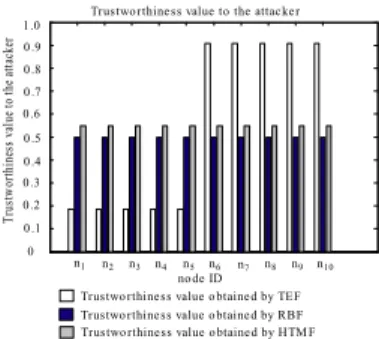
We consider the scenario depicted in Fig. 1. Here, we will not consider influence exponential decrease of observations.
In this scenario, n6 is the attacker, who performs selec- tive misbehavior attack. Here, it is assumed that n6 for- wards the packets from n2 with drop ratio 90%, and with drop ratio 10% for other neighbors. In the mean time, there are 2000 packets forn6to forward for each neighbors, n1,n2,n3,n4,n5.
Under this situation, we can obtain the result as in Fig. 4. In Fig. 4, by the TEF, the trustworthiness fromn2to n6is much lower. However, the trustworthiness from other neighbors ton6is much higher. Obviously, the misbehaviors fromn6 ton2have not influenced the trustworthiness from other neighbors ton6. In contrast, by the proposed HTMF and the RBF, the trustworthiness and the corresponding rep- utation are the same for each neighbor. This is because by each of them, the trust for one node is evaluated objectively.
Thus the misbehavior fromn6 ton2 also put effect on the trust level from other neighbors ton6. That is, the attacker cannot perform misbehaviors and keep its trustworthiness at
Fig. 4 Trustworthiness to the attacker from different nodes in the neigh- borhood.
Fig. 5 The topology of the experiment network.
a high level at the same time. Therefore, we can see that the HTMF and the RBF can inhibit the selective misbehavior.
5.1.2 Throughput of the Attacker
To explain that the proposed HTMF can restrain the selec- tive misbehavior attack, we carry out simulations to inves- tigate how the throughput of the attacker changes with the drop ratio from the attacker to the victim node on the for- warding packets.
We simulate the proposed objective framework using an object-oriented modular discrete event simulator called OMNET++[33]. In our simulation, each node is a com- pound module and the communications between the mod- ules are made via message exchange. The routing model we use is the routing protocol, AODV [17], since it is represen- tative protocol for multihop dynamic wireless network.
The topology shown in Fig. 5 is used for simulations.
In this topology, the connections between any two nodes are the wireless links. That is,n1,n3,n4exist in the radio region ofn2, butn5is out of the radio region ofn2.
In this scenario, n1 and n2 send packets to n5 with constant rate, 100 packets/second. At the same time, n3 and n4 send packets to n1 with constant rate, 1 packet/second. Heren2 is the attacker. In our implemen- tation, we letn2 forward the packets fromn1 with drop ra- tio 90%,80%,70%,60%,50%, but forward the packets from n3,n4,n5 normally. In the simulation, the attacker concen- trates the attack on the delivery of three kinds of packets, data packets, RREQ (Route Request) and RREP (Route Re- ply).
In the implementation of the proposed HTMF, the node in the network evaluates the trustworthiness based on all the
Fig. 6 The comparison of throughput for node 1.
observed behaviors from other nodes. In the implementation of TEF, the node evaluates the trustworthiness only based on the direct observations. Additionally, the normal nodes forward the packets from other node according to the trust- worthiness of this node. In our simulation, if the trustwor- thiness from one node,ni, to another node,nj, is lower than Tthreshold,niwill thinknjis an attacker and will not forward the packets fromnj.
The simulation time for each run is 500 seconds. We run the simulation 40 times with different seeds. The confi- dence level in our simulation is 95%, and confidence interval is 10%. We can obtain the results for the throughput of the attacker,n2, as in Fig. 6.
From Fig. 6, we can see that by the proposed HTMF, the throughput of the attacker drops greatly with its drop ratio to the packets from the victim node increases. This is because the misbehaving node is punished by high drop ratio from other nodes to the packets it sends when its trust- worthiness drops. However, by TEF, the throughput has not been influenced by the misbehavior from the attacker to the victim node. At the same time, we can see that the through- put by the proposed framework drops greatly at an interval of the drop ratio to the victim, which is from 0.6 to 0.7. The reason for that is the critical point for the trustworthiness value equaling to Tthreshold exists in this interval. Totally speaking, the simulation result demonstrates the effective- ness of HTMF in inhibiting the selective misbehavior attack compared with the existing framework.
5.2 Location-Dependent Attack
For location-dependent attack, we also investigate trustwor- thiness value to the attacker, and will not consider influence exponential decrease method. Here we consider the scenario depicted in Fig. 2. In this scenario, n11 is the attacker per- forming location-dependent attack.
Without loss of generality, it is assumed that each node in any location has 2000 packets, which need n11 to for- ward. Meanwhile, we assume thatn11forwards the packets for the neighbors at location 1 with drop ratio 90%, and for the neighbors at location 2 with drop ratio 10%.
For this situation, we obtain the results as in Fig. 7. In this Figure, by TEF, the trustworthiness from the neighbors ofn11at location 1 is much lower, while the trustworthiness
Fig. 7 Trustworthiness to the attacker for different nodes at different places when the attacker is at place 2.
Fig. 8 Trustworthiness obtained by HTMF Vs Reputation obtained by RBF under the following cases: case 1:α=1; case 2:α=25; case 3:α=50;
In all cases,βvaries from 1 to 50.
from the neighbors at location 2 is very high. It is obvious thatn11still can obtain good service at location 2 even it has performed many misbehaviors at location 1. The reason that this unfair status occurs is also because the trust for a node is evaluated subjectively only based on direct observations.
In contrast, by the proposed HTMF or RBF, the trust for a node is evaluated objectively. Therefore, the behaviors at location 1 put effect on the trust evaluation at location 2 and location-dependent attack can be prevented by HTMF.
5.3 Absence of Consideration on Confidence Value To show the necessity of introducing confidence value to the framework, we compare the evaluated trusts by the proposed HTMF and the RBF. We will not consider the influence ex- ponential decrease for observations here. The trust metrics in HTMF and RBF are expressed as trustworthiness and rep- utation, respectively.
We consider three cases: case 1: α=1; case 2: α=25;
case 3: α=50. That is, the number of observations on nor- mal behaviors are set as 1, 25 and 50. In all these cases,β varies from 1 to 50, which means the number of observa- tions on misbehaviors varies from 1 to 50. We can obtain the results as Fig. 8. From this figure, we can see that for all cases when the number of observations is low, the eval- uated trustworthiness by HTMF is lower than the reputation obtained by RBF. This is because that the low confidence value influences on the evaluated trust. On the other hand, when the number of observations becomes larger, the confi- dence value will become higher which reflects in the higher trust for the HTMF than that for RBF.
Also, with increasing of number of observations, the difference between HTMF and RBF increases, because HTMF introduces confidence value in trust formation.
When more observations are collected, the evaluated trust is more trustable in HTMF. In contrast, RBF has not in- cluded confidence value and it is not influenced by the num- ber of the collected observations. It is obvious that the trust- worthiness of HTMF coincides with the human intuition.
The trustworthiness with more observed behaviors should be higher than the nodes with less observed behaviors.
Therefore, we can see that by HTMF, the more reli- able trust can be obtained than existing RBF, because HTMF can correspond well to decrease the evaluated trust when the number of collected observations is small and to increase the evaluated trust when the number of observations increases compared to RBF.
6. Conclusions
In the paper, we clarify the intrinsic problems with exist- ing frameworks, and provide the countermeasures for them.
Then we propose a novel hybrid trust management frame- work called HTMF. The proposed HTMF holds objective feature by which trust for a node is evaluated based on not only direct observations but second-hand information. It makes HTMF robust under selective misbehavior attack and location-dependent attack in contrast to the TEF. The pro- posed HTMF can also inhibit other possible attacks in the existing frameworks, such as on-off attack, bad mouthing attack, and conflicting behavior attack. Also confidence value has been included into the trust evaluation and de- tailed second-hand information distribution and processing method have been provided. We perform performance eval- uations for the comparison between the proposed HTMF and existing frameworks. From the evaluation results, we can see that HTMF is more robust and reliable than existing frameworks.
Acknowledgements
This work is partially supported by Grant-in-Aid for Sci- entific Research of Japan Society for Promotion of Science (JSPS) and Collaboration Research Grant of National Insti- tute of Informatics (NII), Japan.
References
[1] J.S. Baras, T. Jiang, and P. Purkayastha, “Constrained coalitional games and networks of autonomous agents,” Proc. Third Interna- tional Symposium on Communications, Control and Signal Process- ing, pp.972–979, St. Julians, Malta, March 2008.
[2] S. Buchegger and J.-Y. Le Boudec, “A robust reputation system for P2P and mobile ad-hoc networks,” Proc. P2PEcon 2004, Harvard University, Cambridge MA, USA, June 2004.
[3] E. Chang and T.S. Dillon, “Trust, reputation, and risk in cyber phys- ical systems,” AIAI 2013, 2013.
[4] D. Chen, G. Chang, D. Sun, J. Li, J. Jia, and X, Wang, “TRM-IoT:
A trust management model based on fuzzy reputation for Internet of things,” Comput. Sci. Inf. Syst., vol.8, no.4, pp.1207–1228, 2011.
[5] A. Davison, “Statistical models,” Cambridge University Press, Cam- bridge Series in Statistical and Probabilistic Mathematics, June 2003.
[6] J. Daly, “Securing cyber-physical systems in the age of connec- tivity,” http://www.fedtechmagazine.com/article/2013/12/securing- cyber-physical-systems-age-connectivity, FedTech Magazine, Dec.
2013.
[7] S. Ganeriwal and M. Srivastava, “Reputation-based framework for high integrity sensor networks,” Proc. ACM Workshop on Security of Ad Hoc and Sensor Networks (SASN 2004), Washington, D.C., USA, Oct. 2004.
[8] M. Haenggi, “Mobile sensor-actuator networks: Opportunities and challenges,” 7th IEEE International Workshop on Cellular Neural Networks and Their Applications, 2002.
[9] A. Jφsang and R. Ismail, “The beta reputation system,” Proc. 15th Bled Conference on Electronic Commerce, Bled, Slovenia, June 2002.
[10] M. Kinateder, E. Baschny, and K. Rothermel, “Towards a generic trust model - Comparison of various trust update algorithms,” iTrust, pp.177–192, 2005.
[11] E.A. Lee, “Cyber physical systems: Design challenges,” Proc. 2008 11th IEEE Symposium on Object Oriented Real-Time Distributed Computing (ISORC’08), pp.363–369, 2008.
[12] R. Levien and A. Aiken, “Attack-resistant trust metrics for public key certification,” Proc. 7th USENIX Security Symposium, pp.229–
242, Jan. 1998.
[13] J. Li, R. Li, and J. Kato, “Future trust management framework for mobile ad hoc networks,” IEEE Commun. Mag., vol.46, no.4, pp.108–114, April 2008.
[14] S. Marti, T. Giuli, K. Lai, and M. Baker, “Mitigating routing misbe- havior in mobile ad hoc networks,” Proc. MobiCom 2000, pp.255–
265, Aug. 2000.
[15] J. Newsome, E. Shi, D. Song, and A. Perrig, “The sybil attack in sensor networks: Analysis and defenses,” Proc. Third International Symposium on Information Processing in Sensor Networks (IPSN), 2004.
[16] T.G. Papaioannou and G.D. Stamoulis, “Achieving honest rating with reputation-based fines in electronic markets,” Proc. IEEE In- focom 2008, April 2008.
[17] C. Perkins and E. Royer, “Ad hoc on-demand distance vector rout- ing,” 2nd IEEE Workshop on Selected Areas in Communication, pp.90–100, New Orleans, LA, Feb. 1999.
[18] Y. Cho, G. Qu, and Y. Wu, “Insider threats against trust mecha- nism with watchdog and defending approaches in wireless sensor networks,” IEEE Symposium on Security and Privacy Workshops, pp.134–141, May 2012.
[19] P. Resnick, R. Zeckhauser, E. Friedman, and K. Kuwabara, “Repu- tation systems,” Commun. ACM, vol.43, no.12, pp.45–48, 2000.
[20] J. Sen, “A distributed trust management framework for detecting ma- licious packet dropping nodes in a mobile ad hoc network,” Int. J.
Network Security & Its Applications (IJNSA), vol.2, no.4, pp.92–
104, Oct. 2010.
[21] Y. Sun, Z. Han, W. Yu, and K.J.R. Liu, “A trust evaluation frame- work in distributed networks: Vulnerability analysis and defense against attacks,” Proc. IEEE Infocom 2006, Barcelona, Spain, April 2006.
[22] C. Zouridaki, B.L. Mark, M. Hejmo, and R.K. Thomas, “A quantita- tive trust establishment framework for reliable data packet delivery in MANETs,” Proc. 3rd ACM Workshop on Security of Ad Hoc and Sensor Networks (SASN 2005), Alexandria, VA, USA, Nov. 2005.
[23] B. Tajes, M. Rajkumar, K. Sushan, and K. Chandrasekaran, “Trust management in ad hoc networks: A social network based approach,”
Network and Complex Systems, vol.1, no.1, pp.24–32, 2011.
[24] Y. Takehana, I. Nishimura, N. Yosaka, T. Nagase, and Y. Yoshioka,
“Building trust among certificates management nodes in mobile ad- hoc networks,” Proc. 26th International Conference on Advanced Information Networking and Applications Workshop, pp.564–568,
2012.
[25] G. Theodorakopoulos and S. Baras, “Malicious users in unstructed networks,” Proc. IEEE Infocom 2007, Alaska, USA, April 2007.
[26] R. Verdone, D. Dardari, G. Mazzini, and A. Conti, Wireless Sensor and Actuator Networks: Technologies, Analysis and Design, Aca- demic Press, 2008.
[27] H. Xia, Z. Jia, L. Ju, X. Li, and Y. Zhu, “A subjective trust man- agement model with multiple decision factors for MANET based on AHP and fuzzy logic rules,” 2011 IEEE/ACM International Confer- ence on Green Computing and Communications (GreenCom2011), pp.124–130, Aug. 2011.
[28] H. Yong, C. Yu, C. Zhou, and W. Song, “A distributed key man- agement framework with cooperative message authentication in VANETs,” IEEE J. Sel. Areas Commun., vol.29, no.3, pp.616–629, 2011.
[29] B. Yu, M.P. Singh, and K. Sycara, “Developing trust in large-scale peer-to-peer systems,” Proc. First IEEE Symposium on Multi-Agent Security and Survivability, 2004.
[30] R. Zhou and K. Hwang, “PowerTrust: A robust and scalable reputa- tion system for trusted peer-to-peer computing,” IEEE Trans. Paral- lel and Distributed Systems, vol.18, no.4, pp.460–473, April 2007.
[31] “Designed-in cyber security for cyber-physical systems,” http://
www.cybersecurityresearch.org/documents/CSRA Workshop Report.pdf, 4-5 April 2013, Gaithersburg, Maryland.
[32] “Internet of Things in 2020: Roadmap for the future,” http://www.
smart-systems-integration.org/public/documents/publications/ Internet-of-Things in 2020 EC-EPoSS Workshop Report 2008 v3.
pdf, 05 Sept., 2008.
[33] “OMNET++Community Site,” http://www.omnetpp.org/index.php
Ruidong Li is a researcher of the network architecture laboratory at NICT. He received a bachelor in engineering from Zhejiang Univer- sity, China, in 2001. He received a master and doctorate of engineering from the University of Tsukuba in 2005 and 2008, respectively. Since 2008, He is a member of the AKARI archi- tecture design project and network architecture laboratory in NICT. His current research inter- ests include information-centric network, inter- net of things, security/secure architectures of fu- ture networks, and regional platform network.
Jie Li is a professor in Division of Infor- mation Engineering, Faculty of Engineering, In- formation and Systems, University of Tsukuba, Japan. His research interests are in mobile distributed multimedia computing and network- ing, OS, network security, modeling and perfor- mance evaluation of information systems. He is a senior member of IEEE and ACM, and a member of IPSJ (Information Processing Soci- ety of Japan). He has served as a secretary for Study Group on System Evaluation of IPSJ and on several editorial boards for IPSJ Journal, IEEE Transactions on Vehicu- lar Technology, Wiley Wireless Communications and Mobile Computing, and so on, and on Steering Committees of the SIG of System EVAluation (EVA) of IPSJ, the SIG of DataBase System (DBS) of IPSJ, and the SIG of MoBiLe computing and ubiquitous communications of IPSJ. He has also served on the program committees for several international conferences such as IEEE ICDCS, IEEE INFOCOM, IEEE GLOBECOM, and IEEE MASS.
Hitoshi Asaeda is a Planning Manager of Network Research Headquarters, National In- stitute of Information Communications Tech- nology (NICT). From 1991 to 2001, he was with IBM Japan, Ltd. From 2001 to 2004, he was a Research Engineer Specialist at INRIA Sophia Antipolis, France. He was Project As- sociate Professor of Graduate School of Media and Governance, Keio University, where he was during 2005-2012. He holds a Ph.D. from Keio University. His research interests include rout- ing architectures and future Internet technologies.