Development of rapid and large amount removal technologies of sick/house gases using ACF and elucidation of their removal mechanisms
柳, 棟 曣
https://doi.org/10.15017/4060197
出版情報:九州大学, 2019, 博士(工学), 課程博士 バージョン:
権利関係:
除去技術の開発およびその除去機構の解明
Development of rapid and large amount removal technologies of sick-house gases using ACF and elucidation of their removal
mechanisms
2020 年 2 月
Kyushu University
Interdisciplinary Graduate School for Engineering Science Applied Science for Electronics and Materials
Dong-Yeon Ryu
柳 棟曣
除去技術の開発およびその除去機構の解明
Development of rapid and large amount removal technologies of sick-house gases using ACF and
elucidation of their removal mechanisms
指導教官: 尹 聖昊
2020 年 2 月
九州大学
総合理工学府大学院 量子プロセス理工学専攻
柳 棟曣 Dong-Yeon Ryu 論文調査委員会
主査 九州大学 教授 尹 聖昊
副査 九州大学 教授 島ノ江 憲剛
副査 九州大学 准教授 宮脇 仁
i
The global urbanization trend drives the air pollution crisis with the rapid increase of energy consumption and transportation demands. The urban site suffers severe air-contamination by the emissions of vehicles exhausted gases such as nitrogen oxides (NOX), sulfur oxides (SOX), volatile organic compounds (VOCs), hydrocarbons, etc. Among those air pollutants, the aldehydes like formaldehyde and acetaldehyde considered as seed compounds of particulate matter (PM) under the ambient air atmosphere and indoor sick-building syndrome contributor. In order to reduce and remove the low concentration of aldehydes in the ambient air, the activated carbon (AC) and activated carbon fibers (ACF) are widely used. However, the problem is that the lifecycle, in other words, uptake amount of pollutants, of the adsorbents is very limited and required to be replaced frequently. In this study, the present author attempted to develop a rapid and large amount of removal technologies for the sick-house gases using ACF. After the development, its removal mechanisms of aldehydes by the amine supported porous media examined closely.
In Chapter 1, brief introduction of VOCs, SBS, carbon materials, changes of structure and property of carbon materials depending on heat-treatment temperature, carbon structure models, and scope and objective of this thesis were described.
In chapter 2, the effect of secondary heat-treatment (Calcination) on the ACFs were examined.
Since the porous carbon materials are derived from various precursors such as polyacrylonitrile (PAN), pitch, and cellulose, the basic physical properties such as elemental composition and surface functional groups of ACF is different. The calcination effects are examined at each temperature from 400 to 1400 ℃ through the formaldehyde and acetaldehyde removal tests.
ii
removal capabilities among the calcined ACFs. Aniline was used for impregnating primary amines on the ACF and the others. All the carbon materials in this chapter showed much-improved acetaldehyde removal performance by supporting the aniline even under the relative humidity of 40%. After the acetaldehyde removal test, the chemical substances in the ACF were tracked by the 2- dimensional gas chromatography time of flight analysis.
In chapter 4, harmless and effective primary amine-containing urea and nitric acid as a promoter were co-impregnated on the pitch-based ACF. Only urea impregnated ACF could remove the formaldehyde effectively. However, it showed inhibited removal performance under the humid condition. Therefore, the acidic substance such as nitric acid was co-impregnated on the ACF. As a result, nitric acid promote the oxidation of formaldehyde to formic acid which driving force drag the overall reaction between the formaldehyde and urea effectively.
In chapter 5, developed ACFs and other candidates are verified by using ambient air. The urea only and urea-nitric acid co-impregnated ACFs showed great aldehydes removal capabilities while the pristine ACF and nitric acid impregnated ACF showing limited and worsened capabilities.
Chapter 6 summarizes the main results of this study.
iii
Abstract --- i
Contents ---iii
Chapter 1 General introduction --- 7
1.1 Volatile organic compounds (VOCs) ---8
1.2 Sick-building syndrome (SBS) ---9
1.3 Removal methods for VOCs ---10
1.3.1 Porous carbon materials for the removal of sick-house gases ---12
1.4 Scope and objective of this thesis ---15
References ---19
Figures & Tables ---25
Chapter 2 Investigation of effective aldehydes removal by various precursor-based ACFs with calcination 2.1 Introduction --- 28
2.2 Experimental --- 34
2.2.1 Sample preparation --- 34
2.2.2 Calcination --- 34
2.2.3 Experimental set-up ---35
2.2.4 Characterization ---36
2.3 Results and discussion --- 36
2.3.1 Comparison of formaldehyde removal capabilities by calcined ACFs ---36
2.3.2 Comparison of acetaldehyde removal capabilities by calcined ACFs ---38
2.3.3 Characteristics of ACFs ---38
iv
References ---40
Figures & Tables ---45
Chapter 3 Removal of low concentration acetaldehyde through aniline supported cellulose-based activated carbon fiber 3.1 Introduction --- 61
3.2 Materials and Methods--- 62
3.2.1 Materials --- 62
3.2.2 Experimental apparatus --- 63
3.2.3 2D-GC and TOF-MS --- 64
3.3 Results and discussion--- 65
3.2.3 Preliminary test for acetaldehyde removal--- 65
3.3.2 Acetaldehyde-removal performance of functionalized amine --- 66
3.3.3 2D GC TOF-MS results --- 67
3.3.4 Acetaldehyde removal mechanisms. --- 69
3.4 Conclusions --- 70
References --- 72
Figure & Tables --- 78
Chapter 4 Urea-Nitric Acid co-supported pitch-based micro-porous activated carbon fiber for effective formaldehyde removal 4.1 Introduction --- 91
4.2 Experimental --- 94
4.2.1 Materials and sample preparation ---94
v
4.2.3 Evaluation of formaldehyde removal from ambient air using the adsorbents--- 95
4.3 Results and discussion 4.3.Formaldehyde removal capabilities of pristine ACF, calcined ACF, and other materials- --- 96
4.3.2 Formaldehyde removal capabilities of urea-impregnated pristine ACF, calcined ACF, and other materials --- 98
4.3.3 Formaldehyde removal by nitric acid-impregnated ACFs and combined urea/nitric acid-impregnated ACFs --- 99
4.3.4 Formaldehyde removal capabilities of pristine, urea-impregnated, and urea/nitric acid- impregnated ACFs in a humid atmosphere --- 101
4.3.5. Formaldehyde removal capabilities of pristine, and urea/nitric acid-impregnated ACFs under an ambient atmosphere--- 102
4.3.6. Mechanism of HCHO removal by urea/nitric acid co-impregnated ACF--- 102
4.4 Conclusions ---105
References ---106
Figures & Tables ---110
Chapter 5 Practical demonstration of developed ACF in the ambient air condition 5.1 Introduction ---126
5.2 Experimental ---127
5.2.1 Experimental set-up for ambient air sampling ---127
5.3 Result and discussion ---128
5.3.1 Formaldehyde and acetaldehyde removal performances ---128
5.4 Conclusions --- 130
vi
Chapter 6 General conclusion ---138
Appendix I ---145
論文内容の要旨--- viii
Acknowledgement --- x
7
General introduction
Since the industrial revolution in the early 18th century, the population rose unprecedentedly. Rapid industrial growth led to the increment of air pollution all over the world. In recent years, air pollution in the urban site is one of the big environmental problems in the 21st century [1]. It should be noted that many developing countries such as China and India are experiencing severe air pollution due to rapid growth. According to the press release article by the United Nations, “55% of the world’s population lives in urban areas, a proportion that is expected to increase to 68% by 2050” [2]. Global urbanization trend drives the air pollution crisis with the rapid increase of energy consumption and transportation demands [3].
The urban site suffers severe air-contamination by the emissions of vehicles exhausted gases such as nitrogen oxides (NOX), sulfur oxides (SOX), volatile organic compounds (VOCs), hydrocarbons, etc. These airborne pollutants should be major reasons for the formation of particulate matters (PM) under the UV irradiation (Fig. 1) [2,4]. In order to reduce the air pollutions, many removal technologies have been developed globally. In particular, air pollutant emission regulation for the automobiles and plants, one of the most polluting sources, are managed strictly. Consequently, most of the major air pollutants reduced significantly as time passed. However, the indoor air pollution quality issues still remain a severe problem.
In this thesis, the present author attempted to develop a rapid and large amount of removal technologies for the sick-house gases using activated carbon fibers.
8
1.1 Volatile organic compounds (VOCs)
Volatile organic compounds (VOCs) are literately organic compounds with highly volatile properties at the room temperature. Due to their relatively low boiling point, VOCs can exist indoor environment from various sources. For example, the formaldehyde can be released from the particle board, paints, decorating materials in the house, and other sources.
The acetaldehyde also can exist in the indoor environment, workplace, and ambient air from in wood ceilings, and wooden, particle-board, plywood, and chipboard furniture [5].
Furthermore, one of the toxic substances like toluene, benzene, xylenes, and other highly volatile toxic substances are also considered as a VOCs which cause the sick-building syndrome [6].
Since the VOCs are a major group of air pollutants which contribute to not only the formation of photochemical smog under the sun irradiation in urban sites but also negative health effects to the human body [7-9]. VOCs participate the multi-complex photochemical reactions generate highly toxic secondary pollutant, such as ozone [10] and peroxyacetylnitrate [11], which can threaten human health, plants and vegetation. The negative effects of VOCs indoor are much severe. Since many people spend most of the time indoors, continuous exposure to VOCs can be critical to the human body [12]. Due to its severe toxic effects to the eco-systems, the VOCs are regulated by the United States Environmental Protection Agency (USEPA) and classified as a possible carcinogen by the International Agency Research for Cancer (IARC) and World Health Organization (WHO) [13-15].
A lot of VOC treatment technologies have been discussed by many researchers. As shown in Fig. 2, the techniques depend on the flow rate and concentration of VOCs. The mass emission of VOCs is suitable for the huge scale of applications such as incineration &
9
catalytic oxidation, condensation, membranes, and absorption [16]. In addition, biotechnologies such as bio-filtration can be considered as a cost-effective method for VOC treatment to compare with the oxidation method such as plasma irradiation, photocatalysis, catalytic oxidation, etc. Therefore, it is highly required to develop the indoor low- concentration of VOCs removal techniques. The representative technique is adsorption using porous activated carbon materials or other precursor-based porous materials like zeolites and silica gels. The VOC removal performance of conventional porous carbon materials still needed to improve.
1.2 Sick-building syndrome (SBS)
In the 1970s, sick building syndrome (SBS) was reported to describe a medical condition where people in a building suffer from symptoms of illness or feel unwell for no apparent reason [17]. The SBS is caused by various sources such as insufficient ventilation, indoor or outdoor chemical contaminants, traffic noise, poor lighting, contaminated indoor buildings, bacteria, etc. Among these clues, many VOCs, which can consider as indoor chemical contaminants and impact on the people in building [18,19]. In addition, outdoor chemical contaminants from vehicle exhaust gas also can contribute to SBS [4,7,13-15,17].
Furthermore, SBS frequently occurred in the insufficient ventilated indoor environment. The VOCs released and came from various sources such as new furniture, wall coverings, and office equipment such as copiers [19]. Good ventilation and air conditioning systems are helpful to reduce VOCs in the indoor environment [20].
Long-Term exposure of sick-house gas can cause various adverse health effects such as nasal, eye, throat, hypersensitivity irritation of the skin, fatigue, headache, nausea, discomfort in breathing, and cough symptoms. A very first survey of SBS symptoms by the
10
WHO. Recently, according to the WHO classification, the symptoms caused by SBS can be classified “mucous membrane irritation (eye, nose, and throat irritation), neurotoxic effects (headaches, fatigue, and irritability), asthma and asthma-like symptoms (chest tightness and wheezing), skin dryness and irritation, gastrointestinal complaints, etc.” [21].
1.3 Removal methods for VOCs
VOC emission control techniques are briefly elucidated in Fig.2. Among them, the most suitable method for the indoor environment is the use of carbon materials for physical adsorption of VOCs. Adsorption techniques using porous carbon materials are flexible in size and cost-effective for indoor applications [22,23]. The VOC adsorption capacity of porous carbon materials can be shown in adsorption isotherm by plotting of VOC adsorption amount at a constant temperature. The VOC molecules physically adhere on the surface and micro- pores of porous carbon material. The VOCs may cover the whole surface of carbon quickly when they exposed under high concentration of VOCs. The lifecycle of the carbon material is the main problem when utilization in practical purpose. In addition, in the economic aspects, the recycle of the adsorbent is should be considered. One of the advantageous points of using a porous carbon material is the high yielded recycling rate. For example, many of the facilities using the porous carbon material as an adsorbent for VOCs. The VOCs containing exhaust gases are physically adsorbed in the porous carbon materials. The adsorbed VOCs are removed by heating of porous carbon materials with steam gas. The removed/outgassed VOCs are condensed and stored separately to recycle the porous carbon materials.
In-situ re-generation also can be applied under air or nitrogen atmosphere by the consideration of purpose and targeted substances independently. However, the moisture is an important parameter which decides the efficiency of the whole process. The VOCs adsorption
11
capabilities of porous carbon materials under humid condition showed much-decreased adsorption capabilities by comparing dry condition. It is believed that the hetero-atoms such as oxygen and nitrogen in microporous carbon materials, usually tend to form bridge structures via hydrogen bonding with water molecules [24,25]. As a result, water molecules are preferentially adsorbed into the micro-pores of microporous carbon materials and may inhibit VOCs adsorption.
Since the adsorption occurred competitively, active sites in the micro-pores become quickly covered with water molecules. However, most of the VOCs are water-soluble gas and can permeate through a layer of adsorbed water film to hydrogen bond with oxygen and nitrogen atoms in the active site of micro-pores. Most of the VOCs have 40 to 150 molecular weight and a boiling point of 38°C to 260°C and especially the boiling points of formaldehyde and acetaldehyde are minus 19 and 20.2oC respectively. For these reasons, VOCs tend to escape from a thin water layer in micro-pores of carbon materials.
Therefore, the control/modification of the surface hydrophilicity and hydrophobicity of carbon material is essential for the removal of VOCs under the humid condition and supporting of catalyst or reactant. In addition, before the design of adsorption system using porous-carbon materials, several parameters should be considered as follows. Target gas, flow rate/volume, temperature, pressure, relative humidity, contaminants, future expansion of the plant, and steam costs.
12
1.3.1 Porous carbon materials for the removal of sick-house gases
One of the well-known adsorbents are the activated carbons (ACs) with a very long human history. Since 2000 BC, the ACs are utilized in the purification of water by an ancient Egyptian [26,27]. Particularly, the granular activated carbons (GACs) are used for the military purpose to protect from the chemical weapons during World War I. Nowadays, the ACs are cannot be separated from our daily life. There are tons of AC applications, such as air purification filter [28], water purification filter [29], heat-pumps [30], medical uses [31], and etc.
In order to remove the highly volatile air pollutants, one of the most well-known methods is the utilization of adsorbents. Adsorbents are widely used in various adsorption fields. The facts that they have a large specific surface area with micro-porosity, which advantages are the important driving force to high capacity in the adsorption system. Li et al.
investigated the hydrophobic VOC i.e. o-xylene removal using granular activated carbon which derived from biomass of coconut shell. They used an acidic and alkaline solution (H2SO4, H3PO4, NaOH, and NH3•H2O) to modify the surface functionalities of GAC. The authors summarized that the higher specific surface area increases the o-xylene uptake amount. The adsorption capability has been further improved by ammonia treatment [32].
Some of the researchers tried to utilize the novel metals for the removal of VOCs over the impregnated AC. Rengga et al. investigated that enhancement of adsorption capabilities of formaldehyde by supporting silver and copper nanoparticles on bamboo-based activated carbon [33].
Besides that, Song et al. [34], Lee et al. [24,25], and Miyawaki et al. [35] examined the formaldehyde removal capabilities using various precursor-based ACFs. In the case of
13
polyacrylonitrile (PAN) contains 26.4 wt% of nitrogen, 67.91 wt% of carbon, and 5.7 wt% of hydrogen. Since the plenty of hetero-atoms like nitrogen and oxygen component, the PAN- based ACF and ACNF with abundant N-functional group showed great removal capabilities against to the not only the VOCs but also the other polar pollutants. According to their scientific findings, the N-functional groups, especially the pyrrolic-N, pyridinic-N, quarternary-N, and N-oxides are mainly influencing the adsorption capabilities of polar pollutants like formaldehyde.
In order to figure out the functional group dependency of VOCs, the pitch-based ACF and cellulose-based ACF also have been studied by many researchers. The pitch-based ACF which consist of more than 90 wt% of carbon homogeneously with less nitrogen and oxygen functional groups and cellulose-based ACF which containing a lot of oxygen functional groups are compared with PAN-based ACF by Song et al. [34]. According to Lee et al., even the nitrogen-rich PAN-based ACF cannot endure under the humid condition [24].
To improve the humidity resistance, same Lee et al., closely examined differences between the conventional thick PAN-based ACF and thin and homogeneously shallow pore containing PAN-based ACNF. According to their novel findings, the shallow pores containing PAN- based ACNF can uptake formaldehyde molecules largely even under the humid condition to compare with the conventional PAN-based ACF because of the porosity characteristic differences [25]. Miyawaki et al. deposited the manganese oxides on the PAN-ACNF to enhance the formaldehyde removal performances even under the very humid conditions [35].
The optimized MnOx deposited PAN-ACNF showed the breakthrough time of c.a. 10.3 h while the other conventional PAN-ACF showed less than c.a. 1 h.
14
Another trial is the impregnation of hetero-atoms on the porous carbon materials.
Metallic catalysts such as TiO2 [36,37] and Pd/CeO2 [38] have been used for direct formaldehyde oxidation. Sekine reviewed the catalytic oxidative decomposition of formaldehyde on Ag2O, PdO, CoO, MnO2, TiO2, CeO2, and another metallic catalyst [39].
Mei and Zhao proposed the alumina doped graphene for the detection of formaldehyde molecules by comparing intrinsic graphene [40].
Except for the metallic compound impregnation on the porous carbon materials, organic compounds which containing amine group impregnation methods were highlighted.
Many researchers investigated the aldehyde removal capabilities using the reaction of primary amine and aldehydes over the porous carbon materials. Firstly, the aldehydes adsorbed in the micro-pores of porous carbon physically. The adsorbed aldehydes attracted by the supported amine and reacted efficiently. Specifically, a carbonyl group in aldehydes, it reacts with an amine group by a nucleophilic reaction. It is considered that amine on carbon materials are electron localized by interaction with carbon materials, therefore, aldehyde molecules are easily adsorbed and reacted. The nitrogen of the amine group has a lone pair of electrons and its chemical activity is amplified on the carbon material.
Ma et al. [41] impregnated the hexamethylenediamine (HMDA) on AC for the removal of 2.2 ppm of HCHO from the air. The HMDA loaded ACs had very small pores which size was 2 to 4 nm in diameter. However, the removal capability decreases when the supporting amount of HMDA increase. Thus, the optimization of the supporting amount of HMDA was required.
Matsuo et al. [42] investigated the formaldehyde adsorption capability over the 3- aminopropylethoxysilanes functionalized graphite oxide (GO). The adsorbed amounts of
15
formaldehyde were between 36.1 mg/g and 91.2 mg/g while the commercial carbon was 30 mg/g. The functionalized GO under humid condition showed considerably decreased formaldehyde adsorption capability. It was believed that was associated with the presence of a hydrophobic alkyl chain of a 3-aminopropyl group of the functionalized GO sheet. The adsorbed water molecules. The alkyl chain hindered the adsorption of water molecules and expanded the space of GO inter-layer. Therefore, the formaldehyde diffusion ability was increased which corresponded the increased adsorption amount of it.
Other challenges also conducted by many researchers using amine functionalized porous materials. Kim et al. [43] reported the amine groups role on the mesoporous material (MCM-41), crystalline microporous zeolite (HY), and amorphous silica (XPO-2412). By the modification of surface functional groups of porous materials, the formaldehyde removal capabilities were improved a lot. Srisuda and Virote [44] also reported that amine- functionalized mesoporous silica materials improve the removal capability of formaldehyde.
1.4 Scope and objective of this study
Activated carbon fibers are one of the high potent materials among the adsorbents due to its relatively high specific surface area, micro-porosity characteristics, and handling flexibility. However, as an adsorbent, there are some problems. For instance, relatively high production cost and limited adsorption capacity of itself. In addition, under the humid condition, the adsorption capabilities are drastically decreased. In order to improve the adsorption properties, hetero-atom dopants are considered. Most of the related studies are focused on the metallic catalyst which can decompose the aldehydes effectively. However,
16
stepping into the real world, the production cost, effective removal capability, and recycling should be considered.
In this thesis, we developed the formaldehyde and acetaldehyde removal adsorbent enormously even under the humid condition. As an approaching method, the surface functional groups of ACFs were modified via calcination and doping of amine groups were has been challenged. Some of the removal mechanisms were clarified using various analytical methods and experimental tests. Finally, the developed samples were tested in ambient air condition.
Contents of this thesis are summarized as follows;
In Chapter 1, the brief introduction of sick-house gases, sick-building syndrome, and adsorbents like ACs, ACFs, ACNFs, and others, and scope & objective of this thesis were described.
In Chapter 2, the calcination effects of ACFs for the aldehyde removal performances were elucidated. Two different types of ACFs were used in chapter 2, 3, 4, and 5 which are pitch-based ACF i.e. OG15A and cellulose-based ACF i.e. S1600 respectively. The calcination temperature varies 300, 400, 600, 800, 1100, and 1400oC respectively under the N2 flowing. The calcined ACFs were used in the further chapters.
In Chapter 3, we examined the reaction between acetaldehyde and primary amine over the cellulose-based ACF i.e. S1600. The aniline (C6H5NH2) was supported on the calcined S1600 and the acetaldehyde removal tests were conducted under the relative humidity 40%. It was possible to figure out the optimum supporting amount of aniline on the
17
ACF. As an analytical method, gas chromatography mass spectroscopy and two dimensional gas chromatography time of flight mass spectroscopy were applied. The removal mechanisms were analyzed by the GC x GC TOF-MS and simple experimental condition changes. It was possible to confirm that the oxidation of acetaldehyde to acetic acid is the rate-determination of the overall reaction. Based on the experimental results of GC x GC TOF-MS, predicted removal mechanisms were elucidated.
In Chapter 4, we tried to support a primary amine on the pitch-based ACF i.e.
OG15A for the removal of formaldehyde. As a representative primary amine, the urea was selected which is not harmful to human health and easy to support on the ACF. However, its removal capability was decreased under humid condition. Therefore, to overcome this problem, the nitric acid was added in the urea solution before supporting on ACF. As a result, the oxidation performance of formaldehyde to formic acid was increased and it can endure the humid condition. Surprisingly, the formaldehyde removal capability of optimized U3N1@OG15A-H1100 showed longer breakthrough time under the relative humidity 40%
condition. The present author assumed that the formaldehyde and urea with nitric acid reaction may following the Eschweiler-Clarke reaction mainly.
In Chapter 5, a series of developed ACFs were tested in the ambient air condition during the summer season and winter season. The humidity of the minimum was 11% and the maximum was 88% while the temperature was 3 and 37oC respectively. Several hundred ppb of formaldehyde and acetaldehyde was captured for 24 h and analyzed using the developed sample. The removal capability of the optimized sample could uptake completely while the pristine ACF uptake only a few amounts.
18
In Chapter 6, the exclusive findings were summarized as a conclusion.
19
REFERENCES
[1] R. Zhang, G. Wang, S. Guo, M.L. Zamora, Q. Ying, Y. Lin, W. Wang, M. Hu, Y. Wang (2015). Formation of urban fine particulate matter, Chemical Reviews, 115(10), 3803-3855.
[2] United Nations, Department of Economic and Social Affairs, Population Division (2014).
World Urbanization Prospects: The 2014 Revision, Highlights (ST/ESA/SER.A/352).
[3] B. Chen, H. Kan, (2008). Air pollution and population health: a global challenge, Environmental health and preventive medicine, 13(2), 94.
[4] W.M. Hodan, W.R. Barnard, (2004). Evaluating the contribution of PM2. 5 precursor gases and re-entrained road emissions to mobile source PM2. 5 particulate matter emissions, MACTEC Federal Programs, Research Triangle Park, NC.
[5] D.A. Missia, E. Demetriou, N. Michael, E.I. Tolis, J.G. Bartzis, (2010). Indoor exposure from building materials: a field study, Atmospheric Environment, 44(35), 4388-4395.
[6] J.T. Brinke, S. Selvin, A.T. Hodgson, W.J. Fisk, M.J. Mendell, C.P. Koshland, J.M.
Daisey, (1998). Development of new volatile organic compound (VOC) exposure metrics and their relationship to “sick building syndrome” symptoms, Indoor air, 8(3), 140-152.
[7] J.A. Stolwijk, (1991). Sick-building syndrome, Environmental health perspectives, 95, 99-100.
[8] S.A. Edgerton, M.W. Holdren, D.L. Smith, J.J. Shah, (1989). Inter-urban comparison of ambient volatile organic compound concentrations in U.S. cities, Journal of the Air & Waste Management Association, 39, 729–732.
20
[9] R. Atkinson, (2000). Atmospheric Chemistry of VOCs and NOx. Atmospheric Environment, 34, 2063–2101.
[10] A.C. Aikin, J.R. Herman, F.J. Maier, C.J. McQuillan, (1982). Atmospheric chemistry of ethane and ethylene. Journal of Geophysical Research: Oceans, 87(C4), 3105–3118.
[11] Crutzen, P. (1979). The role of NO and NO2 in the chemistry of the troposphere and stratosphere. Annual Review of Earth and Planetary Sciences, 7, 443–472.
[12] F. Wang, C. Li, W. Liu, Y. Jin, (2012). Effect of exposure to volatile organic compounds (VOCs) on airway inflammatory response in mice, The Journal of Toxicological Sciences, 37(4), 739-748.
[13] U.S. Environmental Protection Agency. (1990). Cancer Risk from Outdoor Exposure to Air Toxics. PA-450/1-90-004a. Research Triangle Park, NC: Office of Air Quality Planning and Standards.
[14] IARC, (2006). Monographs on the Evaluation of Carcinogenic Risks to Humans 88, 217–375.
[15] W.H. ORGANIZATION, I.A.F.R.O. CANCER, INTERNATIONAL AGENCY FOR RESEARCH ON CANCER IARC Monographs on the Evaluation of Carcinogenic Risks to Humans Formaldehyde, 2-Butoxyethanol, 88 (2006) 497.
[16] M.C. Delhoménie, M. Heitz, (2005). Biofiltration of air: a review, Critical reviews in biotechnology, 25(1-2), 53-72.
[17] World Health Organization. (1990). Indoor air quality: biological contaminants, (No. 31).
WHO Regional Office for Europe.
21
[18] J. Shen, L. Zhao, Y. Liu, (2005). The sampling apparatus of volatile organic compounds for wood composites, Journal of Forestry Research 16(2), 153-154.
[19] Y. Posudin, (2008). Volatile organic compounds in indoor air: Scientific, medical and instrumental aspects, USA: University of Georgia.
[20] C. Yu, D. Crump, (1998). A review of the emission of VOCs from polymeric materials used in buildings, Building and Environment, 33(6), 357-374.
[21] A. Apter, A. Bracker, M. Hodgson, J. Sidman, W. Y. Leung, (1994). Epidemiology of the sick building syndrome, Journal of Allergy and Clinical Immunology, 94(2), 277-288.
[22] M.J. Ruhl, (1993). Recover VOCs via adsorption on activated carbon. Chemical engineering progress, 89(7).
[23] M.H. Stenzel, (1993). Remove organics by activated carbon adsorption. Chemical engineering progress, 89(4), 36.
[24] K.J. Lee, N. Shiratori, G.H. Lee, J. Miyawaki, I. Mochida, S.-H. Yoon, J. Jang, (2010).
Activated carbon nanofiber produced from electrospun polyacrylonitrile nanofiber as a highly efficient formaldehyde adsorbent, Carbon, 48, 4248-4255.
[25] K.J. Lee, J. Miyawaki, N. Shiratori, S.-H. Yoon, J. Jang, (2013). Toward an effective adsorbent for polar pollutants: Formaldehyde adsorption by activated carbon, Journal of Hazardous Materials, 260, 82-88.
[26] A.D. Faust, O.M. Aly, (1983). Chemistry of Water Treatment Butterworths, New York, 188.
22
[27] T. Wigmans, (1989). Industrial aspects of production and use of activated carbons, Carbon, 27(1), 13-22.
[28] C.H. Ao, S. C. Lee, (2003). Enhancement effect of TiO2 immobilized on activated carbon filter for the photodegradation of pollutants at typical indoor air level, Applied Catalysis B: Environmental, 44(3), 191-205.
[29] A.K. Camper, M.W. LeChevallier, S.C. Broadaway, G.A. McFeters, (1986). Bacteria associated with granular activated carbon particles in drinking water, Applied and Environmental Microbiology, 52(3), 434-438.
[30] A. Pal, K. Thu, S. Mitra, I.I. El-Sharkawy, B.B. Saha, H.S. Kil, S.H. Yoon, J. Miyawaki, (2017). Study on biomass derived activated carbons for adsorptive heat pump application, International Journal of Heat and Mass Transfer, 110, 7-19.
[31] C.G. Elliott, T.V. Colby, T.M. Kelly, H.G. Hicks, (1989). Charcoal lung. Bronchiolitis obliterans after aspiration of activated charcoal, Chest, 96 (3), 672–674.
[32] L.Li, S. Liu, J. Liu, (2011). Surface modification of coconut shell based activated carbon for the improvement of hydrophobic VOC removal, Journal of hazardous materials, 192(2), 683-690.
[33] W.D.P. Rengga, M. Sudibandriyo, M. Nasikin, (2013). Adsorption of Low- Concentration Formaldehyde from Air by Siliver and Copper Nano-Particles Attached on Bamboo-based Activated Carbon, International Journal of Chemical Engineering and Applications, 4(5), 332-336.
23
[34] Y. Song, W. Qiao, S. H. Yoon, I. Mochida, Q. Guo, L. Liu, (2007). Removal of formaldehyde at low concentration using various activated carbon fibers, Journal of applied polymer science, 106(4), 2151-2157.
[35] J. Miyawaki, G.H. Lee, J. Yeh, N. Shiratori, T. Shimohara, I. Mochida, S.-H. Yoon, (2012). Development of carbon-supported hybrid catalyst for clean removal of formaldehyde indoors, Catalysis Today, 185, 278–283.
[36] C.H. Ao, S.C. Lee, J.Z. Yu, J. H. Xu, (2004). Photodegradation of formaldehyde by photocatalyst TiO2: effects on the presences of NO, SO2 and VOCs, Applied Catalysis B:
Environmental, 54, 41–50.
[37] C.H. Ao, S.C. Lee, (2005). Indoor air purification by photocatalyst TiO2 immobilized on an activated carbon filter installed in an air cleaner, Chemical Engineering Science, 60, 103 – 109.
[38] H. Tan, J. Wang, S. Yu, K. Zhou, (2015). Support Morphology-Dependent Catalytic Activity of Pd/CeO2 for Formaldehyde Oxidation, Environmental Science & Technology, 49, 8675–8682.
[39] Y. Sekine, (2002). Oxidative decomposition of formaldehyde by metal oxides at room temperature, Atmospheric Environment, 36, 5543–5547.
[40] M. Chi, Y. P. Zhao, (2009). Adsorption of formaldehyde molecule on the intrinsic and Al-doped graphene: a first principle study, Computational Materials Science, 46(4), 1085- 1090.
24
[41] C. Ma, X. Li, T. Zhu, (2011). Removal of low-concentration formaldehyde in air by adsorption on activated carbon modified by hexamethylene diamine, Carbon, 49, 2869-2877.
[42] Y. Matsuo, Y. Nishino, T. Fukutsuka, Y. Sugie, (2008). Removal of formaldehyde from gas phase by silylated graphite oxide containing amino groups, Carbon, 46, 1159-1174.
[43] D. I. Kim, J. H. Park, S. D. Kim, J. -Y. Lee, J. -H. Yim, J. -K. Jeon, S. H. Park, Y. -K.
Park, (2011). Comparison of removal ability of indoor formaldehyde over different materials functionalized with various amine groups, Journal of Industrial Engineering Chemistry, 17, 1- 5
[44] S. Srisuda, B. Virote, (2008). Adsorption of formaldehyde vapor by amine functionalized mesoporous silica materials, Journal of Environmental Science, 20, 379-384.
25
FIGURES & TABLES
FIGURE 1. Formation of particulate matter in ambient air.
26
FIGURE 2. Application limits (flow rate-VOC concentration) of different APCT ("Reprinted from Critical Reviews in Biotechnology, Biofiltration of Air: A Review, Marie-Caroline Delhoménie and Michèle Heitz, 2005, 25, 53-72, with permission from
Taylor & Francis.")
27
This page intentionally left blank.
28
Investigation of effective aldehydes removal by various precursor- based ACFs with calcination
2.1 Introduction
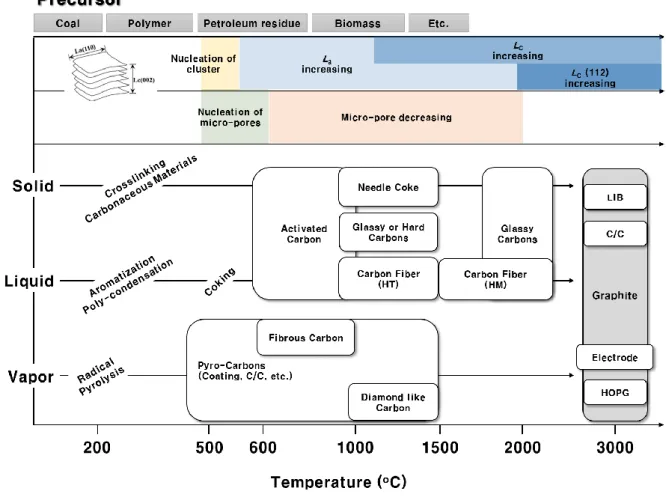
In general, carbon materials are non-flammable materials. However, heat-treatment of carbon materials can change their physical and chemical properties. Structure of carbon materials changes by varying of the heat-treatment temperature [1,2]. In Fig 1, the changes of structure of carbon materials and estimated obtainable carbon materials are described. The solid phase precursor is changed as carbonaceous materials (600oC) as the increment of temperature. In the case of liquid phase precursor, the aromatization and poly-condensation are undergoing for the formation of carbon materials at c.a. 300 ~ 500oC, and carbon structure made after coking process [3-5]. The activated carbons are prepared by the activation of liquid and solid phase derived carbon materials at the 600 ~ 1000oC [6-8].The vapor phase precursor derived carbon materials e.g. pyro-carbon can be obtained above 600oC. The fibrous carbons can be obtained using chemical vapor deposition (CVD) at 600 ~ 1000℃ [9-13]. The glassy carbon, hard carbons, and needle coke can be obtained over 1000oC treatment and high tensile strength carbon fiber can be obtained 1000 ~ 1500oC treatment [15]. At the very high-temperature range, 2000oC to 3000oC or more higher, glassy carbon, carbon fiber with high modulus, carbon/carbon composite (C/C composite), graphite electrode, and highly oriented pyrolytic graphite (HOPG) can be obtained. In order to obtain the targeted carbon materials, the consideration of suitable heat-treatment temperatures are necessary.
29
As mentioned before, the carbon structures are changed by the varies of temperature.
The structural parameters of carbon are the hexagonal carbon layer (Lc(002)) and planar (La(110)), and porosity. The cluster nuclei are generated near the 500oC then, size of La(110) start to increase from 600oC as the increment of temperature. The Lc(002) start to develop from c.a. 1000oC. The parameter of three-dimensional structure i.e. La(112) is developed above 2400oC. The porosity characteristics of carbon materials are much more sensitive. The activation procedure conducted at 600 ~ 1000℃ with an active agent such as steam, carbon dioxide, potassium hydroxide, sodium hydroxide, etc. Generally, the micro-pore structure developed until c.a. 1000℃, conversely over the 1000℃, micro-pores destructed significantly [15].
For the utilization of activated carbon materials, some parameters should be considered. One of the important factors in the gas adsorption using activated carbon materials are the porosity characteristics such as surface area, pore volume, etc. and surface functional groups. The surface functional groups and porosity characteristics are dependent on the starting materials i.e. precursor of the materials. As for the examples, polyacrylonitrile (PAN) contains 26.4 wt% of nitrogen, 67.91 wt% of carbon, and 5.7 wt% of hydrogen. Due to the high contents of the nitrogen sources, the PAN-based porous carbon materials i.e. ACF and ACNF contain various nitrogen surface, functional groups. Among the various N- functional groups, the pyrrolic-N, pyridinic-N, quarternary-N, and N-oxides are mainly developed in the activated state of carbon materials which influence the adsorption capabilities of polar pollutants like formaldehyde significantly [16-18]. According to the report by the Song et al. [16], the removal capability of formaldehyde was examined using
30
PAN-, pitch-, and rayon-based ACFs. Among the candidates, The PAN-based ACFs of FE series showed much longer breakthrough time of formaldehyde to compare with the other precursor based ACFs. In particular, among the PAN-based ACFs, the FE100 which has the lowest surface area of 378 m2/g and the smallest pore volume of 0.22 cm3/g. The formaldehyde removal capability by FE100 may depend on the nitrogen-containing functional groups especially pyrrolic or pyridonic nitrogen and N-oxides.
Lee et al. agreed with that science results in their research by comparing of PAN- and pitch-based ACFs through the formaldehyde removal capabilities and surface functionalities [17]. The authors emphasize that “ACFs with abundant nitrogen groups should be beneficial in producing effective adsorbent for polar adsorbates”. Furthermore, by comparing of formaldehyde removal capabilities under both dry and humid conditions using PAN- and pitch-based ACFs, the results showed contrarily due to the polarity. The author assumed that the “absolute amount of heteroatoms increases, water molecules may be preferentially adsorbed onto the ACFs”.
Present author also agreed with that the N-oxide, graphitic N, pyrrolic N, and pyridinic N functional groups influencing the formaldehyde adsorption capabilities. In our research, we found that among the N-functionalities in chitin derivatives, the N-oxide and graphitic N were increased after the steam activation at 800oC.
Another aspect by Lee et al., the authors closely examined differences between the conventional thick PAN-based ACF and thin and homogeneously shallow pore containing PAN-based ACNF. To summarize, the shallow pores containing PAN-based ACNF can uptake formaldehyde molecules largely even under the humid condition to compare with the conventional PAN-based ACF (Fig.2) [18]. Although the formaldehyde is water-soluble gas,
31
the water molecules preferentially adsorbed in the active site of deep pores in conventional ACF may inhibit the formaldehyde adsorption.
Since the greatest invention by Thomas Edison in the 1880s electric lamp filament using cellulosic precursor, various cellulosic precursor-based carbon fibers still in investigated to improve the physical properties. Cellulose is a linear polymer connected by β- (1-4) glycosidic linkages. The hydroxyl groups (-OH) consist in the cellulose structure which forms hydrogen bonds to then various ordered crystalline arrangements appeared.
The molecular structure of cellulose is (C6H10O5)n which consist of 44.44% of carbon, 6.17% of hydrogen, and 49.39% of oxygen. Theoretical carbonization yield is 44.44%.
However, the actual yield of carbon from the cellulose at 400 oC was c.a. 15%. It is believed that liberation of carbon monoxide (CO), carbon dioxide (CO2), aldehydes, organic acids and tars during the carbonization may due to the de-polymerization of macro-sized molecules.
Carbonization of cellulose at a higher temperature above 800oC yield is below c.a. 12%.
[19.20,21]. The fundamental structure of the carbon forms in the temperature range between 240 ~ 400oC, de-polymerization to mono-saccharide derivatives appeared during carbonization [22]. Heat-treatment range from 400 to 900oC, the amorphous carbon structure is transformed into a more oriented carbon structure. During the pyrolysis of the cellulose molecules, some CO and/or CO2 gases were liberated, carbon-oxygen conjugated functionalities like C=O and C–O–C were converted into single bonded C-C or double bonded C=C due to dehydration, de-polymerization, and aromatization of cellulose [23].
After the activation of cellulose-based CFs, the oxygen components increased [24] in a form of C=O, C-O, -COOH, CO32-, etc. respectively [23-27].
32
In order to control and modify the surface functional groups of ACF, the calcination at each temperature have been examined extensively. Pels et al. examine that evolution of nitrogen functional groups such as pyrrolic-N, pyridinic-N, quarternary-N, and N-oxides in the various chars include PAN char and lignite DE53, during the pyrolysis [28]. The pyrolyzed PAN at 573, 773, and 1073 K were compared by the XPS N1s narrow survey. In that result, as the increase of pyrolysis temperature, the pyridinic-N functional group gradually decrease while the pyrrolic-N, quarternary-N, and N-oxides increase. Shin et al.
reported that liberated surface functional groups of pitch-based ACF at 600, 1100, and 1200
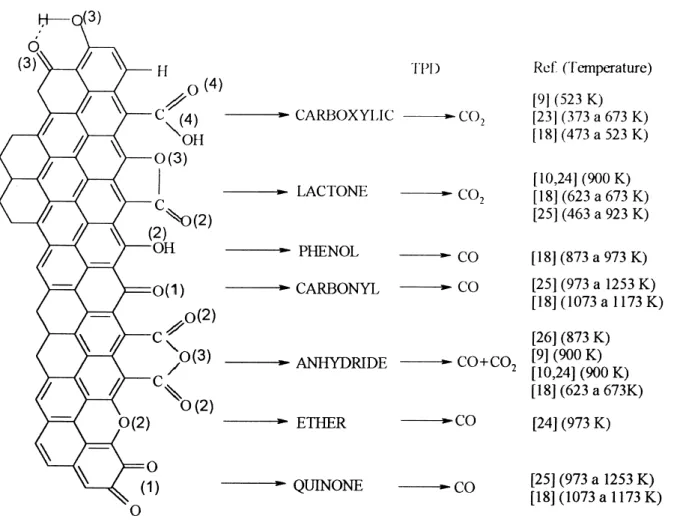
oC by using FT-IR [29]. They found that liberation of CO gas during the calcination from various functional groups and decreased relative surface area. It is worth note that, the calcined at 1100 and 1200 oC showed much-increased graphitization degree and liberation of carbonyl C=O of conjugated or quinone structure (Fig. 3). These scientific results are matching with the findings by Figueiredo et al. and Szymański et al. [30,31].
Mochida group had investigated the calcination effects on the various ACFs through the SOX and NOX removal efficiency comparisons [32-37]. Through the calcination of ACFs, the best removal capabilities of each ACF can be clarified. For example, the largest surface area containing pitch-based ACF;OG20A which calcined at 1100oC showed optimum removal capability of nitrogen monoxide (NO) and nitrogen dioxide (NO2) [28,29]. The optimum point of calcination temperatures depends on the precursor of ACF and its physical properties. The authors indicate that calcination after the activation of carbon fiber can promote the removal of acidic gas by the active sites in ACFs. The hetero-atoms like oxygen and nitrogen in micro-pore can be considered the active site in the adsorption. Furthermore, during the calcination process, the liberation of CO gases was confirmed by Shin et al.[29].
After the liberation of CO gases from the carbon materials which sites are also can be
33
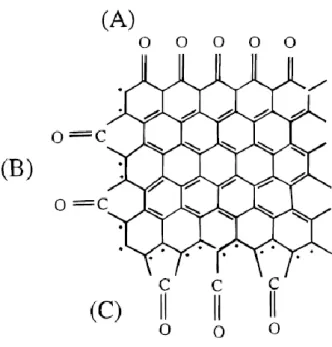
considered as an active site. Fig. 4 by Mochida et al.[38] explained the predicted roles of decomposed sites of A, B, and C. Mochida said, “The decomposition of type A (aromatic carbonyl) groups breaks the hexagonal sheet, while decomposition of types B and C (benzyl carbonyl) groups produces free valences, which may be localized by forming a benzyne type bond in case B or delocalized by conjugation in case C. Thus, case B may provide active sites for oxidation, although there is no direct evidence in our study.”.
Mochida et al., also clarified the optimal points of calcination temperature of pitch- based ACFs which are 850oC calcined ACF of OG8A [32-34], 1100 oC calcined ACF of OG20A [35,36] by the comparing of NO and/or NO2 removal capabilities. Accordingly, the various precursor derived activated carbon fibers were calcined at different temperatures to figure out the optimal points of removal capabilities for the formaldehyde and acetaldehyde.
Furthermore, it was believed that supporting agent may well be dispersed on the calcined ACFs more than non-treated pristine ACF.
In this study, the present author attempted to figure out the aldehydes removal capabilities using pitch-based ACF and cellulose-based ACF with surface modifications.
34
2.2 Experimental
2.2.1 Sample preparation
In this study, two different precursor-based ACFs were prepared. The pitch-based ACF of OG15A, and cellulose-based ACF of S1600 were obtained from Osaka Gas Chemical Co. Ltd. (Osaka, Japan) and East China University. The ACFs were dried at 150°C under vacuum condition for 3h to remove the pre-adsorbed contaminants like moisture content in the micro-pores of ACFs. The elemental composition and porosity characteristics of the pristine ACFs (as-received) are shown in Table 1. The specific surface area of OG15A was 1654 m2/g and S1600 was 1314 m2/g respectively. The carbon contents of OG15A were much higher than S1600 and the oxygen contents (differential amount by the calculation of 100 – (C+H+N) %) in the S1600 were much higher than OG15A. It was believed that the oxygen in the precursor of cellulose is 46.39 wt% theoretically, may remain even after the high-temperature activation process.
2.2.2 Calcination
After the drying at 150oC for 3h under vacuum condition, 5 gram of each sample was calcined at 300, 400, 600, 800, 1100, and 1400oC respectively using the infrared image furnace. The heating rate of the calcination was 10oC/min and maintain the targeted temperature for 1h respectively. The calcination conducted by carrying of N2 gas in 100 mL/min. After the calcination process, the sample was cooled down naturally until the room temperature.
35
2.2.3 Experimental set-up
Figure 5 shows a schematic illustration of our continuous, self-assembled, lab-scale evaluation system for formaldehyde removal. Standard gas, composed of 180 ppm formaldehyde in pure nitrogen, was used as the formaldehyde source (Asahi Gas Co. Ltd., Tokyo, Japan). The standard gas was further diluted to 10 ppm formaldehyde by mixing with 79 v/v% nitrogen and 21 v/v% oxygen. The relative humidity (RH) was controlled between 0% and 40% at 30°C using a nitrogen gas bubbling humidifier. The total flow of formaldehyde gas was controlled to 100 mL/min using calibrated mass flow controllers.
Samples of ACF or other materials (50 mg) were homogeneously packed into identical test tubes at the same packing density. The packed length of the samples held at 25 mm using quartz wool. The formaldehyde concentration of the outlet gas was measured with a Gasmaster (Model 2750; Kanomax Japan Inc., Osaka, Japan). The initial concentration of formaldehyde was calibrated using a detecting tube (91L; Gastec Corp., Kanagawa, Japan) with a sampling pump (GV-100; Gastec Corp.).
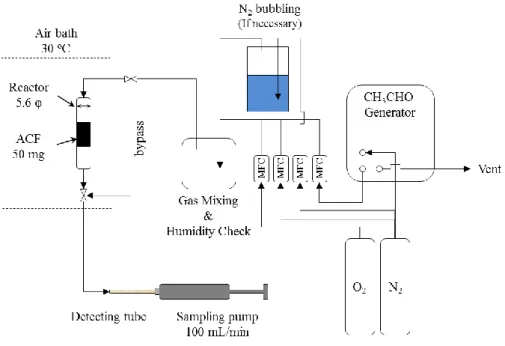
As shown in Fig. 6, the 2 ppm of acetaldehyde-pure N2 balanced standard gas was mixed with 79 vol% of N2 and 21 vol% of O2 with a total flow rate of 100 mL/min. The acetaldehyde was generated by the permeation tube (P-92-1, GASTEC Co.) at 35oC in the permeator (PD-1B, GASTEC Co.) by nitrogen flowing at 0.1 MPa and 200 mL/min. The generated acetaldehyde was partially divided and mixed with the nitrogen and oxygen totally in 100 mL min-1. The humidity was carefully controlled by the nitrogen bubbling. Each gasses are controlled by the mass flow controller, and the mixture gas flowed into the ACF packed glass tube which diameter is 5.6 mm and length are 50 mm. The weight of ACF is 50 mg, and packing length is ≥ 25mm respectively. The exhausted gasses were analyzed by
36
pumping the gasses using the detecting tube (92L, GASTEC Co.) with a sampling pump (GV-100, GASTEC Co.) in 100 mL min-1. The existence of acetaldehyde in the exhausted gas was confirmed by a color change of detecting tube by human eyes. The mechanism of color changes yellow to brown in detecting tube is following reactions:
3CH3CHO + (NH2OH)3H3PO4 → H3PO4
H3PO4 + Base → Phosphate
2.2.4 Characterization
The elemental analyses were carried out using a CHN analyzer (MT-5, Yanako, Japan). The amount of oxygen content (Odiff.) was calculated by the subtraction of carbon, hydrogen, and nitrogen from 100%. N2 adsorption/desorption isotherms were measured at 77 K using a volumetric adsorption system (Belsorp-Max-S, BEL Japan Inc., Japan) to investigate porosity characteristics. Pore structural parameters were calculated from the αs- plot analyses of N2 adsorption isotherms [38]. The pore size distributions were calculated from the quenched solid density functional theory (QSDFT) method which conditions for silt/cylinder adsorption analysis.
2.3 Results and discussion
2.3.1 Comparison of formaldehyde removal capabilities by calcined ACFs
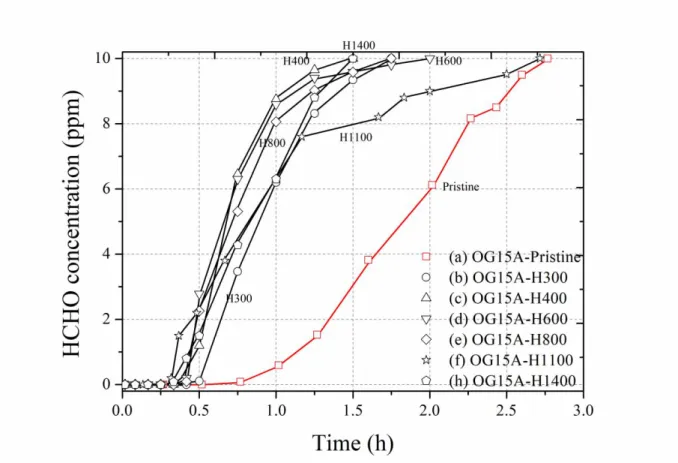
The formaldehyde removal capabilities of calcined ACFs of OG15A and S1600 were investigated under the dry condition. The formaldehyde removal capabilities of OG15A and calcined OG15As shown in Fig. 7. The calcination temperature range from 300 to 800oC and
37
above 1100oC showed much-decreased removal capabilities. The reason is still not clear but the optimal point of OG15A showed at 1100oC. In general, oxygen functional groups in the ACFs will start to decompose about 600oC to 800oC. The liberation of carbon monoxide (CO) and carbon dioxide (CO2) from the carbonyl group conjugated ketone or quinone, carboxylic groups in the non-aromatic or aromatic compound, carboxylic anhydrides, and lactone structures [29-31] are increased as the calcination temperature increases. The removal capability of formaldehyde by 1400 oC treated ACF decreased due to the partial destruction of micro-pores and re-orientation of carbon structure into the graphitic structure. Through the calcination procedure especially near the 1100oC, the surface oxygen functional groups and specific surface area of the ACFs are reduced. Meanwhile, the crystallinity of ACFs and hydrophobicity of ACFs increased [29-31].
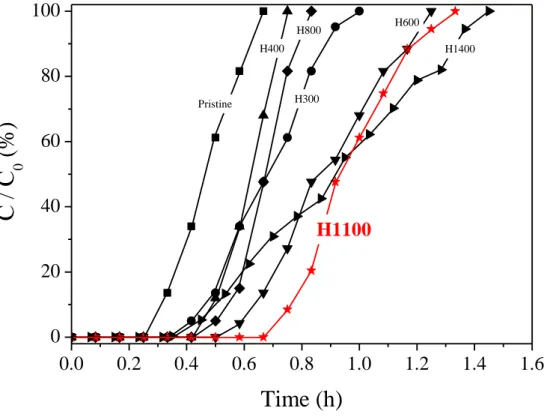
The cellulose-based ACF;S1600 was also prepared by the same procedure. As shown in Fig. 8, the formaldehyde removal capabilities by the calcined S1600 showed the optimum point at the 1100oC treatment. The results are associated with the results of OG15A and previous studies. The authors assumed that ACFs which have similar porosity characteristics regardless of precursors may show similar trends when they calcined at around 1100oC.
Table 1 shows the relevant physical properties of pristine ACFs and calcined ACFs of OG15A and S1600. OG15A-H1100 showed less oxygen content, a lower specific surface area, lower pore volume, and smaller pore width than those of pristine OG15A. As same as OG15A-H1100, the S1600-H1100 showed the same trends by the calcination at optimal points except the pore width increasing. Previous studies have shown that the calcination of ACF at 1100°C greatly improved the removal capabilities of SOX and NOX through improved ACF hydrophobicity and crystallinity [30,31].
38
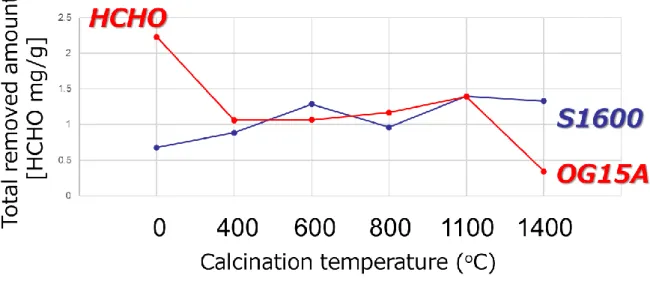
Fig. 9 shows the total formaldehyde removed the amount of ACFs by plotting of calcination temperature. OG15A showed optimum point at pristine state whilst the S1600 showed at 1100oC. The differences are the OG15A showed very promising removal capabilities even as pristine state and more increased at 1100oC. The S1600-H1400 could remove the formaldehyde a lot while the OG15A-H1400 drastically decreased.
2.3.1 Comparison of acetaldehyde removal capabilities by calcined ACFs
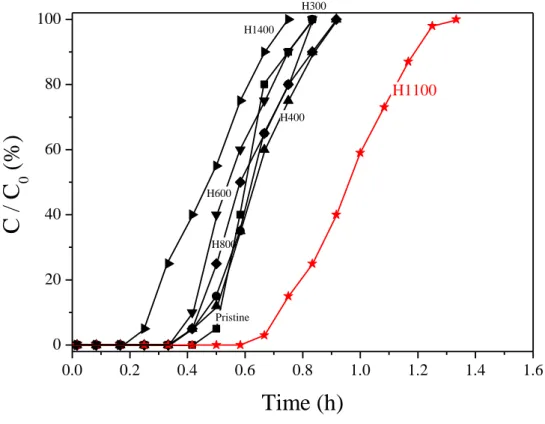
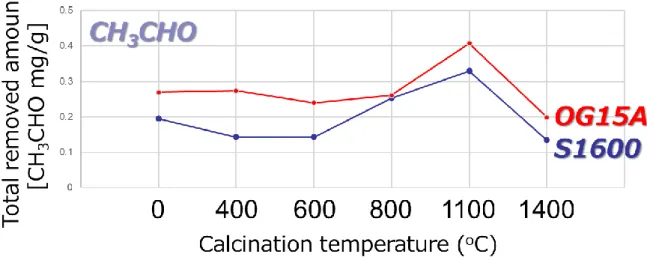
The acetaldehyde removal capabilities of calcined ACFs of OG15A and S1600 were investigated under the dry condition as same as formaldehyde tests. The acetaldehyde removal capabilities of ACFs and calcined ACFs showed in Fig. 10 and Fig. 11. Same as formaldehyde tests, the calcination temperature range from 300 to 800oC and above 1100oC showed decreased removal capabilities. The optimal point of OG15A and S1600 showed at 1100oC. Fig. 12 shows the total acetaldehyde removed the amount of ACFs by plotting of calcination temperature. Both of OG15A and S1600 showed optimum points at 1100oC and start to decrease above 1100oC.
2.3.3 Characteristics of ACFs
After calcination of S1600 at 1100oC, the carbon contents were increased, from 84.1% to 86.5% with the decrement of specific surface area from 1314 m2/g to 1054 m2/g due to the calcination effects. Furthermore, the decrement of nitrogen and oxygen content indicated that the surface functionalities were removed during the calcination step. It is believed that change of surface characteristic may promote the oxidation of aldehydes into acid substances inside of the micro-pores by the acitve sites. According to the N2
39
adsorption/desorption isotherms at 77K, the OG15A consist of the homogeneous microporosity and showed hysteresis type I in accordance with IUPAC [39], conversely, the S1600 consisted of various pore sizes (Fig. 13). As shown in Fig. 14, the surface morphologies of OG15A and S1600 were not changed after the calcination at 1100 oC.
2.4 Conclusion
Through this study, we can conclude that the calcination process for porous carbon materials was very effective and can control the surface functional groups and porosity characteristics. The calcination effects could not be defined in this research. It was very hard to define the calcination effects by some specific terms. However, based on the previous studies by many researchers and our experimental results, calcination impacts on the high specific surface area ACF to enhance the removal capabilities of aldehydes. Also, present author would like to emphasize that calcination of ACF helped not only the porosity characteristics and surface modification but also the dispersion of supporting agents well on the micro-pores of ACFs which will be discussed in Chapter 3 and 4.
40
REFERENCES
[1] I. Mochida, S. H. Yoon, S. Y. Lim, S. H. Hong, (2004). Progress and effectiveness of structural models of carbons, Tanso (Japanese), 215, 274–284.
[2] J.C. Bokros, (1965). The structure of pyrolytic carbon deposited in a fluidized bed, Carbon, 3, 17–29.
[3] Y. Lu, D. Ma, Z. Xu, Z. Tian, X. Bao, L. Lin, (2001). A high coking-resistance catalyst for methane aromatization, Chemical Communications, 20, 2048–2049.
[4] V.R. Choudhary, C. Sivadinarayana, P. Devadas, S. D. Sansare, P. Magnoux, M. Guisnet, (1998). Characterization of coke on H-gallosilicate (MFI) propane aromatization catalyst.:
Influence of coking conditions on nature and removal of coke, Microporous and Mesoporous Materials, 21, 91–101.
[5] I.M. Dawson, E.A.C. Follett, (1959). An electron microscope study of synthetic graphite, Proceedings of the Royal Society of London A: Mathematical, Proceedings of the Royal Society of London. Series A. Mathematical and Physical Sciences, 253(1274), 390-402.
[6] J. Hayashi, A. Kazehaya, K. Muroyama, A.P. Watkinson, (2000). Preparation of activated carbon from lignin by chemical activation, Carbon, 38, 1873–1878.
[7] F. Caturla, M. Molina-Sabio, F. Rodriguez-Reinoso, (1991). Preparation of activated carbon by chemical activation with ZnCl2, Carbon, 29, 999–1007.
[8] B.J. Kim, Y. Eom, O. Kato, J. Miyawaki, B.C. Kim, I. Mochida, S.H. Yoon, (2014).
Preparation of carbon fibers with excellent mechanical properties from isotropic pitches, Carbon, 77, 747-755.
41
[9] Y.L. Li, I.A. Kinloch, A.H. Windle, (2004). Direct spinning of carbon nanotube fibers from chemical vapor deposition synthesis, Science, 304(5668), 276–278.
[10] T.G. Kim, S. Lim, K. Kwon, S.H. Hong, W. Qiao, C.K. Rhee, S.H. Yoon, I. Mochida, (2006). Electrochemical capacitances of well-defined carbon surfaces, Langmuir, 22, 9086–
9088.
[11] G. Che, B.B. Lakshmi, C.R. Martin, E.R. Fisher, R.S. Ruoff, (1998). Chemical vapor deposition based synthesis of carbon nanotubes and nanofibers using a template method, Chemistry of Materials, 10, 260–267.
[12] A. Ahmadpour, D.D. Do, (1997). The preparation of activated carbon from macadamia nutshell by chemical activation, Carbon, 35, 1723–1732.
[13] F. Rodríguez-Reinoso, M. Molina-Sabio, M.T. González, (1995). The use of steam and CO2 as activating agents in the preparation of activated carbons, Carbon, 33, 15–23.
[14] S.H. Yoon, S. Lim, Y. Song, Y. Ota, W. Qiao, A. Tanaka, I. Mochida, (2004). KOH activation of carbon nanofibers, Carbon, 42(8-9), 1723-1729.
[15] R.E. Franklin, (1951). The structure of graphitic carbons, Acta crystallographica, 4, 253–261.
[16] Y. Song, W. Qiao, S. H. Yoon, I. Mochida, Q. Guo, L. Liu, (2007). Removal of formaldehyde at low concentration using various activated carbon fibers, Journal of Applied Polymer Science, 106, 2151-2157.
[17] K.J. Lee, J. Miyawaki, N. Shiratori, S.-H. Yoon, J. Jang, (2013). Toward an effective adsorbent for polar pollutants: Formaldehyde adsorption by activated carbon, Journal of Hazardous Materials, 260, 82-88.
42
[18] K.J. Lee, N. Shiratori, G. H. Lee, J. Miyawaki, I. Mochida, S.-H. Yoon, J. Jang, (2010).
Activated carbon nanofiber produced from electrospun polyacrylonitrile nanofiber as a highly efficient formaldehyde adsorbent, Carbon, 48, 4248-4255.
[19] P.T. Williams, S. Besler, (1996). The influence of temperature and heating rate on the slow pyrolysis of biomass, Renewable energy, 7(3), 233-250.
[20] G. Wegener, M. Przyklenk, D. Fengel, (1983). Hexafluoropropanol as valuable solvent for lignin in UV and IR spectroscopy, Holzforschung-International Journal of the Biology, Chemistry, Physics and Technology of Wood, 37(6), 303-307.
[21] A.G. Dumanlı, A.H. Windle, (2012). Carbon fibres from cellulosic precursors: a review, Journal of Materials Science, 47(10), 4236-4250.
[22] H. Kawamoto, M. Murayama, S. Saka, (2003). Pyrolysis behavior of levoglucosan as an intermediate in cellulose pyrolysis: polymerization into polysaccharide as a key reaction to carbonized product formation, Journal of Wood Science, 49(5), 469-473.
[23] S. Lee, M.E. Lee, M.Y. Song, S.Y. Cho, Y.S. Yun, H.J. Jin, (2016). Morphologies and surface properties of cellulose-based activated carbon nanoplates, Carbon Letters, 20, 32-38.
[24] D. Lee, S. Cho, Y. Kim, Y.S. Lee, (2013). Influence of the pore properties on carbon dioxide adsorption of PAN-based activated carbon nanofibers, Polymer Korea, 37(5), 592- 599.
[25] H. Zhang, L. Zhu, R. Sun (2014). Structure and properties of cotton fibers modified with titanium sulfate and urea under hydrothermal conditions, Journal of Engineered Fibers and Fabrics, 9, 67-75.
[26] Y.R. Rhim, D. Zhang, D.H. Fairbrother, K.A. Wepasnick, , K.J. Livi, R.J. Bodnar, D.C.
Nagle, (2010). Changes in electrical and microstructural properties of microcrystalline cellulose as function of carbonization temperature. Carbon, 48(4), 1012-1024.
43
[27] W. Liu, G. Zhao, (2012). Effect of temperature and time on microstructure and surface functional groups of activated carbon fibers prepared from liquefied wood, BioResources, 7(4), 5552-5567.
[28] J.R. Pels, F. Kapteijn, J.A. Moulijn, Q. Zhu, K.M. Thomas, (1995). Evolution of nitrogen functionalities in carbonaceous materials during pyrolysis, Carbon, 33, 1641-1653.
[29] S. Shin, J. Jang, S.-H. Yoon, I. Mochida, (1997). A study on the effect of heat treatment on functional groups of pitch based activated carbon fiber using FTIR, Carbon, 35, 1739- 1743.
[30] J.L. Figueiredo, M.F.R. Pereira, M.M.A. Freitas, J.J.M. Ó rfão, (1999). Modification of the surface chemistry of activated carbons, Carbon, 37, 1379–1389.
[31] G.S. Szymański, Z. Karpiński, S. Biniak, A. Świa̧tkowski, (2002). The effect of the gradual thermal decomposition of surface oxygen species on the chemical and catalytic properties of oxidized activated carbon, Carbon, 40, 2627–2639.
[32] I. Mochida, S. Kisamori, M. Hironaka, S. Kawano, Y. Matsumura, M. Yoshikawa, (1994). Marked increase of sulfur dioxide removal ability of poly(acrylonitrile)-based active carbon fiber by heat treatment at elevated temperatures, Energy & Fuels, 8, 659-664.
[33] I. Mochida, S. Kawano, M. Hironaka, S. Yatsunami, Y. Korai, Y. Matsumura, M.
Yoshikawa, (1995). Reduction of NO of Very Low Concentration in Air with NH3 at Room Temperature over Calcined Active Carbon Fibers, Energy & Fuels, 9, 659-664.
[34] I. Mochida, Y. Kawabuchi, S. Kawano, Y. Matsumura, M. Yoshikawa, (1997). High catalytic activity of pitch-based activated carbon fibres of moderate surface area for oxidation of NO to NO2 at room temperature, Fuel, 76(6), 543-548.