Title On-line handwritten character string recognition( 本文(FULLTEXT) ) Author(s) 岡本, 正義 Report No.(Doctoral Degree) 博士(工学) 甲第106号 Issue Date 1999-03-25 Type 博士論文 Version author URL http://hdl.handle.net/20.500.12099/1827 ※この資料の著作権は、各資料の著者・学協会・出版社等に帰属します。
Masayoshi Okamoto
Jan. 1999
ABSTRUCT
On-line handwritten character string recognition
オンライン手書き文字列認識技術に関する研究
要 旨
本 論 文 は 、 ペ ン で 容 易 に 文 字 入 力 す る た め の 基 盤 と な る オ ン ラ イ ン 手 書 き 文 字 認 識 技 術 と 文 字 切 り 出 し 技 術 に 関 し て 述 べ た も の で あ る 。 人 に や さ し い 操 作 手 段 の 一 つ と し て ペ ン 入 力 が 期 待 さ れ て い る 。 1 文 字 づ つ 丁 寧 に 筆 記 さ れ た 文 字 を 認 識 す る 技 術 に つ い て は 、 既 に 携 帯 型 情 報 端 末 な ど へ 応 用 さ れ て い る が 、 更 に 筆 記 自 由 度 の 高 い 文 字 入 力 の 実 現 が 課 題 と な っ て い る 。 1 文 字 毎 の 記 入 枠 を 無 く し 、 文 字 列 と し て 連 続 し て 筆 記 入 力 で き る 環 境 を 実 現 す る た め に 、 筆 記 さ れ た 文 字 列 か ら 文 字 を 切 り 出 す 技 術 と 、 自 由 に 筆 記 さ れ た 低 品 質 の 文 字 を 高 精 度 に 認 識 す る 技 術 が 重 要 で あ る 。 本 論 文 で は 、 切 り 出 し に 関 す る 物 理 的 特 徴 と 文 字 認 識 結 果 や 言 語 処 理 結 果 な ど の 論 理 的 特 徴 を 適 切 に 融 合 し た 文 字 切 り 出 し 技 術 の 研 究 成 果 と 、 筆 順 、 画 数 、 字 形 変 動 に 対 応 し た 文 字 認 識 手 法 と し て 、 O C R で 代 表 的 な 方 向 性 特 徴 ( オ フ ラ イ ン 特 徴 ) と 独 自 の 方 向 変 化 特 徴 ( オ ン ラ イ ン 特 徴 ) を 用 い た パ タ ー ン マ ッ チ ン グ に よ る 新 し い 文 字 認 識 手 法 の 研 究 成 果 に つ い て 述 べ る 。 本 論 文 は 、 6 つ の 章 か ら 構 成 さ れ て お り 、 以 下 に そ の 概 要 を 述 べ る 。 第 1 章 で は 、 本 研 究 を 始 め る に 至 っ た 背 景 と 研 究 目 的 お よ び 概 要 を 述 べ て い る 。 第 2 章 で は 、文 字 ピ ッ チ な ど の 物 理 的 特 徴 と 文 字 認 識 結 果 や 言 語 処 理 結 果 な ど の 論 理 的 特 徴 を ネ ッ ト ワ ー ク 表 現 で 融 合 さ せ た 高 性 能 な 文 字 切 り 出 し 手 法 を 提 案 し て い る 。 従 来 、 文 字 切 り 出 し に お い て は 、 ま ず 、 物 理 的 特 徴 に よ っ て 切 り 出 し 位 置 の 候 補 を 抽 出 し 、 こ れ ら の 切 り 出 し 位 置 候 補 間 の 筆 記 ス ト ロ ー ク 集 合 に 対 し て 文 字 認 識 し て 、 文 字 認 識 類 似 度 が 高 い か ど う か の 結 果 や 、 文 字 認 識 候 補 を 組 み 合 わ せ て 、 単 語 あ る い は 文 章 と し て 成 立 す る か ど う か 言 語 処 理 の 結 果 に 応 じ て 切 り 出 し 位 置 を 決 定 す る 方 法 が よ く 知 ら れ て い る 。 し か し な が ら 、 物 理 的 特 徴 に 基 づ く 切 り 出 し の 確 か ら し さ の 情 報 は 使 わ れ ず 、 文 字 認 識 結 果 と 言 語 処 理 の 結 果 だ け に よ っ て 最 終 的 に 切 り 出 し 位 置 が 決 定 さ れ て い る 。 こ の た め 、 文 字 ピ ッ チ が 小 さ く て 本 来 文 字 間 で は な い 個 所 で も 、 候 補 に 含 ま れ て い れ ば 誤 っ て 切 り 出 さ れ る こ と も あ り 、 文 字 認 識 と 言 語 処 理 に よ る 悪 影 響が 少 な く な い 。 こ の 手 法 は 、 必 然 的 に 文 字 認 識 や 言 語 処 理 結 果 の 論 理 的 特 徴 に 極 め て 重 き が 置 か れ た 処 理 系 に な っ て い る と 言 え る 。 本 提 案 手 法 は 、 物 理 的 特 徴 に よ る 切 り 出 し の 確 か ら し さ と 、 文 字 認 識 、 言 語 処 理 に よ る 確 か ら し さ と の 総 合 的 な 判 断 に よ っ て 切 り 出 し 位 置 を 決 定 す る も の で あ る 。 切 り 出 し 実 験 の 結 果 、 従 来 手 法 と 比 較 し て 、 86.10%か ら 90.72% に 性 能 向 上 で き 、有 効 性 を 確 認 し て い る 。ま た 、切 り 出 し 候 補 を 物 理 的 特 徴 と 論 理 的 特 徴 に よ る ネ ッ ト ワ ー ク 表 現 で 表 し 、 そ の 最 短 経 路 探 索 に よ り 、 効 率 的 に 切 り 出 し 処 理 を 行 え る こ と を 示 し て い る 。 よ り 切 り 出 し 性 能 を 高 め る た め に は 、 特 に 文 字 認 識 性 能 を 向 上 さ せ る こ と が 重 要 で あ る 。 第 3 章 で は 、 オ ン ラ イ ン 文 字 認 識 技 術 に お け る 代 表 的 な 手 法 の 概 要 と 、 本 提 案 手 法 の ア プ ロ ー チ に つ い て 述 べ て い る 。 オ ン ラ イ ン 文 字 認 識 で は 、 今 ま で 演 算 量 と ソ フ ト ウ ェ ア サ イ ズ の 面 か ら 構 造 解 析 的 な 認 識 手 法 が 主 流 で あ っ た 。昨 今 の C P U 能 力 向 上 、 メ モ リ の 低 価 格 化 に 伴 い 、 今 後 は 統 計 的 な 認 識 手 法 ( パ タ ー ン マ ッ チ ン グ 法 ) が 有 望 で あ る と 考 え て い る 。 何 故 な ら 、 文 字 認 識 辞 書 の 自 動 学 習 が 容 易 で あ る か ら で あ る 。 ま た 、 筆 順 自 由 に 対 応 す る が た め に 単 に O C R で 使 わ れ て い る 特 徴 を オ ン ラ イ ン 認 識 に 適 用 す る の で は な く 、 オ ン ラ イ ン の 有 効 な 特 徴 ( ス ト ロ ー ク の 情 報 ) を 積 極 的 に 用 い 、 融 合 さ せ る こ と が 肝 要 で あ る 。 第 4 章 で は 、 本 提 案 の 文 字 認 識 手 法 の 基 本 的 な 理 論 と そ の 有 効 性 を 示 し て い る 。 O C R で 代 表 的 な 方 向 性 特 徴 に オ ン ラ イ ン 特 徴 で あ る 独 自 の 方 向 変 化 特 徴 を 加 え て パ タ ー ン マ ッ チ ン グ す る こ と に よ り 、 字 形 の 変 動 に 強 く な る こ と を 確 認 し た 。 こ こ で 、 方 向 変 化 特 徴 と は 、 何 処 で ど の 方 向 に 筆 記 方 向 が 変 化 し て い る か を 表 す 特 徴 で あ り 、 今 ま で 統 計 的 手 法 で 用 い て 有 効 性 を 示 し た 例 は な い 。 ま た 、 ペ ン が ア ッ プ し て い る 区 間 を 仮 想 的 な 直 線( 仮 想 ス ト ロ ー ク )で 補 っ て か ら 方 向 変 化 特 徴 を 抽 出 す る こ と に よ り 、 続 け 字 な ど の 画 数 変 動 に 強 く な る こ と を 確 認 し た 。 本 来 ペ ン ア ッ プ の 区 間 が 短 い 個 所 ほ ど 続 け て 筆 記 さ れ る ケ ー ス が 多 い が 、 自 由 に 筆 記 さ れ た 低 品 質 な 文 字 で は 、 本 来 ペ ン ア ッ プ 区 間 が 長 い 個 所 で も 続 け て 筆 記 さ れ る こ と も 多 く 、 実 験 の 結 果 、 方 向 変 化 特 徴 量 を 仮 想 ス ト ロ ー ク の 長 さ に 依 存 さ せ な い こ と が 適 切 で あ る と 判 明 し た 。 公 開 筆 記 文 字 デ ー タ ベ ー ス(HANDS-kuchibue_d-96-02)を 用 い た 認 識 実 験 の 結 果 、方 向 性 特 徴 だ け を 用 い た 手 法 と 比 較 し て 、77.89% か ら 86.32% に 認 識 率 が 向 上 し 、有 効 性 を 示 し て い る 。 第 5 章 で は 、 本 提 案 手 法 の 改 良 に 関 係 す る 実 験 結 果 に 基 づ き 、 今 後 の 見 通 し に つ い て 述 べ て い る 。 第 6 章 で は 、 本 論 文 の 結 論 に つ い て 述 べ て い る 。
CONTENTS
Contents
1. General Introduction 1
1.1 Background and goal of study ··· 2
1.2 Summary of thesis ··· 3
2. On-line Character String Separation Method using Network Expression 7 2.1 Introduction ··· 8
2.2 Character separation features ··· 9
2.3 String separation method using physical and logical features ··· 9
2.3.1 Separation process with a traditional method ··· 9
2.3.2 Separation process with Multi-level network expression ··· 10
2.3.3 Separation process with Unified network expression ··· 11
2.4 Multi-level network expressions ··· 12
2.4.1 Network expression (A) ··· 12
2.4.2 Network expression (B) ··· 22
2.5 Unified network expressions ··· 25
2.5.1 Combination of network ··· 26
2.5.2 Separation process with Unified networks ··· 26
2.5.3 Effects of Unified network ··· 29
2.6 Experiment ··· 29
2.6.1 Handwritten data sets ··· 29
2.6.2 Experimental results ··· 31
2.6.3 Estimation of experiment results ··· 33
2.7 Conclusion ··· 37
3. Approaches to On-line Character Recognition 39
3.1 Introduction ··· 40
3.2 Structure analysis approaches ··· 40
3.3 Statistical approaches (pattern matching) ··· 41
4. On-line Character Recognition Method using both Directional Features and
Direction-Change Features 43
4.1 Introduction ··· 44
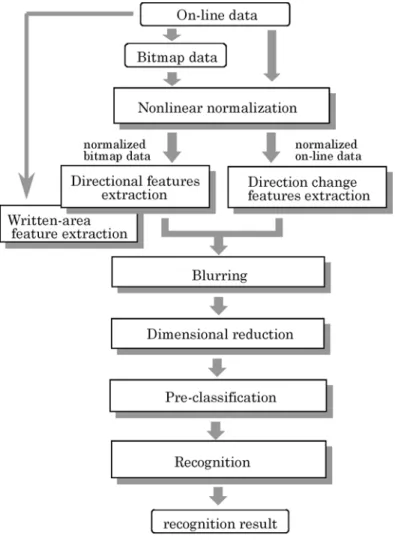
4.2 Recognition Method ··· 45
4.2.1 Acquisition of on-line character data ··· 46
4.2.2 Transformation from on-line data to bitmap data ··· 47
4.2.3 Nonlinear normalization ··· 47 4.2.4 Directional features ··· 48 4.2.5 Written-area feature ··· 48 4.2.6 Direction-change features ··· 49 4.2.7 Blurring ··· 53 4.2.8 Pre-classification ··· 53 4.2.9 Recognition ··· 55 4.3 Experiment ··· 55 4.4 Conclusion ··· 65
5. Improvements of Recognition System 67
5.1 Introduction ··· 68
5.2 Adjusting directional, direction-change and written-area features ··· 68
5.2.1 Adjusting the weights of features ··· 68
5.2.2 Experiments ··· 68
5.3 Possibilities for improvements ··· 70
5.4 Conclusion ··· 74 6. Conclusion 75 Appendixes 79 Acknowledgments 93 References 95 Research achievements 101
Chapter 1
General Introduction
1.1 Background and goal of study
In recent years, a pen-based interface has received much attention since it offers easy operation to the user. The good points of a pen-based interface are listed below. The training of this interface is not necessary because a pen is a typical device for writing characters and drawing figures. Even if the writing area is small, as in the size of a card, the characters can be written clearly. Therefore, pen-based equipment for inputting characters can be made smaller than keyboard-based equipment. In addition, a direct pointing-operation with a pen is easier than an indirect use with a mouse. Thus, pen-based hand-held computers such as PDAs (Personal Digital Assistants) are being used for electronically recording personal information. In addition to PDAs, there are many potential applications for pen-based interfaces: inputting customers’ names and addresses in jobs at a window, validating credit card signatures, interpreting handwritten notes, electronically mailing handwritten images with the common format called ‘electronic ink’(1)(2), writing on electronic whiteboards (3), CAI systems(4) and so on. Generally, tablets are used to detect x, y coordinate data of pen-movements. In recent years, a new kind of pen that can detect these data by acceleration sensors, have been developed (5)(6). This kind of pen, which is convenient to carry about without tablets, may create new applications. In the future, pen-based interfaces will become more and more user-friendly.
A key technology for inputting characters with a pen is on-line character recognition. Methods to recognize characters that are neatly and individually written in single handwriting frames (Fig. 1.1) are being adopted in such applications as PDAs. However, many users are looking forward to a freer, less restrictive method of inputting characters. Therefore, it is important to realize a method to correctly segment a string of characters that have been input by writing them continuously as a string without handwriting frames (Fig. 1.2). Furthermore, there is a need for a highly accurate character recognition method that can recognize cursive-style characters.
1.2. SUMMARY OF THESIS
Fig. 1.1 Handwritten characters
in single frames Fig. 1.2 Continuously handwritten characters as a string
This thesis describes our research on an on-line character string separation method and an on-line character recognition method. To segment a string of characters correctly, our string separation method combines physical features such as character pitch with logical features such as character recognition results and language processing results by network expression. Moreover, to correctly recognize cursive-style characters, which have varied shapes, stroke orders and stroke counts, our character recognition method is based on pattern matching that simultaneously uses both directional features, which are off-line features generally used in OCR, and direction-change features, which we designed as on-line features.
1.2 Summary of thesis
This thesis consists of 6 chapters. The background and goal of this thesis are described in Chapter 1. Our on-line character string separation method using network expression is described in Chapter 2. Approaches to on-line character recognition are described in Chapter 3. Our on-line character recognition method that uses both directional features and direction-change features is described in Chapter 4. Possibilities for future work to improve our method based on recognition results are described in Chapter 5. Chapter 6 concludes the thesis. The following paragraphs summarize chapters 2 through 4.
physical features such as character pitch with logical features such as character recognition results and language processing results by network expression. The following conventional string separation method is well known. In this method, string separator candidates are first extracted by physical features. Next, each stroke group between string separator candidates is recognized, and character recognition candidates and degree of similarity are obtained. Finally, separators are determined by judging whether the degrees of similarity are high and whether characters combined from character candidates are correct as a phrase by language processing. However, this method does not use the degree of a separator ’s likeness to separator candidates based on physical features, and the final separation results are obtained by only using the degree of similarity to characters and language processing results. Therefore, bad effects are sometimes caused by character recognition results and language processing results. For example, string strokes are sometimes incorrectly separated at positions where there should not be separators when there is/are incorrect separator(s) in separator candidates. This method necessarily gives a lot of weight to logical features such as character recognition results and language processing results. Our proposed method obtains separation results by the degree of separator likeness based on both physical features and logical features. In the experimental results, the separation rate is improved over the traditional method from 86.10% to 90.72%. Moreover, in our method, combinations of separator candidates are expressed as network expression with physical features and logical features. By searching for the shortest path of the network, separation results are obtained efficiently. It is important to improve character recognition accuracy to achieve a higher character separation rate.
Chapter 3 gives a summary of traditional on-line character recognition methods and describes our approach. In on-line character recognition, structure analysis approaches are generally used from the point of view of recognition processing time and software size. However, CPU accuracy has recently improved, the cost of memory has rapidly decreased, and various character features can now be used. Therefore, we think a statistical approach holds great promise because it has the advantage of its recognition dictionary being able to learn character features from
1.2. SUMMARY OF THESIS
many handwritten data without any manual work. Moreover, we think it is undesirable to only use off-line features, such as those used in OCRs, to handle free-stroke-order; rather, it is best to actively use effective on-line features based on handwritten strokes in combination with off-line features.
In Chapter 4, the basic theory of our proposed on-line character recognition method and its effectiveness are described. We confirmed that our method is better for handling shape variations. The direction-change features express where and in which direction the character ’s stroke changes. No previous study has been made on a statistical approach that uses direction-change features and that proves their effectiveness. Moreover, we confirmed that our method can better handle stroke count variations by extracting direction-change features after adding lines called “imaginary strokes” between a stroke’s endpoint and the next stroke’s starting point in the pen-up state. In a recognition experiment with a public on-line handwritten database (HANDS-kuchibue_d-96-02), recognition rate improved from 77.89% to 86.32% over the traditional method that only uses directional features, thus clearly demonstrating our method’s effectiveness.
Chapter 2
On-line Character String Separation Method
using Network Expression
SUMMARY
We propose an on-line handwritten character string separation method that uniformly deals with character separation features. This character separation method takes into account both physical and logical features. It is unique in that current methods get the character separation position using a score based on only logical features, such as the character recognition results and the language processing results from separation candidates classified by their physical features. Our methods obtain the character separation position from scores based on both physical features and logical features. We show that the character string separation problem relates to the shortest path problem by expressing character string features as a network expression. We devised our string separation method with Multi-level network expression and Unified network expression. Unifying the physical features and logical features within each network expression improves the separation rate. The separation rate of another method for Japanese kanji strings with only logical features is 85.5%. The separation rate of our first method with the Multi-level network expression is 86.7 %. The separation rate of our second method with the Unified network expression is 90.7%. Furthermore, we can speed up the string separation process with the Unified network expression.
2.1 Introduction
The idea of a pen-type interface has been received with great interest as a means of input (7). Many effective on-line character recognition methods are being investigated for easy text input. Generally, in order to input a Japanese character string using a pen-type interface, writers must individually input characters in handwriting frames. However, this is a troublesome operation for writers. The entry frame should be eliminated, and a method to take notes using continuous strings of characters should be created. Therefore, a character string separation technology for separating each character from a string of characters is important.
It is difficult to correctly obtain the handwritten character separation position because the character pitches and stroke intervals vary (8) and characters sometimes overlap.
For on-line string separation technology, methods (9-13) that use logical features, such as character recognition results and language processing results, and a method
(14)
that considers individual fluctuation tendencies have also been examined. Other methods (15)(16) using logical features for handprinted string separation technology have also been studied.
These methods first classify the separation candidate based on physical features such as character pitch. They then get the separation position using only logical features from separation candidates. These methods disregard the physical feature score when separating characters. We think that a method using only logical feature scores is not sufficient in correctly obtaining the separation position.
In this chapter, we present online handwritten string separation methods that unify physical features and logical features with Multi-level network expressions and Unified network expressions. We will then describe the improvements observed when using our methods.
2.2. CHARACTER SEPARATION FEATURES
2.2 Character separation features
For online handwritten character separation, the physical features, as shown in Fig.2.1, and the logical features, such as the degree of character recognition similarity and language processing results, are well known (14). Our methods use the same features as shown in Table 2.1, but our methods are different from other methods in the separation process, as shown below.
Fig.2.1 Physical features
Table 2.1 Features for handwritten character string separation
2.3 String separation method using physical and logical features
2.3.1 Separation process with a traditional method
(Murase's method using Lattice method)
The typical method of string separation (9)(10)(14) is shown in Fig.2.2. This method first classifies the separation candidates by physical features. For example in
this figure, five separator candidates are extracted and K separation candidates are selected from all combinations of separator candidates. Character recognition candidates are then obtained by examining the degree of similarity of stroke groups between separation points. The final separation is achieved by performing language processing on the character recognition candidates. This example shows when the final result is correct. However, this method sometimes causes mistakes as shown in Sec.6.3. Note that separation scores are not used in obtaining the final separation result (17)(18).
Fig.2.2 Separation process using traditional method
We devised our Multi-Level network expression method and the Unified network expression using both physical and logical feature scores.
2.3.2 Separation process with Multi-level network expression
Our first method, the Multi-Level Network Expression shown in Fig.2.3, first classifies the separation candidates on the basis of physical features in Network A. Once the process enters Network B, a Character Recognition phase is entered, and recognition candidates and the degree of similarity are passed to the Language Processing phase. The method then derives the language processing score for each separation candidate and passes this result to final separation processing. The separation result is obtained by adding the physical feature score and the language processing score.
This method considers not only the logical feature score but also the physical feature score from the initial separation when obtaining the final separation result.
2.3. STRING SEPARATION METHOD USING PHYSICAL AND LOGICAL FEATURES
This method creates two networks and searches K shortest paths from one network to the other, where K is the candidate count. After this is done, the physical and logical feature scores are obtained.
K shortest paths (19)(20) are searched in the following way. The score of a path between position N and the start position is calculated by adding the score of the path between position N-1 and position N to the score of the path between position N-1 and the start position. Position N is moved from the start position to the end position in the network, while only the K paths with the higher score remain.
Fig.2.3 Separation process with Multi-Level network expression
2.3.3 Separation process with Unified network expression
Our second method uses a Unified Network Expression shown in Fig.2.4. Separation candidates are individually obtained and classified by separation scores. Character recognition is then performed on each set of separation candidates, and the degree of similarity to characters are sent to the Language Processing phase where a language processing score is assigned to each phrase. The sum of the scores of the logical and physical features of each phrase are then passed onto a final phase. The final separation result selects a suitable separation candidate among some combinations of phrase candidates that have the highest sum of physical and logical feature scores.
Fig.2.4 Separation process with Unified network expression
2.4 Multi-level network expressions
In this section we propose a Multi-level Network Expression as an effective unification method distinguishing string separation features.
2.4.1 Network expression (A)
Network Expression A is the expression to efficiently obtain the string separation candidates on the basis of the physical features.
2.4.1.1 Extraction of base segments
The stroke interval between stroke #N and stroke #N+1, where N shows the handwriting order, indicates X direction distance between the rectangular area that encloses the stroke group from stroke #1 to stroke #N, and the area that encloses the stroke group from the tail stroke to the stroke #N+1. An example of the stroke interval is shown in Fig.2.5.
2.4. MULTI-LEVEL NETWORK EXPRESSIONS
Fig.2.5 Stroke interval Fig.2.6 Base segments
A base segment is a stroke group that cannot be separated further by the stroke interval and pen-up time thresholds. Strokes are merged into a base segment either when their stroke interval is less than the stroke interval threshold, or when their pen-up time is less than the pen-up time threshold. A character is a combination of base segments. In Fig.2.6, the stroke groups indicated with rectangles are each base segment.
We analyzed the distributions of the physical features of the strings in the handwritten data set 1 (learning data) shown in Table 2.6. Based on the distributions of the pen-up times in data set 1, if the pen-up time is 0.1 seconds or less, it is in a character, and if the pen-up time is 2.0 seconds or more, it is between characters. The maximum stroke interval in a character is set for each height in the character string, and based on Table 2.2, the minimum stroke interval between characters is set for each height in the character string. A negative stroke interval means an overlapping of strokes. If the stroke interval between the target stroke is larger than the maximum stroke interval in a character, the target stroke area is between characters. If the stroke interval between the target stroke area is smaller than the minimum stroke interval between characters, the target stroke area is in a character. Therefore, we defined the pen-up time threshold as 0.1 seconds, and the stroke interval threshold for each string height is the minimum stroke interval as shown in Table 2.2.
Table 2.2 Threshold of stroke interval for base segment
2.4.1.2 Standard value for physical features
The physical features vary from writer to writer. Thus, we define the standard value for physical features from an inputted handwritten string every time a string is written. In our method, the ratio of the maximum width of base segments and the maximum height of base segments define the standard ratio of character width and character height. The standard character width and the standard character pitch are also defined from the input string.
The distributions of the physical features such as character pitch, character width, ratio of width and height, center position, bottom location and character size in data set 1 were analyzed. These distributions are shown in Table 2.3.
Table 2.3 Distributions of features
The standard value for each physical feature is obtained by the following expressions based on Table 2.3.
) 3 ( ... ... ) 2 ...( ... ) 1 ( ... ... segment base the of height maximum H segment base the of pitch maximum P segment base the of width maximum W = = =
2.4. MULTI-LEVEL NETWORK EXPRESSIONS
For example in Fig.2.6, the widest base segment is the 4th base segment from the left side. The maximum pitch is the pitch between the 4th base segment and 5th base segment. The highest base segment is the 1st segment.
(a) Standard ratio of width and height (Sr)
...(4)
W H Sr=
(b) Standard character width (Sw)
[
]
[
]
) 8 ...( ... ... ) 7 ...( ... ... ... ... ... ... ... 78 . 0 62 . 0 16 . 0 _ ) / ( ' ) 6 ( ... ... ... ... ) 5 .( ... ... ... ... 2 2 2 segment base g neighborin nearest its and width maximum has that segment base the between pitch character the Np ratio Dev width height Log s data learning of Average MaxR where MaxR Sr Log when Np W Sw MaxR Sr Log when W Sw = = + = + = > + = ≤ =(c) Standard character pitch (Sp)
[
]
[
]
[
]
(
)
[
]
) 14 ..( ... ... ... 128 ) 13 ...( ) 1 . 0 : ( 100 100 8 5 ) 12 ...( ) 1 . 0 : ( 100 ) 11 ...( ... _ ) ( ) 10 ...( ... ... ... ... ... ) 9 ...( ... ... ... ... ... = = ≥ − × + = < = − = > + = ≤ = pitch character of Average Avp mm unit H when H Avp Ap mm unit H when Avp Ap pitch Dev Ap value pitch character Minimum MinP where P MinP when Np P Sp P MinP when P Sp(d) Standard character size (Ss)
Ss=H ×Sw...(15)
(e) Standard bottom location (Sb)
Sb=Averageof (bottomlocation string height)=0.11...(16)
(f) Standard center position (Sc)
Sc=Averageof (center position string height)=0.03...(17)
(g) Standard character count (Scount)
0 ⎟⎟.5 ...(18) ⎠ ⎞ ⎜⎜ ⎝ ⎛ + − + = Sp Sw Sp Lengh String Integer Scount
(h) Minimum stroke interval (LiMin), Maximum stroke interval (LiMax), and Middle stroke interval (Mi)
) 22 ...( ] 1 [ ) 21 ( ... ] 2 [ 2 / ) ) ) 2 ( ) ) 1 ( ( ) 20 ...( ... ... ... ... ) 2 . ( ) 19 ...( ... ... ... ... ) 2 . ( = = ≥ − + − = = = Scount when interval stroke widest Mi Scount when interval stroke widest th Scount interval stroke widest th Scount Mi Table cf Max int SEG LiMax Table cf tMin in SEG LiMin
In Fig.2.6, when Scount is 4, Mi is the average of the stroke interval of the 3rd-widest stroke interval and that of the 2nd-widest stroke interval.
(i) Minimum pen-up time (LuMin), Maximum pen-up time (LuMax) and middle pen_up time (Mu)
) 26 ( ... ] 1 [ ) 25 ( ... ] 2 [ 2 / ) ) ) 2 ( ) ) 1 ( ( ) 24 ..( ... ... ... ... ... ... ... sec) ( 7 . 0 ) 23 ...( ... ... ... ... ... ... ... sec) ( 1 . 0 = = ≥ − + − = = = − − − Scount when time up pen longest Mu Scount when time up pen longest th Scount time up pen longest th Scount Mu m LuMax m LuMin
2.4.1.3 Extraction of estimation value for separation candidate
The separation candidate is obtained as a combination of base segments. An example of separation candidates is shown in Fig.2.2 and 2.3. The estimation value of the character likeness and character separator likeness is obtained for each feature
2.4. MULTI-LEVEL NETWORK EXPRESSIONS
type in respect to each character’s stroke group candidate and character separator candidate. A character’s stroke group candidate is a group of the base segments
between separator candidates. For example, in Fig.2.2 and 2.3, “ - - - ”,”
- - ” are separation candidates, and “ ”,” ” are character’s stroke group
candidates. The character likeness and character separator likeness for each feature type are expressed with symbols as shown below.
When the stroke interval is narrow, this is in a character. When the stroke interval is wide, this is between characters. Thus, the stroke interval is used for estimating both character likeness and separator likeness. When the pen-up time is short, this is in a character. When the pen-up time is wide, this is between characters. So, the pen-up time is also used for estimating both character likeness and separator likeness.
[Estimated value as a character]
(a) Fa (estimated value for the character size feature)
candidate character each of size character Is where size Dev H H Ss H H Is Min Fa = ⎟ ⎠ ⎞ ⎜ ⎝ ⎛ × × − × = ...(27) ) 2 ( , 1 _
(b) Fb (estimated value for the bottom location feature)
candidate character each of location bottom Ib where bottom Dev Sb H Ib Min Fb = ⎟ ⎠ ⎞ ⎜ ⎝ ⎛ × − = ...(28) ) 2 ( , 1 _
(c) Fc (estimated value for the center position feature)
candidate character each of position center Ic where cent Dev Sc H Ic Min Fc = ⎟ ⎠ ⎞ ⎜ ⎝ ⎛ × − = ...(29) ) 2 ( , 1 _
(d) Fd (estimated value for ratio of width and height feature) candidate character each of height and width of ratio Ir where ratio Dev Sr Log Ir Log Min Fd = ⎟ ⎠ ⎞ ⎜ ⎝ ⎛ × − = ...(30) ) 2 ( , 1 _ 2 2
(e) Fe (estimated value for the character width feature)
candidate character each of width character Iw where width Dev Ap Sw Log Ap Iw Log Min Fe = ⎟⎟ ⎠ ⎞ ⎜⎜ ⎝ ⎛ × − = ⎟ ⎟ ⎟ ⎠ ⎞ ⎜ ⎜ ⎜ ⎝ ⎛ ⎟ ⎟ ⎟ ⎠ ⎞ ⎜ ⎜ ⎜ ⎝ ⎛ ) 31 .( ... ... ... ) 2 ( , 1 _ 2 2
(f) Ff (estimated value for the stroke interval feature)
Wen the input stroke interval is Mi (middle stroke interval), the character likeness is 0.5, which means that the interval can be in the character or between the characters with a 50-50 chance.
(
(
(
(
) (
)
)
)
)
interval stroke Middle Mi candidate character each of Interval Stroke Ii where LiMax Ii Mi where Mi LiMax Mi Ii Ff Mi Ii LiMin where LiMin Mi LiMin Ii Ff LiMax Ii when Ff LiMin Ii when Ff = = < < × − − + = ≤ < × − − = ≥ = ≤ = ] [ 5 . 0 ( 5 . 0 ] [ 5 . 0 ] [ 1 ) 32 ....( ... ... ... ... ] [ 0(g) Fg (estimated value for pen-up time feature)
(
(
(
(
) (
)
)
)
)
time up pen Middle Mu candidate character each of time up pen Iu where LuMax Iu Mu where Mu LuMax Mu Iu Fg Mu Iu LuMin where LuMin Mu LuMin Iu Fg LuMax Iu when Fg LuMin Iu when Fg − = − = < < × − − + = ≤ < × − − = ≥ = ≤ = ] [ 5 . 0 ( 5 . 0 ] [ 5 . 0 ] [ 1 ) 33 ....( ... ... ... ... ] [ 0 (likeacharcter)0≤Fa,Fb,Fc,Fd,Fe,Ff,Fg≤12.4. MULTI-LEVEL NETWORK EXPRESSIONS
[Estimated value as a separation]
(h) Fh (estimated value for the character pitch feature)
candidate character each of pitch character Ip where Sp Sp Ip Min Fh = ⎟⎟ ⎠ ⎞ ⎜⎜ ⎝ ⎛ − = 1, ...(34)
(i) Fi (estimated value for the stroke interval feature)
Fi=1 Ff− ...(35)
(j) Fj (estimated value for the pen-up time feature)
Fj =1 Fg− ...(36)
(likeaseparator)0≤Fh,Fi,Fj≤1
The character likeness VN and character separator likeness VL based on all feature
levels for each character’s stroke group candidate and character separator candidate are expressed as follows:
...(37) Wg Wf We Wc Wb Wa WgFg WfFf WeFe WdFd WcFc WbFb WaFa VN + + + + + + + + + + + = ...(38) Wj Wi Wh WjFj WiFi WhFh VL + + + + = value estimation the to respect with value weight the are Wj and Wi Wh Wg Wf We Wd Wc Wb Wa where , , , , , , , ,
2.4.1.4 Classification of separation candidates with Network A
The separation candidate is obtained from a combination of base segments. The “correct” combination is obtained as a conclusion of the network expression's K shortest paths problem. The combination of base segments is expressed as a network using the character’s stroke group candidate as a node and the character separator
candidate as a link. An example of the network expression is shown in Fig.2.7.
Fig.2.7 Network expression (A)
The node weight, AN, and link weight, AL, in Network A are defined as shown
below. ) 40 ..( ... ) ( ) ( ) 39 ..( ... ... ... ) ( node left former a of count segment Base separator a as value estimated V A node a of count segment Base character a as value estimated V A L L N N × = × =
In Fig.2.7, the base segment count (stroke group count) of AN 3 (node 3) is 1 and that
of AN 4 (node 4) is 1. The base segment count of AN 2 (node 2) is 2 because AN 2
consists of the base segments of AN 3 and AN 4. In Equations (39)(40), the node weight
(AN) includes a base segment count of the node, and the link weight(AL) includes a
base segment count of former nodes because each path cost, whose node count and link count are unique, is obtained fairly.
2.4. MULTI-LEVEL NETWORK EXPRESSIONS
For example, when considering the paths from node 1 to node 5, the path of node
1-2-5 [“ ”-“ ”-“ ”] has one node (node 2)[“ ”] between node 1 and node 5,
but the path of node 1-3-4-5 [“ ”-“ ”-“ ”-“ ”] has two nodes (node 3,4)
[“ ”,“ ”] between node 1 and node 5. Therefore, the weight (AN 2) of node 2 is
obtained by calculating the estimated value (VN 2) as a character of node 2 by the base
segment count (=2) of node 2. The path of node 1-2-5 has two links, but the path of
node 1-3-4-5 has three links. The link weight (AL6) between nodes 2 and 5 is obtained
by calculating the estimated value (VL6) by the base segment count (=2) of the former
node (node 2). The other link weights from nodes 1 to 5 are obtained by calculating the estimated values by the segment counts (= all 1) of the former nodes.
While searching the path (critical path) of the network, the weight of each node is changed to the weight of its respective hypothetical link to reach the K shortest paths problem of a simple network that only includes the weight of the links (Fig.2.8).
Fig.2.8 Change the weight of a node to the weight of a hypothetical link
When searching the path (critical path) of the network, the weight of each node (hypothetical link) and its respective link are added to the sum. The separation candidate of the path that has the minimum sum of the weights of its node links is the suitable candidate. Some separation candidates (paths) are obtained in order of sum by searching Network A. This searching is done by the search path algorithm called "K shortest paths". K refers to the number of separation candidates. Every separation candidate has a physical feature score. For example, the physical score of the candidate " "(gen)-" "(go)-" "(teki)-" "(na) in Fig.2.7 is the sum of AN 1, AL1,
AN 2, AL4, AN 5, AL8 and AN 8.
The weight values Wa to Wj were changed from 0 to 30 in increments of 1, and each weight value for the best possible separation rate was set in respect to Data set 1.
These weight values are shown in Table 2.4
Table 2.4 Weight values for physical features
2.4.2 Network expression (B)
Network expression B is the expression used to find the string separation candidates by efficiently using logical features.
Network B is created as the combination of character recognition candidates for the characters of the separation candidates obtained in Network A. First, the character recognition degree of similarity is obtained by character recognition. Next, characters from the string separation candidates are collected, and a morpheme (word) is extracted.
2.4.2.1 Character recognition
Each stroke group from the string separation candidates is recognized and its character recognition degree of similarity is obtained.
We used a character recognition method with Directional Features and Direction-Change Features (21). The recognition rates of this method for the odd data of the on-line Japanese handwritten data base (TUAT Nakagawa Lab.
HANDS-kuchibue_d-96-02)(22) are 87.97% for kanji characters, 77.37% for
non-kanji characters, and 82.37% for all Japanese characters. Non-kanji refers to hiragana, katakana, numeric, alphabetic, and symbolic characters.
2.4.2.2 Extraction of morpheme candidates
After character recognition, the estimated values of the words and the phrases of
separation candidates are obtained by language processing. Some morpheme
candidates are extracted (23-33) by a combination of character recognition candidates from string separation candidates using the word language dictionary. We use a dictionary with approximately 50,000 Japanese words and the frequency information shown in Table 2.5. Next, morpheme candidates and grammatical connective-costs
2.4. MULTI-LEVEL NETWORK EXPRESSIONS
between each morpheme candidate and its neighbor are obtained by a grammar dictionary that describes 16 levels of connective-cost for 2,688 kinds of morpheme connections.
Table 2.5 Word language dictionary
2.4.2.3 Language processing with Network B
Network B is created by expressing the estimation value (score) of the morpheme as the weight of the node and the estimation value of the morpheme's connection as the
weight of link. The weight (BN i) of the node and the weight (BLi) of the link in
Network B are defined below.
(
)
(
)
01 . 0 ) ( , 1 . 0 ) ( ] ) ( 15 0 [ ] ) ( 1 0 [ ) 41 .( ... ... ... ... ... 1 1 1 = = ≤ ≤ = = ≤ ≤ = × − × − − − =∑
= frequency of weight count character of weight frequency high f candidate mopheme a of frequency f candidate morpheme a of count character m score high R candidate morpheme a of character each of similarity of degree n recognitio character R where f m m j j m j j NiR
B
β α β α 300 ) ( ] ) ( 15 0 [ ) ( ) 42 .( ... ... ... ... ... ... ... ... ... ... = ≤ ≤ = = − − cost connective l grammatica of weight suitable best g candidate morpheme left former a and candidate morpheme a between cost connective l grammatica g where gB
Li γ γFig.2.9 shows an example of Network B. This figure contains the word " " (gengo). The pattern containing " "(gen) and " "(go) is sometimes recognized as a character " "(shiki) by mistake.
Fig.2.9 Network expression (B)
By solving the K shortest paths problem of Network B, some (=K) suitable paths (phrases) and estimated values (scores) for these paths are obtained. In this figure, the suitable paths (phrases) are [" "(gen) " "(go)]-" "(teki)-" "(na)
(BN 1-BL1-BN 4-BL4-BN 1 2) and
" "(shiki)-" "(teki)-" "(na)(BN 5-BL1 1-BN 4-BL 4-BN 1 2). The other paths are not
good phrases.
2.4.2.4 Final separation result with Network A and Network B
2.5. UNIFIED NETWORK EXPRESSIONS
candidates in Network B are added together without the weight of each value in Network A and B. The final separation result is obtained on the basis of the sum.
In Fig.2.10, the final result is [" "(gen) " "(go)]-" "(teki)-" "(na), because its total score is best.
Fig.2.10 Final separation with sum of physical and logical scores
Murase's method obtains the final separation result only on the basis of the scores of candidates in Network B and does not consider the physical score. Therefore, Murase's method sometimes selects an incorrect candidate " "(shiki)-" "(teki)-" "(na) as the final separation result. Our method considers the logical score as well as the physical score. Therefore, an incorrect candidate is not selected and the separation rate is improved.
2.5 Unified network expressions
In this chapter, we explain our second method using Unified network expressions. This method obtains the best separation results by unifying each network level. The Unified network expression executes the separation process, recognition process, language process, and calculations of the sum of the physical score and the language score in only one network expression.
2.5.1 Combination of network
The combination is gradually carried out from the low-level (only physical) network to the high-level (physical and logical) network. Some nodes in the low-level are unified and one new node in the high-level is created. At this time, the weight of nodes and links for the low- level network merges to the high-level network by the method shown in Fig.2.11. For example, the character recognition results (" "(gen) and" "(go)) of AN 2 and AN 3 are combined to form a word (" "(gengo) by
language processing. In other words, the weight of the inside low-level nodes and the weight of the inside low-level links are combined for the weight of the high-level node. The weights of both sides of the low-level links are combined for the weight of high level links.
Fig.2.11 The succession of the node and the link weights
2.5.2 Separation process with Unified networks
The weights (BN i,BLi) of the nodes and links in the character recognition and the
2.5. UNIFIED NETWORK EXPRESSIONS
(
)
(
)
candidate morpheme a of count segment Base E frequency of weight count character of weight frequency high f candidate morpheme a of frequency f candidate morpheme a of count character m score high R candidate morpheme a of character each similarity of degree n recognitio character R where f m m i j j i m j j i NE
R
B
= = = ≤ ≤ = = ≤ ≤ = × ⎪ ⎪ ⎭ ⎪⎪ ⎬ ⎫ ⎪ ⎪ ⎩ ⎪⎪ ⎨ ⎧ × − × − − − =∑
= 01 . 0 ) ( , 1 . 0 ) ( ] ) ( 15 0 [ ] ) ( 1 0 [ ) 43 .( ... ... ... ... 1 1 1 β α β α candidate morpheme left former a of count segment Base E cost connective l grammatica of weight suitable best g candidate morpheme left former a and candidate morpheme a between cost connective l grammatica g where g former former LiE
B
) ( 300 ) ( ] ) ( 15 0 [ ) ( ) 44 ...( ... ... ... ... ... ... ... ... = = ≤ ≤ = × = − − γ γAs in Network A, the weights (BN i)(BLi) of nodes and links in Network B of the
Unified network include the base segment counts shown in Equation (43)(44).
In Fig.2.11, the weights (B'N, B'L) of the nodes and links in the Unified network are
expressed as the sum of weights (AN, AL) of the nodes and links in Network A and the
weights (BN,BL) of the nodes and links during character recognition and language
processing. For example, the weights of the nodes and links in Fig.2.11 are obtained as shown below.
( )
(
)
) 46 ...( ... ... ... ... ... ... ... ) 45 ( .. ... ... ... ... ... 4 1 1 1 2 1 1 1'
'
A
B
B
A
A
A
B
B
L L L L N N N N + = + + + =The weights of the nodes and links in Network B of the Multi-level network expression shown in Fig.2.9 express only the score (the estimated value) for the logical features. The weights of nodes and links in the Unified expression shown in
Fig.2.12 express the score (the estimated value) for both the physical features and the logical features.
Fig.2.12 Unified Network Expression
In this method, each node (B'N) and link (B'L) has the physical feature score (AN,
AL) and the logical feature score (BN,BL). The final separation result is obtained by
solving the shortest path problem in this Unified network. In this network, the path of [" "(gen) " "(go)]-" "(teki)-" "(na) (B'N 1-B'L1-B'N 4-B'L4-B'N 1 2) and the path
of " "(shiki)-" "(teki)-" "(na) (B'N 5-B'L1 1-B'N 4-B'L4-B'N 1 2) have a good score as
far as language is concerned. However, the score of the node B'N 1 (" " (gengo))
is better than the score of the node B'N 5 (" "(shiki)), because the physical score
(AN 1+AL1+AN 2) of the node B'N 1 (" "(gengo)) is better than the physical score
(AN 9) of the node B'N 5 (" "(shiki)). Therefore, the path of [" "(gen)
2.6. EXPERIMENT
2.5.3 Effects of Unified network
Murase's method (10) does not consider physical features because the final result in his method is the same as the result of Network B using only logical features. Our methods (Multi-level network and Unified network) consider the physical features in the network expressions.
In a Multi-level network, creating Network B from separation candidates based on all paths in Network A and their paths’ character recognition candidates results in Network B to count the total number of paths in Network A many times. When a string consists of many characters, the processing time searching Network B becomes enormous. Therefore, the separation candidate counts need to be limited in a Multi-level network.
In a Unified network, despite many path counts, the Unified network count is always one and only the shortest path in this network is obtained, so the processing time in the Unified network is insubstantial.
Network B (language processing) in the Multi-level network doesn’t consider the number of base segments. However, Network B in the Unified Network does consider the number of base segments as shown in Equations (43)(44) by matching nodes and links in Network B to nodes and links in Network A as in Fig.2.11. Therefore, the Unified network is more suitable than the Multi-level network or Murase’s method in obtaining the correct string separation results.
2.6 Experiment
2.6.1 Handwritten data sets
We experimented with character string separation using handwritten data freely written by 42 people regarding character size, shape, and pitch using a regular pen on a pressure-type LCD tablet. The resolution and the digitizing speed of this tablet were 76 dpi and 75 points per second. The string examples from data set are shown in Fig.2.13, where KANJI means words consisting of only Japanese kanji characters,
MIX means phrases consisting of Japanese kanji, hiragana, katakana, numeric, alphabetic and symbolic characters. There are many strings where the shapes of characters are of low quality. Many strings also have varied stroke intervals between each character.
Fig.2.13 Example of data set
The entire data set consists of data set 1 written by 21 people and data set 2 written by another 21 people as shown in Table 2.6, where ALL means the sum of the KANJI string count and the MIX string count.
We used data set 1 to get the stroke interval threshold for basic segments as shown in Table 2.2, the distribution of features as shown in Table 2.3, and the weight values for physical features as shown in Table 2.4. Then, we set the standard value for physical features as shown in section 2.4.1.2. We used data set 1 as learning data and data set 2 as unknown data to estimate the string separation rate.
Table 2.6 Handwriting Data
2.6. EXPERIMENT
2.6.2 Experimental results
We compared the following four methods.
Method 1: method using only physical features
(The method that uses only Network A and carries out character recognition after classification by physical features.)
Method 2: Murase’s method using only logical feature scores (10)
(The method that gets separation candidates from Network A and carries out character recognition and language processing from Network B then returns a result.)
Method 3: our 1st method using the Multi-level network expression
Method 4: our 2nd method using the Unified network expression
The maximum character recognition candidate count in each method is 5.
We obtained the suitable maximum separation candidate count of Network A to get high string separation rates in the Multi-level network (Method 3) from preliminary experiments. The string separation rates when changing maximum separation candidate counts using handwritten data set 1(learning data) are shown in Table 2.7. The string separation rate is defined below.
) 47 ....( ... strings in characters of number Total correctly separated be can that characters of Number rate separation String =
Table 2.7 Separation rates at each maximum separation candidate count in Multi-level network [ for data set 1 ]
We set the maximum candidate count of Network A in the Multi-level network (Method 3) at 5 when the best string separation rate is obtained based on Table 2.7.
We set the maximum candidate count in Murase’s method (Method 2) at 5 as in Method 3. The Unified network is created from all candidates of Network A.
The string separation rates for each character count of a string in all four methods using hand written data set 2 (unknown data) are shown in Fig.2.14.
Fig.2.14 String separation rate for each character count of a string
When the character count of a string is 2, there is little difference between the string separation rates in all methods. However, when a character count of a string is much higher, there are greater differences between these rates. The reason why the string separation rates are too low when the character of a string is 7 and 9 is that there are a few strings in the data set and the quality of these strings is low.
The string separation rates of four methods are shown in Table 2.8.
Table 2.8 String separation rates (averages)
2.6. EXPERIMENT
2.6.3 Estimation of experiment results
(a) Improved string separation rate
As shown in Table 2.8, the average separation rate of method 3 (Multi-level network) is better than that of method 2 (Murase’s method) and that of method 1 (only physical features) for all kinds of data; Kanji words and MIX (phrases that consist of kanji, hiragana, katakana, numeric, alphabetic and symbolic characters) in data sets 1 and 2. Furthermore, the separation rate of method 4 (Unified network) is better than that of method 3 (Multi-level network).
The separation rates of our methods (methods 3,4) are better than those of method 2 because the separation results in method 2 only use the score of the logical features from the separation candidates, but the results in our methods use the physical feature score and the logical feature score. Even if a method can judge that a separation position is a correct separator with physical features such as stroke interval, and the method does not use that information with the physical features, it will sometimes mistake a true separator as a non- separator.
Fig.2.15 Combination of character recognition candidates
Using method 2 (Murase's method) for recognition of the handwritten character
string " "(shisutemu) as shown in Fig.2.15, the language " "(misu) and
" "(kou) were extracted from the separation candidates and the character
recognition candidates. Thus, the wrong result was sometimes obtained because the handwritten shape of " "(te) and" "(mu) were altered.
Methods 3 and 4 judge separators with not only the score of the logical features, but also the score of the character likeness and separator likeness on the basis of physical features. Therefore, even if they cannot judge separators using only logical features, they can find the separator correctly using physical features.
With our methods (methods 3 and 4), the correct result " "(shisutemu) is
outputted. The character " "(kou) is not extracted with the understanding that the handwritten character pitch between " " (te) and " "(mu) is not too short. In addition, the width of this stroke group is too wide to be a character.
In Fig.2.14, the string separation rates of method 2 are worse than those of method 1 when a string character count is small (about 3 or 4) because there are many cases where language processing has a negative effect, as shown in Fig.2.15. This is because there are many incorrect candidates left which have too low a physical score when candidates are selected for Network B.
We think that the separation rate of method 4 (Unified network) was improved over that of method 3 (Multi-level network) for two reasons. First, separation results are obtained by combining both the physical features and logical features (character recognition results and language processing results) more effectively in the Unified network, where the weights of the nodes and links in Network B consider the base segment counts. Second, the Multi-level network limits the maximum string separation candidate count so the decision making process does not review every candidate.
(b) Improved character recognition rate
The character recognition rate is defined as the number of characters correctly recognized by the number of characters that were correctly separated. The character recognition rate was improved by language processing. For data set 2, the character recognition rates using only physical features were 73.76% for KANJI, 65.98% for MIX and 69.69% for ALL. Those with the Unified Network were 89.86% for KANJI, 85.57% for MIX, and 90.72% for ALL, but the number of characters correctly separated with this method were different from the number correctly separated using only physical features.
2.6. EXPERIMENT
(c) Example of incorrect string separation
In Table 2.8, the separation rates are low due to the low quality string data, for example, overlapping character, large variations of character shapes, etc.
The separation result was sometimes not corrected using both physical features and logical features. When a string contains low quality characters, there often was no correct character in the character recognition candidates. As a result, the separation result was sometimes wrong. When an erroneous logical score was too high, even if the physical score was correct, the wrong separation candidate was sometimes selected. There were some cases when a character had very short strokes in its tail, for
example [ ] in [ ](bu) or[ ](gu). These short strokes are incorrectly separated as
a character such as [ ](i) and [ ](ri). Since the character [ ](fu) and [ ](ku) are
correct characters, [ ] can look like [ ](i) and [ ] (ri). Moreover, [
( )](fui(ni)) and [ ](kuri) are correct phrases. However, [ ] is smaller than the
surrounding character and is written on the top right-hand corner of a character. We think that a separation method using this information can prevent the short tail stroke [ ] from being incorrectly separated from the rest of the character.
In this experiment, the estimated value of physical features and logical features are added to the sum without the weight of each feature in the Multi-level network expression and the Unified network expression. When improving this method using the network expression, we think that it is important to use suitable weights of the estimated values for physical features and logical features and to correctly obtain the estimated value for physical and logical features.
(d) Processing time
The average processing times of all four methods for ALL (KANJI and MIX characters) are shown in Fig.2.16. They were measured in this experiment using a DOS/V PC (CPU: Pentium 166MHz: OS: Linux).
Fig.2.16 Comparison of processing speed
The processing times with method 2 (Multi-level network), 3 (Murase’s method: using only logical features’ score) shown in Fig.2.16 are the times when the maximum candidate count in Network A is 5. When that count is changed, the processing times with methods 2 and 3 are changed roughly in proportion to that count.
When a character count of a string is 5, the average processing times are 8.4 sec with method 1, 41.9 sec with methods 2 and 3 and 30.0 sec with method 4. If that count is not limited when a string character count is 5, the average candidate count is 46 and the processing time is 435.2 sec in methods 2 and 3. In methods 2 and 3, Network B is created, and Network A’s candidate count times. Whenever one Network B is created, character recognition processes and language processes are executed and K-paths are searched. In method 4 (Unified network), even though the maximum separation candidate count is not limited, the processing time does not become enormous, as shown in Fig.2.16, because only one Unified network is created and only the shortest path is searched in the Unified network.
In method 4 (Unified network), when a string character count is 5, the detailed processing time is 0.04 sec by obtaining string separation candidate using physical features, 28.11 sec by characters recognition, 1.47 sec by language processing, and 0.45 sec by searching the shortest path.
2.7. CONCLUSION
2.7 Conclusion
In this paper, we propose on-line handwritten character string separation methods that unify physical features, character recognition, and language processing using network expressions.
We introduce two methods that use logical features such as character recognition results and language processing results as well as the score of physical features such as character pitch and stroke interval. The traditional Murase's method (Lattice method) uses only logical features after obtaining string separation candidates by physical features. Language processing estimates characters in the separation candidates as proper morphemes, words, phrases, and sentences
Our first method, using Multi-level network expressions, sums up the score of physical features in Network A and the score of logical features in Network B. Our second method, using Unified network expressions, unifies the score of physical features and the score of logical features using only one network.
The string separation rate could be improved by our methods for the unknown data set consisting of freely written Japanese strings from 21 different people. With the traditional Murase's method, the string separation rates were 94.31% for Japanese kanji words, 79.00% for MIX strings (phrases consist of Japanese kanji, hiragana, katakana, numeric, alphabetic and symbolic characters), and 85.54% for ALL strings (Kanji and MIX). With our Multi-level network expression, the string separation rates were 96.42% for kanji words, 79.51% for MIX strings, and 86.73% for ALL strings. With our Unified network expression, the string separation rates were 97.61 for kanji words, 85.57% for MIX strings, and 90.72% for ALL strings.
The reason the string separation rate was improved by our methods is because our methods obtain separation results using both physical features and logical features. The traditional Murase’s method is apt to select incorrect separation candidates that make morphemes, words, phrases, or sentences because the language processing often has a negative effect. Our methods seldom have negative influences from language processing because even if the incorrect separation candidates that make morphemes are chosen, the incorrect candidates are discarded when the physical feature score is low.
The rate of our second method (Unified network) is better than that of our first method (Multi-level network) is because the second method unifies the physical features, character recognition, and language processing more effectively than the first method. Another reason is that the first method limits the maximum string separation candidate count by physical features but the second method doesn’t limit it.
The processing time of our second method (Unified network) is shorter than that of the our first method (Multi-level network) and Murase’s method because our first method and Murase’s method create some logical networks(Network B) that include recognition process and search K shortest paths for all logical networks. However, our second method creates only one network, then searches the shortest path.
In the future, we will clarify how much weight should be given to each feature in the network expression. We think that the string separation rate can be further improved by better assigning weights to nodes and links in the network expression.