Iron-Catalyzed Functionalization of Amides
through Directed C(sp
2)–H Bond Activation
sp
227
12
(要約)
(
The present thesis describes the development of iron-catalyzed site-selective C–H bond functionalization of arene- and alkene substrates possessing a bidentate amide directing group. The author achieved to generate an organometallic species from an iron(III) salt and an amide substrate possessing an appropriate (quinolin-8-yl) directing group, which enables site-selective functionalizations of a C(sp2)–H bond with electrophiles and multiple bonds as coupling partners.
Chapter 1 describes the importance of utilizing sp2 carbon–hydrogen bonds as a reactive site for organic synthesis, using iron as a catalyst. Chelation-assisted regioselective activation of a C–H bond by taking advantage of a directing group is main focus of this thesis. Challenges in iron catalysis and the goal of this study are also described in this chapter.
Chapter 2 describes attempts to stabilize the organoiron species generated after the C–H activation event, through stoichiometric reactions. The directing group on the substrate and an external ligand were found to be a key to stabilize the organoiron species, and the design of an aromatic substrate possessing a bidentate amide directing group and of a diphosphine ligand enabled the creation of an efficient organoiron species. The newly formed organometallic species are stable under heated comditions and showed tolerance of organic oxidant.
In Chapter 3, development of C–H bond amination of aromatic amides using iron catalysis is described. The stoichiometric organoiron species that was designed in the previous chapter was found to react with electrophilic nitrogen to give a C–N bond.
In Chapter 4, the author investigated the reaction of the organometallic intermediate with alkyl electrophiles, aimed for alkylation of a C–H bond. Delicate tuning of the base successfully enabled the control of the reactivity of iron for the desired pathway, with suppression of “low-valent” iron-catalyzed reactions such as cross- and homo-coupling, and β-hydride elimination. Mechanistic studies revealed that a stable “high-valent” organoiron(III) species may be involving in the reaction.
Chapter 5 depicts the development of the reaction of organoiron species with multiple bonds such as alkenes and alkynes. The reactions smoothly proceeded through a carbometalation pathway, producing a variety of products including potentially-bioactive heterocyclic compounds and precursors for π-extended molecules. These reaction modes are highly dependent on the base or additive, and the author succeeded tuning of the product-selectivity.
Chapter 1.
General Introduction ... 1
1-1. Functionalization of a C(sp2)–H bond using transition-metal catalyst ... 2
1-2. Directed C(sp2)–H bond activation ... 3
1-3. Recent examples and future directions of directed C–H bond activation ... 4
1-4. Iron-catalyzed directed C(sp2)–H bond activation reactions ... 6
1-5. Objective and survey for this thesis ... 7
1-6. References and Notes ... 10
Chapter 2.
Generation of Organoiron using Aromatic Amides Possessing Bidentate Directing Group ... 132-1. Introduction ... 14
2-2. Investigation of directing group/ligand in stoichiometric reactions ... 17
2-3. Examination of stability of the intermediate against organic oxidant ... 20
2-4. Conclusion ... 21
2-5. Experimental ... 22
2-6. References and Notes ... 27
Chapter 3.
Ortho-Amination of Aromatic Carboxamides with N-Chloroamines ... 293-5. Effect of ligand on product selectivity ... 41
3-6. Optimization of the PhMgBr : chloroamine ratio ... 44
3-7. Substrate scope for ortho-amination ... 45
3-8. Reactions with N-oxyamines ... 50
3-9. Effect of the directing group ... 51
3-10. Reaction of the organoiron with sulfonyl chloride ... 53
3-11. Conclusion ... 54
3-12. Experimental ... 55
3-13. References and Notes ... 79
Chapter 4.
Directed Alkylation of Aromatic and Olefinic Amides with Alkyl Tosylates, Mesylates, and Halides ... 854-1. Introduction ... 86
4-2. Initial discovery of ortho-alkylation using iron catalysis ... 91
4-3. Discovery of β-alkylation of alkeneamides using alkyl sulfonates ... 92
4-4. Effect of the organometallic base on β-alkylation of alkeneamide ... 92
4-5. Effect of the leaving group of the alkyl electrophile ... 94
4-6. Investigation of the reaction parameters ... 98
4-7. Scope of the reaction using olefinic amides ... 99
4-8. Scope of the reaction using aromatic carboxamides ... 103
4-9. One-pot mesylation / β-alkylation using alcohol as an alkyl donor ... 105
4-10. Proof of alkyl radical intermediate ... 106
4-11. Stoichiometric reactions ... 108
Chapter 5.
Iron-Catalyzed Coupling Reactions of Amides with Multiple Bonds through C–H
Bond Activation ... 149
5-1. Introduction ... 150
5-2. Reaction of amides with styrene for alkylation and alkenylation ... 154
5-3. Overview of reaction with internal alkynes: reactivity switch of alkenylmetal intermediate ... 160
5-4. Internal cyclization producing indenones ... 161
5-5. Synthesis of ortho-alkenylated amides and isoquinolones ... 166
5-6. Oxidative approach to isoquinolones ... 169
5-7. Synthesis of 2-pyridones using olefinic amides ... 173
5-8. Conclusion ... 182
5-9. Experimental section ... 184
5-10. References and Notes ... 222
Chapter 6.
Conclusions and Perspectives ... 2291-1. Functionalization of a C(sp2)–H bond using transition-metal catalyst
Since the pioneering works by using iron,1 copper,2 nickel,3 and and other metals, 4 transition-metal-catalyzed cross-coupling reactions between organic nucleophiles and electrophiles have been investigated so extensively that now provide one of the most common, easy and practical way to construct new chemical bonds from simple starting materials. These reactions enabled chemists to create a variety of chemical bonds such as C–C, C–N or C–O bonds, which was worth being awarded Nobel Prize Chemistry in 2010 (Figure 1).5
Figure 1. Transition-metal-catalyzed cross-coupling reactions
On the other hand, one of the drawbacks of the cross-coupling reaction is the utilization of functionalized compounds as a substrate (R1–X or R1–metal in Figure 1), which limits the substrate scope, because these starting materials are not easily available in most cases. Preparation of these compounds requires halogenation6 and/or metalation7,8 of a simpler substrate, which needs toxic reagents and harsh reaction conditions.
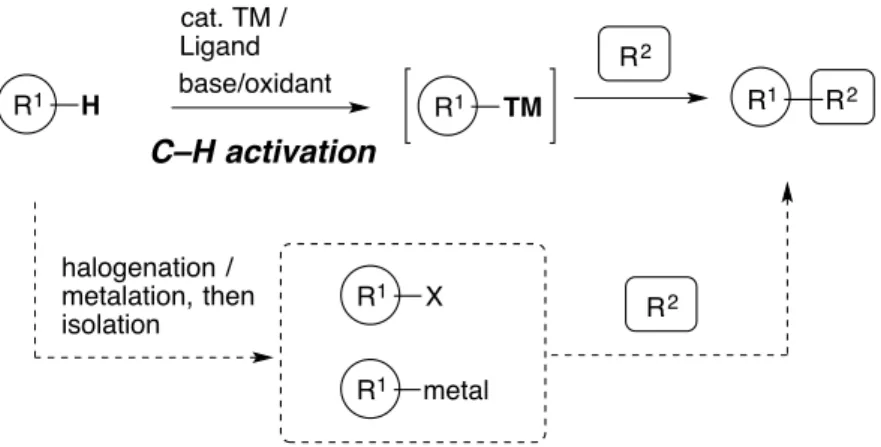
If the cross-coupling reactions could be performed from common and ubiquitous substrates, one could shortcut the troublesome pre-functionalization steps, and facile coupling reactions with atom-, waste-, and step-economy could be achieved. In this context, activation of a carbon-hydrogen bond (C–H bond) using a transition-metal catalyst, followed by cross-coupling with an appropriate reaction
R1 X
+ R2
cat. TM / Ligand
R1 R2
TM = Cu, Ni, Fe, Pd, Mn, etc. X = halides, OSO2R, etc.
metal = Mg, Zn, Li, B, Si, Sn, etc.
base/oxidant R1 metal
or
(coupling partner)
R2 : C–X, C–metal, N, O, S,
partner has been regarded as an important concept for next generation of organic syntheses (Figure 2), and has been rapidly expanding during past several decades9 enough to be applied for synthesis of bioactive compounds10 or π-extended molecules for materials science.11 C–H activation has numerous advantages: streamlines synthetic methodologies, provides alternative or even otherwise impossible strategies, and enables different reactivity from C–X or C–M bond, all of these being useful in reconsidering retrosynthetic strategies for complex molecules such as natural compounds.10b Thus, the C–H bond activation reaction has a multifaceted value, and is now regarded as a hot-topic in organic chemistry.12
Figure 2. Schematic comparison of C–H bond functionalization reactions
with traditional multi-step coupling reactions
1-2. Directed C(sp2)–H bond activation
One of the biggest concerns in development of C–H bond functionalization reactions is how to activate a C–H bond regioselectively, which is the most difficult and important step in many cases. While a great number of methodologies for regioselective C–H activation has been developed,13 , 14 chelation-assisted (directed) C–H bond
R1 H R2 cat. TM / Ligand R1 R2 base/oxidant C–H activation halogenation / metalation, then isolation R 1 X R1 metal R1 TM R2
methodologies because of its perfect predictable regioselectivity at mostly the ortho-position,15 and it typically enables reactions under mild reaction conditions (Scheme 1).
Scheme 2. Directed C–H bond activation
1-3. Recent examples and future directions of directed C–H bond activation
Since the initial discovery of transition-metal-mediated16 or -catalyzed17 reactions (eq. 1), directed C–H activations have been widely investigated and provide one of the common methodologies for ortho-functionalization.18 Representative examples are shown below, where a C–H bond can be functionalized with common and simple functional group such as carboxylic acid (eq. 2),19 and arene coupling partner such as benzene (eq. 3).20 These examples highlight the great potential and synthetic utility of directed C–H bond activation reactions.
X H X M X H M X : directing group "R" X R + RuH2(CO)(PPh3)3 (2 mol %) toluene, reflux, 3 h (1) O H Si(OEt) 3 (1 equiv) O Si(OEt)3 quant
In spite of these progresses, most reports rely on using expensive reagents especially for the catalysts such as palladium and rhodium, metals that suffer from high cost and toxicity. Therefore, replacement of these metals with inexpensive and non-toxic metals should be the direction to go for the sustainable development of our society.21 Thus, achieving such reactions uisng early transition-metals has been a longstanding goal. First-low transition-metal-catalyzed directed activation of a C(sp2)– H bond was firstly achieved in 2006, when Yu22 and Chatani23 independently reported the first directed C–H functionalization using inexpensive copper as a catalyst or a stoichiometric additive (eq. 4). Later the modified reaction conditions with copper catalyst,24 as well as reactions catalyzed by cobalt,25 nickel,26 and manganese27 have been reported. However, these reactions still cannot compete with late-transition-metal catalysts from the viewpoint of reaction versatility, partially because of the scarce understanding of the active species.
CO2H + CO2Et (2 equiv) Pd(OAc)2 (5 mol %) BQ (5 mol %) KHCO3 (2 equiv) t-AmylOH, 85 °C 1 atm O2, 48 h CO2H MeO MeO H CO2Et 96% (2) BQ = 1,4-benzoquinone N(iPr)2 + (20 equiv) [{RhCp*Cl2}2] (2.5 mol %) Cu(OAc)2 (2.2 equiv) C6Br6 (2 equiv) PivOH (0.5 equiv) CsOPiv (0.2 equiv) 2-Cl-p-xylene, 140 °C, 21 h N(iPr)2 MeO MeO H 87% (3) O H O
1-4. Iron-catalyzed directed C(sp2)–H bond activation reactions
Iron is the most abundant and inexpensive among all transition-metals with negligible toxicity, therefore development of organic reactions using iron catalyst should have great impact on the synthetic chemistry and even the whole human society.28,29 While iron has been traditionally known as a Lewis acid or radical initiator,30 its reactivity as an organometallic catalyst has been largely ignored, until the pionering reports by Kharasch,31 Tamura and Kochi (eq. 5).32 After these reports, a large number of reports on cross-coupling reaction had appeared.1a
Importantly, iron as an organometallic catalyst exhibits unique and high reactivity that overwhelms that of late transition-metals,33 which motivated chemists to further investigate its potential. In this context, in 2008 Nakamura and co-workers reported the first example of iron-catalyzed directed oxidative arylation of C(sp2)–H bonds using diarylzinc reagent as a base and an aryl donor, with a dichloroalkane (DCIB) as a mild oxidant.34 Later, the same group35 and other groups36 have contributed to expand this chemistry (Scheme 2). Taking its low-cost, high reactivity and mildness of the reaction condition into consideration, exploiting the iron-catalyzed reaction system would considered to have great potential for contributing to our
+ X H 22–92 % (4) N nucleophillic anion source Cu(OAc)2 (10–100 mol %) under air, solvent, 130 °C N (X) (X = OH, Cl, Br, NHTs, SR) MgBr + Br (5 equiv) (1 equiv) cat. FeCl3 83% (5)
sustainable developments.
Scheme 3. Iron-catalyzed directed C(sp2)–H arylations under oxidative conditions
1-5. Objective and survey for this thesis
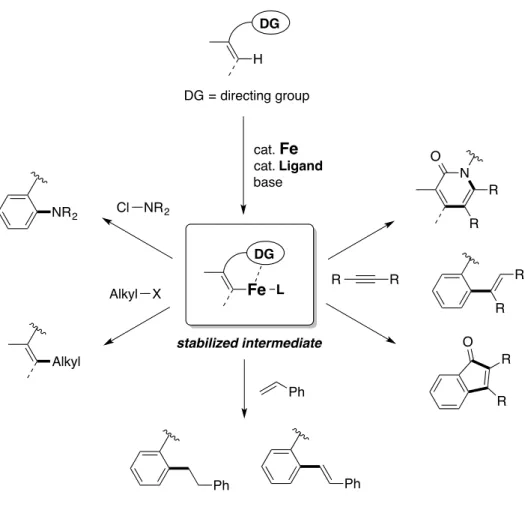
Difficulty for expanding the scope of the iron-catalyzed directed C–H bond activation reaction associates with the unpredictability of “low-valent” iron species generated through homocoupling of organometallic reagents,37,38 which can be ascribed to inadequate support of active iron species by directing group and ligand, and lack of mechanistic understanding.35d To overcome this problem, my Ph.D. studies focused on the development of directed functionalization of C(sp2)–H bonds using iron as a catalyst through sufficient stabilization of the organoiron intermediate by appropriate directing group and ligand, aiming for establishment of coupling reactions using electrophiles including multiple bonds as coupling partners (Figure 3). To this end, I started an
N H cat. Fe(acac)3 / phen or dtbpy ArMgBr or Ar2Zn Cl Cl THF, 0 °C N Ar N H = H N H NHR O H N PMP N N phen N N tBu tBu dtbpy (DCIB) N Fe N N Ar reductive elimination
directing group and diphosphine ligands are effective for its stability (Chapter 2). Then, the reactivity of organoiron species toward an aminating reagent was investigated, and a rare example of intermolecular C(sp2)–H amination reaction has achieved (Chapter 3). Reaction with alkyl electrophiles was also examined, and C(sp2)–H alkylation reaction with primary and secondary alkanol derivatives such as alkyl tosylates was accomplished (Chapter 4). The organoiron intermediate found to be reactive towards multiple bonds such as alkenes and alkynes, to achieve coupling reactions producing a variety of molecules, including cyclic ones such as indenones and pyridones (Chapter 5). The reactions described herein highlight the unique reactivity of iron catalyst for C–H bond activations, which can compete or even overwhelm that of late transition-metals.
Figure 3. Overview of this thesis
DG H DG = directing group cat. Fe cat. Ligand base DG Fe L stabilized intermediate Cl NR2 NR2 Alkyl X Alkyl Ph Ph Ph R R O R R R R O N R R
1-6. References and Notes
1 (a) Ilies, L.; Nakamura, E. In The Chemistry of Organoiron Compounds; Marek, I.; Rappoport, Z., Eds.; John Wiley & Sons, Ltd: Chichester, UK 2014 and references therein.
2 (a) Hassan, J.; Sévingnon, M.; Gozzi, C.; Schltz, E.; Lemaire, M. Chem. Rev. 2002,
102, 1359–1470. (b) Ley, S. V.; Thomas, A. W. Angew. Chem., Int, Ed. 2003, 42, 5400–5449 and references therein.
3 (a) Tamaru, Y., Ed.; Modern Organonickel Chemistry; Wiley-VCH, Weinheim, 2005. (b) Montgomery, J. Angew. Chem., Int. Ed. 2004, 43, 3890–3908. (c) Tasker, S.;
Standley, E.; Jamison, T. F. Nature 2014, 509, 299–309.
4 Palladium: (a) Seechrn, C. C. C. J.; Kitching, M. O.; Colacot, T. J.; Sniekus, V.
Angew. Chem., Int. Ed. 2012, 51, 5062–5085 and references therein. Cobalt: (b) Cahiez, G.; Moyeux, A. Chem. Rev. 2010, 110, 1435–1462. Manganese: (c) Rueping, M.; Ieawsuwan, W. Synlett, 2007, 247–250.
5 PALLADIUM–CATALYZED CROSS COUPLINGS IN ORGANIC SYNTHESIS;
http://www.nobelprize.org/nobel_prizes/chemistry/laureates/2010/advanced-chemistryp rize2010.pdf.
6 (a) Olah, G. A. Acc. Chem. Res. 1971, 4, 240–248. (b) Prakash, G. K.; Mathew, T.; Hoole, D.; Esteves, P. M.; Wang, Q.; Rasul, G.; Olah, G. A. J. Am. Chem. Soc. 2004, 126, 15770–15776.
7 Selected examples of directed ortho-metalation: (a) Kauch, M, Hoppe, D. Synthesis
2006, 1575–1577. (b) Nguyen, T.-H.; Castanet, A.-S.; Mortier, J. Org. Lett. 2006, 8,
765–768. (c) Pena, M. A.; Sestelo, J. P.; Sarandeses, L. A. J. Org. Chem. 2007, 72, 1271–1275.
8 Metalation with (TMP)
2Zn•2MgCl2•2LiCl: (a) Wunderlich, S. H.; Knochel, P. Angew.
Chem., Int. Ed. 2007, 46, 7685–7688. (b) Wunderlich, S. H.; Knochel, P. Chem.
Commun. 2008, 6387–6389. (c) Kienle, M.; Dunst, C.; Knochel, P. Org. Lett. 2009, 11, 5158–5161.
J.-Q. Angew. Chem., Int. Ed. 2009, 48, 5094–5115. (c) Kulkarni, A. A.; Daugulis, O. Synthesis 2009, 4087–4109. (d) Kuhl, N.; Hopkinson, M. N.; Wencel-Delord, J.; Glorius, F. Angew. Chem., Int. Ed. 2012, 51, 10236–10254. (e) Wencel-Delord, J.; Glorius, F. Nat. Chem. 2013, 5, 369–375.
10 (a) Gutekunst, W. R.; Baran, P. S. Chem. Soc. Rev. 2011, 40, 1976–1991. (b) Yamaguchi, J.; Yamaguchi, A. D.; Itami, K. Angew. Chem., Int. Ed. 2012, 51, 8960– 9009.
11 Segawa, Y.; Maekawa, T.; Itami, K. Angew. Chem., Int. Ed. 2014, 54, 66–81. 12 C–H activation as one of the “Hot-Topics” in WILEY-VCH:
http://www.wiley-vch.de/util/hottopics/c-h-activation/.
13 Selected examples of steric-controlled C–H activation: (a) Saito, Y.; Segawa, Y.; Itami, K. J. Am. Chem. Soc. 2015, 137, 5193–5198. (b) Obligacion, J. V.; Semproni, S. P.; Chirik, P. J. J. Am. Chem. Soc. 2014, 136, 4133–4136.
14 Selected examples of electronic-controlled C–H activation: (a) Larsen, M. A.; Hartwig, J. F. J. Am. Chem. Soc. 2014, 136, 4287–4299. (b) Yanagisawa, S.; Sudo, T.; Noyori, R.; Itami, K. J. Am. Chem. Soc. 2006, 128, 11748–11749. (c) Feve, G.; Mahe, A.; Berroir, J. M.; Kontos, T.; Placais, B.; Glatti, D. C.; Etienne, B.; Jin, Y. Science,
2007, 316, 1169–1172. For a review, see: (d) Seregin, I. V.; Gevorgyam, V. Chem. Soc.
Rev. 2007, 36, 1173–1193.
15 Recently meta- or para-C–H activation to the directing group has been reported with special design of the directing group: (a) Leow, D.; Li, G.; Mei, T.-S.; Yu, J.-Q. Nature
2013, 486, 518–522. (b) Bag, S.; Patra, T.; Modak, A.; Deb, A.; Maity, S.; Dutta, U.;
Dey, A.; Kancherla, R.; Maji, A.; Hazra, A.; Bera, M.; Maiti, D. J. Am. Chem. Soc.
2015, 137, 11888–11891.
16 Nickel: (a) Kleiman, J. P.; Dubeck, M. J. Am. Chem. Soc. 1963, 85, 1544–1545. Platinum and Palladium: (b) Cope, A. C.; Siekman, R. W. J. Am. Chem. Soc. 1965, 87, 3272–3273. Cobalt: (c) Murahashi, S. J. Am. Chem. Soc. 1955, 77, 6403–6404.
17 Murai, S.; Kakiuchi, F.; Sekine, S.; Tanaka, Y.; Kamatani, A. Nature 1993, 366, 529–531.
Shabashov, D. Acc. Chem. Res. 2009, 42, 1074–1086. (b) Lyons, T. W.; Sanford, M. S. Chem. Rev. 2010, 110, 1147–1169. (c) Engle, K. M.; Mei, T.-S.; Yu, J.-Q. Acc. Chem. Res. 2012, 45, 788–802. (d) Colby, D. A.; Bergman, R. G.; Ellman, J. A. Chem. Rev.
2010, 110, 624–655.
19 Wang, D.-H.; Engle, K. M.; Shi, B.-F.; Yu, J.-Q. Science 2010, 327, 315–319.
20 Wencel-Delord, J.; Nimphius, C.; Wang, H.; Glorius, F. Angew. Chem., Int. Ed. 2012,
51, 13001–13005.
21 (a) Clark, J. H. Green Chem. 1999, 1, 1–8. (b) Poliakoff, M.; Fitspartrick, J. M.; Farren, T. R.; Anastas, P. T. Science 2002, 297, 807–810.
22 Chen, X.; Hao, X.-S. Goodhue, C. E.; Yu, J.-Q. J. Am. Chem. Soc. 2006, 128, 6790– 6791.
23 Uemura, T.; Imoto, S.; Chatani, N. Chem. Lett. 2006, 35, 842–843.
24 Selected examples: (a) Shang, M.; Sun, S.-Z.; Wang, H.-L.; Laforteza, B. N.; Dai, H.-X.; Yu, J.-Q. Angew. Chem., Int. Ed. 2014, 53, 10439–10442. (b) Li, Q.; Zhang, S.-Y.; He, G.; Ai, Z.; Nack, W. A.; Chen. G. Org. Lett. 2014, 16, 1764–1767. (c) Roane, J.; Daugulis, O. Org. Lett. 2013, 15, 5842–5845.
25 (a) Gao, K.; Lee, P.-S.; Fujita, T.; Yoshikai, N. J. Am. Chem. Soc. 2010, 132, 12249. (b) Chen, Q.; Ilies, L.; Nakamura, E. J. Am. Chem. Soc. 2011, 133, 428–429. For
reviews, see: (c) Yoshikai, N. Bull. Chem. Soc. Jpn. 2014, 87, 843–857. (d) Ackermann, L. J. Org. Chem. 2014, 79, 8948–8954.
26 Shiota, H.; Ano, Y.; Aihara, Y.; Fukumoto, Y.; Chatani, N. J. Am. Chem. Soc. 2011,
133, 14952–14955.
27 (a) Kuninobu, Y.; Nishina, Y.; Takeuchi, T.; Takai, K. Angew. Chem., Int. Ed. 2007,
46, 6518–6520. (b) Zhou, B.; Chen, H.; Wang, C. J. Am. Chem. Soc. 2013, 135, 1264– 1267.
28 (a) Nakamura, E.; Sato, K. Nat. Mater. 2011, 10, 158–161. (b) Bolm, C. Nat. Chem.
2009, 1, 420.
M. Angew. Chem., Int. Ed. 2008, 47, 3317−3321. (d) Sherry, B. D.; Fürstner, A. Acc. Chem. Res. 2008, 41, 1500−1511. (e) Czaplik, W. M.; Mayer, M.; Cvengros, J.; Jacobi von Wangelin, A. ChemSusChem 2009, 2, 396−417. (f) Sun, C.-L.; Li, B.-J.; Shi, Z.-J. Chem. Rev. 2011, 111, 1293−1314.
30 Vrancken, E.; Campagne, J.-M. In The Chemistry of Organoiron Compounds; Marek, I.; Rappoport, Z., Eds.; John Wiley & Sons, Ltd: Chichester, UK 2014 and references therein.
31 Kharasch, M. S.; Weiner, M.; Nudenberg, W.; Bhattacharya, A.; Wang, T.-I.; Yang, N. C. J. Am. Chem. Soc. 1961, 83, 3232–3234.
32 Tamura, M.; Kochi, J. K. J. Am. Chem. Soc. 1971, 93, 1487–1489.
33 (a) Fürstner, A.; Martin, R.; Krause, H.; Seidel, G.; Goddard, R.; Lehmann, C. W. J.
Am. Chem. Soc. 2008, 130, 8773–8787. (b) Nakamura, E.; Yoshikai, N. J. Org. Chem.
2010, 75, 6061–6087.
34 Norinder, J.; Matsumoto, A.; Yoshikai, N.; Nakamura, E. J. Am. Chem. Soc. 2008,
130, 5858–5859.
35 (a) Yoshikai, N. Matsumoto, A.; Norinder, J. Nakamura, E. Angew. Chem., Int. Ed.
2009, 48, 2925–2928. (b) Yoshikai, N.; Matsumoto, A.; Norinder, J. Nakamura, E.
Synlett 2010, 313–316. (c) Ilies, L.; Asako, S.; Nakamura, E. J. Am. Chem. Soc. 2011, 133, 7672–7675. (d) Yoshikai, N.; Asako, S.; Yamakawa, T.; Ilies, L.; Nakamura, E. Chem. Asian. J. 2011, 6, 3059–3065. (e) Ilies, L.; Kobayashi, M.; Matsumoto, A.; Yoshikai, N.; Nakamura, E. Adv. Synth. Catal. 2012, 354, 593–596. (f) Ilies, L.; Konno, E.; Chen, Q.; Nakamura, E. Asian J. Org. Chem. 2012, 1, 142–145.
36 (a) Sirois, J. J.; Davis, R.; DeBoef, B. Org. Lett. 2014, 16, 868–871. (b) Gu, Q.; Al Mamari, A, H.; Graczyk, K.; Diers, E.; Ackermann, L. Angew. Chem., Int. Ed. 2014, 53, 3868–3871.
37 (a) Nagano, T.; Hayashi, T. Org. Lett. 2005, 7, 491–493. (b) Cahiez, G.; Chaboche, C.; Mahuteau-Betzer, F.; Ahr, M. Org. Lett. 2005, 7, 1943–1946.
2-1. Introduction
• Investigation of active species through stoichiometric experiments
Experiments using a stoichiometric amount of transition-metal (stoichiometric reactions) are often employed in many organometallic reactions to investigate information on the reaction mechanism and determine the active organometallic species.1 This is also the case for in C–H activation reactions: organometallic species generated from a C–H substrate and a catalyst have been isolated or prepared in situ, and then subjected to the reaction with coupling partners to determine the intermediate involved in a catalytic cycle.2 , 3 Stoichiometric reactions are also effective when exploring new reactions, through discovery of coupling partners that would react with the organometallic species.
• Previous studies on stoichiometric reactions in C–H activation with iron
As discussed in the previous chapter, one of the most serious problems causing the limited scope of iron catalysis is the instability of the organoiron species. Previously, Nakamura and coworkers investigated the stability of organoiron through stoichiometric experiments using Grignard reagents.4 When they performed a stoichiometric reaction in the absence of the oxidant, the organoiron species was generated in THF at 0 °C, as indirectly confirmed by ortho-deuterium incorporation after quenching by D2O (eq. 1). The reaction also produced biphenyl (92%, based on phenylpyridine) along with an ortho-phenylated compound (6%), suggesting that the intermediate is not stabilized enough and is competing with these side-reactions. Attempts to develop coupling reactions between the organoiron intermediate and electrophiles mostly failed,5 with one exception when using allyl phenyl ether as the electrophile and 1-phenylpyrazole as the substrate, which was later developed into a catalytic reaction (eq. 2).6 In most cases, the organoiron species readily produces
which may also act as an oxidant to accelerate reductive elimination.
• Stabilization of the organoiron by bidentate directing group
To establish a robust catalytic system for iron-catalyzed C–H functionalization, the instability problem of the organoiron species should be overcome.
H
N Fe(acac)dtbpy (2 equiv)3 (1 equiv) PhCl, 0 °C
PhMgBr in THF (4 equiv)
addition over 3 min then stirred for 60 min
D2O H/D N 80% recovery (86% D incorp.) + Ph N Ph Ph 92% (based on phenylpyridine) 6% + (1) (1 equiv) [Fe] N Ph L N N tBu tBu dtbpy N N H + OPh Fe(acac)3 (10 mol %) dtbpy (10 mol %) PhMgBr (6 equiv) ZnCl2•TMEDA (3 equiv) THF, 0 °C, 48 h N N (2) 80% (2 equiv) N N Ph + + Ph + Ph Ph
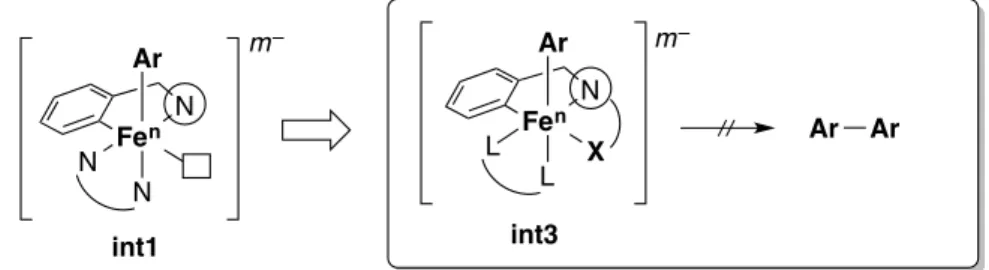
caused by fast reductive elimination from diaryliron ate species int27 after coordination of another aryl nucleophile to int1. To suppress this undesired pathway, it is necessary to occupy the vacant coordination site of int1,8 and another coordinating heteroatom on the directing group (such as a bidentate directing group) can be considered to occupy the coordination site, through formation of int3 (Figure 2).
Figure 1. Possible coordination geometry of iron in directed C–H bond activation
Figure 2. Working hypothesis using a bidentate directing group
The feasibility of using a bidentate directing group for the reaction is supported by successful literature reports using Pd, 9 Cu,10 Ni 11 and other transition-metal catalysts,12 including iron-catalyzed directed arylation of C(sp3)–H bonds reported by Nakamura and coworkers (eq. 3).13 Based on these backgrounds, I hypothesized that a bidentate directing group might be effective for C(sp2)–H bond activation using iron catalysys, and enables coupling reactions with electrophiles through stabilization of the organoiron species.
N Fen Ar N N N Fen Ar N N Ar Ar Ar Ar– m– n– + "low-valent iron" int1 int2 ligand exchange N Fen Ar L L X Ar Ar m– N Fen Ar N N m– int1 int3
• Investigations described in this chapter
This chapter describes my investigation of a stoichiometric reaction of iron for directed C–H bond activation using a bidentate directing group, aimed to stabilize the organoiron intermediate. Through discovery of an appropriate base and ligand, organoiron species with coordinated by a bidentate directing group was generated, and it was found to be stable even upon heating. Reductive elimination induced by an oxidant was considerably slow, suggesting that the species possesses different reactivity from the species coordinated by a monodentate directing groups.4
2-2. Investigation of directing group/ligand in stoichiometric reactions
I performed stoichiometric reactions using aromatic substrates possessing a bidentate directing group according to the reaction sequence developed previously,4 where an organometallic base (3–4 equiv) was added to the THF solution of substrate (1 equiv), Fe(acac)3 (1 equiv) and ligand (1–2 equiv). After extensive investigations, I discovered that organoiron species (plausible structure is shown as A in Scheme 1)
could be generated from N-(quinolin-8-yl)amide as a substrate,
NH N Fe(acac)3 / dppbz (10 mol %) p-AnisMgBr (7 equiv) ZnCl2•TMEDA (3 equiv) (3) H O Cl Cl (2 equiv) THF, 50 °C, 24 h NH N p-Anis O Ph Ph 85% PPh2 Ph2P dppbz
literature,4 existence of A was indirectly confirmed by ortho-deuteration after quenching with D2O, and 67% of deuterium incorporation was observed.14 The intermediate A did not decompose at all, and the ortho-phenylated product was not observed under the reaction conditions. Homocoupling of the base was observed in ca. 50% yield, suggesting that iron(III) was reduced to generate iron(II)15 that might be an active species.
Scheme 1. Organoiron species A from N-(quinolin-8-yl)amide directing group
and a diphosphine ligand
Other bidentate directing groups that worked poorly are shown in Scheme 2. Amide directing groups were chosen because they are easily removed by hydrolysis.9 Reaction using N-(quinolyn-8-yl)benzamide with methyl substituent on amide nitrogen did not work, which means the amide nitrogen is covalently attached to the center iron atom. C2 position of the quinoline completely shut down the reaction, suggesting the sensitivity of the organoiron species to sterics. Reaction with N-picolinylbenzamide gave ortho-phenylated product in around 20% yield together with a mixture of unidentified compounds, which is possibly caused by the flexibility of the picolinyl group and the acidic proton at the benzyl position. N-(2-thioanysyl)benzamide as a N,S-type directing group was almost unreactive. Overall, quinolylamide was found to
NHQ O H Fe(acac)3/ dppbz (1 equiv) PhMgBr (3 equiv) THF, 50 °C N O N Fe P P (Ph) (Q = quinolin-8-yl) A D2O NHQ O D/H quantitative recovery with 67% D incorp. PPh2 PPh2 dppbz + NHQ O Ph 0%
be uniquely effective, probably due to its rigidity and strong coordination ability of nitrogen to iron.
Scheme 2. Examples for ineffective directing groups
The reactions is also very sensitive to the nature of the external ligand (Scheme 3). 1,2-bis(dimethylphosphino)benzene, a dppbz analogue with methyl substituents on phosphine was not effective at all. Other ineffective ligands include monodentate ones such as N-heterocyclic carbenes and triphenylphosphine, and diphosphines with wider bite angle such as dppp (1,3-diphenylphosphinopropane) and Xantphos (4,5-bis(diphenylphosphino)-9,9-dimethylxanthene). A diphosphine possessing a saturated backbone and similar bite angle with dppbz, dppe (1,2-diphenylphosphinoethane) worked less efficiently, give the ortho-phenylated product. An organoiron in the presence of dtbpy as a ligand was mostly decomposed to give the phenylated product. From these results, it can be concluded that a diphosphine with aromatic substituent and rigid backbone is necessary for stabilization of the organoiron. NH O H Fe(acac)3/ dppbz (1 equiv) PhMgBr (3 equiv) THF, 50 °C D2O NH O X DG DG O N H N Me O NH H N Me O NH H N O NH H SMe no reaction X = H or D or Ph
Scheme 3. Examples of ineffective ligands
2-3. Examination of stability of the intermediate against organic oxidant
The newly formed organoiron species was found to be stable at 50 °C, which is sharp contrast to the species coordinated by a monodentate directing group. To further assess the stability, next I examined the reactivity of A toward oxidant that might induce reductive elimination (Scheme 4). Into the solution of A, 1,2-dichloroisobutane (DCIB)16 was added and stirred at 50 °C for 1 hour, to find that the ortho-phenylation product was formed in 12% yield, while 59% of phenylation product was obtained when the monodentate directing group was used.4 Thus, I could confirm the improved stability of organoiron even in the presence of an oxidant accelerates reductive elimination, which is promising to develop novel reactions with coupling partners such as electrophiles.17
NHQ O H Fe(acac)3/ Ligand (1 equiv) PhMgBr (3 equiv) THF, 50 °C (Q = quinolin-8-yl) D2O NHQ O X X = H or D or Ph no reaction X = D (ca. 20%) X = Ph (ca. 20%) X = Ph (ca. 40%) Me2P PMe2 PPh2 Ph2P Ph2P PPh2 O PPh2 PPh2 PPh3 N N tBu tBu N N R R Cl
Scheme 4. Reaction of A with an organic oxidant DCIB
2-4. Conclusion
In conclusion, a stabilized ferracycle intermediate could be generated from an aromatic substrate possessing N-(quinolin-8-yl)amide as a bidentate directing group and dppbz as a ligand. The intermediate is stable and does not decompose below 50 °C, which is sharp contrast to the case of monodentate directing group. Reductive elimination affording ortho-arylation in the presence of DCIB was considerably slow, which means that the organoiron was also stable toward oxidant. Results obtained herein will be used to design a robust catalytic system using iron as a catalyst, as described in the next chapters.
12% recovery: 81% NHQ O H Fe(acac)3/ dppbz (1 equiv) PhMgBr (3 equiv) THF, 50 °C N O N Fe P P (Ph) A NHQ O Ph Cl Cl (oxidant) 50 °C, 1 h
2-5. Experimental
Materials and instruments
All reactions dealing with air- or moisture-sensitive compounds were performed by standard Schlenk techniques in oven-dried Schlenk tubes under an argon atmosphere. Flash chromatography was performed as described by Still et al.,18 employing Kanto Silica gel 60 (spherical, neutral, 140-325 mesh). 1H and 13C nuclear magnetic resonance (NMR) spectra were recorded on a JEOL ECA-500 (500 and 125 MHz) and JEOL ECX-400 (400 and 100 MHz) NMR spectrometer. 1H NMR and 13C NMR spectra are reported in parts per million (ppm) downfield from an internal standard, tetramethylsilane (0 ppm) and CHCl3 (7.26 and 77.0 ppm), respectively. Gas chromatographic (GC) analysis was performed on a Shimadzu GC-14B instrument equipped with an FID detector and a capillary column, HR-1 (25 m x 0.25 mm i.d., 0.25 mm film).
Unless otherwise noted, materials were purchased from Tokyo Kasei Co., Aldrich Inc., and other commercial suppliers and were used after appropriate purification before use. Anhydrous tetrahydrofuran was purchased from KANTO Chemical Co. and purified prior to use by a solvent purification system (GlassContour) equipped with columns of activated alumina and copper catalyst.19 The water content
was determined with a Karl-Fischer moisture titrator (MKC-210, Kyoto Electronics Company) to be less than 30 ppm. Phenylmagnesium bromide was prepared from bromobenzene and magnesium turnings in anhydrous tetrahydrofuran, and titrated prior to use using I2 in THF saturated with LiCl (0.5 M).20
Preparation of the starting materials
General procedure for preparation of amides: synthesis of N-(quinolin-8-yl)benzamide Benzoic acid (10 mmol) was placed in an oven-dried two-necked flask and thionyl chloride (10 mL) was added under a nitrogen atmosphere. The reaction mixture was stirred at 80 °C for 60 min, and then the excess thionyl chloride was removed in vacuo. The flask was cooled to 0 °C, the reaction mixture was diluted with dichloromethane (100 mL), then triethylamine (5 mmol) and 8-aminoquinoline (11 mmol) were added and the reaction mixture was stirred for 2 h at room temperature. The reaction was quenched by the addition of a saturated aqueous NH4Cl solution, and the organic layer was separated, and the aqueous layer was extracted with dichloromethane for 3 times. The organic layer was dried over magnesium sulfate, and then the solvent was evaporated. The residue was passed through a pad of silica gel to remove unreacted 8-aminoquinoline. The crude compound was recrystallized to afford the pure amide.
Compound data for amides described in this chapter were in good agreement in previous literatures.21
Procedure for stoichiometric reactions: reaction with D2O (Scheme 1).
In a Schlenk tube N-(quinolin-8-yl)benzamide (25 mg, 0.10 mmol), Fe(acac)3 (35 mg, 0.10 mmol), and 1,2-bis(diphenylphosphino)benzene (dppbz, 45 mg, 0.10 mmol) were dissolved in THF (1 mL). A solution of PhMgBr in THF (0.34 mL, 0.89 mol/L, 0.30 mmol) was added dropwise and the resulting mixture was stirred at 50 °C to generate the intermediate A. D2O was added to this solution and the mixture was stirred at rt for 5 min. The reaction mixture was quenched by the addition of a saturated solution of potassium sodium tartrate (0.3 mL). After aqueous workup, the organic layer was extracted with EtOAc (2 mL × 3). The combined organic layers were passed through a pad of Florisil, and concentrated in vacuo. The amount of recovery and the degree of deuterium incorporation were determined by 1H NMR. Ortho-phenylated product was not detected by 1H NMR.
NHQ O H Fe(acac)3/ dppbz (1 equiv) PhMgBr (3 equiv) THF, 50 °C N O N Fe P P (Ph) (Q = quinolin-8-yl) A D2O NHQ O D/H quantitative recovery with 67% D incorp. PPh2 PPh2 dppbz + NHQ O Ph 0%
Procedure for stoichiometric reactions: reaction with DCIB (Scheme 4).
A solution of A was prepared according to the procedure described in the reaction with D2O. 1,2-Dichloroisobutane (23 µL, 0.2 mmol) was added to this solution and the mixture was stirred at 50 °C for 30 min. After workup, the amount of phenylation product and the recovery were determined by 1H NMR measurement of the crude mixture using 1,1,2,2-tetrachloroethane as an internal standard.
12% recovery: 81% NHQ O H Fe(acac)3/ dppbz (1 equiv) PhMgBr (3 equiv) THF, 50 °C N O N Fe P P (Ph) A NHQ O Ph Cl Cl (oxidant) 50 °C, 1 h
2-6. References and Notes
1 Selected examples for stoichiometric reactions with organoiron complexes: (a) Adams, C. J.; Bedford, R. B.; Carter, E.; Gower, N. J.; Haddow, M. F.; Harvey, J. N.; Huwe, M.; Carter, M, Á.; Mansell, S. M.; Mendoza, C. J. Am. Chem. Soc. 2012, 134, 10333– 10336. (b) Fürstner, A.; Krause, H.; Lehmann, C. W. Angew. Chem., Int. Ed. 2006, 45, 440–444. (c) Fürstner, A.; Martin, R.; Krause, H.; Seidel, G.; Goddard, R.; Lehmann, C. W. J. Am. Chem. Soc. 2008, 130, 8773–8787.
2 Selected examples: Rhodium: (a) Tauchert, M. E.; Incarvito, C. D.; Rheingold, A. L.; Bergman, R. G.; Ellman, J. A. J. Am. Chem. Soc. 2012, 134, 1482–1485. (b) Park, S. H.; Kwak, J.; Shin, K.; Ryu, J.; Park, Y.; Chang, S. J. Am. Chem. Soc. 2014, 136, 2492– 2502. Ruthenium: (c) Hofmann, N.; Ackermann, L. J. Am. Chem. Soc. 2013, 135, 5877–5884. Cobalt: (d) Lee, P.-S.; Fujita, T.; Yoshikai, N. J. Am. Chem. Soc. 2011, 133, 17283–17295. Iridium: (e) Ryu, J.; Kwak, J.; Shin, K.; Lee, D.; Chang, S. J. Am. Chem. Soc. 2013, 135, 12861–12868. Manganese: (f) He, R.; Huang, Z.-T.; Zheng, Q.-Y.; Wang, C. Angew. Chem., Int. Ed. 2014, 53, 4950–4953.
3 Ikemoto, K.; Inokuma, Y.; Rissanen, K.; Fujita, M. J. Am. Chem. Soc. 2014, 136, 6892–6895.
4 Yoshikai, N.; Asako, S.; Yamakawa, T.; Ilies, L.; Nakamura, E. Chem. Asian. J. 2011,
6, 3059–3065.
5 Asako, S. Ph.D. thesis.
6 Asako, S.; Norinder, J.; Ilies, L.; Yoshikai, N.; Nakamura, E. Adv. Synth. Catal. 2014,
356, 1481–1485.
7 Bedford, R. B. Acc. Chem. Res. 2015, 48, 1485–1493 and references therein. 8 Occupation of coordination site of iron by a fluorine anion is effective in cross coupling reaction: Hatakeyama, T.; Hashimoto, S.; Ishizuka, K.; Nakamura, M. J. Am. Chem. Soc. 2009, 131, 11949–11963.
9 Zaitsev, V. G.; Shabashov, D.; Daugulis, O. J. Am. Chem. Soc. 2005, 127, 13154– 13155.
10 (a) Tran, L. D.; Roane, J.; Daugulis, O. Angew. Chem., Int. Ed. 2013, 52, 6043–6046. (b) Nishino, M.; Hirano, K.; Satoh, T.; Miura, M. Angew. Chem., Int. Ed. 2013, 52,
4457–4461. (c) Shang, M.; Sun, S.-H.; Dai, H.-D.; Yu, J.-Q. J. Am. Chem. Soc. 2014, 136, 3354–3357.
11 (a) Shiota, H.; Ano, Y.; Aihara, Y.; Fukumoto, Y.; Chatani, N. J. Am. Chem. Soc.
2011, 133, 14952–14955. (b) Song, W.; Lackner, S.; Ackermann, L. Angew. Chem., Int.
Ed. 2014, 53, 2477–2480. (c) Aihara, Y.; Wuelbern, J.; Chatani, N. Bull. Chem. Soc. Jpn. 2015, 88, 438–446.
12 Selected examples: Cobalt: (a) Grigorjeva, L.; Daugulis, O. Angew. Chem., Int. Ed.
2014, 53, 10209–10212. (b) Grigorjeva, L.; Daugulis, O. Org. Lett. 2014, 16, 4684–
4687. (i) Grigorjeva, L.; Daugulis, O. Org. Lett. 2014, 16, 4688–4690. (j) Grigorjeva, L.; Daugulis, O. Org. Lett. 2015, 17, 1204–1207. Ruthenium: (k) Shibata, K.; Hasegawa, N.; Fukumoto, Y. Chatani, N. ChemCatChem 2012, 4, 1733–1736. (l) Aihara, Y.;
Chatani, N. Chem. Sci. 2013, 4, 664–670. (c) Rouquet, G.; Chatani, N. Chem. Sci. 2013, 4, 2201–2208. Rhodium: (d) Shibata, K.; Chatani, N. Org. Lett. 2014, 16, 5148–5151. (e) Shibata, K.; Yamaguchi, T.; Chatani, N. Org. Lett. 2015, 17, 3584–3587.
13 Shang, R.; Ilies, L.; Matsumoto, A.; Nakamura, E. J. Am. Chem. Soc. 2013, 135, 6030–6032.
14 Estimated by EI-MS analysis and determined by 1H NMR spectrum.
15 Adams, C. J.; Bedford, R. B.; Carter, E. C.; Gower, N. J.; Haddow, M. F.; Harvey, J. N.; Huwe, M.; Cartes, M. Á.; Mansell, S. M.; Mendoza, C.; Murphy, D. M.; Neeve, E. C.; Nunn, J. J. Am. Chem. Soc. 2012, 134, 10333–10336.
16 DCIB as an effective oxidant for iron to induce reductive elimination: (a) Norinder, J.; Matsumoto, A.; Yoshikai, N.; Nakamura, E. J. Am. Chem. Soc. 2008, 130, 5858– 5859. (b) Nakamura, Y.; Ilies, L.; Nakamura, E. Org. Lett. 2011, 13, 5998–6001. 17 At the same time, our group discovered ortho-allylation of amides with allylic electrophile using a bidentate directing group: Asako, S.; Ilies, L.; Nakamura, E. J. Am. Chem. Soc. 2013, 135, 17755–17757.
18 Still, W. C.; Kahn, M.; Mitra, A. J. Org. Chem. 1978, 43, 2923–2924.
21 (a) Li, X.; Liu, Y.-H.; Gu, W.-J.; Li, B.; Chen, F.-L.; Shi, B.-F. Org. lett. 2014, 16, 3904–3907. (b) Suess, A. M.; Ertem, M. Z.; Cramer, C. J.; Stahl, S. S. J. Am. Chem. Soc.
2013, 135, 9797–9804. (c) Wang, K.; Shen, M.; Sun, W.-H. Dalton Trans. 2009, 4085–
3-1. Introduction
• Synthesis of anilines through C(sp2)–N bond forming reactions
Formation of a C(sp2)–N bond from an aromatic substrate and a nitrogen source provides rapid access to functionalized anilines, compounds widely utilized and have attracted much attention in medicinal chemistry and materials science.1 Traditional approaches for anilines from arenes include the direct nitration of an arene with nitronium ion generated from nitric acid and sulfuric acid,2 followed by reduction to afford the aniline product (eq. 1).3 However, this approach suffers from poor regioselectivity when a substituted arene is used as the starting material, and the reaction efficiency is strongly affected by substituents. For example, electron-withdrawing substituents on the substrate shut down the reaction.
Transition-metal-catalyzed cross-coupling reactions between a (pseudo)halogenated4 , 5 , 6 or metalated7 , 8 aromatic substrate and an amine is an alternative approach, where the C–N bond is formed under much milder reaction conditions (Scheme 1).9 However, as already discussed in chapter 1, cross coupling reactions require pre-halogenation/metalation of an aromatic substrate that also suffers from poor regioselectivity, additional synthetic steps and costs.
HNO3, H2SO4 R R NO2 o-, m-, p- regioisomers of nitroarenes Pd/C, H2 R NH2 (1)
Scheme 1. Transition-metal-catalyzed cross-coupling for the synthesis of aniline
derivatives
• Amination of a C(sp2)–H bond with a nucleophilic amine under oxidative conditions Because of the reasons mentioned above, regioselective activation of the C(sp2)–H bond of an aromatic substrate, followed by reaction with a nucleophilic amine to form a C–N bond is considered to be an ideal synthesis of anilines, but such reactions have rarely been achieved because of the difficulty of either C–H bond activation or C– N bond forming steps.10
In 2006, Yu and coworkers reported the first example of the amination of C(sp2)–H bonds of an aromatic substrate, where the ortho C–H bond of 2-phenylpyridine is activated through radical pathway using a stoichiometric amount of copper, followed by reaction with a tosylamine to produce an ortho-aminated product in good yield (eq. 2).11 A similar reaction was reported by Chatani at almost the same time, using an aromatic amine as the aminating reagent with lower efficiency.12 The reaction system was modified by Daugulis and coworkers recently, where a N-(quinolin-8-yl)benzamide was employed as a substrate (eq. 3).13 However, the
X cat. metal cat. ligand base H NR1R2 NR1R2 X: Br, I BuLi/X2 or NXS H catalyst: Pd, Ni, Fe M cat. metal base oxidant H NR1R2 NR1R2 M: Mg, Zn, Li, Cu H
catalyst: Pd, Cu, Ni, Fe BuLi/ Mg, Zn, Cu Ar Ar Ar Ar Ar Ar
• From halogenated arenes
Other literature examples for C(sp2)–H amination using nucleophilic amines include palladium-catalyzed intra-16 and intermolecular17 amidations (eqs. 4 and 5), which mostly suffer from limited scope.18,19,20 Moreover, these reactions have to be operated under harsh reaction conditions with strong/toxic oxidants to accelerate C–N bond forming reductive elimination, which will decompose sensitive substituents and limits versatility of the reaction.
H N Cu(OAc)2 (1 equiv) air, MeCN, 130 °C + TsNH2 NHTs N (2) 74% (2 equiv) H NHQ Cu(OAc)2 (10–25 mol %) Ag2CO3 (12–25 mol %) NMO, NMP, 110 °C + O R HN O N NHQ O R (Q = 8-quinolinyl) O up to 87% (3) (2 equiv) O H N OMe Pd(OAc)2 (10 mol %) CuCl2 (1.5 equiv) AgOAc (2 equiv) DCE, 100 °C N O OMe 94% (4) H N OMe + H 2N O OCH3 Pd(OAc)2 (5 mol %) K2S2O8 (5 equiv) DCE, 80 °C NH N OMe OCH3 O 92% (5)
• Umpolung amination with electrophilic nitrogen source
Recently the repertoire of C(sp2)–H bond amination reactions has been rapidly expanding, after the discovery of an “umpolung” amination strategy using an electrophilic nitrogen as the amine source (Scheme 2).21 Because the electrophilic amine can react with a nucleophilic organometal intermediate through electrophilic amination,22 the reaction can be operated under milder reaction conditions with broader scope.
Scheme 2. Concept for “umpolung” C–H amination
The umpolung amination strategy enabled synthetic chemists to achieve a variety of methodologies for C–H amination reactions using transition-metal catalysts. Hirano, Miura and coworkers achieved copper-catalyzed amination of electron-deficient heteroaromatic C–H bonds using N-oxyamines (eq. 6).23 Similarly, Ritter and coworkers developed amination of electron-rich anisole derivatives using palladium catalysis (eq. 7).24 X NR1R2 NR1R2 H Ar Ar cat. M / Ligand M Ar (nucleophilic carbon) (electrophilic amine)
mild reaction conditions
C–H activation H N N O MeO + O NEt2 O Ph Cu(OAc)2 (10 mol %) phen (10 mol %) LiOt-Bu 1,4-dioxane, rt, 5 h NEt2 N N O MeO 85% (6) = Bz N N phen
Importantly, the amination reaction of an aromatic substrate possessing a directing group has also been recently established, using late transition-metals (eq. 8).25,26,27 Thus, amination of a C(sp2)–H bond became much easier to proceed using electrophilic nitrogen. To further improve its utility, achievement of such a reaction using an inexpensive metal catalyst23,28 is highly desired.29
• Reactions described in this chapter
Taking into account this backgrounds, I focused on achieving directed C(sp2)–H amination using iron as a catalyst, which is described in this chapter. In previous chapter, I achieved the generation of an organoiron species using a bidentate directing group that is stable upon heating and hardly decomposes in the presence of an oxidant. With this species in hand, I hypothesized that the organoiron intermediate would react with nucleophilic or electrophilic aminating reagents, to afford aniline derivatives through C–N bond formation (Scheme 3). To this end, I discovered that the reaction of organoiron with a N-chloroamine proceeded to give ortho-aminated product,
OMe CO2Me + N F SO2Ph PhO2S Pd catalyst (2 mol %) Ag(bipy)ClO4 (4 mol %) MeCN, rt (1.5 equiv) OMe CO2Me N SO2Ph SO2Ph 83% (7) N N O Pd N N O (OTf)2 Pd catalyst X H X = N, O + Cl NR2 or BzO NR2
cat. M (Pd, Ru, Rh, Ir)
X
and finally achieved ortho-amination of aromatic amides using iron as a catalyst. Importantly, the reaction does not require any toxic oxidants, and can be performed under mild reaction conditions, to produce anthranilic acid derivatives that exhibit interesting biological and photochemical properties.30
Scheme 3. Working hypothesis for ortho-amination of amide using iron catalysis,
through reaction of organoiron with an amine
NHQ O H cat. Fe(acac)3 / diphosphine PhMgBr base (Q = quinolin-8-yl) NHQ O NR2 N O N Fe P P (Ph) stabilized intermediate aminating reagent
3-2. Reaction design for ortho-aminaton of aromatic amides through C–H activation with stoichiometric amount of iron
To achieve the ortho-amination reaction using iron, initially I designed conditions for a stoichiometric reaction according to the previous investigations described in chapter 2, where organoiron species A was generated from an aromatic amide possessing N-(quinolin-8-yl)amide as a bidentate directing group, 1,2-diphenylphosphinobenzene (dppbz) as a ligand and aryl Grignard reagent as a base. I explored an appropriate aminating reagent that would react with A to form a C–N bond at the ortho-position of the amide (Scheme 4).
Scheme 4. Design of a stoichiometric reaction for ortho-amination
After investigations, I found that N-chloromorpholine reacts with A to give an ortho-aminated product in 60% yield (eq. 9). Other amine sources such as nucleophilic zinc- and magnesium amides6,8a,c and amines in the presence of inorganic bases were also investigated, but they were not reactive at all (Figure 1). Control experiments revealed that the bidentate directing group, the diphosphine ligand and the iron salt are necessary. Other ligands such as dinitrogen ligands or NHC (N-Heterocyclic Carbene) ligands were not effective: recovery of the starting material, or ortho-phenylated product was observed.31 Other organometallic reagents such as alkyl Grignard reagents or organozinc reagents were not effective for the ortho-amination reaction.
NHQ O H Fe(acac)3 / dppbz (1 equiv) PhMgBr (3 equiv) THF, 50 °C (Q = quinolin-8-yl) NHQ O NR2 N O N Fe P P (Ph) A aminating reagent
Figure 1. Examples of unreactive nucleophilic amines
3-3. Ortho-amination of amides using a catalytic amount of iron
With the result of a stoichiometric reaction in hand, next I performed the reaction with a chloroamine using a catalytic amount of iron/diphosphine, to confirm the reaction would proceed with catalytically (Scheme 5). The reaction was largely suppressed when 50 mol % of Fe(acac)3/dppbz was used, and did not take place with 20 mol % of the catalyst. In all entries, the yield of the aminated product did surpass the amount of catalyst loading, which means the reaction is not catalytic in iron. As a matter of fact, I observed N-phenylmorpholine and chlorobenzene by GC analysis, suggesting these reagents were decomposed through a side reaction between N-chloroamine and PhMgBr.32 NHQ O H Fe(acac)3 / dppbz (1 equiv) PhMgBr (3 equiv) THF, 50 °C NHQ O N 50 °C, 1 h 60% N O Cl (5 equiv) O (9) H N "ZnCl" H N "MgBr" NH2 + inorganic bases
Scheme 5. Amination reaction with a catalytic amount of iron/dppbz
Then I changed the reaction operation to suppress the side reaction, and I slowly added the reagents. Slow addition of a reagent is sometimes effective to obtain product selectivity, if the desired reaction is faster than the side reaction.33,34 However, slow addition of PhMgBr or chloroamine was not effective to achieve catalytic turnover, and the desired product was not obtained at all (Scheme 6). This suggests that the side reaction32 is much faster than the desired ferracycle formation / electrophilic amination pathway.
Scheme 6. Slow addition of PhMgBr or chloroamine
3-4. Strategy to obtain catalytic turnover
The problem and the strategy to achieve catalytic turnover can be explained
NHQ O H N O Cl Fe(acac)3/ dppbz (X mol %) PhMgBr (3 equiv) THF, 50 °C (Q = quinolin-8-yl) NHQ O N O 60% (5 equiv) X = 100 27% X = 50 0% X = 20 N O N Fe P P (Ph) A N O Ph Ph Cl detected NHQ O H Fe(acac)3 (20 mol %) dppbz (25 mol %) THF, 50 °C PhMgBr / chloromorpholine (3.0 equiv) NHQ O N O 0 chloromorpholine
slow addition reagent PhMgBr
yield of the product (%)
by considering the possible catalytic cycle (Scheme 7). According to the catalytic cycle, PhMgBr is consumed to generate an iron active species B, as well as deprotonating the starting amide substrate. The amide and B form ferracycle A, which then reacts with chloroamine to give the product and iron species C. If C reacts with PhMgBr to regenerate B, catalytic turnover should be achieved. However, as already discussed, PhMgBr and chloroamine will react with each other,32 and this is the problem to
overcome in order to obtain catalytic turnover.
Scheme 7. Possible catalytic cycle for the amination reaction
To overcome this dilemma, I considered mimicking the catalytic cycle by controlling the addition sequence of reagents. If the active ferracycle A could form from
C, and if A would react with chloroamine to give the product again, then the amination
reaction would proceed catalytically. To achieve this scenario, I considered adding
PhnFeL PhH Cl NR2 PhMgBr MgClBr PhMgBr (1 equiv) PhFeClL O NHQ NR2 N O N Fe P P (Ph) O N H Q O NH H Q Fe(acac)3/ dppbz PhMgBr B A C Mg
Figure 2. Strategy to obtain catalytic turnover:
mimicking the catalytic cycle by controlling the addition sequence
I designed the reaction conditions according to this hypothesis. Thus, after deprotonation of the amide and generation of organoiron A by adding PhMgBr (1.5 equiv), a THF solution of PhMgBr and a THF solution of chloroamine (3 equiv each) were added simultaneously to the mixture over 30 min, to find 33% of the ortho-aminated product was obtained with 20 mol % of iron catalyst (Scheme 8), which is a strong evidence for catalyst turnover by “double” slow addition. Further optimizations were performed motivated by this result, to find that careful tuning of the addition rate and ratio of the reagents dramatically affects the reaction outcome. Finally I obtained 78% of the aminated product along with the 14% of the phenylated product, with 20 mol % of iron catalyst. (Scheme 9). C–H activation and electrophilic amination steps are both fast enough to complete the reaction within 30 minutes.
Scheme 8. “Double” slow addition of PhMgBr and chloroamine cat. Fe(acac)3 / diphosphine PhMgBr Cl N O product A amide (1 equiv) PhMgBr A N O Cl product + C C ... O NHQ H Fe(acac)3 / dppbz (20 mol %) PhMgBr (1.5 equiv) THF, 50 °C PhMgBr (3 equiv) N O Cl (3 equiv) THF, 50 °C
slow addition over 30 min
O NHQ N O
Scheme 9. Optimized result for catalytic amination of C–H bond with iron/dppbz
3-5. Effect of ligand on product selectivity
To improve the product selectivity, further optimization of the reaction conditions was performed. The formation of a phenylated product in 14% (Scheme 9) suggests that the iron intermediate partially decomposed through reductive elimination,31 in the presence of oxidant (chloroamine). Therefore, further improvement of stability of A toward oxidant was considered to be effective for suppression of the phenylation pathway (Scheme 10).
Scheme 10. Possible pathways from A: phenylation and amination
I investigated the ligand for the amination reaction, because the nature of ligand on A strongly affects its stability (Table 1).31 Initially the reaction was performed
O NHQ H Fe(acac)3 (20 mol %) dppbz (25 mol %) PhMgBr (140 mol %) THF, 65 °C PhMgBr (3 equiv) N O Cl (2.4 equiv) THF, 65 °C
slow addition over 30 min
O NHQ N O + O NHQ Ph 78% 14% + recovery 10% N O N Fe (Ph) A NHQ O N O NHQ O Ph N O Cl (oxidant) L electrophilic amination reductive elimination
desired amination (entry 2), suggesting that the active species is different from an organomagnesium species, as suggested in a previous study by other chemists.32 A dinitrogen ligand such as dtbpy is not effective for amination, and the reaction mostly gave the phenylated product through reductive elimination (entry 3). Reactions using diphosphine ligands afforded the aminated product (entries 4–6), but a diphosphine bearing a saturated backbone produced a mixture of the aminated and phenylated product in almost 1:1 ratio, suggesting that A is not stablilized enough to produce the amination product selectively (entry 4). Diphosphines with a conjugated backbone such as dppbz (entry 5) and dppen (entry 6) gave products with higher selectivity.
Table 1. Effect of ligands on product selectivity
Next I examined the electronic effect of the dppbz ligand on the product selectivity,35 because stability of organometallic complexes is typically highly affected by electronic bias of ligands.36 I prepared a series of dppbz derivatives possessing methoxy or fluoro substituents, and used them for the amination reaction (Table 2). The ligand with electron-donating methoxy substituent (L2, MeO-dppbz) accelerated the
NHQ O H Fe(acac)3 (20 mol%) ligand (25 mol%) PhMgBr (1.4 equiv) THF, 65 °C NHQ O R PhMgBr (3.0 equiv) entry 1 2 3 4 5 NMR yield (%) 0 0 27 0 81 1 2 3 1 Ligand none TMEDA (1.5 eq) dppe dtbpy dppbz 6 dppen
slow add. (30 min) Cl N O (2.4 equiv) 2: R = 3: R = Ph N O 4 59 0 98 30 1 41 51 12 10 78 14 10 using 1,1,2,2-tetrachloroethane as an internal standard.
phenylation and the product selectivity became lower, suggesting that intermediate A became less stable toward oxidation (entry 1). On the other hand, a ligand with electron-withdrawing fluorine substituent (L3, F-dppbz) gave the desired product with improved selectivity, and I obtained the product in 87% yield with a trace amount of phenylated byproduct (entry 2). This indicates that decreasing the electron density on the iron center by introducing electron-withdrawing substituents on the ligand stabilized intermediate A toward oxidation. Further installation of fluorine on the ligand (L4, F2-dppbz and L5, F3-dppbz) slowed down the reaction (entries 4 and 5).
Table 2. Amination with electronically-biased dppbz derivatives
The results with ligand L4 and L5 in Table 2 suggest that the electronic property of a ligand can also affect the efficiency of C–H activation step. I performed stoichiometric reactions with ligands L1–L5 and quenched the reaction after 30 seconds with D2O to compare the initial rate of the C–H activation step (Table 3). Reaction with
L1–L3 smoothly proceeded to generate the intermediate A in 30 seconds, producing L1 (Ph) L2 (4-MeOC6H4) L3 (4-FC6H4) L4 (3,4-F2C6H3) L5 (3,4,5-F3C6H2) 1 2 3 4 5 78 14 10 44 34 31 87 1 17 42 3 55 22 2 81 NHQ O H Fe(acac)3 (20 mol%) ligand (25 mol%) PhMgBr (1.4 equiv) THF, 65 °C NHQ O R PhMgBr (3.0 equiv) entry NMR yield (%) 1 2 3 1 ligand (Ar)
slow add. (30 min) Cl N O (2.4 equiv)
2: R =
3: R = Ph
N O
using 1,1,2,2-tetrachloroethane as an internal standard.
PAr2
PAr2
incorporation was only 25% and 7%, respectively (entries 4–5). From these results, L3 was determined to be the best ligand with respect to stabilization of organoiron A toward oxidation, while also maintaining the efficiency of the C–H activation step.
Table 3. Ligand effect on the rate of the C–H activation event
3-6. Optimization of the PhMgBr : chloroamine ratio
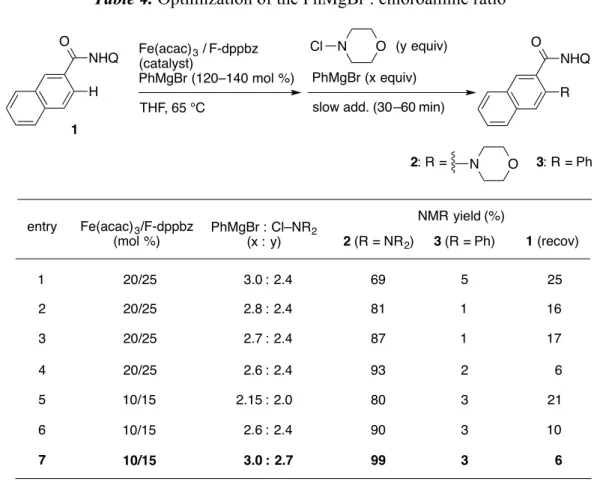
The reaction was further optimized using F-dppbz as a ligand (Table 4). Changing the ratio of PhMgBr : chloroamine improved both product selectivity and the yield of the aminated product, and I finally discovered that a slight excess amount of PhMgBr to chloroamine (ratio of 2.6:2.4) was the best ratio for the reaction (entries 1– 4), probably due to undesired consumption of PhMgBr in homocoupling.37 The catalyst loading could be decreased to 10 mol %, retaining the reaction efficiency (entry 6). Increasing the amount of the reagents while keeping their ratio (ratio of 3.0:2.7) furnished almost quantitative conversion of the amide into the aminated product (entry 7). In all entries, the phenylated product was suppressed by using F-dppbz as the ligand.
NHQ O Fe(acac)3 (1 equiv) Ligand (1 equiv) PhMgBr (3 equiv) THF, 65 °C, 30 sec D2O NHQ O D ligand L1 (dppbz) L2 (MeO-dppbz) L3 (F-dppbz) L4 (F2-dppbz) L5 (F3-dppbz) D incorp. (%) entry 1 2 3 4 5 67 52 62 25 7 Determined by EI-MS. H
Table 4. Optimization of the PhMgBr : chloroamine ratio
3-7. Substrate scope for ortho-amination
With the optimized reaction conditions in hand, I investigated the scope of aromatic amide substrates (Table 5). Most of the substrates that I examined gave the desired amination product in over 90% yield, which demonstrates the high reactivity of iron as a catalyst compared to other transition-metals.21–28 Benzamides para-substituted by methyl (entry 2), methoxy (entry 3), trifluoromethyl (entry 4), and halide groups (entries 5–6) were successfully aminated in good yield with complete monoselectivity.38 Amides bearing electron-withdrawing substituents (entry 4–6) required longer time for slow addition to complete the reaction, because the C–H activation step slower for
entry PhMgBr : Cl–NR2 (x : y) 2.7 : 2.4 3.0 : 2.4 2.8 : 2.4 2.6 : 2.4 NMR yield (%) 2 (R = NR2) 3 (R = Ph) 1 (recov) 87 1 17 69 5 25 81 1 16 93 2 6 1 2 3 4 90 3 10 80 3 21 99 3 6 6 5 7 2.6 : 2.4 2.15 : 2.0 3.0 : 2.7 Fe(acac)3/F-dppbz (mol %) 20/25 20/25 20/25 20/25 10/15 10/15 10/15 NHQ O H Fe(acac)3 / F-dppbz (catalyst) PhMgBr (120–140 mol %) THF, 65 °C NHQ O R PhMgBr (x equiv) 1
slow add. (30–60 min) Cl N O (y equiv)
reaction of amides meta-substituted by methyl (entry 8), methoxy (entry 9), dimethylamino (entry 10), and fluorine groups (entry 11) also took place smoothly, but strong electron-withdrawing substituents such as trifluoromethyl slowed down the reaction even with elongated reaction time (entry 12). Ortho-substitution on benzamide completely shut down the reaction, highlighting the high sensitivity of iron catalysis to sterics (entry 13).38 Naphthaleneamide also participated into the reaction to give the aniline derivatives quantitatively (entry 14). Amination of thiophene (entry 15) and indole (entry 16) also proceeded, which is rare example of directed amination reaction of hetroaromatic substrate.
Table 5. Scope of aromatic amides for ortho-amination NHQ O H Fe(acac)3 (10 mol %) F-dppbz (15 mol %) PhMgBr (120 mol %) THF, 65 °C NHQ O N PhMgBr (3.0 equiv)
slow add. (60–120 min) Cl N O (2.7 equiv)
R R
O
substrate product yield (%) entry NHQ O H X NHQ O N X O 1 2 3 4 5 6 7 8 9 10b 11b 12 91 96 92 91 92 100 54 a 99 100 94 81 40 c X = H Me OMe CF3 F Cl Br Me OMe NMe2 F CF3 NHQ O H NHQ O N O X X 14 99 13b 0 NHQ O H NHQ O N O NHQ O H NHQ O N O
Table 5. (continued)
The scope of chloroamines was also examined (Table 6) and I also obtained the aminated products in over 90% yield in most cases. Dialkylamines such as morpholine (entry 1), N-protected piperazine (entry 2), cyclic amines (entries 3–4) and acyclic dialkylamines (entry 5) could participate in the reaction, producing the corresponding aminated products. Substituents such as benzyl (entries 6–8) and allyl (entry 9) groups are well tolerated. Arylbromide was also well tolerated (entry 7). On the other hand, primary amines, aromatic amines or amides could not be utilized for this reaction, probably due to their instability (Figure 3).41 Overall, the reaction has a broad scope of N-chlorodialkylamines, and a variety of aniline derivatives can be prepared under these reaction conditions.
NHQ O 15 S 75 NHQ O S N O NHQ O 16 N 60 NHQ O N N O Me Me b
See experimental section for detailed reaction conditions.
a Debrominated compound was obtained in 9%. b 20 mol % of catalyst was used. c Yield was determined by 1H NMR.
H