CASE REPORT
Congenital Hypogonadotropic Hypogonadism with
Early-Onset Coronary Artery Disease
Akira Takashima1,2, Shusuke Yagi2, Koji Yamaguchi2, Kiyoe Kurahashi3, Yuko Kojima2, Robert Zheng2, Takayuki Ise2, Kenya Kusunose2, Sumiko Yoshida3, Hirotsugu Yamada2, Takeshi Soeki2, Tetsuzo Wakatsuki2, Ken-ichi Aihara4, Masashi Akaike5, and Masataka Sata2
1Department of Cardiovascular Medicine, Kitajima Taoka Hospital, Tokushima, Japan, 2Department of Cardiovascular Medicine, Tokushima
University Hospital, Tokushima, Japan, 3Department of Haematology, Endocrinology and Metabolism, Tokushima University Graduate School
of Biomedical Science, Tokushima, Japan, 4Department of Community Medicine for Diabetes and Metabolic Disorders, Tokushima University
Graduate School of Biomedical Science, Tokushima, Japan, 5Department of Medical Education, Tokushima University, Tokushima, Japan Abstract : The patient with congenital hypogonadotropic hypogonadism (HH) shows low serum levels of andro-gen, which is a group of sex hormones including testosterone, caused by the decreased gonadotropin release in the hypothalamus. Recent reports showed androgens exert protective effects against insulin resistance or ath-erosclerotic diseases, such as diabetes mellitus or coronary artery disease. However, whether the juvenile hypo-gonadism affects the diabetes or cardiovascular disease is unclear. We report a case of a middle-aged man with congenital HH who had severe coronary artery disease complicated with metabolic disorders. J. Med. Invest. 68 : 189-191, February, 2021
Keywords : congenital hypogonadotropic hypogonadism, coronary artery disease, diabetes mellitus, Kallmann syndrome, testosterone
INTRODUCTION
Idiopathic congenital hypogonadotropic hypogonadism (HH) is a rare reproductive disorder that is caused by a gonadotropin-re-leasing hormone (GnRH) deficiency (1). HH shows low plasma levels of luteinizing hormone (LH) and follicle-stimulating hor-mone (FSH) accompanied with low or undetectable circulating androgen concentrations, which are male sex hormones includ-ing testosterone. Congenital HH induces delayed puberty and infertility that is related to various metabolic disorders such as diabetes mellitus (DM), dyslipidemia or atherosclerotic disease (2, 3). Low testosterone concentrations in men are linked with insulin resistance, hyperglycemia, hypertension, dyslipidemia, and an increased risk of vascular disease (3). However, such cases in the real world are very rare. Here we presented a patient who had HH along with DM and coronary artery disease.
CASE
A 48-year-old man with hypertension, dyslipidemia and DM was referred to our hospital due to dyspnea. He had untreated DM with diabetic neuropathy, proliferative diabetic retinopathy, and stage 3 diabetic nephropathy beginning at the age of 43 years. His family history was negative for dyslipidemia ; how-ever, his mother and younger brother—who died unexpectedly in his thirties—had DM. The patient’s height was 169.5 cm, body weight was 85 kg (indicated body mass index was 29.6), arm span was 175 cm, blood pressure was 100 / 64 mmHg, pulse rate was 92 beats per minute, body temperature was 37.3 ˚C, and saturation of percutaneous oxygen was 96% in room air. He
had bipedal edema with bacterial infection and coarse crackles in both lower lungs. Furthermore, he manifested abnormal physical examination results such as anosmia, high-pitched voice, gynecomastia, impotence, and absence of pubic hair. His laboratory findings revealed severe inflammation (white blood cell count, 18300 [4000-9000] / μL ; C-reactive protein level, 16.2 [ < 0.3] mg / dL). He demonstrated hyperglycemia (plasma glucose level, 306 [60-110] mg / dL ; hemoglobin A1c, 9.9 [4.6-6.2] %). He additionally demonstrated dyslipidemia (level of low-density lipoprotein, 162 [70-140] mg / dL ; triglyceride level, 141 [35-150] mg / dL ; high-density lipoprotein level, 61 [40-100] mg / dL), and he exhibited severe heart failure (brain natriuretic peptide, 1398 [< 18.4] pg / mL). Chest radiography revealed car-diomegaly and pulmonary congestion. Additionally, a 12-lead electrocardiogram showed ST-level depression in V5 and V6, and transthoracic echocardiography revealed a low left ventricular ejection fraction of 20%. Computed tomography images revealed gynecomastia, a small penis, and cryptorchidism of the left testis (Figure 1). The estimated volume of each testis was ap-proximately 1 ml. Coronary angiography exposed three-vessel disease, including total left anterior descending artery occlusion and severe stenosis of the left circumflex and right coronary ar-teries (Figure 2). These findings indicated that the dyspnea was caused by ischemic heart failure.
We used insulin and sodium-glucose cotransporter 2 inhibi-tors for diabetes and an angiotensin receptor blocker and loop diuretic for heart failure. The patient did not agree to undergo coronary artery bypass grafting ; hence, percutaneous coronary intervention was performed. Ischemic heart failure successfully improved after revascularization of the left anterior descending and right coronary arteries. The level of brain natriuretic pep-tide improved from 1398 to 300 pg / mL, and his left ventricular ejection fraction, as measured by echocardiography, also im-proved from 20% to 30%.
His physical examination showed no findings of secondary sex characteristics. Blood tests revealed very low serum levels of LH ( < 0.1 [0.6-12.1] mIU / mL), FSH (0.1 [0.9-12.0] mIU / mL), and testosterone (0.6 [2.6-8.7] ng / mL). Although the levels of
The Journal of Medical Investigation Vol. 68 2021
189
Received for publication January 31, 2020 ; accepted September 3, 2020.
Address correspondence and reprint requests to Akira Takashima, MD, PhD, Department of Cardiovascular Medicine, Tokushima University Hospital, Tokushima 770-8503, Japan and Fax : +81-88-633-7894.
190
A. Takashima, et al. CHH with Early-Onset CAD growth hormone and thyroid-stimulating hormone were slightlyelevated, the other anterior pituitary hormones were normal. Contrast enhanced magnetic resonance imaging showed no ab-normal pituitary grand or hypothalamic findings. The LH and FSH serum levels did not increase after the GnRH stimulation test (Figure 3). As these findings indicated HH, we had further diagnosed the patient to have congenital HH with early-onset DM and coronary artery disease.
DISCUSSION
Although many reports showed that low testosterone level induces metabolic disorder, we report a patient who had HH, type 2 diabetes, and early-onset coronary artery disease. Idio-pathic congenital HH is caused by the decreased gonadotropin release in the hypothalamus and is classified by some phenotype. Obesity may induce hypogonadism ; however, the patient’s body mass index was normal when he was young and his weight gain began at the age of 30 years. Some congenital HH cause men-tal retardation, but his menmen-tal status was normal. Kallmann syndrome (KS) is one of the phenotypes of HH, which featured idiopathic GnRH deficiency and anosmia (1). The frequency of occurrence of KS is estimated to be approximately one in 8,000 male individuals and it is featured in several disorders related to genes, including KAL1 and FEZF1 (1, 4). In this case, although anosmia with hypogonadism indicated the possibility of KS, the patient never consented to undergo urological, otolaryngological, and genetic examinations. Consequently, we could not obtain the diagnosis of KS and that is a limitation.
Recent reports showed testosterone deficiency induced met-abolic disorder through hyperglycemia, insulin resistance, and progression of atherosclerosis regardless of age, body mass index or visceral fat (3, 5). In fact, the patient had arteriosclerosis obliterans of his bilateral below-knee arteries, typical of athero-sclerotic disease. As for the vascular function, brachial-ankle pulse wave velocity showed higher-than-average levels given his age. A patient with type 2 diabetes or prediabetes reportedly had a high prevalence of low testosterone levels (6). Interestingly, testosterone replacement therapy prevented the progression of prediabetes to type 2 diabetes and improved glycemic control (7). Although evidences of testosterone therapy in men showed controversial results on cardiovascular disease prevention (8, 9), many reports supported the protective effect of androgen against atherosclerosis (3, 7). In this case report, the patient did not undergo testosterone replacement therapy ; however, this treatment is an effective choice for patients with testosterone Figure 1. Computed tomography (CT) image showing gynecomastia
(yellow arrowhead) (A) and cryptorchidism (arrow) (B). Reconstructed CT image showing gynecomastia and a small penis (C).
Figure 2. Coronary angiography shows three-vessel disease. (A) Total occlusion of the left anterior descending artery (arrow) ; (B) Total occlusion of the distal portion of the left circumflex artery (arrow) and severe stenosis of the middle portion of the left circumflex artery (arrowhead) ; (C) Severe stenosis of the proximal portion of the right coronary artery (arrowhead) and collateral arteries toward the left anterior descending artery (arrow).
Figure 3. Serum luteinizing hormone (LH) and follicle-stimulating hormone (FSH) concentrations during the gonadotropin-releasing hormone (GnRH) stimulation test. Serum LH and FSH concentrations are very low at baseline and these hormones show no response to GnRH stimulation.
191
The Journal of Medical Investigation Vol. 68 February 2021
deficiency.
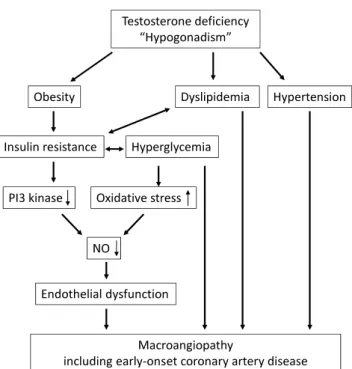
Androgens have anti-atherosclerotic effects because the an-drogen receptor (AR) is widely distributed in the cardiovascular system, including the endothelial and smooth muscle cells as well as fibroblasts. The AR predominantly mediates biological activities of androgens by the transcriptional control of target genes and interaction with multiple signaling pathways (10). AR activation decreases vascular remodeling through the phos-phoinositide 3 / Akt / endothelial nitric oxide synthase activation and oxidative stress through the transforming growth fac-tor beta / Smad pathway and improves angiotensin II-induced cardiac fibrosis (11, 12). As illustrated in Figure 4, androgen deficiency can induce various metabolic disorders that cause macroangiopathy (Figure 4). In this patient, both the activating renin-angiotensin-aldosterone system caused by heart failure or DM and low level of androgen would promote severe coronary atherosclerosis progression.
In male patients who have congenital HH, we should pay attention to metabolic disorders and atherosclerotic diseases, including early-onset coronary artery disease.
CONFLICT OF INTEREST STATEMENT
The authors have no conflicts of interest to declare.ACKNOWLEDGEMENTS
The authors thank Dr. Toshiki Otoda (Department of Community Medicine and Medical Science, Tokushima University Graduate School of Biomedical Sciences, Tokushima) for measurement of the patient’s arm span.
REFERENCES
1. Kim SH : Congenital hypogonadotropic hypogonadism and Kallmann syndrome : past, present, and future. Endocrinol Metab (Seoul) 30 : 456-466, 2015
2. Fichna P, Fichna M, Zurawek M, Nowak J : Hypogonado-tropic hypogonadism due to GnRH receptor mutation in a sibling. Endokrynol Pol 62(3) : 264-267, 2011
3. Traish AM, Saad F, Guay A : The dark side of testosterone deficiency : II. Type 2 diabetes and insulin resistance. J Androl 30(1) : 23-32, 2009
4. Kaplan JD, Bernstein JA, Kwan A, Hudgins L : Clues to an early diagnosis of Kallmann syndrome. Am J Med Genet A 152A(11) : 2796-2801, 2010
5. Tsujimura A, Yamamoto R, Okuda H, Yamamoto K, Fuku-hara S, Yoshioka I, Kiuchi H, Takao T, Miyagawa Y, Nishi-da M, Yamauchi-Takihara K, Moriyama T, Nonomura N : Low serum free testosterone level is associated with carotid intima-media thickness in middle-aged Japanese men. Endocr J 59(9) : 809-815, 2012
6. Buysschaert M, Medina JL, Bergman M, Shah A, Lonier J : Prediabetes and associated disorders. Endocrine 48(2) : 371-393, 2015
7. Yassin A, Haider A, Haider KS, Caliber M, Doros G, Saad F, Garvey WT : Testosterone Therapy in Men With Hy-pogonadism Prevents Progression From Prediabetes to Type 2 Diabetes : Eight-Year Data From a Registry Study. Diabetes Care 42(6) : 1104-1111, 2019
8. Bhasin S, Brito JP, Cunningham GR, Hayes FJ, Hodis HN, Matsumoto AM, Snyder PJ, Swerdloff RS, Wu FC, Yialamas MA : Testosterone Therapy in Men With Hypogo-nadism : An Endocrine Society Clinical Practice Guideline. J Clin Endocrinol Metab 1 103(5) : 1715-1744, 2018
9. Emmelot-Vonk MH, Verhaar HJ, Nakhai Pour HR, Aleman A, Lock TMTW, Bosch JLHR, Grobbee DE, Schouw YT : Ef-fect of testosterone supplementation on functional mobility, cognition, and other parameters in older men : a random-ized controlled trial. JAMA 299 : 39-52, 2008
10. Yoshida S, Ikeda Y, Aihara K : Roles of the Androgen--An-drogen Receptor System in Vascular Angiogenesis. J Atheroscler Thromb 23(3) : 257-265, 2016
11. Ikeda Y, Aihara K, Sato T, Akaike M, Yoshizumi M, Suzaki Y, Izawa Y, Fujimura M, Hashizume S, Kato M, Yagi S, Tamaki T, Kawano H, Matsumoto T, Azuma H, Kato S, Matsumoto T : Androgen receptor gene knockout male mice exhibit impaired cardiac growth and exacerbation of angiotensin II-induced cardiac fibrosis. J Biol Chem 19 280(33) : 29661-29666, 2005
12. Ikeda Y, Aihara K, Yoshida S, Akaike M, Matsumoto T : Ef-fects of androgens on cardiovascular remodeling. J Endocrinol 214(1) : 1-10, 2012
Figure 4. Prospective scheme of the main pathogenic pathway of testosterone deficiency. NO, nitric oxide ; PI3, phosphoinositide 3