高調波共鳴定在波の線形安定性
九大応力研 (RIAM, Kyushu Univ.) 岡村誠 (OKAMURA Makoto)
IRD Mansour IOUALALEN IRPHE Christian KHARIF
Stability calculations ofthree-dimensional short-crested
waves
verynear
their tw0-dimensional standing
wave
limitare
performedon
water ofuni-form depth. Non-resonant
waves are
stable while resonantwaves are
unsta-ble, which
means
that the resonant interaction contributes to instability.1Introduction
Linearly, ashort-crested
wave
is definedas
superposition betweenan
incident travelling
wave
withan
angle $\theta$ to avertical wall and its reflectedwave, where
0is
the angle between the direction of the incidentwave
andthe normal to the wall. The standing
wave
limit corresponds to the angle$\theta=0^{0}$
.
The properties of short-crested
waves
have been discussed in Marchant&Roberts
(1987)on
water of fifinite depth. The authors conjectured thatshort-crested
wave
fields may be unstable through harmonicresonance
phe-nomena.
Later, Ioualalen et al. (1996) showed that harmonicresonance
isassociated with sporadic and weak superharmonic instability for
short-crested
waves
in finite depth. $\ln$ particular the instability region exhibitsabubble-like shape in the
wave
steepness parameter space. However theirshort-crested
wave
solutionswere
not complete because onlyone
branc数理解析研究所講究録 1271 巻 2002 年 32-40
of the multiple-like solutions associated with harmonic
resonance
has beenanalysed. Ioualalen&Okamura (2002) calculated nonlinear short-crested
waves
with multiple-like solutions, $i.e.$, two branches linked byaturn-$\mathrm{i}\mathrm{n}\mathrm{g}$ point and
one
single branch. They found the solutions by Ioualalenet al. (1996) incomplete when harmonic
resonance occurs.
They alsoob-tained their stability diagram in the vicinity of harmonic
resonance
andfound that harmonic
resonance
is associated with two bubbles ofinstabil-$\mathrm{i}\mathrm{t}\mathrm{y}$ that
are
not anymore sporadic.In thepresent study,
we
examine the relation between short-crestedwaves
with
a
small angle $\theta$ and standingwaves near
the critical depth.Then
we
perform
a
superharmonic stability analysis of resonant short-crestedwaves
very
near
the standingwave
limit. Our stability scheme does not applydirectly to standing waves in order to use the stability analysis for steady
waves.
2
Formulation
We consider standing gravity
waves on an
inviscid, incompressible fluidof fifinite depth where the flow is assumed irrotational. The governing
equa-tions
are
given ina
dimensionless form with respect to the reference length$1/k$ and the reference time $(gk)^{-1/2}$, where $g$ is the gravitational
accelera-tion and $k$ the wavenumber of the incident
wave
train.Let
us
defifine aframe of reference $(x^{*}, y^{*}, z^{*}, t^{*}, \phi^{*})$so
that $x^{*}=x-ct$,$y^{*}=y$, $z^{*}=z$, $t^{*}=t$ and $\phi^{*}=\phi-cx^{*}$, where $c$ represents the propagation
velocity of the short-crested
wave
train and is equal to $\omega/\alpha$, $\omega$ being thefrequency of the
wave
and $\alpha=\sin\theta$ is $\mathrm{t}^{-}\mathrm{h}\mathrm{e}$$x$-direction
wave
number, the$y$-direction
wave
number being $\beta=\cos$$\theta$. $1\mathrm{f}$we
omit the asterisks for sakeof simplicity, the governing equations
are:
$\Delta\phi=0$, $\mathrm{f}\mathrm{o}\mathrm{r}-d<z<\eta$, (1)
$\phi_{z}=0$,
on
$z=-d$, (2)$\phi_{t}+\eta+\frac{1}{2}(\phi_{x}^{2}+\phi_{y}^{2}+\phi_{z}^{2}-c^{2})=0$,
on
$z=\eta$, (3) $\eta_{t}+\phi_{x}\eta_{x}+\phi_{y}\eta_{y}-\phi_{z}=0$,on
$z=\eta$, (4)where $d$ is the depth of the fluid, $\phi(x, y, z, t)$ the velocity potential and
$z=\eta(x, y, t)$ the equation of the free surface.
We
introduce the following functions to constructa
stability problem:$\eta(x, y, t)=\overline{\eta}(x, y)+\eta’(x, y, t)$ , (5)
$\phi(x, y, z, t)=\overline{\phi}(x, y, z)+\phi’(x, y, z, t)$, (6)
where we
assume
that the surface elevation and the velocity potentialare
superposition of
a
steady unperturbedwave
$(\overline{\eta},\overline{\phi})$ and infifinitesimalpertur-bations $(\eta’, \phi’)$ where $\eta’<<\overline{\eta}$ and $\phi’<<\overline{\phi}$
.
After substituting expressions(5) and (6) into equations (1)$-(4)$ and linearizing,
we
obtain the zerothorder system ofequations for which permanent short-crested
waves are
so-lutions and the fifirst order perturbation equations representing the stability
problem.
In order to solve the zeroth order system of equations,
we
look for thefollowing form of the velocity potential:
$\overline{\phi}=-cx+\sum_{k=0j=2}^{N}\sum_{-(k\mathrm{m}\mathrm{o}\mathrm{d} 2)}^{N}\phi_{jk}\sin(j\alpha x)\cos(k\beta y)\frac{\cosh[\kappa_{jk}(z+d)]}{\cosh(\kappa_{jk}d)}$, (7)
where $\kappa_{JK}=[(J\alpha)^{2}+(K\beta)^{2}]^{1/2}$ and $N$ is the maximum order of expansion
and is chosen tobe 19 $\mathrm{i}_{11}$ this paper. Further details about the computations
of the short-crested
waves can
be found in Okamura (1996)The first order system of equations is
$\triangle\phi’=0$, $\mathrm{f}\mathrm{o}\mathrm{r}-d<z<\overline{\eta}$, (8)
$\phi_{z}’=0$,
on
$z=-d$, (9)$\phi_{t}’=-\overline{\phi}_{x}\phi_{x}’-\overline{\phi}_{y}\phi_{y}’-\overline{\phi}_{z}\phi_{z}’-\eta’(1+\overline{\phi}_{x}\overline{\phi}_{xz}+\overline{\phi}_{y}\overline{\phi}_{yz}+\overline{\phi}_{z}\overline{\phi}_{zz})$,
on
$z=\overline{\eta}$, (10)$\eta_{t}’=\eta’(\overline{\phi}_{zz}-\overline{\eta}_{x}\overline{\phi}_{xz}-\overline{\eta}_{y}\overline{\phi}_{yz})-\overline{\eta}_{x}\phi_{x}’-\overline{\phi}_{x}\eta_{x}’-\overline{\eta}_{y}\phi_{y}’-\overline{\phi}_{y}\eta_{y}’+\phi_{z}’$,
on
$z=\overline{\eta}$. (11)We look for non-trivial solutions of the following form:
$\eta’=e^{-i\sigma t}\sum_{J=-\infty}^{\infty}\sum_{K=-\infty}^{\infty}a_{JK}e^{i(J\alpha x+K\beta y)}$, (12)
$\phi’=e^{-i\sigma t}\sum_{J=-\infty}^{\infty}\sum_{K=-\infty}^{\infty}b_{JK}e^{i(J\alpha x+K\beta y)_{\frac{\cosh[\kappa_{JK}(z+d)]}{\cosh(\kappa_{JK}d)}}}$ , (13)
which is reduced to the eigenvalue problem determining the eigenvalues $\sigma$
and their eigenvectors consisting of $a_{JK}$ and $b_{JK}$.
3Relation
between
standing
and
short-crested
waves
Marchant&Roberts (1987) showed that harmonic
resonance occurs
forstanding
waves
of fifinite depth whena
harmonic $(m, n)$ isa
solution ofthe homogeneous differential equation derived from the surface conditions.
Such
case occurs
at critical depths $d$ which satisfy the relation,$n\tanh(nd)=m^{2}\tanh d$. (14)
The lowest order harmonic
resonance occurs
at depth $d_{\mathrm{h}\mathrm{r}}\approx 0.624$ which isrelated to harmonic
resonance
$(3, 5)$.We analyse the $(3, 5)$
resonance
because it is the strongest harmonicresonance.
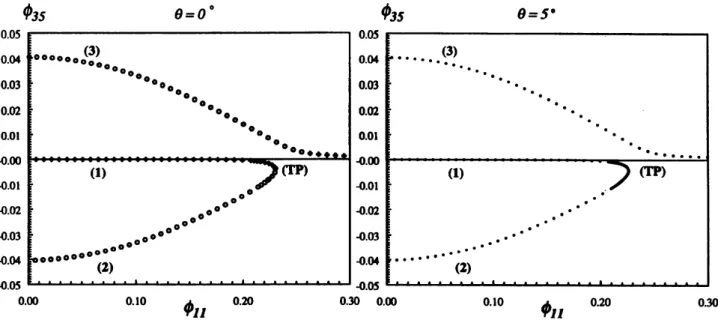
Figure 1exhibits the multiple-like solution structure of thecoefficient $\phi_{35}$
as a
function of the coefficient $\phi_{11}$ of the fundamental mode$\phi_{J\mathit{5}}$ $\theta=\mathit{0}^{\mathrm{o}}$ $\phi_{JS}$ $\theta=5^{\cdot}$
Figure 1: Coefficient $\phi_{35}$ versus coefficient $\_{11}$ for depth $d=0.58$ and angles $0=0^{0}$ (left)
and $\theta=5^{\mathrm{o}}$ (right). Circle-signs $(\circ)$ and plus-signs $(+)$ denote the unstable and stable
solutions, respectively (displayed only for $\theta=0^{\mathrm{o}}$).
for depth $d=0.58$ at angles$\theta=0^{0}$ and $\theta=5^{\mathrm{O}}$
.
The solutionsare
composedof three branches: branches (1) and (2) linked by
a
turning point (TP)and branch (3). The figure shows that the solutions for $\theta=0^{\mathrm{o}}$
are very
similar to those for $\theta=5^{0}$ and thus
we can use
the short-crestedwaves
for$\theta=0.001^{0}$ to obtain the results for the stability of standing
waves.
Figure 1also indicates that the resonant harmonic mode $\phi_{35}$ is relatively
dominant both
on
branch (2) andon
branch (3) for $\phi_{11}$ smaller than theturning point (TP). We call it resonant
wave.
However the fundamentalmode $\phi_{11}$ is relatively dominant both
on
branch (1) andon
branch (3) for$\phi_{11}$ larger than the turning point(TP). We call it non-resonant
wave
4
Superharmonic instability of
short-crested
waves
near
their standing
wave
limit:
$\mathit{0}--0.001^{\mathrm{O}}$We perform here the superharmonic instabilities of short-crested
waves
that
are
very close to standing waves; that is, angle $\theta=0.001^{0}$. The aim ofthis study is to characterize the superharmonic instability associated with
harmonic
resonance
appearing in standingwaves as
Ioualalen&Okamura(2002) clarifified the relation between the superharmonic instability and
harmonic
resonance
for short-crestedwaves.
The time scale of the strongestinstability tells
us
whether the multiple-like solution related to harmonicresonance
is observableor
not.A superharmonic instability associated with
a
harmonicresonance
$(m, n)$can
arise only if the two eigenvalues with opposite signatureare
equal,$\sigma_{m,n}^{s}(h)=\sigma_{-m,n}^{-s}(h)$, (15)
for
some wave
steepness $h$. For standingwaves
the condition of harmonicresonance
is equivalent to condition (14). Such superharmonic instabilityis described
as an
interaction between the two eigenmodes $(\pm m, n)$ and the$2m$-modes $(1, \pm 1)$ of the basic unperturbed standing wave, that is,
$\Omega_{1}=-\Omega_{2}+m\Omega_{01}+m\Omega_{02}$, (16)
$k_{1}=k_{2}+mk_{01}+mk_{02}$, (17)
where $\Omega_{i}=[|k_{i}|\tanh(\kappa_{mn}d)]^{1/2}$, $\Omega_{0i}=\tanh^{1/2}d$ for $i=1,2$ and $k_{1}=$
$(\alpha m, \beta n)$, $k_{2}=( \mathrm{m}, \beta n)$, $k_{01}=(\alpha, \beta)$, and $k_{02}=(\alpha, -\beta)$.
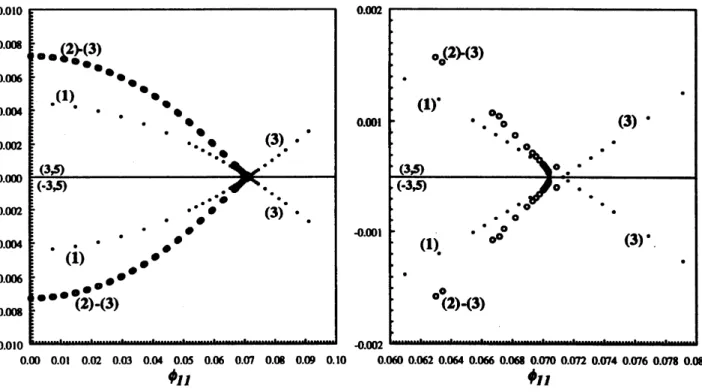
In Figures 2 and 3
are
plotted the frequencies and growth rates of theeigenvalues $\sigma_{\pm 3,5}$ for all branches of the
wave
solutions for depths $d=0.58$ and $d=0.62$ in the vicinity of the critical depth $d_{\mathrm{h}\mathrm{r}}\approx 0.624$.
For both$0.\cdot.100.1\mathrm{R}^{\bullet}\mathrm{r}.\mathrm{o}\mathrm{e}_{0.00.10_{\theta_{\mathit{1}\mathrm{J}}}}\mathrm{o}.\mathrm{u}\mathrm{n}.\alpha \mathrm{l}4\mathrm{I}.020.020.1-.\cdot\ldots\ldots\ldots\cdot\cdot..\cdot.\ovalbox{\tt\small REJECT}^{\bullet_{\bullet_{\bullet}}}000.\alpha\cdots\cdots\cdots\cdot\cdot.\cdot.\cdot\cdot.\bullet\cdot.\cdot.\cdot\cdot.\cdot\circ\{\mathrm{n}^{\bullet}10s_{3S}\bullet\bullet_{\bullet}\bullet\bullet^{\bullet^{\bullet^{\bullet^{\bullet^{\bullet}}}}}(1)\epsilon_{l_{l_{\mathrm{o}}}}\dot{(}\mathrm{i}_{)8}\epsilon^{8^{l}}\bullet_{\bullet}\bullet$
$\mathrm{o}_{l}\cdot\cdot..\cdot\swarrow\dot{\mathrm{o}}_{(2)(3\mathrm{k}^{\mathrm{o}}}.\cdot\cdot.’...\cdot.\cdot.\cdot.\cdot.\cdot.\cdot.\cdot.\cdot.\cdot.\cdot.\cdot.\cdot.\cdot.P[searrow] 02$
)
$\mathrm{t}_{\mathrm{o}}^{\mathrm{O}}0.n\mathrm{o}.\mathrm{n}^{4.02}(3)(3)(\dot{s}\nu.J^{\mathrm{o}_{9}}(3)- 0.01_{\mathrm{O}}0.01_{l}0.\alpha 0.\mathrm{m}_{0.210.220.23}(ss_{l}(1)^{(2)}\mathrm{o}(1r^{\mathrm{Q}}\mathrm{o}_{3}\mathrm{o}_{13)_{\circ\}^{\circ}}\mathrm{o}^{(2)}:i_{\mathit{1}\mathit{1}}^{\mathrm{o}u\mathrm{o}.25}\mathrm{o}\mathrm{o}\mathrm{o}_{\mathrm{o}}\mathrm{o}\mathrm{o}_{13)}\mathrm{o}\circ(3):0.2^{\cdot}6^{\cdot}\cdot..\cdot.0^{\cdot}..27\mathrm{o}\mathrm{o}.(3)(3)\cdot$
$(1)...\mathrm{o}\mathrm{Q}\mathrm{o}(2..)$ 3 $(3)^{\mathrm{O}}l....\circ\cdot..mathrm{t}_{\mathrm{o}}^{\mathrm{O}}$ $0$ $\mathrm{Q}$ $(3)0$ $0$ $0$ $\mathrm{Q}$ $0.\cdot(.3.)\cdot$
.
$\mathrm{t}4\theta$ $J_{0}^{9}$ $0$ $0$ $0$ $0$ $0$ $0$ $\mathrm{Q}^{\cdot}.$.
$\mathrm{Q}(3\mathrm{k}....0...P$ (3).
(3).
$\circ$...
..
$(1f.$.
$\mathrm{Q}$ $\mathrm{o}$ $(2)$Figure 2: Frequency $[-\Re(\sigma\pm 35)]$ $(\bullet)$ and growth rate $[-\Im(\sigma\pm 35)](0)$ as a function of
coefficient $\phi_{11}$ for angle $\theta=0.001^{0}$ and depth$d=0.58$. The right panel is an enlargement
of the left panel.
$-0.\alpha \mathrm{I}44.\mathfrak{W}^{\bullet^{\bullet}}p\}.\alpha \mathrm{I}2-0.\mathrm{m}_{0.\mathrm{m}\mathrm{o}.0}- 0.010^{\cdot}..\cdot.\cdot..\cdot.\cdot.\cdot...\cdot..\cdot.\cdot..\cdot.\cdot.\cdot.\cdot$
.
$\cdot..- 0\ovalbox{\tt\small REJECT}_{\bullet}^{\bullet}(\bullet\bullet \mathfrak{l}_{\bullet\bullet}^{2\succ 13)}.\infty 20.\mathrm{r}^{(3(3S}0.\alpha \mathrm{I}20.\mathfrak{m}0.M0.\mathrm{m}0.0100.\mathrm{m}..\cdot.\cdot.\cdot..\cdot.\cdot.\nwarrow s^{\bullet}\mathrm{Q}\circ(2\succ(3)\bullet\bullet 3s_{10.020.030.u\mathrm{o}.\mathrm{o}s\mathrm{o}.oe\mathrm{o}.\sigma 70.1-0.w0.100.\alpha 00.\mathrm{M}20.\mathfrak{U}0.\mathrm{m}\mathrm{o}.\mathfrak{m}0.\mathrm{o}n\mathrm{o}.\mathrm{o}n\mathrm{o}.0740.0760.1n\epsilon 0.\mathrm{r}}(\cdot 3\theta(1)_{\bullet(1)}\bullet(\mathrm{i})\bullet^{\bullet^{\bullet^{\bullet^{\bullet^{\bullet}}\omega.\alpha 11}}}\bullet(2)-(3)(2)\prec 3)\bullet \mathrm{O}\bullet\bullet\bullet\bullet\bullet\bullet\bullet trr\ell rr\bullet\bullet 0.01.\tilde{\circ}_{\theta}\cdot.\cdot.\cdot..\cdot.(3)\bullet\bullet 13)\bullet(3)\cdot(1)^{\theta^{\mathrm{o}}(3)}\mathrm{o}^{l}e^{9}\mathrm{o}_{d^{0}}.\cdot.\cdot$
.
$\mathrm{o}_{\mathrm{o}^{(2\succ(3)}}$.
.
(1)..
$.\tilde{l}$ (3). $(3S$. .
$\mathrm{Q}.\nwarrow \mathrm{Q}$.
$\cdot$.
$\cdot$.
$(\cdot 3\theta$ $.0\swarrow 0^{\cdot}$.
. .
.
$\cdot \mathrm{Q}$.
.
$\cdot$ $\theta^{\mathrm{o}}$ (1). (3)..
.
$\mathrm{o}_{\mathrm{t}2)\prec 3)}^{l}$Figure 3: The same as Figure 2 except for depth $d=0.62$
depths, branch (1) is stable
on
its whole region, from $\phi_{11}=0$ to the turningpoint ($\phi_{11}\approx 0.2305605$ for $d=0.58$ and $\phi_{11}\approx 0.0705$ for $d=0.62$), while
branch (2) is unstable
on
its whole region. The transition from stable tounstable
occurs
when the frequency reaches the zero-axis, then the growthrate value leaves it. For both depths the dominant instability appears
for $\phi_{11}=0$ and the instability
on
branch (2) weakens with increasing$\phi_{11}$ to disappear at the turning point (here at the zer0-axis). Branch(3)
is unstable from $\phi_{11}=0$ to the turning point ahead ($\phi_{11}\approx 0.2591$ for
$d=0.58$ and $\phi_{11}\approx 0.0709$ for $d=0.62$). The maximum of instability
also appears for $\phi_{11}=0$. The instability
occurs
when eigenvalues $\sigma_{3,5}$ and$\sigma_{-3,5}$ coalesce at zero-frequency ($\mathrm{p}\mathrm{h}_{\mathrm{f}\mathrm{f}\mathrm{i}}\mathrm{e}$-locked with the unperturbed wave).
Such instability is physically associated witha resonant interaction: the
coalescence ofthe two eigenmodes at zero-frequency simply
means
that theharmonics $(\pm 3,5)$ propagate at the
same
phase speedas
the basic wave,bearing in mind that the stability problem has been computed in the frame
of reference moving with the basic
wave.
Ioualalen&Okamura (2002) showed that for resonant short-crested
waves
the instability region is a small range of
0
likea
bubble. In the presentcase
the instability region is
a
wide range of $\phi_{11}$, which is much different fromthat in the short-crested
waves.
The instability is strong for resonant wave,$i.e.$,
on
branch (2) and the left part of branch (3). The instability weakensas
$\phi_{11}$ becomes larger. Beyond the turning point the solutionon
branch (3)remains weakly unstable within
a
certain range of the parameter regimethen it turns stable
5
Conclusion
This study deals with the stability of the two-dimensional standing
waves
with multiple-like solutions for the strongest harmonic
resonance
$(3,5)$oc-curs.
Since
our
numerical procedure calculating the stability ofthree-dimensional short-crested
waves
does not apply totwo-dimensional
stand-$\mathrm{i}\mathrm{n}\mathrm{g}$
waves
because thewaves are
not anymore stationary,we
fifirst showthat short-crested
waves
and standingwaves
match each other at the limit$(\thetaarrow 0^{\mathrm{o}})$ in order to extend the stability results here to standing
waves.
Then
we
performa
superharmonic stability analysis of short-crestedwaves
very
near
$\mathrm{t}\mathrm{h}\mathrm{e},\mathrm{i}\mathrm{r}$standing
wave
limit. The stability analysis shows that $\mathrm{r}\mathrm{e}\mathrm{s}-$onant
waves are
strongly unstable. By contrast, non-resonantwaves are
almost stable andweakly unstable within
a
sporadic range of the parameterregion then non-resonant
waves are
therefore only solutions to exist.参考文献
[1] M.
Ioualalen&M.
Okamura, ”Structure of the instability associatedwith harmonic
resonance
of short-crested waves.” J. Phys. Oceanogr. 32(2002) 1331 1337.
[2] M. Ioualalen, A. J. Roberts&C. Kharif, “On the observability of finite
depth short-crested water waves.” J. Fluid Mech. 322 (1996)
1-19.
[3] T. R. Marchant&A. J. Roberts, ”Properties of short-crested
waves
inwater offinite depth.” J. Austral Math. Soc. $\mathrm{B}29$ (1987)
103-125.
[4] M. Okamura, ”Notes
on
short-crestedwaves
in deep water.”J. Phys.Soc. $Jpn$. 65 (1996)