
Reciprocal Learning Effects between the JICA Collaborative Course and the International Cooperation Seminar in Tanzania
5
0
0
全文
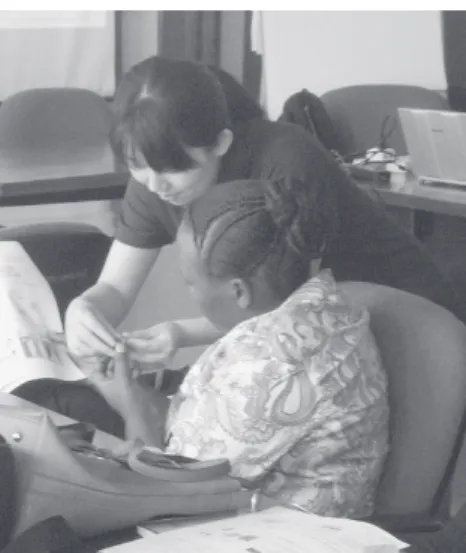
(2) 新福他:タンザニアにおける JICA 連携コースと国際協働論演習の相互学習効果. 59. schools to observe conditions of maternal child health and nursing/midwifery care. Students gave presentations to Tanzanian nurses/midwives as well as graduate/ undergraduate students. It was their first time to visit Tanzania, and for some of them, it was their first time to come to a developing country. For most of them, the major reason they wanted to visit Tanzania was to meet a student in the long-term dispatch program. It was obvious that her existence affected their decision to attend the seminar in Tanzania. As the benefits of having both short-term and long-term programs were observed, this report describes the reciprocal learning. Figure 1. With JICA Tanzania staff and volunteers. effects in Tanzania.. Ⅱ.Contents of the program 1 .JICA health volunteer meeting On the first day, students joined the JICA health volunteer group meeting. Kyoko Tada, the first student in the long-term dispatch program from St. Luke’s-JICA collaboration, is experiencing as a JICA volunteer (Japan Overseas Cooperation Volunteer:JOCV) and. Figure 2. Student presenting CPR for baby. learning at a Master’s student in St. Luke’s at the same time. She presented her experience in Tanzania from. to achieve improvement in the field(Figure 1) .. January, 2016. She disclosed her shocking feelings when she first encountered deaths of children in hospitals and. 2 .Presentations in Muhimbili National Hospital. explained the difficult working conditions of nurses. She. Given advice from Kyoko, Daichi Suzuki, Momo Horii,. decided to start small study hours for nurses to update. Mami Yamamoto, Rika Fukutomi, Yumiko Abe and. their knowledge and to assimilate the concepts of 5-S. Noyuri Toyama chose the topics of “The role of nurse at. KAIZEN to make their environment more efficient to. the time of a sudden change of patient’s condition” and. work.. “Nutrition for mothers and babies/Japanese comple. After the presentation, students of the short-term. mentary food” to give presentations to nurses and. program asked questions about Tanzania. As they. midwives in the Muhimbili National Hospital. The. learned about the many difficulties and weaknesses of. emergency team(Daichi & Momo) explained the. Tanzanian nurses, one of them asked,“Are there any. principles of emergency care and provided a case to. strengths of nurses here?” It reminded Kyoko that. think about how nurses should act when an emergent. there were strengths in Tanzanian nurses. She. situation happens(Figure 2) .. explained that Tanzanian nurses kept positive attitudes. The nutrition team(Mami, Rika, Yumiko, and Noyuri). despite their hard conditions in clinical areas. The Q &. explained anemia during pregnancy, breastfeeding,. A session led the discussion of nurses’ working. complementary foods, and nutritious foods for mothers. environment and work ethics. They concluded that the. and babies. They brought some Japanese dried foods. difficult working conditions hindered their motivation.. that were considered to be nutritious for pregnant. The JICA health volunteers were so cooperative that. women, such as prunes, seaweed, and dried sweet. they shared their information and promised to. potatoes. Tanzanian nurses and midwives tried the food. accumulate knowledge every year even after the. and liked especially dried sweet potatoes. The matron. current members left Tanzania, and new members. expressed appreciation to the students for providing. displaced their positions. It is important for all overseas. up-to-date information and Japanese cultures.. workers to work together and continue to collaborate.
(3) 60. 聖路加国際大学紀要 Vol.3 2017.3.. 3 .Exchange program with MUHAS SON The next day, we observed the maternity ward of the Muhimbili National Hospital. Students learned there were many mothers who had complications that were not common in Japan, such as malaria, eclampsia, etc. After the observation, we visited the Muhimbili University of Health and Allied Sciences(MUHAS) School of Nursing(SON) . The Midwifery Master’s program, which was collaboratively developed with St. Luke’s, is ongoing, and 19 first-year students met students from St. Luke’s. Reona Iso, Chiemi Nagayoshi, and Yurie Kashiwabara provided a presentation on “Moxibustion (kyu)and care to increase patient satisfaction.” Tanzanian students. Figure 3. Providing moxibustion to Tanzanian students. experienced moxibustion and learned warmth of the care(Figure 3). Akiko Kono, Natsuka Suzuki, and Mayo Ogawa presented “Birth plan and birth review.” They wanted to share the notion of women-centered care by showing Japanese midwives’ care for pregnant women. A young nurse tutor told her interest in non-pharmacological care to soothe labor pain and promote contractions for natural births as it was the role of midwives. After presentations from Japan, one of the students of MUHAS, Samwel Mwangoka, raised his hand and. Figure 4. With MUHAS students. said, “I appreciated for your presentations as I learned a lot. We also want to present our student project.” He. different from nursing/midwifery, it was common to. showed his PPT slides and explained their plan to start. have difficulties in working with others from different. health promotion program for improving adolescent and. cultures. They talked that it was not sustainable if their. women’s health in their own country. Students from St.. volunteer activities were not in accordance with Tanza. Luke’s were impressed that Tanzanian nurses/. nian culture; hence, they conducted “trial and error” to. midwives showed their leadership and were trying to. learn what works and what does not work. Their. initiate their own activities. It is the mission of this. experiences gave us good clues to work with nurses. Master’s program in MUHAS to produce midwifery. and midwives in Tanzania.. leaders in Tanzania, and this mission is actually moving forward(Figure 4).. 5 .Bagamoyo District Nursing School We visited Bagamoyo District Nursing School to meet. 4 .JICA volunteer presentations. students there. The school offers a 2-year certificate. As the 6 of July became a public holiday in Tanzania. program, which provides students the license of Enrolled. for Eid(Celebration of completion of Ramadan), the. Nurse(EN). Although EN is the beginning stage of. national institutions had a day off. Students joined the. nursing career, students had concrete knowledge on. JICA volunteer presentations. The volunteers included. maternal child health. They were passionate and. math teachers, a science teacher, a primary school. motivated to help mothers and babies. They asked. teacher, car engineers, a beautician, and an environ. Japanese students many questions on knowledge and. mental engineer. They presented how they had. work of nurses/midwives in Japan(Figure 5) .. th. assimilated with Tanzanian culture, cooperating with Tanzanian counterparts, and their plans until completion. 6 .Bagamoyo District Hospital. of their volunteer term. Although their specialties were. The next day, students visited the Reproductive and.
(4) 新福他:タンザニアにおける JICA 連携コースと国際協働論演習の相互学習効果. Figure 5. Discussion with students in Bagamoyo. Figure 6. Observed nurse’s work at MCH Clinic. Figure 7. Presentation at clinical area. Figure 8. Kyoko with a doctoral student, Kana Shimoda. 61. Child Health(RCH) Clinic, the labor ward, and the. 7 .St. Elizabeth Health Center. pediatric ward of the Bagamoyo District Hospital. After the hospital, we visited a small health center in. (Figure 6).. Bagamoyo. For minor sickness and injury, people come. At the RCH Clinic, they measured babies’ weight,. to the local health center to seek general medical care.. height, and arm circumstance to assess physical. There is a laboratory to diagnose diseases. Kyoko. development. Babies receive immunization, and if there. worked as a translator between English and Swahili. is any concern, mothers can consult with nurses or. and explained to students of the short-term program.. doctors.. The health center is located near the church and the. If there was a serious health issue, babies would be . history museum. Students learned the sad history of. admitted to the pediatric ward. A nurse-in-charge told. slavery and colonization. After the famous Dr.. students their high-prevalent health issues included. Livingstone, who had contributed to emancipation of. malaria, pneumonia, diarrhea, malnutrition, burns,. slaves, passed away, his body was brought to this. urinary tract infection, etc. She showed them diarrhea. church and stayed there for one night. The place is the. medicine with zinc. In the labor ward, they put curtains. remembrance of pre-independence era.. between delivery beds, which we did not see when we. During our stay in Bagamoyo, Kana Shimoda, a PhD. visited there two years ago.. student of St. Luke’s, joined our trip while she was. Satomi Ishikawa had a presentation on newborn care. waiting for her ethical clearance of her research. She. for students in the clinical areas. Students in Bagamoyo. acted as a teaching assistant that explained students. also volunteered to present what they had learned and. the situations of Tanzania.. compared the knowledge between Japan and Tanzania (Figure 7)..
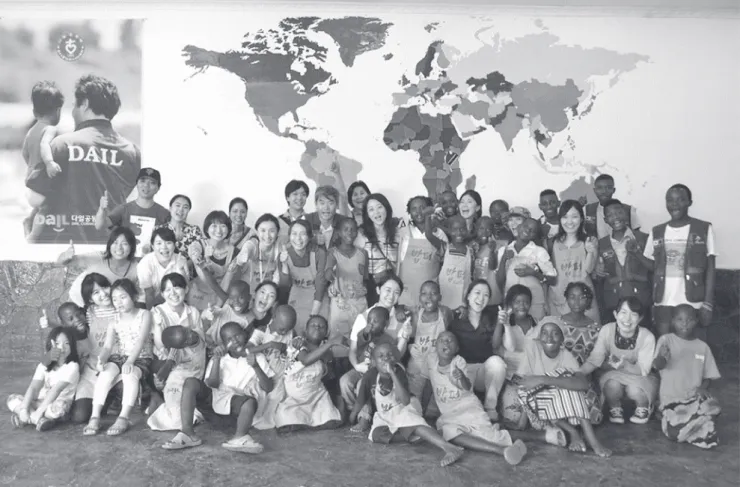
(5) 62. 聖路加国際大学紀要 Vol.3 2017.3.. 8 .Visit of NGO DAIL On the last day, arranged by Kyoko, students visited. Ⅲ.Summary. the NGO DAIL from Korea, which works to serve. The student of the long-term dispatch program. nutritious foods for children in Kunduchi village areas.. increased others’ interest in Tanzania and lowered the. Every Saturday 800 children come to eat there. We. barrier to come to the field. With the advice from the. volunteered to help children wash their hands and to. student who stayed in Tanzania for a long time and the. serve food and water. They sang and danced together. strengths of students of the short-term dispatch. before eating. Some children worked as volunteers, and. program, student presentations became meaningful. they quickly served and cleaned dishes and cups.. learning opportunities for local nurses and nursing. It was a great opportunity for children to work for. students. It is important to intentionally use the. others and take responsibilities of the group work.. reciprocal learning effects for the benefits of all. Their smiles warmed students’ hearts and gave them a. students and Tanzanian nurses/midwives.. great time to contribute to children in Tanzania. Acknowledgment The program was conducted with the support of JSPS Core-to-core program(2015-2017). We sincerely appreciate for all Tanzanian faculty and hospital staff.. Figure 9. After volunteering with children.
(6)
図


関連したドキュメント
The Representative to ICMI, as mentioned in (2) above, should be a member of the said Sub-Commission, if created. The Commission shall be charged with the conduct of the activities
While conducting an experiment regarding fetal move- ments as a result of Pulsed Wave Doppler (PWD) ultrasound, [8] we encountered the severe artifacts in the acquired image2.
Wro ´nski’s construction replaced by phase semantic completion. ASubL3, Crakow 06/11/06
The future agenda in the Alsace Region will be to strengthen the inter-regional cooperation between the trans-border regions and to carry out the regional development plans
She has curated a number of major special exhibitions for the Gotoh Museum, including Meibutsu gire (From Loom to Heirloom: The World of Meibutsu-gire Textiles) in 2001,
This agreement is expected to promote greater freedom in movement of goods, services, and capital between Japan and Chile, and foster comprehensive economic cooperation,
INTERNATIONAL MASTER’S PROGRAM IN JAPANESE HUMANITIES INTERNATIONAL DOCTORATE IN JAPANESE HUMANITIES
JAPAN STUDIES PROGRAMS IN ENGLISH AT THE GRADUATE SCHOOL OF HUMANITIES THE INTERNATIONAL MASTER’S PROGRAM (IMAP) IN JAPANESE HUMANITIES AND THE INTERNATIONAL DOCTORATE (IDOC)
The course aims to help students develop an interest in topics about the mental and physical development and learning process of preschoolers, elementary school children and
