English Teachers
’ Perceptions of Students
Personalities and Attitudes: Comparing English
L1 and Japanese L1 Teachers
Etsuko SHIMO
*学生の性格と態度に関する英語教師の認識:
英語第一言語話者教師と日本語第一言語話者教師の比較
下絵津子
Abstract
A questionnaire survey was administered in 2014 targeting Japanese university English teachers who were teaching first- and/or second- year students. The survey aimed to explore their beliefs about their students. This paper analyzed the teachers’ perceptions of their students’ personalities and attitudes toward learning English, their preferences regarding the use of English in class, and their preferences in terms of class format. Comparisons were drawn between the perceptions of English L1 teachers (ETs) (n=154) and those of Japanese L1 teachers (JTs) (n=170). Perceptions of Japanese students as “passive,” “obedient,” and “shy” occurred in both groups. In terms of differences, more ETs than JTs selected “cheerful,” “willing to communicate in English,” and “interested in how to improve their English” whereas far more JTs than ETs selected “eager to learn.” The teachers’ perceptions about their students’ preferences in terms of a student-centered or teacher-centered class format also differed. Influencing factors may include (a) targeting different skills in class, (b) situational factors relating to interactions between students’ expectations and teachers’ reactions to these, and (c) the amount and content of student-teacher and student-student interactions in classes. Key words: teacher beliefs, Japanese university English teachers, Japanese university English
students, questionnaire survey
日本の大学で 1・2 年生の英語科目を教える教師を対象に、学生に関する教師ビリーフを探求するアンケート 調査を 2014 年に実施した。本稿では、アンケート調査結果をもとに、学生の性格や英語学習に対する態度、 教室内での英語使用についての態度、授業の形態に関する好みに関して、教師がどのように認識しているか を、英語第一言語教師(ETs:154 名)と日本語第一言語教師(JTs:170 名)の間で比較分析した。その結 果、「受身的」「素直」「恥ずかしがりや」といった認識に類似点が見られた一方、いくつかの相違点も観察さ れた。「明るい」「英語でコミュニケーションを取りたがる」「どうしたら英語力が上がるかに関心がある」と の認識の ETs が多かったのに対して、JTs は「学習に真面目に取り組む」との回答が多かった。また、学生が 学習者中心を好むのか、教師中心の教室を好むのかなどについても両グループで認識に差が見られた。これら の相違点を生み出した背景要因には、 (1)授業における目標スキルが異なっていること、(2)学生の教師に対 する期待とその期待への教師の対応の間に存在する相互関係的状況要因、そして(3)授業における教師と学 生、あるいは学生と学生同士の実際のやり取りの内容と量が関係している可能性が指摘される。
Received 30 September 2015 Accepted 8 January 2016
* Kinki university, Faculty of Applied Sociology, Department of General Education, Associate Professor (English Education)
1. The Background of This Study
This paper reports on part of a three-year research project1 in which Japanese university
English teachers beliefs about Japanese learners of English are explored. In Shimo (2014a, 2014b), I discussed the importance of investigating teacher beliefs. Teacher beliefs can influence what individual teachers do in and about their classes. Teachers holding the same beliefs about certain teaching methods and techniques would not always take the same teaching approach in their classes. Instead, they may often be forced to select different teaching techniques depending on their various teaching contexts. For example, Kameda (2005) reported that many Japanese high school teachers in her study expressed their dissatisfaction because they could not implement their teaching beliefs claiming that their students motivation was low. This situation is complicated: These high school teachers had certain beliefs not only about teaching methods but also about their own students. Because of how they perceived their students level of motivations, the teachers could not do what they were hoping to do in the class. Thus, teacher beliefs are among the many factors that influence individual teachers teaching practice, along with other contextual, situational, physical, and social factors.
Shimo (2014a) pointed out teachers “interpretation of institutional guidelines, availability of teaching and learning materials, class size, learners proficiency and motivation levels, and teachers expectations from and about students, colleagues, and other related people (p. 442)” all influence teachers decision-making processes. Then, these teachers actions based on their decisions make a difference to their students learning achievement in the classroom. The individual
classroom achievement eventually influences the outcomes of the curriculum goals. Thus, even though the relationship between teacher beliefs and actions may be unclear and could be fairly complicated as many researchers pointed out (e.g., Borg, 2006; Burns, 1996), investigating teacher beliefs has its significance because teacher beliefs are one of the factors that could make a difference eventually in the curriculum outcomes.
The term “beliefs” in this research project is used interchangeably with “views,” “perceptions,” and “opinions.” The word was used in a similar manner in Horwitz (1988), who explained that “the Beliefs about Language Learning Inventory (BALLI) was developed to assess student opinions on a variety of issues and controversies related to language learning (p. 284; the emphasis added).” Many of the 34 question items in Horwitz s (1988) survey required five-point Likert scale responses ranging from “strongly agree” to “strongly disagree.” The degree of students agreement with statements such as “learning a foreign language is mostly a matter of learning a lot of grammar rules” was analyzed in her study, reflecting the degree to which they believed the statements to be true.
The target of the present research project is Japanese university English teachers beliefs or opinions about their students, specifically their perceptions about their students and their views on why and how their students are or should be learning English. To explore these issues, a questionnaire survey was conducted from May to August in 2014 (the 2014 survey), based on a pilot study done in the previous year (the 2013 survey). The 2014 survey explored Japanese university English teachers perceptions regarding the following
categories: (a) their students personalities and attitudes towards learning English, (b) their students listening, speaking, reading, writing, pronunciation, and grammar ability in English, (c) their students preferences regarding the use of English with their teacher and their classmates, (d) their students preferences regarding teaching and learning styles and methods, (e) the reasons why their students were learning English, and (f) how their students should learn English or another foreign language.
This paper will report on the findings from the 2014 survey, with a focus on the teachers perceptions of their students personalities and attitudes towards English learning and teaching, and comparing the responses of English first language (L1) teachers (ETs) and those of Japanese L1 teachers (JTs) in the categories (a), (c), and (d) listed above. In many university-level English learning programs in Japan, ETs and JTs work together within one program with shared curriculum goals. ETs and JTs are often assigned different teaching roles and may have different expectations, even while working toward the same curriculum goals. Teachers decisions and actions regarding their classes can be influenced by their beliefs, and these decisions and actions can impact on class or curriculum outcomes. Comparison between the ETs and JTs may help to reveal differences and similarities between the two groups and may help all concerned (e.g., teachers, learners, and administrators) to better understand one another and to improve the English learning and teaching environment. For instance, teachers who perceive their students rather reserved and naïve may be reluctant to provide student-initiated activities in their class as much as teachers who consider their
students fairly energetic and eager to participate actively: Teachers different perceptions may result in teachers taking different class activity styles.
Before starting the main discussion, however, I would like to first reexamine the definitions of related terms and explain why “perceptions” rather than “beliefs” and “first language” rather than “native” have been adopted for the current paper.
2. Reexamination of Related Terms 2.1 The term “beliefs” and related words
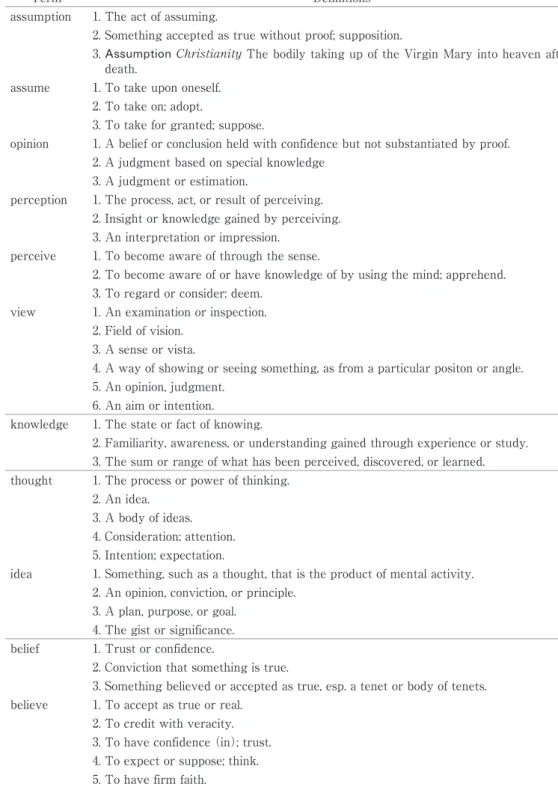
Shimo (2014a, 2014b) discussed definitions of the term “beliefs”: The term often refers to “the attitudes and values that one holds about something, often inseparable from one s knowledge (Shimo, 2014a, p. 442). Pajares (1992) claimed that teacher beliefs are “a messy construct” and pointed out that it is hard to distinguish beliefs from knowledge. Nagatomo (2012) cited Pajares (1992) arguing that “knowledge concerns the knowing of something, but beliefs concern the feelings about something” (Nagatomo, 2012, p. 51). I concur with Woods (1996) that beliefs, assumptions, and knowledge (BAK) refer to “points on a spectrum of meaning” (p. 195). In my research, teacher beliefs include their views, perceptions, opinions, or assumptions, and even knowledge; all of these were collected through the teachers responses on the 2013 and 2014 surveys. Let us further examine the meanings of these words, beginning with their dictionary definitions (Table 1).
The definitions of the four terms “view,” “perception,” “opinion,” and “assumption” help
to explain the relationship between “belief” and these terms. First, some of the definitions overlap, as an “opinion” is defined as a “belief” and a “view” as an “opinion.” Furthermore, one
Table 1. Dictionary Definitions of Related Terms
Term Definitions
assumption 1. The act of assuming.
2. Something accepted as true without proof; supposition.
3. Assumption Christianity The bodily taking up of the Virgin Mary into heaven after her death.
assume 1. To take upon oneself. 2. To take on; adopt.
3. To take for granted; suppose.
opinion 1. A belief or conclusion held with confidence but not substantiated by proof. 2. A judgment based on special knowledge
3. A judgment or estimation.
perception 1. The process, act, or result of perceiving. 2. Insight or knowledge gained by perceiving. 3. An interpretation or impression.
perceive 1. To become aware of through the sense.
2. To become aware of or have knowledge of by using the mind; apprehend. 3. To regard or consider; deem.
view 1. An examination or inspection. 2. Field of vision.
3. A sense or vista.
4. A way of showing or seeing something, as from a particular positon or angle. 5. An opinion, judgment.
6. An aim or intention. knowledge 1. The state or fact of knowing.
2. Familiarity, awareness, or understanding gained through experience or study. 3. The sum or range of what has been perceived, discovered, or learned. thought 1. The process or power of thinking.
2. An idea. 3. A body of ideas. 4. Consideration; attention. 5. Intention; expectation.
idea 1. Something, such as a thought, that is the product of mental activity. 2. An opinion, conviction, or principle.
3. A plan, purpose, or goal. 4. The gist or significance. belief 1. Trust or confidence.
2. Conviction that something is true.
3. Something believed or accepted as true, esp. a tenet or body of tenets. believe 1. To accept as true or real.
2. To credit with veracity. 3. To have confidence (in); trust. 4. To expect or suppose; think. 5. To have firm faith.
of the definitions of “assume” is “suppose,” which the same dictionary defines as “to believe, esp. on uncertain grounds” (emphasis added). Similarly, one of the definitions of “perception” is an “impression,” and an “impression” is defined in the same dictionary as “a vague notion, remembrance or belief” (emphasis added). All these definitions indicate that these terms share part of their meanings. Note that one of the definitions of an “assumption” is “something accepted as true without proof,” which is very close to a definition of “believe”: “to accept as true or real.” Thus, one s views, perceptions, and opinions are by definition part of one s belief system, as are one s assumptions.
As the definitions in Table 1 imply, both assumptions and beliefs tend to be based more on subjective than on objective judgments. This characteristic may be even more pronounced when assumptions and beliefs are compared with knowledge, which is often gained by learning and which seems to be based on scientific evidence. However, knowledge can be gained by experience as well (see Table 1, and the discussion in Shimo (2014b)), and therefore could include fairly subjective information. This is one of the factors that can make it difficult to distinguish knowledge from beliefs.
To summarize, views, perceptions, opinions, assumptions, and even knowledge in certain contexts, are all part of a belief system. On the other hand, some of the definitions of “believe” and “belief” in Table 1 imply that the word “belief” has a certain connotation: These definitions include such expressions as “conviction” or “confidence,” which suggest that beliefs can be more strongly or deeply rooted in one s heart or mind than can views or opinions. The reference to religious beliefs further adds to this interpretation.
For the current paper, the term “perceptions” has been adopted. In the 2014 survey, teachers interpretations or impressions (“perceptions” in Table 1) of their students characteristics and abilities were explored. In other words, how teachers “perceived”─ or regarded or considered their students (see the third definition of “perceive” in Table 1) ─ were investigated. Approximately 370 English teachers2 at Japanese universities
participated in the survey and contributed their opinions, views, and assumptions (part of their beliefs), as well as their knowledge about teaching and learning, while revealing their perceptions of their students by specifically indicating their degree of agreement regarding the students characteristics and abilities. This paper will discuss such perceptions of the teachers ─ how they perceive their students, or “the process, act, or result” (see “perception” in Table 1) of perceiving their students.
2.2 ETs and JTs vs. NESTs and NNESTs3 In the three-year research project of which this paper reports a part, I aim to compare the teachers perceptions of two groups of teachers, namely ETs and JTs. In previous papers (Shimo, 2014a, 2014b), the term “native English-speaking teachers” was used to refer to ETs and “native Japanese-speaking teachers” to refer to JTs. In the current paper, the term “first language” replaces “native-speaking” because of certain connotations “native speaker” possesses. The teachers are described here as “English L1 teachers” or “Japanese L1 teachers,” and the abbreviations ETs and JTs will be used, as in Shimo (2014a, 2014b).
As the current study is about English teaching, note that JTs could be labeled as non-native English speaking teachers
personal identities in relation to language communities. Therefore, the term “first language” suffices for the purpose of this paper. At the same time, the issue of NESTs and NNESTs does feature in the background to this research, and will be discussed in the next section.
3. Validity of the Two Group Comparison A simple comparison between ETs and JTs will be unable to avoid certain criticism. Shimo (2014a) stated that “a criticism can be made of the present approach that it groups ETs from different countries (namely, Australia, Canada, New Zealand, the United Kingdom, the United States, and others) together and treats them as if they come from one culture; however, the comparison of beliefs between ETs (regardless of country) and JTs should lead to insightful findings that we can utilize to improve English-learning programs at Japanese universities” (p. 444). As mentioned above, in many Japanese university-level English programs, ETs and JTs work together within one program toward the same curriculum goals. The comparison in this research project is expected to contribute resources to be utilized by all concerned for a deeper understanding of each other and for improvement of their English language programs.
In comparing the two groups, however, individual teachers idiosyncratic teaching contexts and backgrounds should also ultimately be taken into account, as it is possible that such factors can be directly concerned with any differences found between the two groups (Shimo, 2014a). Teachers individual differences should not be neglected in order to prevent undesirable stereotypes being created (Matsumoto, 2001) (NNESTs or Non-NESTs) while ETs as
NESTs. However, the distinction between NESTs and NNESTs assumes that the native speaker is the norm, which relates to the notion of Native Speakerism (Holliday, 2006; Houghton and Rivers, 2013). The focus of this research is not on any superiority or benefits of native speakers over non-native speakers of English and vice versa, as has been the case in several studies in the past (e.g., Kramsch, 1997; Medgyers, 1992). In the discussion of Native Speakerism, a number of researchers have argued about what defines a native speaker and about the purposes and consequences of such a definition (e.g., Medgyers, 1992; Moussu and Llurda, 2008). The current paper does not address these issues, as categorizing one group “natives” and another “non-natives” can lead to one group Othering the other (Holliday & Aboshiha, 2009), which is not among the aims of this paper.
In previous studies (Shimo, 2014a, 2014b), the term “native” was not used in terms of the dichotomy of native vs. non-native, but was intended in a fair and accurate manner to distinguish between native English-speaking and native Japanese-English-speaking teachers. However, considering the recent history of the term “native” being used extensively in the discussion of Native Speakerism, the term “first language” has been adopted in this paper to avoid any misconception.
Regarding the use of such terms as “first” and “second” for language, Rampton (1990) claimed that these terms “do not go to the heart of language allegiance” (p. 100), proposing that “affiliation” and “inheritance” may be used to reflect such issues. The present study, however, does not focus on language users (i.e., English teachers )
stricter about learners mistakes, that JTs found the use of L1 (Japanese) more beneficial than ETs did, and that ETs appreciated the use of group work and game-like activities more than JTs. Stewart (2005) also investigated English language teachers identities, the formation of which is affected by their beliefs about the social world they experience. Her participants included both ETs and JTs. None of these studies, however, focused on these teachers perceptions of their students.
When a teacher goes into a classroom, he or she has certain assumptions, whether these are conscious or not. The teacher s assumptions influence his or her interpretation of what happens in the classroom. The teacher s interpretation of the students behaviors may differ, depending on his or her assumptions. Thus, if ETs and JTs have different assumptions about their students, they may approach their classes in different ways, even though they are teaching the same students. Any such differences in assumptions may be explained by differences in their language and cultural backgrounds, teaching and educational expertise, and teaching contexts (e.g., course focus and student characteristics). Holliday and Aboshiha (2009) claimed that “an understanding of culture should be used not to label people, but to get to the bottom of how and why they label the Other.” Similarly, I expect that an understanding of teacher beliefs in the two groups will help to capture a better view of how and why they should be collaborating ─ as two groups or perhaps in another way ─ to work toward the same purposes.
4. Methods and Procedures 4.1 Questionnaire survey
Shimo (2014a) discussed how the 2014 survey was developed; a brief summary of through the current research project.
Zukerman (1990) claimed that individual differences within one group are larger than any differences between groups that occur due to genetic characteristics (also cited in Matsumoto, 2001). The two groups, ETs and JTs, in the current research project were not based on genetic characteristics, but the same may apply. Thus, the comparison between the two groups will provide more convincing findings if a careful consideration is given to individual differences within each group.
Nagatomo (2012) pointed out that there has not been enough research on Japanese teachers of English in Japanese universities, and emphasized the importance of such investigation because Japanese teachers constitute the majority of university faculty in Japan, and they are an extremely powerful group that could influence English education in Japan. While agreeing with Nagatomo s view, I would like to emphasize the importance of investigating both ETs and JTs. Very few studies have compared these two groups in the past. Matsuura, Chiba, and Hilderbrandt (2001), in a study of 301 students, 41 ETs, and 41 JTs, explored the study participants beliefs regarding learning and teaching communicative English. One interesting finding regarding the two teacher groups was that ETs and JTs attitudes seemed to differ in terms of important instructional areas. For example, regarding the importance of teaching language functions, speaking, listening, cultural differences, non-verbal cues, and pronunciation, JTs mean scores were higher compared to ETs. Furthermore, Chiba and Matsuura (1998, cited in Matsuura, et al., 2001), who compared ETs and JTs ideas about teaching-related issues (e.g., course objectives, teaching materials, and styles), revealed that JTs were
the methodology is presented. A questionnaire was developed and presented in both paper and online versions. It was divided into two sections and contained a total of 48 questions. Respondents were asked to choose one typical class of first- and/or second- year university students they were teaching at the time, and to base their responses on their general impressions of this particular class when they answered questions about their students.
The first section of the questionnaire contained 13 questions focusing on the respondents teaching backgrounds, the class they had chosen for the survey, and their impressions of the students in the class. The second section contained 35 questions. Of these, 28 were four-point Likert-scale questions regarding their students English abilities, the students preferences in teaching styles, and so on. The remaining questions were either multiple-choice or open-ended, and asked about the respondents interpretation of their students reasons for learning English, the areas of language competence to be emphasized in learning, their understanding of ETs and JTs roles, and so on.
The questionnaire was distributed among well over 1000 university English teachers either physically in envelops or electronically via email and other online media. The questionnaire was made available both in English and in Japanese, and the instructions requested the respondent to respond in his or
her L1.
This paper focuses on the analysis of answers to Section 1 Question 13 (students personalities and attitudes toward learning English) and Section 2 Questions 8 to 12 (students attitudes toward English learning
and teaching).4
4.2 Participants
A total of 374 questionnaires were completed between May and August 2014. As mentioned above, the survey targeted English teachers who were teaching first- and/or second- year university students at a Japanese university in order to reduce teacher variables. Two respondents were not teaching such classes at the time, and their responses were excluded from the current analysis. Of the remaining 372 teachers, 174 were ETs and 192 JTs (Table 2). The current analysis examined the responses of those teachers who indicated that, in responding to the survey, they had selected a typical class of university first- and/or second- year students that they were then teaching. A few responses appeared to have chosen more than one class as a basis for the survey, but these were included if the responses indicated that the classes were for first- and/or second-year students. Thus, the data for the current analysis were drawn from a total of 324 completed questionnaires, those of 154 ETs and 170 JTs.
In terms of nationality, the ETs were from
Table 2.Number of Respondents by First Language
Language English Japanese Other
Number of respondents (N = 372) 1741) 192 62)
Number of participants for the current analysis (N = 324) 154 170 ─ Notes: 1) This includes one respondent who claimed to be a balanced bilingual in English and French; 2) “Other” includes one Hungarian, one Romanian, one Cantonese, one German, one Finnish speaker, and one
English or American literature for JTs (24.7%). The two groups were fairly similar in terms of length of English teaching at a Japanese university (Table 6). In both groups, more than half (61.0% and 57.1%, respectively)5 had between six and 20 years
of experience teaching at a Japanese university.
As explained above, respondents were instructed to base their responses on their impressions of the students in one typical class that they were teaching. Thus, the eight different countries, namely Australia,
Canada, Ireland, Japan, United Kingdom, United States of America, New Zealand, and the Dominican Republic, and most of the JTs were of Japanese nationality (Tables 3 and 4). The ETs and JTs indicated certain differences in terms of their fields of expertise (Table 5). Whereas the most commonly reported field for both groups was English education or TESOL (62.3% and 50.0%, respectively), the second most common field was applied linguistics for ETs (31.8%) and
Table 3. Number of ETs by Nationality (N=154)
Country Australia Canada Ireland Japan UK USA ZealandNew Other
Number of
teachers 17 23 2 5 33 66 6 21)
Note: 1) This includes one Dominican and one with dual-citizenship (Canada and USA).
Table 4. Number of JTs by Nationality (N=170)
Country Japan Ireland No response
Number of teachers 166 1 3
Table 5. Fields of Expertise (N=324) Field English or American
literature
English education or
TESOL Linguistics
Applied
linguistics Other Total ETs
(n=154) N% 4.57 62.396 7.111 31.849 16.225 188
JTs
(n=170) N% 24.736 50.077 15.925 18.227 12.419 184
Note: Multiple responses were allowed.
Table 6. Length of English Teaching Experience at a Japanese University (N=324)
Length of the years Less than 1 year 1 year or longer but shorter than years 3 to 5 years 6 to 10years 11 to 15 years 16 to 20 years 21 to 25 years 26 to 30 years 31 years or longer no response Total ETs (n=154)%n 1.93 4.57 9.715 24.738 17.527 18.829 12.319 5.89 2.64 1.93 154100 JTs (n=170) %n 0.61 4.78 7.613 27.146 16.528 13.523 13.523 8.214 7.112 1.22 170100
teacher and classmates, and (c) their students preferences regarding teaching and learning styles. A comparison was made between the 154 ETs and the 170 JTs, as discussed in sections 5.1 and 5.2. Following this, further comparisons were made between the ETs and JTs teaching students of different majors (section 5.3). The tendencies were similar
across both comparisons, as described below. 5. 1 Teachers perceptions of students
personalities and attitudes
Regarding the respondents perceptions about their students personalities and attitudes towards learning, let us examine responses to Question 13 in the first section of the 2014 survey.6 This question required
respondents to choose up to five out of 22 given phrases to describe their students majors of respondents students varied
(Table 7). The ratio of ETs teaching English related majors was higher than that of JTs, and the ratio of JTs teaching Science related majors was higher than that of ETs.
The survey also asked respondents to indicate the target skills in the typical class they had in mind. The majority of the ETs chose speaking as a main target skill, whereas the majority of JTs chose reading (Table 8). In terms of class type, around 85% in both groups said that it was required (Table 9). 5. Results
In this section, I present data on the respondents perceptions about (a) their students personalities and attitudes towards learning English, (b) their students preferences regarding the use of English with their
Table 7. Students Majors in the Classes Chosen for the Survey (N=324)
English
related1) humanitiesOther 2) Science related Other3) No response Total
ETs
(n=154) N% 14.322 55.886 16.225 13.621 00 154100
JTs
(n=170) N% 8.214 51.888 22.939 14.124 2.95 170100
Notes: 1) This includes English and American literature and English education; 2) The survey asked respondents to write the name of the students study fields. Some names given (e.g., communications and international studies) could mean that the students majored in English, but they were included as “other humanities” here; 3) “Other” includes both humanities and science mixed.
Table 8. Target Skills in the Class Chosen for the Survey
Listening Speaking Reading Writing Pronunciation Grammar Other ETs
(n=154) N% 9863.6 12379.9 31.849 6139.6 2415.6 1912.3 3019.5 JTs
(n=170) N% 9052.9 5431.8 67.1114 6638.8 2414.1 5029.4 148.2 Note: Multiple responses were allowed.
Table 9. Status of the Chosen Class: Required or Elective
Required Elective Other or no response Total
ETs (n = 154) (%) 132 (85.7) 12 (7.8) 10 (6.5) 154 (100)
personalities, with a 23rd option of “Other,
please specify” (Table 10). Both English and Japanese meanings were shown for each phrase on both English and Japanese versions of the survey in order to help respondents better understand what each choice meant. A few teachers commented on problems they had completing the questionnaire, saying for example that it was “impossible to answer. I have 200 individuals who are individuals all with different personalities and attitudes,” and “it varies, all of these attitudes are found.” However, the survey called for respondents general impressions, and certain characteristics were evident across their responses.
Firstly, certain differences between the groups were observed (Table 10). The proportion of ETs who chose “cheerful” was much larger than that of JTs (63.0% vs. 37.1 %). Similarly, the proportion of ETs who chose “willing to communicate in English” was much higher than that of JTs (45.5% vs. 10.0%). In fact, this phrase was the most commonly selected among the ETs. Further, note that the majority of ETs (79.9%) were teaching speaking in their class, whereas only 31.8% of the JTs were doing so (Table 8). Thus, with the target skills in the JTs classes not being productive skills, they may have had fewer opportunities to receive impressions of their students as “cheerful” or “willing to communicate in English.” Moreover, ETs may more often be required to teach students of a higher level of English proficiency at universities, further contributing to these differences in the teachers perceptions. The students proficiency levels may also have contributed to further differences, with 38.3% of ETs selecting “interested in how to improve their English,” as opposed to only 24.1% of JTs, and 24.7% of ETs selecting “not
confident,” as opposed to 35.3% of the JTs. The JTs responses also indicated that their general impression of their students was that they were sincere about studying, but not necessarily interested in learning English. In this regard, 62.4% of JTs selected “eager to learn,” whereas only 31.2% of ETs did so. In contrast, 30.5% of ETs selected the somewhat similar phrase “keen and hard-working,” as opposed to only 21.2% of JTs. Note in this regard that the Japanese translation presented for “eager to learn” was “gakushu ni majimeni torikumu,” and the connotation of majimeni was perhaps not as strong as the English eager. The Japanese for “keen and hard-working” was “nesshin, doryokuka.” Regardless of such nuances that may have been lost in translation, it is noteworthy that the proportion of JTs who chose “eager to learn” was more than double that of ETs.
On the other hand, responses showed that ETs and JTs shared certain perceptions about their students. Half of the JTs selected “obedient, accept instructions and advice at once” and “passive, reactive, waiting for instructions” (50.6% and 50.0%, respectively), with similar proportions among ETs (44.8% and 44.2%, respectively). “Shy” and “mild-mannered” were also selected by a substantial number of teachers from both groups (30.5% of ETs and 29.4% of JTs for the former and 27.9% of ETs and 21.2% of JTs for the latter). 5.2 Teachers perceptions of students
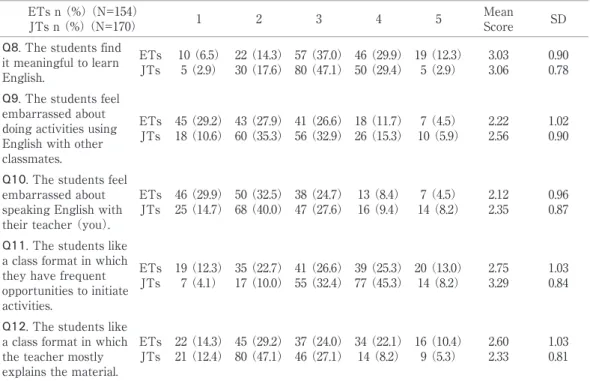
attitudes toward learning and teaching In this section, I present the results of five questions from the second section of the 2014 survey. One question (Q8) focused on respondents perceptions of their students attitudes toward learning English, and the remainders (Q9∼12) on their perceptions of their students preferences regarding the use
of English and class format (Table 11). First, note that ETs and JTs showed similar perceptions regarding whether or not their students find learning English to be meaningful (Q8 in Table 11). The percentage of teachers who responded with “I (somewhat) agree” (3 or 4 on the four-point Likert scale) was greater for the JTs (76.5%) than for the ETs (66.9%), but both groups perceptions were more positive than negative for this item.
Next, the tendency was stronger among JTs to perceive their students as embarrassed to use English with their classmates. Whereas 57.1% of ETs (somewhat) disagreed with the statement “the students feel embarrassed about doing activities using English with other classmates (Q9),” only 45.9% of JTs (somewhat) disagreed with it. The corresponding ratios of (somewhat) agreeing
with this statement were 38.3% and 48.2% for ETs and JTs, respectively. Similar results were revealed in relation to the statement “the students feel embarrassed about speaking English with their teacher (=the survey respondent) (Q10).” The percentage of the ETs who disagreed with this statement was 29.9% and that of JTs was 14.7%. When these were combined with the “somewhat agree” responses, the percentages are 62.3% and 54.7%, respectively. These results, along the mean scores of 2.12 and 2.35, respectively, out of a maximum of 4 and the proportions of those who (somewhat) agreed (33.1% and 37.0%, respectively), indicated that the JTs tended to perceive more strongly that their students were embarrassed to use English with their teacher, a similar tendency regarding their students use of English with classmates. These results did not match those Table 10. Percentage of Teachers who Selected Each Phrase Describing Their Students
Personalities and Attitudes towards Learning English (ETs: N = 154; JTs: N = 170)
n (%) Cheerful communicate Willing to in English
Keen,
hard-working Eager to learn ManneredMild- Confident
ETs 97 (63.0) 70 (45.5) 47 (30.5) 48 (31.2) 43 (27.9) 13 (8.4)
JTs 63 (37.1) 17 (10.0) 36 (21.2) 106 (62.4) 36 (21.2) 4 (2.4)
Gloomy Shy Lazy Lethargic Tend to rely on others Not confident
ETs 3 (1.9) 47 (30.5) 14 (9.1) 15 (9.7) 14 (9.1) 38 (24.7) JTs 6 (3.5) 50 (29.4) 10 (5.9) 28 (16.5) 22 (12.9) 60 (35.3) Try to take initiative Obedient, accept instructions and advice at once Make a plan for their own
learning Interested in how to improve their English Curious Other ETs 23 (14.9) 69 (44.8) 5 (3.2) 59 (38.3) 24 (15.6) 22 (12.6) JTs 27 (15.9) 86 (50.6) 8 (4.7) 41 (24.1) 33 (19.4) 7 (3.6) Passive, reactive, waiting for instructions Resistant,
uncooperative Sloppy in their work
Apathetic, not interested in learning Cannot concentrate ETs 68 (44.2) 3 (1.9) 16 (10.4) 17 (11.0) 18 (11.7) JTs 85 (50.0) 2 (1.2) 8 (4.7) 20 (11.8) 35 (20.6)
of the 2013 survey results (Shimo, 2014b), in which the opposite tendency was observed.
Questions 11 and 12 focused on the teachers perceptions regarding their students preference of class format. In this regard, 77.6% of JTs (somewhat) agreed that “the students like a class format in which they have frequent opportunities to initiate activities.” This contrasts with 51.9% of ETs. Furthermore, whereas 46.1% of ETs (somewhat) agreed that “the students like a class format in which the teacher mostly explains the material,” only 35.3% of JTs did so. This tendency was identified in the 2013 survey as well (Shimo, 2014b).
As a further step in the analysis, a t-test was administered to determine the significance of differences in mean scores between the two groups for Questions 8 to 12 (Table 12).
Some of the mean score differences were statistically significant (p
statistically significant (p
statistically significant ( < .01), indicating that there were perception differences between the ETs and JTs in this survey. The difference seems to lie especially in terms of their perceptions of their students preferences regarding the use of English and class format. 5.3 Comparisons across students majors
For each of the questionnaire items discussed above, further comparisons were made between ETs and JTs teaching students with different majors, i.e., between teachers of English majors, teachers of non-English humanities, and teachers of science majors. These comparisons were conducted in order to determine whether or not differences in teachers perceptions were influenced by their students majors or not. Table 11. Respondents Perceptions of their Students Attitudes toward Learning English
(Q8), Preferences regarding the Use of English, and Class Format (Q9∼12)
ETs n (%) (N=154)
JTs n (%) (N=170) 1 2 3 4 5 Mean Score SD
Q8. The students find it meaningful to learn English.
ETs
JTs 10 (6.5)5 (2.9) 22 (14.3)30 (17.6) 57 (37.0)80 (47.1) 46 (29.9)50 (29.4) 19 (12.3)5 (2.9) 3.033.06 0.900.78 Q9. The students feel
embarrassed about doing activities using English with other classmates.
ETs
JTs 45 (29.2)18 (10.6) 43 (27.9)60 (35.3) 41 (26.6)56 (32.9) 18 (11.7)26 (15.3) 10 (5.9)7 (4.5) 2.222.56 1.020.90 Q10. The students feel
embarrassed about speaking English with their teacher (you).
ETs
JTs 46 (29.9)25 (14.7) 50 (32.5)68 (40.0) 38 (24.7)47 (27.6) 13 (8.4)16 (9.4) 14 (8.2)7 (4.5) 2.122.35 0.960.87 Q11. The students like
a class format in which they have frequent opportunities to initiate activities.
ETs
JTs 19 (12.3)7 (4.1) 35 (22.7)17 (10.0) 41 (26.6)55 (32.4) 39 (25.3)77 (45.3) 20 (13.0)14 (8.2) 2.753.29 1.030.84 Q12. The students like
a class format in which the teacher mostly explains the material.
ETs
JTs 22 (14.3)21 (12.4) 45 (29.2)80 (47.1) 37 (24.0)46 (27.1) 34 (22.1)14 (8.2) 16 (10.4)9 (5.3) 2.602.33 1.030.81 Note: 1 = I disagree; 2 = I somewhat disagree; 3 = I somewhat agree; 4 = I agree; 5 = No response or I don t know.
The results showed that ETs and JTs showed similar group differences regardless of students majors. Thus, it does not seem that the group differences were caused by differences in students majors.
First, considering the data in Table 13, the percentages of ETs selecting “cheerful” and “willing to communicate in English” were fairly high among those teaching English majors (95.5% for the former, and 59.1% for the latter), and also relatively high among those teaching science majors (72.0% for the former, and 56.0% for the latter). On the other hand, the percentages of JTs selecting these two choices were far lower, even among those teaching English majors, (50.0% for the former, and 7.1% for the latter). The same was true for the selection of “interested in how to improve their English.” Even among the JTs teaching English majors, only 14.3% selected this phrase, compared to 54.5% of ETs. It is true that the percentages are higher among both ETs and JTs teaching English majors than among those teaching non-English humanities or science majors.
Nevertheless, the percentages were higher for ETs of all three major groups, and thus it seems that the students majors had little to do with the differences between ETs and JTs perceptions.
As for Questions 8 to 12, certain differences were observed in teachers perceptions across students majors (Table 14). For example, ETs of science majors disagreed most strongly that “the students feel embarrassed about doing activities using English with other classmates.” Furthermore, teachers of English and science majors disagreed more strongly than those of non-English humanity majors that “the students feel embarrassed about speaking English with their teacher.” The mean score for Question 11, regarding students preference for a student-centered class, was smallest for the ETs of English majors, and the mean score for Question 12, regarding students preference for a teacher-centered class, was largest for these ETs. These figures seem to be contradictory to the commonly-accepted notion that science students are rather reserved and do not like Table 12. Statistical Analysis of Mean Score Differences between ETs and JTs on Q8 to Q12
Question ETs JTs df t
M SD M SD
Q8. The students find it meaningful to
learn English. 3.03 0.90 3.06 0.78 298 −.320
Q9. The students feel embarrassed about doing activities using English
with other classmates. 2.22 1.02 2.56 0.90 305 −3.159
**
Q10. The students feel embarrassed about speaking English with their
teacher (you). 2.12 0.96 2.35 0.87 301 −2.131
*
Q11. The students like a class format in which they have frequent opportunities
to initiate activities. 2.75 1.03 3.29 0.84 255.75 −4.923
**
Q12. The students like a class format in which the teacher mostly explains the
material. 2.60 1.03 2.33 0.81 259.11 2.509
*
to participate actively in English communication (Hill, Falout, & Apple, 2013).
Despite these minor differences, which seem at least partially attributable to students different majors, the differences between ETs and JTs remained largely
similar, regardless of their students majors. In all three major groups, the tendency was stronger among JTs to agree that their students felt embarrassed to use English in class, but also in that their students preferred a student-centered classroom. In contrast, the Table 13. Comparison of Teachers Responses Regarding Personalities and Attitudes across
Students Majors (ETs: Ns = 22, 86, and 25; JTs: Ns =14, 88, and 39)1
n (%) Cheerful communicate in Willing to English
Keen,
hard-working Eager to learn ManneredMild- Confident ETs 21 (95.5)48 (55.8) 18 (72.0) 13 (59.1) 35 (40.7) 14 (56.0) 7 (31.8) 26 (30.2) 11 (44.0) 8 (36.4) 29 (33.7) 8 (32.0) 3 (13.6) 27 (31.4) 3 (12.0) 6 (27.3) 4 (4.7) 2 (8.0) JTs 32 (36.4)7 (50.0) 14 (35.9) 1 (7.1) 10 (11.4) 4 (10.3) 1 (7.1) 20 (22.7) 11 (28.2) 10 (71.4) 53 (60.2) 28 (71.8) 2 (14.3) 20 (22.7) 10 (25.6) 0 (0.0) 2 (2.3) 1 (2.6) Gloomy Shy Lazy Lethargic Tend to rely on others Not confident ETs 1 (4.5)2 (2.3) 0 (0.0) 8 (36.4) 23 (26.7) 8 (32.0) 2 (9.1) 10 (11.6) 1 (4.0) 2 (9.1) 9 (10.5) 1 (4.0) 2 (9.1) 11 (12.8) 1 (4.0) 3 (13.6) 22 (25.6) 7 (28.0) JTs 0 (0.0)4 (4.5) 1 (2.6) 2 (14.3) 27 (30.7) 11 (28.2) 0 (0.0) 7 (8.0) 0 (0.0) 5 (35.7) 9 (10.2) 7 (17.9) 3 (21.4) 13 (14.8) 3 (7.7) 5 (35.7) 34 (38.6) 14 (35.9) Try to take initiative Obedient, accept instructions and advice at once Make a plan for their own
learning
Interested in how to improve
their English Curious Other ETs 10 (11.6)6 (27.3) 5 (20.0) 13 (59.1) 35 (40.7) 12 (48.0) 2 (9.1) 2 (2.3) 1 (4.0) 12 (54.5) 30 (34.9) 6 (24.0) 5 (22.7) 11 (12.8) 4 (16.0) 4 (18.2) 12 (14.0) 3 (12.0) JTs 10 (11.4)1 (7.1) 10 (25.6) 7 (50.0) 44 (50.0) 20 (51.3) 0 (0.0) 3 (3.4) 2 (5.1) 2 (14.3) 26 (29.5) 6 (15.4) 1 (7.1) 20 (22.7) 7 (17.9) 0 (0.0) 3 (3.4) 1 (2.6) Passive, reactive, waiting for instructions Resistant,
uncooperative Sloppy in their work
Apathetic, not interested in learning Cannot concentrate ETs 40 (46.5)8 (36.4) 9 (36.0) 0 (0.0) 2 (2.3) 0 (0.0) 3 (13.6) 10 (11.6) 2 (8.0) 0 (0.0) 15 (17.4) 2 (8.0) 2 (9.1) 15 (17.4) 0 (0.0) JTs 44 (50.0)7 (50.0) 20 (51.3) 0 (0.0) 1 (1.1) 0 (0.0) 0 (0.0) 4 (4.5) 1 (2.6) 1 (7.1) 15 (17.0) 2 (5.1) 5 (35.7) 18 (20.5) 5 (12.8)
Note: The N size indicates the number of teachers of English majors, non-English humanities majors and science majors. In the table, the top line figures are of teachers of English majors, the second non-English humanities, and the bottom science majors. The percentages indicate the ratio of the teachers who selected the response in each group.
tendency was stronger among ETs to agree that the students liked a teacher-centered classroom.
As mentioned above, possible factors in such group differences are that ETs more often focus on speaking skills in their classes, and that ETs may be teaching classes of higher-level English skills regardless of the students majors. In this regard, recall that 79.9% of ETs in this study indicated speaking as the main target skill in their chosen classes, followed by listening (63.6%), whereas 67.1% of JTs indicated reading, followed by listening (52.9%) (Table 8). The perception held by ETs that their students are cheerful and like to communicate in English seems like a preferable response for a class targeting speaking skills. It is possible that interactive, multi-directional communication was less prevalent in the JTs classes than in
those of the ETs, which may contribute to the JTs general impressions about their students use of English in class. On the other hand, this speculation still leaves room for argument as to why the ETs did not more strongly perceive that their students liked a student-centered class format, and why more JTs believed that their students liked a student-centered class format. It is possible that ETs and JTs may have differently interpreted the statements on the survey regarding a class format. Different ways of interpreting “to initiate activities” may have affected the survey results.
A further speculation regarding factors contributing to these teachers perceptions concerns the interactive effect among students expectations, the teachers behaviors in reaction to these expectations, and the students reactions to the teachers behaviors Table 14. Comparison of Teachers Responses Regarding Students Attitudes toward Learning English, Preferences regarding the Use of English, and Class Format across Students Majors ETs N = 22 N = 86 N = 25 JTs N = 14 N = 88 N = 39 Mean
Score SD Mean Score SD
Q8. The students find it meaningful to learn English. 3.53 3.06 2.95 0.51 0.84 1.16 3.36 2.91 3.11 0.74 0.84 0.65 Q9. The students feel embarrassed about doing activities
using English with other classmates. 2.302.31 2.04 0.92 1.07 1.02 2.54 2.59 2.56 0.78 0.86 0.77 Q10. The students feel embarrassed about speaking
English with their teacher (you). 2.052.22 2.05 0.92 1.01 0.84 2.33 2.34 2.53 0.65 0.83 0.91 Q11. The students like a class format in which they have
frequent opportunities to initiate activities. 2.652.92 2.78 1.04 1.06 1.06 3.69 3.20 3.29 0.63 0.88 0.69 Q12. The students like a class format in which the
teacher mostly explains the material. 2.672.44 2.57 1.02 0.96 1.16 2.15 2.35 2.38 0.55 0.91 0.72 Note: In the table, the top line is a figure for teachers of English majors, the second non-English humanities, and the bottom science majors.
(Figure 1). Shimizu (1999) reported that Japanese students in general perceived ETs as friendly and their classes as fun, and JTs as knowledgeable but their classes boring. ETs may perceive such expectations among the Japanese students, concluding that their classes ought to be fun and entertaining. When ETs manage their classes based on such expectations, students may react cheerfully, reinforcing the ETs impression of their students as cheerful. The opposite may be true for JTs. JTs, whose class activities may be more serious, with fewer fun elements, and thus JTs do not receive such strong impressions of their students as being cheerful.
In summary, different class contents between ETs and JTs may be contributing to different perceptions among the teachers themselves. Then, such role divisions between the two groups of teachers may be reinforcing students impressions of their teachers, and both teachers and students may end up keeping stereotypical images about each other.
6. Further Analysis Based on Respondents Comments
The analysis presented above has indicated several characteristics of ETs and JTs perceptions about their students. First, ETs perceived their students more strongly as cheerful, willing to communicate in English, and interested in improving their English skills. On the other hand, JTs were more likely to perceive their students as serious about learning.
Second, ETs tended to agree more than JTs that their students were not embarrassed to use English with their classmates and teacher, and this view of ETs coincides with their perceptions regarding their students
willingness to communicate in English. In the 2013 survey, the opposite tendency was observed: The tendency was stronger among [ETs] to believe that their students felt embarrassed to speak in English in class (Shimo, 2014b, p. 39). That pilot survey targeted teachers who worked within one particular English program in a faculty of humanities, and their students in the program were not English majors. It is possible that the students characteristics strongly impacted on the results of the 2013 survey. Possibly, the ETs in the 2014 survey were teaching students with higher levels of English proficiency on average than the JTs, which may have influenced their perceptions.
In contrast, the third main finding was that the ETs in this study tended not to think that their students liked a student-centered, student-initiated class format. This tendency was also identified in the 2013 survey (Shimo, 2014b). A number of respondents comments help to explain the gap in the ETs perceptions. One ET, despite selecting “passive, reactive, waiting for instructions” and “not confident” to describe students in response to Question 13 (see the discussion in 5.1), commented: “But they change to ‘cheerful and ‘eager to learn as the term progresses.” Another ET wrote in response
Students expect the teacher to act
in certain ways based on (stereo)typical images.
Teacher reacts to student expectations.
Figure 1. Interactions between student expectations and teacher behavior
Reinforcement of (stereo)typical situations
to Questions 11 and 12 (Table 12) that “it takes time to make this shift, but it happens” indicating that time is necessary to change from a teacher-centered format to a student-centered format, and that students are not reluctant to make the shift. It may be that Japanese students look very quiet, and the atmosphere extremely quiet, to many ETs initially. Caesar and Bueno (2003) pointed out that the silence that English L1 teachers face in Japanese classes is fairly shocking to them and that some teachers can never get used to it. Such silence among Japanese students may contribute to the impression that students are in general rather passive and less willing to take initiatives in learning activities.
One ET in this study commented on the survey sheet that his or her Japanese students were cheerful “when they are spoken to individually” but socially distant “as a group.” When a teacher speaks to his or her students as a whole, it is common for the students to stay silent: Very few would speak up or respond to the teacher s questions unless their names were called. Such tendencies may contribute to ETs perception that Japanese students prefer a class format in which the teacher mostly explains the material.
On the other hand, JTs in this study tended to believe that their students liked a student-centered class format (i.e., a class format in which students have frequent opportunities to initiate activities). The 2014 survey did not ask how these teachers were actually teaching their classes. Grammar-focused teaching still seems be prevalent in high school English classes. According to Bennesse Holdings, Inc. (2014), as many as 70 to nearly 90 percent of students claimed that they often did English to Japanese translation tasks and listened to their teacher explain grammar in
class. Most of these students have few opportunities to express themselves in English. The Bennesse survey results implied that class format is far from student-centered at the junior and senior high school level. Similarly, one ET in the present study commented in response to a survey question about learning activities that students should be utilizing that “students have not been exposed to such approaches [facilitated, student-centered activities that we communicate and multi-model] in high school; they should be supported in transitioning from a translation and grammar analysis to use.” If JTs believe that their students like a student-centered class format, the question remains as to whether they actually provide such an environment in their classes, and how they define a situation in which students initiate activities in class. Further exploration into the actual class format used by both ETs and JTs is required to better understand the university-level English teaching and learning context.
Finally, in ETs classes, most of which target speaking skills, teacher expectations regarding students interacting with each other in English may be higher than in JTs classes. Such higher expectations among ETs may contribute to their impressions that Japanese students are rather reserved, as they do not meet such teachers expectations. Future investigation should consider the type, content, frequency, and amount of student-teacher and student-student interaction during class. This may help to explain why the ETs in this study did not think their students liked a student-centered class format.
7. Conclusion
indicated several similarities and differences among the ETs and JTs perceptions of their students:
1) A large number of teachers in both groups ─ about half of the JTs and about 44% of the ETs ─ responded that their students were “obedient, accept instructions and advice at once,” and/or “passive, reactive, waiting for
instructions.”
2) About 20 to 30% of the teachers in both groups perceived that their students were “shy” and “mild-mannered.” 3) The proportions of teachers who
perceived that their students were “cheerful,” “willing to communicate in English,” and “interested in how to improve their English” were far higher for ETs than for JTs.
4) The proportion of teachers who perceived their students as “eager to learn” was far higher for JTs than for ETs.
5) The majority of teachers in both groups (66.9% of ETs and 76.5% of JTs) (somewhat) agreed that their students
found English learning meaningful. 6) The tendency to agree that their
students were embarrassed to speak English with their classmates and teacher was stronger among JTs than among ETs.
7) The tendency to perceive that their students liked a student-centered class format was stronger among JTs.
8) The tendency to perceive that their students liked a teacher-centered class format was stronger among ETs.
Despite slight differences depending on the students majors, the above characteristics were observed across ETs and JTs perceptions. Factors that have contributed to
these characteristics may include (a) target language skills to be taught in class, (b) situational factors related to student-teacher and teacher-student expectations, and (c) actual classroom interactions (i.e., student-teacher, and student-student).
The analysis of the 2014 survey data revealed a few issues that future studies should address. First, how do individual teachers define a student-centered class format and a teacher-centered class? What kinds of activities do teachers consider to be student-initiated activities? Secondly, should ETs be given more chances to teach reading and grammar? Should JTs be given more chances to teach speaking? By teaching various kinds of skills, teachers in both groups will be able to perceive their students with different viewpoints and gain a further understanding of their students. I expect that more investigation into how ETs teaching reading and grammar perceive their students and how JTs teaching speaking skills perceive their students would be helpful, and that further investigation into actual teaching practices will provide meaningful insights to complement those of this research project.
Notes
1. The research reported here was funded by a MEXT/JSPS Grant-in-Aid for Scientific Research (Kakenhi), Grant-in-Aid for Young Scientists (B): Grant Number 25770215.
2. Shimo (2014a) stated that “a total of 294 teachers participated” (p. 449) in the 2014 survey. However, a correction is required, as approximately 370 teachers participated. 3. In Japanese, neitibu in katakana (a Japanese
letter style) often carries the connotation entailed by the term native in the discussion of Native Speakerism and the
NEST vs. NNEST dichotomy. Daiichigengo is a literal translation of “L1,” and bogo is “mother tongue.” Both terms are rarely used in public media and bokokugo, meaning “mother country tongue” is oftern used instead; this may be inaccurate in many cases. In the field of language teaching and learning, bogo and daiichigengo are more often used without the connotation of neitibu. In this sense, either term can be used as a translation of “L1” even though bogo is technically another way of translating the English word “native.” In order to avoid confusion, I have used the term daiichigengo in the Japanese abstract of this paper.
4. The questionnaire is available by contacting the author.
5. Due to the rounding of percentages, some totals of the numbers in the tables do not equal 100%.
6. The English version of the online questionnaire contained a typographical error: the response option, “tend to rely on others” appeared as “tend to reply on others.” The effect of this error was considered minor enough to neglect in the current analysis. Every response option in both online and paper versions included a Japanese translation, making the intended meaning clear to the respondents who understood both languages. The percentage differences between the paper and online versions occurred not only among the ETs but also among the JTs. On average, the differences were 3.518% and 3.516%, the maximum for ETs and JTs being 17.5% (“cheerful” and “willing to communicate in English”) and 14.3% (“keen, hard-working”), respectively. There may have been several factors causing these differences, but they were not taken
in to account in the current analysis. References
American Heritage® Dictionary (5th ed.).
(2012). Houghton Mifflin Harcourt Publishing Company. New York.
Benesse Holdings, Inc. (2014). Chukosei no Eigo Jugyo ni kansuru Jittai Chosa 2014 [A Survey on Junior and Senior High School students English Classes 2014]. Retrieved from http://berd.benesse.jp/global/research/ detail1.php?id=4356
Borg, S. (2006). Teacher cognition and language education: Research and practice. London: Continuum.
Burns, A. (1996). Starting all over again: From teaching adults to teaching beginners. In D. Freeman & J. Richards (Eds.), Teacher learning in language teaching (pp. Teacher learning in language teaching (pp. Teacher learning in language teaching 154-177). Cambridge: Cambridge University Press.
Caesar, T., & Bueno, E. P. (2003). Introduction: Absence, Shame and Comedy. In Bueno, E. P. & Caesar, T. (Eds.), I Wouldn t Want Anybody to Know: Native English Teaching in Japan (pp. 14-27). JPGS Press.
Chiba, R., & Matsuura, H. (1998, November). Native and nonnative ideas about teaching goals of EFL in Japan. Paper presented at the 5th International Conference on World
Englishes. University of Illinois.
Hill, G., Falout, J., & Apple, M. (2013). Possible L2 selves for students of science and engineering. In JALT2012 Conference Proceedings, edited by N. Sonda and A. Krause, 210-220. Tokyo: JALT.
Holliday, A. (2006). Native-speakerism. ELT Journal 60(4), 385-387.
Holliday, A and Aboshiha, P. A. (2009). The denial of ideology in perceptions of ‘nonnative speaker teachers. TESOL Quarterly 43(4), 669-689.
Houghton, S. A., & Rivers, D. J. (Eds.) (2013). Native-Speakerism in Japan: Intergroup Dynamics in Foreign Language Education. Multilingual Matters. Bristol, UK.
Horwitz, E. (1988). The beliefs about language learning of beginning university foreign language students. The Modern Language Journal, 72(3), 283-294.
Kameda, R. (2005). Analysis of teachers beliefs to teach Japanese senior high school students with low motivation and low retention toward language learning. Sophia Linguistica: Working Papers in Linguistics, 53, 1-32.
Kramsch, C. (1997). The privilege of the non-native speaker. PMLA 3, 359-369
Matsumoto, D. (2001). Bunka to Shinrigaku: Hikaku Bunka Shinrigaku Nyumon. (M. Minami & K. Sato, Trans.) Kitaoji Shobo. (Original work published in 2000).
Matsuura, Chiba, and Hilderbrandt (2001). Beliefs about learning and teaching communicative English in Japan. JALT Journal 23(1), 69-89.
Medgyers, P. (1992). Native or non-native: Who s worth more? ELT Journal 46(4), 340-349.
Moussu, L., & Llurda, E. (2008). Non-native English-speaking English language teachers: History and research, Language Teaching 41(3), 315-348.
Nagatomo, D. H. (2012). Exploring Japanese University English Teachers Professional Identity. Multilingual Matters. Bristol, UK. Pajares, M. F. (1992). Teachers beliefs and
educational research: Cleaning up a messy construct. Review of Educational Research, 62(3), 307-332.
Rampton, M. B. H. (1990). Displacing the ‘native speaker : expertise, affiliation, and
inheritance. ELT Journal 45(2), 97-101. Shimizu, K. (1999). A survey of expectations of
and characteristics attributed to native-speaker English teachers and Japanese English teachers by Japanese university students. Journal of Intercultural Communication, 3, 53-74.
Shimo, E. (2014a). Exploring Japanese university English teachers beliefs about their students: Questionnaire development and implementation. The Sixth CLS International Conference, Conference Proceedings, 441-450. Retrieved from http:// www.fas.nus.edu.sg/cls/CLaSIC/clasic2014/ Proceedings/shimo_etsuko.pdf
Shimo, E. (2014b). Teachers beliefs about English learners at universities in Japan: A review of previous research and findings from a pilot study, Kinki University Faculty of Applied Sociology Review 3(2), 31-48. Stewart, A. (2005). Teaching positions: A
study of identity in English language teachers in Japanese higher education. PhD thesis, University of London.
Zukerman, M. (1990). Some dubious premises in research and theory on racial differences: Scientific, social and ethical issues. American Psychologist, 45(12), 1297-1303.
Acknowledgement
I am very grateful to an anonymous proofreader of the earlier version of this paper for her editorial advice and linguistic suggestions. I would also like to express my gratitude to two anonymous reviewers for their insightful comments. Finally, my special appreciation goes to all the teachers who participated in the research project.