論 文 R 日本 物 流 学 会 誌 第16号 平 成20年5月
Analysis on the Directions of the Introduction of EDI in Ports
港 湾EDEの 導 入 方 向 性 に 関す る分 析
Marilyn OBOGNE(Graduate School of Tokyo University of Marine Science and Technology), Saburo TSURUTA and Hisayuki KUROKAWA(Tokyo University of Marine Science and Technology) 要 旨 EDIの 効 用 に つ い て は 広 く知 られ て い る と こ ろ で あ るが 、発 展 途 上 国 に お い て どの よ うなEDIを 導 入 す べ き か の 決 定 は 一 般 に 困難 で あ る。 本 論 文 は 港 湾 に 関 わ るEDIの 導 入 の 方 向性 につ い て検 討 した もの で あ る。 本 論 文 で は ア ジ ア を 中心 に14力 国 の58のEDIに つ い て3つ の カ テ ゴ リー(組 織 、機 能 、 サ ー ビス)か ら分 析 を行 った 。 ク ラス ター 分 析 、 数 量 化 理 論 皿類 を 適 用 した 結 果 、 そ れ ぞ れ の カ テ ゴ リー 毎 に 、発 展 途 上 国 が参 考 とす る こ と が 可 能 な い くつ か の 方 向 性 が あ る こ とが 明 らか とな っ た 。 Abstract
The adoption and use of EDI in the developing countries seems to be difficult. This paper attempts to propose the possible introductions steps of EDI in ports. To investigate this issue, analysis on the current trends of EDI in 14 countries are carried out and major developing countries in Asia are included in the study together with USA and two countries in Europe. First, 58 ports related EDI systems in 14 countries are extracted and these systems are distinguished by their version. The study examined the characteristics of each EDI system and three main categories are found such as organizations, functions and services. Next, cluster analysis has been used to find the groups and directions of introducing the EDI systems. Then quantification theory has been applied to the EDI systems in order to extract the trends, stages and the underlying factors in the introduction steps. Findings indicate that organizations, services and functions affect the introduction steps of the EDI systems in port. 1. Introduction
1.1 Background
Electronic Data Interchange (EDI) is considered as a powerful tool for communicating between trading partners and an advanced tool for modern logistics4. It is useful for reducing the accumulation of paper-based trade information and documentation and considered as a powerful tool to decrease labor, mail, telephone costs and elapsed time of trade communications. Supporters of EDI have been arguing that when adequately integrated, the technology can help a company or organizations to increase market share, gain strategic advantage and promote customer and inter-organizational relationships, especially in ports. In spite of the success stories of EDI among some countries (USA, Germany, Singapore, Korea, Malaysia, Japan and Hong Kong) and the other well-publicized benefits of EDI seem to be far
from being realized by the developing countries.
1.2 Objective and Scope of the Study
The primary goal of this paper is to propose the possible and desirable introduction steps of EDI in ports, particularly within the framework of introducing EDI to nations in the early stages of formulating their EDI. The study also aims to identify several factors attributed to the introduction of EDI in ports. The scope is focus only on 14 countries from East-North Asia (China, China-Hong Kong, Rep. North Korea and Taiwan), South-East Asia (Indonesia, Malaysia, Philippines, Singapore, Thailand and Vietnam) and some developed countries (Japan, Netherlands, Germany and United States of America). Reason for selecting these countries was that countries from East-North Asia and South-East Asia are members of the Asia-Pacific Economic Cooperation (APEC).
Only four developed countries are selected because these nations were able to dominate the world trade and maintain to be on the top in acquiring the latest technology in trade facilitation.
2. Review of Researches
Transteknik conducted a project and identified ten factors attributed to the adoption of ICT in ports7. Many research studies discussed that the most significant "inhibitors" to EDI adoption in small businesses is related to the degree of "organizational readiness" 1. Other researcher focused on identifying factors which is relevant to the adoption of EDI that includes firm size (organizations) and IT infrastructure2. Damsgard distinguished six diffusion patterns and assdciated mechanism that molds diffusion patterns in three different factors: local dyadic relationship, industry networks and national initiatives3. Recent EDI research examined the impact of perceived-benefits and perceived-costs (both organizational factors), as well as dependency and trust (inter-organizational factors) on intent to adopt EDI6. Another two researches, discussed almost the same thing that the organizational factors (internal need and top management support), as well as the inter-organizational factors (competitive pressure and exercised power), influence whether a firm's EDI adoption decision is proactive or reactive5'8. Past researches discussed the factors rel4ted to the adoption of EDI in ports, firms, business and organizations. However, most of the past studies did not touch the directions of the introduction steps of EDI in ports. This research intends to find the possible direction of EDI in ports.
3. Characteristics of ports related EDI systems in 14 countries
There are many port related EDI systems being used nowadays. The study collected the EDI
systems related to ports and trade in 14 countries using different resources such as country's websites, journals and so on. These EDI systems are gathered from its earliest adoption to the current year and these are only representative systems and not for a special port, except for the case of Hong Kong and Singapore because these two ports represent their country. Each system is identified according to the date and the year when it was installed in order to distinguish the new systems from the old ones. As a result, the number of EDI systems in 14 countries turns out to be 58. In order to extract the characteristics of each EDI system, the study used the three categories such as the participating organizations, the communication and information services offered and the system's functions. These are the basic characteristics of EDI systems, and publicized in all EDI systems. The three categories are used in this study to be the main indicators in assessing the factors affecting the introduction of EDI in ports. Table 1 shows the part of these systems. The category of "organizations" is classified into eight components
, category of "services" is classified in six components and the category of "functions" is classified into nine functions. The detailed lists of these components for the three categories can be seen below the Table 1. The category of "services" is defined as it relates to the communication and information that are used in port, port related organization or port related business, and these services are offered by the system. The category of "functions" is used to describe a subset of the EDI system. The sub-systems utilize the communication and information services such as mailbox service, custom clearance service and so on. Moreover, the number of components of three categories increases step by step basically. However, the increasing steps of six countries are different as compared by the composition of each
system.
4. Developing steps of the EDI system
The purpose of this chapter is to clarify the introduction and development steps in detail. In this paper hierarchical method is applied to each category and the whole data of the three categories, in order to find the clusters and the step-up paths. These paths are the candidates of feasible, possible and desirable step-up path for developing countries. The study used the Wards Method and Squared Euclidian Distance to evaluate the distance
between clusters because they are used in common in hierarchical method. We show a part of dendrogram limited to five clusters in Figure 1, because the total dendrogram is so big. And these 5 groups are useful to understand the developing steps because almost all the EDI systems in different version are grouped in different clusters. Six countries, Germany, Hong Kong, USA, Korea, Malaysia and Japan, have several EDI system versions distinguished by the year it introduced. There are seven types of systems with versions in six countries which are distinguished by five clusters in three categories and the whole. As applying these five clusters, all the results of the analysis can be expressed by a binary tree representation.
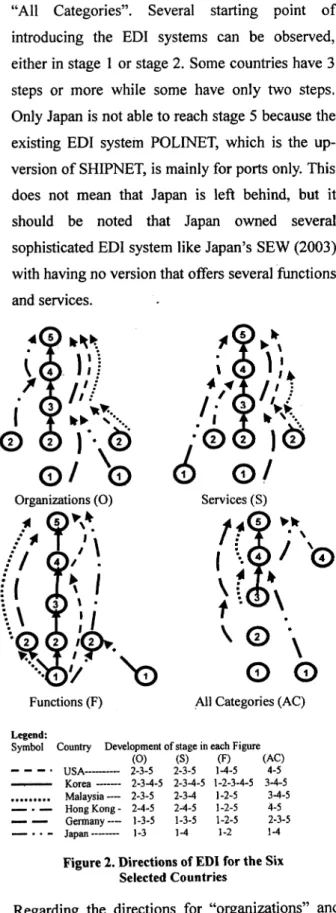
Figure 1 shows the structure of the category "organizations" as a sample and all the trees show that one sub tree of a binary tree is not divided while the other sub tree is divided into deep. Each leg is identified by the stage name. The number of a stage name is determined according to the development of seven EDI systems with versions. Generally speaking, smaller stage number means that the systems in the stage are in the beginning of the introduction. The Figure 2 shows the introduction steps of EDI System using the five clusters (five stages). Six kinds of lines show the six countries on the three categories and the whole
Table 1. EDI Systems with Version
(Abbreviation of each System in this paper is in parenthesis.)
Note: Organizations : CC-Custom Community; GC-Government Agencies; TC-Trade Community; PC-Port Community; FC-Financial Community; TRC -Transport Community; RSC-Retail and SCM Comthunity; PRC-Private Communities; Services : MBX-Mailbox Service; EPS-EDI Duty Payment; CCL-Custom Clearance; DGIS-Dangerous Goods Information Service; GDCS -Global Data Communication Service; TCCS-Truck Carrier Communication Service; Functions : MBS-e-Manifest and Billing System; IES-Import and Export Documentation System; CCT-Communication System for Cargo Transactions; ECS-E-Custom Clearance System; ETS-e-Commerce and Trade Documentation System; MPS-Maritime and Port Communication System; SEIT-System for e-Commerce and International Trade; E-TNBSP-e-Trade and National Border Security Platform; SEW-Single Electronic Windows System.
Figure 1. Cluster Diagram (Organizations)
NOTE: STAGE 5-uACE01, mDNET02, kkLNET02, kKTNET00, hTRLNK02, gDKOSY01 etc; STAGE 2-kKLNET94, kKTNET91, mDNET89, uACS84, hTRLNK88 etc; STAGE 1-gDKOSY82, gDKOSY84, jSHPNT86 etc; STAGE 3-mSMICDN95, uAES95, KT-NET94, kKLNET96, jPOLNT95, gDKOSY88 etc; STAGE 4-kKLNET97, hTRLNK99, kKLNET99 etc.
"All Categories"
. Several starting point of introducing the EDI systems can be observed, either in stage 1 or stage 2. Some countries have 3 steps or more while some have only two steps. Only Japan is not able to reach stage 5 because the existing EDI system POLINET, which is the up-version of SHIPNET, is mainly for ports only. This does not mean that Japan is left behind, but it should be noted that Japan owned several sophisticated EDI system like Japan's SEW (2003) with having no version that offers several functions and services.
Regarding the directions for "organizations" and "services"
, there are several introduction points. Japan and Germany started from the first stage while the rest started introducing EDI on the second stage. The path in "organizations" and the path in "services" are almost the same in all
countries. With respect to "functions" category, it can be seen that all the six countries started from the first stage and the beginning point of them are almost same in introducing the EDI system. Five countries managed to develop from stage 1 to stage 2 and three countries developed along the same steps to stage 5 (stage 1-2-5). As to "functions" there is no option in introducing point and developing direction.
5. Relation of EDI System
5.1 Analysis by Quantification theory type III The purpose of this chapter is to find the connection of 58 port related EDI systems and the relation between the positions of developing countries and step-up paths of EDI systems with version in six countries. Quantification theory type III has been applied to all categories, functions, organizations, services and functions. Reason for this is that Q-III is useful to view the position of each EDI System by extracted the factors scores to see if there is any trends in the introduction steps among the six countries with versions of EDI system. In this study the system with version is distinguished by the year such as DAKOSY (1982). Consequently, it becomes possible to see if there
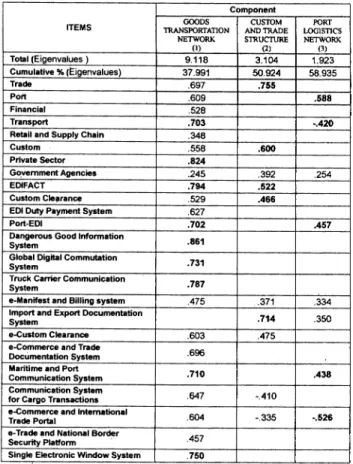
are any trends in the introduction step of the EDI by comparing the systems with version among six selected countries. First, KMO (Kaiser-Meyer-Olkin) check and the Bartlett's test of sphericity have been carried out. KMO value is greater than 0.5 and the Bartlett's value is less than 0.05 in three categories and the aggregated data of all categories. This shows that Q-III can be applied appropriately. Components which eigenvalues are greater than 1.0 are used in this analysis because the numerical value of 1.0 is generally used to decide the component to be analyzed in Q-III. Three components are extracted for "All Categories" (Table 2). The cumulative percentage
Figure 2. Directions of EDI for the Six Selected Countries
of eigenvalues is 58.9%. The first principal component is interpreted as the tendency to goods transportation network because the items which are
related to goods transportation such that "dangerous goods information service"
, "private sector", "EDIFACT" and "truck carrier and
communication system" have high values. "Government agencies" and "retail and supply chain" have low value.
The second component is interpreted as the tendency to custom and trade structure for the reason that the item of "trade organization" and "import and export documentation system" have high values and "e-commerce and international trade portal" has low value. The third component is interpreted as the port logistics network since the most of high weight items mainly related to ports, and "e-commerce and international trade portal" has low value. As to the participating "Organizations"
, three components are extracted
by Q-III The first principal component is interpreted as the scale of organization because the items with high weight are related to almost all business or transactions. The organizations with low weight are related to special ones. Next component is interpreted as the tendency to custom and transport parties because most of the items with high loading weight are related to port and trade community such as "transport", and "custom". The third component is interpreted as the trade and financial bodies. As to the "Functions" category
, two major components are extracted by the same procedure. All items on the first component have high loading weight and can also relate to different types of services. So this component is interpreted as the tendency to major jobs/functions. While items on the second component all seem to be related to services mainly offered in port and custom; therefore this component is labeled as the tendency to custom and trade duties. As to the major "Services", two components are extracted. The first component is interpreted as the wideness of services. The second component quantifies the tendency to custom and harbor services, wherein most of the items with high loading weights are mainly related to EDIFACT, custom clearance and port-EDI.
5.2 Analysis on relation of EDI systems
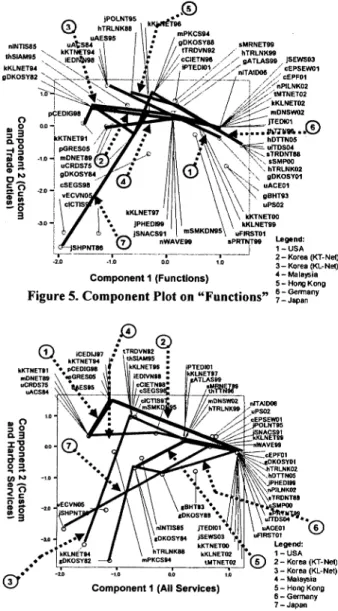
The four scatter diagrams show the Q-III results (Figure 3 - Figure 6). These two dimensional diagrams show the relative position of each EDI system from the viewpoints of four categories, "All Categories"
, "Organizations", "Functions" and "Services". In these figures, the horizontal axis is for component 1 and the vertical axis is related to component 2 of the Q-III analysis results. All the systems are identified by the first letter of a country's name which is written in a small letter and the system's name is in capital letter with the
introduced year in the last. For example, jSHPNT86 means that this is a Japanese SHIPNET EDI system introduced in 1986.These two dimensional diagrams show the relative position of each EDI system from the viewpoints of four categories, "All Categories", "Organizations", "Functions" and "Services" . An EDI system with versions is shown by circles that show different versions and a line that connects each circle by the order of the year in Figure 3 - Figure 6. While EDI systems with no version are plotted by circle only in these Figures. The introduction path of the EDI system can be seen by the direction of a line in a figure. All lines show the positive tendency as to the axis of the first component. This means that these countries manage to update their EDI system that includes a big number of organizations, offer more services and equip several functions as time elapses. All lines show the decreasing tendency in the right part of these figures. As the years passes by, the system is gradually upgraded to a more sophisticated one. So the position moved downward from the legacy system. But because the importance of legacy part is still large, position changed downward a little.
However there are some different tendencies among the four figures, especially on the second component. The four diagrams show almost the
same position pattern. All of these figures for four categories show that most of the current sophisticated systems owned by the developed countries (USA, Germany, Netherlands, Japan, Singapore, Taiwan, Hong Kong, and Korea) can be seen on the right side of the diagram. This position corresponds to stage 5 in chapter 4. While most of the EDI systems for developing countries are scattered and mainly placed at the top-left side of the diagram.
Figure 3 for "All Categories" and Figure 4 for "Organizations" show almost the same pattern
. All lines show the positive tendency as to the horizontal axis, the axis of the tendency to goods transportation network in Figure 3 and the scale of organization in Figure 4, aiming to develop a system to a more sophisticated one. In these figure there are two groups of lines can be seen. Japan and Germany heading to the directions from the bottom left towards upper right. This implies that these two countries manage to start their EDI system from the very simple one which were mainly for custom and trade structure, then manage to develop a new system with more sophisticated network. The other group including USA, Hong Kong, Korea and Malaysia, show a direction starting from top-left side going to middle-right side of these figure. This means this
Figure 3. Component Plot on "All Categories"
group managed to start at a certain level and there is no large difference between the old one and the current system as to the vertical axis, the axis of the tendency to custom and trade structure in Figure 3 and the tendency to custom and transport parties in Figure 4.
The system ECVN (vECVN05 in Figures) of Vietnam is located near the starting point of line of the former group. So the past development of the EDI system in Japan and Germany is possible to be a model for Vietnam. Almost of the other systems with no version are on or near the line of the second group. So the past direction of the group is possible to be a model.
In Figure 5, the trend line of Japan is different
from the other countries among the six countries. This means Japan started from a very simple system from the viewpoint of "functions". In other words, Japan was once largely behind the other developed countries in the system "functions". The system ECVN05 of Vietnam is located near the past position of Japanese port related EDI system SHIPNET (jSHIPNT86 in Figures). So Vietnam has to catch up to other countries on the tendency to custom and trade duties (the axis of second component). Looking at Figure 6, the trends of the line show that many development patterns. With respect to "services", there could be a variety of developing steps. Generally speaking, there are two routes to develop the EDI systems in port. Looking at three categories separately, the category "organizations" has the same tendency as the general one. Regarding to "functions" there is no choice of route as pointed out in chapter 4. As to "services" there could be some options to develop the systems, though this study has pointed out that the developing steps of two categories "functions" and "services" are almost the same in chapter 4. In order to decide the desirable and possible steps for a developing country to follow in setting up a new EDI system, of course the consideration of the ability of the developing countries have to be carried out with respect to the economic and social aspect and inter-country trade relations. But the positions of developing counties in Figure 3 - 6 may be able to be considered that show the current general positions. This indicates that these introductions steps of the six countries shown in lines that are the past "trial-and-error" results by developed countries in the mentioned figures could be models to be followed by the developing countries such as Philippines, Thailand, Vietnam, Indonesia and other countries that are planning to develop a new EDI system. The model shows what type of EDI system is feasible in general,
Figure 5. Component Plot on "Functions"
what "Organizations" should be included, what "Functions" should be had and whet "Services" should be served.
6. Conclusion
The study collected 58 port related EDI systems in 14 countries. The characteristics of these systems are extracted by three categories, such as "organizations"
, "functions" and "services". These systems are distinguished by the year it was introduced. The developing steps and the directions are examined by analyzing the seven EDI systems which have several versions. The results of this study are summarized as follows. (1) The tendencies of position patterns of 58 EDI
systems by quantification theory type III are almost the same in three categories and "all categories" that includes all items data in those three categories. These patterns are such that most of the current sophisticated systems owned by the developed countries (USA, Germany, Netherlands, Japan, Singapore, Taiwan, Hong Kong, and Korea) gather together. While the EDI systems for developing countries are scattered widely. (2) Developing steps can be expressed in five
stages for three categories and "all categories" by the cluster analysis. Stage 5 corresponds to the position where the current EDI systems in developed countries gather in result (1). Regarding the directions for "organizations" and "services", there are several introduction points. The developing step of each path in "organizations" and the path in "services" are almost the same in a country, although there is no option in the path as to "functions".
(3) Looking at three categories separately, the category "organizations" has two routes to develop the EDI systems in port. Regarding to "functions" there is no choice of route. As to
"services" there could be some options to
develop the systems.
The introductions directions of six countries shown in lines in figure 3-6 could be models for the developing countries. These countries can easily find the position of their EDI system and the directions to follow.
References
(1) Chau, P.: Inhibitors to EDI Adoption in Small Business: An Empirical Investigation. University of Hongkong, pp.78-88, 2000
(2) Clarke, R.: "A Contingency Model of EDI's Impact on Industry Sectors." J. Strategic Information Systems, pp.1-18, 1992
(3) Damsgard, J.: "The Danish EDI Bandwagon Gaining Momentum." Proceedings of the Thirteenth Annual Hawaii International Conference on System Sciences, Volume 4, pp.31-34, 1997
(4) Ojala,L.and Suomi,R.: "EDI: An advantage or disadvantage for remotely-situated countries." International Journal of Physical Distribution
& Logistics Management, Volume 22 No.8, p. 35-42, 1992.
(5) Premkumar G., K. Ramamurthy. "Determinants and Outcomes of Electronic Data Interchange Diffusion" IEEE Transactions on Engineering Management, Volume 42, No.4, (1995) , pp.332-351, 1995
(6) Saunders C. S. and S. Clark : "EDI Adoption and Implementation: A Focus on Inter-Organizational Linkages," Information Resources Management Journal, Vol. 5, No. 1, pp. 9-19, 1992
(7) Transteknik: Electronic Intra-Port Community Discussion Groups Pilot Project. APEC Transportation Working Group. Project TPT 01/2003T, pp.10-16, 2003.
(8) Premkumar G., K. Ramamurthy, and M. R. Crum, "Determinants of EDI Adoption in the Transportation Industry," European Journal of Information Systems, Volume 6, No.2, p.107-121, 1997.
(9) Sin, C.Y., "Single Window Development and Implementation. Experience of Singapore. Presentation at the UNESCAP-UNECE Capacity Building Workshop, p.1-16, 2005.