The Prospect on the Technology
Development/Transfer Promotion in Some APEC
(Asia Pacific Economic Cooperation) Economies
著者(英)
Tomohiro Uchida
journal or
publication title
Journal of Inquiry and Research
volume
73
page range
145-160
year
2001-02
MN,4Q ACT W * M73-- (2001* 2 9 ) Journal of Inquiry and Research, No.73 (Feb. 2001)
The Prospect on the Technology Development/Transfer Promotion
in Some APEC (Asia Pacific Economic Cooperation) Economies
Tomohiro Uchida
1. Introduction
Many studies show that technology is an important element in the process of the economic development. Technological progress is regarded as one of the most important factors which determines the economic growth rate of each country. Economic growth can be attributed to the increased inputs and increased productivity which stem from the use of efficient technology. Technology's contribution to economic growth has been broadly argued since the empirical study by Solow on the growth of per capita income in the United States to technological progress.' Kutznetz concluded that an increase in efficiency in the productive resources through the improved quality of resources, effects of changing arrangements, and technological change could explain about 90% of growth.2 Dougherty and Jorgenson argued that technology is a device for accomplishing high productivity and strong competitiveness in the market, and is closely related to economic development.' Krugman argued that the deadlock in economic growth in Asia in the 1990s has been caused by the production style which depends excessively upon factor endowments such as capital and labor.' His study indicates that the comparative advantage of factor endowments cannot ensure a competitive edge any more. Therefore, it can be understood that technology is the engine of economic development.
The purpose of this paper is to identify what economic and technical cooperation in APEC can do to promote technology development/transfer. It is organized as follows. Section 2 will review the background of technology development needs in the APEC region. Section 3 will summarize general concepts of technology, introduce a model for technology develop-ment, and then clarify the role of each institution promoting technological development.
145-tion 4 will evaluate the present situa145-tion of technology infrastructure among some selected APEC members (Korea, Malaysia, Thailand, Indonesia, and the Philippines), in relation to
their science/technology policies. Lastly, section 5 will suggest policy recommendations for supporting technology development/transfer.
2. Background on Technology Development Needs in APEC Economies
The 1994 Bogor Declaration expressed three policies. These are trade and investment liberalization among APEC economies, facilitation of the economic exchange among APEC members, and promotion of economic and technical cooperation. The goals for economic and technical cooperation are to accomplish sustainable growth and equitable development in the Asia Pacific region, to alleviate economic disparities among APEC economies, to bring better economic and social well-being, and to construct an Asia Pacific community. The goals com-plement the purpose of achieving free trade and investment in the APEC economies. The Action Agenda, proposed in the 1995 Osaka Summit, provided a framework for a range of
eco-nomic and technical cooperation activities.
The 1996 Manila Summit advanced work on economic and technical cooperation extensive-ly. In addition to a Joint Statement, the Eighth Ministerial Meeting made the Declaration of a Framework of Principles for Economic Cooperation and Development.5 The declaration in-cluded the following points: economic and technical cooperation in APEC must be result- orient-ed, cooperation should be implemented through the combination of government actions with private activities, and cooperation must create shared benefits among APEC economies, and be based on voluntary contributions and complementary capabilities of the economies. These
four points indicate that economic and technical cooperation in APEC could be made efficient through both joint public and private action.
APEC members have a wide differential in their technological capacities. For the purpose of filling the differential, the importance of technology development was strongly emphasized under a Framework of Principles for Economic Cooperation and Development. The APEC Eminent Person Group also commented that the flow of a new high technology stimulates eco-nomic development, intensifies scientific and technological capabilities, stimulates trade and investment liberalization, and alleviates disparities among APEC economies.6
APEC's work on technology development has been constructed as follows: the Industrial Science and Technology Working Group (IST-WG) creates policy dialogue regarding science and technology and encourages diffusion of technology within its members. In collaboration
146-The Prospect on the Technology Development/Transfer Promotion in Some APEC (Asia Pacific Economic Cooperation) Economies
with Human Resource Development Working Group (HRD-WG), IST-WG develops technolog-ical capacities of the members in order to both utilize and innovate new technology. In turn, IST-WG contributes supportive human resource development work in science education and researcher exchanges. The Committee on Trade and Investment (CTI) promotes enforce-ment and transparency of intellectual property rights for the purpose of stepping up technology transfer to the APEC economies. Thus, it can be said that the issue of technological develop-ment/transfer is cross-cutting in the sense that the issue includes various points.
The forum related to science and technology has had eleven meetings (as of February 1997) and the first one was held in Japan in November 1990. Up to the fourth meeting, the fo-rum was called Investment and Technology Transfer, but at the fifth meeting, the name of the forum changed to Investment and Industrial Science and Technology. The name changed again at the sixth meeting in China to its present name- Industrial Science and Technology. As can be seen from the origins of the forum, IST-WG aims at achieving sustainable development within the APEC economies and focuses on industrial technology closely related to economic
development, and does not focus solely on science and technology.
There was an action program for Industrial Science and Technology proposed in the 1995 Osaka Summit, which was annexed in the Osaka Action Agenda. The vision was the cre-ation of an Asia-Pacific region built on the development and appliccre-ation of industrial science and technology which improved quality of life while safeguarding the natural environment. Eight goals were presented in the action program. What needs to be paid attention to is the follow-ing goal: the policy should achieve enhanced links between government agencies, the private/ business sector including Small and Medium Scale Enterprises (SMEs) and academic institu-tions engaged in collaborative industrial science and technological research and development. The goal puts emphasis on mutual cooperation not only beyond national borders, but also among local sectors. The reason for the goal especially noted in SMEs is that technological change and innovation under trade and investment liberalization policy does not necessarily give uniform benefits to all groups in society. Priority was given to the following three activi-ties: 1) to improve the flow of technological information and technology, 2) to improve research exchanges and HRD, 3) to facilitate joint research projects in industrial science and technology. These activities are included in the projects executed under APEC's economic and technical cooperation.
147-3. General Concepts of Technology and a Model for Technology Development/Transfer
3.1. Definition of Technology and Its Transfer
Being simply defined, technology is knowledge. It is, more elaborately defined as any tool
or technique, product or process, physical equipment or method of doing or making, by which
human capability is extended.? The term used in industrial and business activity includes
process, management, marketing, and production know-how. It is dynamic, continual,
se-quential, and complex.
The term "technology transfer" is more difficult to define. It is subject to different
inter-pretations. The United Nations defines it as follows: technology transfer means the
acquisi-tions of existing technologies and related inputs to produce specific goods and services. In a
more development-oriented meaning, it indicates that the recipients of technology will result in
absorbing the technological assets from providers.8 Interpretation of technology transfer will
also vary in the technological capability stage of the recipients. A study by Baranson
catego-rized the stages into three sections. They are as follows: the first is the operative capability
stage in which firms can operate and maintain the transferred technology components, the
se-cond is the duplicative capability stage in which firms can duplicate the transferred technology
components, building of prototypes, and facilities for testing, and the third is the innovative
stage by which firms can develop products and processes.9 Asian Development Bank argued
that technology transfer can be accomplished through technology acquisition, and technology
development can be achieved through technology self-generation."
3.2. A Model for Technology Development/Transfer
There are different modes by which technological assets are transferred. These modes of technology transfer can be broadly categorized as follows: direct foreign investment, joint ven-tures, licensing agreements, turnkey contracts, consultant services, and technical assistance with foreign aid. The successful modes of technology transfer are different according to a
country's technological need, capability, and market conditions. Each mode is not exclusive, so has its own trait and peculiar impact on technology transfer.
In terms of the embodiment forms, technology can be classified into the following four com-ponents: physical facilities like tools, equipment, machinery, and structures. Documented facts like design parameters, specifications, blueprints, maintenance and service manuals pro-mote rapid learning. Human abilities such as skills, knowledge, expertise, and creativity can
The Prospect on the Technology Development/Transfer Promotion in Some APEC (Asia Pacific Economic Cooperation) Economies
avail themselves to natural and technological resources. Organizational frameworks such as methods, techniques, linkages, and practices harmonize the productive firms." More broadly speaking, technology can be categorized into two elements; hardware such as factories, equip-ment, and infrastructures and software such as education, experience, and organizational struc-tures.
Figure 1 shows a framework for technology development/transfer. As stated above, tech-nology capability consisting of techtech-nology development/transfer embodies four technological components. Factor endowments of production such as labor and capital and the technological components interact vigorously through an enterprise, and result in producing outputs of products. The technology climate including elements such as customers, society, suppliers, rivals, and regulators is an exogenous variable which determines technology development/ transfer.
Figure 1: Framework for Technology Transfer and Development
Technology Climate (Customers & Society, Rivals, Suppliers, Regulators)
Inputs (LI ID Productive Enterprise Technology Components Outputs Technology Development & Transfer Technology Capability Technology Infrastructure
(Source) : Asian Development Bank. op. cit., p.24.
Elements of the technology infrastructure are shown in Figure 2. The technology infras-tructure is composed of three elements: the technology coaches, technology helmsmen, and the innovation triangle. The first elements are the institutions dealing with not only investment promotion and venture capital, but also the quality of testing assurance, standardization, and in-tellectual property rights. As a catalyst, they contribute to the intensification of
149-centered economic development. The second elements are those that provide technology
in-formation services and advisory services. They play supportive roles in technology-centered
economic development. The third element is the innovation triangle which links educational
organizations, academic institutions, including research and development, and firms producing
goods and services.
Each institution that belongs to the three elements implements a chain of activities
essen-tial for technology-centered economic growth. The chain is of three types: a product-process
development chain which searches, designs, generates, and modifies; a knowledge-skill
de-velopment chain which exposes, trains, educates, and upgrades; and an organizational
system-package development chain which conceives, formulates, prepares, and evolves. The level of
the technology infrastructure is dependent upon each individual chain's level of development.
It is also greatly affected by each country's technology climate.
Figure 2: Elements of the Technology Infrastructures
i---~_ Innovation Triangle
Investment Promotion &
Venture Capital
Engineering
& Research
Standardization & Quality
Certification Institutions C 0
N
m Research & Development Units Education & Training Units C)N'
d c b aq mPD N
Technology Transfer &
Consultant Services d c m 0 0 m a sn
Science & Technology
Information Services
(Source) : Asian Development Bank. op. cit., p.26.
As shown in these figures, technology development/transfer is mainly initiated by the pri-vate sector, and not the government sector. However, government policy plays an important role in creating a favorable environment through various kinds of policy related to technology
150-The Prospect on the Technology Development/Transfer Promotion in Some APEC (Asia Pacific Economic Cooperation) Economies
development/transfer. A country's government can assist the private sector by preparing an environment for technology-based development. In terms of the supply side policies, it can contribute to areas such as research and development, human resources development, stan-dardization, and intellectual property rights. Each chain at the firm level does not automatical-ly develop. The government's work in these areas promotes each level of development, which leads to technology-centered economic growth.
4. Evaluation of Technology Policy Framework in Some Selected Countries
4.1. Country-Specific Science and Technology Policy
It goes without saying that firms operate within a framework of technology in each country. The framework forms a country's vision for technology-based development. It indicates which sectors should be prioritized in the country and greatly affects the levels of acquisition, transfer, and adaptation of technology by promoting or impeding the free flow of information and technology. Table 1 summarizes some countries' major problems relating to science and technology (S&T) policies and their guidelines for technology development.
Table 1: Major Science and Technology Issues Facing Five Selected Countries and Their Guidelines for Development
(Indonesia)
Major Problems Related to S&T:
1. Government R&D institutes with less orientation and suitable programs 2. Less linkages between R&D institutes and financial institutes
3. Many private firms' failure in investment in engineering education 4. Shortage of government's investment in science and engineering education Major Guidelines for Development:
1. To suit the S&T policies with regards to other policies such as finance, industry, labor and law, and education policies
2. To develop natural resource-intensive industries with a rising technological level, labor-intensive industries which become skill-intensive, and technology-intensive industries in the long run 3. To combine the influence of government, small, medium, and large industries in terms of S&T 4. To improve information and S&T network
(Korea)
Major Problems Related to S&T:
1. Failure in fair and open competition in the allocation of the S&T funds
2. Fewer opportunities for acquiring technology transfer through the channel of direct foreign ment due to wage hikes in the country
Major Guidelines for Development:
1. To enhance the national R&D projects in order to develop crucial technologies
151-2. To step up basic sciences, put emphasis on seeking and educating creative scientists, and attain a high level of technological manpower
3. To continuously provide an incentive system in a way which the private sector can promote ogy innovation
4. To improve the technological environment of SMEs (Malaysia)
Major Problems Related to S&T:
1. Excessive dependence on foreign technology 2. Shortage of investment in skilled manpower
3. Myopic technology policy conducive to a large amount of investment and rapid industrialization Major Guidelines for Development:
1. To initiate commercially viable research programs
2. To establish a competitive bidding process for R&D projects 3. To promote the R&D projects related to industrial development
(Philippines)
Major Problems Related to S&T:
1. Low level of contribution in the S&T industrial sector 2. Excessive dependence on imported technology
3. Failure to initiate an appropriate policy environment for stepping up S&T development in all sectors 4. Inadequacy for long-term planning and the misidentification of crucial strategic technology Major Guidelines for Development:
1. To modernize the production sector through huge technology transfer from local and foreign sources and through enhanced linkage with industry and academic institutions
2. To improve R&D capabilities through positive roles of private sectors
3. To develop S&T infrastructure including development of S&T culture, institution building, and manpower development
(Thailand)
Major Problems Related to S&T:
1. Shortage of manpower in S&T in terms of quantity and quality 2. Limited application of technology to raise productivity
3. Limited capability in technology acquisition/transfer Major Guidelines for Development:
1. To enhance public technology institutions by supplying them with modern equipment and qualified
personnel
2. To arrange an environment favorable to S&T application through the tariff reduction of imported
technology
3. To increase opportunities for acquiring imported technology through the promotion of foreign
vestment and the establishment of a technology information center
4. To strengthen the technological capabilities of SMEs by supplying financial support
5. To encourage intensified cooperation between educational organizations and industrial firms and to
promote more practical training fitting with the industrial sector
6. To promote the roles of private sector in R&D
(Source) : APEC Investment and Industrial Science and Technology Working Group. APEC Science and Technology Profile Fourth Issue 1995, Science and Technology Task Force Pacific Economic Cooperation Council, 1995, pp.38-61 and Asian Development Bank. op. cit., pp.180-184.
152-The Prospect on the Technology Development/Transfer Promotion in Some APEC (Asia Pacific Economic Cooperation) Economies
The technology development policy varies according to the level of science and technology in each country. In terms of technological capabilities and technological infrastructure, there are some gaps between Korea and other the countries. However, all of the selected counties have common policy guidelines for intensifying and diversifying the S&T base. The guide-lines are summarized as follows: to provide a clear and prepared plan for S&T development, to put emphasis on the education and training of skilled labor forces, to strengthen the networks among the actors involved in technology development/transfer, to develop the technical and financial institutions dealing with new technology, and to make available the private sector in promoting R&D capabilities.
4.2. Some Selected Countries' Environment for Promoting Technology/Transfer
Whether a country can upgrade the acquisition of technological capability or not, depends upon its technology climate including the technology policies of the country. Technology cli-mate has been assessed by various criteria. Here, let me evaluate the technology climate of the selected countries." The criteria are composed of the followings: 1) human resource de-velopment (HRD) for observing technological capability of a country which is represented by the enrollment rate in basic education, the number of skilled labor forces and the indicators related to R&D, 2) trade liberalization policy related to the imports of capital goods which priori-tizes areas of technology development/transfer, 3)investment liberalization policy which is a significant determinant of the technological assets transferred through foreign direct invest-ment, and 4) appropriateness of the adopted technology.
Table 2: Education Trends in the Selected APEC Economies in 1990
Indonesia Korea Malaysia Philippines Thailand Japan US
Primary (%) 117 108 93 111 85 101 105
Secondary (%) 45 87 56 73 32 96 92
Tertiary (%) n.a. 39 7 27 16 31 75
Educational
Attainment" 1.88 2.65 1.92 2.37 2.16 2.87 3.00
(Source) : World Bank. World Development Report 1993, pp.294-295 and UNDP. Human Development Report 1993, pp.135-136.
153-Table 3: Indicators of Human Capital Formation in the Selected APEC Economies
Scientists & Technicians
per 1000 Population Degree
Bachelor's & Master's
s in the Natural Science & Engineering
Doctoral Degrees in
the Natural Science & Engineering
(Year) 1985-1989 1990 1994 1990 1994
Indonesia 10 92,432 134,213(a) 1,107 3,811
Korea 47 68,764 78,482 (b) 1,055 1,489 (b)
Malaysia n.a. n.a. n.a. n.a. n.a.
Philippines n.a. 162,236 n.a. 513 n.a.
Thailand 1 n.a. n.a. n.a. n.a.
Japan 110 149,227 169,973 9,957 10,851
US 55 240,320 253,265 16,256 18,251
(Source) : APEC Investment and industrial Science and Technology Working Group. op. cit., p.14 and UNDP. op. cit., p.194.
(Note) : (a) : 1992 (b) : 1993
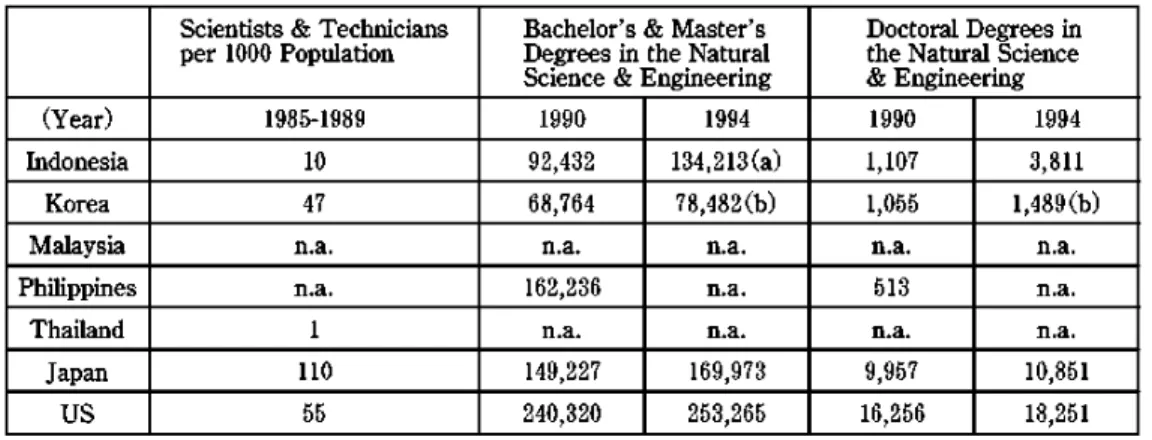
HRD is essential for the effective use of physical facilities in a transformation operation and acquisition. HRD related to the technology development/transfer refers to primary, seconda-ry and tertiaseconda-ry education, the scientific profession, and R&D issues. It can be promoted not only by the public sector but also by the private sector. The importance of HRD should be seen in terms of both quantity and quality. Table 2 shows the trend of basic education in the selected APEC economies. On the other hand, Table 3 shows the human capital formation in-dicators which focus upon the scientific professions. Education can be one of the most im-portant means necessary to raise labor productivity and to acquire skills to keep up with techni-cal change.
As can be seen in Table 2, all of the economies had a high school enrollment rate in terms of primary level. However, in terms of secondary and tertiary levels, there were wide differen-tials seen between the developed economies such as Japan and the developing economies such as Thailand and Indonesia. Educational attainment, which is correlated with the economic de-velopment stage, also varied in each economy. What is worthy of attention is that the number of scientists and technicians per 1000 persons over the 1985-1989 period was the highest in Japan (110), followed by the US (55) and Korea (47). It is interesting to note that the
Philip-pines (162,236) was in a higher position than Japan (149,227) in 1990 as far as the number of people with bachelor's and master's degrees in natural science and engineering were con-cerned. Indonesia (92,432) had a large number in the indicator, taking into account that the country was standing at the low number in terms of the basic education trend. In 1990, the US (16,256) had the highest number of doctoral degrees in natural science and engineering,
1,54-The Prospect on the Technology Development/Transfer Promotion in Some APEC (Asia Pacific Economic Cooperation) Economies
lowed by Japan (9,957). The Philippines (513) and Indonesia (1,107) had about one twentieth and one tenth respectively when compared with Japan in terms of the indicator. This means that the developing economies such as the Philippines and Indonesia still have fewer engineers with high skills necessary for technology designing and self-generation, when compared to the
developed countries such as Japan and the US.
Teitel presented a strong correlation between R&D expenditure and technology capability in his empirical study." The establishment of the R&D section is the final stage of technology development/transfer. Table 4 shows that Japan (2.92) had the highest ratio of domestic R&D expenditure to GDP, followed by the US (2.67) and Korea (2.33). The developing economies such as Malaysia (0.37), Indonesia (0.26), and the Philippines (0.21) had low num-bers in the indicator, so there were large gaps among the selected economies. The indictor of
the percentage of R&D by sector shows us some relevant points. In the developed economies such as Japan (78.3), the US (59.0), and Korea (76.2), business enterprises occupied the highest shares in the R&D funds. On the other hand, government recorded the highest percen-tage in the developing economies such as Indonesia, Thailand, Malaysia, and the Philippines. It can be said that in the developed countries, private sectors have the initiatives in technology development while in the developing countries governmental sector occupies a significant presence in technology development. This might be reflected in the companies' views in the developed economies that R&D must be established in the factory where resource accumulation such as effective operations, tough maintenance abilities, and modification capabilities exists.
Table 4: Percentage of R&D Expenditure in Selected APEC Economies
Percentage of R & D by Sector of Funds
xpe Ratio of Gross Domestic E nditure on R&D to GDP Busines Enterprises s Higher Education
0vernmentG Private
Non-profit Sector
(Year) 1990 1994 1990 1994 1990 1994 1990 1994 1990 1994
Indonesia 0.12 0.26 n.a. 14.0 n.a. 6.0 n.a. 80.0 n.a. n.a.
Korea 1.88 2.33 n.a. 76.2 n.a. 3.1 n.a. 16.3 n.a. 4.4
Malaysia n.a. 0.37 n.a. 43.0 n.a. n.a. n.a. 53.1 n.a. n.a.
Philippines 0.15 0.21 33.1 23.4 10.3 9.1 42.9 37.2 3.0 1.5
Thailand n.a. n.a. 6.9 5.2 25.2 12.0 53.0 70.0 14.8 12.5
Japan 3.02 2.92 82.0 78.3 n.a. n.a. 17.9 21.6 n.a. n.a.
US 2.73 2.67 54.9 59.0 2.9 3.0 40.7 36.3 1.6 1.7
(Source) : APEC Investment and Industrial Science and Technology Working Group. op. cit., p.9 and p.12. -
There are several modes of technology development/transfer. To import capital goods is one of the most important sources of technology acquisition. In a sense, a country's trade liberalization concerning capital goods is likely to prepare the environment for facilitating tech-nology transfer. Table 5 shows the tariffs and non-tariff barriers (NTBs) of machinery goods in selected economies. In 1993, developed economies such as Japan (0.22) and the US (3.44) had low numbers in the average tariff rates of machinery goods. On the other hand, in 1993, developing economies such as Thailand (32.64) and the Philippines (22.05) had high points in terms of numbers. The Philippines had the highest numbers (83.46) of NTBs represented by the import quota.
Table 5: Profiles of Tariffs and Non-Tariff Barriers of Manufacture of Machinery in Selected APEC Economies (Unit: Percent)
Indonesia Korea Malaysia Philippines Thailand Japan Us
Non-Tariff
Barriers" 1.97 0.00 2.62 83.46 3.02 0.00 14.81
Average
Tariffs (1993) 12.10 10.77 6.91 22.05 32.64 0.22 3.44
Average
Tariffs (1995) 10.19 n.a. n.a. 12.75 32.75 n.a. n.a.
(Source) : The Pacific Economic Cooperation Council for APEC. Survey of Impediments to Trade and Invest-ment in the APEC Region, 1995, pp.229-235.
(Note) : 1) The selected ISIC divisions are 3821, 3822, 3823, 3824, 3825, and 3829.
2) Data for 1990 for Indonesia and Philippines, 1991 for Malaysia and Thailand, and 1992 for Korea are available.
The revealed comparative advantage (RCA) is one of indicators for identifying the ap-propriateness of industrial technology. RCA index gauges the extent of competitiveness of an economy's industrial sector in the context of international trade. If an economy has a RCA in-dex of more than 1 for a particular industrial sector, it means that the economy has a compara-tive advantage in export in the industrial sector. Similarly, if the economy has a RCA index of less than 1 for a particular industrial sector, it means that the economy's export performance in the industrial sector is comparatively inferior to other industrial sectors. The fundamental as-sumption of the RCA index is that if a economy fails in introducing appropriate technology by which it can produce a better and cheaper product, it can not be competitive in the international
market.
The index can be measured using the following formula: -
156-The Prospect on the Technology Development/Transfer Promotion in Some APEC (Asia Pacific Economic Cooperation) Economies
RCA= (Xpq / Xq) / (Wp / W)
Xpq is exports of commodity p from country q to the world, Xq is country q's total exports, Wp is the world trade of commodity p, and W is the world trade volume.
Table 6 shows the RCA in categories of industrial goods in the selected economies. I cal-culated the RCA for two periods of 1985 and 1995 in order to see the change of comparative ad-vantage among these economies. It can be said that Indonesia, Korea, the Philippines, and Thailand have a high comparative advantage in labor intensive goods. However, Korea and Thailand have gradually advanced their comparative advantage from labor intensive commodi-ties to technology intensive commodities such as machines and transportation equipment while other two countries still have strong competitiveness only in labor intensive commodities. It is interesting to note that Malaysia, which is categorized as middle-income countries like Indone-sia and the Philippines, has shifted the competitive structure towards technology intensive com-modities. This implies that a country with only about twenty million people can have com-petitiveness in technology intensive commodities rather than labor intensive commodities. The US and Japan have similar advantage structures in industrial commodities with strong competitiveness in technology intensive commodities and weak competitiveness in labor inten-sive commodities.
However, analysis is based upon a static advantage which neglects the developing econo-mies' transformation of industrial structures toward the industries of higher technology and val-ue-added products. The transformation of pursing a dynamic comparative advantage is
neces-sary to achieve long-term development. Therefore, an economy's persistence in the adoption of technology, based on static comparative advantage, might bring about a negative impact on the possibility of economic development.
Table 6: RCA by the Categories of Industrial Goods in the Selected Economies
Year Indonesia Korea Malaysia Philippines Thailand Japan Us
1985 0.584 4.328 0.616 1.223 2.602 0.603 0.281 Labor Intensive 1995 2.111 2.143 0.723 1.159 1.930 0.251 0.374 1985 0.099 0.966 0.111 0.310 0.174 0.991 0.870 Capital Intensive 1995 0.298 0.893 0.282 0.157 0.347 0.799 0.857 1985 0.017 1.209 0.602 0.220 0.288 2.180 1.480 Technology Intensive 1995 0.220 1.370 1.439 0.579 0.878 1.831 1.259
(Source) : Author's calculation by the data from International Trade Statistics Yearbook 1988 and 1997, United Nations.
(Note) : See footnotes for commodity categorization.16 -
1,57-5. Conclusion
In order to promote technology development/transfer and to identify the role of APEC's economic and technical cooperation, this paper has surveyed some selected APEC economies' technology climate. The summary of findings is as follows:
1) An economy's technology development/transfer has to be stepped up by various sectors such as the government, private local and international firms, non-governmental organizations, academic institutions, and international organizations. What is essential is mutual dence and coordination among the sectors. The specific measures are to fulfill the grams for developing well-trained and well-educated human resources, especially scientists, engineers, managers, and skillful labors indispensable to the development and absorption of new technology, and to make legal arrangements. It is confirmed that developing countries among APEC members should make their own efforts or enjoy the economic cooperation from the developed countries in order to promote human resource development on their own. 2) The technology or technological level is one of key factors to determine a firm's productivity which in turn, would be a major determinant of the competitiveness and profitability of the
product. The technological change and innovation are closely related to the important changes in output and productivity. The technological progress is also greatly influenced by the environment of both the international market and the domestic market, such as tariff and non-tariff factors and the investment policy on the side of the host country. The trade and investment liberalization policy can be one of the important factors for expanding the production frontier of individual host countries and in turn a policy which boosts the
ic development.
3) RCA, which is based on static analysis, is one of the important measures for seeing the propriateness of industrial technology. Korea, Thailand, and Malaysia have gradually ed their comparative advantage from labor intensive commodities to technology intensive commodities. Each country should introduce appropriate technology and develop the thrusting industries in the way that it could efficiently allocate factors of production of its own. However, it is very difficult to judge the appropriateness of the technology adopted within an economy, taking into consideration that many economies wish to transform the economy into a dynamic comparative advantage necessary to achieve long-term ment.
There is an increasing need to promote mutual technology development/transfer in the -
158-The Prospect on the Technology Development/Transfer Promotion in Some APEC (Asia Pacific Economic Cooperation) Economies
APEC region. The continuous interdependence among APEC economies is essential to sus-tain and further accelerate the process of economic development. The economic cooperation under APEC is such that every member contributes in accordance with each APEC members' capabilities and resources, and where priorities are jointly determined, and where there are e-qual partners.
Notes
1) Solow, P.M. "Technical Change and the Aggregate Production Function," Review of Economics and Statistics, 1957, vol.39, pp.312-320.
2) Kutznets, S. Modern Economic Growth: Rate, Structure, and Spread, Yale University Press, 1966, 81.
3) A study by Dougherty and Jorgenson showed that consideration should be taken in the improvements of quality of capital, that is, embodied technology. The study indicates that the contribution of nology to growth is hard to measure, particularly separating from that of factor endowments such as
capital and labor. (Dougherty, C and Jorgenson, D. W. "International Comparison of the Sources of Economic Growth," American Economic Review, May 1996, pp.25-29.)
4) Kruguman, P. "The Myth of Asian Miracle," Foreign Affairs, November & December, 1994, pp.76-78. 5) The declaration put an emphasis on six themes: developing human capital, fostering safe and efficient
capital markets, strengthening economic infrastructures, harnessing technologies for the future, promoting environmentally sustainable growth, and encouraging the promotion of small and medium enterprises. These themes are connected with the basic concepts to increase job opportunities, growth, and sustainable and equitable development.
6) Eminent Persons Group. Implementing the APEC Vision, APEC Secretariat, 1995, p.43.
7) Goldring, L. The Management of Science and Technology, Lecture Series at New York University, Graduate school of Business Administration, 1976, pp.26-28.
8) United Nations Conference on Trade and Development. The Report on Transfer and Development of Technology in Developing Countries: a Compendium of Policy Issues, United Nations, 1990, p.48.
9) Baranson, J. Technology end the Multinationals, Lexington Books, 1978, pp.38-40.
10) Asian Development Bank, Technology Transfer and Development.- Implications for Developing Asia, an Development Bank Publication, 1995, p.21.
11) Ibid., pp.23-24.
12) As the paper surveying industrial technological capabilities among Asian developing countries, see Kakazu, H. Industrial Technology Capabilities and Policies in Selected Asian Developing Countries, Asian
Development Bank Economic Staff Paper No.46, June 1990.
13) Education Attainment is defined as knowledge measured by adult literacy and mean years of schooling for individuals over 25 years of age (weighted two-thirds and one-third respectively). One main cism of using these indicators is that literacy is difficult to measure because it takes different amounts of effort to achieve in different languages. The difficulty of achieving literacy in different cultures would matter when a universal definition was applied. However, a better definition of literacy, which would be measured by the qualitative variables, not by simple quantitative variables, has yet to be
found.
14) Teitel, S. "Science and Technology Indictors, Country Size and Economic Development: An tional Comparison," World Development, vol.15, September, 1987, pp.1225-1235.
15) Non-tariff barriers (NTBs) are mainly composed of two types of measures, price control measures and quantitative measures. The former takes the forms of the voluntary export price constraints, the
able charges which bring the market prices of the exporting products close to those of corresponding domestic products, and the anti-dumping actions from the importing countries while the latter refers to
the non-automatic licensing and export restraints. The formulas for measuring NTBs are discussed in detail by Deardorff and Stern. (Deardorff, V. A. and Stern, M. R. Measurement of Non-tariff Barriers, The University of Michigan Press 1998, pp.105-122.)
16) The commodity classification table is as follows:
Sector Commodities Corresponding SITC Code
Textile Yarn and Fabrics 65
Labor Intensive
Clothing 84
Chemicals 5
Capital Intensive Iron and Steel 67
Other Manufactured Metal Products 691-695, 699, 812
Technology Intensive Machinery and Transport Equipment 7