During a Structured Psychotherapeutic
Interview
著者
Kenji Yokotani, Gen Takagi, Kobun Wakashima
journal or
publication title
Journal of nonverbal behavior
volume
44
page range
85-116
year
2019-10-24
URL
http://hdl.handle.net/10097/00130910
Article in Journal of Nonverbal Behavior · October 2019 DOI: 10.1007/s10919-019-00319-w CITATION 1 READS 31 3 authors, including:
Some of the authors of this publication are also working on these related projects:
implicit dyadic copingView project
The effects of "Miracle Question" and "Exception Question"View project Kenji Yokotani
The University of Tokushima 30PUBLICATIONS 52CITATIONS
SEE PROFILE
Takagi Gen
Tohoku Fukushi University 10PUBLICATIONS 10CITATIONS
Abstract 1
Nonverbal synchrony (NVS) of a patient’s and therapist’s body parts during a therapy 2
session has been linked with therapeutic alliance. However, the link between NVS of 3
face parts with therapeutic alliance remains unclear. The clarification of this link is 4
important in understanding NVS. Accordingly, we used a video imaging technique to 5
provide quantitative evidence of this link. The 55 participants in this study were the 6
same as in a previous study. Both the participants' and the therapist's faces were video 7
recorded during structured psychotherapeutic interviews. Our machine quantified 8
500,500 participants’ faces and 500,500 therapists’ faces from the perspectives of facial 9
movements and expressions. Results show that absolute synchrony of happy and scared 10
expressions were positively related to therapeutic alliance. However, symmetrical 11
synchrony of left eye movements negatively predicted therapeutic alliance, although 12
participants’ sex, age, volume of facial movements, and volume of facial expressions 13
were controlled. Absolute synchrony of facial expressions was regarded as emotional 14
interaction within 2 seconds delay, whereas symmetrical synchrony of left eye 15
movements was regarded as a blocker of emotional interaction. 16
17
Keywords: nonverbal synchrony, facial movement, facial expression, video imaging 18
technique, structured psychotherapeutic interview, symmetrical communication pattern 19 20 1 2 3 4 5 6 7 8 9 10 11 12 13 14 15 16 17 18 19 20 21 22 23 24 25 26 27 28 29 30 31 32 33 34 35 36 37 38 39 40 41 42 43 44 45 46 47 48 49 50 51 52 53 54 55 56 57 58 59 60
Title 21
Nonverbal synchrony of facial movements and expressions predict therapeutic alliance 22
during a structured psychotherapeutic interview 23
Introduction 24
Humans synchronize nonverbally with others during interactions (Repp & Su, 2013) in 25
terms of posture, facial movements (Semin & Cacioppo, 2008), and even breathing 26
patterns (McFarland, 2001). This is referred to as nonverbal synchrony (NVS; Condon 27
& Ogston, 1966). Many studies have found that NVS can strengthen collaborative 28
relationships between two adults (Chartrand & Lakin, 2013). Recent studies have 29
measured NVS precisely within a short time without a human rater’s bias (Bernieri, 30
Davis, Rosenthal, & Knee, 1994) through video imaging techniques (Ramseyer & 31
Tschacher, 2011; Schmidt, Morr, Fitzpatrick, & Richardson, 2012) and have enabled 32
clarification of the link between NVS of body/head parts and collaborative relationships 33
(Won, Bailenson, Stathatos, & Dai, 2014). However, such studies have primarily 34
focused on body/head parts; the link between NVS of face parts and collaborative 35
relationships remains unclear, even though an electromyography study established the
36
link between NVS of face parts and willingness for future interaction (Riehle & Lincoln, 37
2018). Clarification of this link through a video image method is important to fully 38
understand NVS and contribute to the understanding of nonverbal behavior in dyadic 39
relationships (Riehle, Kempkensteffen, & Lincoln, 2017; Schmidt et al., 2012; Won et 40 2 3 4 5 6 7 8 9 10 11 12 13 14 15 16 17 18 19 20 21 22 23 24 25 26 27 28 29 30 31 32 33 34 35 36 37 38 39 40 41 42 43 44 45 46 47 48 49 50 51 52 53 54 55 56 57 58 59 60
al., 2014). Accordingly, our study clarified the link between NVS of face parts and 41
collaborative relationship during structured psychotherapeutic interviews. 42
Nonverbal Synchrony and Collaborative Relationship 43
On the basis of social cognition theory (Semin & Cacioppo, 2008), our rationale 44
was that one’s NVS with the other encourages perceived social unity and a collaborative 45
relationship with the other. Indeed, a study found that people who watched and 46
experienced a stranger’s nonverbal behavior synchronously reported social unity with 47
the stranger and perceived physical and personal resemblance to the stranger more 48
strongly than those who experienced asynchronous nonverbal behavior (Paladino, 49
Mazzurega, Pavani, & Schubert, 2010). An empirical review indicated that NVS 50
between two persons is linked with liking, empathy, and a feeling of closeness 51
(Chartrand & Lakin, 2013). Meta-analysis of NVS also supported the link between NVS 52
and collaborative relationships (Vicaria & Dickens, 2016). 53
The link between NVS and collaborative relationships was confirmed in 54
community settings (Chartrand & Bargh, 1999). NVS is positively linked with social 55
unity (Miles, Lumsden, Richardson, & Neil Macrae, 2011), self-disclosure 56
(Vacharkulksemsuk & Fredrickson, 2012), and collaborative intentions, regardless of 57
whether the intentions are conscious (Shockley, Santana, & Fowler, 2003) or 58
unconscious (Lakin & Chartrand, 2003). High school teachers who perceive a 59
collaborative relationship with their students show more NVS than those without such a 60 2 3 4 5 6 7 8 9 10 11 12 13 14 15 16 17 18 19 20 21 22 23 24 25 26 27 28 29 30 31 32 33 34 35 36 37 38 39 40 41 42 43 44 45 46 47 48 49 50 51 52 53 54 55 56 57 58 59 60
relationship (Bernieri, 1988). Adults who feel positive affect during a conversation with 61
a stranger also show NVS with the stranger more frequently than those who do not feel 62
positive affect (Tschacher, Rees, & Ramseyer, 2014). These findings validate the link 63
between NVS and collaborative relationships in a community setting. 64
The link between NVS and collaborative relationships was also found in clinical 65
settings (Riehle & Lincoln, 2018), although the collaborative relationship in clinical 66
settings was referred to as therapeutic alliance (Martin, Garske, & Katherine, 2000). 67
One study analyzed 70 outpatients who took part in approximately 40 psychotherapy 68
sessions per patient and found that NVS between the patients and their therapists during 69
the sessions was positively linked with their therapeutic alliance (Ramseyer & 70
Tschacher, 2011). Outpatients whose conditions improved during psychotherapy 71
sessions also showed higher NVS with their therapists than those who dropped out 72
during the sessions (Paulick et al., 2017). A review of NVS in clinical fields suggested 73
NVS between therapist and client as a marker of therapeutic alliance (Tschacher & 74
Pfammatter, 2016), with several exceptions (Kupper, Ramseyer, Hoffmann, & 75
Tschacher, 2015; Lavelle, Healey, & McCabe, 2013; Paulick et al., 2018). 76
The link between NVS and therapeutic alliance has been corroborated (Paulick et 77
al., 2017; Ramseyer & Tschacher, 2011; Tschacher & Pfammatter, 2016); however, a 78
previous NVS study that used a video imaging technique mainly focused on body parts, 79
movement perspective, and total volume of synchrony (absolute value of synchrony). In 80 2 3 4 5 6 7 8 9 10 11 12 13 14 15 16 17 18 19 20 21 22 23 24 25 26 27 28 29 30 31 32 33 34 35 36 37 38 39 40 41 42 43 44 45 46 47 48 49 50 51 52 53 54 55 56 57 58 59 60
other words, the NVS studies that use video imaging techniques rarely report face parts, 81
expression perspective, and direction of synchrony (positive or negative value of 82
synchrony), even though many studies indicated the importance of these parts, 83
perspective, and direction (Ekman, 2003; Riehle et al., 2017; Riehle & Lincoln, 2018). 84
Hence, the current study formulated research questions and hypotheses with this regard. 85
Exploration of these research questions contributed to the body of knowledge by 86
extending NVS location (face), meaning (emotional expression), and index 87
(symmetrical or complementary) (Kupper et al., 2015; Paulick et al., 2018; Ramseyer & 88
Tschacher, 2011, 2014; Tschacher et al., 2014). 89
Nonverbal Synchrony of Facial Movements and Therapeutic Alliance 90
Previous NVS studies through video imaging techniques (Ramseyer & Tschacher, 2011) 91
primarily focused on the body/head area (Kupper et al., 2015; Paulick et al., 2017; 92
Tschacher et al., 2014); as such, it is unclear whether NVS of face parts is linked with 93
therapeutic alliance. Our study defined facial movements as physical movements of face 94
parts (e.g., eye movements) without any emotional message conveyed by the 95
movements (Ekman & Friesen, 1976). Hence, NVS of facial movements indicates 96
synchrony of the physical movements between two persons. NVS of facial movements 97
was a hot topic in an NVS study (Riehle et al., 2017; Riehle & Lincoln, 2018). Hence, 98
our first research question is, “Is NVS of facial movements linked with therapeutic 99
alliance?”(RQ1) One study using a video imaging technique found that synchrony of 100 2 3 4 5 6 7 8 9 10 11 12 13 14 15 16 17 18 19 20 21 22 23 24 25 26 27 28 29 30 31 32 33 34 35 36 37 38 39 40 41 42 43 44 45 46 47 48 49 50 51 52 53 54 55 56 57 58 59 60
head movements was positively correlated with therapeutic alliance, although the 101
correlation did not reach a significant level (Ramseyer & Tschacher, 2014). Facial 102
movements are key components of nonverbal behavior (Ekman, 2003). Hence, it is 103
possible that NVS of facial movements could show correlations similar to the NVS of 104
other areas, such as head and body movements. Hence, we hypothesized that NVS of 105
facial movements would be positively correlated with therapeutic alliance (Hypothesis 106
1). 107
Facial Movements and Facial Expressions 108
The previous NVS studies that used video imaging techniques encoded movements only 109
(Kupper et al., 2015; Paulick et al., 2018), with one exception (Lozza et al., 2018), so 110
that emotional messages conveyed through the movements were still unclear. We 111
defined facial expressions as emotional messages conveyed through facial movements, 112
such as a happy message through one’s smile (Ekman, 1993). Hence, NVS of facial 113
expressions indicates synchrony of emotional messages between two persons. A 114
previous study suggested that a specific emotional message can be interpretable from 115
specific muscle movements (Riehle et al., 2017). Actually, occurrences of specific facial 116
movements indicate the occurrence of a specific emotional message (Ekman, 2003). 117
Still, the occurrences of facial movements and emotional messages were measured 118
through a discrete variable (e.g., 0 or 1) but not a continuous variable (e.g., 0 to 1). Our 119
second research question is, “Are continuous movements of face parts linked with 120 2 3 4 5 6 7 8 9 10 11 12 13 14 15 16 17 18 19 20 21 22 23 24 25 26 27 28 29 30 31 32 33 34 35 36 37 38 39 40 41 42 43 44 45 46 47 48 49 50 51 52 53 54 55 56 57 58 59 60
continuous emotional messages of the face?” Eye movements have previously been 121
linked to negative emotional expressions (Baron-Cohen, Wheelwright, Hill, Raste, & 122
Plumb, 2001); for instance, widened and narrowed eyes are considered to represent fear 123
and disgust, respectively (Lee, Mirza, Flanagan, & Anderson, 2014). Another study also 124
shows the link between eye movements and negative emotions, such as confusion and 125
frustration (D’Mello, Picard, & Graesser, 2007). Hence, we hypothesized that eye 126
movements could be correlated with negative emotional expression (Hypothesis 2). 127
Complementary and Symmetrical Synchrony 128
Previous NVS studies focused on absolute values of synchrony (Kupper et al., 2015; 129
Paulick et al., 2017; Ramseyer & Tschacher, 2011; Tschacher et al., 2014), whereas they 130
did not differentiate the direction (positive and negative values) of synchrony. A positive 131
value of synchrony consists of a symmetrical synchrony (Watzlawick, Bavelas, & 132
Jackson, 2011), in which one sends a message and the recipient returns the same 133
message. In case of facial movement, when one’s amplitude of facial movement reaches 134
a crescendo, the other’s amplitude of facial movement also reaches a crescendo. In case 135
of a facial expression, when one smiles strongly, the other also smiles strongly. Contrary 136
to symmetrical synchrony, a negative value of synchrony consists of a complementary 137
synchrony, in which one sends a message and the recipient returns another message 138
(Watzlawick et al., 2011). In case of facial movements, when one’s amplitude of facial 139
movement reaches a crescendo, the other’s amplitude of facial movement falls to a 140 2 3 4 5 6 7 8 9 10 11 12 13 14 15 16 17 18 19 20 21 22 23 24 25 26 27 28 29 30 31 32 33 34 35 36 37 38 39 40 41 42 43 44 45 46 47 48 49 50 51 52 53 54 55 56 57 58 59 60
minimum. In case of facial expressions, when one smiles strongly, the other displays 141
anger strongly. 142
Many studies have evaluated these directions of synchrony and reported their 143
different functions in the psychotherapeutic field (Erchul et al., 1999; Fraser, Vachon, 144
Hassan, & Parent, 2016; Rogers & Farace, 1975) but not yet in the NVS field. Hence, 145
our third research question is, “Are complementary and symmetrical synchrony of the 146
face linked differently with therapeutic alliance?” A previous study found positive 147
effects of complementary synchrony on collaborative relationships and negative effects 148
of symmetrical synchrony (Rogers & Farace, 1975). For example, a complementary 149
synchrony of leadership, where one takes leadership and the other takes followership, is 150
linked with a collaborative relationship (Erchul et al., 1999). In contrast, a symmetrical 151
synchrony of leadership, where both people take leadership, is linked with a conflict 152
relationship. These findings were also corroborated in couple relationships (Escudero, 153
Rogers, & Gutierrez, 1997) and therapeutic relationships (Heatherington & Friedlander, 154
1990). Complementary and symmetrical synchronies are observable in any 155
communication (Watzlawick et al., 2011); consequently, we hypothesized that the 156
symmetrical synchrony of facial movements would be negatively correlated with 157
therapeutic alliance, whereas complementary synchrony of facial movements would be 158
positively correlated with therapeutic alliance (Hypothesis 3A). Similarly, we 159
hypothesized that the symmetrical synchrony of facial expressions would be negatively 160 2 3 4 5 6 7 8 9 10 11 12 13 14 15 16 17 18 19 20 21 22 23 24 25 26 27 28 29 30 31 32 33 34 35 36 37 38 39 40 41 42 43 44 45 46 47 48 49 50 51 52 53 54 55 56 57 58 59 60
correlated with therapeutic alliance, whereas complementary synchrony of facial 161
expression would be positively correlated with therapeutic alliance (Hypothesis 3B). 162
Prediction of Therapeutic Alliance through Nonverbal Synchrony of Facial 163
Movements and Facial Expressions 164
Most NVS analyses of movements (Kupper et al., 2015; Paulick et al., 2017; Ramseyer 165
& Tschacher, 2011; Tschacher et al., 2014) and expressions (Riehle et al., 2017; Riehle 166
& Lincoln, 2018) were carried out separately; almost none were performed together. 167
Hence, the effects of facial movements and expressions on therapeutic alliance were 168
unclear. The fourth research question is, “Do NVS of facial movements and expressions 169
predict therapeutic alliance?” To avoid multicollinearity (Graham, 2003), we selected 170
eye movements from facial movements because eye movements were the representative 171
of facial movements (Baron-Cohen et al., 2001; Lee et al., 2014). Similarly, we selected 172
happy and scared expressions from facial expressions because the happy and scared 173
expressions were also the representatives of facial expressions (Ekman, 2003; Riehle & 174
Lincoln, 2018). Further, participants’ age, sex, the volume of facial expressions, and the 175
volume of facial movements were controlled because they might affect therapeutic 176
alliance (Elvins & Green, 2008; Martin et al., 2000). We hypothesized that NVS of 177
facial movements and expressions would predict therapeutic alliance even after 178
participants’ age, sex, the volume of facial expressions, and the volume of facial 179
movements were controlled (Hypothesis 4). 180 2 3 4 5 6 7 8 9 10 11 12 13 14 15 16 17 18 19 20 21 22 23 24 25 26 27 28 29 30 31 32 33 34 35 36 37 38 39 40 41 42 43 44 45 46 47 48 49 50 51 52 53 54 55 56 57 58 59 60
Aims 181
Before testing these hypotheses, we inspected whether genuine synchrony [synchrony 182
between real pairs] of facial movements and expressions is different from pseudo 183
synchrony [synchrony between random pairs] of facial movements and expressions 184
(Gatewood & Rosenwein, 1981). Similar to a previous study (Ramseyer & Tschacher, 185
2014; Riehle et al., 2017), we hypothesized that synchrony of facial movements and 186
expressions for the genuine pair would be different from the synchrony of the pseudo 187
pair (Hypothesis 0). The current study aims to test these hypotheses. 188
To evaluate participants’ facial movements, we used dlib (King, 2009) and 189
OpenCV (Bradski & Kaehler, 2000) as the program packages because they have been 190
used in clinical settings and are well validated (Yokotani, Takagi, & Wakashima, 2018). 191
To evaluate participants’ facial expressions, we utilized a convolutional neural network 192
model for an emotion recognition task (Arriaga, Valdenegro-Toro, & Plöger, 2017). The 193
convolutional neural network model was common for detection tasks of the human face 194
and human emotion (Levi & Hassner, 2015; Matsugu, Mori, Mitari, & Kaneda, 2003). 195
Methods 196
Participants 197
The present participants were the same as those in a previously published study 198
(Yokotani et al., 2018); however, the sampling of video images and analysis methods 199
were different. The 57 Japanese university students were recruited by asking a 200 2 3 4 5 6 7 8 9 10 11 12 13 14 15 16 17 18 19 20 21 22 23 24 25 26 27 28 29 30 31 32 33 34 35 36 37 38 39 40 41 42 43 44 45 46 47 48 49 50 51 52 53 54 55 56 57 58 59 60
university professor to make an announcement during a psychology class, and through 201
snowball sampling that involved identifying students’ friends through referrals. Of the 202
57 students, two were excluded because one refused to participate and the other did not 203
work at our laboratory; consequently, our final sample comprised 55 students. All of the 204
participants provided written informed consent and received a gift card (1,500 Japanese 205
yen, around 12 Euro) in return for their participation. They received no prior 206
information regarding our research questions. 207
Of the 55 students, 30 were female and 25 were male, and their average age 208
was 22.92 years (S.D. 2.82). All participants were native Japanese speakers and were 209
not regular patients at mental hospitals or counseling centers. A male Japanese clinical 210
psychologist with a doctorate degree in philosophy conducted the Structured Clinical 211
Interview for Diagnostic and Statistical Manual of Mental Disorders, Fourth Edition, 212
Text Revision Axis I disorders, Non-patient Edition (First, Spitzer, Gibbon, & Williams, 213
1997), using the Japanese version (First et al., 2010). The psychologist had over 10 214
years’ experience in the mental health field and had conducted psychological treatment 215
sessions for the inmates of a Japanese prison, as well as mental evaluations for the 216
accused in a Japanese court (Yokotani & Tamura, 2015, 2016). The participants’ mean 217
score for global assessment of functioning was 70.25 (S.D. 7.98); hence, the majority of 218
participants belonged to a non-clinical sample (Aas, 2011). 219 Questionnaires 220 2 3 4 5 6 7 8 9 10 11 12 13 14 15 16 17 18 19 20 21 22 23 24 25 26 27 28 29 30 31 32 33 34 35 36 37 38 39 40 41 42 43 44 45 46 47 48 49 50 51 52 53 54 55 56 57 58 59 60
A previous study recommended assessment of therapeutic alliance using participants’ 221
responses on a self-report questionnaire (Elvins & Green, 2008). As such, we used a 222
self-report questionnaire to assess therapeutic alliance (Kakii, 1997). The questionnaire 223
consisted of two items (1. I felt that the counselor created a warm atmosphere; 2. I felt 224
familiarity with the counselor) that were rated using a five-point scale (1 to 5). 225
Participants were asked to respond to this questionnaire, after they had completed the 226
interviews. The average score of the two items was 4.44 (S.D. 0.63). To validate the 227
questionnaire, participants also answered an additional four-item questionnaire using the 228
five-point scale. The first two questions pertained to transmission of information (e.g., 229
item 1: I felt that what I wanted to say was transmitted to the counselor) and the last two 230
questions pertained to transmission of emotion (e.g., item 4: I felt that the counselor 231
understood my feelings). The therapeutic alliance scores were positively correlated with 232
transmission of information (r = .444, p < .001) and transmission of emotion (r = .502, 233
p < .001), respectively.
234
Sampling of video images for facial movements 235
Participants were interviewed by the clinical psychologist in an experimental room (Fig. 236
1A). During the interview, both the participants' and the therapist's facial movements 237
were video recorded. All videos recorded during the conversation (1280 × 720 pixels, 238
29.9 frames per second) were converted into a series of pictures that represented one 239
image for every 100 milliseconds of video (Fig. 1B-1: therapist’s face). Participants’ and 240 2 3 4 5 6 7 8 9 10 11 12 13 14 15 16 17 18 19 20 21 22 23 24 25 26 27 28 29 30 31 32 33 34 35 36 37 38 39 40 41 42 43 44 45 46 47 48 49 50 51 52 53 54 55 56 57 58 59 60
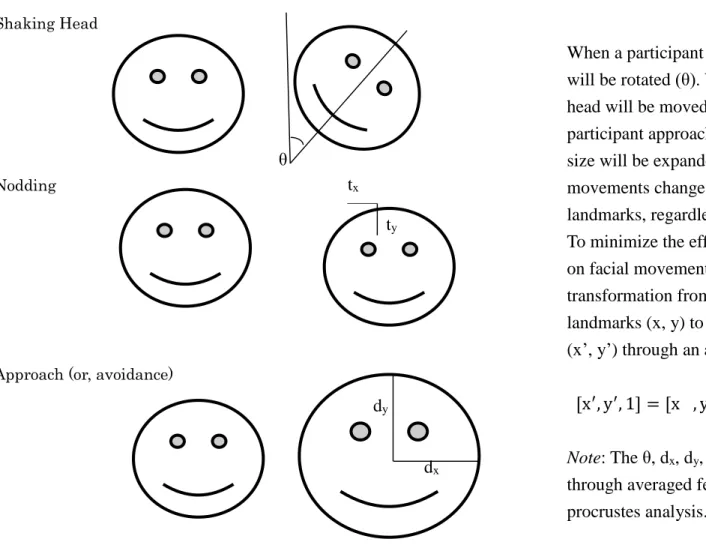
therapist’s head movements change the face coordinates, regardless of actual facial 241
movements (Fig.2). To minimize the effects of their head movements on their facial 242
movements, we used an affine formula (Fig.2). All faces were transformed to one 243
averaged female face image (530 × 530 pixels) (Langlois & Roggman, 1990) (Fig.1B-2, 244
B-3). To determine facial landmarks of the transformed faces, we used OpenCV and 245
dlib (King, 2009), which identified 68 landmarks for each picture (Fig.1B-4). Fig. 3 246
indicates actual ranges of numbers that cover specific facial parts. The number of 247
participants’ pictures was 1,258,716. For some pictures (5.99 %), we were unable to 248
detect their facial landmarks perfectly because the landmarks were sometimes covered 249
during conversation. The missing facial landmarks in these pictures were estimated 250
using a multiple imputation method (Sterne et al., 2009). The therapist’s missing facial 251
landmarks were estimated in the same manner. 252
A previous NVS study regarding body movements utilized the first 900 253
seconds of interviews (Paulick et al., 2017; Ramseyer & Tschacher, 2011; Tschacher et 254
al., 2014). To be similar to these studies, we used the first 910 seconds of interviews. 255
Further, a previous NVS study regarding facial expressions recommended a 7-second 256
frame as a time window size (Riehle et al., 2017). Hence, we divided the interview into 257
7-second portions; a portion involves 70 faces. The final dataset consisted of 258
participants’ 7150 seven-second portions involving their 500,500 face images and their 259
therapist’s 7150 seven-second portions involving his 500,500 face images. 260 2 3 4 5 6 7 8 9 10 11 12 13 14 15 16 17 18 19 20 21 22 23 24 25 26 27 28 29 30 31 32 33 34 35 36 37 38 39 40 41 42 43 44 45 46 47 48 49 50 51 52 53 54 55 56 57 58 59 60
Quantification of facial movements 261
We calculated absolute differences in facial landmarks between each picture and a 262
previous picture (i.e., the picture that was taken 100 milliseconds prior to the current 263
one). When the landmarks between the two pictures differed along the X axis, we 264
scored the difference as horizontal movement. Xk, n is the x coordinate at time n at
265
position k; K indicates all positions in specific areas. For the right eyebrow, K contains 266
positions from 18 to 22 (Fig.3). Similarly, when the landmarks differed along the Y axis, 267
we scored the difference as vertical movement. The average of horizontal and vertical 268
movements was regarded as the movement of a specific area. High movement scores 269
indicated a high frequency and wide variety of movements. 270 m[n] = 1 2|𝐾|(∑ |𝑋𝑘,𝑛+1− 𝑋𝑘,𝑛| 𝑘∈𝐾 + |𝑌𝑘,𝑛+1− 𝑌𝑘,𝑛|) 271
The averages of these movements during the first 910 seconds of interviews were also 272
used as an average facial movement score during a session. 273 𝑚̅ = 1 2|𝐾|∙ 1 𝑁 − 1( ∑ ∑ |𝑋𝑘,𝑛+1− 𝑋𝑘,𝑛| + |𝑌𝑘,𝑛+1− 𝑌𝑘,𝑛| 𝑘∈𝐾 𝑛∈𝑁−1 ) 274
N indicates the total number of pictures in a session (9,100). Hence, the average facial
275
movement scores were constant during the session. Fig. 1C shows pairs of one 276
participant’s facial movements and the therapist’s facial movements for 200 frames (20 277
seconds). Fig. 1D compares a participant's (𝑚𝑝𝑎𝑟[𝑛]) and the therapist's (𝑚𝑡ℎ[𝑛]) left 278 2 3 4 5 6 7 8 9 10 11 12 13 14 15 16 17 18 19 20 21 22 23 24 25 26 27 28 29 30 31 32 33 34 35 36 37 38 39 40 41 42 43 44 45 46 47 48 49 50 51 52 53 54 55 56 57 58 59 60
eye movements for the same 200 frames. 279
Quantification of Complementary, Symmetrical, and Absolute synchrony for 280
Facial Movements 281
Cross-correlation coefficients between the participants’ and therapist’s facial 282
movements were computed using the following formula: 283
φ𝑝𝑎𝑟,𝑡ℎ[𝑗] = {𝑚𝑝𝑎𝑟[𝑛 − min (𝑗, 0)] − 𝑚̅̅̅̅̅̅̅ }{𝑚𝑝𝑎𝑟 𝑡ℎ[𝑛 + max(𝑗, 0)] − 𝑚̅̅̅̅̅ } 𝑡ℎ
284
𝑚𝑝𝑎𝑟[𝑛] and 𝑚𝑡ℎ[𝑛] represent the participant’s and therapist’s facial movements at
285
time n. 𝑚̅̅̅̅̅̅̅ and 𝑚𝑝𝑎𝑟 ̅̅̅̅̅ are the averages of the facial movements. j represents time lags 𝑡ℎ
286
between the participant and therapist, which ranged from -20 to +20 frames (one frame 287
is 100 milliseconds) as recommended by previous studies (Riehle et al., 2017; Riehle & 288
Lincoln, 2018). Negative j values indicate that the participant’s facial movements 289
occurred after j frames of the therapist’s facial movements. Positive j values indicate 290
that the therapist’s facial movements occurred after j frames of the participant’s facial 291
movements. In short, negative and positive j values indicate a delayed response by the 292
participant and therapist, respectively. 293
To distill symmetrical, complementary, and absolute synchrony, we utilized the 294 following formula: 295 sym[𝑗] = ∑ max (0, 𝜑𝑝𝑎𝑟,𝑡ℎ[𝑗]) M−1−|𝑗| 𝑛=1 296 2 3 4 5 6 7 8 9 10 11 12 13 14 15 16 17 18 19 20 21 22 23 24 25 26 27 28 29 30 31 32 33 34 35 36 37 38 39 40 41 42 43 44 45 46 47 48 49 50 51 52 53 54 55 56 57 58 59 60
comp[𝑗] = − ∑ min (0, 𝜑𝑝𝑎𝑟,𝑡ℎ[𝑗]) M−1−|𝑗| 𝑛=1 297 abs[𝑗] = ∑ |𝜑𝑝𝑎𝑟,𝑡ℎ[𝑗]| M−1−|𝑗| 𝑛=1 298 𝑠𝑒𝑙𝑓𝑝𝑎𝑟[𝑗] = ∑ {𝑚𝑝𝑎𝑟[𝑛 − min (𝑗, 0)] − 𝑚̅̅̅̅̅̅̅ }𝑝𝑎𝑟 2 M−1−|𝑗| 𝑛=1 299 𝑠𝑒𝑙𝑓𝑡ℎ[𝑗] = ∑ {𝑚𝑡ℎ[𝑛 + max (𝑡, 0)] − 𝑚̅̅̅̅̅ }𝑡ℎ 2 M−1−|𝑗| 𝑛=1 300
M is the total number of pictures within a seven-second interval (70). Sym[j] includes
301
only positive values of φ𝑝𝑎𝑟,𝑡ℎ[𝑗], whereas comp[j] includes only negative values of 302
φ𝑝𝑎𝑟,𝑡ℎ[𝑗]. Abs[j] include all φ𝑝𝑎𝑟,𝑡ℎ[𝑗] as absolute values (Ramseyer & Tschacher,
303
2011). 𝑠𝑒𝑙𝑓𝑝𝑎𝑟[𝑗] and 𝑠𝑒𝑙𝑓𝑡ℎ[𝑗] were variances of the participants’ and therapist’s
304
movements at t time lag, respectively. 305
The cross-correlation coefficients were also normalized (Yoo & Han, 2009) and 306
these values were referred to as SYM, COMP, and ABS synchrony, respectively. The 307
formula used is more accurate than a previously reported one (Boker, Xu, Rotondo, & 308
King, 2002) because the denominator is adjusted by the time lag.1
309
SYM𝑝𝑎𝑟,𝑡ℎ[𝑗] = 𝑠𝑦𝑚[𝑗]
√𝑠𝑒𝑙𝑓𝑡ℎ[𝑗]√𝑠𝑒𝑙𝑓𝑝𝑎𝑟[𝑗]
310
1Previous formula in SYM is SYM𝑝𝑎𝑟,𝑡ℎ[𝑗] = 𝑠𝑦𝑚[𝑗]
√𝑠𝑒𝑙𝑓𝑡ℎ[0]√𝑠𝑒𝑙𝑓𝑝𝑎𝑟[0] 2 3 4 5 6 7 8 9 10 11 12 13 14 15 16 17 18 19 20 21 22 23 24 25 26 27 28 29 30 31 32 33 34 35 36 37 38 39 40 41 42 43 44 45 46 47 48 49 50 51 52 53 54 55 56 57 58 59 60
COMP𝑝𝑎𝑟,𝑡ℎ[𝑗] = 𝑐𝑜𝑚𝑝[𝑗] √𝑠𝑒𝑙𝑓𝑡ℎ[𝑗]√𝑠𝑒𝑙𝑓𝑝𝑎𝑟[𝑗] 311 ABS𝑝𝑎𝑟,𝑡ℎ[𝑗] = 𝑎𝑏𝑠[𝑗] √𝑠𝑒𝑙𝑓𝑡ℎ[𝑗]√𝑠𝑒𝑙𝑓𝑝𝑎𝑟[𝑗] 312
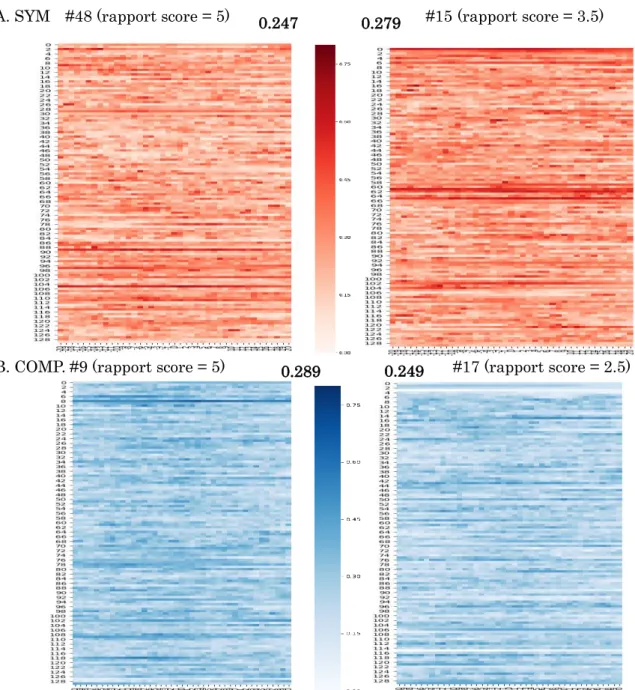
Fig. 4A shows SYM[𝑗] of left eye movements between a participant and the therapist 313
during a session. Fig. 4B shows COMP𝑝𝑎𝑟,𝑡ℎ[𝑗] of left eye movements between a
314
participant and the therapist during a session. The vertical line indicates the duration of 315
the session (one unit is 7 seconds). The horizontal line indicates time lags [j]. Negative j 316
indicates that the participant synchronized after j frames of the therapist’s facial 317
movements. Similarly, positive j indicates that the therapist synchronized after j frames 318
of the participant’s facial movements. Their average was regarded as an indicator of 319
genuine synchrony during the session (Fig. 4A, 4B, bold scores). Unlike a prior study, 320
we did not use Fisher’s Z-transformation (Ramseyer & Tschacher, 2011) because the 321
synchrony values might exhibit a multimodal distribution2.
322
Sampling of video images for facial expressions 323
The number of pictures for participants’ facial expression was the same as the number 324
of pictures for facial movements (N = 1,258,716). Still, in some participants' pictures 325
(6.49%), we were unable to identify their facial expressions. These pictures were 326
discarded. The missing facial expressions in these pictures were estimated using a 327
2 Fisher’s Z-transformation assumes a unimodal distribution
2 3 4 5 6 7 8 9 10 11 12 13 14 15 16 17 18 19 20 21 22 23 24 25 26 27 28 29 30 31 32 33 34 35 36 37 38 39 40 41 42 43 44 45 46 47 48 49 50 51 52 53 54 55 56 57 58 59 60
multiple imputation method (Sterne et al., 2009). The therapist’s missing facial 328
expressions were estimated in the same manner. 329
Quantification of facial expressions 330
To quantify facial expressions, we utilized an emotion recognition model (Arriaga et al., 331
2017). The model consists of a fully-convolutional neural network and involves around 332
60, 000 parameters. The model learned the parameters through 28,709 gray faces with 7 333
emotion categories (Happy, Scared, Angry, Disgust, Sad, Surprised, and Neutral) 334
(Carrier, Courville, Goodfellow, Mirza, & Bengio, 2013). After 102 epochs training 335
(one epoch involves 28,709 faces), the model predicted 7 emotions of a new data set 336
(3,589 faces) at 66 percent accuracy. Fig. 5 shows examples of three faces and estimated 337
probabilities of emotional expressions on these faces (A-1, A-2, A-3, B). A high 338
probability of a specific emotional expression indicates that the face expresses emotions 339
strongly: for instance, a baby’s smiling face (Fig.5 A-1) indicates 97.034 % of happiness 340
(Fig.5 B) meaning the baby strongly expressed happy emotions at the moment the 341
picture was taken. 342
We applied this emotional recognition machine on the therapist’s and 343
participant’s faces to quantify their facial expressions at the moment a picture was 344
captured. Further, application of this machine on time-varying faces (their faces during 345
interviews) also quantifies the dynamics of their facial expressions during interviews. 346
Fig. 5 C shows examples of therapist’s faces in 20 seconds (200 frames). The model 347 2 3 4 5 6 7 8 9 10 11 12 13 14 15 16 17 18 19 20 21 22 23 24 25 26 27 28 29 30 31 32 33 34 35 36 37 38 39 40 41 42 43 44 45 46 47 48 49 50 51 52 53 54 55 56 57 58 59 60
estimated the probability of happy and scared expressions during the 200 frames (every 348
frame involves one face). Fig. 5 D-1 and D-2 shows the therapist’s probability of happy 349
and scared expressions during the 200 frames, respectively. In the same way, 350
participants’ facial expressions were estimated: Fig.5 D-1 and D-2 shows a participant’s 351
probability of happy and scared expressions, respectively. The therapist’s and the 352
participant’s quantified facial expressions were used to estimate the synchrony of facial 353
expressions. Before we estimated synchrony, we calculated the average of the facial 354
expressions during the interview. 355
𝑒̅ = 1
𝑁∑ 𝑒[𝑛]
𝑛∈𝑁
356
N is the total number of pictures during a session (9100). e[n] indicates the probability 357
of a specific facial expression (such as a happy expression) at time n. 358
Quantification of complementary, symmetrical, and absolute synchrony for facial 359
expressions 360
Formulas of cross-correlation coefficients for facial expressions were mainly the same 361
as formulas for facial movements, although the formulas for facial expressions changed 362
from mpar[n], mth[n], 𝑚̅̅̅̅̅̅̅, and 𝑚𝑝𝑎𝑟 ̅̅̅̅̅ to e𝑡ℎ par[n], eth[n], 𝑒̅̅̅̅̅̅, and 𝑒𝑝𝑎𝑟 ̅̅̅̅, respectively. 𝑡ℎ
363 φ𝑝𝑎𝑟,𝑡ℎ[𝑗] = {𝑒𝑝𝑎𝑟[𝑛 − min (𝑗, 0)] − 𝑒̅̅̅̅̅̅ }{𝑒𝑝𝑎𝑟 𝑡ℎ[𝑛 + max(𝑗, 0)] − 𝑒̅̅̅̅ } 𝑡ℎ 364 𝑠𝑒𝑙𝑓𝑝𝑎𝑟[𝑗] = ∑ {𝑒𝑝𝑎𝑟[𝑛 − min (𝑗, 0)] − 𝑒̅̅̅̅̅̅ }𝑝𝑎𝑟 2 M−|𝑗| 𝑛=1 365 2 3 4 5 6 7 8 9 10 11 12 13 14 15 16 17 18 19 20 21 22 23 24 25 26 27 28 29 30 31 32 33 34 35 36 37 38 39 40 41 42 43 44 45 46 47 48 49 50 51 52 53 54 55 56 57 58 59 60
𝑠𝑒𝑙𝑓𝑡ℎ[𝑗] = ∑ {𝑒𝑡ℎ[𝑛 + 𝑚𝑎𝑥 (𝑗, 0)] − 𝑒̅̅̅̅ }𝑡ℎ 2 M−|𝑗|
𝑛=1
366
epar[n] and eth[n] represent the participant’s and therapist’s facial movement at time n.
367
𝑒𝑝𝑎𝑟
̅̅̅̅̅̅ and 𝑒̅̅̅̅ are the averages of the facial movements. 𝑡ℎ
368
Quantification of pseudo synchrony for both facial movements and expressions 369
The 7150 seven-second portions (70 faces in each portion) of participants’ faces were 370
randomly paired with the 7150 seven-second portions of the therapist’s faces. Among 371
them, 125 pairs were in the same session; these pairs were excluded. The other 7025 372
pairs never occurred in an actual interview; they were regarded as pseudo pairs. We 373
calculated the synchrony of pseudo pairs as pseudo synchrony of facial movements. The 374
pseudo pairs were also used to calculate pseudo synchrony of facial expressions. 375
Analysis 376
To test hypothesis 0, we used t-test and Cohen’s d. Pearson’s correlation was also used 377
to test hypothesis 1, 2, 3A, and 3B. Hierarchical regression analysis was also used to 378
test hypothesis 4. For the purpose of exploratory analysis, we did not adjust p values in 379
our analysis. 380
Ethical considerations 381
Our study was approved by an ethics committee of a national university in Japan. 382
Furthermore, all procedures were conducted in accordance with guidelines for studies 383
involving human participants, the ethical standards of the institutional research 384 2 3 4 5 6 7 8 9 10 11 12 13 14 15 16 17 18 19 20 21 22 23 24 25 26 27 28 29 30 31 32 33 34 35 36 37 38 39 40 41 42 43 44 45 46 47 48 49 50 51 52 53 54 55 56 57 58 59 60
committee, and the revised 1964 Helsinki declaration and its later amendments or 385
comparable ethical standards. 386
Results 387
Comparison of genuine synchrony and pseudo synchrony (Hypothesis 0) 388
We compared symmetrical, complementary, and absolute synchrony of facial 389
movements between real (genuine) and random (pseudo) pairs. Synchronies of facial 390
movements for the genuine pair were mostly lower than for the pseudo pair (Table 1). 391
Compared to complementary synchronies (4/10), symmetrical and absolute synchronies 392
showed high rates of significant differences (9/10, 8/10, respectively). These findings 393
indicate that symmetrical and absolute synchronies were more robust for facial 394
movements than the complementary synchronies. 395
Similarly, we compared symmetrical, complementary, and absolute synchrony 396
of facial expressions between real (genuine) and random (pseudo) pairs. The synchrony 397
of facial expressions for the genuine pair was also mostly lower than for the pseudo pair 398
(Table 2). Except for the complementary synchrony of disgust, the other synchronies 399
show that the synchrony of facial expressions for the genuine pair was significantly 400
lower than for the pseudo pair. These findings indicate that the synchrony of facial 401
expressions was robust regardless of the direction of synchrony. 402
Relevance between facial expressions and movements (Hypothesis 2) 403
Before we check correlations between facial movements and expressions, we 404 2 3 4 5 6 7 8 9 10 11 12 13 14 15 16 17 18 19 20 21 22 23 24 25 26 27 28 29 30 31 32 33 34 35 36 37 38 39 40 41 42 43 44 45 46 47 48 49 50 51 52 53 54 55 56 57 58 59 60
compared these movements and expressions between the participants and their therapist. 405
Tables 3 and 4 show the average of the participants’ and the therapist’s facial 406
movements. The therapist showed significantly higher facial movements than the 407
participants in all facial areas, including the jaw (paired t = -15.080, p < .001), right 408
eyebrow (paired t = -9.119, p < .001), left eyebrow (paired t = -8.578, p < .001), nasal 409
cavity (paired t = -23.715, p < .001), ridge of nose (paired t = -22.981, p < .001), right 410
eye (paired t = -13.042, p < .001), left eye (paired t = -18.668, p < .001), outer lip 411
(paired t = -20.210, p < .001), inner lip (paired t = -18.489, p < .001), and face (paired t 412
= -18.417, p < .001). These findings indicated that the therapist’s face moved more 413
frequently and widely than the participants’ during the interviews. 414
Similarly, we compared the facial expressions of the participants and the 415
therapist (Tables 3 and 4). Participants showed stronger disgust (paired t = 5.104, p 416
< .001), happy (paired t = 4.188, p < .001), surprise (paired t = 4.657, p < .001), and 417
neutral expressions (paired t = 7.590, p < .001) than their therapist. On the other hand, 418
the therapist showed stronger angry (paired t = -7.607, p < .001), scared (paired t = 419
-7.427, p < .001), and sad expressions (paired t = -14.479, p < .001) than his 420
participants. These findings indicated that distributions of facial expressions are 421
different between participants and their therapist. 422
Table 3 shows correlations between participants’ facial expressions and their 423
facial movements. Their angry expressions were positively correlated with their jaw, 424 2 3 4 5 6 7 8 9 10 11 12 13 14 15 16 17 18 19 20 21 22 23 24 25 26 27 28 29 30 31 32 33 34 35 36 37 38 39 40 41 42 43 44 45 46 47 48 49 50 51 52 53 54 55 56 57 58 59 60
right eyebrow, left eyebrow, nasal cavity, ridge of nose, right eye, left eye, and total face 425
movements (Table 3). Furthermore, their sad expressions were positively correlated 426
with their jaw, left eyebrow, nasal cavity, ridge of nose, right eye, left eye, outer lips, 427
inner lips, and total face movements (Table 3). Moreover, their neutral facial 428
expressions were negatively correlated with all of their facial movements (Table 3). 429
These findings indicate that participants’ facial movements were related to their 430
negative emotional expressions. 431
Table 4 shows correlations between the therapist’s facial expressions and his 432
facial movements. In contrast to the participants’ findings, the therapist’s scared 433
expressions were negatively correlated with his jaw, left eyebrow, right eye, left eye, 434
and face movements. Furthermore, the therapist’s happy expressions were positively 435
correlated with his nasal cavity, ridge of nose, outer lips, and inner lips movements. 436
These findings indicated that the therapist’s facial movements were related to their 437
increased positive emotions and decreased negative emotions. 438
Relevance between Therapeutic Alliance and NVS of Facial Movements 439
(Hypothesis 1 and 3A) 440
Fig. 4A shows examples of symmetrical synchrony of left eye movements during a 441
structured psychotherapeutic interview for the high therapeutic alliance and low 442
therapeutic alliance scorers. The strong red area indicates strong symmetrical 443
synchronies. The examples imply that the high therapeutic alliance scorer’s symmetrical 444 2 3 4 5 6 7 8 9 10 11 12 13 14 15 16 17 18 19 20 21 22 23 24 25 26 27 28 29 30 31 32 33 34 35 36 37 38 39 40 41 42 43 44 45 46 47 48 49 50 51 52 53 54 55 56 57 58 59 60
synchronies were weaker than those of the low therapeutic alliance scorer. Fig. 4B 445
shows examples of complementary synchrony of left eye movements during an 446
interview. The strong blue area indicates strong complementary synchronies. In contrast 447
to symmetrical synchrony, the examples imply that the high therapeutic alliance scorer’s 448
complementary synchronies were stronger than those of the low therapeutic alliance 449
scorer. Table 5 also confirmed this tendency. The symmetrical synchronies of facial 450
movements, including eye and mouth movements, were negatively correlated with 451
therapeutic alliance, whereas the complementary synchronies of a facial movement, 452
including left eyebrow movements, were positively correlated with therapeutic alliance, 453
although several correlations did not reach significant levels. These findings indicated 454
that the symmetrical synchrony of facial movements was negatively correlated with 455
therapeutic alliance. Table 6 shows the correlations between therapeutic alliance and 456
absolute synchrony of facial movements. Unlike Table 5, Table 6 did not show any 457
significant relations between therapeutic alliance and absolute synchrony of facial 458
movements. 459
Relevance between Therapeutic Alliance and NVS of Facial Expressions 460
(Hypothesis 3B) 461
Table 7 shows the correlations between therapeutic alliance and synchrony of facial 462
expressions. The symmetrical synchronies of facial expressions, including angry, happy, 463
and neutral, were positively correlated with therapeutic alliance. Furthermore, the 464 2 3 4 5 6 7 8 9 10 11 12 13 14 15 16 17 18 19 20 21 22 23 24 25 26 27 28 29 30 31 32 33 34 35 36 37 38 39 40 41 42 43 44 45 46 47 48 49 50 51 52 53 54 55 56 57 58 59 60
complementary synchronies of facial expressions, including scared, happy, and sad, 465
were also positively correlated with therapeutic alliance. The correlations between 466
symmetrical synchrony and complementary synchrony were also positive regarding 467
angry, scared, sad, surprise, and neutral expressions (Table 7). These findings indicated 468
that both complementary and symmetrical synchronies of facial expressions were 469
positively correlated with therapeutic alliance. 470
Prediction of Therapeutic alliance from NVS of Facial Movements and Facial 471
Expressions (Hypothesis 4) 472
Before we test the hierarchical regression analysis on therapeutic alliance from the 473
synchrony of facial movements and expressions, we indicated the correlations among 474
them (Table 8). Table 8 shows that therapeutic alliance was positively correlated with 475
symmetrical synchrony of scared expressions, complementary synchrony of happy 476
expressions, and complementary synchrony of scared expressions. On the other hand, 477
therapeutic alliance was negatively correlated with the symmetrical synchrony of right 478
eye and left eye movements. Further, symmetrical synchrony of left eye movements was 479
negatively correlated with complementary synchrony of scared expressions, 480
symmetrical synchrony of happy expressions, and symmetrical synchrony of scared 481
expressions. These findings suggested that both symmetrical and complementary 482
synchronies of facial expressions were positively related to therapeutic alliance; 483
however, the symmetrical synchrony of right and left eye movements was negatively 484 2 3 4 5 6 7 8 9 10 11 12 13 14 15 16 17 18 19 20 21 22 23 24 25 26 27 28 29 30 31 32 33 34 35 36 37 38 39 40 41 42 43 44 45 46 47 48 49 50 51 52 53 54 55 56 57 58 59 60
related to therapeutic alliance. 485
Table 9 shows the hierarchical regression analysis on therapeutic alliance from 486
symmetrical and complementary synchronies. Model 1 predicted therapeutic alliance 487
from participants’ age and sex only. Model 2 included both the participants' and the 488
therapist's facial movements and expressions as independent variables. Model 3 489
included complementary and symmetrical synchronies of happy and scared emotions as 490
independent variables. Model 3 also included complementary and symmetrical 491
synchronies of right and left eye movements as independent variables. Model 2 492
indicated that participants’ happy expressions during the interviews predicted a positive 493
therapeutic alliance, whereas the therapist’s scared expression during the interviews 494
predicted a negative therapeutic alliance. Further, model 3 also indicated that inclusion 495
of complementary and symmetrical synchronies increased the contribution rate 496
significantly (Table 9). Further, symmetrical synchrony of left eye movements predicted 497
a negative therapeutic alliance; however, complementary synchrony of left eye 498
movements predicted a positive therapeutic alliance. Table 10 used absolute synchronies 499
of facial expressions and movements, and predicted therapeutic alliance similar to Table 500
9. Unlike Table 9, model 3 did not increase the contribution rate. 501
Discussion 502
The current study used video imaging methods and quantified facial movements and 503
facial expressions for every 100 milliseconds. Our machine-based method measured 504 2 3 4 5 6 7 8 9 10 11 12 13 14 15 16 17 18 19 20 21 22 23 24 25 26 27 28 29 30 31 32 33 34 35 36 37 38 39 40 41 42 43 44 45 46 47 48 49 50 51 52 53 54 55 56 57 58 59 60
facial movements and expressions precisely within a short time and without a human 505
rater’s bias (Bernieri et al., 1994), similar to previous studies (Arriaga et al., 2017; Levi 506
& Hassner, 2015; Matsugu et al., 2003; Ramseyer & Tschacher, 2011; Schmidt et al., 507
2012). Our extension of participants into the Asian population is also important for 508
generalizing the findings of NVS (Bernieri, 1988; Condon & Ogston, 1966; Gatewood 509
& Rosenwein, 1981; Lakin & Chartrand, 2003), similar to a previous study (Kimura & 510
Daibo, 2006). Our findings can summarize the genuine synchrony, speaker role, 511
symmetry/complementary synchrony, and the meaning of NVS with regards to facial 512
parts. 513
Lower Scores of Synchrony for Genuine Pairs than for Pseudo Pairs (Hypothesis 514
0) 515
Our study confirmed that the synchrony of facial movements for the genuine pair was 516
significantly different from the synchrony of the pseudo pair. Yet, our study found that 517
the synchrony of facial movements was lower for genuine pairs than for pseudo pairs, 518
although previous studies of body movements supported that the synchrony of 519
movements was higher for genuine pairs than for the pseudo pairs (Kupper et al., 2015; 520
Lavelle et al., 2013; Paulick et al., 2018; Tschacher & Pfammatter, 2016). The 521
inconsistency of the findings between current and previous studies comes from the 522
differences of active frames between these movements. The body movements were 523
mostly inactive for most frames (a frame is 100 milliseconds) and became rapidly active 524 2 3 4 5 6 7 8 9 10 11 12 13 14 15 16 17 18 19 20 21 22 23 24 25 26 27 28 29 30 31 32 33 34 35 36 37 38 39 40 41 42 43 44 45 46 47 48 49 50 51 52 53 54 55 56 57 58 59 60
for specific frames (Tschacher et al., 2014). The random pairs of body movements 525
missed these specific active frames, so the synchrony of pseudo pairs was lowered. On 526
the other hand, facial movements were mostly active during most frames; these frames 527
were regarded as active frames (Fig.1 D, Table 3, and Table 4). Consequently, the 528
random pairs of facial movements did not miss the active frames. Furthermore, the 529
pseudo pairs involved so many individuals that individual differences of pseudo pairs 530
could increase the deviation from the average, which directly increases the size of 531
synchrony among the pseudo pairs. As a result, the synchrony of pseudo pairs in facial 532
movements could be increased. The same discussion can be applicable in 533
electromyography-based emotion encoding (Riehle et al., 2017) and machine-based 534
emotion encoding. The former’s active frames were rare because of a high threshold of 535
activation (Riehle & Lincoln, 2018), whereas the latter’s active frames were frequent 536
because it had no threshold of activation. 537
Speaker role moderates the relevance between facial movements and facial 538
expressions (Hypothesis 2) 539
Our study also confirmed the links between eye movements and negative emotions 540
among participants. Like previous studies (Baron-Cohen et al., 2001; D’Mello et al., 541
2007; Lee et al., 2014), participants’ eye movements were linked with angry and sad 542
expressions. Diagnostic interviews by a clinical psychologist are considered to be 543
stressful for the participants. Hence, it is natural that their facial movements were linked 544 2 3 4 5 6 7 8 9 10 11 12 13 14 15 16 17 18 19 20 21 22 23 24 25 26 27 28 29 30 31 32 33 34 35 36 37 38 39 40 41 42 43 44 45 46 47 48 49 50 51 52 53 54 55 56 57 58 59 60
with these negative facial expressions. On the other hand, our study did not confirm the 545
links of eye movements with regards to the clinical psychologist. Actually, his eye 546
movements were negatively linked with his scared expression (Table 4). Further, his 547
outer and inner lip movements were positively linked with his happy expression, which 548
did not appear in these participants (Table 3, 4). The inconsistency of facial expressions 549
between the participants and therapist might come from role differences. During the 550
diagnostic interview, the psychologist has to build therapeutic alliance with his 551
participants, so he intentionally interacts with the participants (Elvins & Green, 2008; 552
Martin et al., 2000). Actually, the volume of his facial movement was higher than the 553
volume of the facial movement by the participants (Table 3, 4). Further, his eye 554
movements were also more rapid than the participants’ eye movements (Fig1.D). These 555
data indicated that a diagnostic interview motivated him to build a therapeutic alliance; 556
consequently, his movements might be linked with prosocial emotional expressions 557
rather than negative emotional expressions. Still, our therapist’s data was only from a 558
male therapist so these findings might be originated from a peculiarity of him. Hence, 559
generalization of current relevance between therapist’s facial movements and facial 560
expressions (Table 4) needs caution. 561
Complementary and Symmetrical Synchronies of Facial Movements and Facial 562
Expressions (Hypothesis 1, 3A, 3B) 563
Unlike NVS of many movements (Bernieri, 1988; McFarland, 2001; Miles et al., 2011; 564 2 3 4 5 6 7 8 9 10 11 12 13 14 15 16 17 18 19 20 21 22 23 24 25 26 27 28 29 30 31 32 33 34 35 36 37 38 39 40 41 42 43 44 45 46 47 48 49 50 51 52 53 54 55 56 57 58 59 60
Repp & Su, 2013; Semin & Cacioppo, 2008; Vacharkulksemsuk & Fredrickson, 2012; 565
Vicaria & Dickens, 2016; Won et al., 2014), we did not find any link between absolute 566
synchrony of facial movements and therapeutic alliance (Table 6). Detailed analysis also 567
found that complementary synchrony of facial movements was positively linked with 568
therapeutic alliance, whereas symmetrical synchrony was negatively linked with 569
therapeutic alliance (Table 5). These findings indicated that absolute synchrony of facial 570
movements cancelled the positive effects of complementary synchrony and the negative 571
effects of symmetrical synchrony on therapeutic alliance, so that no significant link was 572
found between the absolute synchrony of facial movements and therapeutic alliance. 573
Still, it is unclear why symmetrical and complementary synchrony of facial expressions 574
indicated correlations with therapeutic alliance in the same direction (Table 7), while the 575
synchrony of facial movements did not (Table 5). 576
This inconsistency can be explained by the stability of facial expressions and 577
volatility of facial movements. For encoding of facial expressions, emotion-relevant 578
facial movements were selected and emotion-irrelevant facial movements were 579
discarded. Meanwhile, for encoding of facial movements, all facial movements were 580
encoded. This indicates that all one’s facial movements affected all the other’s facial 581
movements; that is, NVS of facial movements is volatile. The volatility of NVS of facial 582
movements might require a sensitive index, such as complementary and symmetrical 583
synchronies, to capture these NVSs. In contrast, one’s emotional-irrelevant facial 584 2 3 4 5 6 7 8 9 10 11 12 13 14 15 16 17 18 19 20 21 22 23 24 25 26 27 28 29 30 31 32 33 34 35 36 37 38 39 40 41 42 43 44 45 46 47 48 49 50 51 52 53 54 55 56 57 58 59 60
movements did not affect the other’s facial expressions; that is, NVS of facial 585
expressions is stable regarding emotional-irrelevant facial movements. The stability of 586
the NVS of facial expressions might require total volume, such as the absolute values of 587
synchronies, to capture these NVSs. Hence, absolute values of synchronies fit well with 588
the NVS of facial expressions, but not with the NVS of facial movements (Table 8). 589
Although complementary and symmetrical synchronies might be necessary for 590
assessing the NVS of facial movements, they could also be useful for assessing the NVS 591
of body movements. If complementary and symmetrical communication synchronies 592
exist in NVS of body movements, symmetrical synchronies might be prevalent in 593
competitive settings (Lozza et al., 2018; Tschacher et al., 2014), whereas 594
complementary synchronies might be prevalent in collaborative settings (Bernieri, 595
1988; Ramseyer & Tschacher, 2011; Shockley et al., 2003). Further, reanalysis of head 596
movements from the perspective of symmetrical and complementary synchronies is also 597
interesting (Ramseyer & Tschacher, 2014). Testing these hypotheses is important to 598
clarify the direction of synchrony associated with NVS. 599
Meanings of NVS with regards to Facial Movements and Expressions (Hypothesis 600
4) 601
Complementary and symmetrical synchronies of scared expressions were positively 602
linked with therapeutic alliance. Furthermore, symmetrical synchrony of happy 603
expressions was positively linked with therapeutic alliance, same as symmetrical 604 2 3 4 5 6 7 8 9 10 11 12 13 14 15 16 17 18 19 20 21 22 23 24 25 26 27 28 29 30 31 32 33 34 35 36 37 38 39 40 41 42 43 44 45 46 47 48 49 50 51 52 53 54 55 56 57 58 59 60
synchrony of scared expressions. Absolute synchronies of happy and scared expressions 605
were also positively correlated with therapeutic alliance. These findings indicated that 606
the total synchrony of facial expressions is linked with therapeutic alliance, regardless 607
of synchrony directions (symmetrical or complementary) and emotional values (positive 608
or negative emotions). The synchrony of facial expressions might be regarded as an 609
emotional interaction between participants and the therapist, which positively affect 610
therapeutic alliance (Elvins & Green, 2008; Martin et al., 2000). Many studies have 611
found that one’s mimicking of another’s facial expressions affect one’s emotional 612
experience and the collaborative relationship between them (Chartrand & Bargh, 1999; 613
Chartrand & Lakin, 2013; Shockley et al., 2003). Symmetrical synchrony of facial 614
expressions during an interview can be regarded as mimicry of facial expressions 615
between the participants and the therapist within a 2 second delay, similar to previous 616
studies (Riehle et al., 2017; Riehle & Lincoln, 2018). Our study measured the 617
synchrony at 100 milliseconds; consequently, most synchronies could be regarded as at 618
unconscious level (Lakin & Chartrand, 2003). Complementary synchrony of facial 619
expressions was positively related to symmetrical synchrony of facial expressions 620
(Table 7); consequently, the complementary synchrony of facial expressions could be 621
regarded as a by-product of mimicry of facial expressions. 622
Contrary to NVS of facial expressions, symmetrical synchrony of left eye 623
movements was negatively correlated with therapeutic alliance. Hierarchical regression 624 2 3 4 5 6 7 8 9 10 11 12 13 14 15 16 17 18 19 20 21 22 23 24 25 26 27 28 29 30 31 32 33 34 35 36 37 38 39 40 41 42 43 44 45 46 47 48 49 50 51 52 53 54 55 56 57 58 59 60
models also confirmed that symmetrical synchrony of left eye movements predicted a 625
negative therapeutic alliance. Further, symmetrical synchrony of left eye movements 626
was negatively related to complementary synchrony of scared expressions, symmetrical 627
synchrony of happy expressions, and symmetrical synchrony of scared expressions. 628
When we regard the synchrony of facial expressions as an emotional interaction 629
between the participants and the therapist (Chartrand & Bargh, 1999; Chartrand & 630
Lakin, 2013; Shockley et al., 2003), symmetrical synchrony of left eye movements can 631
be regarded as a blocker of emotional interaction between them. Our model also found 632
that the complementary synchrony of left eye movements positively predicted 633
therapeutic alliance. These findings indicate that complementary synchrony of left eye 634
movements could be smooth emotional turn taking, whereas the symmetrical synchrony 635
of left eye movements was conflict of emotional turn taking. NVS of left eye 636
movements can be an index of emotional turn taking at a micro visual level. 637
Interestingly, symmetrical synchrony of inner and outer lips was also negatively 638
correlated with therapeutic alliance. The symmetrical synchrony of mouth movements 639
might imply an error of turn taking and an increased number of cross-talk. These 640
findings also indicated that symmetrical synchrony of eye and mouth movements might 641
be a blocker index of emotional turn taking. The current findings extended the index of 642
emotional turn taking from the prosody level (Acosta & Ward, 2011) to the micro visual 643
level. Still, coefficients of therapist’s left eye movement were deviant from those in his 644 2 3 4 5 6 7 8 9 10 11 12 13 14 15 16 17 18 19 20 21 22 23 24 25 26 27 28 29 30 31 32 33 34 35 36 37 38 39 40 41 42 43 44 45 46 47 48 49 50 51 52 53 54 55 56 57 58 59 60
other movements and participants’ movements (Table 3 and 4), the current findings 645
might be originated from a peculiarity of the interviewer. Hence, generalization of 646
synchrony of left eye movements during therapy (Table 8, 9 and 10) needs caution. 647
Limitations 648
Despite these positive findings and implications, our study had four limitations. First, 649
our therapist was unaware of the current hypothesis because he had another hypothesis 650
during the experiment (Yokotani et al., 2018); however, he was not naive to the current 651
research question because he was a main analyzer and main writer of our paper. Hence, 652
the therapist might have been biased as an experimenter, even though the control of eye 653
movements every 100 milliseconds during the interview might have been impossible. 654
Second, encoding of facial expressions was still under development. Especially, 655
differentiation between negative emotions was still difficult for machines because 656
several areas, such as a frown, were quite similar to angry and disgust expressions 657
(Arriaga et al., 2017). Further, machine learning from a Western face database might not 658
fit well with an emotion recognition of Asian faces (Carrier et al., 2013). Addition of 659
Asian faces to the database is required for further study. Third, our setting had only one 660
male therapist with glasses; thus, we could not clarify the gender effect, especially 661
among female participant-female therapist pairs. Gender differences might affect NVS 662
of facial movements (Stratou, Hoegen, Lucas, & Gratch, 2017). The gender effects need 663
to be controlled. Further, our emotion recognition model frequently confused the 664 2 3 4 5 6 7 8 9 10 11 12 13 14 15 16 17 18 19 20 21 22 23 24 25 26 27 28 29 30 31 32 33 34 35 36 37 38 39 40 41 42 43 44 45 46 47 48 49 50 51 52 53 54 55 56 57 58 59 60