Exploring the interactions between microbes
and plants in rhizosphere of arsenic
hyperaccumulators to improve arsenic
phytoremediation
著者
楊 重陽
number
64
学位授与機関
Tohoku University
学位授与番号
環博第138号
URL
http://hdl.handle.net/10097/00129718
ヤン チョンヤン
氏
名
楊
重陽
授
与
学
位
博士(環境科学)
学 位 記 番 号
学 位 授 与 年 月 日
令和 2 年 3 月 25 日
学位授与の根拠法規 学位規則第 4 条第 1 項
研究科,専攻の名称 東北大学大学院環境科学研究科(博士課程)環境科学専攻
学 位 論 文 題 目
Exploring the interactions between microbes and plants in
rhizosphere of arsenic hyperaccumulators to improve arsenic phytoremediation
指
導
教
員 東北大学教授 井上 千弘
論 文 審 査 委 員
主査 東北大学教授 井 上 千 弘
他大学教授 山路 恵子
(筑波大学)ABSTRACT
As a toxic and carcinogenic metalloid, arsenic (As) has posed serious threat to human health.
Phytoremediation is a promising inexpensive method of detoxifying As contaminated soils using
plants and associated soil microorganisms. Pteris vittata and Pteris multifida are widely studied
As hyperaccumulators that absorb As mainly via roots. Hence, rhizobacteria exhibit promising
potential in phytoextraction owing to their immense microbial diversity and interactions with
plants. Because the potential of P. vittata to hyperaccumulate As contamination has been
investigated widely, the mechanisms of As uptake by P. vittata was used for basement of this
research.
As uptake by As hyperaccumulators is largely determined by As speciation and mainly
occurs via roots; thus, rhizospheric microbial activities may play a key role in As accumulation.
The aim of this study was to investigate the potential of As resistant rhizobacteria to enhance As
phytoextraction. In nature, inorganic As transformations between As(V) and As(III) are
commonly mediated by microbes. P. vittata was reported to accumulate As(V) more efficiently
環博第138号
東北大学教授 李 玉友
東北大学助教 簡 梅芳
than As(III). Given that two As species exist in soil and are absorbed by plants, intensification of
As(III) oxidation and suppression of As(V) chelation in the rhizosphere could enhance As removal
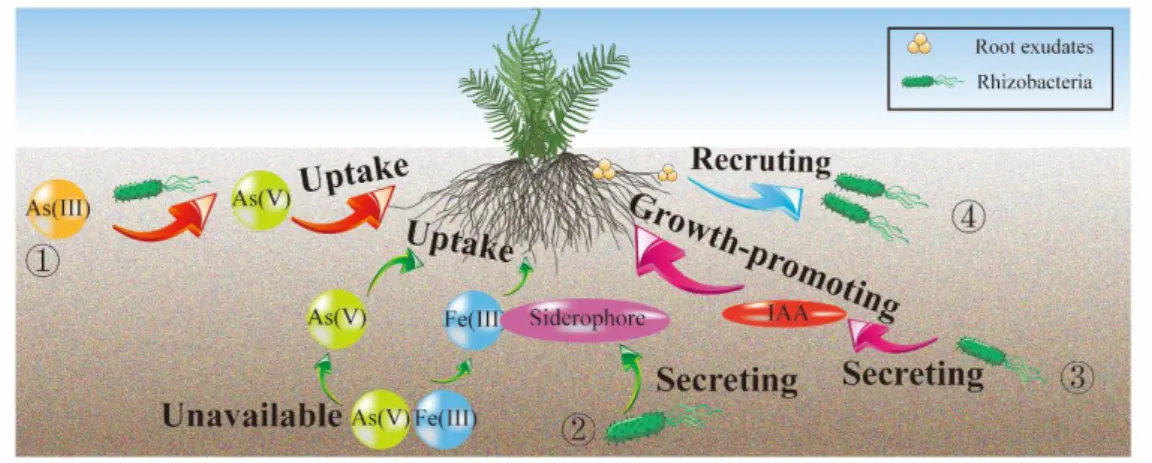
by P. vittata. Beside As speciation, bacteria can provide specific compounds which promote
growth of the plant. Specifically, plant-associated bacteria can produce the phytohormone indole
acetic acid (IAA), which can promote plant growth, contributing to the enhancement of
phytoremediation. Also, rhizobacteria can synthesize siderophores that can solubilize As adsorbed
on Fe-oxides, releasing As for plant to absorb. From the view of plant, root exudates are assumed
to be the major nutrient source for rhizobacteria that induce them to colonize near plant roots.
Successful colonization is believed to be the key step to maximum their function. Better
understanding of these processes has led to the development of conventional phytoremediation
strategies for the cleanup of As (Fig. 1).
Fig. 1 The interactions of rhizobacteria and Pteris vittata
In chapter 2, Cupriavidus basilensis strain r507 contained aioA-like genes was isolated from
mM; 98% oxidation of 0.1 mM As(III) within 24 h; chemotaxis response to root exudates of P.
vittata; strong colonization to the root of P. vittata). However, Pteris multifida was another
excellent As hyperaccumulator also belong to Pteris genus. The similar screening criteria was
applied to this new found As hyperaccumulator. Pseudomonas vancouverensis strain m318
harboring aioA-like genes was selected not only by above traits (MICs against As(III): 16 mM;
MICs against As(V): 320 mM; 98% oxidation of 0.1 mM As(III) within 24 h; chemotaxis response
to several organic acid and root exudates of P. vittata; rapid colonization to P. vittata in 24 h) but
also by plant growth-promoting rhizobacteria (PGPR) properties, siderophore and IAA secretion
(siderophore unit: 88%; IAA: 12.45 mg L-1).
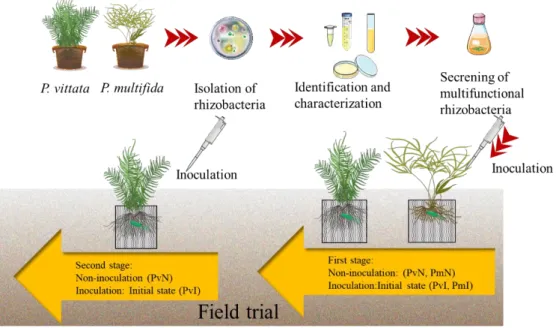
In chapter 3, the selected candidate isolates, strain r507 and strain m318, were applied to
testify their potential in As phytoremediation (Fig. 2). In first stage, strain r507 and m318 were
detected their preliminary performance on co-cultivation with As hyperaccumulators. Firstly,
strain r507 was used in co-cultivation trials with P. vittata in the field for six months. Results
showed that the inoculation with strain r507 potentiated As accumulation of P. vittata up to 171%.
Molecular analysis confirmed that the inoculation increased the abundance of aioA-like genes in
the rhizosphere, which might have facilitated arsenite oxidation and absorption. Secondly, strain
m318 was isolated from P. multifida but presented higher affinity to P. vittata, it was used to do
co-cultivation with P. multifida and P. vittata. Inoculation with strain m318 increased As
accumulation in P. vittata by 48–146% and in P. multifida by 42–233%. Moreover, P. vittata
showed more potential for As hyperaccumulation than P. multifida. The findings of this study
arsenic phytoremediation. In second stage, on account of the multifunction of Pseudomonas
vancouverensis strain m318 and its initial excellent behavior in inoculation to P. vittata testified
in field trials, strain m318 strain was inoculated to P. vittata as same pattern in a field trial for 3
years to evaluate the long-term efficacy and stability for enhancing As phytoextraction. The
biomass, As concentration and As accumulation of ferns showed increasing by inoculation
treatment, while this trend was gradually declined years by years which may on account of lower
As concentration in soil and lower amount of precipitation during experiments. The potential of
inoculation was observed in enrichment coefficients that exhibited increasing. The aioA-like
genes in the rhizosphere were detected to evaluate the influence of inoculation on As
phytoremediation. The findings of this study suggested that potential application of rhizosphere
processes to the development of phytoremediation technologies for As contaminated soils, while
the conditions which maintain the efficacy of this method could be further optimized.
Recently, multi-omics approaches have been widely deployed in research of rhizosphere.
Omics aims at the collective characterization and quantification of pools of biological molecules
that translate into the structure, function, and dynamics of an organism or organisms. Multi-omics
integrates diverse omics data to find a coherently matching geno-pheno-envirotype relationship
or association and expands the landscape of tools available for the high-throughput analysis of
complex biomes. Therefore, in chapter 4, close system by genomics and metabolomics was used
to investigate the interaction between plants and associated microorganisms under the condition
of non-inoculation and inoculation with strain m318. Inoculation treatment did not show positive
performance on As phytoremediation in this system, which may because that the delay effect of
inoculation occurred in rhizosphere and pot size limited plants healthy growth subsequently As
extraction by plants. P. vittata was the major driving force to shift the rhizobacterial community
structure. Metabolite profiling also elucidated the changes in composition in soil, root exudates
of P. vittata and root exudates of inoculated P. vittata grown in As exposure soil.
Microbial As transformation is an important process in rhizosphere of As hyperaccumulators.
Several studies have pointed out the potential roles of As-oxidizing bacteria in As uptake by
hyperaccumulators, however little information to investigate and testify the roles of specific
As-oxidizing bacteria because large proportion of As-As-oxidizing bacteria is unculturable. This research
was the first report pointed out the positive correlation between aioA-like genes and As removal
efficiency at soil scale and the long-term performance of multifunctional As-oxidizer in As
phytoremediation. In addition, complex reactions in rhizosphere of As hyperaccumulators provide
one to explore the interactions between plant and microbes of P. vittata by multi-omics approaches
to find more possibility in promoting As phytoremediation. Overall, this study established the
efficient approaches to use potential rhizobacteria co-cultivation with As hyperaccumulators to
improve As phytoremediation. However, further researches are needed to explore the mechanism
(別紙)
論文審査結果の要旨及びその担当者
論文提出者氏名 楊 重陽
論 文 題 目
Exploring the interactions between microbes and plants in rhizosphere of arsenic hyperaccumulators to improve arsenic phytoremediation (ファイトレメディエーショ ン効果改善のためのヒ素高蓄積植物根圏における微生物-植物間相互作用の探究) 論文審査担当者 主査 教授 井上 千弘 教授 李 玉友 教授 山路 恵子 助教 簡 梅芳 (筑波大学)
論文審査結果の要旨
ヒ素による土壌汚染の修復技法として、ファイトレメディエーションが提案され、既存の手法に無い低コストかつ 環境負荷の小さい方法として近年注目を集めている。亜熱帯性のヒ素高蓄積植物であるイノモトソウ科のモエジマ シダ(Pteris vitatta)は、ヒ酸イオンを根から選択的に吸収し地上部の羽片にヒ素を蓄積させる。しかしながら土壌中 のヒ素は大部分が難溶性の化学形態で存在しているため、モエジマシダ単独の作用では十分に吸収除去できないと いう問題がある。本論文ではモエジマシダ等のイノモトソウ科のシダの根圏に生息する微生物に着目し、ヒ素耐性、 植物成長促進因子の分泌能、根への親和性など様々な機能を有する細菌を獲得し、その機能を活用してモエジマシダ の生育促進と土壌中のヒ素の可溶化促進を実験室レベルと圃場レベルで試みた結果が述べられており、全5章で構成 されている。 第 1 章は序論であり、本研究に関わる背景や研究目的について述べている。第 2 章「Isolation and characterization of functional rhizobacteria from As hyperaccumulators」では、モエジマシダとイノ モトソウの根圏から単離した細菌の中から、ヒ素耐性と亜ヒ酸酸化能力による一次スクリーニング、植物成長促進因 子の分泌能、シデロフォアの分泌能、根への親和性による二次スクリーニングを経て、それら多機能を有する
Pseudomonas vancouverensis m318 株 と Cupriavidus basilensis r507 株を選抜した結果について述べている。これら 2 株
の細菌は
第 3 章「Inoculation of isolated rhizobacteria with As hyperaccumulators in field trial」では、2 章で選抜した 2 株の多機能 株を用いて、仙台市内のヒ素を少量含有する農地において、圃場実験を行った結果について述べている。圃場にモエ ジマシダを定植した後、多機能株の培養液をその根元に接種し、約半年間の栽培期間後に植物の成長量、植物による ヒ素の吸収量、土壌からのヒ素除去量を非摂取区と比較し、いずれの点でも植菌区、中でも P. vancouverensis m318 株 で高い効果が認められた結果を示している。さらにこの m318 株を用いた合計 4 年間の圃場試験の実施において、非 植菌区と比較して植菌区で有意な効果が認められたことを世界で初めて示している。
第 4 章「Multi-omics approaches toward understanding the interactions among soil microbes and plants in rhizosphere of Pteris
vittata」では、気仙沼市の高濃度のヒ素を含有する農地土壌を用いた実験室内のポット試験において、3 章と同様の デザインの試験を通じ、モエジマシダの植栽の有無と m318 株の接種の有無による、土壌からのヒ素の除去、土壌中 の菌叢変化並びに土壌中の代謝産物の関係をそれぞれ解析し、モエジマシダの植栽が土壌中の菌叢と代謝産物を大 きく変化させている結果を示している。これまで重金属類の高蓄積植物にこのような統合オミックス解析例は世界 で初めてである。 第 5 章は結論であり、各章における研究成果を総括するとともに、本論文全般の結論について述べている。 以上、本論文ではモエジマシダの根圏に生息する多機能微生物を活用して、ファイトレメディエーションによる汚 染土壌中からのヒ素の効率的な除去を可能にする方法論を提案するとともに、その過程で起こる植物・微生物・土壌 間の複雑な相互作用を解明するための方法論を提示しており、今後のファイトレメディエーション技術の発展に大 きな貢献をするとともに、環境科学および土壌生物学、植物学への学術面でのインパクトも大きいと考えられる。 よって,本論文は博士(環境科学)の学位論文として合格と認める。