A
monotone
convergence
theorem
for
a
sequence
of
convex
fuzzy
sets
on
$\mathbb{R}^{n}$千葉大学教育学部 蔵野正美 (Masami Kurano)
Faculty of Education, Chiba University
千葉大学理学部 安田正實 (Masami Yasuda)
千葉大学理学部 中神潤– (Jun-ichi Nakagami)
Faculty of Science, Chiba University
北九州大学経済学部 吉田祐治 (Yuji Yoshida)
Faculty of Economics and Business Administration, Kitakyushu University Abstract
In this paper, we study the convergence ofa sequenceoffuzzy sets on $\mathbb{R}^{n}$ which
is monotone w.r.t. a pseudo order $\neg\prec K$ induced by a closed convex cone $K$ in $\mathbb{R}^{n}$.
Our study is carried out by restricting the class of fuzzy sets into the subclass in
which $\neg\prec K$ becomes apartial order and a monotone convergence theorem is proved.
This restricted subclass of fuzzy sets is created and characterized in the concept of
a determining class. These results are applied to obtain the limit theorem for a
sequence of fuzzy sets defined by the dynamic fuzzy system with a monotone fuzzy
relation.
Keywords: Pseudo-order, fuzzy $\max$ order, multidimensional fuzzy sets,
monotone convergence theorem, determining class, dynamic fuzzy system.
1. Introduction and
Notations
A
convergence
theorem fora
sequence of fuzzy sets is mathematically interesting andapplicable to sequential decision analysis in
a
fuzzy environment. In fact, the limitingbehavior of fuzzy states of dynamic fuzzy system or sequential fuzzy decision process have
been studied by developing asuitable convergencetheorem of
a
sequence of fuzzy sets. (cf.[4, 5, 6, 14, 15, 16, 17]$)$ Also, the theory of metric space of fuzzy sets has been developed
by many authors (cf. [2, 9, 13]), in which several convergence theorems of fuzzy sets
are
given. On the other hand, in multiple criteria decision making, the rewards from dynamic
system are described in terms of fuzzy sets and the model is often optimized under some
order or pseudo order relation among fuzzy sets. In this case, it is more important to
study the convergence theorem related to fuzzy order relation.
Recently, Kurano et al [7] have introduced a pseudo order $\neg K\prec$ in the class of fuzzy sets
on
an
$n$-dimensional Euclidian space $\mathbb{R}^{n}$, which is natural extension of fuzzy$\max$ order
(cf. [3], [11]) in fuzzy numbers
on
$\mathbb{R}$ and induced by a closedconvex cone
$K$in $\mathbb{R}^{n}$. For a
lattice-structure of the fuzzy $\max$ order, see [1], [19]. Here, we study the convergence ofa
sequence of fuzzy sets on $\mathbb{R}^{n}$ which is monotone w.r.t. a pseudo order
$\neg K\prec$. Our study is
done by restricting the class of fuzzy sets into the subclass in which $\neg K\prec$ becomes a partial
order and a monotone convergence theorem is proved. This restricted subclass of fuzzy
sets is created and characterized in the concept of
a
determining class. These resultsare
applied to obtain the limit theorem for a sequence of fuzzy states defined by the dynamic
In the remainder of this section, we will give
some
notations and basic concepts offuzzy sets and review a vector ordering of $\mathbb{R}^{n}$ by a
convex cone.
In Section 2,a
pseudoorder of fuzzy sets on $\mathbb{R}^{n}$ is reviewed referring to Kurano et al [7] and the related new
results are given. In Section 3, we introduce a concept of determining class and give
a
convergence theorem for
a
sequence ofconvex
compact subclass $\mathbb{R}^{n}$. In Section 4, theseresults are applied to obtain
a
monotone convergence theorem for fuzzy setson
$\mathbb{R}^{n}$. InSection 5,
we
consider the limit of a sequence of fuzzy states defined by the monotonedynamic fuzzy system.
We write fuzzy setson$\mathbb{R}^{n}$ by their membership functions
$\overline{S}:\mathbb{R}^{n}arrow[0,1]$ (see Nov\’ak [10]
and Zadeh [18]$)$. The $\alpha$-cut $(\alpha\in[0,1])$ ofthe fuzzy set $\overline{s}$on $\mathbb{R}^{n}$ is defined as
$\overline{s}_{\alpha}:=\{x\in \mathbb{R}^{n}|\overline{s}(x)\geq\alpha\}$ (a $>0$) and $\overline{s}_{0}:=\mathrm{c}1\{x\in \mathbb{R}^{n}|\overline{s}(x)>0\}$,
where cl denotes the closure of the set. A fuzzy set $\overline{s}$
is called
convex
if$\overline{s}(\lambda x+(1-\lambda)y)\geq\overline{s}(X)\wedge\overline{S}(y)$ $x,$$y\in \mathbb{R}^{n},$ $\lambda\in[0,1]$,
where $a$ A $b= \min\{a, b\}$. Note that $\overline{s}$ is
convex
if and only if the$\alpha- \mathrm{c}\mathrm{u}\mathrm{t}\overline{s}_{\alpha}$ is
a convex
set for all $\alpha\in[0,1]$. Let $\mathcal{F}(\mathbb{R}^{n})$ be the set of all
convex
fuzzy sets whose membershipfunctions $\overline{s}$
:
$\mathbb{R}^{n}arrow[0,1]$ are upper-semicontinuous and normal $( \sup_{x\in \mathrm{R}^{n}}\overline{S}(X)=1)$ and
have
a
compact support. In the one-dimensionalcase
$n=1,$ $F(.\mathbb{R})$ denotes the set of allfuzzy numbers.
Let $C(\mathbb{R}^{n})$ be the set ofall compact
convex
subsets of$\mathbb{R}^{n}$, and $C_{r}(\mathbb{R}^{n})$ be the set of allrectangles in $\mathbb{R}^{n}.$ For $\overline{s}\in F(\mathbb{R}^{n})$,
we
have$\overline{s}_{\alpha}\in C(\mathbb{R}^{n})(\alpha\in[0,1]).\cdot.\cdot:$
.We write
a
rectangle in$C_{r}(\mathbb{R}^{n})$ by
$[x, y]=[x_{1}, y_{1}]\mathrm{x}[x_{2}, y2]_{\mathrm{X}}\cdots \mathrm{X}[x_{n}, y_{n}]$
for $x=(x_{1}, x_{2}, \cdots, x_{n}),$$y=(y_{1}, y_{2}, \cdots, y_{n})\in \mathbb{R}^{n}$ with $x_{i}\leq y_{i}(i=1,2, \cdots, n)$. For the
case of$n=1,$ $C(\mathbb{R})=C_{r}(\mathbb{R})$ and it denotes the set of all bounded closed intervals. When $\overline{s}\in F(\mathbb{R}^{n})$ satisfies $\overline{s}_{\alpha}\in C_{r}(\mathbb{R}^{n})$ for all $\alpha\in[0,1],$ $\overline{s}$
is called a rectangle-type. We denote
by $F_{r}(\mathbb{R}^{n})$ the set of all rectangle-type fuzzy sets
on
$\mathbb{R}^{n}$. Obviously $F_{r}(\mathbb{R})=\mathcal{F}(\mathbb{R})$.The definitions of addition and scalar multiplication
on
$F(\mathbb{R}^{n})$are as
follows: For $\overline{s},$$\overline{r}\in \mathcal{F}(\mathbb{R}^{n})$ and $\lambda\geq 0$,(1.1)
$( \overline{s}+\overline{r})(X):=x_{1},x_{2\in \mathbb{R}}x_{1}+x2=\sup_{n}x\{\overline{S}(X_{1})\wedge\overline{r}(x_{2})\}$
,
(1.2) $(\lambda\overline{s})(x):=\{$
$\sim s(x/\lambda)$ if$\lambda>0$
$1_{\{0\}}(x)$ if$\lambda=0$
$(x\in \mathbb{R}n)$,
where $1_{\{\cdot\}}(\cdot)$ is an indicator.
By using set operations $A+B:=\{x+y|x\in A, y\in B\}$ and $\lambda A:=\{\lambda x|x\in A\}$ for
any non-empty sets $A,$$B\subset \mathbb{R}^{n}$, the following holds immediately.
(1.3) $(\overline{s}+\overline{r})_{\alpha}:=\overline{s}_{\alpha}+\overline{r}_{\alpha}$ and $(\lambda_{S)_{\alpha}\overline{S}_{\alpha}}^{\sim}=\lambda$ $(\alpha\in[0,1])$.
We need
a
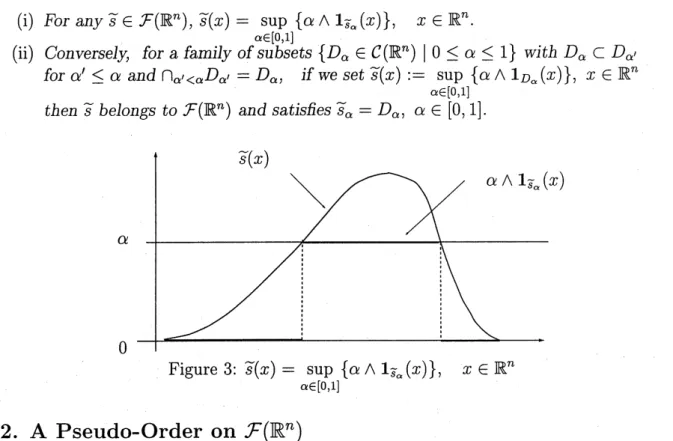
representative theorem (cf. [7, 10]).(i) For any$\overline{s}\in \mathcal{F}(\mathbb{R}^{n}),$ $\overline{s}(X)=\sup$
{
$\alpha$A $1_{\overline{s}_{\alpha}}(x)$},
$x\in \mathbb{R}^{n}$. $\alpha\in[0,1]$(ii) Conversely, for
a
$f\mathrm{a}\mathrm{m}ily$ of$su$bsets $\{D_{\alpha}\in C(\mathbb{R}^{n})|0\leq\alpha\leq 1\}$ with $D_{\alpha}\subset D_{\alpha’}$for $\alpha’\leq\alpha$ and $\bigcap_{\alpha’<\alpha}D_{\alpha^{J}}=D_{\alpha}$, if
we
set$\overline{S}(X):=\sup_{\alpha\in[0,1]}$
{
$\alpha$ A $1_{D_{\alpha}}(x)$
},
$x\in \mathbb{R}^{n}$then $\overline{s}$ belongs to $F(\mathbb{R}^{n})$ and
sa
tisfies $\overline{s}_{\alpha}=D_{\alpha},$ $\alpha\in[0,1]$.2. A
Pseudo-Order
on
$\mathcal{F}(\mathbb{R}^{n})$In this section,
we
reviewa
pseudo order introduced by [7] and give a related resultnecessary in the sequel. Henceforth
we
assume
that theconvex cone
$K\subset \mathbb{R}^{n}$ is given. Apseudo order $\neg K\prec$
on
$C(\mathbb{R}^{n})$ is defined, whose idea is basedon a
set-relation treated in [8],as follows.
For$A,$ $B\in C(\mathbb{R}^{n}),$ $A\neg\prec_{K}B\mathrm{m}e$
ans
the following (C.a) and (C.b) :(C.a) For any $x\in A$, there exists $y\in B$ such that $x\prec_{\neg K}y$.
(C.b) For any$y\in B$, there exists $x\in A$ such that $x\neg\prec_{K}y$.
$A$
(C.a) (C.b)
When $K=\mathbb{R}_{+}^{n}$, the relation $\neg K\prec$
on
$C(\mathbb{R}^{n})$ will be written simply by $\neg n\prec$ withsome
abuse of notation and for $[x, y],$ $[x^{J\prime}, y]\in C_{r}(\mathbb{R}^{n}),$ $[x, y]\neg n\prec[x’, y]’$
means
$x\neg n\prec x’$ and $y\neg n\prec y’$. Note that $\neg n\prec$on
$C(\mathbb{R}^{n})$ is partial order.Using a pseudo order $\neg K\prec$ on $\mathbb{R}^{n}$,
a
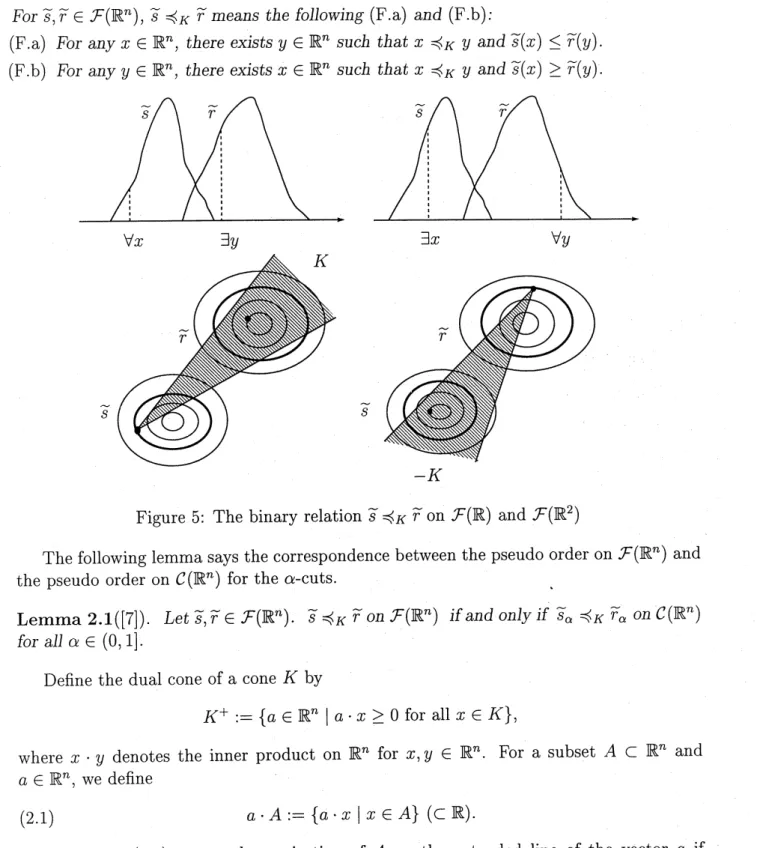
pseudo order $\neg K\prec$ on $F(\mathbb{R}^{n})$ is defined as follows.$Forsr\sim,$$\sim\in F(\mathbb{R}^{n}),$ $\overline{s}\neg\prec_{K}\overline{r}$ me
ans
the followi$\mathrm{n}g$ (F.a) and (F.b):(F.a) For any$x\in \mathbb{R}^{n}$, there exists $y\in \mathbb{R}^{n}$ such that $x\neg K\prec y$ an$d\overline{s}(x)\leq\overline{r}(y)$.
(F.b) For any $y\in \mathbb{R}^{n}$, there exists $x\in \mathbb{R}^{n}$ such that $x\neg K\prec y$ an$d_{S}^{\sim}(x)\geq\sim r(y)$.
$3x$ $\nabla y$
Figure 5: The binary relation $\overline{S}_{\neg K}\prec\overline{r}$
on
$\mathcal{F}(\mathbb{R})$ and $F(\mathbb{R}^{2})$The following lemmasays the correspondence between the pseudo order on $\mathcal{F}(\mathbb{R}^{n})$ and
the pseudo order on $C(\mathbb{R}^{n})$ for the $\alpha$-cuts.
Lemma 2.1([7]). Let $\overline{s},$$\overline{\gamma}\in \mathcal{F}(\mathbb{R}^{n})$. $\overline{s}\neg\prec_{K}r\sim$
on
$\mathcal{F}(\mathbb{R}^{n})$ if and on$l\mathrm{y}$$i\mathrm{f}\sim s_{\alpha}\neg\prec_{K}\overline{r}_{\alpha}$on $C(\mathbb{R}^{n})$for all $\alpha\in(0,1]$.
Define the dual
cone
of acone
$K$ by$K^{+}.--$
{
$a\in \mathbb{R}^{n}|a\cdot x\geq 0$ for all $x\in K$},
where $x\cdot y$ denotes the inner product on
$\mathbb{R}^{n}$ for
$x,$$y\in \mathbb{R}^{n}$. For a subset $A\subset \mathbb{R}^{n}$ and $a\in \mathbb{R}^{n}$, we define
(2.1) $a\cdot A:=\{a\cdot x|x\in \mathrm{A}\}(\subset \mathbb{R})$
The equation (2.1)
means
the projection of $A$on
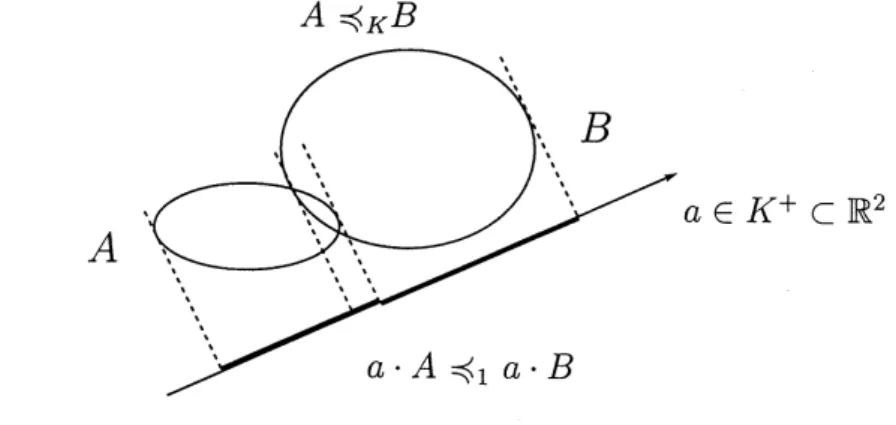
the extended line of the $\mathrm{v}e$ctor $a$ ifLemma $2.2([7])$. Let $A,$$B\in C(\mathbb{R}^{n})$. $A\neg K\prec B$ on $C(\mathbb{R}^{n})$ if and only if $a\cdot A\neg 1\prec a\cdot B$ on
$C(\mathbb{R})$ for all$a\in K^{+}$.
$A\prec_{-\Gamma\nearrow}R$
$A$
Figure 6: The image ofLemma 2.2
For $a\in \mathbb{R}^{n}$ and $\overline{s}\in F(\mathbb{R}^{n})$, we define a fuzzy number $a\cdot s\sim\in \mathcal{F}(\mathbb{R})$ by
(2.2) $a \cdot\overline{s}(x):=\sup_{\alpha\in[0,1]}\mathrm{m}\mathrm{i}\mathrm{n}\mathrm{f}\alpha,$
$1a\cdot\overline{S}_{\alpha}(x)\}$, $x\in \mathbb{R}$.
The following theorem gives the correspondence between the pseudo-order $\neg K\prec$
on
$F(\mathbb{R}^{n})$ and the fuzzy $\max$ order $\neg 1\prec$
on
$\mathcal{F}(\mathbb{R})$.Lemma 2.3 ([7]). For $\overline{s},$$r\sim\in F(\mathbb{R}^{n}),$ $\overline{s}\neg\prec_{K}r\sim if$and onlyif $a\cdot s\neg\prec_{1}\sim a\cdot\overline{r}$ for all$a\in K^{+}$.
$a\cdot s\neg\prec_{1}a\cdot r$
Figure 7: The image of Lemma 2.3
A closed
cone
$K$ is said to be acute (cf. [12]) if there exists an $a\in \mathbb{R}^{n}$ such that$a\cdot x>0$ for all $x\in K$ with $x\neq 0$. We have the following lemma.
Lemma 2.4. Let $K$ be a closed, $ac\mathrm{u}te$
convex
cone and $x_{0},$ $y_{0}\in \mathbb{R}^{n}$ with $x_{0}\prec_{\neg K}y_{0}$.Let $\rho$ be the Hausdorff metric on $C(\mathbb{R}^{n})$, that is, for $A,$ $B\in C(\mathbb{R}^{n}),$ $\rho(A, B)=$
$\max_{a\in A}d(a, B)\vee\max d(bb\in B’ A)$, where $d$is a metric in $\mathbb{R}^{n}$ and
$d(x, Y)= \min_{y\in Y}d(x, y)$ for $x\in \mathbb{R}^{n}$
and $Y\in C(\mathbb{R}^{n})$. It is well-known that $(C(\mathbb{R}^{n}), \rho)$ is a complete metric space. A sequence $\{D\ell\}_{\ell=1}^{\infty}\subset C(\mathbb{R}^{n})$ converges to $D\in C(\mathbb{R}^{n})$ w.r.t. $\rho$ if$\rho(D_{\ell}, D)arrow \mathrm{O}$ as $parrow\infty$.
Definition(Convergence offuzzy set, [17]).
For $\{\overline{s}_{l}\}_{\ell}\infty=1\subset F(\mathbb{R}^{n})$ and $\overline{r}\in \mathcal{F}(\mathbb{R}^{n}),\overline{s_{l}}$
converges
to $\overline{r}W.r.t$.
$\rho$ if $\rho(\overline{s}_{f\alpha},, \overline{r}_{\alpha})arrow 0$
as
$\ellarrow\infty$ except at $\mathrm{m}ost$ countable $\alpha\in[0,1]$.
3. Sequences
in
$C(\mathbb{R}^{n})$In this section, restricting $C(\mathbb{R}^{n})$ into the subclass by
use
of the concept of determiningclass,
we
prove the monotone convergence theorem.Let $K$ be a convex
cone.
The sequence $\{D_{f}\}_{\ell}\infty=1\subset C(\mathbb{R}^{n})$ is said to be bounded w.r.t.$\prec_{\neg K}$ ifthere exists $F,$$D\in C(\mathbb{R}^{n})$ such that $F\neg K\prec D_{f}\neg K\prec D$ for all $\ell\geq 1$ and said to be
monotone w.r.t. $\neg K\prec$ if$D_{1}\neg K\prec D_{2}\neg K\prec\ldots$
.
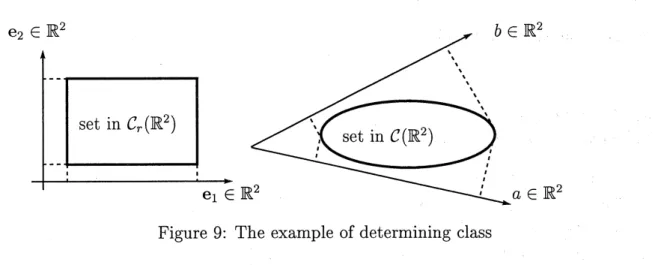
Let $L\subset C(\mathbb{R}^{n})$ and $A\subset \mathbb{R}^{n}$. Then we say that $A$ is a determining class for $L$ if $a\cdot D=a$ , $F$ for all $a\in A$ and $D,$$F\in,\mathbb{C}$ implies $D=F$. For example, the set of unit
vectors $\{\mathrm{e}_{1}, \mathrm{e}_{2}, , . . , \mathrm{e}_{n}\}$ in $\mathbb{R}^{n}$ is
a
determining class for $C_{r}(\mathbb{R}^{n})$. Also, by the separationtheorem, $\mathbb{R}^{n}$ is a determining class for $C(\mathbb{R}^{n})$.
Figure 9: The example of determining class
Theorem 3.1. Let $K$ bea closed convex cone of$\mathbb{R}^{n}$. Suppose that $K^{+}$ is a determining
classfor $L\subset C(\mathbb{R}^{n})$. Then, the pseudo order $\neg K\prec$ becomes a$p$arti$\mathrm{a}l$ order in the restricted
class L.
As a simple application of Theorem 3.1, we have the following.
Corollary 3.1. Let $K$ be
a
closedconvex cone
of$\mathbb{R}^{n}$ and $L\subset C(\mathbb{R}^{n})$ closed. Supposethat $K^{+}$ is a determining class for L. Then, any sequen
ce
$\{D_{l}\}\subset L$ which is $\mathrm{m}$onotone$w.r.t$. $\neg K\prec$ and satisfies $D_{l}\subset X(l\geq 1)$ for
some
compact subset$X$ of$\mathbb{R}^{n}$ converges $w.r.t$.
$\rho$.
In order to continue a further discussion, we need the acuteness of the ordering cone
We have the following.
Lemma3.1. Let$K$ be
a
closed, acuteconvex
cone
and$D,$$F,$ $G\in C(\mathbb{R}^{n})$ with$D\prec F\prec G\neg K\neg K$.Let (3.1)
$X:=x \in D\bigcup_{x\prec_{Ky}\neg},y\in G(x+K)\cap(y-K)$
.
Then, it holds that $F\subset X$ and $X$ is bounded.
Theorem 3.2. Let $K$ be a closed, $ac\mathrm{u}te$
convex
cone of $\mathbb{R}^{n}$ and $L\subset C(\mathbb{R}^{n})$ closed.Suppose that $K^{+}$ is a determining class for L. Then, any seq$\mathrm{u}$ence $\{D_{l}\}^{\infty}\iota=1\subset L$ which is
bounded and $\mathrm{m}$onotone $w.\mathrm{r}.6$. $\neg K\prec$
converges
$w.r.t$. $\rho$.As applications of Theorem 3.2, we have the following Corollaries.
Corollary 3.3. Anysequ
ence
in $C_{r}(\mathbb{R}^{n})$ with $\mathrm{m}$onotonicity and boundedness $w.\mathrm{r}.t$. $\neg n\prec$converges $w.r.t$. $\rho$.
For any $D\in C(\mathbb{R}^{n})$ and $\xi>0$, the $\epsilon$-closed neighborhood of$D$ will be denoted by
(3.2) $S_{\epsilon}(D):=\{x\in \mathbb{R}^{n}|d(x, D)\leq\in\}$,
which is
a
compactconvex
subset of$\mathbb{R}^{n}$. Note that(3.3) $s_{\epsilon}(D)=D+\xi U0$,
where $U_{0}$ is the closed unit ball (cf. [2]).
The following lemma is useful in the sequel. Lemma 3.2. The following (i) to (iii) hold.
(i) For any $D,$$F\in C(\mathbb{R}^{n})$, if$S_{\delta_{1}}(D)\subset S_{\delta_{2}}(F)$ for
some
$\delta_{1},$$\delta_{2}\geq 0$,then $S_{\delta_{1}+\mathit{6}}(D)\subset S_{\delta_{2}+\epsilon}(F)$ for any$\epsilon\geq 0$.
(ii) For any $D\in C(\mathbb{R}^{n})$ and $\lambda>0,$ $S_{\xi}i(\lambda D)=\lambda s_{/\lambda}\epsilon(D)$.
(iii) For any sequence $\{D_{l}\}\subset C(\mathbb{R}^{n})$ and $D\in C(\mathbb{R}^{n})$, if$D_{l}arrow D$
as
$larrow\infty$,then $S_{\delta}(D_{\iota)}arrow S_{\delta}(D)$
as
$larrow\infty(\delta\geq 0)$.For any closed
convex cone
$K\subset \mathbb{R}^{n}$, let $L(K^{+})$ be the set of all $D\in C(\mathbb{R}^{n})$ satisfyingthat for any $x_{0}\in \mathbb{R}^{n}$ and $\epsilon>0$ with $x_{0}\not\in S_{\epsilon}(D)$ there exists $a\in K^{+}(a\neq 0)$ such that
$a\cdot y\geq a\cdot x_{0}$ for all $y\in S_{\epsilon}(D)$.
The properties of$L(K^{+})$
are
stated in the following lemma.Lemma 3.3. The following (i) to (iii) hold.
(i) $K^{+}$ is a determiningclass for $L(K^{+})$.
(iii) For any $D\in L(K^{+}),$ $\lambda D+\mu D\in \mathcal{L}(K^{+})(\lambda, \mu\geq 0)$.
Noting that $K^{+}=\mathbb{R}_{+}^{2}$ when $K=\mathbb{R}_{+}^{2}$ in $\mathbb{R}^{2}$, the
sets included in $L(\mathbb{R}_{+}^{2})$ are illustrated
in Figure 10.
Theorem 3.3. Let $K$ be
a
closed, acuteconvex
cone
of $\mathbb{R}^{n}$. Then, any sequence$\{D_{l}\}^{\infty}\iota=1\subset L(K^{+})$ which is bounded and $\mathrm{m}$onotone $w.r.t$. $\neg K\prec$ converges $w.r.t$. $\rho$.
4. Sequences
in
$\mathcal{F}(\mathbb{R}^{n})$In this section, the monotone convergence theorem for
a
sequence in $\mathcal{F}(\mathbb{R}^{n})-$ is given.Let $\overline{L}\subset \mathcal{F}(\mathbb{R}^{n})$ and $A\subset \mathbb{R}^{n}$. Then we call $A$ a determining class for ,$\mathrm{C}$ if $a\cdot\overline{s}=a\cdot\overline{r}$
for all $a\in A$ and $\overline{s},$
$r\sim\in,\sim \mathrm{C}$
implies $\overline{s}=\overline{r}$.
A natural extension of Theorem 3.1 to fuzzy sets will be given in the following theorem.
Theorem 4.1. Let $K$ be a closed convex
cone
of$\mathbb{R}^{n}$ and $\overline{L}\subset F(\mathbb{R}^{n})$.$S\mathrm{u}p\underline{p}oSe$ that $K^{+}$
$is$ a determining $cl\mathrm{a}SS$ for $\overline{L}$
. Then, a pseudo order $\neg\prec K$ is a partial order in $L$.
Let $K$ be
a
convex
cone. The sequence $\{\overline{s}_{l}\}\subset F(\mathbb{R}^{n})$ is said to be bounded w.r.t. $\neg K\prec$if there $\mathrm{e}\mathrm{x}\mathrm{i}_{\mathrm{S}}\mathrm{t}_{\mathrm{S}u},$$\overline{v}\sim\in F(\mathbb{R}^{n})$ such that $\overline{u}\neg\prec_{K}s_{\iota}\sim\neg\prec_{K}\overline{v}\mathrm{f}_{0}\mathrm{r}$all $l\geq 1$ and said to be monotone
w.r.t.
$..$
$\neg K\prec$ if$\overline{s}_{1}\neg K\prec\overline{s}_{2}\neg K\prec\ldots$
.
In order to obtain theconvergence theorem,
we
need the concept of directionality givenin [17]. Denote thesurface of the unit ball by $U:=\{x\in \mathbb{R}^{n}|||x||=1\}$. Let $V\subset U$. Then,
for $D,$$D’\in C(\mathbb{R}^{n})$ with $D\subset D’$, we call $D’V$-directional to $D$ (written by $D’\supset_{V}D$) if
there exists
a
real $\lambda>0,$$y\in D$ and $z\in D’$ such that(i) $d(z, y)=\rho(D’, D)$ and (ii) $z-y=\lambda v$ for
some
$v\in V$.Definition (V-directional). Let $V\subset \mathbb{R}^{n}.$ For$\overline{s}\in F(\mathbb{R}^{n}),$ $\overline{s}$ is called
$V$-direction$\mathrm{a}l$ if
$\sim s_{\alpha}\supset_{V}\overline{s}_{\alpha}$; for $0\leq\alpha\leq\alpha’\leq 1$.
Corollary 4.1. Let $K$ be a closed $con$vex cone of$\mathbb{R}^{n}$ and $\tilde{L}\subset F(\mathbb{R}^{n})$ closed. Suppose
that $K^{+}$ is a determining $cl\mathrm{a}SS$ for $\overline{L}$
. Let a sequence $\{\overline{s}_{l}\}\subset F(\mathbb{R}^{n})$ be satisfied that
(b) $each_{\overline{S}}\iota$ is $V$-directional for
a
finite set $V\subset \mathbb{R}^{n}$ and(c) there exists a compact subset $D$ of$\mathbb{R}^{n}$ such that $\overline{s}\iota 0\subset D$ for all $l\geq 1,$ where $\overline{s}_{l0}$ is
the support or the $0$-cut $of\overline{s}_{l}$.
Then the sequence $\{\overline{s}_{l}\}$ converges $w.r.t$. $\rho$.
The following monotoneconvergence theorem is thought of
as an
extension of Theorem3.2 to fuzzy sets.
Theorem 4.2. Let $K$ be a closed, acute
convex cone
of$\mathbb{R}^{n}$ and $\overline{L}\subset \mathcal{F}(\mathbb{R}^{n})$ closed.Suppose that $K^{+}$ is a determining class for $\overline{L}$
closed. Then, any sequence $\{\overline{s}_{\iota\}_{l}^{\infty}}=1\subset\overline{L}$
which satisfies (a) and $(b)$ in Corollary 4.1 converges $w.r.t$. $\rho$.
Now, for any closed
convex cone
$K$, we define $\overline{L}(K^{+})$ by$\overline{L}(K^{+}):=$
{
$\overline{s}\in \mathcal{F}(\mathbb{R}^{n})|s_{\alpha}\sim\in L(K^{+})$ for all $\alpha\in[0,1]$}.
The previous Lemma 3.3 is extended to that for $\mathcal{F}(\mathbb{R}^{n})$ in the following lemma.
Lemma 4.1. The following (i) to (iii) hold. (i) $K^{+}$ is a determining class for $\overline{L}(K^{+})$.
(ii) $\overline{L}(K^{+})$ is closed $w.r.t$. the convergence defined in Section 2.
(iii) For any $\overline{s}\in\overline{L}(K^{+}),$ $\lambda\overline{s}+\mu\overline{s}\in\overline{L}(K^{+})(\lambda, \mu\geq 0)$.
We have the following.
Theorem 4.3. Let $K^{+}$ be
a
closed, acuteconvex cone
of$\mathbb{R}^{n}$. Then, any sequence
$\{\overline{s_{l}}\}_{l1}\infty=\subset\overline{L}(K^{+})$ which
sa
tisfies (a) and (b) in Corollary 4.1 converges.5. Applications to Monotone Dynamic
Fuzzy Systems
In this section,
as
an application of the results obtained in the preceding section, weconsider
a
limit theorem fora
sequence of fuzzy states defined by the dynamic fuzzysystem (cf. [5, 6, 14, 15, 16, 17]) with
a
monotone fuzzy relation.Let $\overline{q}:\mathbb{R}^{n}\cross \mathbb{R}^{n}arrow[0,1]$ be
a
continuous fuzzy relation such that $\overline{q}(x, \cdot)\in F(\mathbb{R}^{n})$ foreach $x\in \mathbb{R}^{n}$ and
$q$
is convex, that is,(5.1) $\overline{q}(\lambda X^{1}+(1-\lambda)X^{2}, \lambda y^{1}+(1-\lambda)y)2\geq\overline{q}(x^{1}, y^{1})$ A $\overline{q}(x^{2}, y^{2})$
for any $x^{1},$ $x^{2},$ $y^{1},$ $y^{2}\in \mathbb{R}^{n}$ and $\lambda\in[0,1]$. From this fuzzy relation $\overline{q}$, we define $\overline{q}:F(\mathbb{R}^{n})arrow$
{the
set of fuzzy sets on $\mathbb{R}^{n}$}
as follows.(5.2) $\overline{q}(\overline{u})(y)$
$:= \sup_{\mathbb{R}^{n}x\in}$
{
$\overline{u}(_{X)}$ A $\overline{q}(x,$$y)$
}
$,$
$\in \mathbb{R}^{n}$,
where $a$ A $b= \min\{a, b\}$. Also, for any $\alpha\in[0,1],\overline{q}_{\alpha}$ :
$C(\mathbb{R}^{n})arrow 2^{\mathbb{R}^{n}}$ will be defined by
(5.3) $\overline{q}_{\alpha}(D):=\{$
{
$y|\overline{q}(x,$$y)\geq\alpha$ for
some
$x\in D$},
for $\alpha>0,$ $D\in C(\mathbb{R}^{n})$ $\mathrm{c}1${
$y|\overline{q}(x,$ $y)>0$ forsome
$x\in D$},
for $\alpha=0,$ $D\in C(\mathbb{R}^{n})$,where cl denotes the closure of a set and $2^{\mathbb{R}^{n}}$
the set of all closed subsets of $\mathbb{R}^{n}$. For
simplicity, we put $q(\sim x):=\overline{q}(\{x\})$ for $x\in \mathbb{R}^{n}$.
The following facts are well-known (cf. [4, 5, 17]).
Lemma 5.1 The following (i) to (iii) hold.
(i) $\overline{q}_{\alpha}(D)\in C(\mathbb{R}^{n})$ for any$D\in C(\mathbb{R}^{n})$ and$\overline{q}_{\alpha}(\cdot)$ is contin
uous
in$C(\mathbb{R}^{n})$ for each $\alpha\in(0,1]$. (ii) $\overline{q}(\overline{u})\in F(\mathbb{R}^{n})$ for any $\overline{u}\in F(\mathbb{R}^{n})$.(iii) $\overline{q}(\overline{u})_{\alpha}=q_{\alpha}(\sim\overline{u})_{\alpha}$ for any$u\sim\in \mathcal{F}(\mathbb{R}^{n})$ and $\alpha\in[0,1]$, where $\overline{q}(\overline{u})_{\alpha}$ is the $\alpha$-cut of$q(\sim\overline{u})$.
The sequence of fuzzy states, $\{\overline{s}_{t}\}_{t=1}^{\infty}\subset F(\mathbb{R}^{n})$, for the dynamic system with fuzzy
transition $\overline{q}$is defined
as
follows.(5.4) $\sim_{\iota+1\overline{q}(}s=\overline{S}_{t})$ $(t\geq 1)$,
where $\overline{S}_{1}\in \mathcal{F}(\mathbb{R}^{n})$ is the initial fuzzy state.
The problem in this section is to consider a convergence of the sequence $\{s_{t}\}_{t=1}^{\infty}\sim$ defined
by (5.4),
so
thatwe
derive the monotone property ofthe fuzzy relation $\overline{q}\mathrm{w}.\mathrm{r}.\mathrm{t}$. the pseudoorder $\neg\prec K$ defined by the ordering
cone
$K$ in $\mathbb{R}^{n}$.Definition ($\neg\prec_{K}$-monotone). The fuzzy relation $\overline{q}$is called
$\neg K\prec$-monotone
if $x^{1}\prec_{\neg K}x^{2}$ $(x^{1}, x^{2}\in \mathbb{R}^{n})$
means
$q(\sim x^{1}, \cdot)\neg K\prec\overline{q}(x^{2}, \cdot)$.Remark. Yoshida et al [17] has introduced
a
monotone property concerning the fuzzyrelation $\overline{q}\mathrm{w}\mathrm{h}\mathrm{o}\mathrm{S}\mathrm{e}$ definition is
as
follows: $\overline{q}_{\alpha}(y)\subset q_{\alpha}(\sim x)+\ell(x, y)$ for$x,$$y\in \mathbb{R}^{n}$, where
$\ell(x, y):=\{\gamma(y-x)|\gamma\geq 0\}$. Obviously, if$\overline{q}$is monotone in the
sense
of [17], then $\overline{q}$is$\neg n\prec$-monotone, but the
converse
is not necessarily true.The following lemma is useful for
our
further discussion.Lemma 5.2. Suppose that $q\prec\sim_{i\mathrm{s}_{\neg K}}$-monotone. Then, for
$a,n.yu,$$\overline{v}\sim\in F(\mathbb{R}^{n})$ with
$\overline{u}\neg\prec_{K}\overline{v}$,
it holds that $\overline{q}(u)\sim\neg K\prec\overline{q}(v)\sim$.
Assumption A. The following (i) to (iii) hold.
(i) The $ord$eringcone $K$ is
a
$cloSed$, acuteconvex
one in $\mathbb{R}^{n}$.(ii) The fuzzy$rel$ation $qis\sim\prec_{\neg K}$-monotone.
(iii) There exists a finite subset $V\subset U$ such that, for any $D,$ $D’\in C(\mathbb{R}^{n})(D’\supset D)$, if
$D’\supset_{V}D$ then $\overline{q}_{\alpha’}(D’)\supset_{V\overline{q}_{\alpha}}(D)$ for all $\alpha,$ $\alpha’(0\leq\alpha’\leq\alpha\leq 1)$.
1 ,$\cdot$ . .
For any given $\overline{u}\in F(\mathbb{R}^{n}),$ putting $\overline{s}_{1}:=\overline{u}$,
we
define the sequence $\{s_{t}\}_{t=1}^{\infty}\sim$ by (5.4).Then,
we
have the following.Theorem 5.1. In addition to Assumption $A$, suppose that the following (iv) to (vi) hold.
(iv) $\overline{u}\in\overline{L}(K^{+})$ and $\overline{u}\neg\prec_{K}\overline{q}(\overline{u})$.
(vi) $\{s_{t}\}\sim\subset\tilde{L}(K^{+})$ and bounded from above.
Then, thesequence$\{\overline{s}_{t}\}$ converges andthe limit $\overline{s}:=\lim_{tarrow\infty^{S_{l}}}\sim$
sa
tisfies the following fuzzy$rel$
a
tion$\mathrm{a}l$ equation:(5.5) $\sim\sim s=q(\overline{s})$.
Theorem 5.2. In addition to Assumption $A$, suppose that the following $(\mathrm{i}\mathrm{v}’),$ $(\mathrm{v})$ an$d$
$(\mathrm{v}\mathrm{i}’)$ hold.
$(\mathrm{i}\mathrm{v}’)u\sim\in\overline{L}(K^{+})$ with $u_{0}\sim\subset K$ and $\overline{q}(\overline{u})\neg\prec_{K}\overline{u}$.
(v) $\overline{u}_{\alpha’}\supset_{V}q_{\alpha}\sim$ for all
$\alpha,$$\alpha’(0\leq\alpha’\leq\alpha\leq 1))$, where $V$ is as in Assumption A(iii).
$(\mathrm{v}\mathrm{i}’)$
. $\{\overline{S}_{t}\}\subset\tilde{L}(K^{+})$.
Then, the sequence$\{\overline{s}_{t}\}$ convergesand the$limit \overline{s}:=\lim_{tarrow\infty^{\overline{S}}t}$
sa
tisfies the fuzzy$rel$ation$\mathrm{a}l$equation (5.5).
As
an
example of $\neg K\prec$-monotone fuzzy relation, we put the fuzzy relation $\overline{q}$by(5.6) $\overline{q}(x, y):=r(\sim y)+\beta 1_{\{\}}x$ $(x, y\in \mathbb{R}^{n})$,
$\mathrm{w}\mathrm{h}\mathrm{e}\mathrm{r}\mathrm{e}\sim r\in\overline{L}(K^{+})$ with $\overline{r}_{\alpha’}\supset_{V}\overline{r}_{\alpha}$ for
some
finite set $V\subset U$ and$\alpha,$$\alpha’(0\leq\alpha’\leq\alpha\leq 1)$
and $0<\beta<1$.
Obviously, Assumption A is satisfies for $q\mathrm{o}\mathrm{f}\sim(5.6)$. Also, we observe from Lemma 4.1
that the assumptions (iv) to (vi) in Theorem 5.1 hold $\mathrm{f}\mathrm{o}\mathrm{r}u\sim=\overline{r}$. So that by Theorem 5.1,
the sequence $\{\overline{s}_{t}\}$ defined by (5.4) $\mathrm{w}\mathrm{i}\mathrm{t}\mathrm{h}_{\overline{S}_{1}}=\sim r$converges.
Remark. Note that the fuzzy relation $q\mathrm{o}\mathrm{f}\sim(5.6)$ satisfies the contraction property
intro-duced in [4]. Thus,
we see
that the limit $\overline{s}=\lim_{tarrow\infty^{s_{t}}}\sim$ isa
unique solution of the fuzzyrelational equation (5.5) and given $\mathrm{b}\mathrm{y}s\sim=(1-\beta)^{-1}\overline{r}$.
Example. We give
a
one-dimensional numerical example whose fuzzy relation $\overline{q}$is givenby
$\overline{q}(x, y)=(1-2|y-(3-X^{-2})|)\vee 0$ $(x>0)$.
For $\alpha\in[0,1]$, it holds that by (5.3)
$\overline{q}_{\alpha}(x)=[3-(1-\alpha)2-1-x-2,3+(1-\alpha)2^{-1}-X^{-2}]$.
This is illustrated in Figure 2. So,
we
observe that $\overline{q}$is $\prec_{\neg 1}$-monotone in $(0, \infty)\cross(0, \infty)$,also that $1_{\{1\}}\neg\prec 1\overline{q}(1_{i}1\})$ and $\overline{q}(x, \cdot)\neg 1\prec 1_{\{7/2\}(x})$.
Applying Theorem 5.1, the sequence $\{\overline{s}_{t}(X)\}$ defined by (5.4) with $\sim s_{1}(x)=1_{\{1\}}(x)$
converges. The
convergence
is shown in Figure 2 and 3 with the limit $\overline{s}(X)=\lim_{tarrow\infty}S_{t}(\sim)X$,where the $\alpha$-cut $\sim s_{\alpha}$ of the limit $\overline{s}(x)$ for $\alpha=0$ and $\alpha=1$
are
$\min\overline{s}_{0}=$ 2.313099034,Figure 11: $q_{\alpha}(\sim x)$ and the limit $\overline{s}(X)$ of $\{\overline{s}_{t}(X)\}$
Figure 12: The sequence $\{\overline{s}_{t}(X)\}$
References
[1] W.Congxin and C.Cong, “The supremum and infimum of the set of fuzzy numbers
[2] P.Diamond and P.Kloeden, Metric Spaces
of
Fuzzy $Sets_{\mathrm{z}}$ Theory and Applications(World Scientific, 1994).
[3] N.Furukawa, “Parametric orders
on
fuzzy numbers and their roles in fuzzyoptimiza-tion problems,” Optimization 40 (1997) 171-192.
[4] M.Kurano, M.Yasuda, J.Nakagami andY.Yoshida, “A limittheorem insome dynamic
fuzzy systems,” Fuzzy Sets and Systems 51 (1992) 83-88.
[5] M.Kurano, M.Yasuda, J.Nakagami and Y.Yoshida, “Markov-type fuzzy decision
pro-cesses
witha
discounted reward on a closedinterval,” European Journalof
OperationsResearch 92 (1996)
649-662.
[6] M.Kurano, M.Yasuda, J.Nakagami and Y.Yoshida, “The time average reward for
some dynamic fuzzy systems,” Computers and Mathematics with Applications 37
(1999) 77-86.
[7] M.Kurano, M.Yasuda, J.Nakagami and Y.Yoshida, “Ordering of fuzzy sets–A brief
survey and new results,” J. Operations Research Society
of
Japan 43 No.l (2000)138-148.
[8] D.Kuroiwa, T.Tanaka and T.X.D.Ha, “On
cone
convexity of set-valued maps,”Non-linear Analysis, Theory $\xi y$ Applications 30 (1997) 1487-1496.
[9] Nanda,S., $‘\zeta \mathrm{O}\mathrm{n}$ sequences of fuzzy numbers”, Fuzzy Sets and Systems 33 (1989)
123-126.
[10] V.Nov\’ak, Fuzzy Sets and Their Applications (Adam Hilder, Bristol-Boston, 1989).
[11] J.Ram\’ik and
J.\v{R}im\’anek,
“Inequality relation between fuzzy numbers and its use infuzzy optimization,” Fuzzy Sets and Systems 16 (1985) 123-138.
[12] J.Stoer and C.Witzgall, Convexity and Optimization in Finite Dimensions $I$
(Springer-Verlag, Berlin and New York, 1970).
[13] Y.R.Syau, “Sequences in
a
fuzzy metric space,” Computers and Mathematics withApplications 33 (1997) 73-76.
[14] Y.Yoshida, M.Yasuda, J.Nakagami and M.Kurano, “A potential of fuzzy relations
with a linear structure: The contractive case,” Fuzzy sets and Systems 60 (1993)
283-294.
[15] Y.Yoshida, M.Yasuda, J.Nakagami and $\mathrm{M}.\mathrm{K}\mathrm{u}\mathrm{r}\mathrm{a}\mathrm{n}\mathrm{o}$
)”
“A potential of fuzzy relations
with a linear structure: The unbounded case, Fuzzy sets and Systems 66 (1994)
83-96.
[16] Y.Yoshida, “A time-average fuzzy reward criterion in fuzzy decision processes,)’
In-formation
Sci. 110 (1998) 103-112.[17] Y.Yoshida, M.Yasuda, J.Nakagami and M.Kurano, “A limit theorem in dynamic fuzzy
systems with a monotone property,” Fuzzy sets and Systems 94 (1998) 109-119.
[18] L.A.Zadeh, “Fuzzy sets,”
Inform.
and Control 8 (1965) 338-353.[19] K.Zhang and K.Hirota, “On fuzzy number lattice $(\tilde{R}, \neg\prec),’)$ Fuzzy sets and Systems