Geology, Mineralogy and Paragenesis of the
Bentonite Deposit in Balamban, Cebu Province,
Philippines
著者
ALETA Dennis Gerald A., TOMITA Katsutoshi,
KAWANO Motoharu
journal or
publication title
鹿児島大学理学部紀要=Reports of the Faculty of
Science, Kagoshima University
volume
32
page range
43-54
Bentonite Deposit in Balamban, Cebu Province,
Philippines
著者
ALETA Dennis Gerald A., TOMITA Katsutoshi,
KAWANO Motoharu
journal or
publication title
鹿児島大学理学部紀要=Reports of the Faculty of
Science, Kagoshima University
volume
32
page range
43-54
Rep. Fac. ScL, Kagoshima Univ. No. 32, 43-54, 1999.
Geology, Mineralogy and Paragenesis of the Bentonite Deposit
in Balamban, Cebu Province, Philippines
Dennis Gerald A. Aletal, Katsutoshi Tomital and Motoharu Kawano
(Received August 26, 1999)
Keywords : Smectite, Mixed-layer kaolinite/smectite, Kaolin, Zeolite, Toledo Formation
Abstract
The bentonite deposit occurs as concordant, lenticular or podiform beds interstratified within the Middle Miocene Toledo Formation, in Balamban, Cebu Province, Philippines. Multiple analytical techniques reveal that the clay constitution of the bentonite is principally smectite minerals. Mixed-layer kaolinite/smectite is also indicative in some specimens. X-ray diffractograms of untreated < 2 fi m fraction oriented samples show that the basal dimension reflections are generally distinct at 16Å to 16.3 A. Ethylene glycol solvation promotes significant expansion of the basal distance to about 17.6A to 18Å. Dehydration and rehydration capacities are attributes of the clays possessed at low temperature ranges but structure collapse and subsequent formation of new mineral phase are determinant characteristics observed at high temperature regimes. Scanning electron micrographs generally exhibit irregular smectite flakes resembling broken "potato chips". Kaolin, mica, and zeolite (probably clinoptilolite) are also found to be associated in minor amounts. The surfaces are uniformly rough and appear to be veneered by micro-scale dessication cracks. The non-phyllosilicates assemblage is dominantly of crystalline quartz, feldspar and calcite. Alteration process appears to be syngenetic and seems to be incident in a marine environment.
Introduction
The exploration of bentonite prospect in Barangay La Mesa, Balamban, Cebu Province, was pioneered by Momongan (1986) in line with the BMG Region 7 Project on canvassing and ore reserve evaluation of bentonite deposits of Cebu Island. His work established initial information on the general descriptions and ore reserves of the bentonite prospect.
Follow-up survey was also conducted by Aleta and Diegor (1995) in connection with bentonite reassessment in central Cebu.
This paper is tailored to offer a review and a general perspective of the bentonite deposit. The
focus is on geology, mineralogy and paragenesis of the bentonite. Newly acquired data on x-ray diffrac-tion (XRD) analysis and scanning electron micros-copy (SEM) will be partially presented. A more elaborate mineralogical analysis data and mterpreta-tions will be made in a separate paper.
Location and Access
The study area is located in Barangay La Mesa, about 9 aerial km or ll road km east of Balamban township. It is bordered by geographic coordinates
10- 30′30〝to loo 31′ 10〝Northlatitudeand 123 46 ′ 30〝 to 123 48′ 00〝 East Longitude and
encom-passes roughly 3 square kilometers.
Major access to the area is available through a
Department of Earth and Environmental Sciences, Faculty of Science, Kagoshima University, 1-21-35 Korimoto, Kagoshima City, 890-0065, Japan.
Department of Environmental Sciences and Technology, Faculty of Agriculture, Kagoshima University, 1-2ト24 Korimoto, Kagoshima City, 890-0065, Japan.
circuitous barangay road that splays into smaller feeder roads, consequently providing service to the other barangays or sitios in the hinterlands. Travel time takes about 1 hour by public utility vehicles plying from the town center to Barangay La Mesa. Road condition is relatively poor, particularly during wet seasons and one could expect rough travel through dirトand gravel-surfaced roads.
Balamban Municipality is approximately 60 road kilometers northwest of Cebu City, the island Province's capital.
Topography
The study area, which is chiefly underlain by Toledo Formation, is generally undulating to rolling and has moderate relief. Some portions are hilly, with conspicuous isolated apices and linear ridges. Flatter grounds are converted to arable lands. Slope gradient probably varies from 5% to 15%. Within the immedト ate confines, peak elevations are about 300 to 360 meters above sea level. Towards the east, the topog-raphy gradually becomes rough and rugged. Valleys are more deeply incised and ridge slopes are steeper. The mountainous areas are generally underlain by volcanics and other older sediments and metamorphics. Towards the west, however, the terrain becomes gentler. Limestone areas do not demonstrate peculiar karstic features. Still farther west, the lowlands, basically underlain by alluvium, are defined by wide floodplains and flat landscapes.
GEOLOGY
The bentonite deposit is hosted by the Middle Miocene Toledo Formation. Figure 1 designates the specific locality of the deposit (and sampling sta-tions) and its spatial and temporal relation to other formational units. Generalized descriptions of the rock formations are chiefly lifted and summarized from BMG, 1982.
Lithology and Stratigraphy
Serpentinized Peridotite
Serpentinized ultramafic and mafic rocks occur-ring as diapiric bodies along principal fault zones. The diapirs intrude younger formations. It can be
seen in the northeastern corner of the study area.
Lutopan Diorite
Large elongated masses of dionte and related mtrusives are mostly in central Cebu. They occur as stocks and dikes intruding the Cretaceous metasediments and metavolcanics. The diontes and the intruded metasediments and metavolcanics are occasionally cut by quartz veinlets carrying base metal sulfides and iron ore minerals, near the imme-diate contact. Coarsely crystalline acidic and basic differentiates of the diorite magma, range from dark, coarse grained or pegmatitic gabbros to almost pure plagioclase pegmatites (Santos-Ynigo, 1951 ).
Mananga Group
The Mananga Group consists of the Cansi Volcanics and Pandan Formation. The Cansi Volcanics is an assemblage of massive lava flows, pillow lavas and breccias. The composition ranges from basalt to basic pyroxene andesite. The Pandan Formation is composed generally of contorted, steeply dipping, metamorphosed limestone, shale, sandstone conglomerate and thm bedded chert.
Luka Formation
Interbedded sandstone and mudstone with conglomerate and limestone lenses. The age is placed as early Middle Miocene.
Uling Limestone
This limestone is generally massive and coralline. The color is typically white although some outcrops show variegated hues from beige to pink. The thickness is about 250 meters at the type locality. The abundance of Austrotrillina howchini (Schlumberger) defines the the age of this formation as early Middle Miocene.
Toledo Formation
The formation consists of fossiliferous conglomeratic limestone at the base and thick, calcareous, tuffaceous and locally bentonitic white shale and sandstone with occasional beds of sandy to conglomeratic limestone and gray brown shale at the
Geology, Mineralogy and Paragenesis of the Bentonite Deposit in Balamban, Cebu Province, Philippines 45 s u o i } B } s S u i i d u i e s o ; p u o d s a x i o o a j S i i B p a j 9 i j ; u i s j b j q E n ^ -A p A T ^ o a d s a j Z -l S L m p u e i -i 9 Z 8 * s o u ; 9 9 q s ' S 9 T S u B J D 吋 コ b A o u v n の P U B U ぷ w v y e m j o s d B i u j B o i S o j o a S . S 3 0 U 9 I D S 0 9 9 p i I E S 3 U T ^ J O n B 3 j n 田 9 u i d d i i m d 9 m E o j j p a j d o p y -s a u i d d i j 芸 d . 9 0 U I A O J J n q 3 Q . u E q u i e i B g u x 1 2 9 . 1 1 2 9 ; i u o ; u 3 q 9 u ; t o d B i n t b o i S o t o 9 0 -t -S i j
upper section. It appears to have a maximum
thick-ness of about 250 meters. Middle Miocene age was given based on the dominance of planktonic Forammifera which includes Orbulina universa dOrgbigny, Globorotalia mayeri Cushman and Ellisor, and Sphaeroidinella seminulina Schwager.
Maingit Formation
The formation is divided into a lower limestone, middle conglomerate and an upper sandstone and shale unit. The basal white limestone occurs in lenticular beds and contains numerous corals and few micro fossils. The conglomerate has pebbles of basement rocks and limestone set in a matrix of sands. Coal stringers and occasional thin beds of limestone are interbedded with the shale and sand-stone in the upper part. The maximum thickness is about 2800 meters. A late Middle to Late Miocene age was given.
Carcar Formation
This Plio-Pleistocene limestone formation typi-cally covers the coastal areas, hill ridges and low to moderate mountain slopes. The formation exempli-lies gentle to moderate dips. Basically this carbonate mass is coralline, porous to massive, poorly bedded to well bedded, and rich in various fossils.
Quaternary Alluvium
Quaternary Alluvium consists of unconsolidated or detntal deposits of fine to coarse sedimentary materials derived from mass wasting of pre-existing rocks. It generally deposits along stream channels, tidal flats, beaches, deltas and marshes.
Structure
Structural features in the project area are
generally in a NE-SW orientation. Varied degree and
intensity of structural events and deformations are reflected in the fault and fold patterns recognizable in the study area. Fault contact is distinct between the Mananga Group and the Toledo Formation and implies the dislocation or truncation of other clastic
strata. Anticline and syncline that trend NW-SE are prominent within the Toledo Formation. The folded
strata of most of the sedimentary formations display varied dips from low to moderate to high angles.
Strikes generally follow NE-SW direction in the
central part of the area, however, some strikes also
exhibit NW-SE trend as seen in the northern corner. Inclined layermgs are chiefly observed in Mananga Group.
General Description of the Bentonite Deposit The characterization and description are essentially abridgement from the findings of
Momongan (1986) and Aleta & Diegor (1995). The
bentonite deposit is generally delineated as seams, concordant with the interstratification of calcareous and tuffaceous shale and sandstone and other argillaceous sediments. The seams oftentimes exhibit pinch and swell characteristic. Several other out-crops depict discontinuous lenses or pods that are vertically and laterally separated. The size of seams basically varies from one outcrop to another. Some measurements conducted suggest that on the average, width ranges from 4-20 meters and length from several meters to roughly 150-200 meters. Smaller beds are about 2-4 meters wide and elongation of 6-10 meters. The biggest single seam measuredso far, has a width of about 50 meters and a length of approximately 250-300 meters (Momongan, 1986). Thickness of the seams is from few centimeters (10-20 cm) and barely exceed one (1) meter. The color displays variegated tones of gray, green, cream, and yellow. Fresh outcrops give waxy or soapy appearance and texture. Fissility is commonly well defined and conchoidal fracture is normally conspicuous, especially in fresh samples. On brief exposure to air, the bentonite easily deveト ops shrinkage cracks due to drying and eventually turns disaggregated and pulverized. Some samples readily slake and disperse in water, while other more indurated and silicified varieties take longer time to disaggregate. Wet specimens give slight to moderate plasticity. Previous XRD analysis (Momongan,
1986), showed that the minerals of bentonite grade from pure montmorillonite to a bentonite consisting of montmorillonite, zeolite (?), and other accessory minerals of calcite, plagioclase, and quartz. Cation
Geology, Mineralogy and Paragenesis of the Bentonite Deposit in Balamban, Cebu Province, Philippines 47
exchange capacity (CEC) values range from 70-95 meq.
MINERALOGY
Multiple combination of analytical techniques and various treatments have been carried out on bentonite samples. However, detailed results of the mmeralogical analyses will be published in a separate journal. Only partial outputs on x-ray diffraction tests and scanning electron microscopy will suffice for discussion in this paper.
The x-ray diffraction analysis indicates smectite minerals as the dominant constituents of the bentonite. Minor amounts of mixed-layer kaolinite/
16.3Å Sm
smectite, kaolin, mica, and zeolite (possibly clinoptilolite) are also identified and characterized in the clay fraction. Discrete crystalline quartz, feldspar and calcite are the major minerals in the non-phyllosilicates component.
Fine oriented < 2/*m aggregate fraction displays 16Å to 16.3Å basal dimension (Fig. 2a). Generally, smectite clay show basal spacmgs of about 15A to 15.5Å in untreated state (Brown, 1961). The discrep-ancy in the observed spacings may have been due to intergrade of some clay minerals in the smectite. Solvation treatment with ethylene glycol promotes expansion of the basal size to 17.6Å to 18Å (Fig. 2b). Ethylene glycol (EG) treatment generally
Untreated
Ethylene glycol咋G) treated
20 (Cu-Ka, 20)
Fig. 2. X-ray diffractograms of oriented <2/^m fraction, showing x-ray powder reflections in untreated and ethylene glycol (EG) treated states. Sm-smectite; Q-quartz; F-feldspar; C-calcite; M-mica.
expands the basal size of ordinary smectite to con-stant values of 17Å (Brindley and Brown, 1980). This observation further points to the possibility of admixture of various clay minerals in the predomi-nantly smectite assemblage. Thermal treatment at selected temperature settings shows the dehydration and rehydration capacity and behavior of the
oriented fines. At 300℃ for 1 hour heat treatment, no
significant change in x-ray patterns was observed for the loss of interlamellar water, consequently, basal size maintains 18Å upon ethylene glycol saturation
(Fig. 3). At 500℃ for 1 hour heat treatment, the peak reflection shifts to 9.82 A suggesting expulsion- of interlayer water (Fig 4a). Upon water treatment,
--:- - Ill- 1=--- : I---I
-躍れ
partial intake of H20 molecules is suggestive from peak reflection shifts at 9.93Å and 17.6Å (Fig. 4b). Ethylene glycol treatment still bring back the basal distance to 17.6Å (Fig. 4c). Temperature treatment at 700℃ (Fig. 5a) finally dehydrates and
dehydroxylates the clay, and the structure eventu-ally contracted to 9.93Å. No amount of expandabiト ity is observed even after saturation with water and ethylene glycol as shown by peak reflections con-stantly arrested at 9.93Å (Fig. 5b & 5c). The high intensity peak at 37.40 2㊥ with value of about 2.40 A is still unknown as to what mineral species it belongs (Fig. 5a). The peak is recognized to have developed only after 700℃ temperature exposure.
300oC 300oC + EG
。
∧
誹
20 (Cu-KO, 20)Fig. 3. X-ray diffractograms of oriented <2/^m fraction, showing x-ray powder reflections of thermal treatment at 3 00 C for 1 hour. Sm-smectite; Q-quartz; F-feldspar; C-calcite; M-mica.
Geology, Mineralogy and Paragenesis of the Bentonite Deposit in Balamban, Cebu Province, Philippines 49
The difficulty in identifying this peak is com-pounded by its occurrence as a single peak wherein it could hardly be correlated with other known peaks near this 2㊥ region. This peak disappeared (or just probably shifted to 2.63Å?) after H20 and EG treaL ments. But after H20 and EG saturation however, there is again a noticeable appearance of new peak at around 18 2㊥ and value ofabout4.92Å (Fig. 5b& 5c). The ascription of this peak reflection is still dubious. It is also suspicious whether it is a (002) reflection of the contracted smectite. Provisional explanation, at this instance, attributes this peak
as either an effect of rehydroxylation or a change in aggregate orientation. Should this be rehydroxylation, it therefore suggests that minimal sorption of OH ions in the clay lattice is still possible at this temperature and subsequently produced a sharp peak highly visible in the x-ray patterns. The change in aggregate orientation is also likely to produce similar peak due to some rearrangement of clay particles after resedimentation in the quartz slide. Inclusion of organic impuritites as caused of the appearance of the peak at 180 2㊥ may be possi-bly ruled out since most organic materials may have
20 (Cu-Kq, ie)
Fig. 4. X-ray diffractograms of oriented <2〃m fraction, showing x-ray powder reflections of thermal treatment at 5 00℃ for 1 hour. Sm-smectite; Q-quartz; F-feldspar; C-calcite.
20 (Cu-Ka, 20)
Fig. 5. X-ray diffractograms of oriented <2〃m fraction, showing x-ray powder reflections of thermal treatment at 500℃ for 1 hour. Sm-smectite; Q-quartz; F-feldspar; C-calcite.
already decomposed before reaching 700℃. Further
analysis is still needed to define this kind of x-ray pattern behaviour. Acid treatment using 6N HCl, disintegrates calcite peaks and confirms the non-inclusion of chlorite minerals (Fig.6).
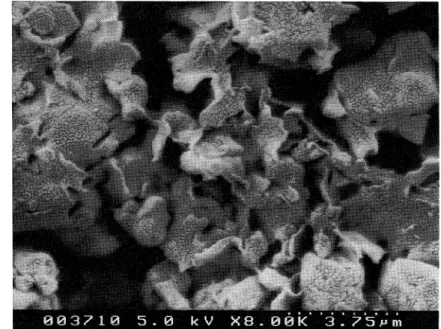
Scanning electron micrographs of the gold-palladium sputtered, <2〃m fine samples generally exhibit irregular clay flakes resembling broken "potato chips". The flakes are relatively thick and the edges are curly and wavy, which seem to be indica-tive of some mixture or interstratification of other
clay species with smectite minerals. The surfaces are uniformly rough and appear to be veneered by micro-scale dessication cracks (Fig. 7).
PARAGENESIS
Momongan (1986) briefly described the origin
of the bentonite seams as product of alteration of the ash fall tuff.
Hewett (1917) and Ross and Shannon (1926) made early appraisal of several clays which had been formed by the alteration of ash and redefined
Geology, Mineralogy and Paragenesis of the Bentonite Deposit in Balamban, Cebu Province, Philippines 51
KC (Cu-Ka, 20)
Fig. 6. X-ray diffractograms of oriented <2/^m fraction, showing x-ray powder reflections of 6N HCl treatment. Sm -smectite; Q-quartz; F-feldspar; C-calcite; M-mica.
the term bentonite to limit it to clays produced by the alteration of volcanic ash in situ. They empha-sized that such clays are largely composed of montmorillonite clay minerals and that they are generally highly colloidal and plastic. Borchardt 1977) defines that bentonite is a rock term referring to altered deposit of volcanic ash usually in prehis-toric lakes or estuaries, and the major alteration constituent mineral is smectite and substantial impurites of quartz and feldspar. The ash contains glassy material of very high Si contents necessary for smectite formation. It appears certain therefore that almost all bentonites are derivative of alteration
of volcanic ash, enriched in silica and alumina. However, the specific mechanisms and conditions necessary for bentonite formation are still until now, not firmly established.
Grim (1953) elaborates that in order for bentonite to form, it is necessary for the ash to fall in water. The kind of water, i. e., fresh or saline, is important in determining whether bentonite forms at all and, if it does, the precise character of the resulting montmorillonite. Since much bentonite is associated with marine formations, it seems certain that the alteration can take place in seawater. The composition of the ash must have a moderate content
Fig. 7. Scanning electron micrographs of the <2〃m fraction. General appearance of the clay assemblages resembles broken or crumpled "potato chips".
Geology, Mineralogy and Paragenesis of the Bentonite Deposit in Balamban, Cebu Province, Philippines 53
of MgO, since ash devoid of magnesia does not seem to alter to montmorillonite. The alteration of the ash to montmorillonite takes place soon after accumula-tion or possibly almost contemporaneously with accumulation. It does not seem, at least in most cases, to be a later process and certainly is not a weathering process. The process of formation of the montmonllonite is essentially a devitrification of the natural glass of the ash and the crystallization of the montmonllonite. The ash probably in most cases contains an excess of silica and alkalies. Most bentonites carry Ca as the most abundant ion and only a few are known which carry Na as the
domi-nant ion.
More recent studies by Weaver ( 1989) suggests
significant difference in the time mode factor of the bentonite formation. He explains that the late-stage alteration of volcanic tuff deposits is of interest from the standpoint of the origin of ancient bentonites and K bentonites. The usual tendency is to envisage volcanic ash beds altering to montmorillonite shortly after deposition and while they retain some contact with the overlying water. It now appears that these ash beds, particularly the more acid types, were probably buried to a considerable depth. They altered after they no longer had direct contact with circulating ocean waters, but presumably were exposed to circulating and expressed water. Most marine bentonites are presumably diagenetic (or epigenetic) in origin rather than authigenic (or syngenetic).
Nemecz ( 1981) indicates that bentonites, apart from the instances of hydrothermal origin, are the hydrolysis products of feldspars and volcanic glass fallen into water, such as typified by some Hungar-mn Bentonites. However only a smaller percentage can be considered lacustrine, a major part is regarded as marine. Magnesium (Mg) and calcium (Ca) ions are mostly absorbed to the detriment of sodium (Na) which leads to the assumption that bentonites largely containing alkali earths are of marine origin. The much scarcer original Na-bentonites were pre-sumably found in lakes poor in Ca and Mg and rich in Na ions.
Hence, in contrast and in correlation to the
explanations of the above authors, it may be well stated that the formation of the bentonite deposit in Balamban was strongly the result of devitrification of volcanic glass fragments contained in the tuff member of the Toledo Formation. Considering all indications of geological and paleontological records, the process of bentonite formation ensued in a marine environment. The association of fossiliferous conglomeratic limestone at the base and another sandy to conglomeratic limestone and shale at the upper section of the Toledo Formation points that the accumulation took place in marine waters. Furthermore, the inclusion of Miocene index foraminifera, in the Toledo Formation, namely Globorotalia mayeri, Orbulina universa and Sphaeroidinella seminulina highly suggests that the marine deposition took place in relatively deep waters in the outer neritic zone. The alteration of the ash and the eventual crystallization of smectite seem to proceed concomitantly with the accumulation since the thickness of the Toledo Formation of about 250 meters, probably could not afford to cause alteration by burial diagenesis. The bentonite pos-sesses Ca as the dominant ion based on XRD and EDX results and the silica and alumina are observed to be appreciably high.
CONCLUSIONS
The bentonite deposit occurs as seams concor-dant with stratification of host rock of the Middle Miocene Toledo Formation. The bentonite lenses or pods are generally clay mineral associations of smectite, minor interstratified kaolinite / smectite, kaolin, mica, and zeolite. Crystalline quartz, feldspar and calcite are notably the accessory minerals of non-phyllosilicates fraction. Electron scanned micrographs display irregular configurations of clay flakes and aggregations suggestive of moderate degree of crystallinity or structural order. The mam-festation of micro-scale dessication cracks on larger crystal surfaces appears to be intergrowths of kaolin minerals. The origin is probably from the alteration of tuff by devitrification of volcanic glass, containing very high amounts of silica and alumina. The altera-tion process of the ash to smectite is inferred to be
almost concomitant with accumulation in an ague-ous saline environment.
ACKNOWLEDGEMENT
This research is generously supported by Monbusho and is greatly acknowledged. Laboratory facilities of Science and Agriculture Faculties of the Kagoshima University, Kagoshima City, Japan were used in undertaking the study. Sincere appreciation is also due to the Geology Division, Mines and Geosciences Bureau, DENR, Region 7, Cebu, Philippines. To kind individuals who have directly or indirectly rendered valuable advice and contribution m this study, the authors express profound gratitude.
REFERENCES
Aleta, D.G.A. and Diegor, EJ. M., 1995, Activity Report on Geological Exploration of Bentonite Clay Deposits in Central Cebu. Unpublished report.
BMG, 1982, Geology and Mineral Resources of the Philip-pmes, Vol. 1, BMG, Manila, Philippines.
Borchardt, G. A., 1977, Montmorillonite and Other Smectite
Minerals; In Dixon, J. and Weed, S. Bり1977, Minerals in
Soil Environments, Soil Science Society of America, Inc., Madison, Wisconsin, U.S.A.
Brmdley, G.W. and Brown, G., 1980, Crystal Structures of Clay Minerals and Their X-ray Identification, Minera-logical Society Monograph No.5, MineraMinera-logical Society, London.
Brown, G., 1961, The X-ray Identification and Crystal Structures of Clay Minerals, Mineralogical Society, Jarrold and Sons Ltd., Norwich, London.
Dixon, J. B. and Weed, S. B., 1977, Minerals in Soil Environ-merits, Soil Science Society of America, Inc., Madison, Wisconsin, U.S.A.
Grim, R. E., 1953, Clay Mineralogy, McGraw-Hill Series in Geology, McGraw-Hill Book Company, Inc., U.S.A. Hewett, D. F., The Origin of Bentonite; In Grim, R. E., 1953,
Clay Mineralogy, McGraw-Hill Series in Geology, McGraw-Hill Book Company, Inc., U.S.A.
Momongan, A. L., 1986, Interim Report on the Bentonite Exploration in Bgy. La Mesa, Balamban, Cebu Province. Unpublished report.
Nemecz, E., 1981, Clay Minerals, Akademiai Kiado, Buda-pest, Hungary.
Philippine BMG, 1983, Geological Map of Balamban Quad-rangle, Sheet 375ト1, Scale 1 : 50,000.
Philippine BMG, 1983, Geological Map of Buanoy Quadran-gle, Sheet 3751-2, Scale 1 : 50,000.
Ross, C. S. and Shannon, E. V., 1926, Minerals of Bentonite and Related Clays and Their Physical Properties; In Grim, R. E., 1953, Clay Mineralogy, McGraw-Hill Series in Geology, McGraw-Hill Book Company, Inc., U.S.A. Santos-Ynigo, L. M., 1951, Geology and Ore Deposits of
Central Cebu: Philippine Bureau of Mines Unpublished Report.
Weaver, C. E.,1989, Clays, Muds, and Shales, Developments in Sedimentology 44, Elsevier Science Publishers B. V., Amsterdam, The Netherlands.