Japan Advanced Institute of Science and Technology
JAIST Repository
https://dspace.jaist.ac.jp/Title
物理化学的手法によるカルモジュリンとmGluR7の相互
作用解析
Author(s)
五十棲, 規嘉
Citation
Issue Date
2011-03
Type
Thesis or Dissertation
Text version
none
URL
http://hdl.handle.net/10119/9608
Rights
Description
Supervisor:大木 進野, マテリアルサイエンス研究科,
Physicochemical Study on the Interaction between Calmodulin and mGluR7
Noriyoshi Isozumi
Introduction
Glutamate is one of the best-known excitatory neurotransmitters occurring in a wide variety of synapses in the central nervous system. Glutamate is recognized by 2 types of receptors: ionotropic glutamate receptors (iGluRs) and G-protein-coupled metabotropic glutamate receptors (mGluRs). To date, at least 8 subtypes of mGluRs, termed mGluR1–8, have been identified and categorized into 3 groups (group I–III) on the basis of their sequence homology and second-messenger coupling properties. In all of mGluRs, the most interesting member is mGluR7, which is most extensively distributed and shows the highest degree of evolutionary conservation. The mGluR7 is localized presynaptically at central synaptic sites and acts as a low-pass filter for glutamate (by sensing released glutamate at a high concentration). The C-terminal region of group III mGluRs, except for mGluR6, has been reported to interact with calmodulin (CaM) in Ca2+-dependent manner. The Ca2+/CaM-binding region of mGluR7 is conserved in group III mGluRs. Heretofore, very limited information had been known about the interaction properties between CaM and mGluR7. Furthermore, little is known about the structure of the CaM-mGluR7 complex. Toward the fully understanding the CaM-mGluR7 system in vivo, further investigation is obviously necessary. In this study, extensive analyses of interaction between CaM and multifunctional segment in mGluR7 are performed to characterize the biochemical and biophysical properties.
Results and Discussion
A recombinant peptide expression method using Escherichia coli and purification system was established for biophysical analyses of mGluR7 peptides. Preparation of small peptides using Escherichia coli is usually difficult due to their easy degradation. The non-specific enzymatic cleavage was suppressed by addition of CaM to the crude sample solution; binding of Ca2+/CaM to mGluR7 prevents enterokinase cleavage. Purity and molecular mass of resulting peptides were confirmed by MALDI-TOF-MS. As a result, the molecular mass of the peptide was identical to the theoretical value. This complex method for precise enzymatic reactions may be applicable for the recombinant preparation of a wide variety of peptides.
Surface plasmon resonance (SPR), circular dichroism (CD), and nuclear magnetic spectroscopy (NMR) studies using the mGluR7 peptides were performed to study structure of the peptides corresponding to the CaM-binding domain of mGluR7 and their interaction with CaM. Unlike well-known CaM-binding peptides, it was found that mGluR7 has a random coil structure even in the presence of trifluoroethanol (TFE). Moreover, the complex between Ca2+/CaM and the mGluR7 peptide is in multiple conformations. The mGluR7 peptide had been found to interact with CaM even in the absence of Ca2+, and the binding was occurred mainly at the C-domain of apo-CaM.
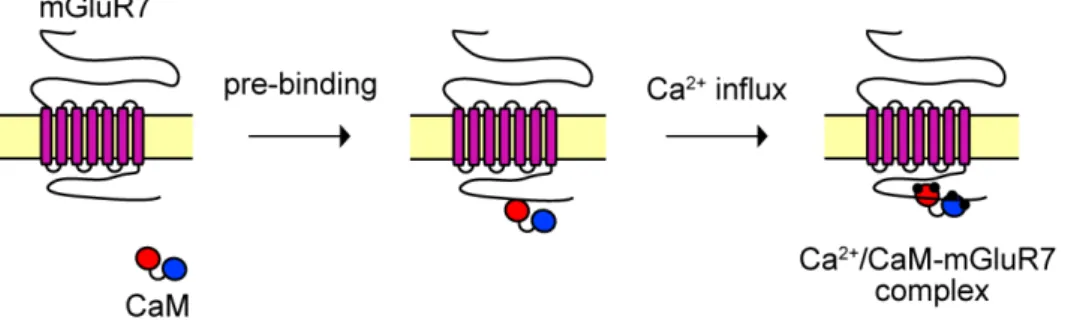
In conclusion, various physicochemical studies on the interaction between CaM and mGluR7 were performed, and a reasonable pre-binding mechanism for the activation of mGluR7 by CaM was proposed (Fig. 1).