熊本学園大学 機関リポジトリ
Impacts of information sources on Japanese
students' in-class and out-of-class
self-efficacy beliefs in speaking English
著者
宮内 なぎさ
学位名
博士(文学)
学位授与機関
熊本学園大学
学位授与年度
2019年度
学位授与番号
37402甲第68号
URL
http://id.nii.ac.jp/1113/00003361/
博 士 学 位 論 文
IMPACTS OF INFORMATION SOURCES
ON JAPANESE STUDENTS’ IN-CLASS
AND OUT-OF-CLASS SELF-EFFICACY
BELIEFS IN SPEAKING ENGLISH
日本人学生の教室内・教室外英語スピーキング
自己効力感におよぼす情報源の影響
2019年度
宮内 なぎさ
熊本学園大学大学院
国際文化研究科 国際文化専攻
i
ABSTRACT
This thesis examines the relationships between learners’ speaking self-efficacy and the four sources of self-efficacy information that Bandura (1977, 1997) advocated, and then recommends ways for Japanese English speakers to enhance their speaking self-efficacy.
It is often reported that Japanese people are not confident when speaking English. Horwitz, Horwitz, and Cope (1986) claim that in the EFL learning environment students are likely to feel anxious about speaking English because they have to interact with each other using their limited skills. Cheng, Horwitz, and Schallert (1999) also argue that low confidence contributes to anxiety in L2 speaking.
The world has globalized and it is expected that people will have colleagues whose cultural backgrounds are different from their own. Studying or working abroad will likely become more common in the near future. In such settings, it will be urgent for learners to acquire better L2 speaking skills. Warschauer (2000) argues that globalization will make English an international language, forcing non-native speakers to use English daily in their communications. It will be essential for these learners to be confident in speaking English.
Bandura (1995) defines self-efficacy as “beliefs in one’s capabilities to organize and execute the courses of action required to manage prospective situations” (p. 2), adding that self-efficacy influences one’s thinking, feeling, motivation and actions. He postulates that efficacy beliefs are derived from one’s interpretation of the four sources of self-efficacy information (1997, p. 79); mastery experiences (ME), vicarious experiences (VE), verbal persuasion (VP), and emotional states (ES).
ii
ME is based on successful performances that can predict one’s future course, and is regarded as the most influential source (Bandura, 1997, p. 80). VE indicates observers’ self-comparison with the performances and outcomes of their models (e.g., Usher & Pajares, 2008). When observers watch models similar to themselves perform successfully, it raises their confidence, helping them believe in their ability to master comparable tasks (Bandura, 1997, p. 87). VP denotes feedback or encouragement received from significant others such as parents and teachers about academic performance (Usher & Pajares, 2008). People who are convinced that they are capable of accomplishing provided tasks often make more sustained efforts than those who doubt their own capabilities when adversity occurs (e.g., Bandura, 1997, p. 101). ES indicates emotional arousal through physiological reactions (e.g., stress, anxiety, mood, or elation) that one experiences while performing an academic task (e.g., Britner & Pajares, 2006). While positive mood might raise one’s self-efficacy and contribute to the expectation of future successful performances, negative mood might undermine one’s perceived self-efficacy (e.g., Bandura, 1997, p. 113). Bandura (1995, p. 3) asserts that nurturing these four sources of self-efficacy information could develop people’s beliefs about their competence.
Researchers assert that high self-efficacy learners have lower levels of anxiety, continually make more efforts to achieve their goals, utilize more effective learning strategies and are more successful while low self-efficacy learners tend to show opposite reactions (e.g., Bandura, 1997, p. 39). Bandura (1995, p. 6) also affirms that highly self-efficacious people can imagine successful scenarios which lead them to good performances while people with self-doubt may imagine unsuccessful scenarios which lead them to failure.
iii
athletics and health. There are also numerous studies which investigated the relationships between self-efficacy and acquiring foreign languages, but compared with other English skills such as reading, listening, and writing, very few studies (e.g., Asakereh & Dehghannezhad, 2015; Liu, 2013) can be found which have investigated the relationships between self-efficacy and speaking skills. Above all, empirical studies which examined Japanese students’ English-speaking self-efficacy are rare. Self-efficacy can predict one’s oral proficiency (Woodrow, 2006), so more research should be conducted to investigate the relationships between self-efficacy and oral proficiency (Mills, 2014, p. 13). Sufficient investigation into Japanese learner self-efficacy beliefs in speaking English has yet to be developed.
In this thesis, both quantitative (Chapter 3, 4, 6, and 7) and qualitative (Chapter 5) analyses were adopted. Chapter 3 investigated the relationships among 180 undergraduates’ speaking self-efficacies, their speaking proficiency levels, and Bandura’s (1997) hypothesized four sources of self-efficacy information, ME, VE, VP, and ES. The participants responded to a 36-item questionnaire on speaking self-efficacy beliefs. A factor analysis demonstrated that in-class and out-of-class self-efficacies formed separate factors. A multiple regression analysis revealed that ME and ES were significant predictors of in-class and out-of-class self-efficacies and that only in-class self-efficacy contributed to the prediction of the learners’ speaking proficiency levels. In-class self-efficacy was found to be a significant predictor of Japanese undergraduates’ speaking proficiency levels, where ME especially showed a stronger influence. The reason only in-class self-efficacy predicted learners’ speaking self-efficacy is due to Japanese students’ lack of speaking experiences outside the classroom. Therefore, accumulating speaking experiences not only in the classroom but also outside the classroom enhances
self-iv
efficacy and improves learners’ overall speaking proficiency.
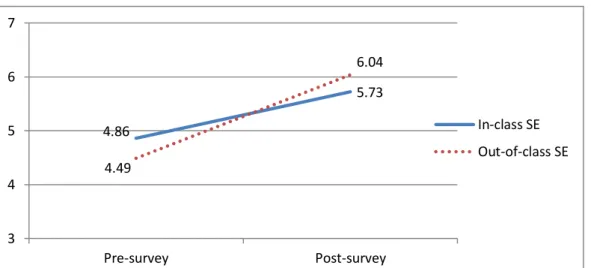
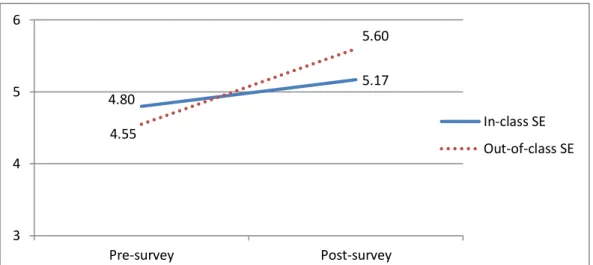
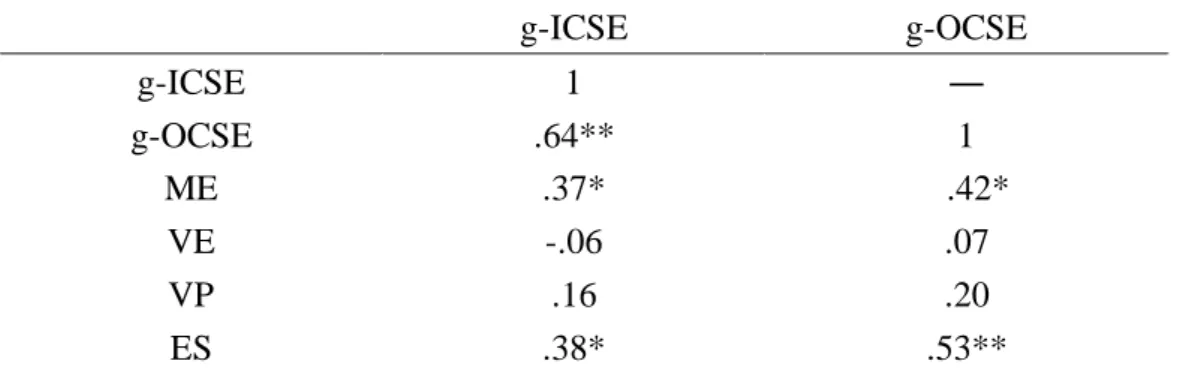
Chapter 4 examined how 17 university undergraduates’ English-speaking self-efficacies changed through their participation in a three-week language training program in the United States. The results of a paired-samples t-test and correlation analyses revealed three things. First, the participants showed greater gains in out-of-class self-efficacy than in in-class self-self-efficacy. Second, the correlation between in-class and out-of-class self-efficacies in a post-survey was much stronger than that in a pre-survey. Finally, in general, ME and ES had stronger correlations with in-class/out-of-class self-efficacy gains than VE and VP, but such traits were especially evident regarding out-of-class self-efficacy gain. The advantage of speaking experiences abroad is that they could enhance learners’ out-of-class self-efficacy through interactions with native speakers in natural settings, which are often accompanied by an emotional surge. It was found that this occurs in reflection of in-class self-efficacy which learners possess.
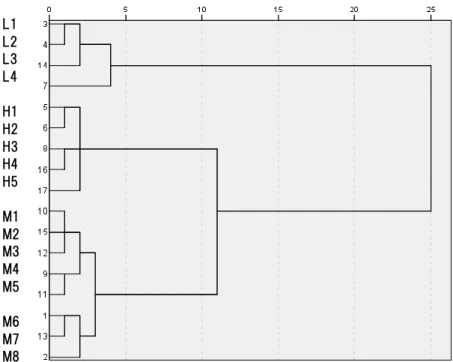
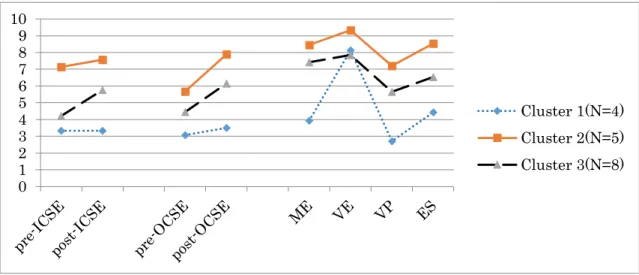
Chapter 5 reexamined the qualitative data on how attending a three-week study abroad program in the United States affected the participants’ speaking self-efficacies. Specifically, this study focused on how the student groups divided by a cluster analysis differed in terms of the four sources of self-efficacy information with their in-class and out-of-class self-efficacies. This study attempted to reveal what the participants really experienced in the way of self-efficacy beliefs presented in Chapter 4. Quantitative analysis of the interview results revealed that the High and Middle self-efficacy groups obtained more beneficial experiences to enhance their self-efficacy, especially in ME, VP, and ES, than the Low self-efficacy group. Though the Low self-efficacy group showed much lower means of ME, VP, and ES than the High and Middle self-efficacy groups, they demonstrated almost the same level of VE as the High and Middle self-efficacy
v
groups. The high means of VE in the Low self-efficacy group indicated that their admiration for models was strong. However, it also made them realize their inferiority when speaking English, which negatively affected their speaking self-efficacy. In addition, the interviews confirmed that the High and Middle self-efficacy groups enhanced their self-efficacies more than the Low self-efficacy group, though the correlations between pre-survey in-class/out-of-class self-efficacies and the gains in self-efficacies were slightly negative.
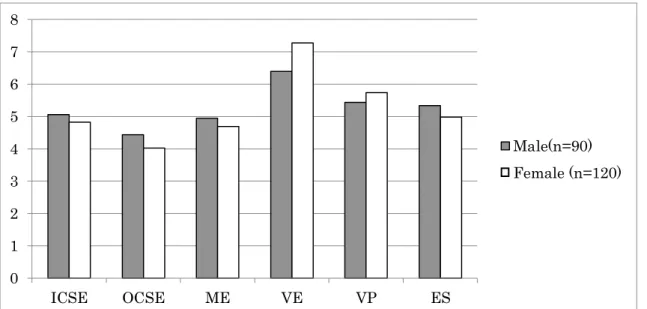
Chapter 6 investigated the relationships between high school students’ speaking self-efficacy and the four sources of self-efficacy information, ME, VE, VP, and ES across genders. Two hundred and ten Japanese high school freshmen answered a 36-item questionnaire about speaking self-efficacy beliefs. Multiple regression analyses revealed that ME and ES overall significantly predicted male and female students’ self-efficacies, with the exception that ES did not predict in-class self-efficacy for male students. An independent samples t-test demonstrated that there was a significant gender difference in VE, females showing higher VE than males. The higher VE and VP for female students than for males were taken to indicate stronger sensitivity of females to others’ reactions.
Chapter 7 examined how cognitive self-modeling (CSM) and self-persuasion (SP), which are more self-derived influential sources than traditional VE and VP, differ in terms of influence on self-efficacy. It was found that both CSM and SP were more influential sources of self-efficacy than traditional VE and VP. This implies that visualizing oneself accomplishing a difficult task and persuading oneself that one can do a provided task are more influential than traditional VE and VP, revealing that students are more likely to be influenced by themselves than by others.
vi
to how Japanese learners of English can improve their self-efficacy in speaking English. The studies in this thesis confirmed the general tendency that ME and ES are more directly linked to self-efficacy than VE and VP. It was also found that experiences in natural settings work effectively to improve ME and ES, which especially helps boost out-of-class self-efficacy. On the other hand, it was revealed that heightening self-efficacy in speaking English before studying abroad works effectively for having more beneficial experiences based on ME and ES in study abroad settings and for improving self-efficacy. If students with little confidence in English proficiency go abroad, it might lead them to lose confidence further. Moreover, it was found that VE and VP, which depend on influence from others, were higher for female students than male students. It could be suggested that instructors with female students should consider their sensitivity to others. In addition, it was found that visualizing oneself achieving a difficult task (CSM) or persuading oneself to become confident of one’s ability (SP) are more effective ways to improve one’s self-efficacy than admiring others as speaking models (VE) or being persuaded to be confident by others (VP).
So far, few empirical studies have examined the relationships between English-speaking and Japanese learners’ self-efficacy, and the author hopes that this thesis will encourage further research into this area.
vii
ACKNOWLEDGEMENTS
I would like to express my sincere gratitude to Professor Hideo Hayashi, my
supervisor, who has provided me with professional instructions and suggestions based on his plentiful experiences.
My greatest appreciation is also expressed to the teachers and students of Kumamoto Gakuen University and Yatsushiro Senior High School who cooperated with me to gather quantitative and qualitative data for my research. Among them, especially, Professor Judith Yoneoka of Kumamoto Gakuen University and Mr. Charles Waterman, an adjunct English instructor there, saved a lot of time by helping me conduct my research or providing me with insightful tips. If it had not been for their generous cooperation, this thesis would not have been completed.
I also extend my gratitude to anonymous researchers and ALTs, especially Mr. Richard Grumbine of National Institute of Technology, Ariake College, who provided me with useful insights to revise my articles, which became a great help to continue my study. Lastly, I appreciate special support from my family, colleagues, and friends, who encouraged my study behind my back. Their warm visible and invisible assistance also made this thesis a real product.
viii TABLE OF CONTENTS ABSTRACT………..i ACKNOWLEDEMENTS……….…..vii TABLE OF CONTENTS………...viii LIST OF FIGURES………xiv LIST OF TABLES………..xiv LIST OF ABBREVIATIONS………xvii 1. CHAPTER 1 INTRODUCTION.…………...……..………..1
1.1 Statement of the Problem………1
1.2 Objectives of the Study………...2
1.3 Overview of the Chapters………...3
2. CHAPTER 2 THEORETICAL FRAMEWORK……….…...7
2.1 Introduction………7
2.2 The Historical Background of Self-Efficacy and Its Mechanism………7
2.2.1 Self-Efficacy………..7
2.2.2 Measurement of Self-Efficacy………..………...10
ix
2.3 The Relationship Between Self-Efficacy and Academic Achievement………14
2.4 Speaking Self-Efficacy and Other Views Related to Self-Efficacy…………..15
2.4.1 Speaking Self-Efficacy………15
2.4.2 In-Class and Out-of-Class Learning Environments……….16
2.4.3 Self-Efficacy and Self-Confidence………..17
3. CHAPTER 3 THE RELATIONSHIPS BETWEEN JAPANESE UNDERGRADUATES’ ENGLISH-SPEAKING SELF-EFFICACY AND THEIR SPEAKING LEVELS………..………18
3.1 Introduction………..18
3.1.1 Learning Environments in Japan……….18
3.2. Objectives and Research Questions……….19
3.3 Methods .………..20 3.3.1 Participants………..20 3.3.2 Procedures ………..20 3.3.3 Instrument………...21 3.3.3.1 Speaking Proficiency………21 3.3.3.2 Speaking Self-Efficacy……….21
3.3.3.3 Sources of English-Speaking Self-Efficacy Information…..22
3.3.4 Data Analysis………...23
3.4 Results………..23
3.4.1 Factor Analysis of In-Class and Out-of-Class Self-Efficacies…….…23
3.4.2 Prediction of the Speaking Proficiency Levels by In-Class and Out-of-Class Self-Efficacies………25
x
3.4.3 How Strongly Do the Four Sources of Self-Efficacy Information Predict
the Learners’ In-Class and Out-of-Class Self-Efficacies?...27
3.5 Discussion ………33
3.6 Conclusion………37
4. CHAPTER 4 THE IMPACT OF A STUDY ABROAD PROGRAM ON COLLEGE STUDENTS’ SELF-EFFICACY IN ENGLISH-SPEAKING (PART I)…….……39
4.1 Introduction ………..39
4.1.1 Positive Effects of Study Abroad on the Participants and Their Self-Efficacy ……….39
4.1.2 Opportunities for Japanese Students to Study Abroad………42
4.2 Objectives and Research Questions………..43
4.3 Methods………....43 4.3.1 Participants………..43 4.3.2 Instrument ………...43 4.3.3 Procedures ………...44 4.3.4 Data Analysis………...44 4.4 Results………..45 4.5 Discussion……….50 4.6 Conclusion..………..53
5. CHAPTER 5 THE IMPACT OF STUDY ABROAD PROGRAM ON COLLEGE STUDENTS’ SELF-EFFICACY IN ENGLSH-SPEAKING (PART II)…………57
5.1 Introduction………..57
5.2 Objectives and Research Questions…….………57
xi 5.3.1 Participants………..58 5.3.2 Instrument..………..58 5.3.3 Interviews.. ………..59 5.3.4 Procedures………...60 5.3.5 Data Analysis………...61
5.4 Results of Quantitative Analysis………...61
5.5 Results of Qualitative Analysis (Research Question 1)………...67
5.5.1 Mastery Experiences (Interview Results and Responses to Open- Ended Questions)……….………....68
5.5.2 Emotional States (Interview Results) ……….70
5.5.3 Vicarious Experiences (Interview Results) …..………..…73
5.5.4 Verbal Persuasion (Interview Results and Responses to Open-Ended Questions)………76
5.5.5 Summary of Research Question 1………78
5.6 Results of Qualitative Analysis (Research Question 2)………..…..……80
5.7 Discussion……….83
5.8 Limitations………....85
5.9 Conclusion………..…………..86
6. CHAPTER 6 GENDER DIFFERENCES IN ENGLISH-SPEAKING SELF- EFFICACY AMONG JAPANESE HIGH SCHOOL STUDENTS………….…….88
6.1 Introduction ………..88
6.1.1 Gender Differences in Self-Efficacy………..………..88
6.1.2 Collaborative Work and Gender Difference in High School English Classrooms………...89
xii
6.2 Objectives and Research Questions………..91
6.3 Methods ………...91
6.3.1 Participants ………..91
6.3.2 Procedures ………...92
6.3.3 Instrument………93
6.3.3.1 Speaking Self-Efficacy………..……….93
6.3.3.2 Sources of English-Speaking Self-Efficacy Information…93 6.3.4 Data Analysis………...94 6.4 Results ………..94 6.4.1 Research Question 1……….………95 6.4.2 Research Question 2………...99 6.5 Discussion ………101 6.6 Conclusion………..………105
7. CHAPTER 7 EXAMINING TWO TYPES OF SELF-EFFICACY INFORMATION DERIVED FROM LEARNERS’ OWN EXPERIENCES……109
7.1 Introduction………109
7.1.1 Problematic Aspects of the Four Sources of Self-efficacy Information ………...………110
7.1.2 Assessing VE and VP Based on One’s Own Experiences………….111
7.2. Objectives and Research Questions………112
7.3 Methods………..113
7.3.1 Participants………113
7.3.2 Instrument ……….113
xiii 7.3.4 Data Analysis ………115 7.4 Results ………115 7.4.1 Research Question 1 ………..………116 7.4.2 Research Question 2 ………..118 7.5 Discussion………...119 7.6 Conclusion………..…121 8. CHAPTER 8 CONCLUSION….……….………...123 8.1 Summary of Findings………..123
8.2 Limitations and Future Implications………..……….………127
8.3 Conclusion ……….128
LIST OF REFERENCES .……….132
APPENDIX A: SELF-EFFICACY QUESTIONNAIRE (CHAPTER 3 and CHAPTER 6)………....147
APPENDIX B: SELF-EFFICACY QUESTIONNAIRE (CHAPTER 4)………151
APPENDIX C: THE RESULT OF 31 STUDENTS WHO PARTICIPATED IN THE STUDY ABROAD PROGRAM (CHAPTER 4)…..…………...155
APPENDIX D: WRITTEN STATEMENTS OF THE HIGH, MIDDLE, AND LOW SELF-EFFICACY STUDENTS (CHAPTER 5)..…………..……..158
xiv
LIST OF FIGURES
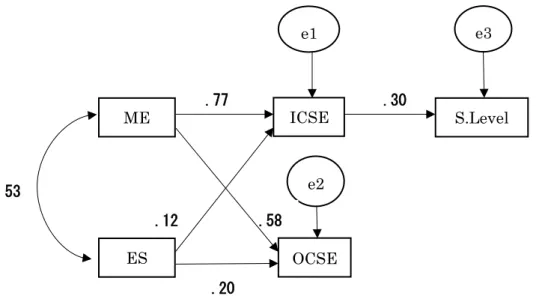
Figure 1.1. The framework of this thesis……….………5 Figure 2.1. The mechanism of self-efficacy forming………...14 Figure 3.1. Causal model of in-class and out-of-class self-efficacies with standardized
estimates………32 Figure 4.1. The mean differences in self-efficacies between the pre- and post-surveys,
concerning in-class and out-of-class self-efficacies. ………48 Figure 5.1. Dendrogram using Ward’s method……….62 Figure 5.2. Means of in-class/out-of-class self-efficacies on the pre- and post-surveys and the four sources of self-efficacy information in each self-efficacy group ………...63 Figure 6.1. Means of in-class/out-of-class self-efficacies and the four sources of self-
efficacy information for each gender.………..100
LIST OF TABLES
Table 3.1 Factor Loadings of the Responses to the Self-Efficacy Scale (Promax Rotation)………..24 Table 3.2 Correlations Between Speaking Proficiency Levels and In-Class/Out-of-
Class Self-Efficacies.…...………25 Table 3.3 Model Summary of the Relation Between Speaking Proficiency Levels and In-Class/Out-of-Class Self-Efficacies………..26 Table 3.4 Standard Multiple Regression of In-Class/Out-of-Class Self-Efficacies on the
xv
Table 3.5 Correlations Among In-Class Self-Efficacy, Out-of-Class Self-Efficacy, and the Four Sources of Self-Efficacy Information……….28 Table 3.6 Model Summary of the Relationship Between the Learners’ In-Class Self-
Efficacy and the Four Sources of Self-Efficacy Information………. .29 Table 3.7 Standard Multiple Regression of the Four Sources of Self-Efficacy
Information on In-Class Self-Efficacy……….29 Table 3.8 Model Summary of the Relation Between the Learners’ Out-of-Class Self-
Efficacy and the Four Sources of Self-Efficacy Information………30 Table 3.9 Standard Multiple Regression of the Four Sources of Self-Efficacy
Information on Out-of-Class Self-Efficacy……….31 Table 4.1 Correlations Among In-Class Self-Efficacy, Out-of-Class Self-Efficacy, and
the Four Sources of Self-Efficacy Information, on the Pre- and Post-
Surveys………..…..47 Table 4.2 The Result of Paired-Samples T-Tests…….……...………..………...48 Table 4.3 Correlations Between the Gains in In-Class/Out-of-Class Self-Efficacies
and the Four Sources of Self-Efficacy Information…………..…………...49 Table 5.1 Subscale Means for Each Self-Efficacy Group..………62 Table 5.2 Self-Efficacy Scores and Their Gains for Individual Participants…...65 Table 5.3 Correlations Between In-Class/Out-of-Class Self-Efficacies on the Pre-
Survey and the Four Sources of Self-Efficacy Information as Well as the Gains in In-Class/Out-of-Class Self-Efficacies………...66 Table 6.1 Correlations between In-Class/Out-of-Class Self-Efficacies and the Four
xvi
Table 6.2 Standard Multiple Regression of the Four Sources of Self-Efficacy
Information on In-Class Self-Efficacy for Each Gender………..97 Table 6.3 Standard Multiple Regression of the Four Sources of Self-Efficacy
Information on Out-of-Class Self-Efficacy for Each Gender………..98 Table 6.4 Subscale Means and Standard Deviations of In-Class/Out-of-Class Self-
Efficacies and the Four Sources of Self-Efficacy Information for Each Gender………..100 Table 6.5 The Results of Independent Samples T-Tests Across Genders…..………..101 Table 7.1 Correlations Between In-Class/Out-of-Class Self-Efficacies, VE, CSM, VP, and SP………116 Table 7.2 Hierarchical Multiple Regression of VE and CSM on In-Class Self-
Efficacy………..117 Table 7.3 Hierarchical Multiple Regression of VE and CSM on Out-of-Class Self-
Efficacy………..……....117 Table 7.4 Hierarchical Multiple Regression of VP and SP on In-Class Self-
Efficacy………..…118 Table 7.5 Hierarchical Multiple Regression of VP and SP on Out-of-Class Self-
xvii
LIST OF ABBREVIATIONS
ALT Assistant Language Teacher ANOVA Analysis of Variance
CEFR Common European Framework of Reference for Languages CLT Communicative Language Teaching
EFL English as a Foreign Language
EIKEN The Eiken Test in Practical English Proficiency FL Foreign Language
GTEC Global Test of English Communication JTE Japanese Teachers of English
L2 Second Language
MEXT The Ministry of Education, Sports, Science and Technology SE Self-efficacy
SL Second Language
SLA Second Language Acquisition VIF Variance Inflation Factor
1
CHAPTER 1 INTRODUCTION
1.1 Statement of the Problem
In Japan, an EFL country, many people lack confidence in speaking English. For instance, in a survey conducted at the author’s high school at the beginning of the school year in 2016 and again in 2017, freshmen were asked about their learning strategies during junior high school. Merely 14 and 19 percent respectively answered that they spoke English enthusiastically. This suggests that high school freshmen had low confidence or motivation in speaking English at the time they entered high school. They think that it is difficult to speak in English. Their low confidence in speaking makes them overly apprehensive. In light of the common understanding that Japanese English learners in general are in a state of low confidence and high anxiety when speaking the language, these high school students can be taken as representing the typical Japanese EFL learners. There may be several reasons for this tendency in Japanese English learners. First, English as a language is fundamentally different from Japanese in terms of letters, word order, grammar, pronunciation, usage, and most importantly, background cultures. Therefore, quite a few Japanese learners tend to think that English is both difficult to learn and to speak.
Furthermore, among the four language skills, reading, listening, writing, and speaking, only speaking requires an impromptu response, which could easily cause anxiety and stress among learners. Moreover, many contemporary English classrooms use English as the medium of instruction, where students have to understand lesson contents in English and must interact with the instructor and their peers in English.
2
Horwitz, Horwitz, and Cope (1986) argue that in the EFL environment students are likely to feel anxious in their FL speaking lessons, because interacting with limited FL skills makes it difficult for students to express themselves or to understand their classmates. Cheng, Horwitz, and Schallert (1999) also assert that perceived low self-confidence is contributory to anxiety in L2 speaking.
A number of studies have examined speaking anxiety among language learners (e.g., Horwitz, 2001; MacIntyre, Noels, & Clément, 1997). Horwitz et al. (1986) categorize the anxiety into three types: communication apprehension, test anxiety, and
fear of negative evaluation (p. 127). Cutrone (2009) asserts that communication anxiety
is most associated with oral EFL classes in Japan, adding that such apprehension should be overcome or lessened in language classrooms.
It may be that other factors, such as Japanese modesty, concern about making mistakes, or receiving negative evaluations from others, could lead to anxiety in speaking English. However, speaking anxiety should be first overcome when speaking another language (Horwitz et al., 1986).
1.2 Objectives of the Study
This dissertation investigates the relationships between learners’ speaking
self-efficacy and the four sources of self-self-efficacy information (mastery experiences, vicarious experiences, verbal persuasion, and emotional states) that Bandura (1977, 1997) argues
develop self-efficacy. This study examines learners’ speaking self-efficacy, as opposed to reading, listening, or writing self-efficacy, and differentiates between in-class and out-of-class learning environments. The four experimental studies in this thesis investigate how the relationships between self-efficacy and the four sources of self-efficacy information are manifested when other factors such as the learners’ speaking proficiency,
3
speaking experiences in a study-abroad program, and gender, are given consideration. Considering the results of these studies, in the final quantitative analysis, the author reexamines Bandura’s (1977, 1997) traditional sources of self-efficacy information, vicarious experiences and verbal persuasion from a different perspective, in which two other sources of self-efficacy information, cognitive self-modeling and self-persuasion, derived from learners’ direct experiences, are investigated. It is hoped that investigating these relationships will reveal how Japanese English speakers can enhance their speaking self-efficacy, by providing different perspectives from those traditionally held.
This study draws on the theory of self-efficacy that Bandura first advocated in the 1970s. Bandura (1997) defined self-efficacy as “beliefs in one’s capabilities to organize and execute the courses of action required to produce given attainments” (p. 3), adding that the degree of self-efficacies that individuals hold could influence their future actions and results. In brief, those who possess high self-efficacy believe that they can accomplish provided tasks, which would lead to their successful performance, while those low with self-efficacy show the opposite behaviors (Bandura, 1997, p. 39). While this theory has been applied in various fields such as sports and health care, it has not been investigated sufficiently in language learning studies (Woodrow, 2006).
In an ever globalizing world, young Japanese students will have more experiences using English at school and work. However, in the current situations, students may not be able to fulfill their speaking obligations due to extreme tension or nervousness. By examining factors related to improving learners’ speaking self-efficacies, it is hoped that future instructors will be able to encourage learners to speak English by reducing anxiety.
1.3 Overview of the Chapters
4
The other chapters are designed as follows: Chapter 2 demonstrates the theoretical framework of self-efficacy theory and its related views. Chapter 3 presents a quantitative study on the relationships between Japanese undergraduates’ English-speaking self-efficacy and their speaking competence. Chapter 4 addresses the impact of a study abroad program on college students’ self-efficacy in English-speaking using a quantitative method, followed by Chapter 5 which conducts additional analyses on the data obtained in Chapter 4 and adds a qualitative investigation for further fact-finding about the impacts of studying abroad. Chapter 6 explores gender differences in English-speaking efficacy among Japanese high school students. Chapter 7 examines two sources of self-efficacy information, cognitive self-modeling (CSM) and self-persuasion (SP), which are different from Bandura’s (1997) traditional vicarious experiences (VE) and verbal persuasion (VP). Contrary to Bandura’s widely-used VE and VP, CSM and SP are derived from learners’ own experiences and self-appraisals. Finally, Chapter 8 summarizes all the findings and suggests future implications. The chapters are as follows:
5 Chapter 1 Introduction
Chapter 2 Theoretical Framework
Chapter 3 Research 1--- The relationships between Japanese undergraduates’ English-speaking self-efficacy and their speaking levels
<Quantitative Study> Chapter 4 Research 2--- The impact of a study abroad program on college students’
self-efficacy in English-speaking Part I
<Quantitative Study> Chapter 5 Research 3--- The impact of a study abroad program on college students’
self-efficacy in English-speaking Part II
<Quantitative + Qualitative Study> Chapter 6 Research 4--- Gender differences in English-speaking self-efficacy among Japanese high school students < Quantitative Study > Chapter 7 Research 5--- Examining two types of self-efficacy information derived
from learners’ own experiences < Quantitative Study > Chapter 8 Conclusion
6
Chapters 4, 5, 6 and 7 are based on the author’s own publications as listed below.
Chapter 4
Miyauchi, N. (2017). The impact of a study abroad program on college students’ self- efficacy in English speaking. The JACET Kyusyu-Okinawa Chapter Annual Review
of English Learning and Teaching, 22, 1–18.
(With peer review)
Chapter 5
Miyauchi, N. (in press). The impact of a study abroad program on college students’ self- efficacy in English speaking (Part II). The JACET Kyusyu-Okinawa Chapter
Annual Review of English Learning and Teaching, 24, 1–21.
(With peer review)
Chapter 6
Miyauchi, N. (2019). Gender differences in English-speaking self-efficacy among Japanese high school students. Eigo Kumamoto [English Kumamoto], 53, 1–15.
Jono Publishing Company: Kumamoto.
Chapter 7
Miyauchi, N. (2019). Examining two sources of self-efficacy information derived from learners’ authentic experiences. LET Kyushu-Okinawa BULLETIN, 19, 37–52.
7
CHAPTER 2
THEORETICAL FRAMEWORK
2.1 Introduction
This chapter presents the historical background and mechanism of self-efficacy and discusses its measurement, the four sources of self-efficacy information, and the relationship between self-efficacy and academic achievement. This chapter also discusses why self-efficacy in speaking, as opposed to reading, listening, or writing, is the main focus of study in this dissertation, and why the contrast between in-class and out-of-class speaking self-efficacies is highlighted throughout the studies. The theory of self-efficacy was first advocated by Bandura (1977).
2.2 The Historical Background of Self-Efficacy and Its Mechanism 2.2.1 Self-Efficacy
The history of language learning motivation is viewed as having experienced several turning points. Dörnyei and Ryan (2015, pp. 73–74) categorizes its history into three periods: the social psychological period from the 1960s to 1990s when the motivational constructs advocated by Gardner and his colleagues were the main concerns of language learning motivation studies, followed by the cognitive situated period in the 1990s when Crooks and Schmidt (1991) insisted on the need of introducing educational settings in order to investigate learners’ motivation in FL learning. This was followed by the process-oriented period from the beginning of the 21st century to the present time, which focuses more on the mechanism of motivation derived from the interaction between individuals and their surroundings.
8
integrative motivation and instrumental motivation. Integrative motivation is related to the desire of meeting and communicating with native speakers in the target culture while instrumental motivation is concerned with the usefulness of the language for obtaining jobs or educational achievements. This period had a strong influence on studies of SL learning (Crookes & Schmidt, 1991, p. 471), but they failed to integrate other motivational theories from the standpoint of educational psychology, for example, teachers’ viewpoints and SL classroom settings (Crookes & Schmidt, 1991, p. 470; Mills, 2014, pp. 6–7). Oxford and Shearin (1994, p. 14) criticize Gardner’s framework of motivation, claiming that it regulates motivation solely to integrative and instrumental motivation, which should be broadened in accordance with students’ learning situations. Concerned about such situations, several researchers thought that more practical, education-focused approaches, especially from the perspectives of teachers and students’ behaviors, should be included. This opened the way for the introduction of the social
cognitive theory (Crookes & Schmidt, 1991, p. 470; Dörnyei, 1994, p. 516; Oxford &
Shearin, 1994, p. 15).
In the cognitive situated period in the 1990s, social cognitive theory (Bandura, 1977, 1997), attribution theory (Weiner, 1985), self-determination theory (Deci & Ryan, 1985), goal setting theory (Locke & Lathem, 1990), and expectancy value theory (Atkinson, 1957; Wigfield, 1994; Wigfield and Eccles, 1992) were the principal theories in discussing FL motivation. Bandura’s (1977, 1997) self-efficacy theory played a pivotal role in social cognitive theory.
Social cognitive theory postulates that human behaviors are extensively controlled by self-influence, that is, through “cognitive, vicarious, self-reflective, and self-regulatory processes” (Bandura, 1989, p. 1175). In human behavior, people possess self-beliefs
9
which control their thoughts, feelings, and actions (Mills, Pajares, & Herron, 2007). Bandura (1997, p. 5) affirms that in the system of self-beliefs, self-reflection plays an especially crucial role in human thoughts and actions. This is because through reflecting on and examining their own deeds, people are able to control their thoughts and actions regarding future behaviors (Mills, 2014, p. 7).
Self-efficacy is defined as “beliefs in one’s capabilities to organize and execute the courses of action required to produce given attainments” (Bandura, 1997, p. 3), and it is believed that it exercises control on human actions because they affect “how people think, feel, motivate themselves, and act” (Bandura, 1995, p. 2). This is based on the important proposition that people’s emotional states, level of motivation, and actions are derived more from what they believe, than from what they actually are (Bandura, 1997, p. 2). This means that people who lack a positive image in their proficiency may not be able to perform well even though they actually have the capacity, and vice versa.
One of the most outstanding features of self-efficacy is its ability to predict future performance. For example, Mills (2014, p. 8) and Palmer (2006) claim that people’s self-efficacy beliefs might determine how they perform in the future. Bandura (1997, p. 81) also asserts that self-efficacy beliefs can predict individuals’ future performances better than their prior achievements.
The question now arises: Why are there differences between those who possess high self-efficacy and those who do not? It is maintained that high self-efficacy learners have lower levels of anxiety, continually make more efforts to achieve their goals, utilize effective learning strategies, and are more successful while low self-efficacy learners tend to show the opposite behaviors (Bandura, 1997, p. 39; Britner & Pajares, 2006; Mills, 2014, p. 9). Bandura (1995) also affirms that highly self-efficacious people can imagine
10
successful scenarios which lead them to good performances, while people who doubt their ability may imagine unsuccessful scenarios which will guide them to failure, implying that efficacy beliefs play an important role in learners’ motivation, behavior, self-regulation, academic achievement, and so forth (p. 6).
2.2.2 Measurement of Self-Efficacy
Self-efficacy beliefs can predict future performance under variable circumstances even better than past performances can because more information is included in one’s self-efficacy than in simple measures of success or failure (Bandura, 1997, p. 81). When measuring self-efficacy, three dimensions, level, generality, and strength, should be considered (Bandura, 1997, pp. 42–43). Regarding the level (e.g., high or low), the degree of perceived capability to achieve a successful performance can be measured by specific tasks representing different degrees of challenge or difficulty, for example, spelling words or solving math problems with increasing difficulty (Bandura, 1997, p. 42; Zimmerman, 1995, 2000). Self-efficacy beliefs are also examined in terms of generality, that is, whether the beliefs pertain to specific tasks or to something more general. It is often believed that general, global, ambiguous, and indefinite measures are not able to predict human motivation and behavior with any precision (Bandura, 1997, pp. 47–50). Finally, strength of self-efficacy can be assessed by asking individuals how certain they are (e.g., strongly or weakly) that they can perform provided tasks (Zimmerman, 1995). These three features should be considered in designing a scale for assessing self-efficacy.
In a standard self-efficacy measurement which Bandura constructed, individuals are given scale items presenting different levels of task demands, and they rate how strongly they believe that they can perform the required activities (Bandura, 1997, p. 43). In addition, the scale items should be based on individual concrete tasks, rather than on
11 indefinite tasks (Bandura, 1997, p. 45).
2.2.3 Four Sources of Self-Efficacy Information
Self-efficacy beliefs are based on a person’s interpretation of the four sources of efficacy information (Bandura, 1997, p. 79). Bandura (1995, p. 3) asserts that the following four sources have a great influence on how self-efficacy beliefs are formed, by either heightening or lowering one’s confidence in accomplishing a given task.
Mastery experiences (ME) are based on successful performances that can predict one’s future course, and are regarded as the most influential and durable source (Bandura, 1997, p. 80; Pajares & Valiante, 2006). ME becomes especially stronger when a person overcomes obstacles through sustained effort (Bandura, 1997, p. 80), and maintains a long-lasting effect on self-efficacy (Usher & Pajares, 2006b, 2008). The reason why ME has stronger influence on self-efficacy may be because it is derived from one’s authentic experience. A number of studies point out several effects of ME which could contribute to improving performance. For example, accomplishing provided tasks would encourage learners to observe how they have made progress (Mills, 2009), and to continue obtaining continuing feedback from their teachers or classmates on their performance (Stoller, 2006, p, 30). Bandura (1997, p. 80) also asserts that self-efficacy beliefs obtained through ME could lead to self-regulative skills for better performances. Whereas successful performances can strengthen one’s self-efficacy belief, failed performances may weaken it (Britner & Pajares, 2006).
Vicarious experiences (VE) indicate observers’ self-comparison with the performances and outcomes of their models (Usher & Pajares, 2008; Zimmerman, 2000). A number of authors insist that it is of great importance whether people can identify with their models in being self-efficacious (e.g., Bandura, 1995; Britner & Pajares, 2006;
12
Usher & Pajares, 2008). Bandura (1997, p. 87) and Schunk (1987) claim that when observers watch models similar to themselves perform successfully, it raises their confidence in self-efficacy and they come to believe in their ability to master comparable tasks. However, compared with ME, VE generally shows weaker effects on self-efficacy due to the observers’ indirect knowledge about their own capabilities (Bandura, 1997, p. 88; Britner & Pajares, 2006; Pajares & Valiante, 2006). VE can be divided into several modes. Palmer (2006) summarizes Bandura’s (1997, pp. 86–101) VE into four modes; (1) effective actual modeling, which occurs when one sees a desirable model similar to oneself perform a given task successfully, (2) symbolic modeling, which occurs when one is influenced by an impressive model on television or other media, (3) self-modeling, which occurs when one’s performance is videotaped or recorded so that one can watch it, but focusing only on the favorable aspects, and (4) cognitive self-modeling, which occurs when one visualizes oneself performing successfully in a challenging task.
Verbal persuasion (VP) denotes feedback or encouragement received from significant others such as parents and teachers about one’s own performance (Usher & Pajares, 2008). It is thought to make a great difference whether or not one receives encouragement from others. People who are convinced that they are capable of accomplishing provided tasks often make more sustained efforts than those who doubt their own capabilities when adversity occurs (Bandura, 1997, p. 101; Palmer, 2006). Similar to VE, VP alone does not produce a significant influence on self-efficacy beliefs because it does not provide an authentic and direct influence like ME (Bandura, 1997, p. 80; Britner & Pajares, 2006). Usher and Pajares (2008) and Schunk (1984) also claim that neither VP nor VE possesses enduring effects on self-efficacy, because they are easily affected and negated by subsequent unsuccessful performances.
13
Emotional states (ES) indicate emotional arousal through physiological reactions (e.g., stress, anxiety, mood, or elation) that one experiences while performing a provided task (Britner & Pajares, 2006; Usher & Pajares, 2006b). Bandura (1995, p. 5) claims that what matters is not just the strength of physical or emotional reactions but the way people perceive and interpret them, adding that individuals with high self-efficacy tend to regard the surge of emotions as a contributor to their performance, whereas those with self-doubt in their abilities are likely to regard the same emotional surge as a sign of debilitation. Furthermore, many authors point to the effects of mood on self-efficacy beliefs. While positive mood might raise one’s self-efficacy belief and contribute to the expectation of future successful performances, negative mood might undermine one’s perceived self-efficacy (Bandura, 1997, p. 113; Britner & Pajares, 2006; Maddux, 2002, p. 12; Usher & Pajares, 2008). Usher and Pajares (2008) also assert that high levels of apprehension can be interpreted as a proof that one lacks skill.
Bandura’s (1977, 1997) self-efficacy theory hypothesizes that the four sources of
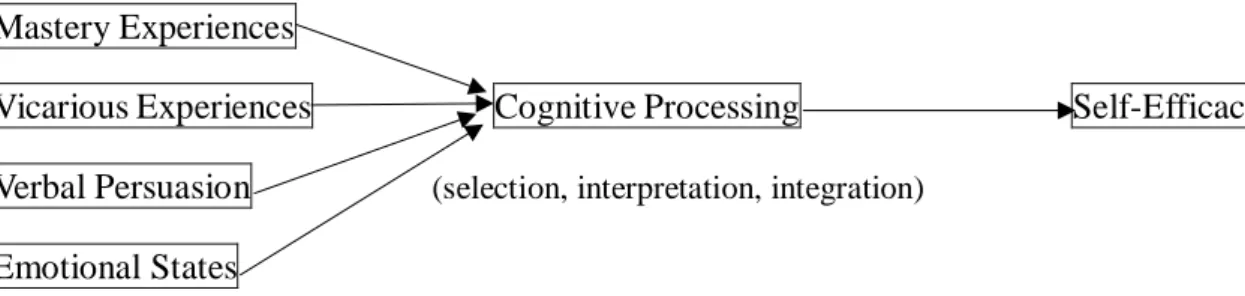
self-efficacy information alone cannot directly influence self-efficacy. Figure 2.1. is a diagram which shows the mechanism of how self-efficacy is formed in an individual. Individuals select influential self-efficacy information derived from the four sources, interpret the information selected, and integrate their interpretations to form self-efficacy (Bandura, 1997, p. 79). It is only through this cognitive processing and reflective thought that self-efficacy can be formed (Bandura, 1997, p. 79).
14 Mastery Experiences
Vicarious Experiences Cognitive Processing Self-Efficacy Verbal Persuasion (selection, interpretation, integration)
Emotional States
Figure 2.1. The mechanism of self-efficacy forming.
2.3 The Relationship Between Self-Efficacy and Academic Achievement
Self-efficacy beliefs exert a strong influence, which can be applied to academic domains. Only recently has self-efficacy been examined widely in area of educational research, particularly in the area of academic performance, motivation, and self-regulation (Bandura, 1997; Mills, 2014; Pajares, 1996). For example, Bandura and Schunk (1981) discovered in their empirical study related to mathematics that elementary school students’ self-efficacy beliefs showed positive relations to their academic performance and intrinsic motivation. Hsieh and Schallert (2008) and Hsieh and Kang (2010) found that self-efficacy strongly predicted academic achievement among university students and ninth-graders learning foreign languages. A number of other studies have also demonstrated strong positive relationships between self-efficacy and academic achievement (e.g., Asakereh & Dehghannezhad, 2015; Bandura, Barbaranelli, Caprara, & Pastorelli, 1996; Brinter & Pajares, 2006).
Significant differences can be found between those with a strong sense of self-efficacy and those with a weak one in academic achievement. As aforementioned, high self-efficacy learners possess less anxiety, strive harder to achieve their goals, and are more likely to succeed while low self-efficacy learners show the opposite behaviors (e.g., Bandura, 1997, p. 39). Bandura (1997, p. 194) also claims that perceived self-efficacy
15
influences the degree of an individual’s effort, persistence, and choice of tasks. Since a student’s perception of academic self-efficacy can promote their achievement by raising their motivation (Zimmerman, Bandura, & Martinez-pons, 1992), it can be confirmed that nurturing learners’ self-efficacy is essential in helping them achieve their academic goals.
Perceived self-efficacy could lead to heightening an individual’s academic ability
above actual ability (Zimmerman, 1995, pp. 213–214). Zimmerman (1995) found that students with high self-efficacy used effective strategies and solved problems in efficient ways, which means that the higher students’ self-efficacies are, the better they can accomplish their performance. Therefore, it is suggested that schools should develop students’ self-efficacy beliefs and their self-regulatory abilities beyond teaching intellectual skills, so that students can educate themselves through life (Zimmerman, 1995, p. 202). This is needed for students to become mature, full-fledged learners.
2.4 Speaking Self-Efficacy and Other Views Related to Self-Efficacy 2.4.1 Speaking Self-Efficacy
With respect to studies of self-efficacy and language skills, most have examined reading (e.g., Mills et al., 2006; Nelson & Manset-Williamson, 2006; Schunk & Zimmerman, 2007; Shell, Colvin, & Bruning, 1995; Shell, Murphy, & Bruning, 1989), listening (e.g., Graham, 2011; Levitt, 2002; Mills et al., 2006, 2007; Rahimi & Abedini, 2009), and writing (e.g., Pajares & Johnson, 1996; Pajares & Valiante, 1997, 1999, 2001, 2006; Pajares, Johnson, & Usher, 2007; Schunk & Swartz, 1993). In contrast, the number of studies which investigated speaking self-efficacy in foreign/second language learning has been rather small, though they have been increasing (e.g., Asakereh & Dehghannezhad, 2015; Cubillos & Ilvento, 2012; Idrus, Salleh, & Abdullah, 2011; Liu, 2013; Paradewari, 2017; Saeidi & Ebrahimi, 2012).
16
In this globalizing world, it is essential for learners to acquire English-speaking proficiency to communicate with people from different cultural backgrounds. In Japan, the government course guidelines for high school, which were revised and re-issued in March 2019, aim to nurture student attitudes and capacity to try to communicate with foreign people by means of a foreign language enthusiastically. It also emphasizes interaction with foreign people in accordance with their aims and situations (MEXT, 2019). Certainly, Japanese students need to acquire better communicative speaking skills in English in order to adapt to globalization. Higher levels of self-efficacy can increase speaking proficiency (Woodrow, 2006) and therefore more research should be conducted to examine the function of self-efficacy in speaking a foreign language. This research area has yet to be fully developed, so it is worth investigating more thoroughly.
2.4.2 In-Class and Out-of-Class Learning Environments
According to Tanaka (2004), an in-class environment in Japan implies using English in the classroom, but where grammatical and lexical knowledge are the main focus due to preparing for university entrance exams. In the typical classroom, students are surrounded by large numbers of their peers and taught English by a solitary teacher. This is usually a teacher-centered environment. On the other hand, an out-of-class environment implies using English outside the classroom, for example, in study-abroad settings, English camps, or English language schools. In such settings, students are expected to speak English voluntarily in order to acquire hands-on communication skills while interacting informally with native speakers. Krashen and Seliger (1975) distinguish in-class from out-of-class settings, stating that in the formal learning environment (typically in the classroom) learners are expected to acquire correct linguistic forms of the language while in the informal learning environment (typically outside the classroom)
17
students can learn language in natural settings. Furthermore, Gardner (1985, p. 85) refers to the in-class learning environment as the place where students develop their knowledge and skill in L2, and the out-of-class environment as the place where students interact with L2 community members with little instruction in L2 (Gardner, 1985, p. 89). In short, learning English in the classroom and learning to use it in the out-of-class informal settings are largely different.
In assessing students’ self-efficacy related to English speaking, this thesis divided the learning environment into in-class and out-of-class environments. This distinction in L2 self-efficacy has not been applied in other studies except Woodrow (2006), who found that self-efficacy could predict speaking proficiency in both in-class and out-of-class contexts. It is expected that this distinction of in-class and out-of-class settings could help reveal several aspects of the students’ past, present, and future speaking experiences associated with their self-efficacy beliefs.
2.4.3 Self-Efficacy and Self-Confidence
It is often difficult to distinguish self-efficacy from self-confidence. The two seem similar but embody different notions. Bandura (1997, p. 382) defines perceived self-efficacy as “a belief in one’s power to produce given levels of attainment,” adding that “a self-efficacy assessment, therefore, includes both the affirmation of a capability and the strength of that belief.” On the other hand, Bandura asserts that confidence is an unremarkable and ambiguous term, which does not necessarily specify its certainty. To put it briefly, self-efficacy can be interpreted as a concept that refers to specific tasks while self-confidence is a more general concept.
18
CHAPTER 3
THE RELATIONSHIPS BETWEEN JAPANESE UNDERGRADUATES’ ENGLISH-SPEAKING SELF-EFFICACY AND THEIR SPEAKING LEVELS
3.1 Introduction
Chapter 2 investigated prior studies regarding self-efficacy and its mechanism, and
other views related to self-efficacy. This investigation led the author to examine the relationships among learners’ speaking self-efficacies, their speaking proficiency levels, and Bandura’s (1997) hypothesized four sources of self-efficacy information, ME, VE, VP, and ES. For this, 194 Japanese first- and second-year undergraduates were asked to respond to a 36-item questionnaire on speaking self-efficacy beliefs.
3.1.1 Learning Environments in Japan
In this globalized world, speaking English has become important to communicate with people from different backgrounds. This can be confirmed from Warschauer’s (2000) assertion that globalization will make English an international language, causing non-native speakers to use English daily and to acquire communication skills by means of English.
Traditionally in Japan, grammar-focused and grammar-translation methods were utilized in English education for a long time. This is because preparing for university entrance examinations took the highest priority with a focus on rote learning over productive learning. Then, communicative language teaching (CLT), which promotes higher communication skills among secondary school students, was introduced in English education in 1989 by the Ministry of Education, Culture, Sports, Science and Technology (MEXT) (Nishino, 2011). This was followed by several changes to the course guidelines,
19
but overall enhancing students’ reading and writing skills seemed to be prioritized more than listening and speaking skills in junior and senior high schools.
However, these days in Japan, due to the drastic change of the course guidelines in response to globalization, teachers are required to teach English basically in English. In addition, introducing student-centered and collaborative learning has been strongly recommended by MEXT. It can be said that developing students’ productive skills in English, especially speaking skills, is urgently desired in school. Furthermore, English is to be taught as a compulsory subject in the fifth and sixth grades in Japanese elementary schools from 2020 (Aoki, 2016). Students as well as teachers may have no choice but to adjust to these new changes.
In order to improve students’ oral proficiency, helping students develop their self-efficacy in English-speaking would play a fundamental role. However, so far, there seem to be few studies which have examined the relations between Japanese students’ self-efficacy and their speaking proficiency, and therefore this area is worth investigating more profoundly.
3.2 Objectives and Research Questions
This study aims to examine the relationships among learners’ in-class/out-of-class speaking self-efficacies, speaking proficiency levels, and the four sources of self-efficacy information. For this aim, the following research questions were designed:
1. Can in-class and out-of-class self-efficacies be differentiated?
2. How strongly do in-class and out-of-class self-efficacies predict learners’ speaking proficiency levels?
3. How strongly do the four sources of self-efficacy information predict learners’ in-class and out-of-class self-efficacies?
20
3.3 Methods 3.3.1 Participants
The participants were 194 Japanese first- and second-year English-major undergraduates at a university located in the western part of Japan. Among them, 103 were freshmen and 91 sophomores. The participants were selected because they were all English majors and engaged in English speaking class once a week, which implies that valid data could be obtained based on their actual experiences of speaking English. The speaking classes are taught by three native speakers of English, and the students are divided into three classes representing three levels ranging from basic and intermediate to advanced. A placement interview test was conducted beforehand at the beginning of the spring semester by three native speakers of English, where each group of three students was observed while discussing one topic freely in English.
3.3.2 Procedures
In this study, a quantitative approach was adopted. The participants were asked to answer 36-questionnaire items in their listening class (freshmen) and in their reading class (sophomores). The questionnaire was written in Japanese, and later translated into English by the author (Appendix A). At the end of the questionnaire, the participants were asked whether they had had experiences of staying abroad for more than one month. Among the participants, there were several juniors and seniors who attended listening and reading classes for the purpose of repeating the courses, all of whom were regarded as invalid considering their additional experiences of practicing speaking English. In addition, several missing data were found. Taking these things into consideration, 14 forms were excluded from the data, and in total, 180 (96 freshmen and 84 sophomores; 56 males and 124 females) out of 194 collected forms were analyzed.
21
3.3.3 Instrument
3.3.3.1 Speaking Proficiency
Speaking classes were divided into three groups by the students’ speaking levels based on the result of the aforementioned placement interview test. Each level was scored by using a point system, from 1 to 3 points corresponding to low to advanced level, put into the data, and analyzed.
3.3.3.2 Speaking Self-Efficacy
In order to assess speaking self-efficacy, a Japanese version of scale was first constructed by the author, corresponding to the present situations of the participants. Then, the original questionnaire was improved and redesigned, referring to several similar scale items found in other research papers, (e.g., Asakereh & Dehghannezhad, 2015; Betz, 1978; Cheng et al., 1999; Horwitz et al., 1986; Idrus et al., 2011; Liu, 2013; Matsui, Matsui, & Ohnishi, 1990). The scale consisted of two subscales: in-class self-efficacy subscale, composed of 6 items related to in-class activities, and out-of-class self-efficacy subscale, comprising 6 items involving the activities outside the class. The questionnaire was designed based on Bandura’s assertion (1997, p. 42) that the scale items assessing self-efficacy beliefs should include one’s capability judgments on specific tasks, under different task-demand levels. In this study, the participants were asked to indicate self-efficacy in their ability for each item in the scale. An 11-point Likert scale ranging from zero (cannot do at all) to ten (certainly can do) was utilized in this study. This is because Pajares, Hartley, and Valiante (2001) affirm that an 11-point Likert scale format predicts one’s performance better than a traditional 6-point Likert format. Streiner and Norman (1989) also assert that scales with only a few steps are not reliable. Furthermore, Bandura (1997, p. 44) insists that scales with too few steps may not be able to differentiate subjects’
22
detailed information and that individuals’ responses could be differentiated if the scale includes intermediate steps. Actually, in his guidebook for self-efficacy scales, Bandura (2006) utilizes an 11-point Likert scale format to assess self-efficacy, ranging from Cannot do at all to Highly certain can do. The contents of the items in the questionnaire were examined beforehand by three English teachers. The reliability coefficients (Cronbach’s α) for in-class and out-of-class self-efficacy subscales based on the current data were .91 and .92 respectively.
3.3.3.3 Sources of English-Speaking Self-Efficacy Information
In order to examine the four sources of self-efficacy information, a Japanese questionnaire composed of 24 items was designed; 6 items each for ME, VE, VP, and ES. While analyzing the data, 2 items, one each in the VP and ES sections (No. 30 and No. 35) were excluded for the purpose of improving reliability. There is a possibility that the negative wording of these 2 items confused the participants and lowered the reliability. Concerning the scale items including negative wording, Usher and Pajares (2008) refer to its problematic aspects that might make the scale items unclear. However, there were another 3 items with negative wording included in the scale, but they were adopted because they did not seem to cause any problems to the participants’ response. Later, responses to these negative-wording items were reversed and converted into positive numerals, corresponding to the other positive scale items. Therefore, 34 items out of original 36 items were adopted in the data. The participants were asked to indicate the degrees of their applicability of each item, utilizing an 11-point Likert scale ranging from zero (entirely inapplicable) to ten (completely applicable). Reliability coefficients (Cronbach’s α) of the four subscales were .94 (ME), .84 (VE), .65 (VP) and .66 (ES).
23
3.3.4 Data Analysis
Statistical Packages for Social Sciences (SPSS) version 23.0 was utilized to analyze the quantitative data. A factor analysis and multiple regression analyses were adopted. The factor analysis was carried out in order to determine whether in-class and out-of-class self-efficacies could be discriminated or not (Research Question 1). Then, multiple regression analyses were conducted to assess the independent contribution of in-class and out-of-class self-efficacies to the prediction of the learners’ speaking proficiency levels (Research Question 2). Lastly, two more multiple regression analyses were performed to assess the independent contribution of the four sources of self-efficacy information to the prediction of the learners’ in-class and out-of-class self-efficacies (Research Question 3).
3.4 Results
3.4.1 Factor Analysis of In-Class and Out-of-Class Self-Efficacies
Research Question 1 asked the distinction between in-class and out-of-class self-efficacies. In order to investigate the factor structure of the self-efficacy scale, a factor analysis employing maximum likelihood extraction method was carried out on 12 self-efficacy items (6 each for in-class and out-of-class self-efficacies). The result was then rotated using promax rotation. Kaiser’s criterion for the number of factors to be based on the eigenvalue greater than 1.0 produced two factors. The two factors together accounted for 64.3 % of the total variance.
As shown in the factor pattern matrix shown in Table 3.1, items from 1 to 6 involved in in-class self-efficacy scale demonstrate salient loadings on Factor Ⅰ (eigenvalue = 6.75), while items from 7 to 12 involved in out-of-class scale reveal outstanding loadings on Factor Ⅱ (eigenvalue = 1.68). These findings assure that the two subscales of self-efficacy, indicating in-class and out-of-class self-efficacies,
24
represent two distinct dimensions derived from different aspects of learner beliefs. While these two types of self-efficacy showed a significant relation between them, r = .61, p < .001 (Table 3.2), they turned out to be different in nature as Table 3.1 shows.
Table 3.1
Factor Loadings of the Responses to the Self-Efficacy Scale (Promax Rotation)
Factor
Items Ⅰ Ⅱ
In-class self-efficacy
4. I can continue my speech in English even if I forget the content. 5. I can deliver a speech in English for my partner to understand well. 6. I can deliver a speech in English using the time fully.
1. I can smoothly deliver a speech in English which I have prepared beforehand.
2. I can answer correctly what I am asked in English.
3. I can ask some questions in English while listening to my partner.
Out-of-class self-efficacy
10. I can easily make friends with foreigners.
9. I can communicate smoothly with a foreigner in English. 8. I can offer help in English to a foreigner if he/she is in trouble. 7. I can correspond with a foreigner in English when spoken to. 11. I can smoothly use the English expressions I have learned in
conversations with foreigners.
12. When I meet foreigners that I know, I can greet them in English.
.87 .85 .78 .75 .72 .69 -.08 -.00 -.14 .12 .14 .13 -.06 -.00 .02 -.08 .06 .17 .89 .86 .86 .78 .70 .64 Note. N = 180.
To sum up, Research Question 1 can be answered by saying that in-class and out-of-class self-efficacies constitute clearly differentiated dimensions of learner beliefs.
25
3.4.2 Prediction of the Speaking Proficiency Levels by In-Class and Out-of-Class Self-Efficacies
Given that the two subscales of efficacy represent different dimensions of self-efficacy, Research Question 2 asked which type of self-efficacy explained the learners’ speaking proficiency levels better.
Table 3.2
Correlations Between Speaking Proficiency Levels and In-Class/Out-of-Class Self-Efficacies 1 2 3 M SD 1.SPL 2. ICSE 3. OCSE 1 .30*** .18 * ― 1 .61*** ― ― 1 2.12 4.76 4.39 .85 1.52 1.82
Note. N = 180. SPL = Speaking proficiency level, ICSE = In-class self-efficacy, OCSE =
Out-of-class self-efficacy. *p < .05, *** p < .001.
Table 3.2 shows the correlations between the learners’ speaking proficiency levels and in-class/out-of-class speaking self-efficacies. Speaking self-efficacy correlated significantly with both in-class and out-of-class self-efficacies, though it correlated more strongly with in-class self-efficacy (r = .30, p < .001) than with out-of-class self-efficacy (r = .18, p < .05).
In order to investigate which variable could more accurately predict the learners’ speaking proficiency levels, a multiple regression analysis was conducted, where the speaking proficiency level was determined as the dependent variable, and in-class/out-of-class efficacies as the independent variables. Though in-in-class/out-of-class and out-of-in-class/out-of-class self-efficacies correlated significantly with each other, multicollinearity was not detected in the variables, variance inflation factor (VIF) indicating 1.58, which means that the