タイトル
Use of Facebook in University Students
Career
Education Based on a Job Hunting Process under
the Japanese Employment Practice
著者
大石, 雅也; 関, 哲人; 近藤, 弘毅; Oishi,
Masanari; Seki, Norihito; Kondo, Hiroki
引用
北海学園大学経営論集, 14(2): 27-34
Use of Facebook in University Studentsʼ
Career Education Based on a Job Hunting Process
under the Japanese Employment Practice
Masanari Oishi, Norihito Seki, Hiroki Kondo
ABSTRACT
Japanʼs labor employment is distinctive, which derives from the unique employment custom and practice of Japanese companies. As a result, vocational education, also known as “career education” in Japan, was not imple-mented in Japanese universities for a long time. In recent years, the necessity of its implementa-tion has been pointed out. However, vocaimplementa-tional education in Japan is slightly different from that in other countries. Students are trained to be competitive in the job hunting process; they obtain technical skills and knowledge necessary to pass a company entrance examination or a university oral interview. This practice is in stark contrast with the intrinsic meaning of vocational/career education, which is the proc-ess by which students acquire the abilities and independence required by a certain industry. This meaning is manifested in the purpose of the vocational/career education program of Hokkai-Gakuen Universityʼs Faculty of Business Administration. The programʼs purpose is to foster independence in its students rather than the acquisition of skill for a job hunting process. The autonomy of every student is important to oneʼs career formation after graduating from a university. This study found that the utilization
of Facebook is useful and effective in improving a studentʼs independent will.
Keywords
Facebook, Portfolio Assessment Support System, University Vocational Education in Japan, Japanese Employment Practice
1. Employment Path in Japan
1.1 Japanese Employment Practice
Typical Japanese companies constructed the Human Resources System. In this system called lifetime employment, a person obtains a position in a company after graduation from school and keeps working for the same company until reaching the retirement age to be able to gain great employment benefits. Under such employment practice, general Japanese compa-nies obtain many benefits such as an employeeʼs loyalty to the company and acceptance of the compulsory career change. They can also premeditate their career development programs and coordinate a stable manpower planning. As such, a characteristic job hunting process in Japan has been formed. Lower youth unemploy-ment rate is among the most important benefits that can be gained from the practice.
prac-tice contains various flaws. Among its disadvan-tages is making Japanese companies become rigid. In Japan, quitting a company into which employees enter after graduating from school adversely affects them; therefore, most employ-ees remain at the Japanese company as long as possible, avoiding risk and losing the spirit of challenge.
1.2 Job Hunting Process in Japan
Most Japanese companies recruit a con-stant number of people every year on the same day, April 1. Nearly all Japanese companies hold an initiation ceremony, which is similar to a schoolʼs entrance ceremony or an induction of the armed forces. Prior to this ceremony, Japanese companies start their recruitment for junior students from March to around September of the year. Large companies or those higher than the medium-scale ones employ a university graduate in Japan. Unlike companies in many other countries, however, Japanese companies employ students who do not have any occupation ability for almost all types of job except the work of the field of specific physical science. A number of Japanese companies start their recruitment on campus. They gather many students and hold company information sessions for the hiring of a new employee in a classroom or a lecture hall of a university. Then they perform a written exami-nation and multiple job interviews. After this process, they select a prospective employee. Oneʼs potentials and training possibilities are asked during a paper test or interviews. Whether students have vocational skills is not raised.
Japanese students have to participate in certain briefing sessions conducted by a com-pany in which they are interested. The period of the participation starts at the end of their junior
year. Then they have to continue receiving tests and job interviews during the summer of their senior year or until they get an offer letter from a company into which they hope to enter. University students in Japan have to conform to such job hunting process and obtain a job before graduation if they want to be regularly employed by a Japanese company [1].
1.3 Vocational/Career Education for University Students in Japan
Owing to the job hunting process, univer-sity education is regarded as purely academic in Japanese society. Hence, university education is hardly expected to play any role in the business world. However, the necessity of career educa-tion for university students has gradually gained attention in Japan. In the 1990s, this necessity surfaced along with the two changes in Japanese labor market: partial disruption of lifetime employment and reduction in the number of new graduates entering the labor market.
As the Japanese economy experienced a low growth rate in the 1990s, many Japanese companies could not retain its lifetime employ-ment except for its core personnel. Hence, employees realized the need to consider carving out their own careers by themselves. Big Japanese businesses also did not employ many new graduates. As such, even those who graduated from high-level universities failed to enter their desirable companies and, thus, worked at small- and medium-scale companies (SMCs); SMCs had poor employee treatment and had have hired high school graduates at the time.
Of the two changes in the Japanese labor market, the latter had a significant impact on university students who wanted to land a job. Even with the employment changes, Japanese
companies did not change their hiring practice from once-a-year to year-round recruitment, which is akin to American companies. Hence, university students were placed in a stressful situation as this one-time recruitment conducted during the last year of their school life would affect their success for the rest of their lives. Consequently, a number of these students who were unsatisfied with their failure in the initial recruitment totally abandoned applying for a job and lost the will to work. This situation resulted in many social problems in Japan such as higher youth unemployment rate, increasing number of non-regular employment, poor working condi-tions, decreasing birth rate, and aging popula-tion.
To address this problem, Japanese students have been encouraged to have a smooth transition from school to vocational life. The key to this solution has been to introduce career education into higher education, and enable new graduates to carve out their own careers by themselves.
In 1999, the Central Council for Education of the Ministry of Education, Culture, Sports, Science and Technology (MEXT) in Japan first proposed a report that defined the agenda for connecting school and vocational education and insisted the importance of career education. In 2011, the Council proposed another report that clearly defined the role of university in career and vocational education. Since then, univer-sities in Japan have started to seriously implement career education.
However, Japanese universities are con-fronted with the difficulty of designing an appropriate curriculum that connects their own faculty to vocational/career education. Many universities end up implementing job hunting supports such as teaching technique for passing
job interviews. Such easy solution renders no substantial effect on career education and increasing the turnover rate within three years after being employed. To address this problem, Hokkai-Gakuen Universityʼs Faculty of Business Administration1 prepared a one- or two-year
curriculum called Career Support Program (CSP). This program incorporates the faculty education of business administration and corpo-rate internship through cooperation with several local companies. Through this program, the university intends to play the role of career education that Japanese society expects.
1.4 Career Support Program of Hokkai-Gakuen Universityʼs Faculty of Business Administration
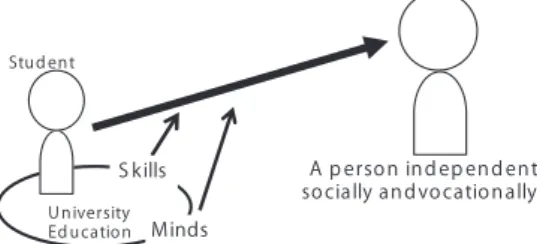
Hokkai-Gakuen Universityʼs Faculty of Business Administration defines career educa-tion as the acquisieduca-tion of basic business skills and knowledge necessary to be independent socially and professionally (see Figure 1). The original career development program had been called “On-site Business Training” and was implemented from 2003 to 2013.
On-site Business Training2 offered a
two-week internship for third-year students during the summer. The program included an “individ-ual guidance” and an “overall instruction” in the earlier period for third-grade students (see Table 1). Taking into consideration the growth of a student as a social being, On-site Business Training was reformed to CSP in 2014. CSP consists of courses shown in Table 2; it adopts active learning that is centered on group work. This new program is expected to enable students to work independently on their career development.
2. Portfolio Assessment Support System
2.1 Portfolio Assessment Support System Career education intends to make students realize the impact of their experiences on vocational life and encourage them to become socially independent. Students acquire the necessary skills and knowledge that an industry needs based on their plans, which address their goals and problems. They also need to record and assess their plans, including a record of self-growth process and a visualization of the process using information systems.
Portfolio Assessment Support System sup-ports this recording and assessment process. The system is closed and consists of three record functions, namely, “Portfolios,” “Reflective Journals,” and “Learning Logs” [2]. Each student records his/her activities in the system, which enables a self-assessment of his/her efforts to promote his/her activities. The three functions may overlap.
(1) Portfolios
Portfolio is a personʼs achievements or activity record that contains evidence. These contents that a person selects and records are categorized and sorted. The portfolio is equiva-lent to information as the sorting process comes with an evaluation.
(2) Reflective Journals
Reflective Journals are contents of a studentʼs understandings and records through portfolios. When the understandings are taken into consideration, those records are equivalent to knowledge.
(3) Learning Logs
These are logs of a studentʼs evaluation of their own Reflective Journals. Students will have tackled their own activities with those evalua-tions.
2. 2 Portfolio Assessment Support System in Japan
Many universities have introduced the use of an expensive packaged software called Portfolio Assessment Support Systems. It was developed by a software house in Japan. Few students use this software, whereas faculty staff
経営論集(北海学園大学)第 14 巻第 2 号
Figure 1. Career Support Program Concept
Table 1. On-site Business Training Course Course name Grade Average number of par-ticipants for 11 years On-site Business
Training 3rd 30
Table 2. CSP Courses
Course name Grade Average number of par-ticipants for three years
Academic Literacy 1st 340 Career Design 2nd 200 Business Practice 3rd 24 Research on Business 3rd 24 Business Model Analysis 3rd 24 Career Raising 3rd 24 Business Work 4th 10
members are covered with assessment and have many duties in the use of these systems [3]. However, these universities have only intro-duced the use of the software; they do not relate the portfolio system with their career education programs. As such, many portfolio systems are unsuccessful in Japan.
Recently, these universities have focused their attention on the portfolio systems as the possibility of assessment by peers replacing that of a teacher has emerged. Peer assessment can replace the usual process where a teacher evaluates a studentʼs every activity. Sato [4] shows that peer assessment encourages a student to work independently on reflective journals as regards information education for college students.
3. Activity on the Utilization of Facebook
in CSP
3.1 Component of CSP Facebook System Based on the above, to foster independence in students, CSP combines Portfolio Assessment Support System and Facebook. This system is called CSP Facebook System, which consists of a studentʼs and CSP Official Facebook pages. 3.1.1 A Studentʼs Facebook Page
A studentʼs Facebook page is central in the CSP Facebook System. The students who are admitted to take the course in their third grade3
must use their own individual Facebook pages. They tackle to use each Facebook.
3.1.2 CSP Official Facebook Page
CSP staff members have managed the CSP Official Facebook page
(https://www.facebook.com/hgubacsp)
since February 2014. This page promotes the use of a studentʼs Facebook page. It obtained about 1,000 to 2,000 viewers by one status in
April 2016.
3.2 Facebook Function
Facebook is a social networking site (SNS). Everyone can use Facebook freely unlike the packaged software. A user can selectively show his/her profile and post a status such as an event in his/her daily life. Interested readers can provide feedback [5]. Below are the Facebook functions used in CSP.
Comment
Facebook users can comment as regards any article posted on another userʼs Facebook page. They can also reply to other peopleʼs comments on their own posts.
“Like”
Facebook users can provide a positive evaluation on another userʼs status by clicking the “like” button. In addition, about the person doing “like,” is to log in to Facebook “like.”
Sharing status
This function refers to sharing of other Facebook userʼs status. A Facebook userʼs status shared by another user is displayed on the latterʼs Facebook page. The sharing status function enables the sharing of information among one other. They can also add sentences to the shared status. As such, the CSP Facebook System utilizes the functions of Portfolio Assessment System and peer assessment.
3.3 Function of the CSP Facebook System As seen in Figure 2, the CSP Facebook System, a CSP class, and a studentʼs portfolio assessment system are connected as seen in Figure 2. The three functions of the CSP Facebook System are as follows:
3.3.1 Generation of Portfolio
Students generate portfolios through the CSP classes they attend. However, the Japan University Association for Computer Educationʼs conference has cases where stu-dents do not generate portfolios [3], which demonstrates that it is difficult for students to do so. As such, this study focused on Facebookʼs “Share” function, which makes it easy for students to do ones.
On the CSP Official Facebook page, CSP staff members post detailed status updates regarding the class situation, including lectures and group work. This is considered a portfolio. The status is registered on the CSP Official Facebook page and can be read by anyone. Students can assume ownership of the status via the “Share” button on Facebook, thereby generating their own portfolio on their individual studentsʼ Facebook pages (see Figure 3). The dashed line from “(1) Portfoliosʼ” to “(1) Portfolios” in Figure 2 shows this process. 3.3.2 Record of Reflective Journals and
Learning Logs
Students can add a sentence to the status shared on their Facebook page. They can share statuses on the CSP Official Facebook page. Hence, adding sentences enables students to generate their own “Reflective Journals.” The arrow line from “(1) Portfolios” to “(2) Reflective Journals” in figure 2 shows this
process, while the arrow line from “(2) Reflective Journals” to “(3) Learning Logs” in Figure 2 represents the process of adding a sentence to the original status. The students then work on the next class (labeled “Classʼ” in Figure 2).
3.3.3 Promotion of Peer Assessment
Studentsʼ Facebook pages are open and aim to connect them with others on the web. Anyone
経営論集(北海学園大学)第 14 巻第 2 号
Figure 3. A Studentʼs Facebook Page The section within the dash-lined rectangle shows a studentʼs post. The one within the solid-lined rectangle shows a status shared on the CSP Official Facebook page.
Figure 2. A Student Process under the Portfolio Assessment Support System
can click the “Like” button with respect to a good article of theirs. Studentsʼ Facebook pages enable peers to assess their activities by clicking the “Like” button or sharing another userʼs status. Furthermore, anyone can share a studentʼs status, which means that anyone can have an interesting status. Therefore, the “Like” button and sharing statuses play the role of a peer assessment function.
4. Evaluation and Future Topics
4.1 Evaluation of Activity on the CSP Facebook The authors propose the effectiveness of Facebook functions in the promotion of career education. Table 3 shows the activities con-ducted in evaluating the CSP Facebook, includ-ing the observations conducted on the studentsʼ Facebook pages and a questionnaire survey. The questionnaire survey was conducted on fourth-grade students from October 1 to 23, 2014 and open-ended questions were employed. The results of our survey analysis (Table 3) demonstrate that the students did not use their Facebook pages as reflective journals or learning
logs.
One student commented, “Anyone whose motivation is low made fun of a number of posts and comments. So, we cannot make the comments that we would like to make, in fact. We wonder if this fact is a demerit of disclosure on studentsʼ Facebooks.” Derogatory comments can impede a student from posting a status. A studentʼs page can be viewed by any person admitted by them. However, their disclosure of status can cause the viewer to assess their activity on Facebook. This trade-off must be canceled.
4.2 Future Topics
A unique adoption system is a major contributing factor which characterizes Japanese employment practice. Generally speaking, in Japan, peoples are employed without any specific business skills just after graduating from their schools, and then they acquire the business skills by the in-house education such as OJT( On the Job Training). Therefore, in career-education at the university, professional educa-tions which are highly specialized in some fields
Table 3. Evaluation of a Studentʼs Facebook Page
Expected Function Function on Facebook Evaluation
Portfolios “Share” the status on HGU BA CSP Official Facebook page ○
Reflective Journals Status on a studentʼs Facebook page △
Learning Logs Status on a studentʼs Facebook page △
Peer Assessment “Like” for a status on a studentʼs Facebook page
Comments on a status on a studentʼs Facebook page
○ △
Diary of Oneself Status on a studentʼs Facebook page ○
Creating Human Relation “Like” for another Facebook “Like” from someone
Sharing link of another web page
△ △ ○ “○” is fulfill function, “△” is not fulfill function
or technical skills for job hunting such as personal history making techniques or interview techniques are not important. It is important to foster independence in the students using the specialty in each department. We introduced CSP as a case considering Japanese circumstan-ces, and trying to practice from the viewpoint of education at the university.
The activities conducted to assess CSP Facebook were employed for two years. The following issue must be addressed if CSP Facebook is to be utilized. Second, students must realize that the use of a studentʼs Facebook page is closely related to their CSP activities. Students hardly understand their reasons for using their Facebook. Senior studentsʼ Facebook pages were expected to help the junior students to work on their Facebook. As such, the latter are encouraged to emulate senior studentsʼ Facebook pages. In this process, Facebook as a freeware is maximized.
Acknowledgement
Hokkai-Gakuen Kenkyu Josei (Sogo) 2015-2016 supported this study.
REFERENCES
[1] Igarashi, T. 2012. What did the spread of
communication of media bring to us?: “CMC study” to an empty social study of media, The Social Psychology of Interpersonal Relations, Yoshida, T., Hashimoto, T., Ogawa, K., Ed. NakanishiyaCo., Kyoto, 193-215 (in Japanese).
[2] Japan University Association for Computer Education (JUCE) 2014, 2015, Proceedings of
Conference of ICT Strategy for Education
Improvement, 2014, 2015 (in Japanese).
[3] Loise, T. and Pat, W. 2006. The Smart Study, Guide, Oxford.
[4] Nomura, M. 2007. Japanese Employment Practice, Minervashobo, Kyoto (in Japanese).
[5] Sato, O. 2014. Reflective Learning and e-portfolio, Proceedings of 69th Japan Society of Information and Management Conference, 43-46 (in Japanese).
Note
1 Hokkai-Gakuen Universityʼs Faculty of Business Administration was established in 2003.
2 In the initial period, students interned at a total of 30 enterprises with which the Faculty of Business Administration had concluded an agreement. 3 The number of admitted students was 30 in 2016, 24
in 2015, and 17 in 2014. They were selected for the CSP course at their second grade under the “Career Design Lecture” in the previous year. The Career Design Lecture had 190 students in 2015, 250 in 2014, and 270 in 2013.
4 We observed all the studentsʼ status posts on their pages.