Analog and Digital Intercultural Perception
The cultural impact on pedagogical decisions of foreign teachers in Japan
Kaori Ono
松 山 大 学
言語文化研究 第 巻第 − 号(抜刷) 年 月
Matsuyama University Studies in Language and Literature
Analog and Digital Intercultural Perception
The cultural impact on pedagogical decisions of foreign teachers in Japan
Kaori Ono
Abstract
Globalization has increased the number of multicultural teaching settings in many areas of the world and Japan is no exception. Teaching across cultures, obtaining a greater understanding of cultural propensities can help students and influence teacher decision making in the classroom. We should be aware of the analog and digital concepts and utilize a well-known culture general mental model in our field introduced by Hayashi( ). Hayashi’s six lens model refers to the adverse traits of both concepts. Westerners, especially male, tend to have a digital perception while it is generally considered that % of Japanese people tend to have analog propensities(Hayashi ).
In his studies on the topic of inter-cultural understanding, Hayashi provides a list of countries that typically fit into each division. In order to cultivate educator’s tolerance for diversity, broaden global horizons and help reduce the potential risk of causing conflict in the classroom, obtaining a deeper understanding of the concept and the mental models that we have can benefit both teachers and students alike.
This research discusses the cultural influence on pedagogical decisions in the classroom for foreign professors teaching in Japan. A semi-structured survey with a Likert-type format was conducted to identify analog and digital propensities regarding decisions teachers made in the classroom. All participants in this study are of Western origin and reside in Japan. This paper attempts to discover if typically, analog cultural traits can have an impact on pedagogical classroom decisions in foreign teachers of digital origin.
Data was obtained from teachers(male , female )all teaching at the tertiary level in Japan. Results showed that the average score of male foreign professors were, . for analog and . for digital, while the average score of female foreign professors were . for analog and . for digital.
This research also highlights data sets from three different individuals. This research discovered that gender and language ability could be contributing factors in facilitating analog perception. The shifting of respective perceptions in classroom settings adapted by those professors may provide key elements to a successful pedagogy in Japan.
.Introduction
As Japanese society becomes more globalized, it is becoming more diverse. With this change, the opportunity to interact multiculturally rises exponentially. While cultural diversity is generally regarded as a positive, cultural differences nonetheless can lead to conflict in some cases. Furthermore, this difference in the culture of varying nations(Hall, , Hayashi, , , Hofstede, , Shaules, , , Weaver, ) creates a disparity in educational practices (Bennett, , Hofstede, ). Professors who originate in Western countries may be more likely to become frustrated by the hidden cultural aspects when teaching Japanese students, since their cultural distance is far greater(Hall, , Hayashi, , , Hofstede, , Shaules, , ). In other words, it is worthwhile for educators to consider the impact of varying cultural values on education(Bennett, , Hayashi, , , Hofstede, ). In order for Japan to become a successful globalized nation, it may also be beneficial for the educational systems to provide a link between Japan’s cultural values and pedagogical practices(Hayashi, , ). Doing this may help to attract more foreign professors and increase student motivation. How can people from different cultures get along with each other in spite of such differences ? In terms of education, Hofstede( )explains that “the burden of adaptation in cross-cultural learning situations should be primarily on the teacher.”
In order to cultivate educator’s tolerance for diversity, broaden their global horizons and help reduce the potential risk of causing conflict in the classroom, one approach to this question is understanding analog and digital culture and becoming aware of the mental models that we have. This area of research has been widely referred to by Hayashi Kichiro of Aoyama Gakuin University, who proposed an analog/digital perception concept. At the same time, we must also bear in mind
that not all individuals can be described by certain stereotypes since the cultural environment is different depending on the individual. However, understanding the tendencies of predominant cultures can help inform and educate individuals how to better facilitate communication between people of differing cultures(Hall, , Hayashi, , , Hofstede, , Shaules, , ). This paper will make reference to the cultural dimensions and values of Japan and Western countries and will also present the differences in their educational practices while taking the impact of culture into consideration. One of the first steps towards successful education with people from different cultural backgrounds is to facilitate the awareness of analog and digital concepts(Hayashi, , )which utilizes a culture general ‘mental model)’. The general perception is that such concepts are known to have a powerful impact on an individual’s personality and intercultural communication (Hayashi, , , Shaules, , ). This research will also discuss a short survey completed by forty-three non-Japanese professors from individualistic cultures who work in Japan.
. Aims
It can be argued that individual pedagogy would be quite different if we were more aware of our subconscious mental model. If more can be understood about our subconscious mental model, this may have a great impact on our learning path and actions in the classroom. This study aims to facilitate awareness of the analog/ digital perception that we have and to utilize them at educational settings. This paper begins by an overview of empirical studies of cross-cultural values frequently referenced to in the field of intercultural relations. Then a survey conducted with forty-three professors of Western origin in Japan to identify characteristics )Mental models are not easily recognized as such by conscious awareness and influence the person’s perception, sense-making, and information processing.
in perception useful when teaching in cross-cultural settings, will be introduced. Lastly, while there are numerous studies about English teaching in Japan, less attention is afforded to teaching based on the differences of mental models. This study seeks to fill this gap and explore practical implications for effective Second Language Acquisition in Japan from a cross-cultural perspective.
The purpose of this study is to introduce our mental models which stay in the subconscious and influence the person’s perception, sense-making, and information processing. And in better understanding those perceptions, it would enable an individual in actively utilizing both analog and digital perception more flexibly in educational settings.
.Literature review
This paper will begin by first introducing empirical studies of cross-cultural values frequently referenced in the field of intercultural relations. Next, it will examine the mental models that are useful in intercultural teaching. Finally, three research questions will be presented.
. Hofstede’s Cultural Dimensions Theory
It is widely acclaimed that communication in general, is influenced by various cross-cultural factors. One of the pioneers in the field of cross-cultural communication, Hofstede developed the Cultural Dimensions Theory(Hofstede, ) which explains the effects of a society’s culture on the values of its members, and how these values relate to behavior, using a structure derived from factor analysis). Hofstede’s Cultural Dimensions Theory(Hofstede, )
)Hofstede developed his original model as a result of using factor analysis to examine the results of a world-wide survey of IBM between and .
suggested the four dimensions of, Individualism-Collectivism, Power Distance, Uncertainty Avoidance and Masculinity-Femininity along which cultural values could be analyzed. Individualism-Collectivism refers to the relationship between the individual and the group. Highly individualistic cultures believe the individual is the most important unit while highly collectivistic cultures believe the group is the most important unit. Power Distance focuses on the nature of human relationships in terms of a hierarchy. Uncertainty Avoidance describes how cultures adapt to changes and cope with uncertainty in society. Lastly, masculinity and femininity focuses on to what extent genders in society react regarding individual achievements and society’s expectations of them. Later he expanded his theory from the −D
model adding a fifth dimension, long-term orientation, to cover aspects of values not discussed in the original paradigm. Hofstede added a sixth dimension, indulgence versus self-restraint in , which refers to the decisions we make regarding self-indulgence.
. Analog and Digital in Intercultural Communication
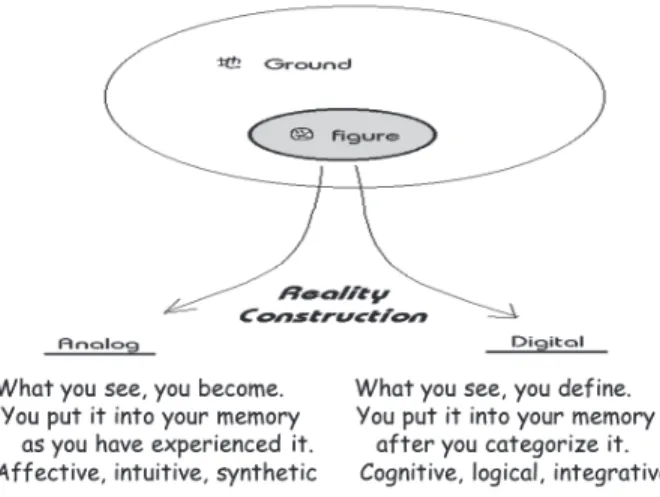
Although the concept of analog and digital)is usually used in the field of technology, these terms can also be used to describe an individual’s way of perception. Hayashi( ) mentions that the operating mode of analog is feeling and that of digital is thinking. The former is approximated by the following descriptions. The analog style of communication represents intuitive, holistic sensing, followed by sense-making through feeling, and thus created feeling information is processed or communicated for the purpose of the feeler(See figure ). In a way, analog is right brain in action. In contrast, digital style of communication means analytical sensing, followed by logical sense-making, and )Due to the confusion between the current ICT trend, terminology reform may be conducted in the near future.
thus created logic is processed or communicated for the objective of the thinker. Again, digital perception is left brain in action. Scientifically it is understood that, language and sign are originally right brain activities. When learning Japanese, for example it is necessary to acquire and memorize Kanji and the Kana writing systems in the right hemisphere. This corresponds to empirical research done by Hayashi ( ) who declares that over seventy percent of Japanese office employees primarily have analog propensities. Hayashi and Gordon( )claim that analog reality arising from the right hemisphere dominance is prominent not only in Japan but also is commonly estimated to be almost % of global population. It has been earlier described, however, that Westerners are largely left brain-dominant. The two authors also make the assumption that a primary cause of this change comes from intervening sixteen years of writing and thinking by way of using the digital, written form of the language which largely sets the pattern of the left brain. They
also claim that there are two intriguing characteristics of the alphabet using societies. One is the lack of tolerance for ambiguity which is often reflected in the cultures using the phonetic writing system(Hall, , Hayashi, , , Hofstede, , ). Another is the detachment or isolation of figure from ground, the viewer from the viewed, which could be seen as the origin of individualistic
Analog and Digital Mindset and Orientation (Hayashi )Used with permission
Analog Digital
Right hemespheric Left hemispheric
Pictorial Codifying
Wholistic Reductionistic
Relational Analytical
Visual Image Symbolic representation
Gestalt Focused
Touchy-feely Verbalized information
Affective Cognitive Intuitive Reasoning Implicit Explicit Atmospheric Defining Spacial Linguistic Experiential Logical
Simultaneus processing Classificatory processing
Oral Written
Do it first Think of it first
Soft data Hard data
Informal Formal
Continuous reality Discontinuous reality
Irregularity Regularity
Change Stability
Groping about Planning
Case by case Systematic
Miscellanies-connecting Discontinuous reality
Interactive Regularity
Synthesizing Stability
Global view Planning
Relation-oriented Systematic
Emerging Designing
Artist, sportsman, politician Lawyer, accountant, planner Table Analog and Digital Mindset and Orientation
cultures(Hall, , Hayashi, , , Hofstede, , ). This is also a predominant trait of most of the societies using versions of this alphabet writing system today.
The six lenses model including analog/digital, past experience/future vision and objectivity/subjectivity are all propensity and competence based. Individuals can work for high competence in some lenses even against one’s propensity if one is encouraged to do so by parents, teachers and/or other influential persons. Furthermore, it is stated that the same person may fluctuate from one modality to another, either from digital to analog or the other way around depending upon the context and the function they are performing(Hayashi, , ). Many people are engaged in interpersonal relations, art, sports, sales, etc. in the analog mode, but they switch to the digital mode in matters relating to science, law, accounting, mass marketing, etc.
. High context cultures and Low context cultures
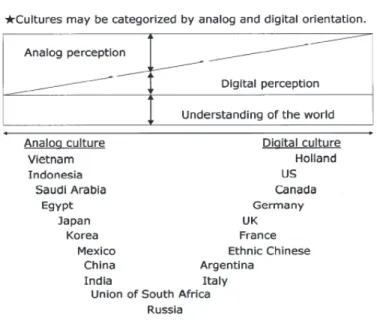
There seems to be a correlation between analog perception and high context cultures, for example, China, Indonesia and Japan. Similarly, digital traits are usually found in low contextual cultures for example the U. S. A, Canada and the U. K. The anthropologist Edward T. Hall( ) coined the expressions high context culture and low context culture. These terms are used to differ cultures based on how explicit the messages are exchanged and how much the context means in certain settings. Hall( )explains, messages exchanged in a high context culture deliver meanings implicitly rather than depending on the words itself. As shown in figure , this type of communication relies more on the context of the situation, so many things are left unsaid. On the other hand, in low context cultures, the message may have a clearer meaning and therefore, it is vital for the communicator to be very explicit with choice in word order for the meaning to be
conveyed by the recipient in each respective country.
As previously mentioned, in high context cultures, people may have a tendency to behave in an analog fashion and in low context cultures, they may behave in a ‘digital’ way(Hayashi, ). It is essential for us to understand this point in order to become aware of the balance between the two paradigmatic modalities of perception that are always in motion in all intercultural interactions. Hayashi ( )mentions that Japanese culture is inclined towards or characterized by analog propensity and competence, while Western cultures, including the United States is inclined towards digital propensity and competence. Many Americans, who come from a low context culture, have a tendency to place more value on things digital, for example science, facts, and other things that are based on logic. On the other
hand, many Japanese have an unconscious notion to value more highly on analog things, for example, intuition, gut feeling, and personal connections since these things are premised to have a large impact on Japanese society.
. Culture Analogy
Another popular concept in cross-cultural awareness is Gary Weaver’s iceberg analogy. Weaver’s iceberg analogy of culture( )is derived from the distinction made by Hall( )between external culture or surface culture, which indicates those aspects of a culture that people are usually consciously aware of, and internal culture or deep culture, which indicates those aspects of a culture which people are often unconscious of. With regards to Weaver’s iceberg analogy, he claims that in a similar manner to icebergs where only the tip is visible above the water, that is only a small part of a given culture may be visible to outsiders and in the same way
that most of the iceberg is hidden beneath the water, a large part of a culture may remain invisible to outsiders unless they spend a considerable amount of time learning about and, or experiencing it.
Another frequently referred to analogy of culture is Hofstede’s “Onion Diagram”( )figure . On the outside are visible manifestations of culture and social systems while on the inside there are values or beliefs which are invisible. Hofstede indicates that surface behavior on the “Onion Diagram” is interpreted through a filter of deep cultural values, expectations and assumptions. Shaules ( )illustrates that “deep” refers to the out-of-awareness nature of the patterns that have been imprinted into us and a “kind of mental programming” that we acquire over time. Therefore, conflicts that occur between people from opposing cultures at the inner level when referring to the Onion Diagram, similar to the underwater level when referring to the Iceberg analogy may be relatively difficult to
resolve. Since beliefs, values and concepts(underlying reality systems)are usually hidden, people may be less aware of them and they may be harder to change.
. What is a mental model ?
A mental model is an explanation of someone’s thought process about how something works in the real world. It is a representation of the surrounding world, the relationships between its various parts and an individual’s intuitive perception about his or her own acts and their consequences. In general, mental models can help shape human behavior and set an approach to solving problems similar to a personal algorithm or doing tasks. According to Hayashi( )mental models are known to have a powerful impact upon one’s personality and intercultural communication style.
Through use of a psychometric test by Kichiro Hayashi and Ryuhei Yagi ( )it was claimed that a majority of Japanese people seem to have a mindset characterized by preferred propensities towards “right mind” rather than “left mind”, “past experience” rather than “future vision”, and “objectivity” rather than “subjectivity”. As shown in figure number , Japanese culture is inclined towards or characterized by analog propensity and competence whereas, US and many western cultures are inclined towards digital propensity and competence. These authors claim that it appears difficult for most people to control these preferences, even when communication becomes more effective. One reason for this could be that these preferences are known to have been installed in the mind through the subconscious process of cultural influence at an early age from parents, school mates, and other agents of socialization(Shaules, , ). If the preferred propensities can be aligned between the communicators this can further improve and strengthen this notion. However, the difficulty of this issue is complicated because analog/digital propensity and competence are mental models and therefore not easily
recognized as such by conscious awareness. They stay in the subconscious and influence the person’s perception, sense-making, and information processing.
As previously noted, Japanese culture is inclined towards or characterized by analog propensity and competence, and US culture towards digital propensity and competence(Hayashi, / ). Male westerners, in particular, are known to have digital traits. Those who have lived in Japan for more than a few years may become assimilated or acculturated to the Japanese style of analog perception and competence. The difficulty of this issue is complicated because, as previously noted, analog and digital propensity and competence are mental models and therefore not easily recognized as such by conscious awareness. They stay in the subconscious and influence the person’s perception, sense-making, and information processing. Hayashi( )mentions that what is intriguing in this issue is that the issue is globally culture general.
In addition, it is widely known in Japan that returnees, or the so-called “kikokushijos” )may be treated unfairly when returning back to Japan after long periods abroad. One such case could be when a Japanese person who may have lived in the US for a prolonged period of time studying for an MBA ends up quitting a Japanese post on returning due to huge discrepancies between their ideas of business and their company’s. Conversely, several Japanese companies have recently known to have changed their Japanese operating mindset to follow a more Western operating system, as they became more globalized, for example, Toyota, Nissan and Panasonic etc. Examples may include from experiential seniority to visionary leadership, from objective consensus to a top-down strategic management, intuitive feeling to analytical-logical decision-making, passion to planning, etc. As )Returnees, or the so-called “kikokushijos” are children of Japanese nationals who have spent a period of at least a year abroad. They are known as kaigai-shijos while they reside abroad due to their parents’ work and as kikoku-shijos upon their return to Japan. They are referred to in English as “returnees”.
a result, Japanese recruiters may feel disappointed unless young returnees appear to have acquired, for instance, U. S left brain orientation. Those Japanese children or kikokushijos, who spend a long period of their life in Western cultures, particularly north America, may have returned to Japan with non-Japanese propensities. Though the answer to this may vary a great deal depending upon certain circumstantial factors including the age they went abroad and the length of time they stayed. It is not too difficult to imagine what difficulties these young Japanese people may be confronted with soon after they return to Japan.
. Purpose of this study
There are three research questions for this paper. The first is a closed question, while the second and third are more open questions.
.Can adamantly digital non-Japanese adapt successfully in Japan over the long term ?
.What dimensions influence the perception of non-Japanese professors in Japan ?
.How have typically digital based subjects adapted pedagogical decisions in a classroom with analog thinkers ?
.Methodology
. Participants
This study focused on non-Japanese professors who have resided in Japan for more than a few years. Forty-three non-Japanese professors who fall into this category were recruited to complete a simple survey. The number and percentage of the participants’ gender was male and female, which consists of % and
% of the respective totals. The males had spent an average of . years living in Japan, whereas the females had spent a shorter length of time living in Japan showing an average of years. All of the participants in this survey originated from Western countries including the U. S, Australia, Canada, U. K, Germany, France, Poland and New Zealand.
. Data Collection
These participants proved more difficult to recruit than anticipated, thus this survey was carried out twice for this research. The first survey was conducted in mid-June . In order to obtain information of other eligible non-Japanese professors, the second survey was conducted during July . One of the joint researchers personally sent out questionnaires nation-wide to professors who he thought might be able to cooperate in this survey via email through Google Forms, a free survey tool.
With regard to the traits of the non-Japanese professors’ mental model characteristics, the researchers asked participants to comment on the following constructs by using a Likert-type scale questionnaire :
⑴ In decision making, I rely more on ‘intuitive feelings’ than ‘analytical-logical decision-making’.
⑵ I prefer to ‘think first than act’ rather than ‘act first and then see’.
⑶ I care about the image others have in society with regard to my standing in society.
⑷ I rely more on ‘subjective data’ than ‘objective data’.
⑸ When conceptualizing, I prefer to ‘analyze and categorize’ than ‘attend to the whole’.
⑹ When communicating, the most important thing is to ‘build relationships’ than ‘take the initiative’.
⑺ In decision making, I tend to ‘rely on rationality’ than ‘rely on intuition’. ⑻ When explaining an idea to others, I would ‘help visualize’ them rather than
‘persuade by logic’.
⑼ When evaluating, I measure accuracy or effort rather than inaccuracy, such as attitudes.
⑽ When working, I tend to ‘ponder about’ making decisions than to ‘plan’. Note : Regarding the content of the questions, question number , , , and
are constructed to measure an individual’s analog propensity. However, question numbers , , , and are constructed to measure digital propensity.
With regards to the second survey, a semi-structured style format that added the following questions was employed :
Do you think the decisions you make in the classroom have been influenced by your time in Japan ?
Are there any opinions or views you would like to share about this topic ?
. Analysis
This survey utilized a Likert-type scale questionnaire asking non-Japanese university professors to measure their analog/digital propensities. In order to avoid neutral answers from participants, this research constructed the answers in even numbers on a scale of one to six.
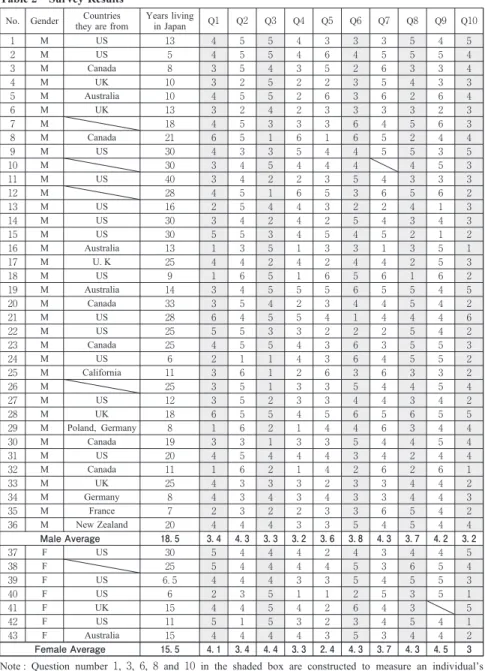
This research highlighted data sets from three different individuals. The diagram below(Table )was made to show the interrelationships obtained from these three participants. Two of the three participants showed no particular change from a typical digital country. Whereas, the last participant showed a huge change among the forty-three participants.
No. Gender they are fromCountries Years livingin Japan Q Q Q Q Q Q Q Q Q Q M US M US M Canada M UK M Australia M UK M M Canada M US M M US M M US M US M US M Australia M U. K M US M Australia M Canada M US M US M Canada M US M California M M US M UK M Poland, Germany M Canada M US M Canada M UK M Germany M France M New Zealand Male Average . . . . . . . . . . . F US F F US . F US F UK F US F Australia Female Average . . . . . . . . . .
Table Survey Results
Note : Question number , , , and in the shaded box are constructed to measure an individual’s analog propensity. However, question numbers , , , and are constructed to measure digital propensity. Those respondents without a country name did not identify their nationality.
.Results
This research calculated the average score of total male non-Japanese professors’ analog/digital scores. The male professors had spent an average of . years of living in Japan. Any response from − . indicated a negative response,
whereas any score from .− . indicated a positive response. Their average analog score was . and average digital score was .. These scores had similar traits from those living in Western countries. This data will be compared to the following participants A, B and C. Qualitative data of the participants’ comments on their views and opinions regarding pedagogy in Japanese classrooms, will also be introduced.
(Participant A)
One male professor from both, Poland and Germany, who has resided in Japan for years, stated :
“Topic choice, subject depth, and teaching methods have to be adjusted(are limited)to/by students’ preexisting background knowledge, students’ intelligence, character and flexibility. Experience showed this is a very problematical field, especially in Japan.”
This participant showed an analog average score of . and a high digital score of .. This shows a higher preference towards a digital perception.
(Respondent B)
Another male professor from Canada who has resided in Japan for years, mentioned :
“Humor. I use an abundance of humor in class. (This always gets an)excellent response from students - Always !”
Respondent B’s analog average score was . while his digital score was .. This indicates a far greater preference to digital perception than respondent A.
Humor in classroom settings used to be a trait especially valued in Western cultures (Shaules, ). Respondent B seems to well-adapt those characteristics in the
Japanese analog classroom settings.
(Respondent C)
A male professor from UK who has resided in Japan for years, said :
“I definitely feel like my decisions in the classroom have changed and my understanding of Japanese and culture has influenced that greatly.”
This respondent’s average analog scores were ., which was the highest among the participants. As well as maintaining high digital scores of .. These results showed a huge change compared to those from other participants. This data shows, respondent C acquired flexibility in being able to switch between these respective perceptions with a sort of unconsciousness. It seems that while maintaining the digital characteristic of western cultures, this participant became well adapted and acquired the ability to “become Japanese” during classroom settings.
.Discussion
from different cultural backgrounds is influenced by various factors such as analog and digital perception(Hayashi, ). If educators are informed that our behavior is largely decided upon the processes we are not even conscious of, our pedagogy may change drastically. In addition, we may be able to utilize these traits to bridge the cultural differences and may be informed with a real understanding of how an individual can learn. The key in doing so is becoming aware of differing cultural perceptions, in particular the “analog and digital” concept. Furthermore, the expression omotenashi used as a catchphrase for the Tokyo Olympics is a good example of Japanese cultural characterization in receiving foreign visitors to Japan. Omotenashi commonly translated as hospitality, refers to a spirit of unconditional hospitality, which has been passed down by our ancestors. The word has two meanings in Japanese. The first meaning derives from the word “ura-omote nashi” )which means that any act of kindness is not two-sided and is a genuine act of hospitality from the giver’s perception. The second meaning comes from the phrase “mono-wo motte nashitogeru” which means to “carry through” with an act of kindness, or service. It does not simply mean to provide somebody with something rather it refers to doing the best an individual can do through the entire process of hospitality. For example, beginning with welcoming the customer, providing the service, accompanying them, sending them off etc. Many Japanese are fond of the phrase omotenashi, but they may have never thought of the conceptual origins of the phrase and that it originates in the analog mental model. The researcher suggests, however, the ideal stage for an individual is to be able to bridge the cultural differences. That is, switching between these respective perceptions. This could be achievable through a deep understanding of both cultural differences.
)Ura meaning the back or the inside omote means the front of the surface and nashi means [there isn’t and there aren’t]therefore, ura-omote-nashi means a genuine act of hospitality
Furthermore, if individuals display a good comprehension of both languages this can further enhance code-switching between both perceptions.
This paper examined the analog/digital concept of non-Japanese professors residing several years in Japan. It posed three research questions. With regards to the first research question the answer is that male non-Japanese professors living in Japan for a long time were slightly digital and had the same traits from those living in western countries, by having a high digital score of . compared to an analog score of .. Therefore, the answer for the first research question is found to be in the affirmative with a slightly high perception of digital perception rather than analog. Regarding female professors living in Japan, the female participants of this research also tends to have a stronger analog perception of . and digital, .. These results suggest that gender also influences the perceptions of non-Japanese professors, as Hayashi( , )mentions, females tend to have stronger analog perception worldwide compared to males. Which shows that women tend to value feelings or emotions rather than an analytical approach. Furthermore, Goleman ( ), the author of the book “Working with Emotional Intelligence”, also explains that females tend to have high scores of emotional intelligence compared to males. Furthermore, it could be said that mutual understanding and communication between the two genders tends to occur more prominently in Western cultures).
With regards to the second research question, what dimensions influence the perception of non-Japanese professors in Japan ? In the beginning, the researcher predicted male westerners living in Japan would indicate relatively high analog scores. As successful communications among intercultural teacher/student relationship in Japan seems to be well supported by non-Japanese who diligently
)There are many research on mutual-understanding and communication between the two genders, such as “You just don’t Understand”-Women and Men in Conversation(Tanen, ,
attempt to adapt to life in Japan and are proactively working with their students and community. One observation that could be made here is the connection with Japanese language ability. Although it cannot be verified from the data obtained in this study, several of the teachers who participated were known to the author. These teachers individually described their Japanese ability as low and wished it was better. There are two major implications behind this point.
One is that the frequent use of English(digital)language as the international lingua franca may have a greater and deeper influence upon the shaping of our mental models than people may be aware of. In addition, living in the modernized world of today, where digital technologies are prevalent and freely available, foreign teachers living here do not necessarily have to give up on their cultural traits as they might have had to in the past. High speed internet, freely available communication tools and other access to mass-media outlets may help foreigners living here to maintain their “digital” identity. Therefore, perception patterns of foreign teachers in Japan may not change at all, showing a digital predominance. This may be particularly true for westerners from traditionally digital based countries.
This research also acquired three non-Japanese male teachers who have been residing in Japan for over years. Being immersed in Japanese culture for such a long time may have a great impact on their mental models. It is intriguing to find out, however, that data from these participants show no particular change from a typical digital country. Their average scores showed an analog propensity of . and a digital propensity of ., having similar traits to those living in quintessential digital countries. One further observation that could be made here is the connection to the command of the Japanese language. This ability enhanced the participant to communicate actively with the Japanese students which enhanced the understanding of Japanese culture and facilitated the analog perception as a result.
spoken in the country where the study was conducted, in this case Japanese. This study found out however, there was a relation between their Japanese language ability and the development of their analog scores. As for the several teachers who thought their Japanese language ability was low, their analog and digital patterns stayed the same showing a digital predominance. The participant with the highest analog and digital score has an outstanding command of Japanese with a degree in Japanese. This illustrates that an individual’s language ability seems to strengthen the flexibility between the two perceptions with a good balance. What this implies is that a deeper understanding of the Japanese language seems to be more of a greater advantage than we initially assumed with regards to developing a flexible mental model. The length of a foreign teacher’s residence is not as influential as expected.
Interestingly, except for one participant who had resounding analog score of ., showed a huge change while maintaining a high digital score of .. It is also intriguing to know that this participant has a good command of Japanese and also a degree in Japanese language. The Japanese language ability of this participant may have influenced him to become more open minded. This demonstrates that having a good proficiency, in this case, in Japanese, was a vital factor to understand Japanese culture and perception. Through an understanding of language, it is easier to grasp cultural traits for non-Japanese professors. Language is important not only because it is useful in terms of communication with local students but because it may provide a kind of psychological relief for their students.
The third research question was, how have typically digital based subjects adapted pedagogical decisions in a classroom with analog thinkers ? The answer to this research question and another interesting finding of this survey was that several male non-Japanese participants had a high score of both analog and digital perception. In other words, while holding on to their original digital mindsets, they
seem to have acquired flexibility with regard to their perceptional patterns, that is, applying the analog/digital perception best suited to the situation. Being able to code-switch between these respective perceptions seems to be the ideal stage especially for professors or instructors who are teaching interculturally. Though unconsciously, this shifting of the respective perceptions in a classroom setting adapted by those professors, may provide key elements to a successful pedagogy in Second Language Acquisition in Japan. Next several research limitations will be considered.
. Research limitations
As with any research this study identified several limitations. Firstly, the sample size of this study could have been larger. However, as the subjects targeted in this research are in the minority, it still proved difficult to obtain the number that was acquired. Other limitations are the number of questions asked. It may have been more beneficial to ask participants to rate their Japanese ability on a scale of −
. By doing this researchers could gain an insight into ability of Japanese and make further conclusions. In addition, collecting more living narrative data of non-Japanese professors may undercover a wider range of elements in adaptation to Japan and cross-cultural pedagogy. Lastly, the countries professors originated from in this research did not necessarily represent a realistic proportion of global nationalities. Meaning there may be a risk of overlooking diversity by emphasizing the conceptual patterns between Japan and Western countries.
.Conclusion
It is commonly understood that English is basically a digital or analytical language(Hayashi, ). This is partly because the cultures of English-speaking
people are also relatively digital. Second Language Acquisition and teaching hypothesis are validated using subjects who will naturally conform to the standard patterns in the Western countries claiming adults primarily learn second languages via the left brain. By and large they do for Northern and Western European Language speakers, but not in Japan. Hayashi( ) has proposed a culture general model that distinguishes between analog and digital forms of perception that could be utilized in teaching intercultural communication. All of the subjects in this study are currently English teachers at the tertiary level in Japan. When teaching across cultures, we should be aware of the analog and digital concepts suggested by Hayashi( ). By becoming aware of our mental models, it allows us to see that it is may be the unconscious that plays the dominant role even in the most conscious of decisions. Our behavior is largely decided upon by processes we are not even conscious of. This is especially true when communicating with people from different cultural backgrounds. Achieving the ability to switch between these respective perceptions can be adapted by an intercultural education or contact with people of other nationalities from a young age.
The researcher hopes that this study can draw attention to the specific need for research in this area. And also to serve practical advice for non-Japanese professors to create language and culture learning that is mental model based which is best suited for Japanese students. If both these hopes can be met this research would help foreign teachers here and abroad to better prepare themselves and become more efficient educators.
Acknowledgements
The researcher would like to express her profound gratitude to Dr. Bruce Lander of Matsuyama University Graduate School. Without his persistent help, guidance and input this research would not have been possible. And the survey could not
have been successfully conducted. I would also like to thank Dr. Jay Scott Ercanbrack and the teachers who participated in the survey for this research.
References
Bennett, M. J.( ). A developmental approach to training for intercultural sensitivity. International journal of intercultural relations, ( ), − .
Clinchy, B. M., Goldberger, N. R., Belenky, M. F., & Tarule, J. M.( ). Women’s ways of knowing : The development of self, voice, and mind.
Gans, E.( ). Anthropoetics I, no. . Anthropoetics, ( ), . Goleman, D.( ). Working with emotional intelligence. Bantam. Hall, E. T.( ). Beyond culture. Anchor.
Hayashi, K.( ). “Two” Thoughts on Analog and Digital Language(In Honor of Professor Mitsuo Hashimoto). Aoyama kokusai seikei ronnshu, , − .
Hayashi, K., & Yagi, R.( ). Hontou no jubunga wakaru rokugan-shinri tesuto[six lenses model]. Osaka : Sougensha.
Herrmann, N.( ). The whole brain business book : Unblocking the power of whole brain thinking in organizations and individuals. New York, San Francisco, Washington DC, Auckland, Bogota, Caracs, Lisbon, London, Madrid, Mexico City, Milan, Montreal, New Delhi, San Juan, Singapore, Sydney, Tokyo, Toronto : McGraw-Hill , − .
Hofstede, G.( ). Cultural differences in teaching and learning. International Journal of intercultural relations, ( ), − .
Klauser, H. A.( ). Writing on both sides of the brain : Breakthrough techniques for people who write. Harper Collins.
Michael Rowley.( ). Kanji pict-o-graphix : over , Japanese kanji and kana mnemonics. Stone Bridge Press.
Nisbett, R. E. The Geography of Thought. .
Ornstein, R. E.( ). The right mind : Making sense of the hemispheres. Harcourt.
Pink, D. H., & Pink, D. H.( ). A whole new mind : Moving from the information age to the conceptual age(pp. − ). New York : Riverhead Books.
Shaules, J.( ). Deep culture : The hidden challenges of global living(Vol. ). Multilingual matters.
Weaver, G.( ). American cultural values. Kokusai bunka kenshu(intercultural training),