Regarding ultimate fate of our mother earth
Manjunath. R. (Reader in physics)
#16, 8th Main road, Shivanagar, Rajajinagar,
Bangalore-560010 Karnataka, India [email protected]
Abstract: From past several centuries many scientists are struggling hard to understand the truth of ultimate fate of our mother earth . Most of the assumptions and predictions regarding the ultimate fate of our mother earth have been proved to be wrong .I have made an attempt to figure out the ultimate fate of our mother earth through a mathematically derived equation i.e R = c/ H cosec θ [ (ρ / ρ0 )^ 1/3 - 1] { where R=Radius of elliptical orbit in which earth moves around the sun, c= speed of light in vaccum (3*10^8m/s), H=present Hubble constant ( which is the function of time), ρ0 = present mass density of universe , ρ= later mass density of universe which vary with respect to time ‘t’. θ =angle between concepts d1 and d respectively}.The above expression was developed based on cosmological, astronomical and mathematical concepts.The above paper also describes about the variation of radius of earth’s elliptical orbit around the sun with mass density of infinite universe. [Academia Arena, 2010;2(3):32-40] (ISSN 1553-992X).
Keywords: Angle, Density, Radius
Introduction : The Universe comprises everything we perceive to physically exist, the entirety of space and time, all forms of matter and energy, and the physical laws and constants that govern them . It is believed that earth is only a part of our universe and only place in the Universe in which life is known to exist . As the result of our universe expansion distant galaxies are moving away from the earth. Moreover there is variation of mass density of infinite universe with respect to time due to the cause of expansion. Hence there is change in radius of earth’s elliptical orbit around the sun with mass density of infinite universe. Every beginning of nature’s creation has an end. Earth is created by law of nature and it will be destroyed by the nature itself. When the mass density of infinite universe remains constant i.e ρ / ρ0 = 1 (ρ = ρ0 ) ,then the value of radius of earth’s elliptical orbit around the sun will become 0 i.e R=0. The ultimate fate of earth depends totally upon the mass density of universe.The ratio ρ / ρ0 also varies with the value of θ.
Derivation:
A B
D
R S R
d
d1
d
Figure1: Parallax method
D=distant galaxy
S=sun.(center of the solar system).
R=Radius of elliptical orbit in which earth moves around the sun.
A and B are the position of earth at different instants of time respectively.
d1=distance between sun and distant galaxy.
d=distance between earth and distant galaxy.
θ =angle between d1 and d respectively.
From triangle SDB , tan θ=R/ d1 i.e d1=R / tan θ By appyling law of Pythogarous theorm to triangle SDB we get BD^2=DS^2+ SB^2 BD= d, DS= d1, SB= R i.e d ^2= d1^2+ R ^2 (As d1=R / tan θ ) Then the equation d ^2= d1^2+ R ^2 becomes d ^2= R ^2 /tan^2 θ + R ^2 d ^2= R ^2(1 /tan^2 θ + 1) ,as (1 /tan^2 θ + 1= cosec^2 θ ) The equation d ^2= R ^2(1 /tan^2 θ + 1) becomes d ^2= R ^2 cosec^2 θ i.e d = R cosec θ is obtained.
According to Hubble law: Greater the distance of distant galaxy from the earth(observer on earth) ,greater is the velocity with which distant galaxy moving away from the earth (observer on earth)
Hence mathematically represented by the equation v=H d where H=present Hubble constant ( which is the function of time) .
v= velocity with which distant galaxy moving away from the earth (observor on earth) . d= distance of distant galaxy from the earth.
As d = R cosec θ then the equation v=H d becomes v=H R cosec θ is obtained . Let us divide the above equation v=H R cosec θ by c where c= speed of light in vaccum (3*10^8 m/s) Then we get v/c=H R cosec θ /c is obtained.
If a source of the light is moving away from an observer, then red shift (z > 0) occurs; if the source moves towards the observer, then blue shift (z < 0) occurs. This is true for all electromagnetic waves and is explained by the
Doppler effect. Consequently, this type of red shift is called the Doppler red shift. If the source moves away from the observer with velocity v, which is much less than the speed of light (v << c), the red shift is given
(Since ) where c is the speed of light in vaccum.
i.e v/c = Z (where Z=Red shift) i.e Z= H R cosec θ /c is obtained Another application of the z parameter is to imply the scale factor R of the universe at the time that light
was emitted from a given observed galaxy The z parameter is related to R by the expression 1+Z=λ Observed / λ emitted = R0 /R = 1/R .
Since the present scale factor of universe is taken as R0 =1 . The z parameter can also be used to assess the mass density compared to them mass density ρ0 at the
present time. ρ = ρ0 / R^3 , we know mass density of universe vary with respect to time where ρ0 = present mass density of universe.
ρ= later mass density of universe which vary with respect to time ‘t’ . As 1+Z = 1/R ,
Cubing of equation 1+Z = 1/R we get ( 1+Z)^3 = 1/R^3.
The equation ρ = ρ0 / R^3 becomes ρ / ρ0 = 1/ R^3 i.e ρ / ρ0 = ( 1+Z)^3 is obtained.
(ρ / ρ0 )^ 1/3 = ( 1+Z) , As ( Z= H R cosec θ /c ) . Equation (ρ / ρ0 )^ 1/3 = ( 1+Z) becomes (ρ / ρ0 ) ^1/3 = ( 1+ H R cosec θ /c) (ρ / ρ0 )^ 1/3 * c = ( c + H R cosec θ ) . H R cosec θ = (ρ / ρ0 )^ 1/3 c ‐ c .
H R cosec θ = c [ (ρ / ρ0 ) ^1/3 ‐ 1] i.e R = c/ H cosec θ [ (ρ / ρ0 )^ 1/3 ‐ 1].
Where R=Radius of elliptical orbit in which earth moves around the sun.
c= speed of light in vaccum (3*10^8m/s) H=present Hubble constant ( which is the function of time)
ρ0 = present mass density of universe.
ρ= later mass density of universe which vary with respect to time ‘t’.
θ =angle between d1 and d respectively . By taking the the ratio (ρ / ρ0 ) =1 Hence Mass density of universe remains constant . then R = c/ Hcosec θ [ (1)^ 1/3 ‐ 1].
R = c/ H cosec θ [1 ‐ 1] .
Since (1)^ 1/3 = 1 (cube root of 1 is 1) . i.e R = c/ H cosec θ [0] then R= 0 . Hence Radius of elliptical orbit in which earth moves around the sun is zero i.e R=0.
As R= 0(distance between the earth and the sun is zero) .
Proof for the equation ρ = ρ0 / R^3
Please refer Doppler Red shift ( Google search )
At such large values of z, the redshift is mainly the cosmological redshift, and not a valid measure of the actual recessional velocity of the object with ...
hyperphysics.phy-astr.gsu.edu/Hbase/astro/redshf.html - Cached - Similar
Result : When (ρ / ρ0 ) =1 i.e ( Mass density of universe remains constant ), then there is no distance between sun and earth .Thus our mother earth will come into an end( Earth and sun are close to each other).
Discussion and Conclusion : As we know our infinite universe is growing and expanding. Hence we can observe variation of mass density of universe with respect to time ’t’. Many questions like Does the universe expands forever or contracts …….come into our mind, when we think about our universe But the answer will again become a question itself. If the mass density of universe remains constant( mass density does not vary with time) then R=0 i.e there is no distance between sun and earth. If the collapse of earth towards the sun happens we are just a human being in front of nature who can do nothing but simply watch like a movie in an astonished way. Creation of earth took billions of years but destruction of earth will take only few seconds .There after deep silence remain in our
universe . The value of ρ / ρ0 vary with the value of θ.
For example : if θ= 0 degree then HRcosec θ /c +1= (ρ / ρ0 ) ^1/3 i.e (ρ / ρ0 ) ^1/3 = infinity i.e Z=infinity
If θ= 90 degree then HR /c +1= (ρ / ρ0 ) ^1/3 i.e Z=HR/c ( Z= red shift) .
Additional information:
Does energy and impulse are interconvertable
Consider a photon of relativistic mass ‘m’ moving with speed ‘c’ is associated with the wavelength ‘λ’ is given by the relation λ=h/mc, Where h=planck’s constant (6.625*10^-34 JS).
According to wave theory, speed of the photon wave is given by c = λ /T, where T= time period.
By substitution of value of ‘c’ in the equation λ = h/mc, we get the expression m λ^2 = hT.
According to wave theory, as frequency of photon wave is given by f=1/T.
Then the equation m λ^ 2 = hT becomes f=h/mλ^2
De Broglie wavelength associated with the photon is given by λ= h/p, thus the equation f=h/mλ^2 becomes f=p/mλ.
Angular frequency associated with the photon is given by ω= 2 πf.
By putting the value of f=p/mλ. in the above equation we get ω= 2 πp/mλ.
The above equation ω= 2 πp/mλ. can be applied to both photons and material particles like electron in motion.
Debroglie wavelength associated with the electron is given by λ=h/mv Where v=velocity of electron in motion
Then the equation ω= 2 πp/mλ becomes ω= 2 πpmv/mh i.e ω= 2 πpv/h.
Part: 2
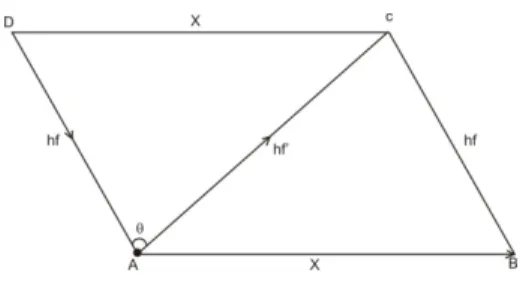
Consider a electron of mass “me”at rest, total energy associated with the electron is given by “me c^2”. Suppose radiation of energy hf is incident on this electron at rest. Part of energy hf” is absorbed by electron and part of energy hf’ is scattered by electron . Absorbed energy hf” is converted to motion of electron, hence electron travels a distance ‘x’ in time ‘t’. let θ be the scattering angle.
Figure :1 –schematic diagram of scattering of energy of photon by electron
x= Linear displacement of electron hf = Energy of incident radiation hf’ = Energy of scattered radiation θ = scattering angle
Consider a parallelogram ABCD constructed as shown in the figure 1.
Let AB=CD=x, AD=BC=hf, AC=hf’(opposite sides in parallelogram are equal)
Law of cosine is given by a^2=b^2+c^2-2bc cos θ. Let a = x, b=hf, c=hf’, cos A = cosθ.
By applying the law of cosine to the triangle ADC, we get X^2=(hf)^2+(hf’)2-2(hf)(hf’) cos θ = 1
By law of conservation of momentum of photon.
We get
→
→
→
= +
'
" y
y y
p p
p
where→
→
→ '
"
, ,
y y y
p p
p
be the momentum of incident, absorbed and scattered photon respectively.Let us assume absorbed momentum of photon = momentem of electron i.e.
→
→
p = p
y"
Thus
→
→
→
= +
' y y
p p
p
where→
p
= momentum of electron→
→
→
= −
' y y
p p
p
Squaring on the both sides we getP^2=
⎟
⎠
⎜ ⎞
⎝ ⎛ −
→ →' y y
p
p
^2, as (a-b)^2=a^2+b^2-2abThus the above equation becomes p ^2=py ^2+py’ ^2-2 |
→
p
y.
→p
y’|According to dot product rule | →a•→b|= |a||b|cosθ Then we get p^2= py ^2+ py’ ^ 2-2| py | | py’ | cos θ Let us multiply the above equation by c ^ 2we get Where c = speed of light in vaccum (3* 10 ^ 8 m/s) P ^2 c ^2 = py ^ 2c ^2 +py’ c^2-2| py | | py’ |c^2 cos θ
As we know frequency of photon is directly proportional to it’s momentum i.e hf = pc thus the below equation is obtained
p ^2 c ^ 2= =(hf)^2+(hf’)2-2(hf)(hf’)cos θ = 2 By comparison of 1 and 2 we get x ^ 2 = p ^2 c^ 2
i.e x = pc (position of electron is defined as the function of it’s momentum) As told earlier position of electron is defined as a function of it’s momentum i.e x = pc
Small change in momentum of electron causes small change in it’s position i.e. dx = dpc hence, dp = dx/c
Newton second law of motion is mathematically represented by equation F=dp/dt Where F = force exerted by photon
dp = Small change in momentum of electron with respect to time As dp = dx/c then the above equation becomes F= dx/dtc.
as velocity of electron is defined as v = dx/dt.
Then F =v/c is obtained
Force exerted by photon is defined as function of velocity of electron
As impulse exerted by photon is mathematically given by I = F dt.
then the equation F= dx/dtc becomes Fdt = dx/c i.e I =dx/c
Impulse exerted by photon is defined as function of change in position of electron At point A and B mass of electron is me i.e total energy associated with electron is mec^2.
(As electron is at rest at point A and B) But in between point A and B mass of electron is mc^2 (since electron is in motion in between point A and B )
Hence Total energy of electron in motion is mathematically given by E= mec^2+hf’
(As absorbed energy adds up to rest mass energy ) where E= total energy of electron in motion hf’=absorbed energy of photon
mec^2=rest mass energy of electron As x=pc (position of electron is defined as the function of its momentum) As absorbed momentum of photon equals the momentum of electron i.e py’’= p then x= py’c py’c=hf’then x=hf’ then the equation E= mec^2+hf’ becomes equation E= mec^2+x=3
According to Einstein equation E= mec^2+Ek=4 By camparison of 3and 4 we get Ek = x i.e kinetic energy of electron = position of electron . mc^2= mec^2+x , let us multiply the equation by c^2 then we get m = me +x/c^2 .
Thus m approaches me by the factor x/c^2 i.e relativistic variation of mass of electron with respect to its position Small change in kinetic energy of electron causes small change in its position i.e d Ek = dx i.e I =dx/c
i.e I= d Ek/c i.e d Ek=Ic
According to Work energy theorm
Work done on particle equals change in kinetic energy of particle i.e W= d Ek i.e W= Ic Work done on particle involves storage of energy in particle i.e W=Ea where Ea= Energy stored in particle.
Ea =Ic ,energy stored in particle is defined as a function of impulse applied on the particle Thus
E
aa I
(as c is constant ) i.e Impulse and energy are interconvertable.Result: Energy is in direct measure of impulse applied is given by relation Ea =Ic.
Relativistic variation of mass of particle with respect to its position is given by the relation m = me +x/c^2
For example: Foot ballplayer applies a very large force on football in very short time ( very large force applied on foot ball in short time is impulse) thus foot bal l player loses some energy in the form of impulse applied by the player.Foot ball gains energy in the form of impulse applied on it .Thus impulse and energy are interconvertable
2)
Proof for Einstein predicted formulaE=tc
As x = pc (position of electron is defined as the function of its momentum)
As momentum of electron can be given by p= m v then the equation x = pc becomes x=(m v)c i.e x/v=mc
According to Newton v=x/t i.e Equation x/v=mc becomes t = mc ( m= relativistic mass of electron) According to Einstein E=mc^2 hence E=(mc)c becomes E=t c
Energy= time * speed of light in vaccum
Acknowlegement:
I would like to express my deep gratitude to all those who gave me the possibility to complete this thesis. My sincere thanks to the Lord Ganesha, Editor of “Nature and science” journal, my physics teachers, & parents.
Correspondance to:
Manjunath. R.(Reader in physics)
#16,8th Main road, Shivanagar, Rajajinagar, Bangalore-560010 Karnataka, India
Contact: res -080-65960971
mob: 91-9008487836 [email protected]
References:
1) Doppler red shift (hyperphysics.phy-astr.gsu.edu/Hbase/astro/redshf.html - Cached - Similar)i.e Google search. 2) Hubble law From (Wikipedia, the free encyclopedia).
3) Red shift (From Wikipedia, the free encyclopedia).
4) Parallax (From Wikipedia, the free encyclopedia).
5) Pythogarous theorm (From Wikipedia,the free encyclopedia).
6) Universe (From the free Wikipedia encyclopedia).
7) Trignometry (From the free Wikipedia encyclopedia).
8) Gravitation (From the free Wikipedia encyclopedia).
Date of submission: 26.1.2010