Introduction
The Fukuji Formation, named by Kamei (1952), is the richly fossiliferous Devonian se- quence that crops out in the Fukuji area of Okuhidaonsen-gou in Takayama-shi, Gifu Pre- fecture, Central Japan. Although the stratigraphy has been studied minutely as summarized by Igo and Adachi (1981), Harayama (1990) and Niko (2006a), even the most fundamental problem of the sedimentary direction was still an unsettled question. In addition, there was some confusion about its lithostratigraphic subdivisions. The pur- poses of the present study are to clarify the whole aspects of the Fukuji Formation and to document the favositid coral fauna.
Used abbreviations indicating depositories of coral specimens are as follows: GISUL: Depart- ment of Geology, Faculty of Science, Shinshu University, HMM: Hikaru Memorial Museum,
NSM: National Science Museum, and UMUT:
University Museum of the University of Tokyo.
Stratigraphy
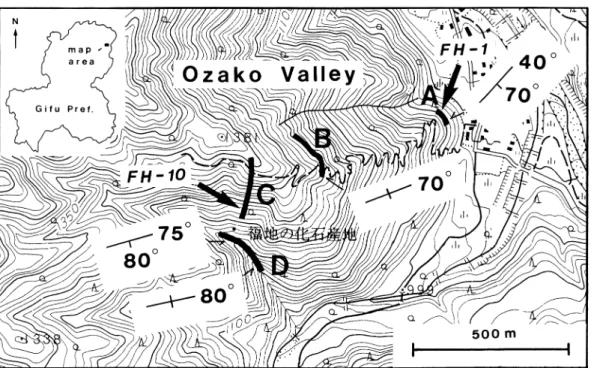
The Fukuji Formation trends east-northeast to northeast and has dips of southwardly steep to nearly vertical gradients (Fig. 1). Diametrically opposite opinions concerning the sedimentary di- rection were presented, namely Kamei (1952) stated that north-northwest- to northwest-ward the formation becomes older, on the other hand Igo and Adachi (1981) had a reversed view. The former opinion was an established theory and widely accepted (Research Group for the Palaeo- zoic of Fukuji, 1973; Igo et al., 1975; Ohno, 1977; Niikawa, 1980; Kuwano, 1987 and others).
The present observations using geopetal structure consisting of sediment fillings of lime mud and sparry calcite (Fig. 2-3) have resulted in support
Stratigraphy of the Devonian Fukuji Formation in Gifu Prefecture and Its Favositid Coral Fauna
Shuji Niko
Department of Environmental Studies, Faculty of Integrated Arts and Sciences, Hiroshima University, 1–7–1 Kagamiyama, Higashihiroshima, Hiroshima 739–8521, Japan
E-mail: [email protected]
Abstract The Fukuji Formation is subdivided into the lower Takaharagawa Member and the upper Ozako Member (new name). The Takaharagawa Member exceeds 200 m thick and mainly composed of limestones, argillaceous limestones and calcareous shales with subordinate amounts of sandstones and tuffs to tuffaceous sandstones. The Ozako Member is estimated to be 150 m thick and composed of massive limestones. The formation ranges in age from the Lochkovian (early Early Devonian) to possibly the Eifelian (early Middle Devonian). Constituents of the favositid coral fauna of the formation are Mesofavosites igoi(Kamei, 1955), Sapporipora kami- takaraensisTsukada, 2005, Pachyfavosites katoisp. nov., Plicatomurus flexuosus(Kamei, 1955), Squameopora takarensis (Kamei, 1955), Squameofavosites fukujensis(Kamei, 1955), Squameo- favosites ichinotanensis (Kamei, 1955), and Squameofavosites sugiyamai (Kamei, 1955). The generic assignment of a species ichinotanensischanges from Favosites. Sapporipora karataniorum Tsukada, 2005 and Squameopora hidensis(Kamei, 1955) are synonymized respectively with Sap- poripora kamitakaraensis and Squameopora takarensis. Pachyfavosites katoi represents the first record of the genus in Japan.
Key words : Early to Middle Devonian, tabulate corals, Favositidae, Pachyfavosites katoi sp.
nov., Fukuji Formation, Takaharagawa Member, Ozako Member (new name), Gifu.
Bull. Natl. Mus. Nat. Sci., Ser. C, 33, pp. 57–79, December 21, 2007
of the minor opinion, i.e., north-northwest- to northwest-ward the Fukuji Formation becomes younger and it is commonly upturned. A varie- gated basal conglomerate bed in Igo et al. (1980) can be compared with the conglomerates of the Mesozoic Tetori Group.
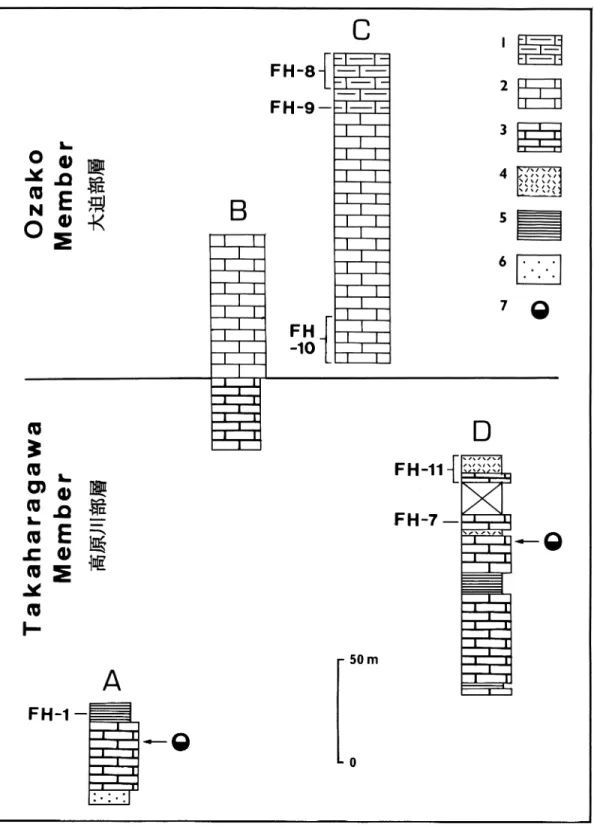
Lithologically the formation is divided into two units (Fig. 3). It is recommended that the term Takaharagawa should now be restored for the lower unit. The upper unit is newly named the Ozako Member. These members are con- formable.
Takaharagawa Member
The exclusion of the Devonian rocks contain- ing a trilobite Crotalocephalina from the “Got- landian” Fukuji Formation was made by Kobayashi and Igo (1956). They called them the Takaharagawa Formation, however subsequent workers revealed that the resting strata are also correlative with the Devonian rather than the
“Gotlandian” (see the age mentioned below).
Therefore, an important ground separating these formations ceased to exist, and at once time the Takaharagawa Formation was abandoned (Re- search Group for the Palaeozoic of Fukuji, 1973).
Because of the lower portion of the Fukuji For- mation in the present two-fold stratigraphic sub- division includes the former Takaharagawa For- mation, this portion being here named the Taka- haragawa Member with a redefinition.
The Takaharagawa Member is equivalent to the Beds 2 to 6 (the Middle Acid Vitric Tuff Member), the Beds 7 to 11 (the Upper Limestone and Shale Member) and a part of the Bed 1 (the Lower Limestone Member) in Kamei’s (1955) lithostratigraphic nomenclature, the Upper Fuku- ji Formation, the Takaharagawa Formation and a part of the Lower Fukuji Formation in Kobayashi and Igo’s (1956) one, the Beds B and C (the Lower Member), the Beds E to I (the Middle Member), the Beds J to N (the Upper Member) and a part of the Bed D (the Lower Member) in Ohno’s (1977) one, the D1, D3 and D4 Members
Fig. 1. Index map of the Fukuji area, Gifu Prefecture showing strikes and dips of the Fukuji Formation, and po- sitions of stratigraphic columnar sections (A–D) and coral localities (FH-1, 10). Geographic positions of other localities used in this paper are given in Niko (2005, p. 14, fig. 1). Base map is “Yakedake” (1:25,000 quadrangle) published by Geological Survey Institution.
Stratigraphy and Favositid Coral Fauna of the Devonian Fukuji Formation 59
Fig. 2. Lithology of the Fukuji Formation. 1–5, the Takaharagawa Member. 6, the Ozako Member. Except for Fig. 2-3 that is polished surface, all figures are hotomicrographs of thin sections. 1, peloidal wackestone, scale bar equals 1.0 mm for this figure. 2, bioclastic wackestone, scale bar equals 3.9 mm for this figure. 3, bioclastic wackestone to wackestone, arrow indicates geopetal structure, this rock specimen was collected near locality FH-7, scale bar equals 14.8 mm for this figure. 4, sandstone at the base of the member, note con- taining of brachiopod shell and biotite fragments, scale bar equals 0.8 mm for this figure. 5, felsic tuff, scale bar equals 2.8 mm for this figure. 6, bioclastic wackestone, scale bar equals 1.0 mm for this figure.
and a part of the D2 Member in Niikawa’s (1980) one, the Lower Shaly Member, the Middle Shaly Member, the Upper Carbonate Member, the Upper Shaly Member and a part of the Lower Carbonate Member in Kuwano’s (1987) one. Re- cently Kurihara (2003) tentatively correlated the calcareous rocks in the Kanashirozako Valley with the Fukuji Formation, whose sequence also can be assignable to the Takaharagawa Member.
Type locality and geographic distribution: The type locality is the lower reaches of the Ichino- tani Valley (columnar section D), where it’s low- est and upper beds are cut away by the faults.
The successions of these missing portions are re- spectively observable in outcrops at the vicinity of a community of Fukuji (columnar section A) and the eastern slope of Mt. Sora-yama (colum- nar section B). The Takaharagawa Member also crops out in the southern flank of the Ozako Val- ley and the northern flank of the Kanashirozako Valley.
Lithology: The Takaharagawa Member is well-bedded, and consists mainly of limestones, argillaceous limestones and calcareous shales.
The limestones, typically dark gray- to black-col- ored, are composed predominately of bioclastic wackestones (Fig. 2-2) and peloidal wackestones (Fig. 2-1) with subordinate amounts of stromato- poroidal and/or coral bafflestones, wackestones and bioclastic packstones, and rarely interbedded with bioclastic grainstones in the middle portion.
The base of the member is a gray fossiliferous sandstone (Fig. 2-4) containing a characteristic trilobite Craspedarges superbus Kobayashi and Hamada, 1977. The middle portion of the mem- ber contains the intercalated thin felsic tuff (Fig.
2-5) to tuffaceous sandstone beds, whose freshly broken surfaces are greenish gray, and weather a light ocherous color. The calcareous sandstone to sandy limestone facies are present in a transition- al zone between limestones and tuffaceous inter- calations.
Thickness: The thickness exceeds 200 m.
Age: Except for Dr. Tadao Kamei who con- sidered the age of the Takaharagawa Member to be the “Gotlandian” (Kamei, 1952), the Silurian
(Kamei, 1955) or the Middle Devonian (Kamei, 1961), roughly the Lochkovian (early Early De- vonian) to the Emsian (late Early Devonian) ages are given by trilobites (Kobayashi and Igo, 1956;
Kobayashi and Hamada, 1977), corals (Hamada, 1959; Research Group for the Palaeozoic of Fukuji, 1973), brachiopods (Ohno, 1977), con- odonts (Igo et al., 1975; Kuwano, 1986, 1987;
Igo and Adachi, 1993) and ostracodes (Kuwano, 1987). Unfortunately some fossils were derived from floats thus their exact stratigraphic horizons are not always certain, but the interval of Lochkovian to Emsian probably represents depo- sitional range of the member. The present investi- gations on the basis of the favositid corals are consistent with this age determination.
Ozako Member (new name)
The member is equivalent to a part of the Bed 1 (the Lower Limestone Member) in Kamei’s (1955) lithostratigraphic nomenclature, a part of the Lower Fukuji Formation in Kobayashi and Igo’s (1956) one, the Bed A and a part of the Bed D (the Lower Member) in Ohno’s (1977) one, the D5 Member and a part of the D2 Member in Ni- ikawa’s (1980) one, and a part of the Lower Car- bonate Member and an unnamed formation of Kuwano’s (1987) one.
Type locality and geographic distribution: The distribution of the Ozako Member is restricted to a small area in the upper reaches of the Ozako Valley to the northern flank of the Ichinotani Val- ley, which serves as the type locality. The type- section for the member situates near the western margin of the outcrop (columnar section C).
Lithology: The bulk of the member is com- posed of gray massive limestones. The highest exposed succession is a characteristically fossilif- erous limestone, which is lightly stained to buff, brown to reddish brown in color. Wackestone and bioclastic wackestone (Fig. 2-6) are predominant, in addition stromatoporoidal bafflestone is com- monly present.
Thickness: The thickness is estimated to be about 150 m.
Age: Detailed correlation of the Ozako
Stratigraphy and Favositid Coral Fauna of the Devonian Fukuji Formation 61
Fig. 3. Stratigraphic columnar sections of the Fukuji Formation. Horizons containing favositid corals (FH-1, 7–9, 11) and geopetal structures are indicated. 1, massive limestone indicating buff, brown to reddish brown in color. 2, massive limestone indicating gray in color. 3, bedded limestone to argillaceous limestone. 4, tuff to tuffaceous sandstone. 5, calcareous shale. 6, sandstone. 7, geopetal structure.
Member has been disputed because fossils that can indicate a precise age have not been found.
Kuwano (1987) identified conodonts from the vicinities of localities FH-8 and FH-9, and stated that “the yield is very low and no diagnostic species have been recovered to fix age as either the Silurian or the Devonian”. The present stud- ies on a favositid coral, Pachyfavosites katoi sp.
nov. yielding near the top of the member and the stratigraphy furnish new clues to this problem.
As indicated in the discussion of the species, P.
katoi shows close affinity with P. vilvaensis Sokolov, 1952, whose documented chronological data are Middle Devonian, Eifelian (early Middle Devonian) and Middle (to Early?) Devonian. In consideration of the age of the Takaharagawa Member beneath, the Ozako Member appears to be of Emsian to Eifelian age.
Systematic Paleontology Order Favositida Wedekind, 1937 Suborder Favositina Wedekind, 1937 Superfamily Favositoidea Dana, 1846
Family Favositidae Dana, 1846 Subfamily Favositinae Dana, 1846 Genus Mesofavosites Sokolov, 1951 Type species: Mesofavosites dualis Sokolov, 1951.
Mesofavosites igoi (Kamei, 1955)
(Figs. 4-1–5)
Mesofavosites igoi(Kamei); Niko, 2006b, p. 14, 16, figs.
1-1–3; 2-1–5 [with earlier synonymy].
Material examined: Twenty-three specimens, HMM 03029, 03135, 03141; NSM PA15804, 15805(?), 15806–15809, 15810(?), 15811, 15812, 16274–16284.
Emended diagnosis: Thickness of intercoral-
lite walls rarely attains 0.15–0.21 mm, 0.04–0.11 mm most common. See Niko (2006b) for other diagnostic features.
Description: Morphologies of coralla, coral- lites and tabulae and position of mural pores are referable in Niko (2006b). Intercorallite walls differentiated into median dark line and stereo- plasm of rect-radiate fibers; thickness of interco- rallite walls is mostly 0.04–0.11 mm, and 0.15–
0.21 mm in thickened portion as rare cases; di- ameters of mural pores are 0.15–0.25 mm; septal spines rod-like, whose protruded portions into tabularia attain 0.23 mm in length.
Occurrence: The examined specimens were collected from the float blocks of argillaceous limestone (HMM 03135; NSM PA15805, 15806, 16280) and black limestone of bioclastic wacke- stone (HMM 03029; NSM PA15807, 15812, 16274–16276) near locality FH-6, an outcrop of black to dark gray limestone of bioclastic wacke- stone (NSM PA 15804, 16277, 16278), peloidal to bioclastic wackestone (NSM PA16279) and bioclastic packstone (NSM PA16281) at locality FH-7, a float block of gray limestone (stromato- poroidal bafflestone) near locality FH-10 (NSM PA16284), an outcrop of greenish gray tuffa- ceous sandstone at locality FH-11, (NSM PA15808, 15809), and the float blocks of black limestone of wackestone (NSM PA15810, 15811) and bioclastic wackestone (HMM03141; NSM PA16282, 16283) in the Ichinotani Valley. Except for a specimen (NSM PA16284) that is derived from the Ozako Member, this species commonly occurs in the Takaharagawa Member.
Discussion: The two syntypes of Favosites uniformis igoi Kamei, 1955 were re-described by Niko (2006b) as the lectotype (GISUL 30123a) and paralectotype (GISUL 30123b) of Meso- favosites igoi. Subsequently, 71 thin sections of newly obtained specimens from the type stratum of this species permit refinement of the specific
Fig. 4. Mesofavosites igoi(Kamei, 1955), thin sections. 1, HMM 03141, transverse sections of corallites, 10.
2, 3, NSM PA15811, transverse sections of corallites, note slightly thickened intercorallite walls at peripheral zone of corallum (Fig. 4-3), 10. 4, 5, NSM PA16279. 4, longitudinal sections of corallites, 10. 5, partial enlargement to show intercorallite wall structure, longitudinal section, 75.
Stratigraphy and Favositid Coral Fauna of the Devonian Fukuji Formation 63
concept, particularly with respects to intercoral- lite wall nature. This knowledge is documented herein.
Genus Sapporipora Ozaki in Shimizu, Ozaki and Obata, 1934
Type species: Sapporipora favositoides Ozaki in Shimizu, Ozaki and Obata, 1934.
Sapporipora kamitakaraensis Tsukada, 2005
(Figs. 5-1–6)
Sapporipora kamitakaraensis Tsukada; Niko, 2006b, p.
16, 18, figs. 2-6–8 [with earlier synonymy].
Sapporipora karataniorum Tsukada, 2005, p. 69, 70, pl.
9, fig. 6, pl. 10, figs. 1–6.
Material examined: Eighteen specimens, HMM 03133, 03338; NSM PA16285–16300.
Emended diagnosis: Species of Sapporipora with 0.9 mm in approximate corallite diameter, and 0.08–0.12 mm in intercorallite wall thick- ness; distribution of septal spines ranges from al- most absent to numerous as regional differences;
fewer tabulae than type species of genus.
Description: Coralla massive indicating dom- ical, subspherical to bulbous growth forms, ceri- oid; largest specimen (HMM 03338) excesses 127 mm in diameter and 81 mm in height. Coral- lites prismatic with 3–7 sides, 6 sides most com- mon, to subprismatic; diameters of corallites are rather equal, range from 0.44 to 1.57 mm with 0.9 mm mean; increases of new corallites are lat- eral, relatively rare; calices may be shallow. Inter- corallite walls consists of median dark line and dark stereoplasm composed of very fine fibers that directed perpendicular to upward from medi- an dark line in longitudinal section; thickness of intercorallite walls is fairly uniform, 0.08–0.12 mm; mural pores numerous, occur on corallite faces as mid-wall pores and at corallite corners
as angle pores, circular to elliptical profiles; di- ameters of typical mural pores are 0.21 mm, 0.22 0.29 mm; in peripheral zone of coralla, in- tercorallite walls slightly wavy in some corallites;
distribution of septal spines is variable ranging almost absent to numerous as regional differ- ences; septal spines long and slender, needle-like to rod-like, attaining 0.27 mm in length of their protruded portions into tabularia; tabulae well- developed, but not so abundant in comparison with the type species of the genus, mostly com- plete, very rarely incomplete; usual profiles of complete tabulae are nearly flat to weakly sag- ging (concave proximally), but oblique, uparched (concave distally), strongly sagging tabulae also recognized; some tabulae arrange at same level in adjacent corallites; there are 7–13 tabulae in 5 mm of corallite length.
Occurrence: The examined specimens were collected from the float brocks of argillaceous limestone (HMM 03133, 03338; NSM PA16286–
16291, 16296) and black limestone of bioclastic wackestone (NSM PA16285, 16292) near locality FH-6, the float blocks of black limestone of bio- clastic wackestone on the eastern slope of Mt.
Sora-yama (NSM PA16295, 16297), the float brocks of bioclastic wackestone in the Ichinotani Valley (NSM PA16298–16300), and the float blocks of black limestone of bioclastic wacke- stone (NSM PA16293) and gray limestone of wackestone (NSM PA16294) in the Osobudani Valley. This species occurs in the Takaharagawa Member.
Discussion: Tsukada (2005) proposed a new species, Sapporipora karataniorum, for speci- mens with the slightly wavy intercorallite walls in the peripheral zone of the coralla and the nu- merous septal spines, but these fall within specif- ic variation of S. kamitakaraensis. For this reason they are synonymized herein.
Fig. 5. Sapporipora kamitakaraensisTsukada, 2005, thin sections. 1, 4–6, HMM 03338. 1, transverse sections of corallites, 10. 4, 5, longitudinal sections of corallites, 10. 6, partial enlargement to show intercorallite wall structure, longitudinal section, 75. 2, 3, HMM 03133, transverse sections of corallites, note regional differences in spacing of septal spines, 10.
Stratigraphy and Favositid Coral Fauna of the Devonian Fukuji Formation 65
Subfamily Pachyfavositinae Mironova, 1965 Genus Pachyfavosites Sokolov, 1952 Type species: Calamopora polymorpha var.
tuberosa Goldfuss, 1826.
Pachyfavosites katoi sp. nov.
(Figs. 6-1–5)
[?] Caliapora? sp., Wakata, 1974, fig. 6 [p. 6].
Holotype: NSM PA16313, from which five thin sections were made.
Other specimens: Nineteen thin sections were studied from the five paratypes, NSM PA16303, 16304, 16308–16310. In addition, seven speci- mens, NSM PA16301, 16302, 16305–16307, 16311, 16312, were also examined.
Diagnosis: Small species of Pachyfavosites with up to 28 mm in corallum diameter of holo- type; corallites approximately 1.2 mm in diame- ter; thickness of intercorallite walls is usually 0.10–0.29 mm, partly thickening to 0.36 mm;
mural pores common; typical mural pore has 0.21 mm in diameter; septal spines uncommon, low to high conical; tabulae mostly complete.
Description: Coralla small, subspherical to bulbous, cerioid; holotype has up to 28 mm in di- ameter and 21 mm in height; maximum observ- able height of the largest paratype (NSM PA16303) attains 27 mm. Corallites relatively narrow, prismatic, straight, and radiate in arrange- ment; immature corallites have 3–5 sides, then ontogenetically shift 5–6 sided profiles in adult corallites; corallite diameters range from 0.67 to 1.33 mm, with 1.2 mm mean in adult ones; calices very shallow, perpendicularly oriented to coral- lum surface; increases of new corallites may be lateral, relatively rare. Intercorallite walls consist of median dark line and stereoplasm, the latter of which microstructure is rect-radiate fibers, and thick in comparing to corallite diameter; thus,
tabularia exhibit rounded polygonal to circular profiles; usual thickness of intercorallite walls is 0.10–0.29 mm, slightly thicken to 0.36 mm in pe- ripheral zone of corallum; diameters of tabularia are 0.48–0.90 mm; mural pores common, circular in profile, developed on corallite faces and at near corallite corners; some mural pores closed by pore plate; diameter of typical mural pore is 0.21 mm; septal spines uncommon, low to high conical, ranging 0.08–0.25 mm in length of their protruded portions into tabularia; tabulae mostly complete, weakly sagging to nearly flat, but oblique or uparched complete tabulae are fre- quently recognized; in addition, incomplete vesic- ular tabulae are rarely developed; there are 8–15 tabulae in 5 mm of corallite length.
Etymology: The specific name honors Dr.
Makoto Kato in recognition of his contributions to the taxonomic study of Paleozoic corals.
Occurrence: Pachyfavosites katoi sp. nov. was collected from the float blocks of buff, gray to light brown limestone of bioclastic wackestone at locality FH-8 (NSM PA16301, 16302, 16306–
16309, 16311–16313), and an outcrop of reddish light brown limestone of bioclastic wackestone at locality FH-9 (NSM PA16303–16305, 16310).
This species occurs in the Ozako Member.
Discussion: The morphological characters of the Fukuji specimens fit well with the diagnosis of Pachyfavosites that is known to range from the Upper Silurian to the Upper Devonian. This is the first record of the genus in Japan.
Based on its corallite diameters and intercoral- lite wall thickness Pachyfavosites katoi sp. nov.
appears to have close affinities with P. vilvaensis Sokolov (1952, p. 48, 49, pl. 11, figs. 1–4) from the Middle Devonian of the Urals, the Eifelian (lower Middle Devonian) of the Kuznetsk Basin, southwestern Siberia (Dubatolov, 1959, p. 59, 60, pl. 16, figs. 3a, b, 4a, b), and the Middle (to Lower?) Devonian of Da Xinggan Ling (Da
Fig. 6. Pachyfavosites katoisp. nov., thin sections. 1–4, holotype, NSM PA16313. 1, oblique section of coral- lum, 5. 2, 3, transverse sections of corallites, note thickened intercorallite walls at peripheral zone of coral- lum (Fig. 6-2), 10. 4, partial enlargement to show intercorallite wall structure, transverse section, 75. 5, paratype, NSM PA16303, longitudinal sections of corallites, 10.
Stratigraphy and Favositid Coral Fauna of the Devonian Fukuji Formation 67
Hinggan Ling), Northeast China (Tchi, 1982, p.
176, pl. 1, figs. 5a, b). However, P. katoi differs from P. vilvaensis in having fewer mural pores.
Pachyfavosites katoi is also similar to P. bystrowi Yanet (1959, p. 106, text-figs. 34a, b, pl. 48, figs.
3a, b) from the Eifelian of the Urals and the Lower Devonian of the Kuznetsk Basin (Duba- tolov, 1963, p. 23, 24, pl. 9, figs. 1a, b, v, g), but differs in that its corallite diameters are some- what smaller (approximately 1.2 mm versus 1.25–1.50 mm in P. bystrowi) and its septal spines are low to high conical, whereas P. bystrowi has the thin and needle-like septal spines. The new species can be differentiated from a somewhat similar species, P. rariporosus Dubatolov (1963, p. 24, 25, pl. 10, figs. 1a, b, v, 2, 3), known from the Lower Devonian of the Kuznetsk Basin and the Siegenian (Lower Devonian) of Salair and Altai in southwestern Siberia (Mironova, 1974, p.
63, 64, pl. 31, figs. 1a, b, 2a, b, pl. 32, figs. 1a, b, v, pl. 33, fig. 1, pl. 78, figs. 1a, b), in displaying larger corallite diameters (0.8–1.0 mm in adult corallites of P. rariporosus) and intercorallite wall thickness (attaining 0.36 mm in P. katoi ver- sus up to 0.25 mm in P. rariporosus). Additional- ly, the coralla of P. rariporosus are larger than those of P. katoi and attain 100 mm in diameter.
Genus Plicatomurus Chang, 1959 Type species: Plicatomurus solidus Chang, 1959.
Plicatomurus flexuosus (Kamei, 1955)
(Figs. 7-1–3)
Plicatomurus flexuosus(Kamei); Niko, 2006b, p. 18, 20, figs. 3-1–5 [with earlier synonymy].
Material examined: Twenty-one coralla, HMM 03520; NSM PA4219 (same specimen
with pl. 21, fig. 3 in Masutomi and Hamada, 1966), 16314–16332.
Occurrence: The examined specimens were collected from an outcrop of calcareous shale at locality FH-1 (NSM PA16314), the float blocks of argillaceous limestone (NSM PA16318) and black limestone of bioclastic wackestone (HMM 03520; NSM PA16315–16317, 16321–16329) near locality FH-6, the float blocks of black lime- stone of bioclastic wackestone in the Ichinotani Valley (NSM PA16330–16332), and the float blocks of black limestone of bioclastic wacke- stone in the Osobudani Valley (NSM PA16319, 16320). A specimen (NSM PA4219) was collect- ed by Dr. Tadao Kamei from black limestone (?
in the Ichinotani Valley). This species occurs in the Takaharagawa Member.
Remarks: Based on a thin section of the neo- type (GISUL 30109), the diagnostic features of Plicatomurus flexuosus have been minutely docu- mented by Niko (2006b), thus they are not to re- description.
Genus Squameopora Preobrazhenskiy, 1967 Type species: Favosites forbesi takarensis Kamei, 1955. See the following discussion.
Squameopora takarensis (Kamei, 1955)
(Figs. 7-4, 5; 8-1–6)
Squameopora takarensis(Kamei); Niko, 2006b, p. 21, 22, figs. 4-7–9; 5-3 [with earlier synonymy].
Squameopora hidensis(Kamei); Niko, 2006b, p. 20, 21, figs. 4-1–6 [with earlier synonymy].
Material examined: Twenty-seven speci- mens, NSM PA16333–16354; UMUT PC7301 (same specimen with pl. 16, figs. 1a–c in Hama- da, 1959), 7302 (same specimen with pl. 16, fig.
2 in ditto), 7303 (same specimen with pl. 16, fig.
Fig. 7. 1–3, Plicatomurus flexuosus(Kamei, 1955). 1, NSM PA4219, longitudinal polished sections of branch- es, 1. 2, NSM PA16331, transverse thin section of branch, 5. 3, NSM PA16323, longitudinal thin sections of corallites at peripheral zone of branch, 10. 4, 5, Squameopora takarensis(Kamei, 1955), thin sections. 4, NSM PA16343, transverse to oblique sections of corallites at axial zone of branch, 10. 5, NSM PA16342, longitudinal sections of corallites at peripheral zone of branch, 10.
Stratigraphy and Favositid Coral Fauna of the Devonian Fukuji Formation 69
3 in ditto), 7304 (same specimen with pl. 16, fig.
4 in ditto), 7305 (same specimen with pl. 16, figs. 5, 6 in ditto).
Emended diagnosis: Species of Squameopo- ra with most common branch diameters of 10–16 mm, and approximately 1.5 mm in adult corallite diameters; thickness of intercorallite walls attains 0.36 mm in peripheral zone of branch; mid-wall and angle pores developed; septal spines low conical; peripheral tabulae closely spaced.
Description: Coralla ramose with subcylin- drical to somewhat irregular shaped branches, ce- rioid; branching relatively rare, probably bifur- cate; anastomoses of adjacent branches are un- commonly developed. Diameters of branches range from 5 to 25 mm, 10–16 mm most com- mon. Corallites prismatic, growing longitudinally and parallel in axial zone of branches, then turn- ing outward to open at acute, approximately 30°, to nearly right angle; transverse sections of coral- lites are 3–5 sided in immature and 5–8 sided in adult ones, whose diameters ranging 0.33–1.88 mm, with 1.5 mm mean in adult corallites; tabu- laria have rounded subpolygonal transverse sec- tions; increases of new corallites frequent, later- al; calices very shallow, approximately 0.5–0.7 mm in depth. Usual intercorallite walls consist of median dark line and stereoplasm, but this differ- entiation becomes obscure in peripheral zone of gerontic branches, where they indicate transpar- ent in appearance; microstructure of stereoplasm is rect-radiate fibers; thickness of intercorallite walls weakly to moderately thickened even in axial zone of branch, 0.09–0.29 mm, furthermore increases attaining 0.36 mm in peripheral zone;
peripheral stereozone is indistinct; mural pores occur on corallite faces (mid-wall pores) and at corallite corners (angle pores), have circular to elliptical profiles; diameters of typical mural pores are 0.23 mm, 0.23 0.25 mm; most mural
pores closed by pore plate; septal spines sporadic to well-developed in axial zone and well-devel- oped in peripheral zone, short with wide basis, usually low conical having 0.10–0.15 mm in length of protrude portions into tabularia; tabulae usually complete, nearly flat to weakly sagging;
spacing of tabulae is close in peripheral zone; in axial zone, there are 6–12 tabulae in 5 mm of corallite length, then this count increases up to 17 in 2.5 mm at peripheral zone; incomplete tab- ulae indicating strongly oblique, uparched or dis- sepiment-like profiles are commonly recognized in crowded portions.
Occurrence: The examined specimens were collected from the float blocks of argillaceous limestone (NSM PA16348) and black limestone of bioclastic wackestone to packstone (NSM PA16341) near locality FH-6, an outcrop of gray limestone of bioclastic packstone at locality FH- 7 (NSM PA16336), an outcrop of greenish gray tuffaceous sandstone, calcareous sandstone, sandy limestone to limestone of bioclastic grainstone at locality FH-11 (NSM PA16342–16346, 16349–
16354), a float block of black limestone of bio- clastic wackestone on the eastern slope of Mt.
Sora-yama (NSM PA16340), and the float blocks of black limestone of bioclastic wackestone (NSM PA16333–16335, 16337), bioclastic pack- stone to wackestone (NSM PA16338, 16339), peloidal wackestone (NSM PA16347) in the Ichinotani Valley. The specimens kept in Univer- sity Museum of the University of Tokyo (UMUT PC7301–7305) were collected by Dr. Takashi Hamada, of which lithofacies are quite identical with those of locality FH-11. This species occurs in the Takaharagawa Member.
Discussion: Kamei (1955) proposed in p. 50 of the literature a new subspecies, Favosites forbesi takarensis on the basis of the three syn- types (GISUL 30116a–c) from black limestone,
Fig. 8. Squameopora takarensis(Kamei., 1955). 1, NSM PA16340, longitudinal thin section of branch, 5. 2, 4, NSM PA16342, thin sections. 2, transverse section of branch, 5. 4, partial enlargement to show interco- rallite wall structure, longitudinal section, 75. 3, NSM PA16343, transverse thin section of branch, 5. 5, UMUT PC7301, transverse thin section of branch, 5. 6, UMUT PC7305, longitudinal to oblique weathered sections of branches, 1.
Stratigraphy and Favositid Coral Fauna of the Devonian Fukuji Formation 71
and in p. 53 in ditto a new species, Favosites hi- densis, on the basis of the holotype (GISUL 30119), paratype (GISUL 30120) and two speci- mens (GISUL 30121, 30122) from greenish gray tuffaceous sandstone. Results of reexamination of the Kamei’s original specimens by Niko (2006b) were as follows; 1) the both forms can be assignable to the genus Squameopora and 2) the differences between the forms are minor and only dimensional concerning corallite diameters.
The present observations on 123 thin sections of newly collected specimens from the type stratum confirm that Squameopora takarensis and S. hi- densis represent the ecophenotipic variations of a single species. Thus, I place S. hidensis in a ju- nior subjective synonym of S. takarensis because of the latter species has a priority.
Subfamily Emmonsiinae Lecompte, 1952 Genus Squameofavosites Chernyshev, 1941 Type species: Favosites hemisphericus bo- hemica Pocˇta, 1902; renamed Squameofavosites cechicus Galle, 1978.
Squameofavosites fukujensis (Kamei, 1955)
(Figs. 9-1–5)
Squameofavosites fukujensis(Kamei); Niko, 2006b, p. 22, 24, figs. 5-5–7 [with earlier synonymy].
Squameofavosites fukujiensis[sic] (Kamei); Katoet al., in Minatoet al., 1979, p. 64, pl. 10, figs. 1, 2.
Material examined: Seven specimens, HMM 03083; NSM PA16355–16360.
Emended diagnosis: Thickness of intercoral- lite walls 0.06–0.11 mm; squamulae short with 0.21–0.25 mm in length, thin. See Niko (2006b) for other diagnostic features.
Description: Morphologies of coralla, coral- lites, mural pores, and tabulae are referable in Niko (2006b). Intercorallite walls thin, differenti- ated into median dark line and stereoplasm of very fine rect-radiate fibers; thickness of interco- rallite walls ranges from 0.06 to 0.11 mm; squa- mulae short and thin, their dimensions are as fol- lows, 0.21–0.25 mm in length, 0.06–0.12 mm in
thickness of their bases, and 0.13–0.19 mm width of their bases.
Occurrence: The examined specimens were collected from the float blocks of black limestone of bioclastic wackestone (NSM PA16355, 16358, 16359) and peloidal wackestone (NSM PA16356) near locality FH-6, the float blocks of argilla- ceous limestone in the Ichinotani Valley (NSM PA16357, 16360), a float block of argillaceous limestone in the Osobudani Valley (HMM 03083).
This species occurs in the Takaharagawa Mem- ber.
Discussion: The holotype (GISUL 30126) of Parafavosites fukujensis Kamei, 1955 was re-de- scribed by Niko (2006b) as Squameofavosites fukujensis. Subsequently, 58 thin sections of newly obtained specimens from the type stratum of this species permit refinement of the specific concept, concerning respects to intercorallite wall and detailed squamulae natures. These new findings are documented herein.
Separating characters of Squameofavosites fukujensis from S. ichinotanensis and S. sugiya- mai are given in the discussions of the latter two species.
Squameofavosites ichinotanensis (Kamei, 1955)
(Figs. 10-1–5)
Favosites ichinotanensisKamei; Niko, 2006b, p. 14, figs.
1-4–7 [with earlier synonymy].
Material examined: Seven specimens, HMM 03172; NSM PA16361–16366.
Emended diagnosis: Species of Squameo- favosites with large corallite diameters having approximately 3.0 mm in adult corallites; interco- rallite walls 0.09–0.15 mm in thickness; mural pores occur on corallite faces; development of squamulae varies from rare or absent to well-de- veloped; squamulae relatively long with 0.37–
0.54 mm in length, thin.
Description: Except for microstructure of stereoplasm and morphology of squamulae, all other features are referable in Niko (2006b).
Stereoplasm of intercorallite walls consists of
very fine rect-radiate fibers. Development of
Stratigraphy and Favositid Coral Fauna of the Devonian Fukuji Formation 73
Fig. 9. Squameofavosites fukujensis(Kamei, 1955), NSM PA16357, thin sections. 1, 2, transverse sections of corallites, arrows indicate commensal worm tubes (Helicosalpinx), 10. 3, 4, longitudinal sections of coral- lites, note commensal worm tube (Fig. 9-3), 10. 5, partial enlargement to show intercorallite wall and squa- mula structure, longitudinal section, 75.
squamulae varies from rare or absent to well-de- veloped even in a corallum; squamulae relatively long and thin, their dimensions are as follows, 0.37–0.54 mm in length, 0.19–0.23 mm in thick- ness of their bases, and commonly 0.25–0.31 mm in width of their bases.
Occurrence: The examined specimens were collected from an outcrop of calcareous shale at locality FH-1 (NSM PA16361, 16362), the float blocks of argillaceous limestone (HMM 03172) and black limestone of bioclastic wackestone (NSM PA16365) near locality FH-6, and the float blocks of argillaceous limestone (NSM PA16363) and black limestone of peloidal wackestone (NSM PA16364) and bioclastic wackestone (NSM PA16366) in the Ichinotani Valley. This species occurs in the Takaharagawa Member.
Discussion: This species was originally de- scribed as Favosites ichinotanensis by Kamei (1955). When the author reexamined the species, the holotype (GISUL 30112) is missing and a single thin section of the paratype (GISUL 30113) is an only available type specimen.
Owing to this insufficiency in material, Niko (2006b, p. 14) inadequately wrote that “septal spines irregularly distributed, vary from nearly absent to abundant, thin rod-like, attaining 0.15 mm in length”. Twenty-six thin sections of newly collected specimens reveal that apparent septal spine is not recognized in the species and its rela- tively long and thin squamula indicates “thin rod- like” appearance in section. The generic assign- ment of the species changes from Favosites to Squameofavosites herein.
Squameofavosites ichinotanensis is distin- guished from S. fukujensis by its larger diameter of the adult corallites (approximately 3.0 mm versus approximately 2.1 mm in S. fukujensis) and longer squamulae (0.37–0.54 mm versus 0.21–0.25 mm in S. fukujensis). In addition, angle pore and tube of commensal worm are not
recognized in the present species. Separating characters of S. ichinotanensis from S. sugiyamai are given in the discussion of the latter species.
Squameofavosites sugiyamai (Kamei, 1955)
(Figs. 11-1–4)
Squameofavosites sugiyamai (Kamei); Niko, 2006b, p.
24, 26, figs. 5-4; 6-1–4 [with earlier synonymy].
Squameofavositessp. indet; Niko, 2006b, p. 26, 28, figs.
5-1, 2; 6-5, 6 [with earlier synonymy].
Material examined: Eleven specimens, NSM PA16367–16376; UMUT PC5708 (same speci- men with pl. 21, fig. 4 in Masutomi and Hamada, 1966).
Emended diagnosis: Intercorallite walls usu- ally thickened attaining 0.29 mm; squamulae rel- atively short, 0.25–0.36 mm in length; develop- ment of squamulae varies from nearly absent to well-developed. See Niko (2006b) for other diag- nostic features.
Description: Morphology of coralla, coral- lites, mural pores and tabulae are referable in Niko (2006b). Structure of intercorallite walls is median dark line and stereoplasm of very fine rect-radiate fibers; intercorallite walls usually thickened, attaining 0.29 mm, where squamulae well-developed and frequently contiguous, but thin (0.07–0.10 mm) walled portions, almost lacking squamulae, are commonly developed; di- mensions of squamulae are as follows, 0.25–0.36 mm in length; 0.15–0.27 mm in thickness of their bases, and 0.21–0.33 mm in width of their bases;
adhesion of adjoining 2 or rarely 3 squamulae is commonly developed.
Occurrence: The examined specimens were collected from an outcrop of argillaceous lime- stone (NSM PA16367, 16369, 16371, 16373, 16374) and dark gray limestone of bioclastic grainstone (NSM PA16370) at locality FH-7, an outcrop of sandy limestone (NSM PA16368) at
Fig. 10. Squameofavosites ichinotanensis(Kamei, 1955), NSM PA16363, thin sections. 1, transverse sections of corallites, 10. 2, longitudinal to oblique sections of corallites, 10. 3, partial enlargement to show inter- corallite wall structure, longitudinal section, 75. 4, longitudinal sections of corallites, 10. 5, oblique sec- tions of corallites, note well-developed squamulae, 10.
Stratigraphy and Favositid Coral Fauna of the Devonian Fukuji Formation 75
locality FH-11, and the float blocks of argilla- ceous limestone (NSM PA16372) and black limestone of bioclastic to peloidal wackestone (NSM PA16375, 16376) at the Ichinotani Valley.
A specimen kept in University Museum of the University of Tokyo (UMUT PC5708) was col- lected by Dr. Takashi Hamada, of which lithofa- cies are quite identical with those of locality FH- 7. This species occurs in the Takaharagawa Member.
Discussion: Examination of 29 thin sections of newly collected specimens confirms the au- thor’s prediction that “the examined specimen ( Squameofavosites sp. indet.) represents an in- traspecific variation of Squameofavosites sugiya- mai” (Niko, 2006b). This species was originally described as Favosites forbesi sugiyamai Kamei, 1955 or incorrectly referred to a Silurian species Favosites baculoides Barrande by Kamei (1955).
Squameofavosites sugiyamai is dissimilar to S.
fukujensis as its thickened intercorallite walls (at- taining 0.29 mm versus 0.06–0.11 mm in S. fuku- jensis), and robust and somewhat longer squamu- lae (0.25–0.36 mm versus 0.21–0.25 mm in S.
fukujensis). The absence of tube of commensal worm in S. sugiyamai may be a diagnostic fea- ture. This species is also unlike S. ichinotanensis.
Squameofavosites sugiyamai has smaller diame- ter of the adult corallites (approximately 2.3 mm versus approximately 3.0 mm in S. ichinotanen- sis), the thickened intercorallite walls (0.09–0.15 mm in S. ichinotanensis), and robust and shorter squamulae (0.37–0.54 mm in S. ichinotanensis).
Acknowledgments
I would like to thank the late Mr. Satoru Ya- makoshi, and Messrs. Yoshihito Senzai, Toshiaki Kamiya, Akiyasu Watanabe and Tomohisa Nishi- tani for making coral collections at the Fukuji Formation. For loan of specimens in their care I
also grateful to Messrs. Atuko Yoshiyama and Yukou Goto (Hikaru Memorial Museum), Dr.
Yasunari Shigeta (National Science Museum), and Dr. Takenori Sasaki (University Museum of the University of Tokyo). The critical review of Dr. Hisayoshi Igo (Institute of Natural History) substantially improved the manuscript and is gratefully acknowledged.
References
Chang, C. C., 1959. Plicatomurus, gen. nov. (Favositidae) iz verkhnesiluriyskikh otlozheniy tsentralnogo Kaza- khstana [Plicatomurus, gen. nov. (Favositidae) from the Upper Silurian deposits of central Kazakhstan]. Akad.
Nauk SSSR, Paleont. Zhurnal, 1959, (3): 27–32, pls. 1, 2. (In Russian.)
Chernyshev, B. B., 1941. Siluriyskie i nizhnedevonskie korally basseyna reki Tarei (yugo-zapadnyy Taimyr) [Silurian and Lower Devonian corals from the Tareia River Basin (southwest Taimyr Peninsula)]. Tr. Vses.
Arktichi Inst., 158: 9–64, pls. 1–14. (In Russian with English abstract.)
Dubatolov, V. N., 1959. Tabulyaty, geliolitidy i khetetidy silura i devona Kuznetskogo basseyna [Silurian and De- vonian Tabulata, Heliolitida, and Chaetetida from the Kuznetsk Basin]. Tr. Vses. Neft. Nauchno-Issled. Geol.- Razved. Inst., 139: 1–293, pls. 1–88. (In Russian.) Dubatolov, V. N., 1963. Pozdnesiluriyskie i devonskie tab-
ulyaty, geliolitidy i khetedidy Kuznetskogo basseyna [Late Silurian and Devonian Tabulata, Heliolotida, and Chaetetida from the Kuznetsk Basin]. 193 pp. 45 pls., Akad. Nauk SSSR. Sibirskoe Otd.Inst. Geol. Geofiz., Moscow. (In Russian.)
Galle, A., 1978. Favositidae (Tabulata) from the Devonian of Bohemia. Sb. Geol. Veˇd., Paleont., 20: 33–62, pls.
1–8.
Goldfuss, A., 1826. Petrefacta Germaniae, tam ea, quae in Museo Universitatis Regiae Borussicae Fridericiae Wil- helmiae Rhenanae servantur, quam alia quaetunque in Museis Hoeninghusiano, Muenstriano aliisque extant, iconibus et descriptionibús illustrata. Abbildungen und Beschreibungen der Petrefacten Deutschlands und der angranzenden Länder, unter Mitwirkung des Herm Grafen Georg zu Münster. pp. 77–164, pls. 26–50, Arnz & Co., Düsseldorf.
Fig. 11. Squameofavosites sugiyamai(Kamei, 1955), thin sections. 1, NSM PA16374, transverse sections of corallites, note well-developed squamulae, 10. 2, NSM PA16371, transverse sections of corallites, 10. 3, 4, NSM PA16367. 3, longitudinal sections of corallites, 10. 4, partial enlargement to show intercorallite wall structure, longitudinal section, 75.
Stratigraphy and Favositid Coral Fauna of the Devonian Fukuji Formation 77
Hamada, T., 1959. On the taxonomic position of Favosites hidensis and its Devonian age. Japan. Jour. Geol.
Geogr., 30: 201–213, pl. 16.
Harayama, S., 1990: Geology of the Kamikochi District.
With Geological Sheet Map at 1:50,000. 175 pp., Geol.
Surv. Japan. (In Japanese with English abstract.) Igo, H. & S. Adachi, 1981. Study on the Paleozoic rocks
in the Fukuji district, Kamitakara Village, Yoshiki County, Gifu Prefecture. —Present status and unsolved problems—. Jour. Geograph., 90: 336–345. (In Japan- ese with English abstract.)
Igo, H. & S. Adachi, 1993. A new Devonian panderodon- tan genus, Nipponogladius (Conodonta, Panderodonti- dae) from the Fukuji Formation, Hida Massif, central Japan. Sci. Rep., Inst. Geosci., Univ. Tsukuba, Sect. B, 14: 99–114.
Igo, H., S. Adachi, H. Furutani & H. Nishiyama, 1980.
Ordovician fossils first discovered in Japan. Proc.
Japan Acad., Ser. B, 56: 499–503.
Igo, H., T. Koike & H. Igo, 1975. On the base of the De- vonian System in Japan. Proc. Japan Acad., 51: 653–
658.
Kamei, T., 1952. The stratigraphy of the Palaeozoic rocks of the Fukuji district, southern part of Hida Mountain- land. (Study on Palaeozoic rocks of Hida I). Jour. Fac.
Lib. Art. Sci., Shinshu Univ., (2): 43–74.
Kamei, T., 1955. Classification of the Fukuji Formation (Silurian) on the basis of Favositeswith description of some Favosites. (Study on Paleozoic rocks of Hida II).
Jour. Fac. Lib. Arts Sci., Shinshu Univ., Part 2, Nat.
Sci., (5): 39–63, pls. 1–4.
Kamei, T., 1961. Notes on Japanese Middle Devonian.
Chikyu Kagaku(Earth Science), (56): 1–9, pl. 1.
Kato, M., M. Minato, I. Niikawa & Y. Fujiwara, 1979.
Chapter 2c. Lower Devonian. 2c4) Correlations. InM.
Minatoet al. (eds.), Variscan Geohistory of Northern Japan: The Abean Orogeny, pp. 63–65, pl. 10, Tokai Univ. Press, Tokyo.
Kobayashi, T. & H. Igo, 1956. On the occurrence of Cro- talocephalus, Devonian trilobites, in Hida, West Japan.
Japan. Jour. Geol. Geogr., 27: 143–155.
Kobayashi, T. & T. Hamada, 1977. Devonian trilobites of Japan in comparison with Asian, Pacific and other fau- nas. Palaeont. Soc. Japan, Sp. Pap., (20): 1–202, pls.
1–13.
Kurihara, T., 2003. Early Devonian Palaeoscenidiidae (Radiolaria) from the “Yoshiki Formation” in the Fuku- ji area of the Hida-gaien Terrane, central Japan, and its biostratigraphic significance. Jour. Geol. Soc. Japan, 109: 635–647. (In Japanese with English abstract.) Kuwano, Y., 1986. Geological age of the Fukuji Forma-
tion, Central Japan. Mem. Natn. Sci. Mus. Tokyo, 19:
67–70. (In Japanese with English abstract.)
Kuwano, Y., 1987. Early Devonian conodonts and ostra-
codes from Central Japan. Bull. Natn. Sci. Mus., Tokyo, Ser. C, 13: 77–105.
Masutomi, K. & T. Hamada, 1966. Fossils in Colour. 268 pp. Hoikusha, Osaka. (In Japanese.)
Mironova, N. V., 1974. Rannedevonskie tabulyaty Gornogo Altaya i Salaira [Early Devonian Tabulata from Gornyy Altay Mountains and Salair]. Tr. Sibirsko- go Nauchno-Issled. Inst. Geol. Geofiz. Mineral. Syrya, (163): 1–166, pls. 1–81. (In Russian.)
Niikawa, I., 1980. Geology and biostratigraphy of the Fukuji district, Gifu Prefecture, Central Japan. Jour.
Geol. Soc. Japan, 86: 25–36. (In Japanese with English abstract.)
Niko, S., 2005. Devonian pachyporoidean tabulate corals from the Fukuji Formation, Gifu Prefecture. Bull. Natn.
Sci. Mus., Tokyo, Ser. C, 31: 13–29.
Niko, S., 2006a. Limestone beds of the Fukuji Formation.
The Devonian shallow marine deposits on the Sino- Korea Massif. InGeological Society of Japan (ed.), Re- gional Geology of Japan, Volume 4. Chubu District, pp.
168, 169, Asakura Shoten, Tokyo. (In Japanese.) Niko, S., 2006b. Reexamination of Devonian favositid
corals described from the Fukuji Formation of Gifu Prefecture. Bull. Natn. Sci. Mus., Tokyo, Ser. C, 32:
13–30.
Ohno, T., 1977: Lower Devonian brachiopods from the Fukuji Formation, Central Japan. Mem. Fac. Sci., Kyoto Univ., Ser. Geol. Mineral., 44: 79–126, pls. 1–11.
Pocˇta, F., 1902. Anthozoaires et Alcyonaires. InJ. Bar- rand, Systême Silurien du centre de la Boheme. 1 Par- tie: Recherches Paléontogiques. Volume 8, part 2, 347 pp. pls. 20–118. Privately published, Prague, Paris.
Preobrazhenskiy, B. V., 1967. Znacheniye zonalnkh yavleniy v skelete tabulyatomorfnykh korallov [Signifi- cance of zonal features in the skeleton of tabulate corals]. Akad. Nauk SSSR, Paleont. Zhurnal, 1967, (3):
3–8. (In Russian.)
Research Group for the Palaeozoic of Fukuji, 1973. On the occurrence of Rhizophyllum(Rugosa) from the De- vonian Fukuji Formation, Central Japan. Jour. Geol.
Soc. Japan, 79: 423–424. (In Japanese.)
Shimizu, S., K. Ozaki & T. Obata, 1934. Gotlandian de- posits of Northwest Korea. Jour. Shanghai Sci. Inst.
Sect. 2, 1: 59–88, pls. 8–18.
Sokolov, B. S., 1951. Tabulyaty paleozoya evropeyskoy chasti SSSR. Chast 2. Silur Pribaltiki (Favozitidy llan- doverskogo yarusa) [Paleozoic Tabulata of the Euro- pean parts of the USSR. Part 2. Silurian of the Baltic area (Favositidae of the Llandovery stage)]. Tr. Vses.
Neft. Nauchno-Issled. Geol.-Razved. Inst., N. S., 52:
1–124, pls. 1–37. (In Russian.)
Sokolov, B. S., 1952. Tabulyaty paleozoya evropeyskoy chasti SSSR. Chast 4. Devon Russkoy platformy i za- padnogo Urala [Paleozoic Tabulata of the European
parts of the USSR. Part 4. Devonian of the Russian Platform and the western Urals]. Tr. Vses. Nauchno- Issled. Geol.-Razved. Inst., N. S., 62: 1–292, pls. 1–40.
(In Russian.)
Tchi, Y. 1982. Some Middle Devonian Tabulata corals from Unur Formation at Zhadunhe district of Da Hing- gan Ling. Chinese Acad. Geol. Sci., Shenyang Inst.
Geol. Mineral Res., (3): 169–186, pls. 1, 2. (In Chinese with English abstract.)
Tsukada, K., 2005. Tabulate corals from the Devonian Fukuji Formation, Hida Gaien belt, central Japan. Part
1. Bull. Nagoya Univ. Mus., (21): 57–125.
Wakata, S., 1974. Fossils, Fukuji · Hitoegane Areas. 20 pp.
Privately published. (In Japanese.)
Yanet, E. Ye., 1959. Podklass Tabulata [Subclass Tabula- ta]. In A. N. Khodalevich and I. A. Breyvil (eds.), Brakhiopody i korally iz eyfelskikh boksitonosykh ot- lozheniy vostochnogo sklona srednegoi i severnogo Urala [Brachiopods and corals from the Eifelian baux- ite-bearing strata from eastern slope of the central and northern Urals], pp. 86–133, pls. 39–61, Gostoptekhiz- dat, Moscow. (In Russian.)
Stratigraphy and Favositid Coral Fauna of the Devonian Fukuji Formation 79