九州大学学術情報リポジトリ
Kyushu University Institutional Repository
新規な機能性高分子材料を用いた分子認識システム の創製
兼清, 泰正
https://doi.org/10.11501/3180686
出版情報:Kyushu University, 2000, 博士(工学), 論文博士 バージョン:
Chapter 4 Application of AMP-imprinted polyion complexes as a sensing element on a QCM system
An AMP-sensing system has been constructed utilizing a polyion complex as a sensing element of quartz crystal microbalance (QCM) system. Gold electrode on the QCM resonator surface was modified with anionic thiols.
Then, polycation and boronic acid-containing polyanion were adsorbed onto the anionic surface to form a polyion complex multilayer film, utilizing an alternating adsorption technique. When the polymer adsorption was conducted in the presence of AMP, the anionic charges of the phosphate group introduced into the polyanion by a boronate - ci�diol interaction were neutralized by the polycation. Thus, after removal of AMP from the multilayer film, a swollen multilayer film consisting of free boronic acid groups and excess cationic charges was created. This QCM system sensitively and selectively changed its resonance frequency in response to AMP. The responsiveness is derived from the mass decrease of the resonator in relation to the shrinkage of the surface multilayer film.
4.1 Introduction
In chapter 3, the polyion complex was utilized for the molecular imprinting of AMP. The ribose moiety in AMP has the cis-dial function that is bound to the boronic acid group under basic pH conditions where the
boronic acid group exists as an anionic boronate group.1-7 Hence, this boronate anion site and the pendent phosphate anion site in addition to the carboxylate anion site in polyanion 1 (Figure
3.2)
are counted for the formation of a polyion complex with polycation 2 (Figure3.2).
Asexpected, the molecular memory created after removal of AMP showed high affinity with AMP. In addition, I found that the removal and re
binding processes for AMP coincide with the swelling and shrinking phenomena of this polyion complex.
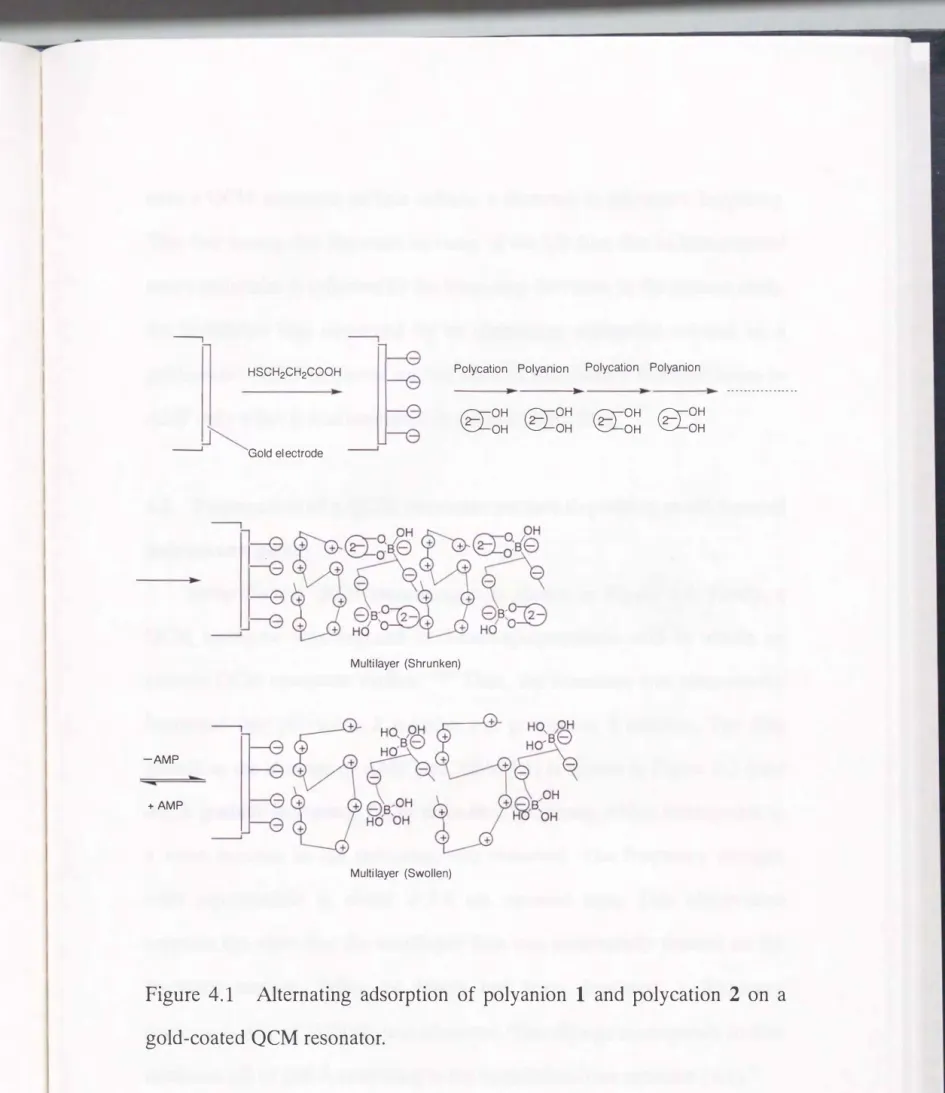
This chapter describes the application of this novel AMP-imprinting me th od to an AM P sensing system using QCM (quartz crystal microbalance). 8-27 The basic concept for the present methodology is illustrated in Figure 4.1. The QCM system sensitively changes its resonance frequency in response to the mass change of the resonator, and it can detect even the formation of monoatomic layer on the resonator surface.
P olyanion 1 and polycation 2 are deposited onto the QCM resonator surface in the presence of AMP utilizing the alternating adsorption technique.28-38 By repeating the polymer adsorption steps, one can obtain an AMP-imprinted polyion complex multilayer film on the resonator surface.
Since the desorption and re-binding of AMP induces the swelling and shrinkage of the multilayer film, AMP concentration in a solution can be read out with a frequency change in the QCM system. Actually, Ariga et al. 41 reported that the swelling of a Langmuir-Blodgett (LB) film deposited
--,
�
HSCH2CH2COOH ____Ju�
Gold el ectrode-AMP
+AMP
--,
-e Polycation
--e
a
oH-e OH ____J
Multilayer (Shrunken)
Multilayer (Swollen)
Polyanion Polycation Polyanion
- � .. ... - ............. -
a
oH OHa
OH OHa
oH OHFigure 4.1 Alternating adsorption of polyanion 1 and polycation 2 on a gold-coated QCM resonator.
onto a QCM resonator surface induces a decrease in resonance frequency.
This fact means that the mass increase of the LB film due to incorporated water molecules is reflected by the frequency decrease. In the present study, the multilayer film deposited by an alternating adsorption method on a gold-coated QCM resonator surface showed satisfactory responsiveness to AMP only when it was imprinted in the multilayer film.
4.2
Preparation of a QCM resonator surface depositing multi-layered polyion complexes
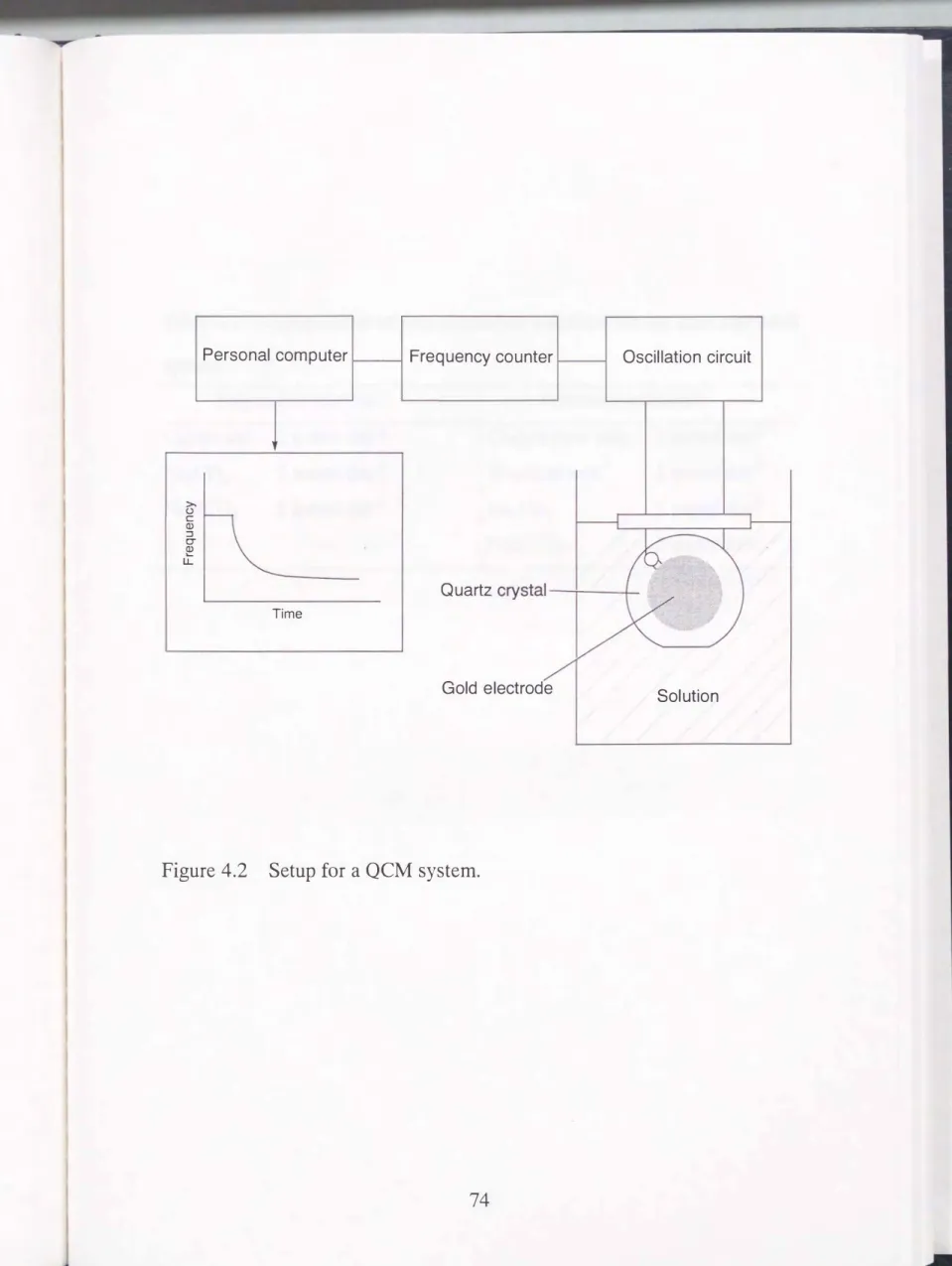
Setup for the QCM measurement is shown in Figure
4.2.
Firstly, a QCM resonator was exposed to 3-mercaptopropionic acid to obtain an anionic QCM resonator surface.39'40
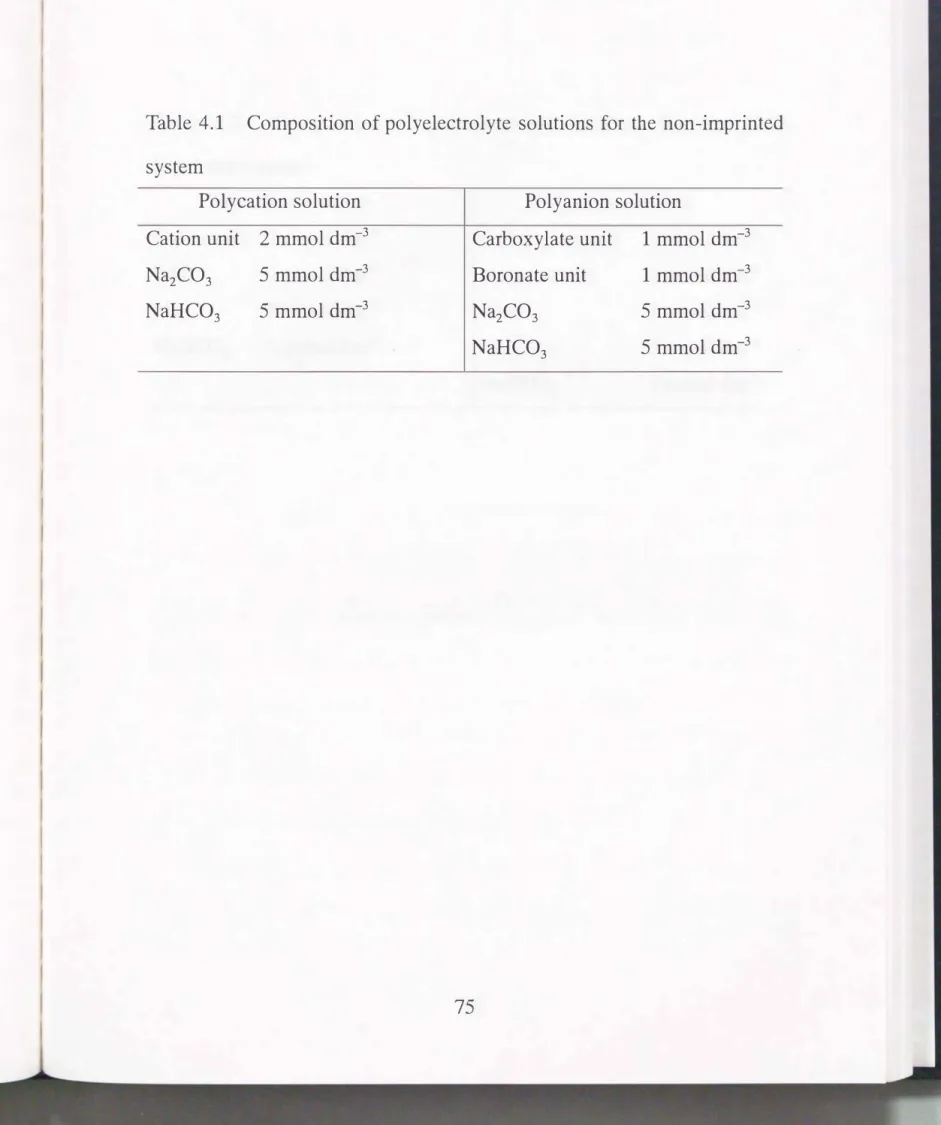
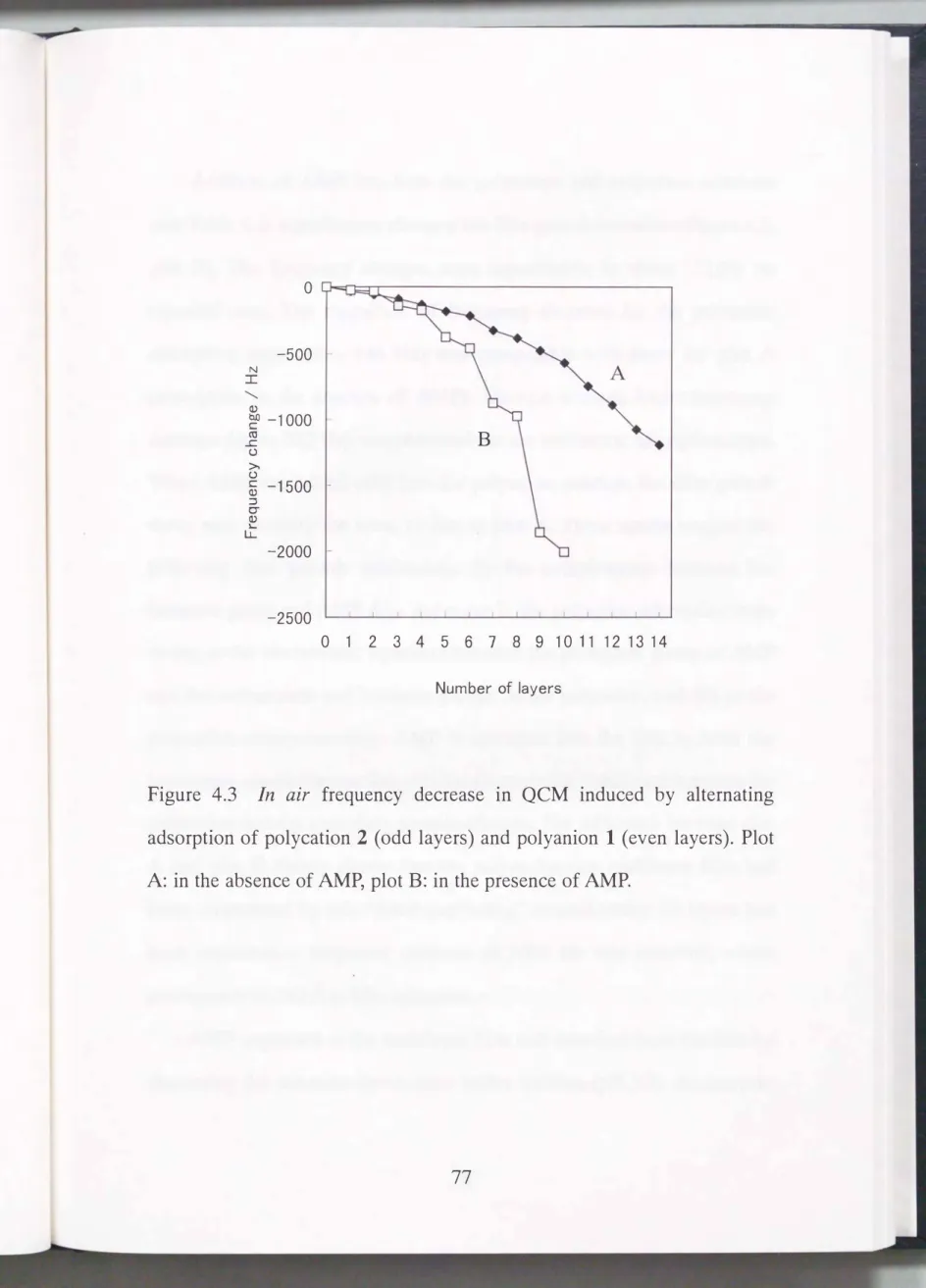
Then, the resonator was alternatively immersed into polyanion 1 solution and polycation 2 solution. The filmgrowth in the absence of AMP
(
see Table4.1)
is shown in Figure 4.3(
plotA). A
gradual decrease in QCM resonance frequency, which corresponds to a mass increase in the resonator, was observed. The frequency changes were reproducible to about + 5% on repeated runs. This observation supports the view that the multilayer film was successfully formed on the resonator surface. When14
layers had been deposited, a frequencydecrease
(-L1F)
of1189Hz
was observed. This change corresponds to film thickness(d)
of190 A
according to the calculation from equation(4.1).41
d(A)
0 =-0.16L1F(Hz) (4.1)
>.
u c Q) :::::l 0"
U:: Q)
Personal computer 1---i Frequency counter 1---i Oscillation circuit
Quartz crystal--r----4--
Time
Gold electrode
Figure 4.2 Setup for a QCM system.
Solution
Table 4.1 Composition of polyelectrolyte solutions for the non-imprinted
system
Polycation solution Cation unit 2 mmol dm-3 Na2C03 5 mmol dm-3 NaHC03 5 mmol dm-3
Pol yanion solution
Carboxy late unit 1 mmol dm-3
Boronate unit Na2C03 NaHC03
1 mmol dm-3 5 mmol dm-3 5 mmol dm-3
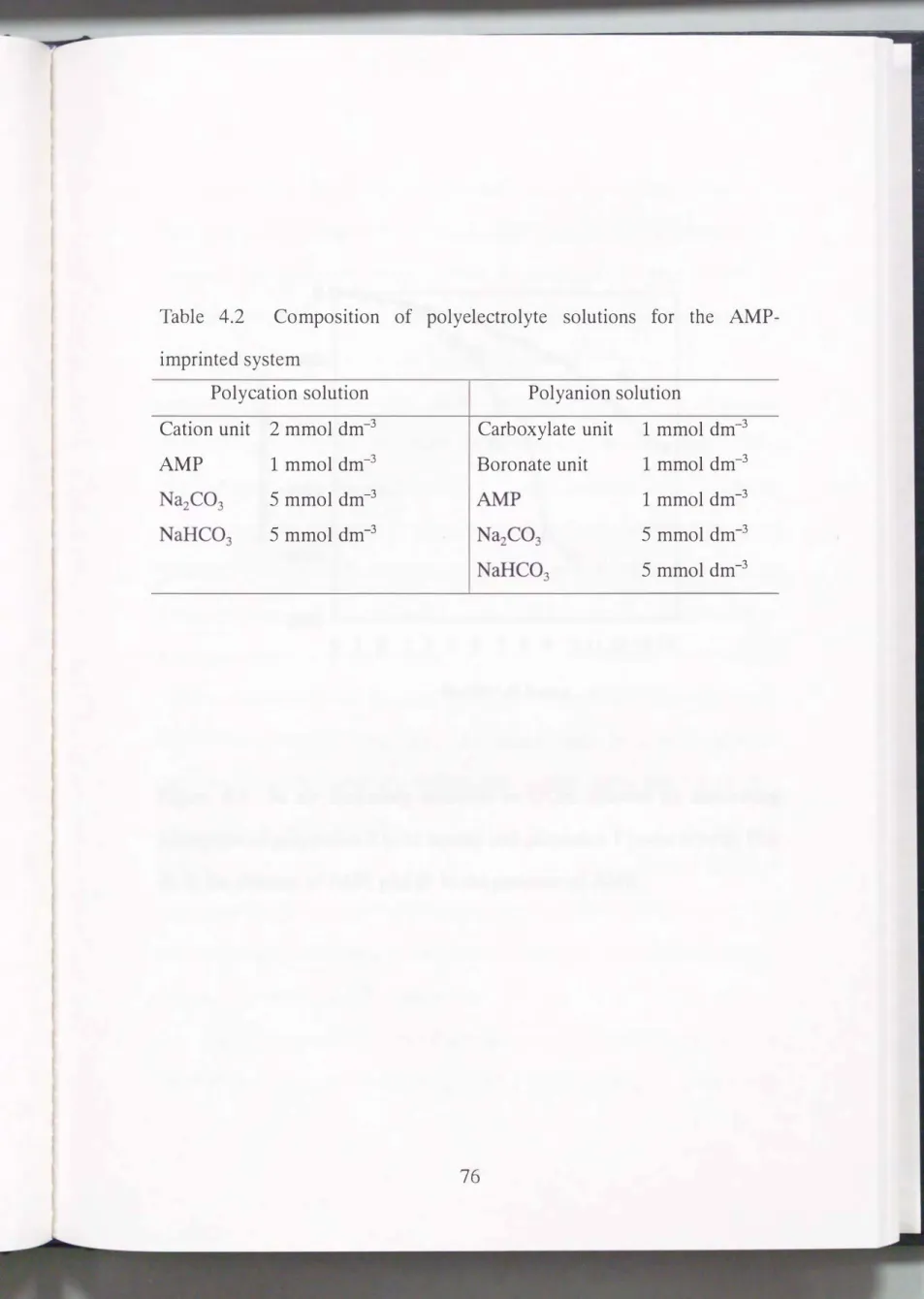
Table 4.2 Composition of polyelectrolyte solutions for the AMP-
imprinted system
Polycation solution
Cation unit 2 mmol dm-3 AMP 1 mmol dm-3 5 mmol dm-3 5 mmol dm-3
Polyanion solution
Carboxylate unit 1 mmol dm-3
Boronate unit 1 mmol dm-3 1 mmol dm-3 5 mmol dm-3 5 mmol dm-3
I N
'--...
Q)
0
- 500 -
� -1000
...r::: co (.)
>.
(.)
a5 -1 500 -
::s 0"
l... Q) LL
-2000 -
-2500
B
0 1 2 3 4 5 6 7 8 9 1011 121314 Number of layers
Figure 4.3 In air frequency decrease in QCM induced by alternating adsorption of polycation 2 (odd layers) and polyanion 1 (even layers). Plot A: in the absence of AMP, plot B: in the presence of AMP.
Addition of AMP into both the polycation and polyanion solutions (see Table 4.2) significantly changed the film growth behavior (Figure 4.3, plot B). The frequency changes were reproducible to about
+10% on repeated runs. The magnitude of frequency decrease for the polyanion adsorption steps (12
-146 Hz) was comparable with those for plot A (adsorption in the absence of AMP), whereas a much larger frequency
decrease (up to 882 Hz) was observed for the polycation adsorption steps.
When AMP was added only into the polyanion solution, the film growth curve was basically the same as that in plot A. These results suggest the following film growth mechanism: (i) the complexation between the boronate group and AMP does not occur in the polyanion adsorption steps owing to the electrostatic repulsion between the phosphate group in AMP and the carboxylate and boronate groups in the polyanion, and (ii) in the polycation adsorption steps, AMP is adsorbed into the film by both the boronate - cis-diol interaction and the electrostatic interaction between the polycation and the phosphate anionic charges. The difference between plot A and plot B clearly shows that the polycation-rich multilayer film had been constructed by this "AMP-imprinting" method. After 10 layers had
been deposited, a frequency decrease of 2001 Hz was observed, which corresponds to 320 A in film thickness.
0AMP imprinted in the multilayer film was desorbed from the film by
immersing the resonator into acetate buffer solution (pH 5 .5).
Anincrease
in resonance frequency
(119
Hz, measured in air) was observed after this treatment, which corresponds to a mass decrease due to the desorption of AMP.4.3
Frequency change in AMP-imprinted QCM systems
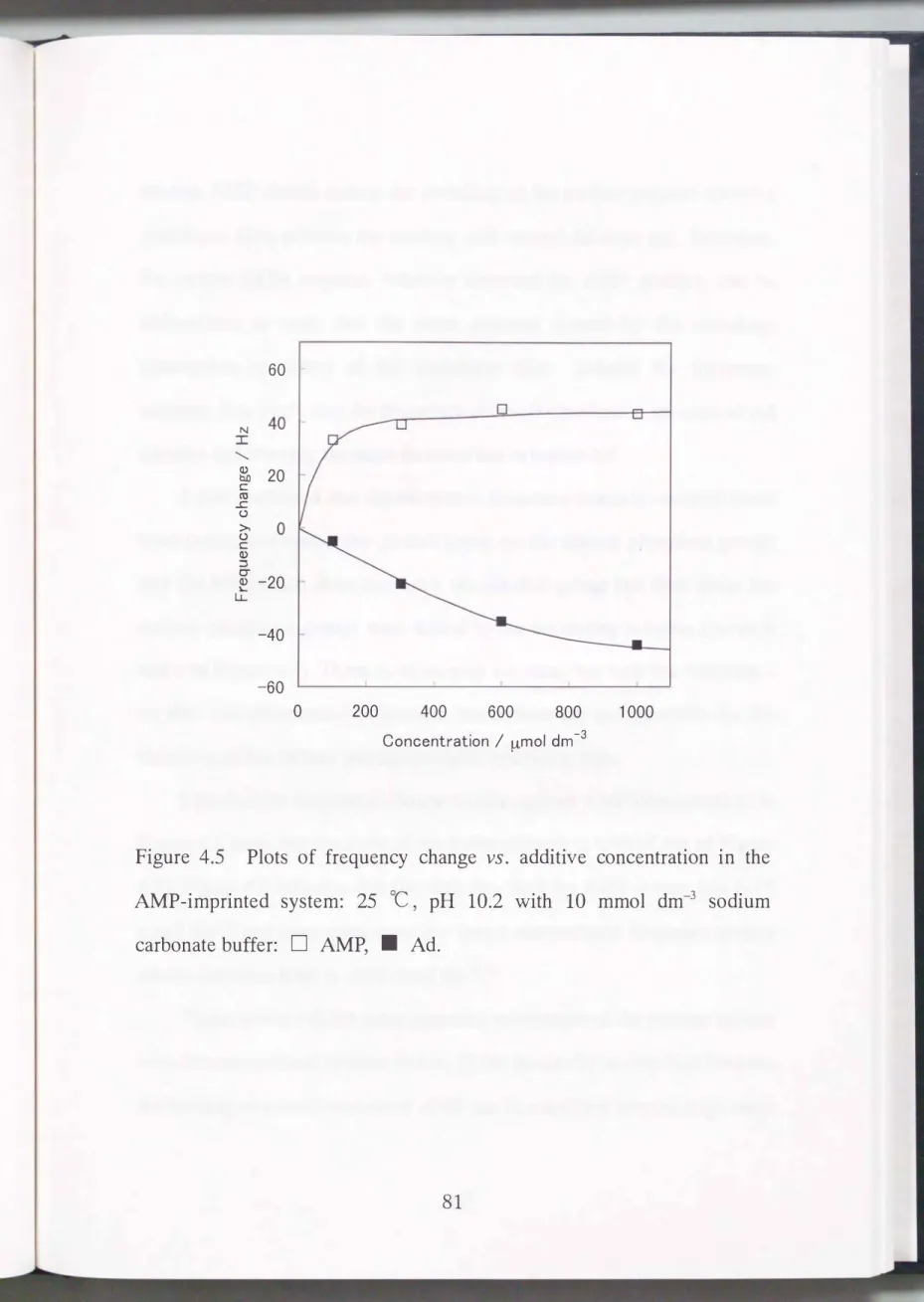
The responsiveness of the AMP-imprinted QCM system was examined in aqueous solutions. Figure 4.4 shows the resonance frequency changes induced by the addition of AMP and its analogues. The resonance frequency decreased when Ad was added to the solution (curve d). This frequency decrease is understood as such that the mass of the surface polyion complex multilayer film increased as the consequence of the binding with Ad. On the contrary, the resonance frequency increased when AMP was added (curve a). The relationships between resonance frequency and additive concentration are shown in Figure 4.5. The response time for AMP was about
7
min. This could be shortened by decreasing the film thickness, at the sacrifice of the sensitivity.These response characteristics can be explained by the swelling
shrinking phenomena of the polyion complex multilayer film deposited on the QCM resonator surface. Before the addition of AMP and Ad, the multilayer film should be swollen because it has excess cationic charges.
Then, if the surface polyion complex layer behaves in a similar manner as the bulk polyion complex, which is shown in Figure 3.8, the binding with
30
N 25
I a
" 20
Q) b.O
15
c ro
...c
u 10
>-
u 5
c b
Q) '--A--1...#'
:J 0
0"
Q) c
� -5
LL -
d -10
-200 0 200 400 600 800 1000 1200 Time Is
Figure 4.4 In situ QCM frequency change for the AMP-imprinted system induced by the addition of (a) AMP, (b) DAd, (c) DAMP and (d) Ad. The final additive concentration is 100 �mol dm-3: 25 oC, pH 10.2 with 10 mmol dm-3 sodium carbonate buffer.
60 -
I N
"
� 20
c ro ..c (..)
>
(..) .C :::l Q.) 0"
� -20
LL
-40
-60 0
0
200 400 600 800 1000
Concentration I �mol dm -3
Figure 4.5 Plots of frequency change vs. additive concentration in the AMP-imprinted system: 25 oC, pH 10.2 with 10 mmol dm-3 sodium carbonate buffer: D AMP, • Ad.
anionic AMP should induce the shrinking of the surface polyion complex multilayer film, whereas the binding with neutral Ad does not. Therefore, the unique QCM response behavior observed for AMP addition can be rationalized as such that the mass decrease caused by the shrinkage (desorption of water) of the multilayer film induces the frequency increase. It is likely that the frequency decrease observed in the case of Ad addition reflects only the mass increase due to bound Ad.
I also confirmed that the resonance frequency scarcely changed when DAd (which has neither the cis-diol group nor the anionic phosphate group) and DAMP (which does not have the cis-diol group but does have the anionic phosphate group) were added to the measuring solution (curve b and c in Figure
4.4 ).
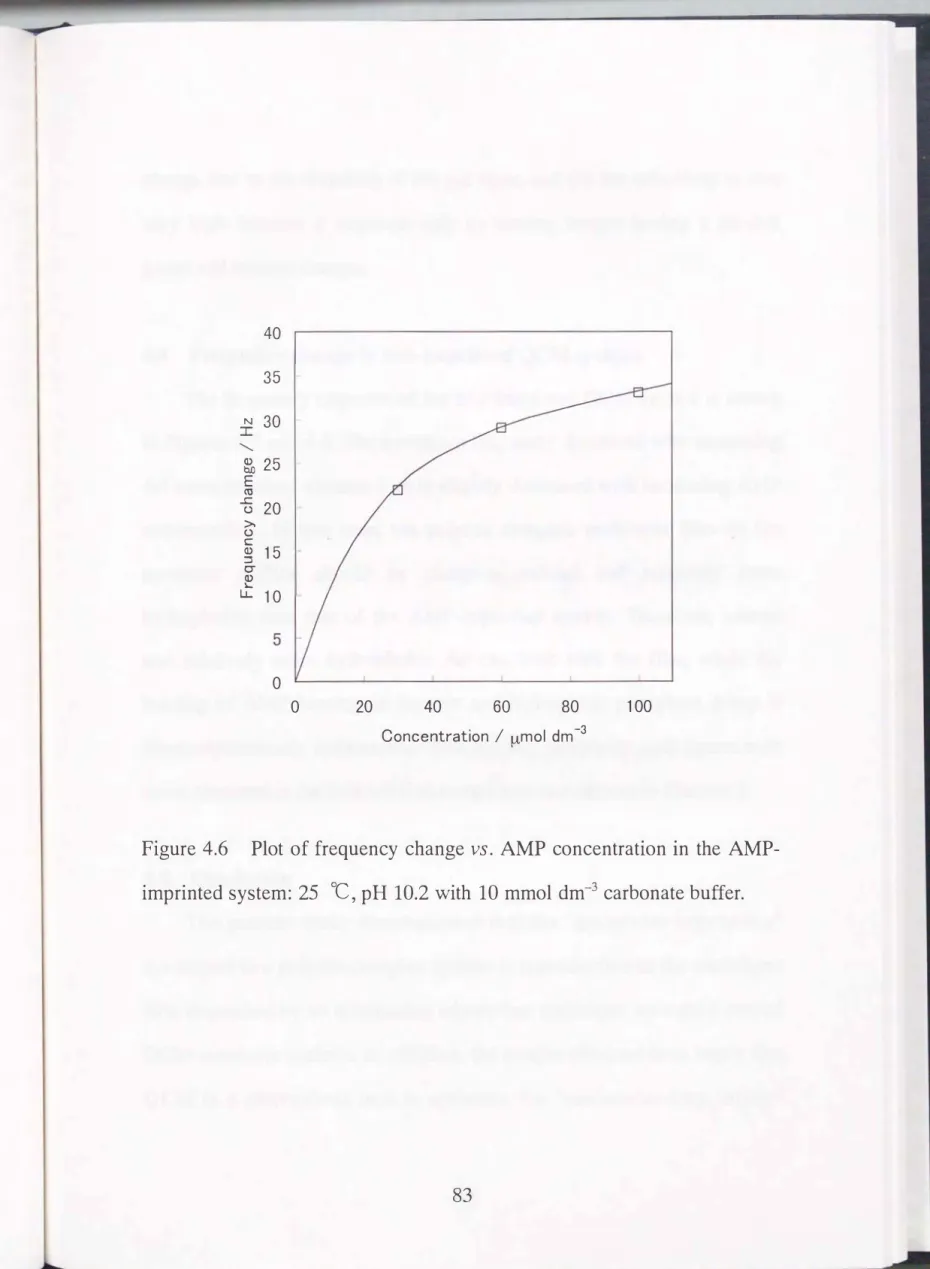
These facts support the view that both the boronate - cis-diol and phosphate - polycation interactions are indispensable for the shrinking of the surface polyion complex multilayer film.I plotted the frequency change values against AMP concentration in Figure
4.6
(note that the scale of the horizontal axis is 1/10 of that of Figure4.5).
Figure4.6
indicates that the detection limit for AMP is very low ( ... 10�mol dm-3) and even more sensitive than a conventional biosensor system whose detection limit is
...
300 �mol dm-3•42These results exhibit some potential advantages of the present system over the conventional system: that is, (i) the sensitivity is very high because the binding of a small amount of AMP can be amplified into the large mass
40 35 -
N 30
I
""'-..
� 25 - E
i3 ro 20 -
» (.) s:::::
� 15
0"' l.... Q) LL 10
-
0
0 20 40 60 80 100
Concentration I !-!mol dm -3
Figure 4.6 Plot of frequency change vs. AMP concentration in the AMP
imprinted system: 25 oC, pH 10.2 with 10 mmol dm-3 carbonate buffer.
change due to the shrinking of the gel layer, and
(
ii)
the selectivity is also very high because it responds only to sensing targets having a cis-diol group and anionic charges.4.4
Frequency change in non-imprinted QCM systems
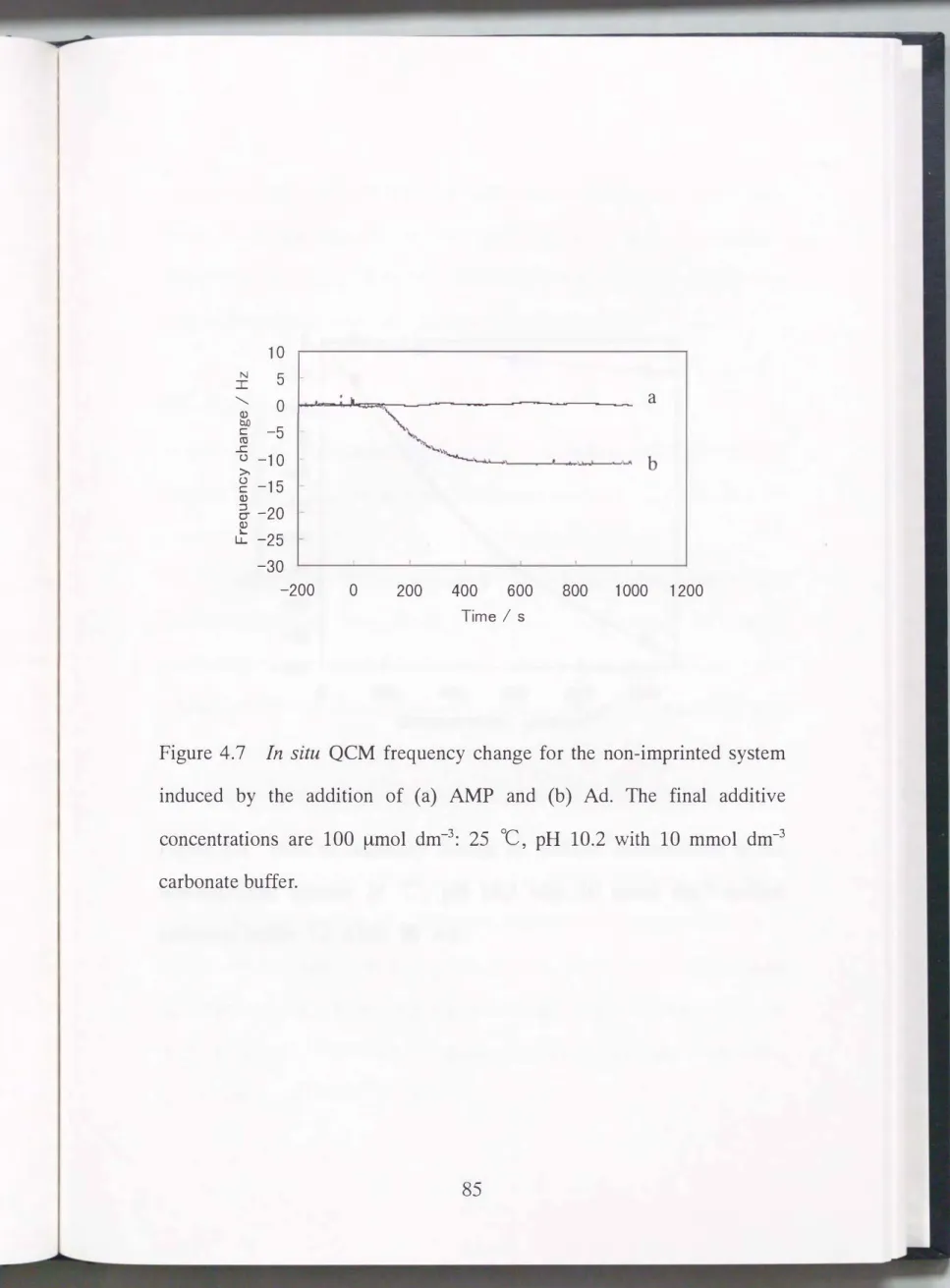
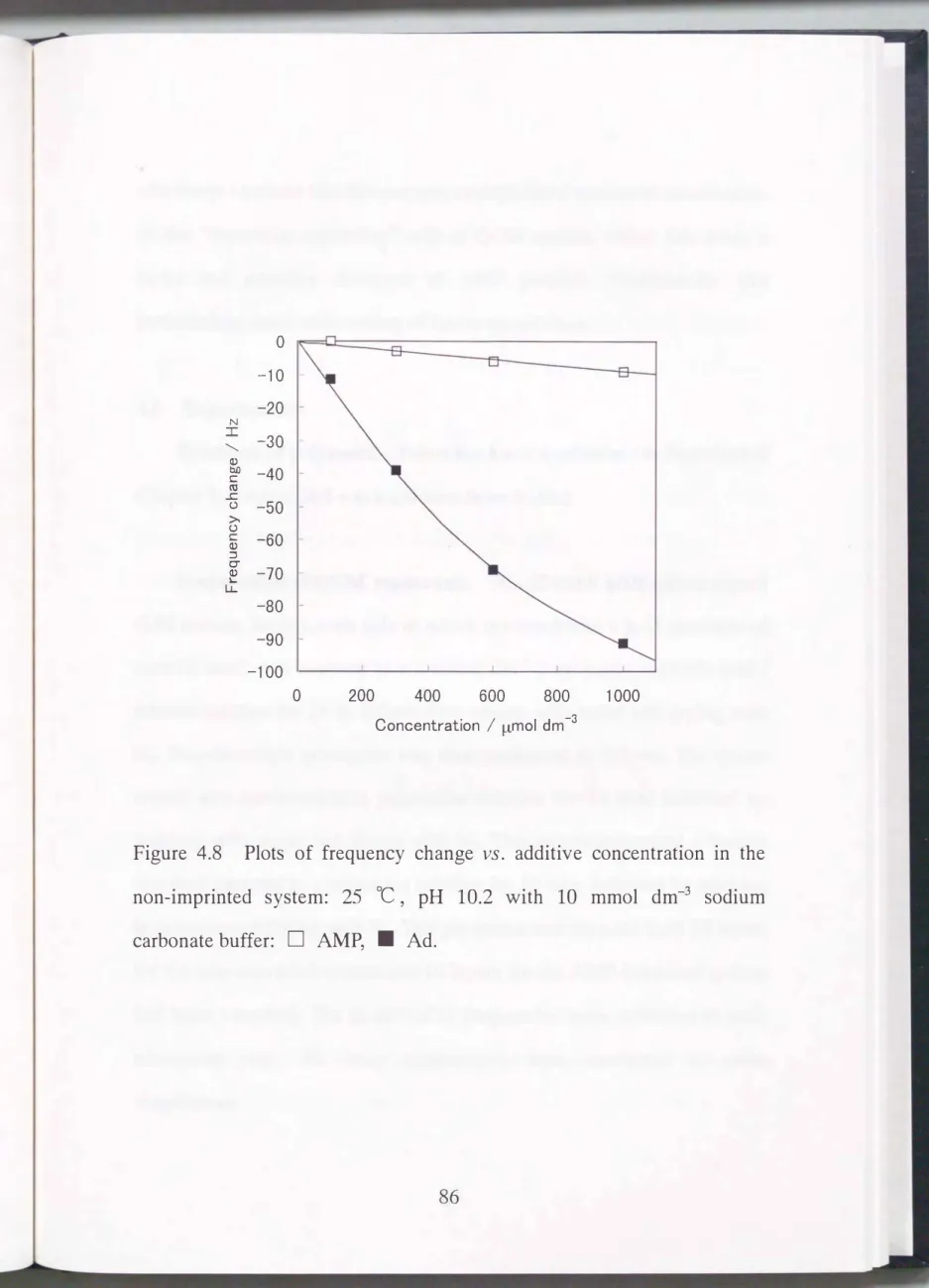
The frequency response of the non-imprinted QCM system is shown in Figures 4.7 and 4.8. The resonance frequency decreased with increasing Ad concentration, whereas it only slightly decreased with increasing AMP concentration. In this case,. the polyion complex multilayer film on the . resonator surface should be charge-neutralized and relatively more hydrophobic than that of the AMP-imprinted system. Therefore, neutral and relatively more hydrophobic Ad can bind with the film, while the binding of AMP bearing an anionic and hydrophilic phosphate group is thermodynamically unfavorable. This binding selectivity well agrees with those observed in the bulk polyion complex system shown in Chapter 3.
4.5
Conclusion
The present study demonstrated that the "molecular-imprinting"
developed in a polyion complex system is reproducible in the multilayer film deposited by an alternating adsorption technique on a gold-coated QCM resonator surface. In addition, the results obtained here imply that QCM is a convenient tool to estimate the "molecular-imprinting"
N I
10 5 -
�
0b.O c -5
ro -
....c
(.) -10 -
>-
g -15 r-
(1)
5- -20 r- Lt (1) -25 r-
-30 -200
•- ' II a
0 200 400 600 800 1 000 1200 Time Is
Figure 4.7 In situ QCM frequency change for the non-imprinted system induced by the addition of (a) AMP and (b) Ad. The final additive concentrations are 100 �mol dm-3: 25 oC, pH 10.2 with 10 mmol dm-3 carbonate buffer.
0 -10 -20 -
I N
-30 -
'-....
Q.) bD -40
c ro ....c
() -50
>-
() c -60
Q.) :::J 0"
-70
Q.) -
LL �
-80 - -90
-100
0 200 400 600 800 1000
Concentration I �mol dm -3
Figure 4.8 Plots of frequency change vs. additive concentration in the non-imprinted system: 25 oC, pH 10.2 with 10 mmol dm-3 sodium carbonate buffer: D AMP, • Ad.
efficiency.
I
believe that this is a rare example for a successful combination of the "molecular-imprinting" with a QCM system, which has made a facile and sensitive detection of AMP possible. Undoubtedly, this methodology has a wide variety of future applications.4.6
Experimental
Synthesis of polymers.
Polyanion 1 was synthesized as described in Chapter 3. Polycation 2 was purchased from Aldrich.Preparation of QCM resonators.
An AT-cut 9 MHz quartz crystal(USI
system, Japan), each side of which is coated with a gold electrode of area 16 mm2, was exposed to a 1 mmol dm-3 3-mercaptopropionic acid I ethanol solution for 24 h, followed by rinsing with water and drying with N2• Polyelectrolyte adsorption was then performed as follows. The quartz crystal was immersed in a polycation solution for 10 min, followed by washing with water and drying with N2. This polycation-coated substrate was then exposed to a polyanion solution for 10 min, followed by washing with water and drying with N2• This procedure was repeated until 14 layers for the non-imprinted system and 10 layers for the AMP-imprinted system had been adsorbed. The in air QCM frequencies were measured at each adsorption step. All these experiments were conducted at room temperature.Desorption of AMP from the AMP-imprinted polyion complex layer. The QCM substrate was immersed into acetate buffer solution (pH 5.5 with 90 mmol dm-3 CH3COONa and 10 mmol dm-3 CH3COOH) at room temperature for 20 min, followed by washing with water and drying with N2•
Frequency change in the AMP-imprinted and non-imprinted QCM systems. The QCM measurements in aqueous solution were . possible only when one side of the QCM resonator was sealed in a Teflon casing. The resonator was equilibrated with 10 cm3 of 10 mmol dm-3 carbonate buffer solution (pH 10.2) in a glass vessel at 25 oC, and then a small amount of 100 mmol dm-3 AMP (or its analogue) was added to the solution.
4. 7 References
1 M. Takeuchi, M. Taguchi, H. Shinmori, and S. Shinkai, Bull. Chern.
Soc. Jpn., 69, 2613 (1996).
2 S. Patterson, B. D. Smith, and R. E. Taylor, Tetrahedron Lett., 38, 6323 (1997).
3 For a comprehensive review for boronic acid - diol interactions see: T.
D. James, K. R. A. S. Sandanayake, and S. Shinkai,Angew. Chern., Int.
Ed. Engl., 35, 1910 (1996).
4 J. Yoon and A. W. Czarnic, 1. Am. Chern. Soc., 114, 5874 (1992); L. K.
Mohler and A. W. Czarnic, 1. Am. Chern. Soc., 115, 2998 (1993).
5 P. R. Westmark and B. D. Smith, 1. Am. Chern. Soc., 116, 9343 (1994) and references therein.
6 Y. Nagai, K. Kobayashi, H. Toi, andY. Aoyama, Bull. Chern. Soc. 1pn., 66, 2965 (1993).
7 G. Wulff, S. Krieger, B. Kubneweg, and A. Steigel, 1. Am. Chern. Soc., 116, 409 (1994).
8 G. Suaerbrey, Z. Phys., 1959, 206.
9 T. Nomura and 0. Hattori, Anal. Chim. Acta., 115, 323 (1980).
10 E. S. Grabbe and R. P. Buck, 1. Electroanal. Chern., 223, 67 (1987).
11 M. R. Deakin and D. A. Buttry, Anal. Chern. , 61, 1147A (1989).
12 Y. Okahata and K. Ariga, Thin Solid Films, 178, 465 (1989).
13 L. J. Kepley and R. M. Crooks, Anal. Chern., 64, 3191 (1992).
14 F. Caruso, E. Rodda, and D. N. Furlong, 1. Colloid Interface Sci., 178, 104 (1996).
15 I. Ichinose, H. Senzu, and T. Kunitake, Chern. Lett., 1996, 831.
16 K. Ariga, M. Onda, Y. Lvov, and T. Kunitake, Chern. Lett., 1997, 25.
17 S.-W. Lee, I. Ichinose, and T. Kunitake, Langmuir, 13, 3422 (1997).
18 Y. Lv ov, K. Ariga, M. Onda, I. Ichinose, and T. Kunitake, Langmuir, 13, 6195 (1997).
19 F. Caruso, K. Niikura, D. N. Furlong, and Y. Okahata, Langmuir, 13,
3427 (1997).
20
M. Sastry, V. P atil, and K. S. Mayya, J. Phys. Chern. B,101, 1167 (1997).
21
F. Caruso, D. N. F urlong, K. Ariga, I. Ichinose, and T. Kunitake,Langmuir,
14, 2857 (1998).
22
S. Dante, R. Advincula, C. W. F rank, and P. Stroeve, Langmuir,14, 4559 (1998).
23
Y. M. Lvov, Z. Lu, J. B. Schenkman, X. Zu, and J. F. Rusling, J. Am.Chern. Soc .,
120, 4073 (1998).
24
K. Shimazu, T. Teranishi, K. Sugihara, and K. Uosaki, Chern. Lett.,1
998
,669.
25
M. T. Cygan, G. E. Collins, T. D. Dunbar, D. L. AHara, C. G. Gibbs,and C. D. Gutsche,Anal. Chern.,
71, 142 (1999).
26
J. Anzai, Y. Kobayashi, N. Nakamura, M. Nishimura, and T. Hoshi,Langmuir,
15, 221 (1999).
27
S. Dante, R. Advincula, C. W. F rank, and P. Stroeve, Langmuir,15, 193 (1999).
28
G. Decher, J. D. Hong, and J. Schmitt, Thin Solid Films,210/211, 831 (1992).
29
Y. Lvov, F. Essler, and G. Decher, J. Phys. Chern., 97,13773 (1993).
30
Y Lvov, G. Decher, and G. Sukhorukov, Macromolecules,26, 5396
(1993).
31 E. R. Kleinfeld and G. S. Ferguson , Science, 265, 370 (1994).
32 S. W. Kel ler, H.-N. Kim, and T. E. Mal l ouk, J. Am Chern. Soc, 116, 8817 (1994).
33 M. Ferreira, J. H. Chen g, and M. F. Rub ner, Thin Solid Films, 244, 806 (1994).
34 M. Ferreira and M. F. Rub ner, Macromolecules, 28, 7107 (1995).
35 W. Chen and T. J. McCarth y, Macromolecules, 30, 78 (1997).
36 J. H. Cheun g, W. B. Stockton , and M. F. Rub ner, Macromolecules, 30, 2712 (1997).
37 Y. Sh imazaki, M. Mitsuishi, S. I to, and M. Yamamoto, Langmuir, 14, 2768 (1998).
38 P. Bertrand, A. Jonas, A. Laschewsky, and R. Legras, Macromol. Rapid Commun., 21, 319 (2000).
39 J. A.M. Sondag-Hueth orst, C. Schonen berger, and L. G. J. Fokkin k, J.
Phys. Chern., 98, 6826 (1994 ).
40 F. Caruso, K. Niikura, D. N. F urlong, and Y. Okahata, Langmuir, 13, 3422 (1997).
41 K. Ariga, Y. Lovov, and T. Kunitake, J. Am. Chern. Soc., 119, 2224 (1997).
42 T. Kawabe, T. Iida, F. Noguchi, T. Mitamura, T. Katsube, and K.
Tomita, Denki Kagaku oyobi Kogyo Butsuri Kagaku, 55, 446 (1987).
Chapter 5 Nucleotide-responsive hydrogels designed from copolymers of boronic acid and cationic units
Nucleotide-responsive hydrogels comprised of boronic acid monomer, cationic monomer, and cross-linker monomer were prepared by radical copolymerization. These hydrogels showed interesting swelling and shrinking phenomena. In the hydrogel with specific monomer composition, the swollen gel once changed to the shrunken gel with increasing adenosine triphosphate (ATP) concentration, and then swelled again in the presence of excess ATP. These nucleotide-induced swelling and shrinking phenomena were reproduced on the gold surface of a QCM resonator and could be monitored as the resonance frequency change.
5.1 Introduction
In Chapter 3, the AMP-responsive hydrogel constructed from polyanion 1 and polycation 2 (Figure 3.2) utilizing the novel molecular imprinting method is described. After the success of the AMP-imprinted system, it was also attempted to create the ATP-imprinted polyion complex, however the trial failed due to the low stability of the resultant polyion complex,
i.e.,
the highly cation-excess polyion complex tended to decompose and dissolve into an aqueous solution (for structure of ATP see Figure 3.3).The AMP-imprinted polyion complex invented in Chapter 3 can be described as an ionically-crosslinked polyelectrolyte gel containing boronic acid and excess cationic charges. Such a functional polymer system can alternatively be designed by a controlled copolymerization of boronic acid monomer 3, cation monomer 4, and crosslinker 5 (Figure
5.1).
In theresultant three-dimensional copolymer, one can control the number of boronic acid units and cationic units. The swelling and shrinking phenomena in response to the nucleotide binding should also be observable in the copolymer gel system. This method has several advantages: (i) covalently-crosslinked polymer gel is more stable than the polyion complex gel constructed by an ionic interaction, (ii) selectivity between AMP and ATP can be realized by changing the monomer compositions, and (iii) various kinds of functionality other than boronic acid group could be incorporated into the gel system. With these ideas in mind I synthesized crosslinked copolymers from 3, 4, and 5 using 7 as an initiator. It was found that the nucleotide-responsiveness of the hydrogels was sensitively controlled by changing the molar ratio between 3 and 4, and the specific swelling and shrinking phenomena also appeared. Furthermore, this hydrogel system could be applied to a QCM system for nucleotide sensing.
This novel nucleotide-responsive hydrogel has potential application to chemomechanical system/ drug delivery system, 2 sensing system, 3 etc.
�
coNH I
CH2 I
CH2 I
�
I�
s�
co co I co NH I s CH2 I II
CSNH
I I
NH CH2 CH2
ri
� B(OH)2 --N+-I �
co NH I I�
co NH I I3 4 5 6
Figure 5.1 Structures of the monomers and the initiator.
---rt
N NH2 2+ crII N
�
NH2NH2+ Cl- 7
Table 5.1 Preparation of copolymers
Sample 3 4 5
Copolymer 1 38 mg 41mg 0.6mg 200 �mol 200 �mol 4 �mol
Copolymer 2 25mg 55mg 0.6mg 133 �mol 266 �mol 4 �mol
Copolymer 3 19mg 62mg 0.6mg 100 �mol 300 �mol 4 �mol
Copolymer 4 13 mg 68mg 0.6mg 66 �mol 330 �mol 4 �mol
Copolymer 5 7.6mg 74mg 0.6mg 40 �mol 360 �mol 4 �mol
Copolymer 6 83mg 0.6mg
400 �mol 4 �mol
Sample Yield 4/3 in Feeda Copolymer 1 66 mg (84 %) 1 Copolymer 2 76 mg (95 %) 2 Copolymer 3 78 mg (95 %) 3 Copolymer 4 70 mg (86 %) 5 Copolymer 5 71 mg (87 %) 9 Copolymer 6 71 mg (86 %) 00
7 Solvent
1.4 mg H20 110 cm3 5 �mol MeOH 200 cm3
1.4 mg H20 210 cm3 5 �mol MeOH 100 cm3
1.4 mg H20 210 cm3 5 �mol MeOH 100 cm3
1.4 mg H20 210 cm3 5 �mol MeOH 100 cm3
1.4mg H20 210 cm3 5 �mol MeOH 100 cm3
1.4 mg H20 310 cm3 5 �mol
4/3 in Copol:ymera, b 0.91
1.64 3.07 4.66 8.76
00
a Mole-ratio between cation monomer and boron ic acid monomer .
b Determined by elemental analysis.
5.2 Preparation of copolymers
According to the method described In Experimental, SIX different copolymers were prepared (Table
5.1).
The monomer composition (4/3) in these copolymers were estimated by elemental analysis (C/N ratio), neglecting the contribution of 5(1
mol% compared to 3 + 4). Examination of Table5.1
reveals that the yields are very high(
> 84 %) and therefore, the 4/3 ratios in the copolymers are nearly comparable with those in the feeds.Thus, I could obtain the copolymers with 4/3 ratios varying form
0.91
to(X)
5.3 Swelling and shrinking phenomena
When the copolymer contained an excess amount of the cationic charge over that of the anionic charge, it tended to swell in aqueous solution. The measurements of the swelling degree of the copolymer gels were carried out at pH
10.2
buffered with100
mmol dm-3 NaHC03/Na2C03 at25
°C. The pi<a of the monomeric boronic acid is ca.9.04-6,
however the boronic acid group situated in the cationic polymer gel should have lower pKa value compared to the monomeric boronic acid. So, there is no doubt that all the boronic acid groups in the copolymer gel exist as the anionic boronate groups at this pH10.2.
The cationic and anionic charges are balanced in Copolymer1
([boronic acid unit] = [cation unit]). On the other hand, in Copolymers2
-5
the amount of the cationic charge presentsexcess over that of the boronate anionic charge. In fact, the hydrogel of Copolymer 1 shrunk in comparison to other hydrogels of Copolymers
2-5.
These copolymers (Copolymers
2 - 5)
can find a chance to shrink only when the boronic acid unit binds nucleotides so that additional phosphate anionic charges neutralize the excess cationic charges.When AMP or ATP was added to aqueous solution containing Copolymer 1, it gradually swelled with increasing nucleotide concentration (Figure
5 .2).
This behavior should be due to the introduction of anionic charges into the copolymer gel. Before the addition of nucleotides, the gel is charge-neutralized because it has the same number of cationic and anionic units, so that the gel is in the shrunken state. After the binding with anionic AMP or ATP via the boronate - cis-diol interaction4-10 the gel gains excess anionic charges that make the copolymer gels swollen. At the additive concentration of 10 mmol dm-3, AMP swelled the gel more effectively than ATP did. This might be attributable to the suppression of the binding with ATP due to the electrostatic repulsion between the triphosphate anionic charges concentrated on the polymer network.The hydrogel of Copolymer
2
swelled because of the existence of excess cationic charges (Figure5.3:
compare the value of the ordinate with that in Figure5.2).
When AMP or ATP was added, the hydrogel primarily shrunk and then secondarily swelled with . .Increasing additive concentrations. These bi -phasic behaviors imply that the charge-state of the
hydrogels changes from the cation-excess stage to the anion-excess stage via the neutral stage as illustrated in Figure
5.8.
This rationale wasevidenced by the dye adsorption experiment: the swollen hydrogel of Copolymer
2
in the absence of nucleotides adsorbed only an anionic dye (Xylenol Orange), whereas the re-swollen hydrogel in the presence of excess nucleotides adsorbed only a cationic dye (Toluidine Blue). It is seen from Figure5.3
that ATP carrying triphosphate group (4-)
reaches the neutral stage at the lower concentration than the case of AMP carrying monophosphate grqup(2-
). These results show that the copolymer gels can recognize the charge difference between AMP and ATP.The hydrogel of Copolymer
3
showed the similar shrinking behavior for AMP and ATP addition (Figure5.4).
However, the re-swelling behavior at high AMP and ATP concentration was not so conspicuous as observed for the hydrogel of Copolymer2
(Figure5 .3).
These behavior can be interpreted as follows: even though all the boronic acid units bind nucleotide, they can reach at the most to the neutral stage (in the case of AMP addition) or the slightly anion-excess stage (in the case of ATP addition) because Copolymer3
features the large cationic-charge excess. In contrast to these nucleotides, Ad that has cis-diol group but does not have anionic phosphate group only slightly shrunk the gel. Presumably binding with Ad makes the gel network more hydrophobic so that the gel slightly shrinks by a weak hydrophobic association within the copolymer network.To prove the importance of the boronate - cis-dial interaction, DAMP that does not have the cis-dial group was examined. As shown in Figure 5 .4, DAMP scarcely influenced the shrinking phenomena. This result clearly shows that the fixation of phosphate anionic charge of AMP and ATP to the gel network via the covalent bonding
(
boronate - cis-dial interaction)
iscrucial for the shrinking phenomena.
The swelling and shrinking experiments for the hydrogel of Copolymers 4 and 5 are shown in Figures 5.5 and 5.6, respectively. From Figure 5.5, it is seen . that the sharp shrinking behavior was induced, whereas the re-swelling was scarcely observable. In addition, the effect of Ad or DAMP was nearly negligible. The important finding in Figures 5.5 and 5.6 is that the difference in the shrinking behavior was expanded between AMP and ATP. In these cationic-charge-excess systems, the influence of AMP carrying only di-anionic charges is relatively small, whereas ATP carrying tetra-anionic charges can still influence the shrinking phenomena utilizing the strong electrostatic interaction between triphosphate group and cation units.
Then, how does the hydrogel of Copolymer 6 not containing boronic acid unit behave? As shown in Figure 5. 7, addition of AMP scarce! y induced the shrinkage of this hydrogel, whereas addition of ATP induced the shrinking with increasing its concentration. This result indicates that the polycationic hydrogel can be shrunken only by the electrostatic interaction
30
25
.Q 20
+.J ro
�
-� 15 b.O (]) �
(/) 10 5
0
� ,.. ""'� �/
,...
--� � ,...
,...
� /
.�,...
� ..=:--
·�I
v �
� �--
/ )
� ..r
0 2 3 4 5 6 7 8 9 10
Additive concentration I mmol dm -3
-
Figure
5.2
Equilibrium swelling ratio of Copolymer1
([cation] I [boronic acid] =1)
in the presence of AMP(+)
or ATP(•):
pH10.2
with100
mmol dm-3 carbonate buffer,
25oC.
20 18 16 0 14
-� ro 12
lo..
.S 10 bD
Q) 8
(/) :;:
6 4 2 0
••
1\
-==1 1:::1\ -- � --
�\ �..,
, .... -��---\\ /
,.-'"" .... " --,.,��' ,,�
�I
- - -� �-- ---��
Iv
0 2 3 4 5 6 7 8 9 10
Additive concentration I mmol dm -3
,.,
Figure 5.3 Equilibrium swelling ratio of Copolymer 2 ([cation]
I[boronic
acid]
=2) in the presence of
AMP(+) or
ATP(•): pH 10.2 with 100
mmol dm-3 carbonate buffer, 25oC.
18 16 14
0 12
'.;i
ro
� 10
b.O c
Q3 8
Cl) :5: 6
4 2 0
•t:- -·1 .. -.
L
._ -·-·-·l
._ -·-·-·1
·-� • -·-I "
�-
I I d'-..
I .. ....
I ...
r-. ••
I k·-· -..
.. .. ,._� ��
I ---�
I I
I
I ��
\
\ I \ �- ·�\
IL.I\� .x- /
---v ---"' ."' -� --- ---r------� �--0 2 3 4 5 6 7 8 9 10 Additive concentration I mmol dm -3
Figure
5.4Equilibrium swelling ratio of Copolymer 3 ([cation]
I[boronic acid]= 3) in the presence of AMP (+), ATP (•), Ad (•), or DAMP(e):
pH
10.2with
100mmol dm-3 carbonate buffer,
25oC.25
20
-�
0 15�
b.O c
�
10 (/)5
0
.... : ��-
�I
--J
I .
\ �
\\
\\
\ � �,.__
.L
_�--r--._
\
\ '�� ... -- ---·�
.--__ .
1
._.-·-.
.- -·
'-·--·-
· · -
4 1--
· --.� L .. _
- .. .. , l·-·
---� t __ --- ---
---� �--
•• II
0 2 3 4 5 6 7 8 9 10
Additive concentration I mmol dm-3
Figure
5.5
Equilibrium swelling ratio of Copolymer 4 ([cation] I [boronic acid]=5)
in the presence ofAMP (+), ATP
(.),Ad(_.), orDAMP(e):
pH
10.2
with100
mmol dm-3 carbonate buffer,25oC.
30
25
._g
20ro lo....
-� 15 b.O
� Q.) (/) 10
5
0
I
II, I
\ \
\
��-- .... �, ��
-�-
��
---�--� ------ ---- --- - -� �--
\ \
--.. 1- . .I
·�0 2 3 4 5 6 7 8 9 10
Additive concentration I mmol dm -3
Figure
5.6Equilibrium swelling ratio of Copolymer
5([cation]
I[boronic
acid]
=9) in the presence of
AMP(+) or
ATP(
.)
:pH
10.2with
100mmol dm-3 carbonate buffer,
25oC.35 30
25
".;:i 0
e 20
b.O c
(1) 15
�
(/)
10 5 0
·�
I �I ---� �-- ---1------- --- --- --� �--\, �
""''� �
...
--...__
r---.
---u--
0 2 3 4 5 6 7 8 9 10
Additive concentration I mmol dm-3
Figure 5.7 Equilibrium swelling ratio of Copolymer 6 (cation only) in the presence of AMP(+) or ATP (.):pH 10.2 with 100 mmol dm-3 carbonate buffer, 25oC.
Cation-rich
L,____-> AMP
f)''+
+ \
0 -;:::.0?--a--�
+
v 0 11111'8
�-
B(OHbL--AM - -P
->
H�� \t
Adenine
= H
\ +
8'''''
+ \
0 -;:::.0 j-{)--�1/0 0
HO\J
i
O��
Q O H Adenine Anion-rich+
Neutral
Figure 5.8 Schematic representation of the AMP binding to the hydrogel of Copolymer 2, which induces the "charge inversion" via the neutral stage.
between the cation units and tetra-anionic triphosphate group at high ATP concentration conditions. However, at low ATP concentration conditions
(e.g., 1
mmol dm-3), the degree of shrinking was quite small compared to the cases where copolymer has boronic acid units. For example, the swelling ratio of Copolymer5
changed from24
to5
(ca.80%
of shrinking) by the addition of1
mmol dm-3 ATP, whereas that for Copolymer6
merely changes from33
to26
(ca.20%
of shrinkage). This finding again tells us the importance of the boronate - cis-dial interaction for shrinking the copolymer gels ..5.4
Nucleotide sensing using a QCM resonator
To apply the nucleotide-responsive copolymer gels as a sensing element on a QCM resonator system, I synthesized another hydrogel (Copolymer
SS)
in which disulfide-containing crosslinker 6 (Figure5.1)
was used. The feed composition between boronic acid monomer 3 and cationic monomer 4 was the same as that for Copolymer
3
( 4/3 =3.0),
which showed the sensitive shrinking behavior for AMP addition (Figure
5.4).
After the deposition of CopolymerSS
on a gold-coated QCM resonator surface via a sulfur - gold interaction (Figure5.9),
the QCM frequency change was monitored in an aqueous solution buffered at pH10.2
with100
mmol dm-3 NaHC03/Na2C03 at 25 °C.The QCM system did not resonate in air probably because the mass of
�
Gold electrodeFigure 5.9 Schematic illustration of the QCM system.
the deposited copolymer (dried gel) was too heavy, whereas it showed the measurable frequency by immersing the QCM resonator into an aqueous solution. This behavior implies that the mass of the swollen hydrogel is apparently lessened than that of the dried gel. Probably, the highly-swollen hydrogel behaves like a Newtonian fluid and the frequency energy loss arising from the viscosity is relatively small.11'12 In other word, the copolymer gel layer behaves just like water so that the mass of the gel layer is not reflected by the resonance frequency.
As shown in Figure . 5.1 0, the frequency decreased with increasing AMP concentration. One can regard that the hydrogel on the gold surface shrinks by binding AMP as shown for Copolymer 3 in Figure 5 .4. Hence, the frequency decrease is rationalized by the viscosity increase caused by the shrinkage of the copolymer gel layer.13'14 With increasing viscosity of the gel layer, it becomes to behave as a solid. Therefore, the frequency energy loss increases and the resonance frequency decreases. On the other hand, the addition of Ad or DAMP scarcely affected the frequency (Figure 5.11). Thus, selective detection of AMP among its analogues has been realized. In Figure 5 .12, the frequency decrease is plotted against the AMP concentration. The plot clearly shows that AMP can be conveniently sensed using a QCM resonator.
0
I N
... -20
<1) b.O c
ro -40
...c ()
>-
() c
-60
<1) :::l C"'
<1) LL �
-80
-100 0
0.1 mM AMP
0.2 mM AMP
'w ....
50
0.5 mM AMP
'
I
\
I
100 Time I min
--
1.0 mM AMP
w
.,,
\
I
150 200
Figure 5.10 In situ QCM frequency change induced by AMP, which was added into the measuring solution at the time marked with arrows: pH 10.2 with 100 mmol dm-3 carbonate buffer, 25oC.
0.1 mM DAMP
I N
'-....
0
Q) -5
b.O c ...r::: ro
(..)
� -10
c Q) :::J C"
Q) !...
LL -15
-20
0.1 mM Ad
0 50
0.1 mM AMP
100 Time I min
150 200
Figure 5.11 In situ QCM frequency change induced by DAMP, Ad and AMP, which were added into the measuring solution at the time marked with arrows: pH 10.2 with 100 mmol dm-3 carbonate buffer, 25°C.
I N
90 80 70
'--._ 60 -
Cl) b.O
� 50
...r:::
(.')
� 40
c Cl) ::::::l
0'" 30
Cl) � LL
20 10
0 0
•
0.2 0.4 0.6 0.8
Concentration I mmol dm -3
Figure 5.12 Plot of frequency change vs. AMP concentration: pH 10.2 with 100 mmol dm-3 carbonate buffer, 25oC.
5.5
ConclusionThe present study demonstrated the novel strategy for the creation of
"molecule-responsive hydrogel"; only a few such kind of gel has been reported until now.15-17 By the controlled copolymerization of boronic acid monomer 3 and cationic monomer
4
in the presence of a crosslinker monomer, I could obtain the functional hydrogels, which change their swelling volume responding to the nucleotide concentration. The boronic acid unit binds nucleotides and shrinking I swelling phenomena are induced in response to the total charge state of the resultant hydrogel system. The responsiveness can be controlled by changing the composition of boronic acid unit vs. cation unit in the hydrogel, and nucleotides can be discriminated on the basis of the charge difference. This copolymer gel was also be extended to a QCM system, and sensitive and selective detection of nucleotides was realized. These findings opened up the way to construct novel sensing systems by the combination of QCM and responsive gels.5.6
ExperimentalMaterials. (3-Acrylamidopropyl)trimethylammonium chloride (cation monomer
4)
and 2' -deoxyadenosine-5 '-monophosphate disodium salt(DAMP)
were purchased from Aldrich and Sigma, respectively.Acryloyl chloride, N,N' -methylenebisacrylamide ( crosslinker
5),
2,2'azobis(2-amidinopropane) dihydrochloride (initiator
7),
adenosine-5 '-monophosohate dis odium salt (AMP), adenosine-5 '-triphosphate disodium salt (ATP), and adenosine (Ad) were purchased from Wako. Toluidine Blue (cationic dye) and X y lenol Orange (anionic dye) were purchased from Wako and Dojin, respectively.
Synthesis of Boronic acid monomer.18 3-Aminophenylboronic acid (155 mg, 1.0 mmol) and NaHC03 (168 mg, 2.0 mmol) were dissolved in a 2:1 vol/vol mixture of water and THF. To this solution was added acryloyl chloride (180 mg, 2.0 mmol) at 0 oc and the mixture was stirred for 1 h.
After the reaction, ethyl acetate was added and shaken with the reaction mixture so that the product was extracted into ethyl acetate layer. Then, it was separated and evaporated to dryness. The residue was recrystallized from water twice: yield 65 mg, 34 %; 1H NMR (300 MHz, CD30D) 6 5.80 (dd, 1H, vinyl CH), 6.39, 6.48 (dd, 1H each, vinyl CH2), 7.37, 7.53, 7.73, 7.92 ( dd, d, d, s, 1H each, ArH).
Preparation of copolymer gels. Six different kinds of gels were prepared (see Table 1 ). Cation monomer 4 and boronic acid monomer 3 in various ratios (total 400 !-!mol), and crosslinker 5 ( 4 !-!mol) were dissolved in water-methanol mixed solvent (total 310 cm3), and N2 gas was bubbled into the solution for 15 min to remove the dissolved oxygen. After the addition of initiator 7 (5 !-!mol), the solution was stored at 50 oc for 24 h.
The resultant gel was immersed into water for more than 1 day with occasionally exchanging the water. After this treatment, acetone was added to shrank the gel, which was then dried under vacuum. Monomer compositions of the gels were determined by elemental analysis (C/N ratio).
Swelling-shrinking equilibrium of copolymer gels.
Each dried gelwas immersed in nucleotide solutions at pH 10.2 buffered with 100 mmol dm-3 NaHCOiNa2C03 at 25 oC for 24 h. The gel was taken out of the solution and weighed after wiping excess water from the gel surface. The swelling ratio was defined as water content per mass of dried gel:
Swelling ratio=
(
Wswollen-Wdry)
I Wdry·Synthesis of
2,2'-dithiobis(acrylamidoethane).19
Cystamine dihydrochloride (225 mg, 1.0 mmol) and NaHC03 (500 mg, 6.0 mmol) were dissolved in 5 cm3 of water. Acryloyl chloride (320 mm3, 4.0 mmol) was added dropwise into the solution and the mixture was stirred at 0 oc for 4 h. White precipitate was separated, which was recrystallized from water: yield 26 mg, 10 %; 1H NMR (300 MHz, CDC13) 6 2.88 (t, 4H, SCH2), 3.67(q,
4H, NCH2), 5.67 (dd, 2H, vinyl CH), 6.20, 6.34 (dd, 2H each, vinyl CH2), 6.59 (s, 2H, NH).Modification of the QCM resonator surface.
The gel containing disulfide crosslinks was synthesized as follows. Boronic acid monomer
3(9.5 mg, 50 �mol), cationic monomer 4 (31 mg, 150 �mol), disulfide
containing crosslinker
6(0.50 mg, 2.0 �mol), and initiator
7(0.56 mg, 2.0
�mol) were dissolved in a mixed solvent of water (260 cm3) and methanol (50 cm3). After bubbling N2 into the solution, polymerization was carried out at 50
ocfor 24 h. In order to attach this gel to a QCM resonator surface, the following treatments were performed.
AnAT -cut 9 MHz QCM resonator (USI System) was cleaned by washing with "piranha" solution (mixed solution of cone. sulfuric acid and 30% H202 in 3:1 vol/vol ratio). A small piece of the gel swollen with pure water was put onto the gold electrode on the resonator surface and then dried under vacuum.
Frequency change in the gel-deposited QCM system.
The QCM measurements in aqueous solution were possible only when one side of the crystal was sealed in a Teflon casing. The resonator was equilibrated with 10 cm3 of 10 mmol dm-3 carbonate buffer solution (pH 10.2) in a glass vessel at 25 °C, and then a small amount of 100 mmol dm-3 AMP (or its analogues) was added to the solution.
5. 7 References
1
Y.Osada, H. Okuzaki, and H. Hori,
Nature, 355,242 (1992); T.
Mitsumata, K. Ikeda, J.-P. Gong, andY. Osada, Appl. Phys. Lett., 73,
2366 (1998).
2
P. F. Kiser, G. Wilson, and D. Needham, Nature, 394,459 (1998).
3
J. H. Holtz and S. A. Asher, Nature, 389,829 (1997).
4
M. Takeuchi, M. Taguchi, M. Shinmori, and S. Shinkai, Bull. Chern.Soc. Jpn. , 69,
2613 (1996).
5
B. D. Smith, Su pramol. Chern., 7,55 (1996).
6
T. D. James, K. R. A. S. Sandanayake, and S. Shinkai, Angew. Chem.Int. Ed. Engl., 35,
1910 (1996).
7
J. Yoon and A. W. Czarnik, J. Am. Chem. Soc., 114,5874 (1992);
L. K.Mohler and A. W. Czarnik, J. Am. Chem. Soc., 115,
2998 (1993).
8 P.R. Westmark and B. D. Smith, J. Am. Chem. Soc., 116,
9343 (1994)
and references cited therein.
9
Y. Nagai, K. Kobayashi, H. Toi, and Y. Aoyama, Bull. Chern. Soc. Jpn., 66,2965 (1993).
10
G. Wulff, S. Krieger, B. Kubneweg, and A. Steigel, J. Am. Chern. Soc., 116,409 (1994);
M. Takeuchi, K. Koumoto, M. Goto, and S. Shinkai,Tetrahedron , 52,
12931 (1996);
Y. Kaneko, S. Nakamura, K. Sakai, T.Aoyagi, A. Kikuchi, Y Sakurai, and T. Okano, Macromolecules, 31,
6099 (1998).
11
M. I. Ivanchenko, H. Kobayashi, E. A. Kulik, and N. B. Dobrova,Anal.Chim. Acta, 314,
23 (1995).
12 Y. Nakano, Y. Seida, and K. Kawabe, Kobunshi Ronbunshu, 55, 791 (1998).
13 N. Oyama, T. Tatsumi, and K. Takahashi, J. Phys. Chern., 91, 10504 (1993).
14 T. Tatsuma, Y. Hioki, and N. Oyama, J. Electroanal. Chern, 396, 371 (1995).
15 K. Kataoka and H. Miyazaki, Macromolecules, 21, 1061 (1994); T.
Aoki, Y. Nagano, K. Sanui, N. Ogata, A. Kikuchi, Y Sakurai, K.
Kataoka, and T. Okano, Polym. J., 28, 3 71 (1996); K. Kataoka, H.
Miyazaki, M. Bunya, T. Okano, and Y. Sakurai, J. Am. Chern. Soc., 120, 12694 (1998).
16 M. Watanabe, T. Akahoshi, Y. Tabata, and D. Nakayama, J. Am. Chern.
Soc., 120, 5577 (1998).
17 T. Miyata, N. Asami, and T. Uragami, Nature, 399, 766 (1999).
18 G. L. Igloi and H. Kassel, Nucleic acids Res., 13, 6881 (1985).
19 J. N. Hansen, B. H. Pheiffer, and J. A. Boehert, Anal. Biochem., 105, 192 (1980).
Chapter 6 Summary and concluding remarks
The present thesis describes interesting discoveries on "intelligent"
polymer systems. They recognize specific molecules and send us messages in the forms of, e.g., IR absorption, swelling/shrinking phenomena, and QCM signals.
Chapter 2 shows that metal ions were imprinted in the porous thin films composed of a poly( vinyl chloride) derivative containing COOH units. The template metal ion and the functional polymer were mixed in a solution, and then a cast film was prepared. After removal of the template metal ion, the resultant imprinted film showed higher binding affinity for the original template metal ion. These imprinting processes were thoroughly monitored by FT-IR spectroscopy.
In Chapter 3 AMP was imprinted in a polyion complex. Aqueous solutions of a polycation and a polyanion containing boronic acid units were mixed in the presence of AMP to form polyion complex precipitate.
AMP having a cis-diol group and an anionic phosphate group was bound by the polyion complex through the boronate - cis-diol and electrostatic interactions. Removal of the template AMP from the polyion complex created a molecular memory, which showed high affinity for AMP.
Interestingly, the polyion complex changed their swelling volume coinciding with the desorption and re-binding of AMP.
In Chapter 4 the AMP-imprinted polyion complex was applied to a sensing element on a QCM system. The AMP-imprinted polyion complex multilayer film was deposited on a QCM resonator surface utilizing the alternating adsorption technique. This QCM system sensitively and selectively changed the resonance frequency in response to AMP concentration. The responsiveness is related to a mass decrease of the resonator due to the shrinking of the surface polyion complex multilayer film, which is induced by the binding with AMP.
In Chapter 5 nucleotide-responsive hydrogels were created from a copolymerization of boronic acid monomer, cation monomer, and crosslinker. The swelling-shrinking characteristics of the copolymers were controlled by changing the molar ratio between the boronic acid unit and the cation unit. The hydrogel was also applied as a sensing element on a QCM resonator surface.
This thesis shows the usefulness of functional polymer materials for the creation of molecular recognition systems. Firstly, the polymer has to have functionalities to interact with target molecules. This functional polymer changes its molecular recognition ability depending on the three-dimensional conformational change. If the functional groups distribute randomly in the polymer matrix, the recognition selectivity cannot be higher than that of each monomer functional unit. By appropriately organizing the functional groups in the polymer matrix, much
higher molecular recognition ability can be realized. I have developed novel molecular imprinting techniques to organize functional groups in the polymer systems. I also designed the three-dimensional copolymers in which monomer compositions are well controlled to exhibit unique functionalities. As the result, I could obtain polymer films and polymer gels that have high recognition abilities for metal ions and molecules. In addition, by combining the molecular recognition ability with polymer gel matrices, novel molecule-responsive chemomechanical systems were created. These molecular recognition systems were successfully applied as sensing elements.
In the 21st century, science and technology must play an important role in promoting the welfare of the people. I am convinced that my work shown in the present thesis is going to be a tiny but irreplaceable seed for the realization of the better world.
Acknowledgments
This thesis is based on my research work in Chemotransfiguration Project, Japan-the Netherlands international cooperative research project under Japan Science and Technology Corporation (JST). I participated in the project on April 1997 and had worked on "Molecular Recognition Systems Designed from Novel Functional Polymer System" until July 1999 at Kurume, Japan under the direction of Professor Seiji Shinkai. Then, I moved to Twente University, the Netherlands, and had studied on gold nanoparticles until March 2000.
First of all I would like to express my gratitude to Prof. S. Shinkai for offering me the opportunity to work in the research project and for his guidance and advice on my research. I had learned from him "how to create new science".
I also wish to appreciate Prof. Shintaro Furusaki and Prof. Atsushi Takahara for the examination of this thesis and helpful advice.
Colleagues in the project helped me in many ways during my research period. It is invaluable to me to become acquainted with them, who are now scattered all over the world.
Thanks are due to Chisso Corporation, my original and present employer, for permitting me to do what I really wanted to do.
Finally, I express my thankfulness to my parents and my wife, Mas ami.
Kodak Color Control Patches
Blue Cyan Green Yellow
KodakG Sc
A
1 2 s 4 s eRed agenta White