九州大学学術情報リポジトリ
Kyushu University Institutional Repository
量子スピン系における磁化率の異常に関する研究
相場, 信孝
http://hdl.handle.net/2324/4474935
出版情報:Kyushu University, 2020, 博士(理学), 課程博士 バージョン:
権利関係:
Doctoral Thesis
On the anomaly of susceptibility for quantum spin systems
Nobutaka Aiba
Department of Physics, Kyushu University, Fukuoka,
819-0395, Japan
Abstract
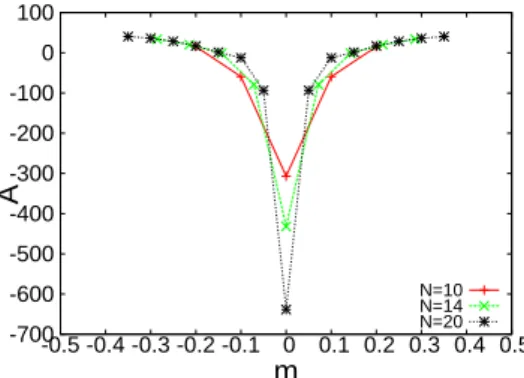
In this thesis, we propose a novel method of evaluating an anomaly by investigat- ing the magnetic susceptibility χ and the fourth derivativeA of the energy with respect to magnetization. The term ‘anomaly’ means a divergence in the thermo- dynamic limit. This anomaly usually marks a phase transition. Researchers have studied the anomaly of the magnetic susceptibility from exact solutions. However, few investigations of high-order differentials such asAhave been carried out. We show that the method observing the anomaly by χ and A is appropriate for the analysis of the phase transition, compared with the method using the magnetic susceptibility χ alone. The introduction of A resolves the issue of whether the high-order differential of energy diverges.
As an example, we apply this method to theS = 1/2XXZ antiferromagnetic chain, which shows a ferromagnetic phase for ∆ ≤ −1, Tomonaga–Luttinger (TL) phase for −1 < ∆ ≤ 1, and antiferromagnetic phase for∆ > 1. ∆ is an anisotropic parameter with thez component of the XXZ antiferromagnetic chain.
The lowest energy of the chain is calculated by numerical diagonalization. Sub- sequently, we analyze the anomalies ofχandAto observe the phase transition.
The results demonstrate that an anomaly ofχ−1 at zero magnetization exists under ∆ > 1, while A at zero magnetization shows an anomaly for ∆ > 1/2.
Hence, the anomaly of A is easier to observe than that of χ. We then consider the anomaly from the perspective of the scaling dimension which indicates the critical phenomena. The scaling dimension of the chain is subject to the parameter
∆. For ∆ = 1, the scaling dimension changes from irrelevant to relevant for U(1)symmetry. This change of the scaling dimension means the phase transition corresponding to the Kosterlitz–Thouless (KT) transition. In contrast, for −1 <
∆≤1region that shows Tomonaga–Luttinger (TL) phase, the scaling dimension is irrelevant. For∆ = 2region that shows the antiferromagnetic phase, the scaling dimensionxT is relevant in∆ > 1. Thus, we conclude that the anomaly ofAat 1/2<∆<1is different from that ofAat∆ = 1and does not indicate the phase transition. Moreover, we reveal that TL phase is divided into two phases with a
∆ = 1/2boundary by the behavior ofA. We refer to−1<∆<1/2as TL phase (I) and1/2<∆≤1as TL phase (II).
These findings indicate that the method usingAis better than that usingχfor analyzing critical phenomena with phase transitions.
Contents
1 Introduction 1
1.1 Condensed matter and spin . . . 1
1.2 Anomaly of magnetic susceptibility . . . 1
1.3 Purpose of research . . . 6
1.4 Organization of this thesis . . . 6
2 Quantum spin systems 8 2.1 Magnetic susceptibility for Heisenberg chain . . . 8
2.2 General properties of XXZ chain . . . 11
2.3 Behavior of ground state energy . . . 15
3 Theory 18 3.1 Energy and correction term . . . 18
3.2 Magnetic susceptibility and fourth derivative . . . 19
3.3 Free boson . . . 21
3.4 Sine-Gordon model . . . 25
3.5 Behavior of magnetic susceptibility and fourth derivative . . . 26
4 Results 29 4.1 Setup of system . . . 29
4.2 S = 1/2XXZ antiferromagnetic chain . . . 30
4.3 Numerical results . . . 31
4.3.1 Magnetic susceptibility . . . 31
4.3.2 Fourth derivative . . . 31
5 Comparison with exact solutions 35 5.1 Magnetic susceptibility near saturation magnetization . . . 35
5.2 Bethe-ansatz solution . . . 37
5.2.1 Case of magnetic susceptibility near zero magnetization . 37 5.2.2 Case of fourth derivative . . . 39
6 Discussion 41
6.1 Anomaly of∆ = 1/2 . . . 41
6.1.1 Scaling dimension . . . 41
6.1.2 Scaling dimension and the anomaly . . . 42
6.2 Analysis of anomalies . . . 43
6.2.1 Magnetic susceptibility . . . 43
6.2.2 Fourth derivative . . . 43
6.2.3 Third derivative . . . 45
6.3 Correction term and boundary conditions . . . 46
7 Conclusion 52 Acknowledgment 54 Appendix 55 A Calculation method 55 B Gaussian model and Sine-Gordon model 57 B.1 Gaussian model . . . 57
B.2 Sine-Gordon model . . . 61
B.3 Sine-Gordon model and XXZ chain . . . 61
C Relation between magnetization and magnetic field 66 C.1 Case of spin-glass system . . . 66
C.2 Case of XXZ chain . . . 68
C.3 Nonlinear magnetic susceptibility . . . 69
D Conformal field theory 71 D.1 Conformal algebra forddimension . . . 71
D.2 Conformal algebra ind= 2dimension . . . 73
D.3 Primary field . . . 76
References 78
Chapter 1 Introduction
1.1 Condensed matter and spin
In condensed matter physics, phase transitions and their corresponding energy gaps are important research subjects. Researching these gaps is necessary for studying the behavior of quantum spin systems. Bethe showed that an S = 1/2 antiferromagnetic Heisenberg chain had the characteristic of the absence of a gap [1]. In addition, it was confirmed that the correlation function for the sys- tem decreases with a power low. Later, Haldane argued the difference between half-odd-integer and integer spin antiferromagnet chains [2]. For the integer spin case, Haldane showed that the antiferromagnetic Heisenberg chain have a gap and the correlation function is exponentially decreased.
Many researchers have observed the energy gap via the magnetization curve as a function of the magnetic field. The magnetic field at zero magnetization is equal to the magnitude of the gap. However, the method of observing the gap via the magnetization curve is not appropriate for deciding whether a spin system is gapless or gapped in numerical calculation; it is difficult to distinguish a gapless system from one with a very small energy gap [3]. Hence, Sakai and Nakano [4, 5, 6, 7] proposed a method for distinguishing a gapless system from a gapped system. In the next section, we introduce Sakai and Nakano’s method.
1.2 Anomaly of magnetic susceptibility
In this section, we review Sakai and Nakano’s work [4], which shows a method for distinguishing a gapless from a gapped system and an anomaly of magnetic susceptibility. The term ‘anomaly’ means that the magnetic susceptibility diverges in the thermodynamic limit.
First, they focus on the spinS = 1/2square lattice antiferromagnetic Heisen- berg model in two dimensional systems. The Hamiltonian of the model is given by
Hˆ =J1X
⟨i,j⟩
( ˆSixSˆjx+ ˆSiySˆjy+ ˆSizSˆjz) +J2X
⟨k,l⟩
( ˆSkxSˆlx+ ˆSkySˆly+ ˆSkzSˆlz), (1.1) whereJ1, J2 are an exchange interaction,Sˆi,Sˆj,Sˆk,Sˆl are the spin operator, and
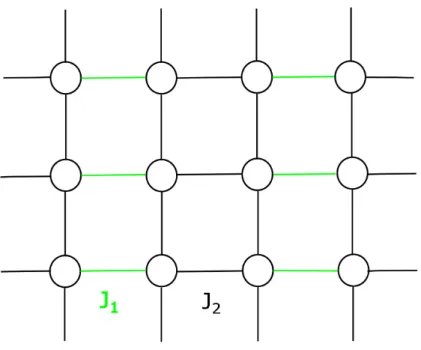
⟨i, j⟩and⟨k, l⟩indicate the nearest neighbor pairs on the lattice. Figure1.1shows the model (1.1). In J1 ≫ J2, neighboring spins form pair, which indicates a spin-singlet state (Fig.1.2). Subsequently, the lowest energyE(N, M)and mag- netizationM of the model (1.1) are defined as
Hˆ|ϕ⟩=E(N, M)|ϕ⟩, XN
j=1
Sˆjz|ϕ⟩=M|ϕ⟩,
whereN is the system size,M is a magnetization,Sˆjzis thejth spin operator inz direction, and|ϕ⟩is the eigenstate. We note that|ϕ⟩is a simultaneous eigenstate of Hˆ and P
jSˆjz. To calculate the lowest energy, a numerical diagonalization method is used under a periodic boundary condition. The interaction to the exter- nal magnetic fieldhis
Hˆz =−h XN
j=1
Sˆjz. (1.2)
In the thermodynamic limit (N → ∞), the lowest energy ofHˆper site,ϵ(m), is defined as
Nlim→∞
E(N, M)
N =ϵ(m), (1.3)
wherem = M/Msis a magnetization normalized andMs = SN is a saturation magnetization which means the magnetization of the state where all the spins are aligned in the z direction. They then consider ϵ′′(m)and ϵ′(m). When ϵ(m)is analytic, the spin excitation energyE(N, M+ 1)−E(N, M)becomes
1
N(E(N, M + 1)−E(N, M))≃ϵ
m+ 1 N S
−ϵ(m). (1.4) From Taylor expansion ofϵ m+N S1
, Eq. (1.4) is written as E(N, M + 1)−E(N, M)≃ 1
Sϵ′(m) + 1
2N S2ϵ′′(m) +· · ·. (1.5)
Similarly, the spin excitation energyE(N, M)−E(N, M−1)becomes E(N, M)−E(N, M −1)≃ 1
Sϵ′(m)− 1
2N S2ϵ′′(m) +· · ·. (1.6) From Eq. (1.5) and Eq. (1.6),ϵ′′(m)is given by
(E(N, M + 1)−E(N, M))−(E(N, M)−E(N, M −1))≃ 1
N S2ϵ′′(m).
(1.7) This indicates that ϵ′′(m)is represented by the difference of energies. By mini- mizing the energy of total Hamiltonian including Eq. (1.1) and Eq. (1.2),ϵ′(m)is written as
∂
∂m
E(N, M)
N −hM N
= 0 h= ϵ′(m)
S . (1.8)
Asϵ(m)is assumed to be analytic,ϵ′(0)becomes zero. Conversely, assuming that ϵ(m)is not analytic,ϵ′(0)becomes finite.
The derivative ofmwith respect tohis defined as χ≡ dm
dh = S
ϵ′′(m), (1.9)
whereχis a magnetic susceptibility. In particular, in the case ofm = 0, Eq. (1.7) is written as follows
2∆N S ≃ 1
N S2ϵ′′(0), (1.10)
where∆N S =E(N,1)−E(N,0)is the spin energy gap. Whenχ(m = 0) = 0, ϵ′′(m = 0)is infinite in the thermodynamic limit. In contrast, whenχ(m= 0)̸= 0, ϵ′′(m = 0) = 0in the thermodynamic limit. In the thermodynamic limit, the relation betweenχand∆N S is
Nlim→∞χ(m= 0) = 0
⇒∆N S =finite (gapped),
Nlim→∞χ(m= 0)̸= 0
⇒∆N S = 0 (gapless).
(1.11) (1.12)
This indicates whether the spin systems is gapless or gapped from the numerical results ofχ.
The model (1.1) is gapless forα > αcwhereαc= 0.52337(3)andα =J1/J2, while this model is gapped forα < αc [8]. They then calculate χfor the model (1.1). Figure1.3 shows the magnetization dependence ofχ for the model (1.1).
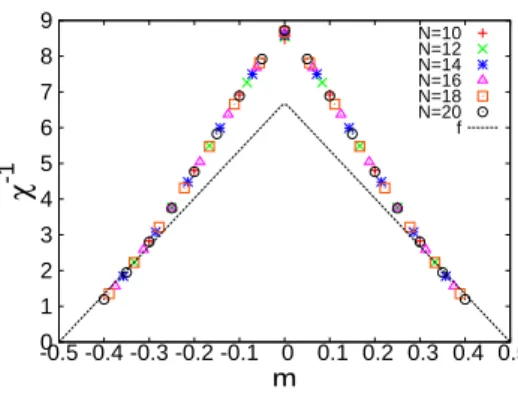
Figure1.3(a)shows that the curve is smooth andχ̸= 0atm= 0forα=J2/J1 = 1. Conversely, Fig.1.3(b)shows thatχ = 0 atm = 0forα =J2/J1 = 0.2, and χseems to diverge nearm = 0in the thermodynamic limit. The divergence near m = 0in Fig. 1.3(b) means the anomaly of magnetic susceptibility. Figure 1.4 shows the1/N dependence ofχatm = 0. Figure1.4(a)indicates thatχatm = 0 becomes finite in the thermodynamic limit. In contrast, Fig.1.4(b)indicates that χatm = 0becomes zero in the thermodynamic limit. Thus, the numerical results of χ demonstrate that the model (1.1) is gapless for α = 1 and is gapped for α = 0.2.
These results indicate that they propose a method for distinguishing a gapless system from a gapped system by using magnetic susceptibilityχ. We focus on the anomaly of magnetic susceptibilityχnear zero magnetization in Fig.1.3(b). The term ‘anomaly’ refers to a divergence in the thermodynamic limit. This anomaly usually exhibits a phase transition.
Fig. 1.1:Square lattice antiferromagnetic Heisenberg model. The solid green line and black line are the exchange interactionJ1and the exchange interactionJ2of the model (1.1).
Fig. 1.2:Spin-singlet state that neighboring spins form pair when the exchange interac- tionsJ1 ≫J2of the model (1.1).
(a) gapless (b) gapped
Fig. 1.3:Magnetization M/Ms = m dependence of the magnetic susceptibility χ for S = 1/2square lattice antiferromagnetic Heisenberg model (1.1) reproduced from [4]. Panel(a)indicates thatχatm = 0is finite. Thus, the system for a ratio of exchange interactionsJ2/J1= 1is gapless from Eq. (1.12). Conversely, panel(b)indicates thatχatm= 0is 0 and the system for the ratioJ2/J1 = 0.2 is gapped from Eq. (1.11).
(a) gapless (b) gapped
Fig. 1.4:1/N dependence ofχat magnetizationm = M/Ms = 0 ofS = 1/2square lattice antiferromagnetic Heisenberg model (1.1) reproduced from [4]. Panel(a) shows that χ at m = 0 is finite inN → ∞ and the system is gapless from Eq. (1.12). Panel(b)shows thatχatm= 0is 0 inN → ∞. Thus, the system is gapped from Eq. (1.11).
1.3 Purpose of research
From previous work of Nakano and Sakai, this study discusses a novel approach of evaluating an anomaly by studying the magnetic susceptibilityχand the fourth derivativeAof the energy with respect to magnetization. The derivative of energy with respect to magnetization is introduced because it has a smaller error than that with respect to magnetic field. The aim of this study is analyzing the phase tran- sition by using high-order differentials such as A. As a test case, in a numerical calculation, we apply this theory to the S = 1/2XXZ antiferromagnetic chain, which shows a ferromagnetic phase for∆≤ −1, Tomonaga–Luttinger (TL) phase for −1 < ∆ ≤ 1, and antiferromagnetic phase for ∆ > 1. Here, ∆denotes an anisotropic parameter associated with thezcomponent of the XXZ antiferromag- netic chain. We show thatχandAderived from Bethe ansatz and conformal field theory are consistent with numerical results.
1.4 Organization of this thesis
This thesis is organized as follows: In the next chapter, we present some reviews of one-dimensional quantum spin systems. In Chapter 3, we introduce some phys- ical quantities which are magnetic susceptibility χand the fourth derivativeAof the lowest energy with respect to magnetization. In addition, we introduce a con-
formal field theory and deriveχandAfrom the conformal field theory describing the low-energy behavior of theS = 1/2XXZ chain. In Chapter 4, our numerical results are presented for theS = 1/2XXZ antiferromagnetic chain. These results suggest thatχandAhave an anomaly in the thermodynamic limit. Here, the term
‘anomaly’ means the divergence, that is, usually a phase transition. In Chapter 5, we indicate that our numerical results are consistent with available exact solu- tions to investigate the behavior of A. In Chapter 6, we consider the suggestion referred to the anomaly of χ and A. Then, we show that the anomaly of A is easier to observe than that ofχfrom the perspective of size dependence. Finally, we summarize this thesis.
Chapter 2
Quantum spin systems
In this chapter, we review some studies of one-dimensional quantum spin systems, which show the exact solutions of magnetization curves and magnetic susceptibil- ity by Bethe ansatz.
2.1 Magnetic susceptibility for Heisenberg chain
In this section, we review Griffiths’s work [9], which shows the behavior of mag- netic susceptibility in zero magnetic field at zero magnetization and zero temper- ature. They focus onS = 1/2antiferromagnetic Heisenberg chain as follows
Hˆ= 2J XN
j=1
( ˆSjxSˆj+1x + ˆSjySˆj+1y + ˆSjzSˆj+1z ), (2.1)
whereJ is an exchange interaction,Sˆjx,Sˆjy,Sˆjz are thejth site spin operator in the x, y, z direction, andN is the system size. The boundary condition is periodic:
SˆN+1 ≡Sˆ1.
First, the highest eigenvalueEF and lowest eigenvalueEAF of the chain (2.1) for J >0are given by
EF = 1
2N J, (2.2)
EAF = 1
2−ln 2
N J. (2.3)
The second equation works onN → ∞. These energies are derived by Hulthen [10]
and des Cloizeaux and Pearson [11], using Bethe ansatz. To a state with energy
E, normalized energies ofEF, EAF are written as follows ϵ= 1
2J N (EF −E) = 1 2N J
1
2N J −E
, (2.4)
η= 1
2J N (E−EAF) = 1 2J N
E−1
2N J+ 2N Jln 2
= ln 2−ϵ, (2.5) where ϵ, η are the highest and lowest energy normalized. They then consider a stateΦ(n1, .., nr)where the spins atn1, .., nr are down and all other spins are up.
The eigenstate of the chain is given by [1]
Φ =X
r
a(n1, .., nr)Φ(n1, .., nr), (2.6)
a(n1, .., nr) = Xr!
P=1
expi Xr
j=1
kPjnj +X
j<l
ϕPjPl
!
, (2.7)
whereP is the permutation andkis the wave vector and satisfies N kj = 2πλj +X
l̸=j
ϕjl, (j = 1,2, ..., r) (2.8) cot1
2ϕjl = 1 2
cot
1 2kj
−cot 1
2kl
, (−π ≤ϕjl ≤π) (2.9) ϵ=N−1
Xr j=1
(1−coskj), (2.10)
whereλjis an integer from 0 toN−1. The state of smallest eigenvaluesEAF,λj satisfies
λ1 = 1
2N−r+ 1, λ2 =λ1+ 2, ..., λr =λ1+ 2(r−1) = 1
2N +r−1, (2.11) where0< λ1 ≤λ2 ≤...≤ λr < N andλj+1 ≥λj + 2. Under the condition of λj Eq. (2.11), Eq. (2.8), Eq. (2.9), and Eq. (2.10) are replaced in largeN limit by integral equation:
k(x) = 2πx+1 2
Z 1/2+ρ
1/2−ρ
ϕ(x, y)dy, (2.12)
cot1
2ϕ(x, y) = 1 2
cot1
2k(x)−cot1 2k(y)
, (−π ≤ϕ ≤π) (2.13) ϵ= 1
2
Z 1/2+ρ
1/2−ρ
[1−cosk(x)]dx, (2.14)
wherex=λj/N,k(x) = kj , andρis 1
2N −S =N ρ, (2.15)
σ≡ S N = 1
2 −ρ, (2.16)
whereSis a total spin andσcorresponds to magnetization per site. Then, differ- entiating both sides of Eq. (2.12) with respect tox, they obtain integral equation:
f(ξ) =g0(ξ)− Z α
−α
K(ξ−η)f(η)dη, (2.17) whereξ = cot(12k), f(ξ) = −dxdξ, g0(ξ) = π(1+ξ2 2), andK(ξ −η) = π(4+(ξ2−η)2). On the basis of the integral equation, energies are calculated for antiferromagnetic Heisenberg chain for magnetization σ → 0that corresponds toα → ∞. Subse- quently, they consider theσandη. Solving the integral equation, they obtain
η=C1
1 + 1 2 lnσ
σ2+O
σ2ln|lnσ| (lnσ)2
, (2.18)
whereC1 is a constant. From integral equations, the relation between theσandη is revealed.
Next, let us consider the Hamiltonian in the presence of a magnetic fieldh:
Hˆz =−h XN
j=1
Sˆjz. (2.19)
The lowest energy Etotal of total Hamiltonian including Eq. (2.1) and Eq. (2.19) is given by
Etotal =E(N, σ)−hN σ, (2.20)
E(N, σ) = 2N J η(σ) +EAF, (2.21) where E(N, σ) is the lowest energy of the chain (2.1) and is same as E(N, M) of Eq. (1.3). Differentiating the both sides of Eq. (2.20) with respect to total spin S =N σunder ∂E∂Stotal = 0, they obtain
1 N
∂E(N, σ)
∂σ −h= 0 2η′(σ) = h
J. (2.22)
η′(σ)is proportional to magnetic fieldh. The magnetization per spinm is given by differentiatingEtotal with respect toh.
m=−1 N
∂Etotal
∂h =σ. (2.23)
Subsequently, the magnetic susceptibilityχis derived:
χ= dm
dh = lim
h→0
m
h = σ
2J η′(σ). From Eq. (2.18),η′(σ)is written in the following way
η′(σ) =−C1 2
σ2
(lnσ)2σ +C1
1 + 1 2 lnσ
×2σ
=C1σ
2 + lnσ−1/2 (lnσ)2
. (2.24)
Thus,χis represented as χ= σ
2J η′(σ) = 1 2J C1
2 + ln(lnσ)σ−1/22
. (2.25)
The relations between χ,m, andhare shown in Fig.2.1. Figure2.1(a)indicates that the magnetization curve is smooth. Conversely, Fig.2.1(b)shows thatχhas a cusp and infinite slope at zero field h = 0. This infinite slope is shown by differentiatingχwith respect toσ:
∂χ
∂σ ≃ 1 4J C1
∂
∂σ
1−lnσ−1/2 (lnσ)2
=− 1
4J C1(lnσ)−2σ−1 1−(lnσ)−1
. (2.26)
When σ → 0 is equal to zero magnetization from Eq. (2.23), the slope of χ becomes infinite from Eq. (2.26) asσ−1diverges quickly compared to(lnσ)−2.
2.2 General properties of XXZ chain
In this section, we review Yang and Yang’s work [12], which shows the analytic solutions of magnetization curve, magnetic susceptibility, and high-order differ- ential ofS= 1/2XXZ chain. First, they introduceS = 1/2XXZ chain Hamilto- nian:
Hˆ = 2J XN
j=1
( ˆSjxSˆj+1x + ˆSjySˆj+1y + ∆ ˆSjzSˆj+1z ), (2.27)
(a) Magnetization as a function of magnetic field at T = 0.
(b) Magnetic susceptibility to a magnetic field at T = 0.
Fig. 2.1:Magnetization and magnetic susceptibility reproduced from [9]. Panel (a) demonstrates the curve of a magnetizationm = M/gµ andh = gµH where g,µ, andH are the electrongfactor, Bohr magneton, and constant. The curve is smooth. Panel(b)demonstrates thatχ = limh→0m/h=M J/g2µ2H has a cusp and infinite slope at zero fieldh= 0.
whereSˆjx,Sˆjy,Sˆjz are thejth site spin operator in thex, y, zdirection andN is the system size. For ∆ = 1, the system corresponds to the antiferromagnetic chain, while for∆ =−1it corresponds to the ferromagnetic chain. The Hamiltonian in the presence of a magnetic fieldhis defined as
Hˆz =−h XN
j=1
Sˆjz. (2.28)
The lowest energy Etotal of total Hamiltonian adding Eq. (2.28) to Eq. (2.27) is given by
Etotal=N(2ϵ(m)−hm), (2.29)
whereϵ(m)is the lowest energy per site of Hamiltonian (2.27) andmis the mag- netization. The magnetic fieldhand magnetic susceptibilityχis defined as [13]
h= 2∂ϵ(m)
∂m , (2.30)
χ=
2∂2ϵ(m)
∂m2 −1
. (2.31)
Through these quantity, they consider the magnetization curve of the system for various values of ∆. First, for ∆ = 0, the lowest energy of the Hamiltonian is written in the form [13]
ϵ(m) = −1
π cosπm
2 . (2.32)
Substituting Eq. (2.30) and Eq. (2.31) for Eq. (2.32), they obtain h= sinπm
2 , (2.33)
χ−1 = π
2 cosπm
2 . (2.34)
For zero magnetization,h(m = 0) = 0andχ−1(m= 0) =π/2.
Next, for−1<∆<1, the lowest energy of the Hamiltonian is given by [13]
ϵ(m)−ϵ(0) = π(π−µ) sinµ
8µ m2(1 +O(m2) +O(mπ4µ−µ)), (2.35) whereµ= arccos(∆). From Eq. (2.35),handχ−1 are derived:
h= π(π−µ) sinµ
4µ (2m+O(m3) +O(mπ4µ−µ+1)), (2.36) χ−1 = π(π−µ) sinµ
4µ (2 +O(m2) +O(mπ4µ−µ)). (2.37) At zero magnetization,h(m= 0) = 0andχ−1(m= 0) = π(π−2µµ) sinµ. In addition, they derive thenth derivative of the energy as follows
mlim→0+
d dm
n
ϵ(m) =
finite
n <2 + π4µ−µ
±∞
n >2 + π4µ−µ
, (2.38)
where π4µ−µ is irrational. Subsequently, introducingχ−1 = 2d2dmϵ(m)2 , they obtain
mlim→0+
d dm
n
χ−1 =
finite
n < π4µ−µ
±∞
n > π4µ−µ
. (2.39)
However, when π4µ−µis an integer, individual discussion is needed. The correspon-
dence between π4µ−µ which is an integer and∆is 4µ
π−µ = 4↔∆ = 0, 4µ
π−µ = 3↔∆≃0.22, 4µ
π−µ = 2↔∆ = 1/2, 4µ
π−µ = 1↔∆ = 1 +√ 5
4 ≃0.81.
The lowest energy for∆ = 0is Eq. (2.32). Other cases are not discussed.
Finally, for∆<−1, the lowest energy is written in the form [13]
ϵ(m)−ϵ(0) = sinhλ 2π
2πe0m+2π3 3
e2
e20m3+O(m4)
, (2.40) X∞
n=−∞
(−1)ncosnσ
2 coshnλ =e0+e2σ2+e4σ4+...,
where ∆ = coshλ ande0, e2, e4 are constants. From Eq. (2.40), h and χ−1 are represented as
h= sinhλ π
2πe0+ 2π3e2
e20m2+O(m3)
= 2 sinhλ e0+e2 πm
e0 2
+O(m3)
!
= 2 sinhλ X∞ n=−∞
(−1)ncosnπme
0
2 coshnλ , χ−1 = sinhλ
π
4π3e2
e20m+O(m2)
. For zero magnetization,handχ−1 are written in the form
h(m= 0) = 2 sinhλ X∞ n=−∞
(−1)n 2 coshnλ
= πsinhλ λ
X∞ n=−∞
sechπ2
2λ(1 + 2n), (2.41)
χ−1(m= 0) = 0. (2.42)
These behaviors ofhandχ−1are shown in Fig.2.2. Figure2.2shows thath(m= 0) = 0for−1 <∆ <1andh(m = 0) = finite for|∆| >1. This indicates that the system is gapless for−1<∆<1and is gapped for|∆|>1, as the magnetic fieldh(m= 0)means the energy gap of the system from Eq. (2.30).
Fig. 2.2:Magnetization m = y at a magnetic field h = H for anisotropic parameter
∆ → −∆reproduced from [12]. The system is gapless for−1 < ∆ <1 and is gapped for|∆|>1, as the magnetic fieldh(m= 0)means the energy gap of the system.
2.3 Behavior of ground state energy
In this section, we review Lukyanov’s work [14], which shows the detail behavior of ground state energy forS = 1/2XXZ chain for−1<∆<1that is anisotropic parameter, comparing with Eq. (2.35). They focus on the chain:
Hˆ = 2J XN
j=1
SˆjxSˆj+1x + ˆSjySˆj+1y + ∆
SˆjzSˆj+1z −1 2
, (2.43)
where J is an exchange interaction and positive,Sˆjx,Sˆjy,Sˆjz are the jth site spin operator in thex, y, zdirection, andN is the system size and even. The boundary condition is defined as
Sˆ1±=e±2πiθSˆN±+1, (2.44)
Sˆ1z = ˆSN+1z , (2.45)
whereSˆj± = ˆSjx±iSˆjy andθis real parameter that takes the value from 0 to 1, that is, 0< θ < 1. In addition, the unitary transformation to spin operator is given in the form
Uˆ+SˆjxUˆ = (−1)jSˆjx, Uˆ+SˆjyUˆ = (−1)jSˆjy, Uˆ+SˆjzUˆ = ˆSjz, (2.46) whereUˆ = exp
iπP
kkSˆkz
is a unitary matrix. Acting on Hamiltonian (2.43), they obtain
Uˆ+HˆUˆ = 2J XN k=1
(−SˆjxSˆj+1x −SˆjySˆj+1y + ∆( ˆSjzSˆj+1z −1))
=−2J XN k=1
( ˆSjxSˆj+1x + ˆSjySˆj+1y −∆( ˆSjzSˆj+1z −1)). (2.47) Comparing Eq. (2.47) with Eq. (2.43), both equations are equivalent whenJ ↔
−J,∆↔ −∆. Thus, the system forJ >0is equal to the system forJ <0. For convenience,∆andJ are parameterized as follows
∆ = cos(πβ2), (2.48)
J = 1−β2
sin(πβ2)a−1, (2.49) wherea >0and0< β2 ≤ 1. Subsequently, they define the ground state energy of the chain in a magnetic fieldhas
ϵ(h) = lim
N→∞
Etotal(h)
N , (2.50)
whereϵ(h)is the ground state energyEtotal(h)per site. The ground state energy per siteϵ(h)is explicitly given by [13]
ϵ(h) =−h 4 +J
Z Λ
−Λ
dα 2π
sin (πβ2)f(α)
cosh(2α) + cos (πβ2), (2.51)
f(α)− Z Λ
−Λ
dα′ π
sin (2πβ2)f(α′)
cosh (2α−2α′)−cos (2πβ2) = h
J − 4 sin2(πβ2) cosh(α) + cos (2πβ2), f(±Λ) = 0.
Using Wiener-Hopf method that solves integral equations by decomposing an ar- bitrary functionΦintoΦ+ = 2πi1 R
C1Φ(z)z−zα andΦ− = 2πi1 R
C2Φ(z)z−zα where
C1andC2are parallel contours to real line, the ground state energyϵ(h)is derived:
ϵ(h) = E0− ah2 16πβ2
1 +κ|ah|β42−4+ (κ++κ−) (ah)2+. . .
, (2.52) E0 =− 2
πa 1−β2 Z ∞
0
dt sinh (β2t)
sinh(t) cosh ((1−β2)t). (2.53) where
κ = Γ2(β−2) tan (πβ−2) 2β2Γ2 12 +β−2
Γ β2
2−2β2
8√ πΓ
1 2−2β2
2 β2−2
, (2.54)
κ+ = 1 64πβ2 tan
π 2−2β2
, (2.55)
κ− = 1 192π
Γ 3
2−2β2
Γ3
β2 2−2β2
Γ 3β2
2−2β2
Γ3
1 2−2β2
. (2.56)
Here, the magnetic fieldhis assumed to be small (|h/J| ≪1). In addition, carry- ing out the exchange ofhand a magnetization mfrom Legendre transformation, the magnetic susceptibilityχ= ∂2∂mϵ(m)2 is described as follows
χ≃ − a 8πβ2
1− κ
2 4
β2 −2 4 β2 −3
|am|β42−4−6a(κ++κ−)m2+...
. (2.57) These indicate that the ground state energy and magnetic susceptibility in the presence of a magnetic field are derived in detail, compared with Eq. (2.35) and Eq. (2.37).
Chapter 3 Theory
In this chapter, we introduce the physical procedure of calculating the magnetic susceptibilityχand fourth derivativeAof energy as a function of magnetization.
In addition, we introduce the free boson model and sine-Gordon model describ- ing the critical phenomena and low-energy behavior of the S = 1/2 XXZ anti- ferromagnetic chain treated in our study. We formulate the behavior of magnetic susceptibilityχand fourth derivativeA.
3.1 Energy and correction term
The total spin operator in thezdirectionSˆTz is defined as SˆTz ≡
XN j=1
Sˆjz, (3.1)
where Sˆjz is the jth site spin operator in the z direction and N is the system size. This operator and a Hamiltonian Hˆ that showsU(1)symmetry commute:
[ ˆH ,SˆTz] = 0. From the commutation relation, we obtain
Hˆ|ψ⟩=E(N, M)|ψ⟩, (3.2) SˆTz|ψ⟩=M|ψ⟩, (M = 0,±1, ...,±N/2) (3.3) whereE(N, M)is the lowest energy,Mis the magnetization, and|ϕ⟩is the eigen- state. We note that|ϕ⟩is a simultaneous eigenstate of Hˆ andSˆTz. ForN → ∞, the energy ofHˆper site,ϵ(m), is then given by [15]
lim
N→∞
E(N, M)
N =ϵ(m), (3.4)
where m = M/N is the magnetization per site. When N is finite, Eq. (3.4) is written as following
E(N, M)
N =ϵ(m) +C(N, m), (3.5)
where C(N, m)is a correction term of a finite size. Generally, ϵ(m) is analytic for m in the thermodynamic limit. The term ‘analytic’ indicates that a function and high-order differential are continuous. However, in this thesis, high-order differential is defined as derivative up to fourth derivative. Then, the correction termC(N, m)satisfies the following conditions:
Nlim→∞C(N, m) = 0, (3.6)
Nlim→∞C(n)(N, m) = 0, (n ≥1) (3.7) whereC(n)(N, m)is thenth derivative of the correction term with respect to mag- netization. The correction term depends on the boundary conditions and dimen- sion. The details are discussed in Section6.3.
3.2 Magnetic susceptibility and fourth derivative
Using energy per siteϵ(m), high-order differentials such as the magnetic suscep- tibilityχand fourth derivativeAare defined in the following way
χ≡ 1
ϵ′′(m), (3.8)
A≡ ∂2
∂m2χ−1 = ∂4
∂m4ϵ(m). (3.9)
The difference between the lowest energiesE(N, M)is explicitly described byχ andAas follows
ϵ′′(N, m)
≡N{E(N, M + 1)−2E(N, M) +E(N, M −1)}
=χ−1+C′′(N, m) + 1
12N2 ϵ(4)(m) +C(4)(N, m) +O
1 N4
, (3.10)
ϵ(4)(N, m)
≡N3{E(N, M + 2)−4E(N, M + 1) + 6E(N, M)
−4E(N, M−1) +E(N, M −2)}
=A+C(4)(N, m) + 1
6N2 ϵ(6)(m) +C(6)(N, m) +O
1 N4
, (3.11)
whereϵ(n)(N, m)is thenth finite-difference between the lowest energies.ϵ(N, m) is obtained directly from our numerical results in finite systems. We then consider the behavior ofϵ′′(N, m)andϵ(4)(N, m). As an example, we consider theS = 1/2 XXZ antiferromagnetic chain that hasU(1)symmetry and an anisotropic param- eter∆in thezcomponent. When∆≫1and there is a Neel state which indicates an energy gap, the lowest energyE(N, M)is described as
E(N, M) = E(N,0) +|M|∆E, (3.12) where∆E is an energy gap for a finite system. Using Eq. (3.12), in the thermo- dynamic limit, Eq. (3.10) can be rewritten as
ϵ′′(N, m) = (
N(2∆E) (m = 0),
0 (m ̸= 0). (3.13)
Similarly, substituting Eq. (3.12) into Eq. (3.11), we obtain
ϵ(4)(N, m) =
N3(−4∆E) (m= 0), N3(2∆E) (m=±1/N), 0 (m̸= 0,±1/N).
(3.14)
However, for a case of finite anisotropy,ϵ′′(N, m)andϵ(4)(N, m)become nonzero atm ̸= 0,1/N region because of interactions between magnons. Thus, for large
N, we giveϵ′′(N, m)andϵ(4)(N, m)as follows ϵ′′(N, m) =
(
N(2∆E) (m = 0),
finite (m ̸= 0), (3.15)
ϵ(4)(N, m) =
N3(−4∆E) (m= 0), N3(2∆E) (m=±1/N), finite (m̸= 0,±1/N).
(3.16)
These relations mean that ϵ(4)(N, m) is N2 times as large as ϵ′′(N, m). The anomaly of A appears stronger than that of χ−1 in the thermodynamic limit. In addition, from Eq. (3.16), the behavior ofϵ(4)(N, m)at m = 0andm = 1/N is different. Thus, we introduceAas physical concept for observing an anomaly.
Next, we discuss the case in whichϵ(m)is not analytic. ϵ(m)is not analytic for m when ϵ′′(N, m) or ϵ(4)(N, m) diverges. In the thermodynamic limit, the relation is given by
lim
N→∞ϵ′′(N, m) =ϵ′′(m)
⇒ϵ(m)is analytic,
Nlim→∞ϵ′′(N, m) =±∞
⇒ϵ(m)is not analytic.
(3.17) (3.18)
The same holds for ϵ(4)(N, m). The divergence of ϵ′′(N, m) and ϵ(4)(N, m) is equivalent to the fact thatχ−1andAdiverge.
3.3 Free boson
We introduce the free boson which indicates the critical phenomena of the S = 1/2XXZ antiferromagnetic chain. The basics of conformal field theory is intro- duced in AppendixD. First, for simplicity, we consider a free boson fieldX(z, z) and an actionS.
S = 1 4πα′
Z
d2x(∇X)2 = 1 4πα′
Z
d2x ∂X
∂x1 2
+ ∂X
∂x2 2!
= 1 4πα′
Z
d2x[(∂zX+∂zX)2 −(∂zX−∂zX)2]
= 1 πα′
Z
d2z∂zX∂zX, (3.19)
whereα′ is parameter which has lengthL2dimension,z =x1+ix2, z =x1−ix2,
∂z ≡ 12(∂x1 −i∂x2), ∂z ≡ 12(∂x1 +i∂x2), and d2x = dz2i∧dz ≡ d2z. From an Euler-Lagrange equation, we obtain
∂z∂zX = 0. (3.20)
From Eq. (3.20), X(z, z) is a function ofz or z. Therefore, the free boson field X(z, z)is divided into holomorphic part and antiholomorphic part.
X(z, z) =X(z) +X(z), (3.21) whereX(z)is a left-mover andX(z)is a right-mover.
Next, we consider a two-point correlation function. The two-point correlation function of the physical quantityx, x′is given:
⟨xqxr⟩=A−qr1 ≡Grq → Z
dxA(x, x′)G(x′) = δ(x−x′), (3.22) whereGrqandG(x′)are Green function andAqrandA(x, x′)is the term involved in a gauss integral:
Z
dxexp
−1 2
txAx
= (2π)N2(detA)−12, (3.23) whereAis matrix andxis vector. The term corresponding toAqr in the actionS is∂z∂z. Thus, the correlation function of the fields is derived from
⟨X(z, z)X(ω, ω)⟩= 1 Z
Z
X(z, z)X(ω, ω)e−S(X)
= 1 2
− 1 πα′∂z∂z
−1
δ(z−ω, z−ω)
∂z∂z⟨X(z, z)X(ω, ω)⟩=−πα′
2 δ(z−ω, z−ω), (3.24)
whereZ is a partition function. The formula of Green function in two dimension is written in the form
∆ ln|z|= 4∂z∂zln|z|= 2πδ2(z, z), (3.25) whereδ2(z, z) =δ(z)δ(z). Comparing Eq. (3.24) with Eq. (3.25), we obtain
∂z∂z⟨X(z, z)X(ω, ω)⟩=−πα′
2 δ(z−ω, z−ω)
=−α′
2∂z∂zln|z−ω|2.
Thus, the two-point correlation function ofX(z, z)andX(ω, ω)is
⟨X(z, z)X(ω, ω)⟩=−α′
2 ln|z−ω|2
=−α′
2 ln (z−ω)− α′
2 ln (z−ω). (3.26) From Eq. (3.21), the two-point correlation function ofX(z)andX(z)is
⟨X(z)X(ω)⟩=−α′
2 ln (z−ω),⟨X(z)X(ω)⟩=−α′
2 ln (z−ω). (3.27) Subsequently, it is convenient to define the currentJ(z)as
J(z)≡ 2
α′ 1/2
i∂zX(z). (3.28)
The product ofJ(z)is written in the form J(z)J(ω) = −
2 α′
∂z∂ωX(z)X(ω)≃ 1
(z−ω)2. (3.29) UsingJ(z), a stress-energy tensorT(z)which means Noether’s current is
T(z) = 1
2 :J(z)J(z) :≡ 1 2 lim
ω→z
J(ω)J(z)− 1 (z−ω)2
. (3.30)
The sign ‘: :’ is a normal order product where the annihilation operator is aligned to the right of the generation operator. For convenience, the currentJ is expanded for a Laurent expansion.
J(z) = 2
α′ 1/2
i∂zX(z) = α0z−1+X
n̸=0
αnz−n−1 =X
n∈Z
αnz−n−1. (3.31) Similarly, the fieldX(z)is derived:
X(z) = α′
2
1/2"
ϕ0−iα0lnz+iX
n̸=0
αn n z−n
#
, (3.32)
whereϕ0is a zero mode. We then derive a commutation relation of the expansion coefficientαn. Usingαn =H dz
2πiznJ(z), we obtain the following relation [αm, αn] =
I dz
2πizmJ(z), I dω
2πiωnJ(ω)
=i2 I
|z|>|ω|
dz
2πizm∂zX(z) I
ω=0
dω
2πiωn∂ωX(ω)
−i2 I
|z|<|ω|
dω
2πiωn∂ωX(ω) I
z=0
dz
2πizm∂zX(z)
=mδm+n,0, (3.33)
![Fig. 1.3: Magnetization M/M s = m dependence of the magnetic susceptibility χ for S = 1/2 square lattice antiferromagnetic Heisenberg model (1.1) reproduced from [4]](https://thumb-ap.123doks.com/thumbv2/123deta/9785630.1868914/11.892.166.729.669.919/magnetization-dependence-magnetic-susceptibility-lattice-antiferromagnetic-heisenberg-reproduced.webp)
![Fig. 1.4: 1/N dependence of χ at magnetization m = M/M s = 0 of S = 1/2 square lattice antiferromagnetic Heisenberg model (1.1) reproduced from [4]](https://thumb-ap.123doks.com/thumbv2/123deta/9785630.1868914/12.892.160.746.196.452/dependence-magnetization-square-lattice-antiferromagnetic-heisenberg-model-reproduced.webp)
![Fig. 2.1: Magnetization and magnetic susceptibility reproduced from [9]. Panel (a) demonstrates the curve of a magnetization m = M/gµ and h = gµH where g, µ, and H are the electron g factor, Bohr magneton, and constant](https://thumb-ap.123doks.com/thumbv2/123deta/9785630.1868914/18.892.195.719.202.446/magnetization-magnetic-susceptibility-reproduced-demonstrates-magnetization-electron-magneton.webp)