INTER-UNIVERSAL TEICHM ¨ ULLER THEORY II:
HODGE-ARAKELOV-THEORETIC EVALUATION
By
Shinichi MOCHIZUKI
August 2012
R ESEARCH I NSTITUTE FOR M ATHEMATICAL S CIENCES
KYOTO UNIVERSITY, Kyoto, Japan
HODGE-ARAKELOV-THEORETIC EVALUATION
Shinichi Mochizuki August 2012
Abstract. In the present paper, which is the second in a series of four papers, we study the Kummer theory surrounding the Hodge-Arakelov- theoretic evaluation — i.e., evaluation in the style of thescheme-theoretic Hodge- Arakelov theoryestablished by the author in previous papers — of the [reciprocal of thel-th root of the]theta functionatl-torsion points, forl≥5 a prime number.
In the first paper of the series, we studied“miniature models of conventional scheme theory”, which we referred to as Θ±ellNF-Hodge theaters, that were associated to certain data, calledinitialΘ-data, that includes anelliptic curveEF over anumber fieldF, together with a prime number l≥5. These Θ±ellNF-Hodge theaters were gluedto one another by means“Θ-links”, that identify the [reciprocal of thel-th root of the]theta functionat primes of bad reduction ofEF in one Θ±ellNF-Hodge theater with [2l-th roots of] the q-parameter at primes of bad reduction of EF in another Θ±ellNF-Hodge theater. The theory developed in the present paper allows one to construct certain new versions of this “Θ-link”. One such new version is the Θ×gauμ- link, which is similar to the Θ-link, but involves thetheta values atl-torsion points, rather than the theta function itself. One important aspect of the constructions that underlie the Θ×gauμ-link is the study ofmultiradialityproperties, i.e., properties of the “arithmetic holomorphic structure” — or, more concretely, the ring/scheme structure — arising from one Θ±ellNF-Hodge theater that may be formulated in such a way as to make sense from the point of the arithmetic holomorphic structure of another Θ±ellNF-Hodge theater which is related to the original Θ±ellNF-Hodge theater by means of the [non-scheme-theoretic!] Θ×gauμ-link. For instance, certain of the various rigidityproperties of the´etale theta function studied in an earlier paper by the author may be intepreted as multiradiality properties in the context of the theory of the present series of papers. Another important aspect of the constructions that underlie the Θ×gauμ-link is the study of“conjugate synchronization” via the F±l -symmetryof a Θ±ellNF-Hodge theater. Conjugate synchronization refers to a certain system of isomorphisms — which arefreeof anyconjugacy indeterminacies!
— between copies of local absolute Galois groups at the various l-torsion points at which the theta function is evaluated. Conjugate synchronization plays an important role in the Kummer theory surrounding the evaluation of the theta function at l- torsion points and is applied in the study ofcoricityproperties of [i.e., the study of objects leftinvariantby] the Θ×gauμ-link. Global aspects of conjugate synchronization require the resolution, via results obtained in the first paper of the series, of certain technicalities involvingprofinite conjugatesof tempered cuspidal inertia groups.
Contents:
Introduction
§1. Multiradial Mono-theta Environments
Typeset byAMS-TEX
1
§2. Galois-theoretic Theta Evaluation
§3. Tempered Gaussian Frobenioids
§4. Global Gaussian Frobenioids
Introduction
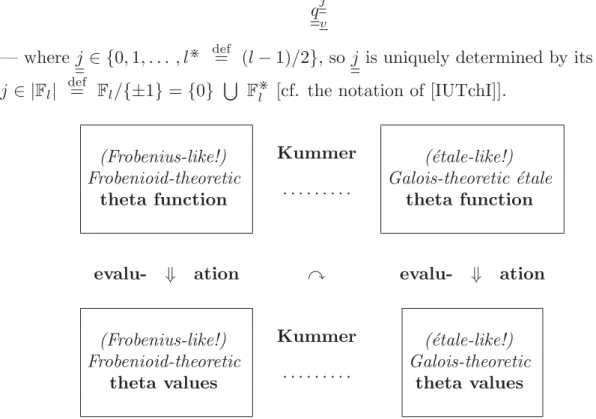
In the following discussion, we shall continue to use the notation of the In- troduction to the first paper of the present series of papers [cf. [IUTchI], §I1]. In particular, we assume that are given an elliptic curve EF over a number field F, together with a prime number l ≥ 5. In the present paper, which forms the sec- ond paper of the series, we study the Kummer theorysurrounding the Hodge- Arakelov-theoretic evaluation [cf. Fig. I.1 below] — i.e., evaluation in the style of the scheme-theoretic Hodge-Arakelov theory of [HASurI], [HASurII] — of the reciprocal of the l-th root of the theta function
Θv def=
qv−18 ·
n∈Z
(−1)n·qv12(n+12)2·Uvn+12−1l
[cf. [EtTh], Proposition 1.4; [IUTchI], Example 3.2, (ii)] atl-torsion pointsin the context of the theory of Θ±ellNF-Hodge theaters developed in [IUTchI]. Here, relative to the notation of [IUTchI], §I1, v ∈ Vbad; qv denotes the q-parameter at v of the given elliptic curve EF over a number field F; Uv denotes the standard multiplicative coordinate on the Tate curve obtained by localizing EF atv. Letq be a 2l-th root of qv. Then these “theta values at l-torsion points” will, up to av
factor given by a 2l-th root of unity, turn out to be of the form [cf. Remark 2.5.1, (i)]
qj2
v
— where j ∈ {0,1, . . . , l def= (l−1)/2}, so j is uniquely determined by its image j ∈ |Fl| def= Fl/{±1}={0}
Fl [cf. the notation of [IUTchI]].
(Frobenius-like!) Frobenioid-theoretic
theta function
Kummer . . . .
(´etale-like!) Galois-theoretic ´etale
theta function
evalu- ⇓ ation evalu- ⇓ ation
(Frobenius-like!) Frobenioid-theoretic
theta values
Kummer . . . .
(´etale-like!) Galois-theoretic
theta values
Fig. I.1: The Kummer theory surrounding Hodge-Arakelov-theoretic evaluation
In order to understand the significance of Kummer theory in the context of Hodge-Arakelov-theoretic evaluation, it is important to recall the notions of
“Frobenius-like” and “´etale-like” mathematical structures [cf. the discussion of [IUTchI], §I1]. In the present series of papers, the Frobenius-like structures consti- tuted by [the monoidal portions of]Frobenioids — i.e., more concretely, by various monoids — play the important role of allowing one to construct gluing isomor- phisms such as the Θ-link which lie outside the framework of conventional scheme/ring theory [cf. the discussion of [IUTchI], §I2]. Such gluing isomor- phisms give rise to Frobenius-pictures [cf. the discussion of [IUTchI], §I1]. On the other hand, the ´etale-like structures constituted by various Galois and arith- metic fundamental groupsgive rise to thecanonical splittingsof such Frobenius- pictures furnished by corresponding ´etale-pictures [cf. the discussion of [IUTchI],
§I1]. In [IUTchIII],absolute anabelian geometrywill be applied to these Galois and arithmetic fundamental groups to obtain descriptions of alien arithmetic holomorphic structures, i.e., arithmetic holomorphic structures that lie on the opposite side of a Θ-link from a given arithmetic holomorphic structure [cf. the discussion of [IUTchI], §I3]. Thus, in light of the equally crucial but substantially differentroles played by Frobenius-like and ´etale-like structures in the present series of papers, it is of crucial importance to be able
to relate corresponding Frobenius-like and ´etale-likeversions of vari- ous objects to one another.
This is the role played by Kummer theory. In particular, in the present paper, we shall study in detail the Kummer theory that relates Frobenius-like and ´etale- like versions of thetheta functionand its theta valuesat l-torsion points to one another [cf. Fig. I.1].
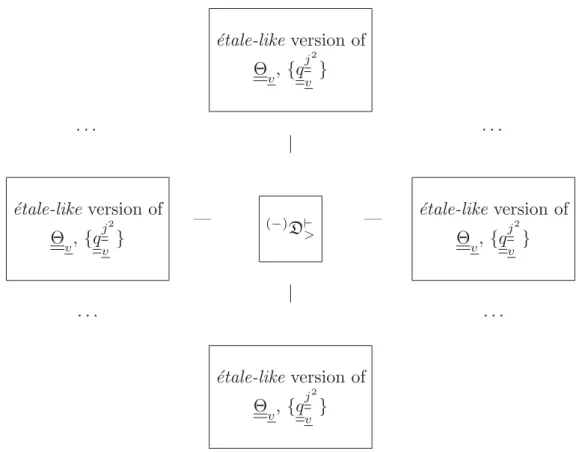
One important notion in the theory of the present paper is the notion of mul- tiradiality. To understand this notion, let us recall the ´etale-picture discussed in [IUTchI], §I1 [cf., [IUTchI], Fig. I1.6]. In the context of the present paper, we shall be especially interested in the ´etale-like version of the theta function and its theta values constructed in each D-Θ±ellNF-Hodge theater (−)HTD-Θ±ellNF; thus, one can think of the ´etale-picture under consideration as consisting of the diagram given in Fig. I.2 below. As discussed earlier, we shall ultimately be interested in applying various absolute anabelian reconstruction algorithms to the various arith- metic fundamental groups that [implicitly] appear in such ´etale-pictures in order to obtain descriptions of alien holomorphic structures, i.e., descriptions of objects that arise on onespokethat make sense from the point of view of another spoke. In this context, it is natural to classify the variousalgorithmsapplied to the arithmetic fundamental groups lying in a given spoke as follows [cf. Example 1.7]:
· We shall refer to an algorithm as coric if it in fact only depends on input data arising from the mono-analytic core of the ´etale-picture, i.e., the data that is common to all spokes.
· We shall refer to an algorithm as uniradial if it expresses the objects constructed from the given spoke in terms that only make sense within the given spoke.
· We shall refer to an algorithm as multiradialif it expresses the objects constructed from the given spoke in terms ofcorically constructedobjects, i.e., objects that make sense from the point of view of other spokes.
Thus, multiradial algorithms are compatible with simultaneous execution at multiple spokes[cf. Example 1.7, (v); Remark 1.9.1], whileuniradialalgorithms may only be consistently executed at a single spoke. Ultimately, in the present series of papers, we shall be interested — relative to the goal of obtaining “descriptions of alien holomorphic structures” — in the establishment of multiradial algorithms for constructing the objects of interest, e.g., [in the context of the present paper] the
´
etale-like versions of the theta functions and the corresponding theta values discussed above. Typically, in order to obtain such multiradial algorithms, i.e., algorithms that make sense from the point of view of other spokes, it is necessary to allow for some sort of “indeterminacy” in the descriptions that appear in the algorithms of the objects constructed from the given spoke.
´etale-like version of Θv, {qj2
v } . . .
| . . .
´
etale-like version of Θv, {qj2
v }
. . .
— (−)D>
|
— ´etale-like version of Θv, {qj2
v }
. . .
´etale-like version of Θv, {qj2
v }
Fig. I.2: ´Etale-picture of ´etale-like versions of theta functions, theta values Relative to the analogy between the inter-universal Teichm¨uller theory of the present series of papers and the classical theory of holomorphic structures on Riemann surfaces [cf. the discussion of [IUTchI], §I4], one may think of coric algorithms as corresponding to constructions that depend only on the underlying real analytic structure on the Riemann surface. Thenuniradial algorithms cor- respond to constructions that depend, in an essential way, on the holomorphic structure of the given Riemann surface, while multiradial algorithms correspond
to constructions of holomorphicobjects associated to the Riemann surface which are expressed [perhaps by allowing for certain indeterminacies!] solely in terms of the underlying real analytic structure of the Riemann surface — cf. Fig. I.3 below; the discussion of Remark 1.9.2. Perhaps the most fundamental motivat- ing example in this context is the description of “alien holomorphic structures” by means of the Teichm¨uller deformations reviewed at the beginning of [IUTchI],
§I4, relative to “unspecified/indeterminate” deformation data [i.e., consisting of a nonzero square differential and a dilation factor]. Indeed, for instance, in the case of once-punctured elliptic curves, by applying well-known facts concerning Te- ichm¨uller mappings [cf., e.g., [Lehto], Chapter V, Theorem 6.3], it is not difficult to formulate the classical result that
“the homotopy class of every orientation-preserving homeomorphism be- tween pointed compact Riemann surfaces of genus one ‘lifts’ to a unique Teichm¨uller mapping”
in terms of the“multiradial formalism”discussed in the present paper [cf. Example 1.7]. [We leave the routine details to the reader.]
abstract inter-universal classical complex
algorithms Teichm¨uller theory Teichm¨uller theory
uniradial arithmetic holomorphic holomorphic
algorithms structures structures
arithmetic holomorphic holomorphic structures multiradial structures described in structures described in
algorithms terms of underlying terms of underlying mono-analytic structures real analytic structures
coric underlying mono-analytic underlying real analytic
algorithms structures structures
Fig. I.3: Uniradiality, Multiradiality, and Coricity
One interesting aspect of the theory of the present series of papers may be seen in the set-theoretic function arising from the theta values considered above
j → qj2
v
— a function that is reminiscent of the Gaussian distribution (R ) x → e−x2 on the real line. From this point of view, the passage from the Frobenius- pictureto the canonical splittings of the´etale-picture[cf. the discussion of [IUTchI],
§I1], i.e., in effect, the computation of the Θ-links that occur in the Frobenius- picture by means of the various multiradial algorithms that will be established in the present series of papers, may be thought of [cf. the diagram of Fig. I.2!] as a sort of global arithmetic/Galois-theoretic analogue of the computation of the classical Gaussian integral
∞
−∞
e−x2 = √π
via the passage fromcartesiancoordinates, i.e., which correspond to theFrobenius- picture, to polar coordinates, i.e., which correspond to the ´etale-picture — cf.
the discussion of Remark 1.12.5.
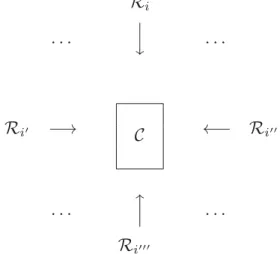
One way to understand the difference between coricity, multiradiality, and uniradiality at a purely combinatorial level is by considering the Fl - and F±l - symmetries discussed in [IUTchI], §I1 [cf. the discussion of Remark 4.7.4 of the present paper]. Indeed, at a purely combinatorial level, the Fl -symmetry may be thought of as consisting of the natural action of Fl on the set of labels |Fl| = {0}
Fl [cf. the discussion of [IUTchI], §I1]. Here, the label 0 corresponds to the [mono-analytic] core. Thus, the corresponding ´etale-picture consists of various copies of|Fl|glued together along thecoric label0 [cf. Fig. I.4 below]. In particular, the various actions of copies of Fl on corresponding copies of |Fl| are “compatible with simultaneous execution” in the sense that they commute with one another.
That is to say, at least at the level of labels, the Fl -symmetry is multiradial.
. . .
. . .
|
— 0 —
Fig. I.4: ´Etale-picture of Fl -symmetries
. . .
± ±
± ± . . .
↓ ↑
± ±
± ±
→← 0 ←→ ± ±
± ±
Fig. I.5: ´Etale-picture of F±l -symmetries
In a similar vein, at a purely combinatorial level, theF±l -symmetrymay be thought of as consisting of the natural action ofF±l on the set oflabelsFl[cf. the discussion of [IUTchI], §I1]. Here again, the label 0 corresponds to the [mono-analytic] core.
Thus, the corresponding ´etale-picture consists of variouscopies ofFlglued together along the coric label 0 [cf. Fig. I.5 above]. In particular, the various actions of copies of F±l on corresponding copies of Fl are “incompatible with simultaneous execution”in the sense that they clearly fail to commute with one another. That is to say, at least at the level of labels, the F±l -symmetry is uniradial.
Since, ultimately, in the present series of papers, we shall be interested in the establishment of multiradial algorithms, “special care” will be necessary in order to obtain multiradial algorithms for constructing objects related to the a priori uniradial F±l -symmetry[cf. the discussion of Remark 4.7.3 of the present paper;
[IUTchIII], Remark 3.11.2, (i), (ii)]. The multiradiality of such algorithms will be closely related to the fact thatF±l -symmetry is applied to relate the variouscopies of local units modulo torsion, i.e., “O×μ” [cf. the notation of [IUTchI], §1] at various labels∈Fl that lie in various spokes of the ´etale-picture [cf. the discussion of Remark 4.7.3, (ii)]. This contrasts with the way in which the a priori multira- dial Fl -symmetry will be applied, namely to treat various “weighted volumes”
corresponding to the local value groups and global realified Frobenioids at various labels ∈Fl that lie in various spokes of the ´etale-picture [cf. the discussion of Re- mark 4.7.3, (iii)]. Relative to the analogy between the theory of the present series of papers and p-adic Teichm¨uller theory [cf. [IUTchI], §I4], various aspects of the F±l -symmetry are reminiscent of the additive monodromy over the ordinary locus of the canonical curves that occur in p-adic Teichm¨uller theory; in a similar vein, various aspects of the Fl -symmetry may be thought of as corresponding to the multiplicative monodromy at the supersingular points of the canonical curves that occur in p-adic Teichm¨uller theory — cf. the discussion of Remark 4.11.4, (iii); Fig. I.7 below.
Before discussing the theory of multiradiality in the context of the theory of Hodge-Arakleov-theoretic evaluation theorydeveloped in the present paper, we pause to review the theory of mono-theta environments developed in [EtTh]. One starts with a Tate curve over a mixed-characteristic nonarchimedean local field.
The mono-theta environment associated to such a curve is, roughly speaking, the Kummer-theoretic data that arises by extracting N-th roots of the theta trivial- ization of the ample line bundle associated to the origin over appropriate tem- pered coverings of the curve [cf. [EtTh], Definition 2.13, (ii)]. Such mono-theta environments may be constructed purely group-theoretically from the [arithmetic]
tempered fundamental groupof the once-punctured elliptic curve determined by the given Tate curve [cf. [EtTh], Corollary 2.18], or, alternatively, purely category- theoreticallyfrom the tempered Frobenioid determined by the theory of line bundles and divisors over tempered coverings of the Tate curve [cf. [EtTh], Theorem 5.10, (iii)]. Indeed, the isomorphism of mono-theta environments between the mono- theta environments arising from these two constructions of mono-theta environ- ments — i.e., from tempered fundamental groups, on the one hand, and from tem- pered Frobenioids, on the other [cf. Proposition 1.2 of the present paper] — may be thought of as a sort of Kummer isomorphismfor mono-theta environments [cf. Proposition 3.4 of the present paper, as well as [IUTchIII], Proposition 2.1, (iii)]. One important consequence of the theory of [EtTh] asserts that mono-theta
environments satisfy the following three rigidityproperties:
(a) cyclotomic rigidity, (b) discrete rigidity, and
(c) constant multiple rigidity
— cf. the Introduction to [EtTh].
Discrete rigidityassures one that one may work withZ-translates[where we writeZ for the copy of “Z” that acts as a group of covering transformations on the tempered coverings involved], as opposed toZ-translates [i.e., where Z ∼=Z denotes the profinite completion of Z], of the theta function, i.e., one need not contend with Z-powers of canonical multiplicative coordinates [i.e., “U”], or q-parameters [cf. Remark 3.6.5, (iii); [IUTchIII], Remark 2.1.1, (v)]. Although we will certainly
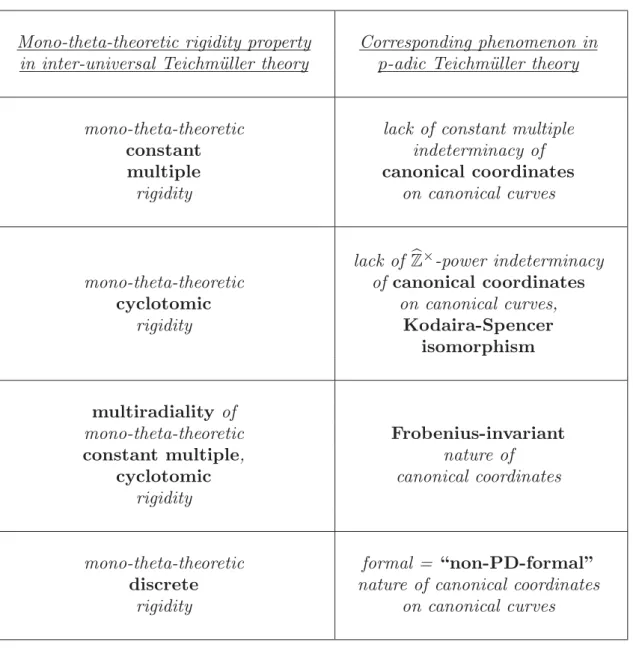
“use” this discrete rigidity throughout the theory of the present series of papers, this property of mono-theta environments will not play a particularly prominent role in the theory of the present series of papers. TheZ-powers of “U” and “q” that would occur if one does not have discrete rigidity may be compared to the PD- formal seriesthat are obtained,a priori, if one attempts to construct thecanonical parameters of p-adic Teichm¨uller theory via formal integration. Indeed, PD-formal power series become necessary if one attempts to treat such canonical parameters as objects which admit arbitraryO-powers, where O denotes the completion of the local ring to which the canonical parameter belongs [cf. the discussion of Remark 3.6.5, (iii); Fig. I.6 below].
Constant multiple rigidity plays a somewhat more central role in the present series of papers, in particular in relation to the theory of thelog-link, which we shall discuss in [IUTchIII] [cf. the discussion of Remark 1.12.2 of the present paper; [IUTchIII], Remark 1.2.3, (i); [IUTchIII], Proposition 3.5, (ii); [IUTchIII], Remark 3.11.2, (iii)]. Constant multiple rigidity asserts that the multiplicative monoid
OF×
v · Θ
v
— which we shall refer to as the theta monoid — generated by the reciprocal of the l-th root of the theta function and the group of units of the ring of inte- gers of the base field Fv [cf. the notation of [IUTchI], §I1] admits a canonical splitting, up to 2l-th roots of unity, that arises fromevaluationat the[2-]torsion point corresponding to the label 0 ∈ Fl [cf. Corollary 1.12, (ii); Proposition 3.1, (i); Proposition 3.3, (i)]. Put another way, this canonical splitting is the splitting determined, up to 2l-th roots of unity, by Θ
v ∈ O×F
v · Θ
v. The theta monoid of the above display, as well as the associated canonical splitting, may be constructed algorithmically from the mono-theta environment [cf. Proposition 3.1, (i)]. Rela- tive to the analogy between the theory of the present series of papers and p-adic Teichm¨uller theory, these canonical splittings may be thought of as corresponding to the canonical coordinates of p-adic Teichm¨uller theory, i.e., more precisely, to the fact that such canonical coordinates are also completely determinedwithout any constant multiple indeterminacies — cf. Fig. I.6 below; Remark 3.6.5, (iii);
[IUTchIII], Remark 3.12.4, (i).
Mono-theta-theoretic rigidity property Corresponding phenomenon in in inter-universal Teichm¨uller theory p-adic Teichm¨uller theory
mono-theta-theoretic lack of constant multiple
constant indeterminacy of
multiple canonical coordinates
rigidity on canonical curves
lack of Z×-power indeterminacy mono-theta-theoretic of canonical coordinates
cyclotomic on canonical curves,
rigidity Kodaira-Spencer
isomorphism
multiradiality of
mono-theta-theoretic Frobenius-invariant
constant multiple, nature of
cyclotomic canonical coordinates rigidity
mono-theta-theoretic formal = “non-PD-formal”
discrete nature of canonical coordinates
rigidity on canonical curves
Fig. I.6: Mono-theta-theoretic rigidity properties in inter-universal Teichm¨uller theory and corresponding phenomena in p-adic Teichm¨uller theory
Cyclotomic rigidity consists of a rigidity isomorphism, which may be con- structed algorithmically from the mono-theta environment, between
· the portion of the mono-theta environment — which we refer to as the exterior cyclotome — that arises from the roots of unity of the base field and
· a certain copy of the once-Tate-twisted Galois module “Z(1)” — which we refer to as the interior cyclotome — that appears as a subquotient of the geometric tempered fundamental group
[cf. Definition 1.1, (ii); Proposition 1.3, (i)]. This rigidity is remarkable — as we shall see in our discussion below of the corresponding multiradiality property —
in that unlike the “conventional” construction of such cyclotomic rigidity isomor- phisms via local class field theory [cf. Proposition 1.3, (ii)], which requires one to use the entire monoid with Galois action Gv OF
v, the only portion of the monoid OF
v that appears in this construction is the portion [i.e., the “exterior cyclotome”] corresponding to the torsion subgroup OFμ
v ⊆ OF
v [cf. the notation of [IUTchI], §I1]. This construction depends, in an essential way, on the com- mutator structure of theta groups, but constitutes a somewhat different approach to utilizing this commutator structure from the “classical approach” involvingirre- ducibilityof representations of theta groups [cf. Remark 3.6.5, (ii); the Introduction to [EtTh]]. One important aspect of this dependence on the commutator structure of the theta group is that the theory of cyclotomic rigidity yields an explanation for the importance of the special role played by the first power of [the reciprocal of the l-th root of ] the theta function in the present series of papers [cf. Remark 3.6.4, (iii), (iv), (v); the Introduction to [EtTh]]. Relative to the analogy between the theory of the present series of papers and p-adic Teichm¨uller theory, mono- theta-theoretic cyclotomic rigidity may be thought of as corresponding either to the fact that thecanonical coordinates of p-adic Teichm¨uller theory are completely determined without any Z×-power indeterminacies or [roughly equivalently] to the Kodaira-Spencer isomorphism of the canonical indigenous bundle — cf. Fig.
I.6; Remark 3.6.5, (iii); Remark 4.11.4, (iii), (b).
The theta monoid
OF×
v · Θ
v
discussed above admits both´etale-likeandFrobenius-like[i.e.,Frobenioid-theoretic]
versions, which may be related to one another via a Kummer isomorphism [cf.
Proposition 3.3, (i)]. The unit portion, together with its natural Galois action, of the Frobenioid-theoretic version of the theta monoid
Gv OF×
v
forms the portion at v ∈ Vbad of the F×-prime-strip “F×mod” that is preserved, up to isomorphism, by the Θ-link [cf. the discussion of [IUTchI], §I1; [IUTchI], Theorem A, (ii)]. In the theory of the present paper, we shall introduce modified versions of the Θ-link of [IUTchI] [cf. the discussion of the “Θ×μ-, Θ×μgau-links”
below], which, unlike the Θ-link of [IUTchI],only preserve [up to isomorphism] the F×μ-prime-strips — i.e., which consist of the data
Gv O×μF
v = OF×
v/OFμ
v
[cf. the notation of [IUTchI], §I1] at v ∈ Vbad — associated to the F×-prime- strips preserved [up to isomorphism] by the Θ-link of [IUTchI]. Since this data is only preserved up to isomorphism, it follows that the topological group “Gv” must be regarded as beingonly known up to isomorphism, while the monoidOF×μ
v must be regarded as beingonly known up to [the automorphisms of this monoid determined by the natural action of] Z×. That is to say, one must regard
the data Gv O×μF
v as subject to Aut(Gv)-, Z×-indetermnacies.
These indeterminacies will play an important role in the theory of the present series of papers — cf. the indeterminacies “(Ind1)”, “(Ind2)” of [IUTchIII], Theorem 3.11, (i).
Now let us return to our discussion of the various mono-theta-theoretic rigidity properties. The key observation concerning these rigidity properties, as reviewed above, in the context of the Aut(Gv)-, Z×-indeterminacies just discussed, is the following:
thecanonical splittings, via“evaluation at the zero section”, of thetheta monoids, together with the construction of the mono-theta-theoretic cyclotomic rigidity isomorphism, are compatiblewith, in the sense that they areleft unchanged by, the Aut(Gv)-, Z×-indeterminacies dis- cussed above
— cf. Corollaries 1.10, 1.12; Proposition 3.4, (i). Indeed, this observation consti- tutes the substantive content of the multiradiality of mono-theta-theoretic con- stant multiple/cyclotomic rigidity [cf. Fig. I.6] and will play an important role in the statements and proofs of the main results of the present series of papers [cf. [IUTchIII], Theorem 2.2; [IUTchIII], Corollary 2.3; [IUTchIII], Theorem 3.11, (iii), (c); Step (ii) of the proof of [IUTchIII], Corollary 3.12]. At a technical level, this “key observation” simply amounts to the observation that the only portion of the monoid OF×
v that isrelevant to the construction of the canonical splittings and cyclotomic rigidity isomorphism under consideration is the torsion subgroup OμF
v, which [by definition!] maps to the identity element of OF×μ
v , hence is immune to the various indeterminacies under consideration. That is to say, the multiradiality of mono-theta-theoretic constant multiple/cyclotomic rigidity may be regarded as an essentially formal consequence of the trivialityof the natural homomorphism
OμF
v → OF×μ
v
[cf. Remark 1.10.2].
After discussing, in§1, the multiradiality theory surrounding the various rigid- ity properties of the mono-theta environment, we take up the task, in §2 and §3, of establishing the theory ofHodge-Arakelov-theoretic evaluation, i.e., of passing [for v∈Vbad]
OF×
v · Θ
v OF×
v · {qj2
v }j=1,... ,l
from theta monoids as discussed above [i.e., the monoids on the left-hand side of the above display] toGaussian monoids[i.e., the monoids on the right-hand side of the above display] by means of the operation of“evaluation” at l-torsion points.
Just as in the case of theta monoids, Gaussian monoids admit both ´etale-like ver- sions, which constitute the main topic of §2, and Frobenius-like [i.e., Frobenioid- theoretic] versions, which constitute the main topic of§3. Moreover, as discussed at the beginning of the present Introduction, it is of crucial importance in the theory of the present series of papers to be able torelatethese´etale-likeandFrobenius-like versions to one another via Kummer theory. One important observation in this
context — which we shall refer to as the “principle of Galois evaluation” — is the following: it is essentially a tautology that
this requirement ofcompatibilitywithKummer theoryforcesany sort of“evaluation operation” to arise fromrestriction to Galois sectionsof the [arithmetic] tempered fundamental groups involved
[i.e., Galois sections of the sort that arise from rational points such as l-torsion points!] — cf. the discussion of Remarks 1.12.4, 3.6.2. This tautology is interesting both in light of the history surrounding the Section Conjecture in anabelian geom- etry [cf. [IUTchI],§I5] and in light of the fact that the theory of [SemiAnbd] that is applied to prove [IUTchI], Theorem B — a result which plays an important role in the theory of§2 of the present paper! [cf. the discussion below] — may be thought of as a sort of “Combinatorial Section Conjecture”.
At this point, we remark that, unlike the theory of theta monoids discussed above, the theory of Gaussian monoids developed in the present paper does not, by itself, admit amultiradial formulation [cf. Remarks 2.9.1, (iii); 3.4.1, (ii); 3.7.1].
In order to obtain a multiradial formulation of the theory of Gaussian monoids — which is, in some sense, the ultimate goal of the present series of papers! — it will be necessary to combine the theory of the present paper with the theory of the log-link developed in [IUTchIII]. This will allow us to obtain a multiradial formulation of the theory of Gaussian monoidsin [IUTchIII], Theorem 3.11.
One important aspect of the theory of Hodge-Arakelov-theoretic evaluation is the notion of conjugate synchronization. Conjugate synchronization refers to a collection of “symmetrizing isomorphisms” between the various copies of the local absolute Galois group Gv associated to the labels ∈ Fl at which one evaluates the theta function [cf. Corollaries 3.5, (i); 3.6, (i); 4.5, (iii); 4.6, (iii)]. We shall also use the term “conjugate synchronization” to refer to similar collections of “sym- metrizing isomorphisms” for copies of various objects [such as the monoid OF
v] closely related to the absolute Galois group Gv. With regard to the collections of isomorphisms between copies of Gv, it is of crucial importance that these isomor- phisms be completely well-defined, i.e.,without any conjugacy indeterminacies!
Indeed, if one allows conjugacy indeterminacies [i.e., put another way, if one allows oneself to work with outer isomorphisms, as opposed to isomorphisms], then one must sacrifice either
· the distinct nature of distinct labels ∈ |Fl| — which is necessary in order to keep track of the distinct theta values “qj2” for distinct j — or
· the crucialcompatibilityof ´etale-like and Frobenius-like versions of the symmetrizing isomorphisms with Kummer theory
— cf. the discussion of Remark 3.8.3, (ii); [IUTchIII], Remark 1.5.1; Step (vii) of the proof of [IUTchIII], Corollary 3.12. In this context, it is also of interest to observe that it follows from certain elementary combinatorial considerations that one must require that
· these symmetrizing isomorphisms arise from a group action, i.e., such as the F±l -symmetry
— cf. the discussion of Remark 3.5.2. Moreover, since it will be of crucial impor- tance to apply these symmetrizing isomorphisms, in [IUTchIII], §1 [cf., especially, [IUTchIII], Remark 1.3.2], in the context of the log-link — whose definition de- pends on the local ring structures at v ∈ Vbad [cf. the discussion of [AbsTopIII],
§I3] — it will be necessary to invoke the fact that
· the symmetrizing isomorphisms at v ∈ Vbad arise from conjugation op- erations within a certain [arithmetic] tempered fundamental group
— namely, the tempered fundamental group of Xv [cf. the notation of [IUTchI], §I1] — that contains Πv as an open subgroup of finite index
— cf. the discussion of Remark 3.8.3, (ii). Here, we note that these “conjugation operations” related to the F±l -symmetry may be applied to establish conjugate synchronization precisely because they arise from conjugation by elements of the geometric tempered fundamental group [cf. Remark 3.5.2, (iii)].
The significance of establishing conjugate synchronization — i.e., subject to the various requirements discussed above! — lies in the fact that the resulting symmetrizing isomorphisms allow one to
construct the crucial coric F×μ-prime-strips
— i.e., theF×μ-prime-strips that are preserved, up to isomorphism, by the modi- fied versions of theΘ-link of [IUTchI] [cf. the discussion of the “Θ×μ-, Θ×μgau-links”
below] that are introduced in §4 of the present paper [cf. Corollary 4.10, (i), (iv);
[IUTchIII], Theorem 1.5, (iii); the discussion of [IUTchIII], Remark 1.5.1, (i)].
In§4, the theory of conjugate synchronization established in §3 [cf. Corollaries 3.5, (i); 3.6, (i)] is extended so as to apply toarbitraryv∈V, i.e., not justv ∈Vbad [cf. Corollaries 4.5, (iii); 4.6, (iii)]. In particular, in order to work with the theta value labels ∈ Fl in the context of the F±l -symmetry, i.e., which involves the action
F±l Fl
on the labels ∈Fl, one must avail oneself of theglobal portionof theΘ±ell-Hodge theaters that appear. Indeed, this global portion allows one to synchronize the a priori independent indeterminacies with respect to the action of {±1} on the various X
v [for v∈Vbad],−X→v [forv ∈Vgood] — cf. the discussion of Remark 4.5.3, (iii). On the other hand, the copy of the arithmetic fundamental group ofXK that constitutes this global portion of the Θ±ell-Hodge theater is profinite, i.e., it does not admit a “globally tempered version” whose localization atv ∈Vbadis naturally isomorphic to the corresponding tempered fundamental group atv. One important consequence of this state of affairs is that
in order to apply the global ±-synchronization afforded by the Θ±ell- Hodge theater in the context of the theory of Hodge-Arakelov-theoretic evaluation at v ∈ Vbad relative to labels ∈ Fl that correspond to conju- gacy classes of cuspidal inertia groups oftempered fundamental groups at
v ∈ Vbad, it is necessary to compute the profinite conjugates of such tempered cuspidal inertia groups
— cf. the discussion of [IUTchI], Remark 4.5.1, as well as Remarks 2.5.2 and 4.5.3, (iii), of the present paper, for more details. This is precisely what is achieved by the application of [IUTchI], Theorem B [i.e., in the form of [IUTchI], Corollary 2.5]
in §2 of the present paper.
As discussed above, the theory of Hodge-Arakelov-theoretic evaluation devel- oped in §1, §2, §3 is strictly local [at v ∈ Vbad] in nature. Thus, in §4, we discuss the essentially routine extensions of this theory, e.g., of the theory of Gaussian monoids, to the “remaining portion” of the Θ±ell-Hodge theater, i.e., tov ∈Vgood, as well as to the case ofglobal realified Frobenioids[cf. Corollaries 4.5, (iv), (v); 4.6, (iv), (v)]. We also discuss the corresponding complements, involving the theory of [IUTchI],§5, for ΘNF-Hodge theaters [cf. Corollaries 4.7, 4.8]. This leads naturally to the construction of modified versions of the Θ-link of [IUTchI] [cf. Corollary 4.10, (iii)]. These modified versions may be described as follows:
· The Θ×μ-linkis essentially the same as the Θ-link of [IUTchI], Theorem A, except thatF-prime-strips are replaced byF×μ-prime-strips[cf.
[IUTchI], Fig. I1.2] — i.e., roughly speaking, the various local “O×” are replaced by “O×μ=O×/Oμ”.
· The Θ×μgau-link is essentially the same as the Θ×μ-link, except that the theta monoids that give rise to the Θ×μ-link are replaced, via composition with a certain isomorphism that arises fromHodge-Arakelov-theoretic eval- uation, by Gaussian monoids[cf. the above discussion!] — i.e., roughly speaking, the various “Θ
v” at v ∈Vbad are replaced by “{qj2
v }j=1,... ,l”.
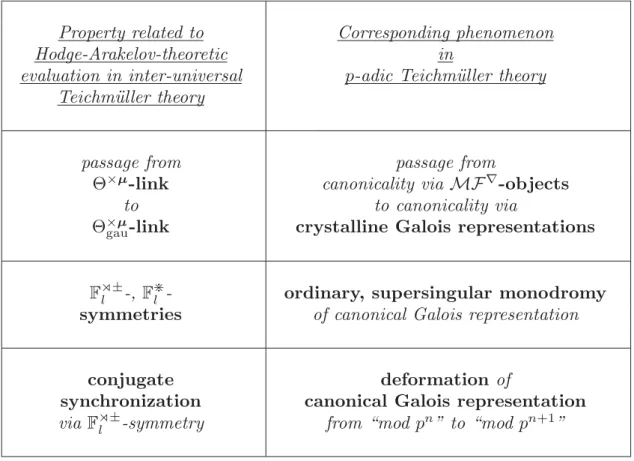
The basic properties of the Θ×μ-, Θ×μgau-links, including the correspondingFrobenius- and ´etale-pictures, are summarized in Theorems A, B below [cf. Corollaries 4.10, 4.11 for more details]. Relative to the analogy between the theory of the present series of papers and p-adic Teichm¨uller theory, the passage from the Θ×μ-link to the Θ×μgau-link via Hodge-Arakelov-theoretic evaluation may be thought of as corresponding to the passage
MF∇-objects Galois representations
in the case of thecanonical indigenous bundlesthat occur inp-adic Teichm¨uller theory — cf. the discussion of Remark 4.11.4, (ii), (iii). In particular, the corre- sponding passage from the Frobenius-picture associated to the Θ×μ-link to the Frobenius-picture associated to the Θ×μgau-link — or, more properly, relative to the point of view of [IUTchIII] [cf. also the discussion of [IUTchI], §I4], from the log-theta-lattice arising from the Θ×μ-link to the log-theta-lattice arising from the Θ×μgau-link — corresponds [i.e.., relative to the analogy with p-adic Teichm¨uller the- ory] to the passage
from thinking of canonical liftings as being determined by canonical MF∇-objects to thinking of canonical liftings as being determined by canonical Galois representations [cf. Fig. I.7 below].
In this context, it is of interest to note that this point of view is precisely the point of view taken in the absolute anabelian reconstruction theory developed in [CanLift],
§3 [cf. Remark 4.11.4, (iii), (a)]. Finally, we observe that from this point of view, the important theory of conjugate synchronization via F±l -symmetry may be thought of as corresponding to the theory of thedeformation of the canonical Galois representation from “mod pn” to “mod pn+1” [cf. Fig. I.7 below; the discussion of Remark 4.11.4, (iii), (d)].
Property related to Corresponding phenomenon
Hodge-Arakelov-theoretic in
evaluation in inter-universal p-adic Teichm¨uller theory Teichm¨uller theory
passage from passage from
Θ×μ-link canonicality via MF∇-objects
to to canonicality via
Θ×μgau-link crystalline Galois representations
F±l -, Fl - ordinary, supersingular monodromy symmetries of canonical Galois representation
conjugate deformation of
synchronization canonical Galois representation via F±l -symmetry from “mod pn” to “mod pn+1”
Fig. I.7: Properties related to Hodge-Arakelov-theoretic evaluation in inter-universal Teichm¨uller theory and corresponding phenomena in
p-adic Teichm¨uller theory
Certain aspects of the various constructions discussed above are summarized in the following two results, i.e., Theorems A, B, which are abbreviated versions of Corollaries 4.10, 4.11, respectively. On the other hand, many important aspects
— such as multiradiality! — of these constructions do not appear explicitly in Theorems A, B. The main reason for this is that it is difficult to formulate “final results” concerning such aspects as multiradiality in the absence of the framework that is to be developed in [IUTchIII].
Theorem A. (Frobenioid-pictures of Θ±ellNF-Hodge Theaters) Fix a col- lection of initial Θ-data (F /F, XF, l, CK, V, ) as in [IUTchI], Definition 3.1. Let †HTΘ±ellNF; ‡HTΘ±ellNF be Θ±ellNF-Hodge theaters [relative to the given initial Θ-data] — cf. [IUTchI], Definition 6.13, (i). Write †HTD-Θ±ellNF,
‡HTD-Θ±ellNF for the associated D-Θ±ellNF-Hodge theaters — cf. [IUTchI], Definition 6.13, (ii). Then:
(i)(Constant Prime-Strips)By applying thesymmetrizing isomorphisms, with respect to the F±l -symmetry, of Corollary 4.6, (iii), to the data of the un- derlying Θ±ell-Hodge theater of†HTΘ±ellNF that is labeled by t ∈LabCusp±(†D), one may construct, in a natural fashion, an F-prime-strip
†F = (†C, Prime(†C) →∼ V, †F, {†ρ ,v}v∈V)
that is equipped with a natural identification isomorphism of F-prime-strips
†F →∼ †Fmod between †F and the F-prime-strip †Fmod of [IUTchI], Theorem A, (ii); this isomorphism induces a natural identification isomorphism of D- prime-strips †D →∼ †D> between the D-prime-strip †D associated to†F and the D-prime-strip †D> of [IUTchI], Theorem A, (iii).
(ii) (Theta and Gaussian Prime-Strips) By applying the constructions of Corollary 4.6, (iv), (v), to the underlying Θ-bridge and Θ±ell-Hodge theater of
†HTΘ±ellNF, one may construct, in a natural fashion, F-prime-strips
†Fenv = (†Cenv , Prime(†Cenv ) →∼ V, †Fenv, {†ρenv,v}v∈V)
†Fgau = (†Cgau , Prime(†Cgau ) →∼ V, †Fgau, {†ρgau,v}v∈V)
that are equipped with anatural identification isomorphism ofF-prime-strips
†Fenv →∼ †Ftht between †Fenv and the F-prime-strip †Ftht of [IUTchI], Theorem A, (ii), as well as an evaluation isomorphism
†Fenv →∼ †Fgau
of F-prime-strips.
(iii) (Θ×μ- and Θ×μgau-Links) Write ‡F×μ (respectively, †F×μenv ; †F×μgau ) for the F×μ-prime-strip associated to the F-prime-strip ‡F (respectively,
†Fenv; †Fgau). We shall refer to the full poly-isomorphism †F×μenv →∼ ‡F×μ as the Θ×μ-link
†HTΘ±ellNF Θ−→×μ ‡HTΘ±ellNF
[cf. the “Θ-link” of [IUTchI], Theorem A, (ii)] from †HTΘ±ellNF to ‡HTΘ±ellNF, and to the full poly-isomorphism †F×μgau →∼ ‡F×μ — which may be regarded as being obtained from the full poly-isomorphism †F×μenv →∼ ‡F×μ by composition with the inverse of the evaluation isomorphism of (ii) — as the Θ×μgau-link
†HTΘ±ellNF Θ−→×μgau ‡HTΘ±ellNF from †HTΘ±ellNF to ‡HTΘ±ellNF.
(iv) (Coric F×μ-Prime-Strips) The definition of the unit portion of the theta and Gaussian monoids that appear in the construction of the F-prime- strips †Fenv, †Fgau of (ii) gives rise to natural isomorphisms
†F×μ →∼ †F×μenv →∼ †F×μgau