Precipitation Behaviors of Aluminium as Hydroxide and Phosphate in Lactic Acid Solution
(Received September 16, 1982)
Y oshihiko MIZUMOTO*
and Shiro IW AT A **
The precipitation behaviors of aluminium as hydroxide and/or phosphate were studied in lactic acid solutions as follows. The solutions containing, (1) aluminium and sodium ions, (2) aluminium, phosphorus and sodium ions or (3) aluminium, phosphorus, calcium and sodium ions were used for the experiments. The experiments were radiochemically performed as functions of concentrations of lactic acid, aluminium, phosphorus, calcium and sodium ions, pH values and reaction temperatures of the reaction phase, and holding times.
KEYWORDS
precipitation behaviors, aluminium hydroxide, aluminium phosphate, lactic acid solutions, various parameters
I. INTRODUCTION
The experiments on formation, structure and chemical properties of aluminium substituted calcium- hydroxyapatite have been performed.l) In the experiments, the precipitations of aluminium as hy- droxide and phosphate became a problem. Therefore, these experiments have been carried out in the presence of organic acid, such as lactic acid, malic acid, etc. In order to obtain correct amount of aluminium substituted into calcium-hydroxyapatite (CaIo(P04)o(OH)2), it was necessary to find out the experimental conditions, such as concentrations of lactic acid and aluminium ions, pH value, etc., in which the precipitate of aluminium as hydroxide and phosphate was not formed.
The stability constants2) of aluminium in organic acids have been investigated by many resear- chers. However, a large number of the reports were useless because of the different experimental conditions to present work. Therefore, the precipitation behaviors of aluminium as hydroxide and phosphate in the lactic acid solutions on the following three cases were examined radiochemically as functions of concentrations of lactic acid, aluminium, phosphorus and calcium ions, reaction tempe ratures, pH values, holding times and so on. They include, (1) the precipitation behaviors of aluminium hydroxide in lactic acid solution containing aluminium and sodium ions, (2) the precipitation behaviors of aluminium as hydroxide and/or phosphate in the lactic acid solution containing aluminium, phos- phorus and sodium ions, and (3) the precipitation behaviors of aluminium as hydroxide and/or phos- phate and of calcium phosphate in the lactic acid solution containing aluminium, phosphorus, calcium and sodium ions. The experimental conditions, such as concentrations of lactic acid, aluminium, phosphorus and calcium ions, pH values and reaction temperatures of the reaction phase, etc., in which the precipitate of aluminium as hydroxide and/or phosphate were not formed, were determined from these experimental results.
*
Department of Nuclear Reactor Engineering, Faculty of Science and Technology**
Research Reactor Institute, Kyoto UniversityMIZUMOTO etc: Precipitation Behaviors of Aluminium as Hydroxide and Phosphate in Lactic Acid Solution
II. EXPERIMENT AL
1. Experimental Procedure on the Precipitation Formation
The standard solutions of aluminium, phosphorus, calcium and sodium were prepared in the follo- wing manners. The standard solution of aluminium was prepared by dissolving aluminium nitrate or aluminium lactate with distilled water. Aluminium concentrations in these solutions were determined by neutron activation analysis. Th~ standard solution of phosphorus was prepared by dissolving ammonium dihydrogenphosphate with distilled water. The standard solution of calcium was obtained by dissolving calcium carbonate with 1 N nitric acid solution. The standard solution of sodium was obtained by dissolving sodium hydroxide with distilled water. In the preparations of these standard solutions, the distilled water of carbondioxide-free passing nitrogen gas was used.
The experiments were carried out in the following manners. 100 ml of mixture of lactic acid solution and aluminium, phosphorus, calcium and/or sodium solutions was put in a side-arm flask with a reflux condenser, and it was agitated with a magnetic stirrer during the reaction. The pH value of the mixture was adjusted by using ammonium hydroxide and nitric acid. Also, nitrogen gas was passed through the mixture during the reaction to prevent the formation of calcium carbonete. The mixture was filtered with a glass filter (3G4) after the reaction for a constant time, and the amounts of aluminium, phosphorus, calcium and sodium both the precipitate and filtrate were determined by neutron activation analysis.
2. Determinations of Aluminium, Phosphorus, Calcium and Sodium in Precipitate
The precipitate on the glass filter was dissolved by 2 N nitric acid solution. The amounts of aluminium, phosphorus, calcium and sodium in this solution and the filtrate were determined by neutron activation analysis. The samples for the irradiation were obtained by dropping a constant volume of these solutions onto a filter paper (20 mm in diameter). These samples were irradiated at a thermal neutron flux of 2.3x 10¹⁸n/cm2·sec for 5 minutes (for aluminium) or 60 minutes (for phos- phorus, calcium and sodium) in the pneumatic tube of Kyoto University Reactor. The gamma ray spectra of 28AI (T +=2.31 min), 49Ca (8.8min) and 24Na (15 hrs) produced from the (n, r) reactions were measured by a 50 cmS Ge(Li) detector (made by HORIBA) and a 1024 channel pulse hight analyzer (made by NAIG). The amounts of aluminium, calcium and sodium were determined from the full-energy peaks of 1779 keV (28Al) , 3086 keV (49Ca) and 1368 keV (24Na) on the gamma ray spectra. On the other hand, the amount of phosphorus was determined by measuring beta rays (1.70 MeV) of up (T+ = 14.3 day) produced from 31P(n, r)32P reaction with a GM counter. In this measurement, an aluminium absorber of about 100 mg/cm2 in thickness was put on the source to absorb beta rays (0.25 MeV) of 45Ca produced from 44Ca(n, r)45Ca reaction.
Precipitation recoveries (R) of aluminium, phosphorus, calcium and sodium were calculated in percentage from the following equation.
Ap
R (%) Ap+As X 100
Ap and As in the equation show the full-energy peak areas on the gamma ray spectra of 28AI, 49Ca and 24Na, and the beta ray intensities of up in the precipitate and filtrate, respectively.
- 22-
1. Precipitation Behaviors of Aluminium Hydroxide in Lactic Acid Solution Containing Aluminium and Sodium Ions
The precipitation recovery of aluminium hydroxide was measured in the lactic acid solutions with the various concentrations. The experiments were carried out under the conditions of pH 7.4, reaction temperature of 37°C, holding time of 30 minutes, 0.001 and 0.01 M aluminium, and with and without the presence of 0.01 and 0.1 M sodium. The experimental results are shown in Fig. 1.
No influence of sodium ions to the precipitation of aluminium hydroxide was observed in both alu- minium concentrations of 0.001 and 0.01 M. The precipitation recoveries of aluminium hydroxide under the aluminium concentration of 0.01 M were reduced rapidly in the 0.05 M lactic acid solution, and it was almost zero in the lactic acid concentration exceeded 0.15 M. On the other hand, the precipitation recovery of aluminium hydroxide under the aluminium concentration of 0.001 M was almost zero in the lactic acid solution exceeded 0.06 M. Thus, the precipitate of aluminium hydroxide was not observed under 0.001 M aluminium in the lactic acid solution with the concentration exceeded 0·.06 M, and under 0.01 M aluminium in the lactic acid solution with the concentration exceeded 0.15
M.
Based on the results from Fig. 1, the precipitation recoveries of aluminium hydroxide to various pH values were determined in the following experimental conditions. The conditions were aluminium concentrations of 0.001, 0.005 and 0.01 M, lactic acid concentrations of 0.06, 0.1 and 0.16 M, sodium concentrations of 0.01, 0.1 and 1 M, holding time of 30 minutes and reaction temperature of 37°C.
The precipitation recoveries of aluminium hydroxide under the various conditions are shown in Fig. 2.
~100
e.'"t:l
... Q.)
80 ... ro
. s.
·u
60Q.)
~
0.
'" 40
@ Q
20~ 0
10-3 10-2 10-1
Lactic acid(M)
Fig. 1 Effect of lactic acid concentration on the precipitation of aluminium hydro- xide at various concentrations of Al and Na.
pH =7.4, reaction temp.=37°C, holding time=
30 minutes
-()-[AIJ=O.OOl M
-f)-[AIJ=O.OOl M, [NaJ=O.l M -O-[AIJ=O.Ol M
-e-[AIJ=O.Ol M, [NaJ=O.l M
:;: ~40
Fig. 2 Effect of pH on the precipitation of aluminium hydroxide at various con- centrations of AI, lactic acid and Na.
reaction temp.=37°C, holding time=30 minutes -O-[AIJ =0.01 M
-C.-[AIJ=O.Ol M, [NaJ=O.l M
-~-[AIJ=O.Ol M, [lactic acidJ=0.16 M -e-[AIJ=O.Ol M, [lactic acidJ=O.16 M,
[NaJ=O.l M
-~-[AIJ=O.OOl M, [lactic acidJ=0.06 M -f)-[AIJ=O.OOl M, [lactic acidJ=0.06 M,
[NaJ=O.l M
MIZUMOTO etc: Precipitation Behaviors of Aluminium as Hydroxide and Phosphate in Lactic Acid Solution
The precipitate of aluminium hydroxide was not observed in the range of pH 3.5"'-'10 under the con- ditions of aluminium concentrations of 0.001 and 0.005 M, and lactic acid concentrations of 0.06 and 0.16 M. Under the experimental conditions of the aluminium concentration of 0.01 M and sodium concentration of 0.1 M, the precipitation recovery of aluminium hydroxide increased rapidly above pH 4, and that of pH 6 was about 90%.
Based on the results from Fig. 2, the precipitation recoveries of aluminium hydroxide with respect to various reaction temperatures were determined under the following experimental conditions. The conditions were 0.01 M aluminium concentration, lactic acid concentrations of 0.001, 0.01 and 0.16 M, sodium concentration of 0.1 M, pH 7.4 and holding time of 30 minutes. The experimental results are shewn in Fig. 3. Under the experimental conditions of 0.01 M aluminium, 0.16 M lactic acid and 0.1 M sodium concentrations, the precipitate of aluminium hydroxide was not produced at the reaction temperature below 60°C. However, its precipitation recovery at the reaction temperature of 80°C was about 40%. Under the experimental conditions of 0.01 M aluminium, and 0.001 and 0.01 M lactic acid, aluminium hydroxide was produced at the reaction temperature of 25",-,80°C, and its precipitation recorvery was higher than 95%.
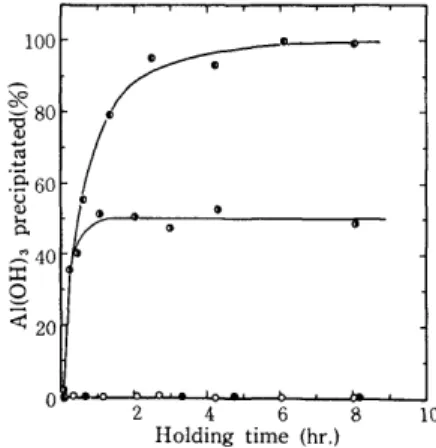
The precipitation recoveries of aluminium hydroxide at various holding times were determined under the following experimental conditions. The conditions were aluminium concentrations of 0.001 and 0.01 M, lactic acid concentrations of 0.06, 0.16 and 0.3 M, sodium concentrations of 0.01 and 0.1 M, pH 7.4 and reaction temperatures of 37 and BO°C. The results are shown in Fig. 4. Under the conditions of 0.01 M aluminium, 0.16 M lactic acid, 0.1 M sodium and reaction temperature of
, .. • -. . .
20
)
20 40 60 80 100 Temperature Cc)
Fig. 3 Effect of reaction temperature on the precipitation of aluminium hydroxide at various concentrations of lactic acid and Na.
[Al]=O.Ol M, pH=7.4, holding time=30 minutes
-.-[lactic acid]=O.OOl M
-()-[lactic acid]=O.Ol M, [Na]=O.l M -Q-[lactic acid]=O.16 M, [Na]=O.l M
100
~.
I
C>
0~~~2~~~4~~~6~~~8~~~10
Holding time (hr.)
Fig. 4 Effect of holding time on the preCIpI- tation of aluminium hydroxide at vari- ous concentrations of AI, lactic acid and Na, and various reaction tempera- tures.
pH=7.4
-Q-[AI]=O.OlM, [lactic acid]=0.16 M, [Na]=O.l M, reaction temp.=37°C -f)-[AI]=O.OOl M, [lactic acid]=0.06 M,
[Na]=O.Ol M, reaction temp.=80°C -()-[AI]=O.Ol M, [lactic acid]=0.16 M,
[Na]=O.l M, reaction temp.=80°C -.-[AI] =0.01 M, [lactic acid] =0.3 M,
[Na]=O.l M, reaction temp.=80°C
37D
e,
the precipitate of aluminium hydroxide was not formed at the holding time of 8 hours. However, when the reaction temperature was risen up to 80De,
the precipitate increased with the holding time, and reached to a saturation value of about 50% after one hour. Furthermore, when the lactic acid concentration increased to 3 M under these conditions, the precipitate was not produced at the hol- ding time up to 8 hours.2. Precipitation Behaviors of Aluminium as Hydroxide and Phosphate in Lactic Acid Solution Coexisting Aluminium, Phosphorus and Sodium Ions
Based on the experimental results obtained in Fig. 1 through Fig. 4, the precipitation recoveries of aluminium and phosphorus as hydroxide and/or phosphate related to various phosphorus concen- trations were determined under the experimental conditions as shown in Fig. 5. The obtained results are shown in Fig. 5. In this figure, AIjP atomic ratios are shown to estimate chemical form of the precipitate. The precipitate containing aluminium and phosphorus was produced under the phosp- horus concentration exceeded 0.002 M in 0.16 M lactic acid solution. When the lactic acid concentration increased to 1 M, the precipitate containing aluminium and phosphorus was observed under the coexistence of phosphorus concentration exceeded 0.012 M. The AI/P atomic ratio of the precipitate decreased as the lactic acid concentration increased, and that of the precipitate in 1 M lactic acid solution was equal to about unity. From these experimental results, as to the chemical forms of the precipitate in the lactic acid solution with low phosphorus concentration, aluminium hydroxide and aluminium phosphate will coprecipitate, and as to one with high phosphorus concentration, aluminium phosphate will be considered. Based on the experimental results described above, the precipitation behaviors of aluminium as hydroxide and/or phosphate related to the concentrations of lactic acid and phosphorus under the experimental conditions of 0.01 M aluminium and 0.1 M sodium is shown in the inset of Fig. 5. If this figure is
prepared for each aluminium concentrat- ion level, it is possible to examine the precipitation behavior of aluminium rela- ted to the phosphorus concentration. It is learned from this figure that the alumin- ium precipitate with hydroxide and/or phosphate is produced at the phosphorus concentration exceeded 0.006 M under the conditions of 0.01 M aluminium and 0.06 M lactic acid.
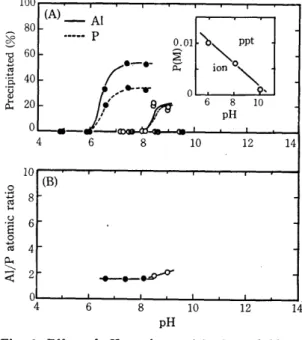
Based on the experimental results obtained from Fig. 5. the precipitation recoveries of aluminium and phosphorus related to various pH values were deter- mined under the experimental conditions as shown in Fig. 6. The results are shown in Fig. 6. The precipitates of aluminium and phosphorus as hydroxide and/or phosphate were not observed at pH 4.5'"'-' 9.5 under the experimental conditions of 0.01 M aluminium, 0.6 M lactic acid and
~ ;0100 2 80 (A) 2 60 '5 'u Q) 40
20 tl.. 1-0
.~ 0 0.02
I"CS 5
1-0 4 (B)
·s
.£ u 3 2~
(3)I"CS (2) ~ (4)
tl..
---
<
0 0.005 0.01 P(M) 0.015 0.02Fig. 5 Effect of P concentration on the preCIpIta- tions of Al and P as hydroxide and/or pho- sphate, and on the AI/P atomic ratio in the precipitate at various lactic acid concentra- tions. The inset shows the precipitation beha- vior of Al as hydroxide and/or phosphate bet- ween lactic acid and P cocentrations under the experimental conditions of 0.01 M Al and 0.1 M Na.
[AIJ=O.Ol M, [NaJ=O.l M, pH=7.4, reaction temp.=37D
e,
holding time=30 minutes (1) [lactic acidJ=0.16 M, (2) [lactic acidJ=0.3 M, (3) [lactic acidJ=0.6 M, (4) [lactic acidJ=1.0 MMIZUMOTO etc: Precipitation Behaviors of Aluminium as Hydroxide and Phosphate in Lactic Acid Solution
0.001 M phosphorus. When the phosphorus concentration increased to 0.006 M, however, the precipitates were observed above pH 8, and when the phosphorus concentration increased further to 0.01 M, the precipitates were also observed above pH 6. The AljP atomic ratio of the precipitate was closely unity in all experimental conditions as shown in the figure. From these experimental results, it is considered that the precipitate containing aluminium and phosphorus produced in these experiments is mainly composed of aluminium phosphate. The precipitation behavior of aluminium as hydroxide and/or phosphate between the pH value and phosphorus concentration is shown in the inset of Fig. 6. Such a figure will be useful for the future experiments as same as Fig. 5.
3. Precipitation Behaviors of Aluminium, Phosphorus and Calcium as Hydroxide and/or Phosphate in Lactic Acid Solution Coexisting Aluminium, Phosphorus, Calcium and Sodium Ions.
The precipitation recoveries of aluminium, phosphorus and calcium as hydroxide and/or phosphate in lactic acid solution under the coexistence of calcium ions in addition to aluminium, phosphorus and sodium ions were determined as functions of calcium concentrations and pH values in the solution.
The precipitation recoveries of aluminium, phosphorus and calcium as hydroxide and/or phosphate related to various calcium concentrations were determined under the experimental conditions as fol- lows. The conditions were 0.01 M alu-
minium, 0.6 M lactic acid, phosphorus concentrations of 0.001, 0.003 and 0.006 M, 0.1 M sodium, reaction temperature of 37°C, holding time of 30 minutes and pH 7.4. The results are shown in Fig. 7.
Under the experimental conditions descr- ibed above in the absence of calcium ions, the precipitate containing aluminium and phosphorus was not observed as shown in Fig. 5. However, when the calcium ions coexisted in the solution, the prec- ipitate containing aluminium, phosphorus and calcium was observed as follows.
Under the experimental conditions of a low phosphorus concentration of 0.001 M, the precipitate was not produced in the presence of calcium ions with 1 X 10⁻⁴ ...
2 X 10⁻¹ M. However, when the phosphorus concentration increased to 0.003 M, the precipitate was produced in the presence of calcium exceeded about 4 X 10⁻³ M.
Futhermore, when the phosphorus conce- ntration exceeded 0.006 M, the precipitate was produced under the calcium concen- tration exceeded about 2x 10⁻³ M, and the precipitation recoveries of aluminium,
100
(A)-AI
~
80 P 0001'0",
ppt"0 ~ 60 ~
(----
2r; ion0",
05. ~ 40
°0 <IJ I-< 20
1
/ /~-. ~
0 6 8 10 9-p..
pH
0'---tf- ~
4 6 8 10 12 14
10 09 ... (B)
CIl 8
l-o
U 6
Os
.B CIl 4p.. ---.
+-e--~
:d3 2 -
0 I
4 6 8 10 12 14
pH
Fig. 6 Effect of pH on the precipitations of Al and P as hydroxide and/or phosphate, and on the AljP atomic ratio in the precipitate at vari- ous P concentrations. The inset shows the precipitation behavior of AI as hydroxide and lor phosphate between P concentration and pH under the experimental conditions of 0.6 M lactic acid, 0.01 M Al and 0.1 M Na.
[AIJ=O.Ol M, [lactic acidJ=0.6 M, [NaJ=O.lM, reaction temp.=37°C, holding time=30 minutes -()-[PJ=O.OOl M, -O-[PJ=0.006 M, -e-[PJ=O.Ol M
26 -
phosphorus and calcium under the calcium concentration of 1 X 10⁻² M were about 60 % (for aluminium and phosphorus) and about 15 % (for calcium), respectively. It is assumed that chemical forms of the precipitate containing aluminium, phosphorus and calcium under these experimental conditions are calcium phosphate in addition to aluminium hydroxide and aluminium phosphate as described pre- viously. Based on these experimental results, the precipitation behavior of aluminium as hydroxide and/or phosphate related to the concentrations of phosphorus and calcium under the conditions of 0.01 M aluminium, 0.6 M lactic acid and 0.1 M sodium is shown in the inset of Fig. 7(C). The following results can be understood from this figure. Under the experimental conditions of 0.01 M
100 80 (A) Al
60
....
40
/.-'
20 0"
Q 10-4 10-3 10-2 10-1 100
~
80 (B) P ~/'0 60
~
•
I
til 40
's. ...
/
'u (J) 20
""
p.. Q
10-4 10-3 10-2 10-1 100
80 (C) Ca
60
~OlEQ
0.. '
40 IOn
0 0,005
20 Ca(M)
010-4 10-2 10-1 Ca (M)
Fig. 7 Effect of Ca concentration on the preci- pitations of AI, P and Ca as hydroxide and/or phosphate at various P concent- rations. The inset shows the precipita- tion behavior of Al as hydroxide and/
or phosphate related to the concentra- tions of P and Ca under the experimen- tal conditions of 0.01 MAl, 0.6 M lactic acid and 0.1 M Na.
[AIJ=O.Ol M, [lactic acidJ=0.6 M, [NaJ=O.l M, pH=7.4, reaction temp. = 37° C, holding time=30 minutes
-()-[PJ=O.OOl M, -Q-[PJ=0.003 M, -.-[PJ=0.006 M
100 80 (A) Al 60
40 20 0
7 8 9 10
100
~
80 (B) P~ Q)
...., 60
CI:S
....,
'a
40'0 Q)
20
10-<
~ 0
7 8 9 10
100
80 (C) Ca 60
40 20 0
7 8 10
pH
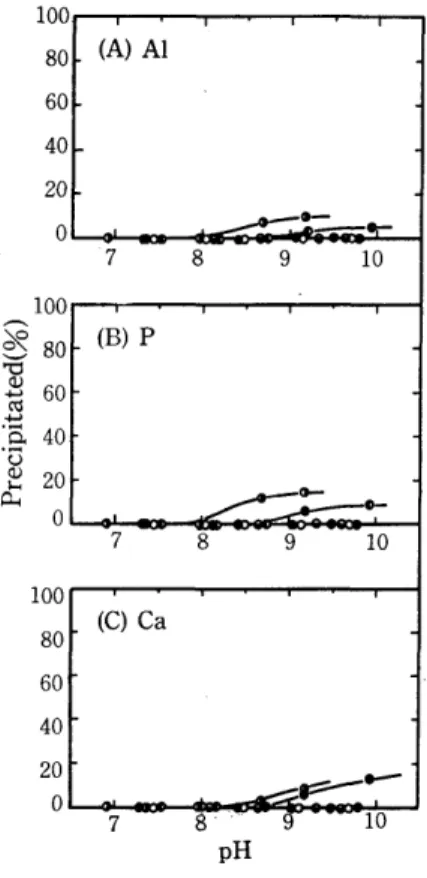
Fig. 8 Effect of pH on the precIpitations of AI, P and Ca as hydroxide and/or pho- sphate at various concentrations of lac- tic acid, N a and Ca.
[AIJ=O.Ol M, [PJ=O.OOl M, reaction temp.
=37°C, holding time=30 minutes -Q-[lactic acidJ=0.6 M, [NaJ=O.l M,
[CaJ=O.0005 M
-.-[lactic acidJ=0.6 M, [NaJ=O.l M, [CaJ=O.OOl M
-()-[lactic acidJ=O.6 M, [NaJ=O.l M, [CaJ=O.Ol M
-()-[lactic acidJ=0.6 M, [NaJ=1.0 M, [CaJ=O.Ol M
-~-[lactic acidJ=1.0 M, [NaJ=O.l M, [Ca] =0.005 M
MIZUMOTO etc: Precipitation Behaviors of Aluminium as Hydroxide and Phosphate in Lactic Acid Solution
aluminium, 0.6 M lactic acid and 0.1 M sodium, if the phosphorus concentration in the lactic acid solution is 0.005 M, the aluminium precipitate is not produced under the calcium concentration below about 0.002 M.
The precipitation recoveries of aluminium, phosphorus and calcium as hydroxide and/or phosphate related to various pH values were determined under the conditions as follows. The conditions were 0.01 M aluminium, lactic acid concentrations of 0.0005, 0.005, 0.001 and 0.01 M, sodium concentra- tions of 0.1 and 1.0 M, reaction remperature of 37°C and holding time of 30 minutes. The results are shown in Fig. 8. Under these conditions in the absence of calcium ions, the precipitate containing aluminium and phosphorus was not produced as shown in Fig. 6. However, when the calcium ions presented in the lactic acid solution, the precipitate containing calcium in addition to alumininium and phosphorus was produced as follows. Under the condition of a low calcium concentration below 0.005 M, the precipitate containing aluminium, phosphorus and calcium was not produced in the lactic acid solution with pH 7--....10. However, when the calcium concentration increased to 0.01 M, the precipitate was produced above pH 8.
IV. SUMMARY
The experimental results in this paper are summarised as follows. Under the lactic acid solution in the presence of aluminium and sodium ions, aluminium hydroxide was not observed in the conditions of the concentrations of 0.01 M aluminium and of lactic acid exceeded 0.16 M, pH 3--....9, holding time below 8 hours and reaction temperatures of 20--....60°C.
In the lactic acid solution containing aluminium, phosphorus and sodium ions, the precipitate containing aluminium tended to produce as compared to that in the absence of phosphorus ions. In order to prevent the formation of aluminium hydroxide and/or aluminium phosphate, therefore, it is necessary to further increase the lactic acid concentration. Under the experimental condition in the presence of phosphorus ions, the formation of aluminium phosphate become also a problem in addition to aluminium hydroxide.
In the lactic acid solution coexisting calcium ions in addition to phosphorus ions, the precipitate containing aluminium was produced easily as compared to that in absence of calcium ions. In order to prevent the precipitation, the lactic acid solution of the higher concentration may be necessary.
The chemical forms of the precipitate containing aluminium, phosphorus and calcium are assumed to be a mixture of aluminium hydroxide, aluminium phosphate and calcium phosphate.
ACKNOWLEDGMENT
This experiments have been performed mainly at Hot Laboratory in Research Reactor Institute of Kyoto University. The authors would like to express sincere gratitude to the members of Hot Laboratory for their great help during the experiments.
The authors also thank to Assistant Professor O. Horibe and the members of Department of Nuclear Reactor Engineering of Kinki University for their heartry supports during this work.
-REFERENCES-
1) IWATA, S., et al.: Ann. Rep. Res. Reactor Inst. Kyoto Univ., 12, 33 (1979).
2) MARTELL, A. E. (Ed.): "Stability Constants of Metal-Ion Complexes", Sp. Public., London, 17 (1964) and 25 (1971).
- 28-