福島県立医科大学 学術機関リポジトリ
This document is downloaded at: 2021-11-08T00:27:36Z
Title Soluble Receptor for Advanced Glycation End Products (RAGE) is a Prognostic Factor for Heart Failure
Author(s) Koyama, Yo; Takeishi, Yasuchika; Niizeki, Takeshi; Suzuki, Satoshi; Kitahara, Tatsuro; Sasaki, Toshiki; Kubota, Isao
Citation Journal of Cardiac Failure. 14(2): 133-139
Issue Date 2008-03
URL http://ir.fmu.ac.jp/dspace/handle/123456789/122
Rights Copyright © 2008 Elsevier Inc. All rights reserved.
DOI 10.1016/j.cardfail.2007.10.019
Text Version author
JCF Ms#071906R2
Soluble Receptor for Advanced Glycation End Products (RAGE) is a Prognostic Factor for Heart Failure
Yo Koyama, MD, Yasuchika Takeishi, MD, Takeshi Niizeki, MD, Satoshi Suzuki, MD, Tatsuro Kitahara, MD, Toshiki Sasaki, MD, and Isao Kubota, MD.
Department of Cardiology, Pulmonology, and Nephrology, Yamagata University School of Medicine, Yamagata, Japan
Running head: soluble RAGE in heart failure
This study was supported in part by a grant-in-aid for Scientific Research (No. 19590804) from the Ministry of Education, Science, Sports and Culture, Tokyo, Japan, a grant-in-aid from the 21st Century Center of Excellence (COE) program of the Japan Society for the Promotion of Science, Tokyo, Japan and grants from Takeda Science Foundation, Osaka, Japan and Fukuda Foundation for Medical Technology, Tokyo, Japan. There was no conflict of interest in this study.
Address for reprints: Yasuchika Takeishi, MD
Department of Cardiology, Pulmonology, and Nephrology Yamagata University School of Medicine
2-2-2 Iida-Nishi, Yamagata, Japan 990-9585 E-mail: [email protected]
Phone: +81-23-628-5302 Fax: +81-23-628-5305
ABSTRACT
Background: We recently reported that serum levels of pentosidine, one of the well defined
advanced glycation end products (AGE), was an independent prognostic factor for heart failure. Receptor for AGEs (RAGE) is expressed in a variety of tissues, and RAGE has a C-truncated secretory isoform of the receptor protein, termed soluble RAGE. In the present study, we measured serum soluble RAGE levels in patients and examined whether serum soluble RAGE predicts prognosis in patients with heart failure.
Methods and Results: Serum soluble RAGE concentration was measured in 160 patients
with heart failure by a competitive enzyme-linked immunosorbent assay. Patients were prospectively followed during a median follow-up period of 872 days with endpoints of cardiac death or re-hospitalization. Serum soluble RAGE level increased with advancing NYHA functional class. Serum soluble RAGE level was also higher in patients with cardiac events than in event free patients. From the receiver operating characteristic (ROC) curve analysis, the cut-off value of serum soluble RAGE level was determined as 1220 pg/ml.
Kaplan-Meier analysis clearly demonstrated that the high soluble RAGE group had a significantly higher incidence of cardiac events than occurred in the low serum soluble RAGE group (P = 0.0004). In the multivariate Cox proportional hazard analysis, soluble RAGE
and serum pentosidine were independent risk factors for cardiac events (soluble RAGE: HR 1.90, 95% CI 1.16 – 3.09, P = 0.010; pentosidine: HR 1.59, 95% CI 1.11 – 2.29, P = 0.012).
Conclusions: Serum soluble RAGE level is an independent prognostic factor for heart failure, and this novel marker may be useful for risk stratification of patients with heart failure.
Key words: advanced glycation end products (AGE), receptor for AGE (RAGE), soluble RAGE, heart failure, prognosis
INTRODUCTION
Congestive heart failure is an important cause of morbidity and mortality. In patients with heart failure, excess free-radical generation may arise from many sources [1].
Markers of oxidative stress such as thiobarbituric acid reactive substances and 8-isoprostaglandin F2-α are elevated in the blood and pericardial fluid, and levels of these markers correlate with the functional severity of heart failure [2, 3]. Advanced glycation end products (AGE) are generated nonenzymatically by glycation and oxidation of proteins [4].
Receptor for AGEs (RAGE) is expressed in a variety of tissues including endothelial cells, vascular smooth cells and cardiac myocytes [5, 6]. It has been reported that interaction of AGE with RAGE causes activation of intracellular signaling, gene expression, production of pro-inflammatory cytokines and free radicals [7, 8]. We have recently reported that serum levels of pentosidine, one of the well defined AGE, is associated with the severity of heart failure and an independent prognostic factor for heart failure [9].
RAGE has a C-truncated secretory isoform of the receptor protein, termed soluble RAGE that may neutralize the AGEs-mediated damage by acting as a decoy [10-12]. In animal experiment, administration of soluble RAGE results in significantly decreased neointimal expansion after arterial injury and decreases smooth muscle cell proliferation,
migration, and expression of extracellular matrix proteins [13]. However, serum soluble RAGE has not been previously examined in patients with heart failure, and the clinical significance is still unclear [14, 15]. In the present study, we measured serum soluble RAGE levels in patients with heart failure and examined whether levels of serum soluble RAGE are related to the disease severity and prognosis of patients with heart failure.
METHODS
Study subjects
We measured serum concentration of soluble RAGE in 160 patients (95 male and 65 female, mean age 69 ± 12 years) admitted to the Yamagata University Hospital for the treatment of worsening heart failure or for diagnosis and pathophysiological investigations of heart failure or for therapeutic evaluation of heart failure. Some of the patients were overlapped with a previous study from our institution [9]. The diagnosis of heart failure was based on a history of dyspnea and symptomatic exercise intolerance with signs of pulmonary congestion or peripheral edema or documentation of left ventricular enlargement or dysfunction by chest X-ray, echocardiography or left ventriculography [16]. We excluded patients with acute coronary syndrome occurring within the 3 months preceding admission, inflammatory disease, autoimmune disease, malignant disease and renal dysfunction (creatinine > 2 mg/dl). Written informed consent was obtained from all patients, and the study protocol was approved by Institutional Review Board on human research.
The etiologies of heart failure were identified as dilated cardiomyopathy in 47 patients (29%), ischemic heart failure in 42 patients (26%), valvular heart disease in 35 patients (22%), tachycardia-induced heart failure in 17 patients (11%), hypertensive heart
disease in 16 patients (10%) and hypertrophic cardiomyopathy in 3 patients (2%). Severity of New York Heart Association (NYHA) class was assessed by independent proficient cardiologists at initial inclusion in the study. There were 33 (21%), 63 (39%), 51 (32%) and 13 patients (8%) with NYHA class I, II, III and IV, respectively.
Hypertension, diabetes mellitus, hyperlipidemia and current smoking were identified in 87 (54%), 39 (24%), 32 (20%) and 36 (23%) patients, respectively. Hypertension was defined as elevated systolic blood pressure ≥ 140 mmHg, diastolic blood pressure ≥ 90 mmHg, or when patients had taken antihypertensive drugs. Diabetes mellitus was defined as an increased fasting plasma glucose concentration of >126 mg/dL, glycosylated hemoglobin of
>6.5%, or when patients undergo treatment with insulin or hypoglycemic agents.
Hyperlipidemia was defined by total cholesterol ≥ 220 mg/dl, triglyceride ≥ 150 mg/dl, high density lipoprotein < 40 mg/dl, or current use of antihyperlipidemia drugs. Current smoking was defined by self-report.
Echocardiographic studies
We performed conventional two-dimensional echocardiographic studies using standard techniques. Left ventricular end-diastolic volume (LVEDV) and left ventricular ejection fraction (EF) was calculated based on Simpson’s rule.
Measurements of soluble RAGE and pentosidine
The serum soluble RAGE concentration in patients with heart failure were measured using a commercially available enzyme-linked immunosorbent assay kit (Quantikine, R&D systems, Minneapolis, MN, USA) in duplicate according to the manufacturer’s protocol.
Serum pentosidine level was measured as reported previously [9].
End-points and follow-up
Median follow-up period was 872 days (range 17 to 1095 days). Events were centrally adjudicated using medical records, autopsy reports, death certificates, and witness statements. The endpoints, which were judged independently by researchers, were (1) cardiac death, defined as death from worsening heart failure or sudden cardiac death, and (2) re-hospitalization with worsening heart failure [16, 17]. Sudden cardiac death was defined as death without definite premonitory symptoms or signs and was established by the attending physician. Patients were contacted after the initial presentation by telephone interview performed by trained researchers.
Statistical analysis
Soluble RAGE, pentosidine and BNP are reported as median and interquartile
range. Other values are expressed as mean ± SD. A P value less than 0.05 was considered statistically significant. Significance between two groups was determined by Mann-Whitney test for continuous variables and chi-square test for discrete variables. The Cox proportional hazard regression model was used to determine which variables were associated with cardiac events. The variables with P values less than 0.05 in the univariate Cox regression analysis were entered into the multivariate Cox regression analysis.
Kaplan-Meier survival analysis was used to compare cardiac event free rates among two groups stratified by levels of serum soluble RAGE concentration and analyzed by a log-rank test. All analyses were performed using a Stat View statistical software package (version 5.0, SAS Institute Inc.).
RESULTS
In baseline clinical characteristics of study subjects, serum creatine was 0.88±0.28 mg/dl, serum pentosidine was 32.0 (22.8-44.8) ng/ml, and plasma BNP was 305 (68-741) pg/ml. LVEDV was 149±57 ml, and EF was 48±19%. Median serum soluble RAGE level was 1066 pg/ml and interquartile range was 669-1733 pg/ml. As shown in Figure 1, serum soluble RAGE level was increased with advancing NYHA functional class [class I: 659 (480-1022); class II: 1108 (668-1626); class III: 1372 (842-2422); class IV: 1363 (1015-2634) pg/ml, P <0.0001].
Serum soluble RAGE levels were not different between patients with and without diabetes mellitus (1113 (685-1749) vs. 1028 (667-1729) pg/ml, P = 0.943), hypertension (1113 (715-1664) vs. 1021 (68-1768) pg/m, P = 0.774) and hyperlipidemia (1074 (659-1787) vs. 1066 (669-1733) pg/ml, P = 0.998).
During follow-up periods (median 872 days, range 17 – 1095 days), there were 48 cardiac events including 11 cardiac deaths and 37 re-hospitalizations due to worsening of heart failure. Table 1 shows comparisons of clinical characteristics between patients with cardiac events and event free patients. Patients with cardiac events were older (P = 0.044) and had more severe NYHA functional class (P < 0.0001) than event free patients. Serum
soluble RAGE level, plasma BNP level, serum pentosidine level and LVEDV were significantly higher in patients with cardiac events than event free patients.
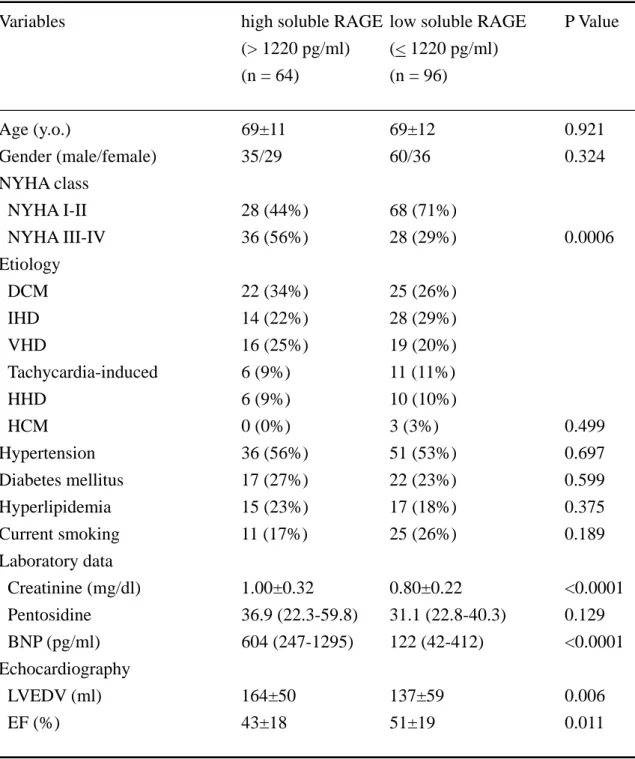
We examined receiver operating characteristic (ROC) curve analysis and determined the cut-off value of serum soluble RAGE levels to predict cardiac events. As shown in Figure 2, the cut-off value of serum soluble RAGE was 1220 pg/ml (sensitivity 0.60 and specificity 0.69). Next, patients with heart failure were divided into two groups based on the cut off value of serum soluble RAGE level (1220 pg/ml). High and low soluble RAGE level groups included 64 and 96 patients, respectively. Comparisons of clinical characteristics between two groups are shown in Table 2. In high soluble RAGE level group, NYHA functional class was more severe (P = 0.0006). In high soluble RAGE group, BNP was higher and EF was lower than in low soluble RAGE group. Age, gender, etiology of heart failure, prevalence of hypertension, diabetes mellitus and hyperlipidemia were not different between two groups. Use of β-blockers and loop diuretics was significantly higher in high soluble RAGE group than in low soluble RAGE group. During follow-up periods, cardiac events were more frequently occurred in high soluble RAGE group than in low soluble RAGE group (45% vs. 20%, P = 0.0006). Positive and negative predictive values of our determined cut-off value were 0.45 and 0.80, respectively. As shown in Figure 3, Kaplan-Meier analysis clearly demonstrated that the high soluble RAGE group had a significantly higher
incidence of cardiac events than occurred in the low serum soluble RAGE group (P = 0.0004 by a log-rank test).
We evaluated correlation between soluble RAGE level and BNP, EF and pentosidine by linear regression analyses (Figure 4). Log (soluble RAGE) was significantly and positively correlated with log (BNP) (R = 0.48, P < 0.0001, Figure 4a). Furthermore, log (soluble RAGE) was negatively correlated with EF (R = -0.25, P = 0.003, Figure 4b).
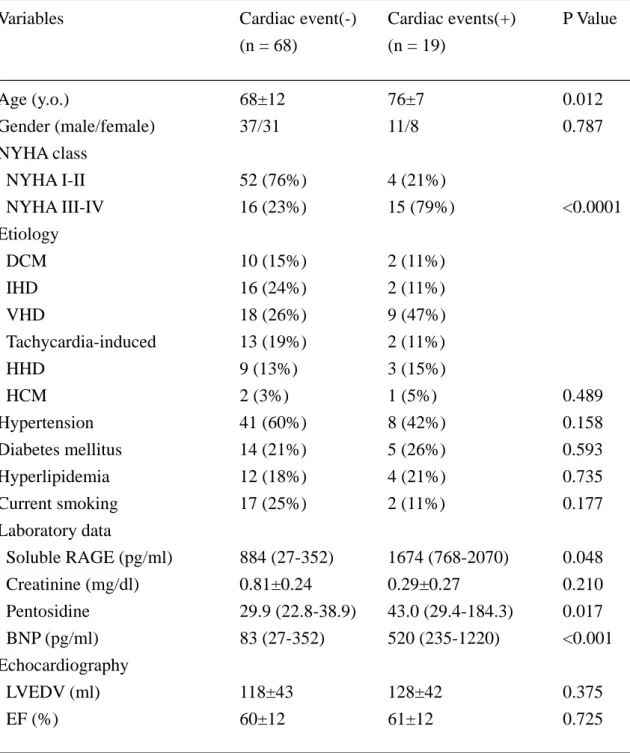
There were 87 patients with preserved EF (EF > 40%). In patients with preserved EF group, 19 patients had cardiac events. Clinical characteristics of patients with cardiac events and event free patients with preserved EF are shown in Table 3. Soluble RAGE, BNP and pentosidine were higher in patients with cardiac events than event free patients in preserved EF group.
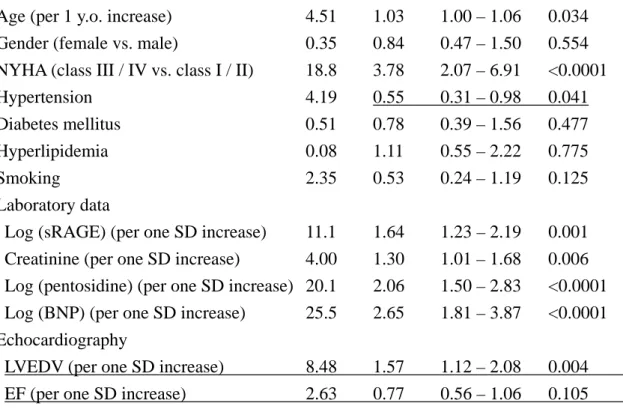
To determine risk factors for cardiac events, we examined the univariate Cox proportional hazard regression analysis (Table 4). Serum soluble RAGE, plasma BNP and serum pentosidine were entered as log transformed continuous variables. In the univariate analysis, log (soluble RAGE) was significantly associated with cardiac events (hazard ratio [HR] 1.64, 95% confidence interval [95% CI] 1.23 – 2.19, P = 0.001). Furthermore, age, NYHA functional class, hypertension, creatinine, log (BNP), log (pentosidine) and LVEDV were significantly associated with cardiac events as shown in Table 4.
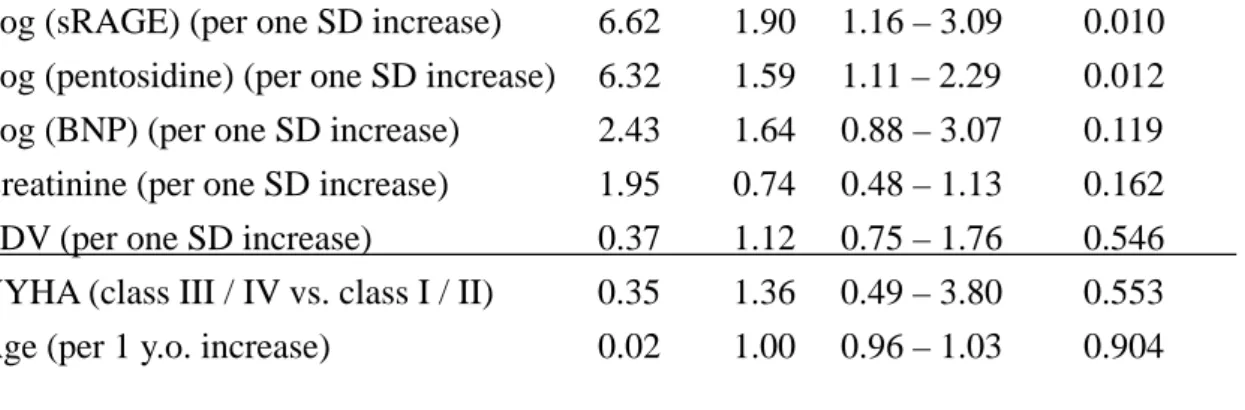
Then, those variables with P value of less than 0.05 in the univariate analysis were entered into the multivariate Cox proportional hazard regression analysis. As shown Table 5, soluble RAGE and pentosidine were independent predictors for cardiac events in patients with heart failure (soluble RAGE: HR 1.90, 95% CI 1.16 – 3.09, P = 0.010 and pentosidine: HR 1.59, 95% CI 1.11 – 2.29, P = 0.012).
DISCUSSION
In the present study, we showed that serum soluble RAGE level increased with advancing NYHA functional class. Serum soluble RAGE level was also higher in patients with cardiac events than in those without cardiac events. Patients with high soluble RAGE levels had higher cardiac event rates than those with low soluble RAGE levels. The multivariate Cox proportional hazard analysis demonstrated that serum soluble RAGE and pentosidine were independent prognostic factors for heart failure. Since BNP has been widely accepted as a marker of prognosis in patients with heart failure, it is noteworthy that only soluble RAGE and pentosidine, but not BNP, were independent factors to predict prognosis of heart failure in the present study.
Activation of RAGE by AGEs induces activation of NADPH oxidase and production of reactive oxygen species [18]. Interaction of AGE with RAGE causes oxidative stress and activation of nuclear factor (NF)-κB via p21ras and the mitogen activated protein (MAP) kinase signaling pathway [19]. NF-κB modulates gene transcription and generates pro-inflammatory cytokines such as interleukin (IL)-1, IL-6, and tumor necrosis factor (TNF)-α [20].
It has been reported that angiotensin II up-regurates RAGE mRNA levels in
endothelial cells, and administration of telmisartan decreases serum soluble RAGE levels in patients with essential hypertension [21]. Although carvedilol, one of β-blockers, has antioxidant activity [22], the effects of β-blocker on AGE-RAGE signaling have not been previously examined. In the present study, the use of β-blockers and loop diuretics was significantly higher in high soluble RAGE group than in low soluble RAGE group. The percentages of patients given ACE inhibitors and/or ARBs were not statistically different between high soluble RAGE group and low soluble RAGE group. Effects of pharmacotherapy on serum soluble RAGE levels should be further examined.
In the present study, we found that soluble RAGE was increased in patients with cardiac events in heart failure patients with preserved EF (Table 3). Little et.al.
demonstrated that treatment with algebrium chloride (ALT-711), AGE cross-link breaker, decreased left ventricular mass and improved left ventricular diastolic filling and quality of life in patients with diastolic heart failure [23]. In a previous study, we reported that serum pentosidine levels were increased in patients with cardiac events and preserved EF [9].
Taken together, these data may suggest that the AGE-RAGE system is at least partially contributed to diastolic heart failure.
Sugiyama et al. reported that plasma pentosidine level was significantly influenced by the quality of glycemic control and renal function [24]. In our present study, patients
with renal dysfunction (creatinine > 2 mg/dl) were excluded, and patients with diabetes mellitus were only 24%. Heidland et al. reported that Nε−carboxymethyl lysine (CML) and AGE associated fluorescence (AGE-Fl) were decreased in patients with heart failure, and increased after heart transplantation [25]. In contrast to this report, we previously demonstrated that serum petosidine levels were increased in patients with NYHA class III/IV, and pentosidine was an independent prognostic factor for heart failure [9]. Furthermore, we showed in the present study that serum soluble RAGE level increased with advancing NYHA functional class and soluble RAGE was a prognostic factor for heart failure. These data may suggest that the AGE-RAGE system is included as one of subcellular mechanisms of heart failure.
To date clinical significance of serum soluble RAGE level is still controversial.
Falcone et al. have reported that low plasma soluble RAGE level is associated with the presence of coronary artery disease in nondiabetic men [14]. However, Nakamura et al.
have reported that serum soluble RAGE levels are significantly higher in type 2 diabetic patients than in non-diabetic subjects and positively associated with the presence of coronary artery disease [15]. It has been reported that RAGE mRNA is up-regulated by the AGEs themselves, TNF-α and 17β-estradiol in human vascular endothelial cells [26]. Furthermore, soluble RAGE is generated from the cleavage of cell surface RAGE by the actions of matrix
metalloproteinases [27, 28]. Currently, two types of enzyme-linked immunosorbent assays are available to measure circulating RAGE. One immunoassay system [29, 20] is to specifically measure endogenous secretory RAGE. The other assay that we and others [14, 15, 31] used is to quantify total soluble RAGE detecting not only native secretory RAGE but also other soluble forms resulted from the cleavage of cell surface receptor by matrix metalloproteinase. It has been reported that matrix metalloproteinase activity was increased in patients with heart failure [32, 33]. Yamagishi et al. have demonstrated that serum soluble RAGE levels are positively associated with circulating AGEs levels in non diabetic general population [31]. We have recently reported that serum levels of pentosidine, one of well defined AGE, is associated with the severity of heart failure [9]. In human cardiac auricles, RAGE protein expression is positively correlated with cardiac dysfunction [34]. In the present study, we demonstrated that serum soluble RAGE level was associated with NYHA functional class severity. We speculate that increased levels of AGEs induced by excessive oxidative stress and inflammation cause up-regulation of RAGE expression and increase circulating serum soluble RAGE resulted from the cleavage of cell surface receptor by matrix metalloproteinase in patients with heart failure.
There are some limitations in the present study. First, it has been reported that some genetic polymorphism exist in the RAGE gene [35]. Jang et al. have investigated the
association between the Gly82Ser (G82S) polymorphism in the RAGE gene and circulating levels of soluble RAGE in 1676 nondiabetic and nonobese Korean subjects. In this study, gene distribution was homozygous for the G allele (G/G) were 1180 subjects, heterozygous for the S allele (G/S) were 449 subjects, and homozygous for the S allele (S/S) were 47 subjects. Plasma soluble RAGE levels were significantly higher in subjects with G/G genotype (1038 + 33 pg/ml) than in those with G/S (809 + 19) and the S/S (428 + 43 pg/ml) genotype [36]. Although the distribution of RAGE G82S genotype is still unknown in Japanese population, polymorphism might affect on serum soluble RAGE levels in our study population. Second, the use of angiotensin-converting enzyme inhibitors/angiotensin II receptor blockers and β-blockers was relatively low in this study. These were data at admission, and there are some reasons for this low rate; (1) many patients were referred to our hospital for admission from general physicians, who were unfamiliar with recent advancement in pharmacotherapy for heart failure including β-blockers, (2) heart failure patients with the first decompensation were included in study population, (3) many of study subjects had preserved left ventricular systolic function (LVEF > 40%) in the present study, and (4) numbers of patients with ischemic heart failure were relatively low (26%) in this study population compared to Western countries. However at discharge, angiotensin-converting enzyme inhibitors/angiotensin II receptor blockers and β-blockers
were given in 92% and 67% of patients, respectively. Third, in our study population, mean LVEF was high (48±19%). Dilated cardiomyopathy and ischemic heart disease were only 47 patients (29%) and 42 patients (26%), respectively. It is possible that since percentages of dilated cardiomyopathy and ischemic heart disease were low compared to previous studies, the mean LVEF was relatively high in the present study.
Conclusions
Serum soluble RAGE level is related to the severity of heart failure and is an independent predictor for heart failure. Soluble RAGE may be a novel marker for risk stratification of patients with heart failure.
REFERENCES
1. Mak S, Newton GE. The oxidative stress hypothesis of congestive heart failure: radical thoughts. Chest. 2001; 120: 2035-2046.
2. Belch JJ, Bridges AB, Scott N, Chopra M. Oxygen free radicals and congestive heart failure. Br Heart J. 1991; 65: 245-248.
3. Mallat Z, Philip I, Lebret M, Chatel D, Maclouf J, Tedgui A. Elevated levels of
8-iso-prostaglandin F2alpha in pericardial fluid of patients with heart failure: a potential role for in vivo oxidant stress in ventricular dilatation and progression to heart failure. Circulation.
1998; 97: 1536-1539.
4. Ahmed N. Advanced glycation endproducts--role in pathology of diabetic complications.
Diabetes Res Clin Pract. 2005; 67: 3-21.
5. Neeper M, Schmidt AM, Brett J, Yan SD, Wang F, Pan YC, Elliston K, Stern D, Shaw A.
Cloning and expression of a cell surface receptor for advanced glycosylation end products of proteins. J Biol Chem. 1992; 267: 14998-15004.
6. Brett J, Schmidt AM, Yan SD, Zou YS, Weidman E, Pinsky D, Nowygrod R, Neeper M, Przysiecki C, Shaw A, et al. Survey of the distribution of a newly characterized receptor for advanced glycation end products in tissues. Am J Pathol. 1993; 143: 1699-1712.
7. Wautier JL, Schmidt AM. Protein glycation: a firm link to endothelial cell dysfunction. Circ Res. 2004; 95: 233-8.
8. Goldin A, Beckman JA, Schmidt AM, Creager MA. Advanced glycation end products:
sparking the development of diabetic vascular injury. Circulation. 2006; 114: 597-605.
9. Koyama Y, Takeishi Y, Arimoto T, Niizeki T, Shishido T, Takahashi H, Nozaki N, Hirono O, Tsunoda Y, Nitobe J, Watanabe T, Kubota I. High Serum Level of Pentosidine, an Advanced Glycation End Product (AGE), is a Risk Factor of Patients with Heart Failure. J Card Fail.
2007; 13: 199-206.
10. Malherbe P, Richards JG, Gaillard H, Thompson A, Diener C, Schuler A, Huber G.. cDNA cloning of a novel secreted isoform of the human receptor for advanced glycation end products and characterization of cells co-expressing cell-surface scavenger receptors and Swedish mutant amyloid precursor protein. Brain Res Mol Brain Res. 1999; 71: 159-170.
11. Yonekura H, Yamamoto Y, Sakurai S, Petrova RG, Abedin MJ, Li H, Yasui K, Takeuchi M, Makita Z, Takasawa S, Okamoto H, Watanabe T, Yamamoto H. Novel splice variants of the receptor for advanced glycation end-products expressed in human vascular endothelial cells and pericytes, and their putative roles in diabetes-induced vascular injury. Biochem J. 2003;
370: 1097-1109.
12. Park IH, Yeon SI, Youn JH, Choi JE, Sasaki N, Choi IH, Shin JS. Expression of a novel
secreted splice variant of the receptor for advanced glycation end products (RAGE) in human brain astrocytes and peripheral blood mononuclear cells. Mol Immunol. 2004; 40: 1203-1211.
13. Sakaguchi T, Yan SF, Yan SD, Belov D, Rong LL, Sousa M, Andrassy M, Marso SP, Duda S, Arnold B, Liliensiek B, Nawroth PP, Stern DM, Schmidt AM, Naka Y. Central role of RAGE-dependent neointimal expansion in arterial restenosis. J Clin Invest. 2003; 111:
959-972.
14. Falcone C, Emanuele E, D'Angelo A, Buzzi MP, Belvito C, Cuccia M, Geroldi D. Plasma levels of soluble receptor for advanced glycation end products and coronary artery disease in nondiabetic men. Arterioscler Thromb Vasc Biol. 2005; 25: 1032-1037.
15. Nakamura K, Yamagishi SI, Adachi H, Kurita-Nakamura Y, Matsui T, Yoshida T, Sato A, Imaizumi T. Elevation of soluble form of receptor for advanced glycation end products (sRAGE) in diabetic subjects with coronary artery disease. Diabetes Metab Res Rev. 2006 Oct 6; [Epub ahead of print]
16. Arimoto T, Takeishi Y, Shiga R, Fukui A, Tachibana H, Nozaki N, Hirono O, Nitobe J, Miyamoto T, Hoit BD, Kubota I. Prognostic value of elevated circulating heart-type fatty acid binding protein in patients with congestive heart failure. J Card Fail. 2005; 11: 56-60.
17. Arimoto T, Takeishi Y, Niizeki T, Takabatake N, Okuyama H, Fukui A, Tachibana H, Nozaki N, Hirono O, Tsunoda Y, Miyashita T, Shishido T, Takahashi H, Koyama Y, Kubota I.
Cystatin C, a novel measure of renal function, is an independent predictor of cardiac events in patients with heart failure. J Card Fail. 2005; 11: 595-601.
18. Wautier MP, Chappey O, Corda S, Stern DM, Schmidt AM, Wautier JL. Activation of NADPH oxidase by AGE links oxidant stress to altered gene expression via RAGE. Am J Physiol Endocrinol Metab. 2001; 280: E685-694.
19. Yan SD, Schmidt AM, Anderson GM, Zhang J, Brett J, Zou YS, Pinsky D, Stern D.
Enhanced cellular oxidant stress by the interaction of advanced glycation end products with their receptors/binding proteins. J Biol Chem. 1994; 269: 9889-9897.
20. Neumann A, Schinzel R, Palm D, Riederer P, Munch G. High molecular weight hyaluronic acid inhibits advanced glycation endproduct-induced NF-kappaB activation and cytokine expression. FEBS Lett. 1999; 453: 283-287.
21. Nakamura K, Yamagishi S, Nakamura Y, Takenaka K, Matsui T, Jinnouchi Y, Imaizumi T.
Telmisartan inhibits expression of a receptor for advanced glycation end products (RAGE) in angiotensin-II-exposed endothelial cells and decreases serum levels of soluble RAGE in patients with essential hypertension. Microvasc Res. 2005; 70: 137-141.
22. Dandona P, Ghanim H, Brooks DP. Antioxidant activity of carvedilol in cardiovascular disease. J Hypertens. 2007; 25: 731-741.
23. Little WC, Zile MR, Kitzman DW, Hundley WG, O'Brien TX, Degroof RC. The effect of
alagebrium chloride (ALT-711), a novel glucose cross-link breaker, in the treatment of elderly patients with diastolic heart failure. J Card Fail. 2005; 11: 191-195.
24. Sugiyama S, Miyata T, Ueda Y, Tanaka H, Maeda K, Kawashima S, Van Ypersele de Strihou C, Kurokawa K. Plasma levels of pentosidine in diabetic patients: an advanced glycation end product. J Am Soc Nephrol. 1998; 9: 1681-1688.
25. Heidland A, Sebekova K, Frangiosa A, De Santo LS, Cirillo M, Rossi F, Cotrufo M, Perna A, Klassen A, Schinzel R, De Santo NG. Paradox of circulating advanced glycation end product concentrations in patients with congestive heart failure and after heart transplantation.
Heart. 2004; 90: 1269-1274.
26. Tanaka N, Yonekura H, Yamagishi S, Fujimori H, Yamamoto Y, Yamamoto H. The receptor for advanced glycation end products is induced by the glycation products themselves and tumor necrosis factor-alpha through nuclear factor-kappa B, and by 17beta-estradiol through Sp-1 in human vascular endothelial cells. J Biol Chem. 2000; 275: 25781-25790.
27. Hudson BI, Harja E, Moser B, Schmidt AM. Soluble levels of receptor for advanced glycation endproducts (sRAGE) and coronary artery disease: the next C-reactive protein?
Arterioscler Thromb Vasc Biol. 2005; 25: 879-882.
28. Hanford LE, Enghild JJ, Valnickova Z, Petersen SV, Schaefer LM, Schaefer TM, Reinhart TA, Oury TD. Purification and characterization of mouse soluble receptor for advanced
glycation end products (sRAGE). J Biol Chem. 2004; 279: 50019-50024.
29. Koyama H, Shoji T, Yokoyama H, Motoyama K, Mori K, Fukumoto S, Emoto M, Shoji T, Tamei H, Matsuki H, Sakurai S, Yamamoto Y, Yonekura H, Watanabe T, Yamamoto H, Nishizawa Y. Plasma level of endogenous secretory RAGE is associated with components of the metabolic syndrome and atherosclerosis. Arterioscler Thromb Vasc Biol. 2005; 25:
2587-2593.
30. Katakami N, Matsuhisa M, Kaneto H, Matsuoka TA, Sakamoto K, Nakatani Y, Ohtoshi K, Hayaishi-Okano R, Kosugi K, Hori M, Yamasaki Y. Decreased endogenous secretory advanced glycation end product receptor in type 1 diabetic patients: its possible association with diabetic vascular complications. Diabetes Care. 2005; 28: 2716-2721.
31. Yamagishi S, Adachi H, Nakamura K, Matsui T, Jinnouchi Y, Takenaka K, Takeuchi M, Enomoto M, Furuki K, Hino A, Shigeto Y, Imaizumi T. Positive association between serum levels of advanced glycation end products and the soluble form of receptor for advanced glycation end products in nondiabetic subjects. Metabolism. 2006; 55: 1227-1231.
32. Thomas CV, Coker ML, Zellner JL, Handy JR, Crumbley AJ 3rd, Spinale FG. Increased matrix metalloproteinase activity and selective upregulation in LV myocardium from patients with end-stage dilated cardiomyopathy. Circulation. 1998; 97: 1708-1715.
33. Spinale FG, Coker ML, Heung LJ, Bond BR, Gunasinghe HR, Etoh T, Goldberg AT,
Zellner JL, Crumbley AJ. A matrix metalloproteinase induction/activation system exists in the human left ventricular myocardium and is upregulated in heart failure. Circulation. 2000; 102:
1944-1949.
34. Simm A, Casselmann C, Schubert A, Hofmann S, Reimann A, Silber RE. Age associated changes of AGE-receptor expression: RAGE upregulation is associated with human heart dysfunction. Exp Gerontol. 2004; 39: 407-413.
35. Hudson BI, Stickland MH, Grant PJ. Identification of polymorphisms in the receptor for advanced glycation end products (RAGE) gene: prevalence in type 2 diabetes and ethnic groups. Diabetes. 1998; 47: 1155-1157.
36. Jang Y, Kim JY, Kang SM, Kim JS, Chae JS, Kim OY, Koh SJ, Lee HC, Ahn CW, Song YD, Lee JH. Association of the Gly82Ser polymorphism in the receptor for advanced glycation end products (RAGE) gene with circulating levels of soluble RAGE and inflammatory markers in nondiabetic and nonobese Koreans. Metabolism. 2007; 56: 199-205.
FIGURE LEGENDS
Figure 1. Association between concentration of serum soluble RAGE and severity of NYHA
functional class. Serum soluble RAGE levels were increased as severity of NYHA functional class advanced. Box plots show median and 25 to 75 percentiles. Bar graphs show 10 to 90 percentiles. Closed circle and open circles show patients with cardiac event and event free patients, respectively.
Figure 2. Receiver operating characteristic (ROC) curve analysis. Serum soluble RAGE
levels were evaluated for the prediction of cardiac events in patients with heat failure.
Cut-off value of serum soluble RAGE was determined as 1220 pg/ml.
Figure 3. Kaplan-Meier survival curve analysis between 2 groups in patients with heart
failure. Patients were divided into two groups by the cut-off value (soluble RAGE 1220 pg/ml).
Figure 4. Correlation between serum soluble RAGE and plasma BNP level (a), EF (b) and serum pentosidine level (c).
Table 1. Clinical characteristics of patients with cardiac events and event free patients.
Variables Cardiac events (-) Cardiac events (+) P Value
(n = 112) (n = 48)
Age (y.o.) 68±11 72±13 0.044
Gender (male/female) 65/47 30/18 0.598
NYHA class
NYHA I-II 80 (71%) 16 (33%)
NYHA III-IV 32 (29%) 32 (67%) <0.0001
Etiology
DCM 33 (29%) 14 (29%)
IHD 29 (26%) 13 (27%)
VHD 23 (21%) 12 (25%)
Tachycardia-induced 15 (13%) 2 (4%)
HHD 10 (10%) 6 (13%)
HCM 2 (2%) 1 (2%) 0.629
Hypertension 67 (60%) 20 (42%) 0.035
Diabetes mellitus 29 (26%) 10 (21%) 0.495
Hyperlipidemia 22 (20%) 10 (21%) 0.863
Current smoking 29 (26%) 7 (15%) 0.116
Laboratory data
Soluble RAGE (pg/ml) 937 (647-1353) 1622 (818-2463) 0.001
Creatinine (mg/dl) 0.85±0.27 0.94±0.29 0.060
Pentosidine (ng/ml) 30.2 (22.5-41.0) 41.4 (24.9-72.9) 0.010
BNP (pg/ml) 148 (55-456) 750 (308-1430) <0.0001
Echocardiography
LVEDV (ml) 140±51 171±64 0.003
EF (%) 49±19 43±20 0.099
NYHA, New York Heart Association; DCM, dilated cardiomyopathy; IHD, ischemic
heart disease; VHD, valvular heart disease; HHD, hypertensive heart disease; HCM, hypertrophic cardiomyopathy; soluble RAGE, soluble receptor for advanced glycation end products; BNP, B-type natriuretic peptide; LVEDV, left ventricular end-diastolic volume; EF, ejection fraction.
Table 2. Clinical characteristics of high and low soluble RAGE groups in patients with heart failure..
Variables high soluble RAGE low soluble RAGE P Value
(> 1220 pg/ml) (< 1220 pg/ml)
(n = 64) (n = 96)
Age (y.o.) 69±11 69±12 0.921
Gender (male/female) 35/29 60/36 0.324
NYHA class
NYHA I-II 28 (44%) 68 (71%)
NYHA III-IV 36 (56%) 28 (29%) 0.0006
Etiology
DCM 22 (34%) 25 (26%)
IHD 14 (22%) 28 (29%)
VHD 16 (25%) 19 (20%)
Tachycardia-induced 6 (9%) 11 (11%)
HHD 6 (9%) 10 (10%)
HCM 0 (0%) 3 (3%) 0.499
Hypertension 36 (56%) 51 (53%) 0.697
Diabetes mellitus 17 (27%) 22 (23%) 0.599
Hyperlipidemia 15 (23%) 17 (18%) 0.375
Current smoking 11 (17%) 25 (26%) 0.189
Laboratory data
Creatinine (mg/dl) 1.00±0.32 0.80±0.22 <0.0001
Pentosidine 36.9 (22.3-59.8) 31.1 (22.8-40.3) 0.129
BNP (pg/ml) 604 (247-1295) 122 (42-412) <0.0001
Echocardiography
LVEDV (ml) 164±50 137±59 0.006
EF (%) 43±18 51±19 0.011
Abbreviations as in Table 1.
Table 3. Clinical characteristics of patients with preserved EF.
Variables Cardiac event(-) Cardiac events(+) P Value
(n = 68) (n = 19)
Age (y.o.) 68±12 76±7 0.012
Gender (male/female) 37/31 11/8 0.787
NYHA class
NYHA I-II 52 (76%) 4 (21%)
NYHA III-IV 16 (23%) 15 (79%) <0.0001
Etiology
DCM 10 (15%) 2 (11%)
IHD 16 (24%) 2 (11%)
VHD 18 (26%) 9 (47%)
Tachycardia-induced 13 (19%) 2 (11%)
HHD 9 (13%) 3 (15%)
HCM 2 (3%) 1 (5%) 0.489
Hypertension 41 (60%) 8 (42%) 0.158
Diabetes mellitus 14 (21%) 5 (26%) 0.593
Hyperlipidemia 12 (18%) 4 (21%) 0.735
Current smoking 17 (25%) 2 (11%) 0.177
Laboratory data
Soluble RAGE (pg/ml) 884 (27-352) 1674 (768-2070) 0.048
Creatinine (mg/dl) 0.81±0.24 0.29±0.27 0.210
Pentosidine 29.9 (22.8-38.9) 43.0 (29.4-184.3) 0.017
BNP (pg/ml) 83 (27-352) 520 (235-1220) <0.001
Echocardiography
LVEDV (ml) 118±43 128±42 0.375
EF (%) 60±12 61±12 0.725
Abbreviations as in Table 1.
Table 4. Results of the univariate Cox proportional hazard analysis.
Variables chi-square HR 95% CI of HR P value
Age (per 1 y.o. increase) 4.51 1.03 1.00 – 1.06 0.034
Gender (female vs. male) 0.35 0.84 0.47 – 1.50 0.554
NYHA (class III / IV vs. class I / II) 18.8 3.78 2.07 – 6.91 <0.0001
Hypertension 4.19 0.55 0.31 – 0.98 0.041
Diabetes mellitus 0.51 0.78 0.39 – 1.56 0.477
Hyperlipidemia 0.08 1.11 0.55 – 2.22 0.775
Smoking 2.35 0.53 0.24 – 1.19 0.125
Laboratory data
Log (sRAGE) (per one SD increase) 11.1 1.64 1.23 – 2.19 0.001 Creatinine (per one SD increase) 4.00 1.30 1.01 – 1.68 0.006 Log (pentosidine) (per one SD increase) 20.1 2.06 1.50 – 2.83 <0.0001
Log (BNP) (per one SD increase) 25.5 2.65 1.81 – 3.87 <0.0001 Echocardiography
LVEDV (per one SD increase) 8.48 1.57 1.12 – 2.08 0.004 EF (per one SD increase) 2.63 0.77 0.56 – 1.06 0.105
Abbreviations as in Table 1.
HR, hazard ratio; CI, confidence interval
Table 5. Results of the multivariate Cox proportional hazard analysis.
Variables chi-square HR 95% CI of HR P value
Log (sRAGE) (per one SD increase) 6.62 1.90 1.16 – 3.09 0.010
Log (pentosidine) (per one SD increase) 6.32 1.59 1.11 – 2.29 0.012 Log (BNP) (per one SD increase) 2.43 1.64 0.88 – 3.07 0.119 Creatinine (per one SD increase) 1.95 0.74 0.48 – 1.13 0.162
EDV (per one SD increase) 0.37 1.12 0.75 – 1.76 0.546
NYHA (class III / IV vs. class I / II) 0.35 1.36 0.49 – 3.80 0.553
Age (per 1 y.o. increase) 0.02 1.00 0.96 – 1.03 0.904
Abbreviations as in Table 1.
HR, hazard ratio; CI, confidence interval
0 1000 2000 3000 4000 5000
NYHA Class I
NYHA Class II
NYHA Class III
NYHA Class IV
Soluble RAGE (pg/ml)
0 0.2 0.4 0.6 0.8 1.0
0 0.2 0.4 0.6 0.8 1.0
Soluble RAGE 1220 pg/ml
(sensitivity 0.60, specificity 0.69)
sensitivity
0 20 40 60 80 100
0 12 24 36
Event free (%)
Follow-up periods (months)
Soluble RAGE > 1220 pg/ml (n = 64)
Soluble RAGE < 1220 pg/ml (n = 96)
Log rank test, P = 0.0004
0 20 40 60 80 100
EF (%)
2.0 2.5 3.0 3.5 4.0
0 1.0 2.0 3.0 4.0
[log (pg/ml)]Log (BNP)
2.0 2.5 3.0 3.5 4.0
1.5 2.0 2.5 3.0
[log (ng/ml)]
R = 0.48, P <0.0001
R = -0.25, P = 0.003 Figure 4a
Figure 4b
R = 0.17, P <0.0001