• 検索結果がありません。

福島県立医科大学 学術機関リポジトリ

N/A
N/A
Protected

Academic year: 2021

シェア "福島県立医科大学 学術機関リポジトリ"

Copied!
7
0
0

読み込み中.... (全文を見る)

全文

(1)

Fukushima Medical University

福島県立医科大学 学術機関リポジトリ

This document is downloaded at: 2021-11-07T23:34:40Z

Title Delayed perforation after endoscopic submucosal dissection for mucosal colon cancer: A conservatively treated case

Author(s) Kawashima, Kazumasa; Hikichi, Takuto; Fujiwara, Tatsuo;

Gunji, Naohiko; Nakamura, Jun; Watanabe, Ko; Katakura, Kyoko; Ohira, Hiromasa

Citation Fukushima Journal of Medical Science. 64(3): 157-162

Issue Date 2018

URL http://ir.fmu.ac.jp/dspace/handle/123456789/712

Rights © 2018 The Fukushima Society of Medical Science

DOI 10.5387/fms.2018-04

Text Version publisher

(2)

[Case Report]

Delayed perforation after endoscopic submucosal dissection for mucosal colon cancer : A conservatively treated case

Kazumasa Kawashima 1) , Takuto Hikichi 2) , Tatsuo Fujiwara 1) , Naohiko Gunji 1) , Jun Nakamura 1,2) , Ko Watanabe 1,2) , Kyoko Katakura 1) , Hiromasa Ohira 1)

1) Department of Gastroenterology, Fukushima Medical University School of Medicine, Fukushima, Ja- pan, 2) Department of Endoscopy, Fukushima Medical University Hospital, Fukushima, Japan

(Received February 22, 2018, accepted August 16, 2018)

Abstract

A 66

-

year

-

old man was diagnosed from colonoscopy as having a 40

-

mm elevated tumor in the ce- cum. With a preoperative diagnosis of intramucosal carcinoma, endoscopic submucosal dissection (ESD) was performed. The tumor was resected en bloc, yielding a specimen with a 66

-

mm diame- ter. No perforation was detected during the operation.

Although neither abdominal pain nor fever was observed immediately after ESD, abdominal pain de- veloped on the following day. Two days after ESD, the abdominal pain ceased. The patient was managed conservatively with fasting and intravenous antibiotic treatment. Four days after ESD, abdominal X

-

ray revealed marked gas retention. Computed tomography revealed pneumoperitone- um and a pelvic abscess, leading to a diagnosis of delayed perforation after colonic ESD and paralytic intestinal obstruction. A decompression tube was then inserted transnasally into the small intes- tine. Because a gradual decrease occurred in intestinal gas, the decompression tube was re- moved. Oral ingestion was resumed 13 days post

-

ESD.

Delayed perforation after colonic ESD often requires emergency surgery. The present case was managed conservatively, despite paralytic intestinal obstruction. This approach is rarely employed for this condition and is therefore worth reporting.

Keywords : colon cancer, complication, endoscopic resection, endoscopic submucosal dissection, perforation

Introduction

Endoscopic mucosal resection (EMR) is the standard treatment worldwide for colon tumors that invade no deeper than the mucosa 1) . However, ac- cording to the lesions’ size and location, not all of them can be removed en bloc using EMR. For such lesions, endoscopic submucosal dissection (ESD) might be a better option. Although ESD is gaining popularity in Japan, the colon has a thinner wall com- pared to the stomach. For that reason, it is associ- ated with poor scope operability, especially in the deep colon 2,3) . Colonic ESD is technically compli- cated and is associated with risks of various adverse

events (AEs) 4,5) .

The most common AEs associated with colonic ESD are hemorrhage and perforation, which can oc- cur not only during an operation but also thereaf- ter. In particular, post - ESD delayed perforation is a rare but severe AE 6) . Post - ESD delayed perfora- tion can engender severe peritonitis because of ex- traintestinal leakage of fecal fluid and intestinal bacteria ; in fact, it often requires emergency sur- gery 6) .

This report presents a case of delayed perfora- tion after colonic ESD for an epithelial tumor in the cecum. This case is being reported because it fol- lowed a rare clinical course during which the perfo- Corresponding author : Takuto Hikichi, M.D., Ph.D. E

-

mail : [email protected]

https://www.jstage.jst.go.jp/browse/fms http://www.fmu.ac.jp/home/lib/F

-

igaku/

157

(3)

158 K. Kawashima et al.

ration was managed conservatively.

Case Report

A 66 - year - old man tested positive for fecal oc- cult blood at a health screening. He underwent colonoscopy (CS) at a local clinic, which revealed a 40 - mm superficial epithelial tumor in the ce- cum. The lesion had the morphological feature of a

“lateral spreading tumor.” The tumor was diagnosed endoscopically as an adenoma or a carcinoma in ade- noma after detailed CS examination at our hospi- tal. En bloc resection was preferred. ESD was selected after obtaining informed consent (Figs. 1a and 1b).

The ESD was performed using a scope (PCF - Q260JI ; Olympus Medical System Corp., Tokyo, Ja- pan) and a high - frequency generator (VIO300D ; Erbe Elektromedizin, Tübingen, Germany). After sodium hyaluronate solution (MucoUp ; Johnson &

Johnson K.K., Tokyo, Japan) was injected into the submucosa, the mucosal incision and submucosal

dissection were conducted using a Dual - Knife (Olympus Medical System Corp., Tokyo, Japan).

The submucosal dissection could not be completed with the Dual - Knife alone because of moderate fi- brosis. Therefore, a SB - Knife Jr (Sumitomo Bake- lite Co. Ltd., Tokyo, Japan) was also used as need- ed. Large blood vessels and hemorrhage encountered during the operation were coagulated with hemo- static forceps (Coagrasper ; Olympus Medical Sys- tem Corp., Tokyo, Japan). After resection, residual vessels in the ulcer bed were also coagulated with hemostatic forceps (Fig. 1c). Neither perforation nor damage to the muscular layer was observed dur- ing the operation. Therefore, prophylactic closure with clips was not conducted. The resected speci- men was later examined pathologically and charac- terized as having specimen diameter of 66 × 56 mm, with tumor diameter of 40 × 36 mm, histological type of carcinoma in adenoma, and a cancerous com- ponent of a well - differentiated tubular adenocarcino- ma. The lesion showed invasion no deeper than the mucosa (Fig. 2).

Fig. 1. Endoscopic images of a colon tumor.

a A 40

-

mm superficially elevated tumor was detected in the cecum.

b Crystal violet staining. According to the pit pattern classification, the tumor was classified predominantly as Type IIIs.

c These images were taken after exposed blood vessels in the ulcer bed were coagulated with hemostatic for-

ceps. No apparent damage to the muscular layer was detected.

(4)

On the day after ESD, a fever of 38°C and mild abdominal pain developed. Peripheral blood tests showed no evidence of inflammation, with a white blood cell (WBC) count of 6,500/μL and C - reactive protein (CRP) of 0.12 mg/dL. Abdominal X - ray re- vealed no pneumoperitoneum (Fig. 3). The abdom- inal pain became aggravated at night on the same day but was relieved by intravenous (IV) injection of an analgesic (15 mg pentazocine, 25 mg hydroxy- zine). By nighttime, the fever had ceased. There- fore, no abdominal computed tomography (CT) was taken.

Two days post - ESD, a fever of 38°C developed again, despite reduced abdominal pain. A peripher- al blood test revealed a normal WBC of 4,300/μL and increased CRP of 26 mg/dL. The abdomen ap- peared flatulent, but no abdominal pain was not- ed. Based on these findings, post - ESD electrocoagu- lation syndrome (PEECS), a condition characterized

by post - ESD localized inflammation leading to intes- tinal paralysis, was suspected. Antibiotic treatment (cefmetazole sodium at 2 g/day) was continued un- der fasting conditions. Because symptoms of this patient were not severe, abdominal CT was not tak- en.

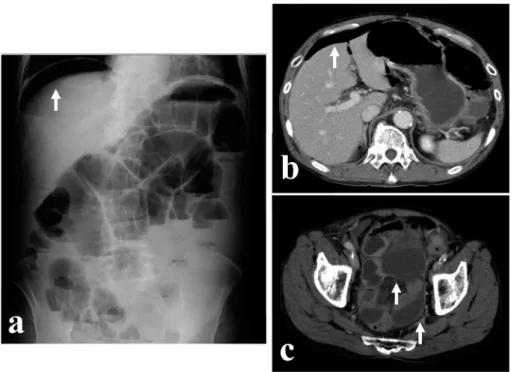
Four days post - ESD, an abdominal X - ray re- vealed pneumoperitoneum over the liver surface and evidence of intestinal obstruction attributable to intestinal paralysis (Fig. 4a). When CT was first taken after ESD, CT also revealed pneumoperitone- um and evidence of intestinal obstruction from in- testinal paralysis, as well as a pelvic abscess (Figs.

4b and 4c). At this time, the diagnosis of delayed perforation was first made. After consulting with a surgeon, given no sign of peritoneal irritation or fe- ver and a stable general condition, we chose conser- vative management with transnasal placement of a 16 - Fr decompression tube to relieve the paralytic intestinal obstruction under fasting conditions and continued antibiotic treatment. Bowel movement was observed 6 days post - ESD. Seven days after ESD, contrast - enhanced CT of the colon after infu- sion of gastrografin through the decompression tube revealed a 10 - mm fistula in the cecum (Fig. 5).

The pelvic abscess remained localized. The CRP level improved to 6.8 mg/dL. Therefore, conserva- tive treatment was continued. After bowel move- ment was confirmed, the decompression tube was removed 13 days post - ESD. Oral ingestion was re- sumed. After a reduced size of pelvic abscess was confirmed on CT 21 days post - ESD, the patient was discharged from hospital 26 days post - ESD. Later, CS taken 63 days post - ESD revealed scarring of the ESD site (Fig. 6).

Discussion

In the case described in this report, delayed perforation after colonic ESD occurred. The diag- nosis of perforation was late. However, the condi- tion of this patient was conservatively man- aged. For this reason, this case report is regarded as valuable.

The rate of delayed perforation after colonic ESD is reported as 0.3% - 0.7% 7

-

9) . In addition, de- layed perforation can follow a severe postoperative course and often requires emergency surgery 6) . In the present case, the diagnosis of perforation was reached after several days. Abdominal pain devel- oped during the daytime on the day after ESD, but it resolved two days post - ESD. These findings led us to speculate perforation was not the cause of the Fig. 2. Loupe image of the resected specimen from

endoscopic submucosal dissection (hematoxylin

-

eosin staining).

Submucosal dissection was performed at an appro- priate depth. No evidence of damage caused by thermocoagulation was observed.

Fig. 3. Abdominal X

-

ray taken on the day after endo- scopic submucosal dissection.

Neither pneumoperitoneum nor evidence of intes-

tinal obstruction was observed.

(5)

160 K. Kawashima et al.

abdominal pain but rather that thermocoagulation had been induced by PEECS, which is defined as fe- ver, regional rebound tenderness, or marked leuko- cytosis after ESD without perforation. If a patient’s condition indicates PEECS, then the patient is treat- ed with intravenous antibiotics 10) . However, in the case described in this report, the event was not PEECS but delayed perforation after colonic ESD.

Fortunately, the perforation site was covered by the surrounding mesentery. Therefore, inflammation was localized in the area from the perforation site to

the pelvic cavity.

Delayed perforation after colonic ESD is thought to result from gradual weakening of the muscular layer injured by transmitted heat from ex- cessive thermocoagulation of the submucosa, or from ischemic changes in the muscular layer caused by thermocoagulation 10,11) . We later reviewed a video that had been filmed during ESD. We noted that excessive thermocoagulation might have oc- curred during the coagulation of blood vessels in the post - dissection ulcer bed. Consequently, coagula- Fig. 4. Imaging findings obtained four days after endoscopic submucosal dissection.

a Abdominal X

-

ray showing pneumoperitoneum over the liver surface (arrow) and gas retention in the colon attribut- able to intestinal paralysis.

b Computed tomography (CT) image showing pneumoperitoneum over the liver surface (arrow).

c A CT image showing an abscess in the pelvic cavity (arrow).

Fig. 5. Computed tomography (CT) image taken sev- en days after endoscopic submucosal dissection.

A contrast

-

enhanced CT image taken after infu- sion of gastrografin through a decompression tube showed a 10

-

mm fistula in the cecum (arrow).

Fig. 6. Endoscopic image taken 63 days after endo-

scopic submucosal dissection showing scarring of

the post

-

ESD site.

(6)

tion necrosis of the ulcer bed might have led to de- layed perforation. Excessive thermocoagulation af- ter colonic ESD should be avoided for unexpected perforation. The cecum has a thinner intestinal wall and is more likely to retain stool compared to other parts of the colon, which is a feature that in- creases the risk of severe peritonitis.

Intraoperative perforation during colonic ESD might be treated conservatively by endoscopic clo- sure with clips. However, no established guideline exists for actions to be taken in the event of delayed perforation. The key criteria for determining sur- gical indication of CS - related perforation include ≥ 65 years of age, CS for diagnostic purposes, perfora- tion not amenable closure with clips, and signs of peritoneal irritation 12) . In contrast, emergency sur- gery is often required in cases of delayed perforation after colonic ESD because of a high risk of peritoni- tis caused by fecal fluid leakage, weakening of peri - perforation tissue because of necrosis, large perfora- tion size not amenable to endoscopic closure with clips, and a risk of expanded perforation induced by scope re - insertion.

We placed a transnasal decompression tube to relieve the paralytic intestinal obstruction. This step might have contributed to avoidance of sur- gery. Regarding the decompression tube placement after perforation of colonic ESD, only one report has been published : Xiao et al. 13) reported a case of de-

layed perforation after colonic ESD in which the perforation was closed endoscopically, and a decom- pression tube was placed transanally (not transna- sally), followed by conservative management with intestinal decompression. Our report is apparently the first describing a case for which a decompression tube was inserted intranasally for delayed perfora- tion after colonic ESD.

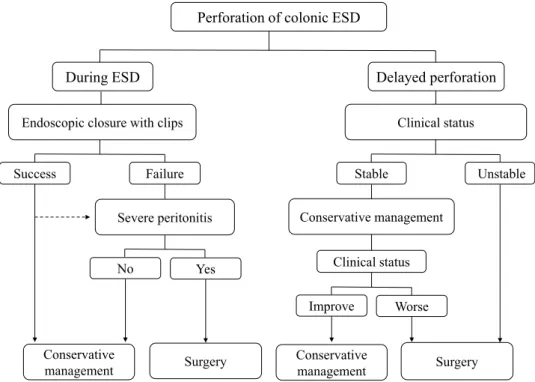
We can suggest the algorithm for both diagnos- tic and management for colonic ESD - associated per- foration in Fig. 7. Although conservative manage- ment might be one treatment for patients with stable clinical condition, patients with sepsis should under- go emergency surgery at any time. In addition, the use of the bipolar hemostatic forceps might be effec- tive to decrease the risk of delayed perforations.

Furthermore, careful radiological follow - up is impor- tant for the early diagnosis of delayed perforation.

In the present case, delayed perforation was conservatively treated successfully. The reasons for the success might include continued fasting, in- flammation being localized in the pelvic cavity and not leading to sepsis, and the concomitant use of in- testinal decompression through a tube to prevent excessive pressure on the perforation site.

Conclusions

This report described a case of delayed perfora- Endoscopic closure with clips

Success

Severe peritonitis No

Surgery

Perforation of colonic ESD

Conservative management

Clinical status Failure

Yes

Unstable Stable

Conservative management

Improve Worse Clinical status

Conservative

management Surgery

During ESD Delayed perforation

Fig. 7. Proposed algorithm for the diagnosis and management of colonic endoscopic submucosal dissection associat-

ed perforation.

(7)

162 K. Kawashima et al.

tion after colonic ESD in a patient with cecal carci- noma. In this case, perforation was regarded as oc- curring on the day after the procedure. However, because inflammation was localized, it was treated conservatively using an intestinal decompression tube. The case is reported because delayed perfo- ration is rarely treated conservatively.

Acknowledgments

We wish to express our deep appreciation to all of the endoscopy medical staff and ward staff of Fu- kushima Medical University Hospital for their assis- tance with endoscopic procedures and the care of this patient.

Conflict of Interest

The authors have no conflict of interest to de- clare.

References

1. Kudo S. Endoscopic mucosal resection of flat and depressed types of early colorectal cancer. En- doscopy, 25 : 455

-

461, 1993.

2. Saito Y, Uraoka T, Yamaguchi Y, et al. A prospec- tive, multicenter study of 1111 colorectal endo- scopic submucosal dissections (with video). Gas- trointest Endosc, 72 : 1217

-

1225, 2010.

3. Tanaka S, Oka S, Kaneko I, et al. Endoscopic sub- mucosal dissection for colorectal neoplasia : possi- bility of standardization. Gastrointest Endosc, 66 : 100

-

107, 2007.

4. Hong SN, Byeon JS, Lee B

-

I, et al. Prediction model and risk score for perforation in patients un- dergoing colorectal endoscopic submucosal dissec- tion. Gastrointest Endosc, 84 : 98

-

108, 2016.

5. Hayashi N, Tanaka S, Nishiyama S, et al. Predic-

tors of incomplete resection and perforation associ- ated with endoscopic submucosal dissection for colorectal tumors. Gastrointest Endosc, 79 : 427

-

435, 2014.

6. Fujihara S, Mori H, Kobara H, et al. The efficacy and safety of prophylactic closure for a large muco- sal defect after colorectal endoscopic submucosal dissection. Oncol Rep, 30 : 85

-

90, 2013.

7. Isomoto H, Nishiyama H, Yamaguchi N, et al.

Clinicopathological factors associated with clinical outcomes of endoscopic submucosal dissection for colorectal epithelial neoplasms. Endoscopy, 41 : 679

-

683, 2009.

8. Fujishiro M, Yahagi N, Kakushima N, et al. Out- comes of endoscopic submucosal dissection for colorectal epithelial neoplasms in 200 consecutive cases. Clin Gastroenterol Hepatol, 5 : 678

-

683, 2007.

9. Toyanaga T, Man

-

I M, Ivanov D, et al. The results and limitations of endoscopic submucosal dissec- tion for colorectal tumors. Acta Chir Iugosl, 55 : 17

-

23, 2008.

10. Jung D, Youn Y, Jahng J, et al. Risk of electrocoag- ulation syndrome after endoscopic submucosal dis- section in the colon and rectum. Endoscopy, 45 : 714

-

717, 2013.

11. Ko YB, Lee J

-

M, Kim WS, et al. Unexpected de- layed colon perforation after the endoscopic sub- mucosal dissection with snaring of a laterally spreading tumor. Clin Endosc, 48 : 570

-

575, 2015.

12. Yang D

-

H, Byeon J

-

S, Lee K

-

H, et al. Is endo- scopic closure with clips effective for both diagnos- tic and therapeutic colonoscopy

-

associated bowel perforation ? Surg Endosc, 24 : 1177

-

1185, 2010.

13. Xiao Y

-

F, Bai J

-

Y, Yu J, et al. Endoscopic treat-

ment of delayed colon perforation : the enterosco-

py overtube approach. Endoscopy, 46 : 503

-

508,

2014.

Fig. 1.  Endoscopic images of a colon tumor.
Fig. 3.  Abdominal X - ray taken on the day after endo- endo-scopic submucosal dissection.
Fig. 5.  Computed tomography (CT) image taken sev- sev-en days after sev-endoscopic submucosal dissection.
Fig. 7.  Proposed algorithm for the diagnosis and management of colonic endoscopic submucosal dissection associat- associat-ed perforation.

参照

関連したドキュメント

We relate group-theoretic constructions (´ etale-like objects) and Frobenioid-theoretic constructions (Frobenius-like objects) by transforming them into mono-theta environments (and

The theory of log-links and log-shells, which arise from the local units of number fields under consideration (Section 5), together with the Kummer theory that relates

The theory of log-links and log-shells, both of which are closely related to the lo- cal units of number fields under consideration (Section 5, Section 12), together with the

清水 悦郎 国立大学法人東京海洋大学 学術研究院海洋電子機械工学部門 教授 鶴指 眞志 長崎県立大学 地域創造学部実践経済学科 講師 クロサカタツヤ 株式会社企 代表取締役.

静岡大学 静岡キャンパス 静岡大学 浜松キャンパス 静岡県立大学 静岡県立大学短期大学部 東海大学 清水キャンパス

Amount of Remuneration, etc. The Company does not pay to Directors who concurrently serve as Executive Officer the remuneration paid to Directors. Therefore, “Number of Persons”

静岡大学 静岡キャンパス 静岡大学 浜松キャンパス 静岡県立大学 静岡県立大学短期大学部 東海大学 清水キャンパス

[r]