Fukushima Medical University
This document is downloaded at: 2021-11-07T23:54:54Z
Title
Human and equipment resources for difficult airway
management, airway education programs, and capnometry use in Japanese emergency departments: a nationwide cross- sectional study( Full text )
Author(s) Ono, Yuko; Tanigawa, Koichi; Shinohara, Kazuaki; Yano, Tetsuhiro; Sorimachi, Kotaro; Inokuchi, Ryota; Shimada, Jiro
Citation International Journal of Emergency Medicine. 10: 28
Issue Date 2017-09-13
URL http://ir.fmu.ac.jp/dspace/handle/123456789/653
Rights © The Author(s). 2017 Open Access This article is distributed under the terms of the Creative Commons Attribution 4.0 International License.
DOI 10.1186/s12245-017-0155-6
Text Version publisher
O R I G I N A L R E S E A R C H Open Access
Human and equipment resources for difficult airway management, airway
education programs, and capnometry use in Japanese emergency departments: a nationwide cross-sectional study
Yuko Ono
1,2*, Koichi Tanigawa
1,3, Kazuaki Shinohara
2, Tetsuhiro Yano
1, Kotaro Sorimachi
1, Ryota Inokuchi
4and Jiro Shimada
1Abstract
Background: Although human and equipment resources, proper training, and the verification of endotracheal intubation are vital elements of difficult airway management (DAM), their availability in Japanese emergency departments (EDs) has not been determined. How ED type and patient volume affect DAM preparation is also unclear. We conducted the present survey to address this knowledge gaps.
Methods: This nationwide cross-sectional study was conducted from April to September 2016. All EDs received a mailed questionnaire regarding their DAM resources, airway training methods, and capnometry use for tube placement. Outcome measures were the availability of: (1) 24-h in-house back-up; (2) key DAM resources, including a supraglottic airway device (SGA), a dedicated DAM cart, surgical airway devices, and neuromuscular blocking agents; (3) anesthesiology rotation as part of an airway training program; and (4) the routine use of capnometry to verify tube placement. EDs were classified as academic, tertiary, high-volume (upper quartile of annual ambulance visits), and urban.
Results: Of the 530 EDs, 324 (61.1%) returned completed questionnaires. The availability of in-house back-up coverage, surgical airway devices, and neuromuscular blocking agents was 69.4, 95.7, and 68.5%, respectively. SGAs and dedicated DAM carts were present in 51.5 and 49.7% of the EDs. The rates of routine capnometry use (47.8%) and the availability of an anesthesiology rotation (38.6%) were low. The availability of 24-h back-up coverage was significantly higher in academic EDs and tertiary EDs in both the crude and adjusted analysis. Similarly, neuromuscular blocking agents were more likely to be present in academic EDs, high-volume EDs, and tertiary EDs; and the rate of routine use of capnometry was significantly higher in tertiary EDs in both the crude and adjusted analysis.
Conclusions: In Japanese EDs, the rates of both the availability of SGAs and DAM carts and the use of routine capnometry to confirm tube placement were approximately 50%. These data demonstrate the lack of standard operating procedures for rescue ventilation and post-intubation care. Academic, tertiary, and high-volume EDs were likely to be well prepared for DAM.
Keywords: Airway equipment, Capnometry, Supraglottic airway device, Portable storage unit, Postal survey
* Correspondence:[email protected]
1Emergency and Critical Care Medical Center, Fukushima Medical University Hospital, Fukushima 960-1295, Japan
2Department of Anesthesiology, Ohta General Hospital Foundation, Ohta Nishinouchi Hospital, Koriyama, Japan
Full list of author information is available at the end of the article
© The Author(s). 2017Open AccessThis article is distributed under the terms of the Creative Commons Attribution 4.0 International License (http://creativecommons.org/licenses/by/4.0/), which permits unrestricted use, distribution, and reproduction in any medium, provided you give appropriate credit to the original author(s) and the source, provide a link to the Creative Commons license, and indicate if changes were made.
Background
Endotracheal intubation (ETI) is a common and, in many cases, life-saving intervention in emergency de- partments (EDs). ETI in the ED setting is much more difficult than elective ETI in the operating room (OR), because of the more critical patient population, the lesser controlled setting, and the inadequate opportunity for a complete evaluation of the patient [1, 2]. The rate of difficult ETI in ED settings ranges from 6.1 to 23.5%
[1, 3–7], while in planned anesthesia settings it is 0.5–
8.5% [8–13]. Consequently, life-threatening ETI-related complications, including hypoxia, esophageal intubation, aspiration, and cardiac arrest, are more likely to occur in the ED [3–5]. These fatal airway-related adverse events can in part be attributed to the limited accessibility of proper human and difficult airway management (DAM) equipment resources [14–17]. Every ED should therefore have the appropriate human and equipment resources for DAM. However, little is known about the availability of either one in Japan ’ s EDs.
Previous studies [14–17] strongly recommended that, regardless of the location, DAM resources should be consistent with those specified for hospital ORs by sev- eral professional anesthesiology societies [18–20]. We previously audited Japanese helicopter physician delivery services [21] and intensive care units (ICU) [22] regard- ing the adequacy of their equipment and its compliance with DAM guidelines [18–20]. However, whether airway management resources in Japanese EDs are compatible with established OR standards has not been comprehen- sively evaluated.
In Japan, residency programs in emergency medicine are not standardized [23], and the quality of emergency airway management education depends on the individual institution. Although adequate training in and familiarity with airway management are among the most important elements in emergency medicine [23], objective informa- tion on the teaching of airway management in Japanese EDs is not available.
The verification of endotracheal tube placement is an indispensable part of any DAM strategy [18 – 20], with end-tidal CO
2(EtCO
2) detection as the most accurate method to verify correct tube placement in emergency settings [24–26]. For this reason, secondary ETI con- firmation using capnometry is strongly recommended in every ED [14]; however, the level of capnometry use for this purpose in ED patients in Japan is unknown.
Furthermore, there are few data on how ED character- istics and volume affect preparedness for DAM. A con- sensus regarding this relationship is needed to assess DAM practice variations in each type of ED.
We conducted a national survey to determine: (1) the adequacy of available DAM resources, airway education programs, and post-intubation care, and (2) the
association between these DAM preparations and ED characteristics in Japan.
Methods
Study design and sites
This cross-sectional study was conducted from April to September 2016 (planning phase, April–June; survey phase, July–September). After its approval (no. 2751) by the Institutional Review Boards of Fukushima Medical University in June 2016, self-administered questionnaires were mailed in July 2016 to the directors of all EDs (530 hospitals in 47 prefectures) registered as certified train- ing facilities by the Japanese Association of Acute Medicine (JAAM). Pre-paid return envelopes with pre- printed addresses were used to increase the response rate, but no incentives were offered. A complete list of these hospitals is available at the official website of the JAAM [27]. The criteria for a JAAM-certified ED in- clude (1) the existence of the facility as an independent, central clinical division; (2) its receipt of a sufficiently large volume of ambulances, patients with cardiopulmo- nary arrest, and acute-phase patients; (3) two or more dedicated JAAM board-certified ED physicians on staff;
and (4) suitable resources and a program for the training of senior residents. EDs that did not respond to the ini- tial survey were sent a repeat mailing in September 2016. No other non-response follow-up techniques, such as phone calls, were used.
Survey items
Our selection of items for inclusion in the questionnaire was based on previous work in which we investigated available DAM resources in the pre-hospital [21] and ICU [22] settings in Japan. We also referred to all rele- vant studies conducted in other countries that similarly assessed EDs [28–36], ICUs [37–41], ORs [42–45], and pre-hospital settings [46–48]. We then circulated drafts among the survey team members (an epidemiologist, an- esthesiologists, and physicians specializing in emergency medicine) and finalized the questionnaire in April 2016.
An English version of the Japanese questionnaire used in this study is available in the Additional file 1 (Online Resource 1). Survey items consisted of facility character- istics, human resources and DAM equipment, airway management training programs, and capnometry use.
Facility characteristics
The survey first asked basic information regarding the
number of hospital beds and annual ambulance admis-
sions in 2015. EDs were classified as (a) academic or com-
munity, (b) high-volume or not, (c) tertiary or not, and (d)
urban or suburban and rural. Academic EDs were defined
as departments in university-affiliated hospitals, and high-
volume EDs were defined as departments in the upper
quartile of annual ambulance visits. The criteria for ter- tiary EDs [49] included (1) 24-h availability of acute care in multiple specialties; (2) the existence of an ICU or cor- onary care unit that receives critically ill patients; (3) provision of emergency medicine education programs for medical students, junior and senior residents, nurses, and paramedics; and (4) service as a referral medical center for regional emergency medical control. A complete list of Japanese tertiary EDs [50] are available online. The criteria for pediatric EDs were [51]: (1) 24-h availability of care in multiple specialties for critically ill children, (2) a referral resource for communities in nearby regions, (3) provision of continuing education programs in pediatric emergency medicine, and (4) incorporation of a comprehensive quality assessment program. Tertiary and pediatric EDs were both certified by the Japanese Ministry of Health, Labor and Welfare. The census grouping [52] by the Statistics Bureau of the Japanese Ministry of Internal Affairs and Communications was used to identify urban EDs. In brief, urban municipalities included 23 wards within the Tokyo metropolis and 20 ordinance-designated cites. In this study, the EDs were divided into urban and others, with the latter including suburban and rural types.
Of 530 eligible EDs in this survey, 107 (20.2%) were academic, 265 (50%) were tertiary, 185 (34.9%) were urban, and 12 (2.3%) were pediatric EDs.
Human resources and DAM equipment
To obtain information on the human resources for air- way management, questions were asked about the usual number of on-duty staff ED physician(s) during the day and overnight, the board certification of ED physicians, and whether in-house, experienced (anesthesiology or intensive care medicine) back-up coverage can be called during overnight hours. Senior residents (post-graduate year 3 or more) were defined as staff ED physicians, but junior residents (post-graduate year 1 or 2) were not.
“24-h in-house back-up coverage” was deemed obtain- able if: (a) two or more physicians were usually on duty, including overnight, or (b) in-house experienced back- up coverage (anesthesiology or intensive care medicine) was available overnight, as previously described [22].
Board-certified physicians were defined based on the Japanese Medical Specialty Board criteria [53].
Equipment resources were queried based on the avail- ability of the following materials in the ED: (1) direct laryngoscope and adjunct equipment (curved blade, straight blade, McCoy laryngoscope, stylet, and gum elastic bougie); (2) alternate intubation equipment (rigid video laryngoscope, flexible fiberscope, retrograde intub- ation kit, and surgical airway equipment); (3) alternate ventilation equipment [supraglottic airway device (SGA), oral and nasal airways]; (4) a portable packaged unit containing several DAM devices (DAM cart); and (5)
analgesics, sedatives, and neuromuscular blocking agents to facilitate ETI, and reversal agents. If a rigid video laryngoscope or SGA was available, respondents were requested to provide the product name. In our previous study [22], SGA availability in Japanese ICUs was deter- mined to be poor, but the reasons were not identified.
Thus, in the current survey participants were queried re- garding the reasons for the lack of SGA devices in the ED. Surgical airway equipment was categorized as a cri- cothyroidotomy kit or a set containing a scalpel and hemostat. If a dedicated DAM cart was present in the ED, respondents were asked to specify its contents.
Airway management training programs
Emergency medicine residency programs, including DAM educational offerings, vary in length because of the absence of bodies responsible for the accreditation of graduate medical training programs in Japan [23]. To clarify the current situation and to provide a reference point, this survey requested information on the airway management training programs available in each ED, in- cluding anesthesiology rotation, DAM simulation train- ing, didactic DAM lecture, and surgical airway training using a simulator, an animal model, a cadaver, etc.
Capnometry use
Finally, to determine the current status of capnometry use, both the availability of capnometry (quantitative, colorimetric, or both) in the ED and the extent of cap- nometry use to confirm tube placement (routinely, sometimes, never) were queried. Our previous study [22]
showed that the extent of capnometry use for ETI verifi- cation in Japanese ICUs is poor, but the reasons were not explored. Thus, in the present study, respondents were requested to provide reasons for the lack of routine capnometry use to confirm ETI.
Exposures and outcome measures
The exposures in this study were ED characteristics, in- cluding academic, high-volume, tertiary, and urban.
Several of these factors were chosen as exposures be- cause previous studies have shown that such hospital characteristics can affect patient outcomes [54–57].
Based on these earlier observations, we hypothesized that such ED types also may be associated with DAM preparedness, airway education, and standardized post- intubation care.
Outcomes of interests in this study were the availability
of: (1) 24-h in-house back-up coverage; (2) DAM re-
sources, including (a) SGA, (b) DAM cart, (c) surgical air-
way equipment, and (d) at least one neuromuscular
blocking agent; (3) anesthesiology rotation as an airway
management training program; and (4) the routine use of
capnometry to confirm ETI. We chose “24-h in-house
back-up coverage” as an outcome measure because the
“call for help” is the first step and the most important component of DAM algorithms [18–20]. Among the selected DAM equipment, SGA, DAM cart, and surgical airway equipment are commonly endorsed by professional anesthesiology societies [18–20]. The availability of
“surgical airway equipment” was defined as the presence in the ED of a cricothyroidotomy kit or a scalpel and hemostat. “Availability of at least one neuromuscular block- ing agent” was chosen because the current use of rapid sequence intubation (RSI) in Japanese EDs has yet to be assessed. “Anesthesiology rotation as an airway manage- ment training program” is an outcome of interest because of the established association of prior OR exposure with a higher ETI success rate and a lower ETI complication rate in high-risk populations [58–60]. Since post-intubation care with EtCO
2detection is strongly recommended following emergency ETI [14, 24–26], the routine use of capnometry for tube placement was included as an outcome measure.
Statistical analysis
All survey items were evaluated using descriptive statistics.
The associations between outcome of interest and ED type (academic, high-volume, tertiary, and urban) were ana- lyzed using a Fisher’s exact test that included only the complete data sets; those with missing data were excluded.
Because these four exposures may have overlapped and become confounded by one another, a logistic regression model was constructed to yield an adjusted odds ratio for appropriate DAM preparedness. In this multivariate ana- lysis, a variance-inflation factor was used to detect multi- collinearity, and the model’s fit was verified using the Hosmer–Lemeshow goodness-of-fit test. All statistical analyses were performed using IBM SPSS Statistics for Windows, version 21.0 (IBM Corp., Armonk, NY).
P < 0.05 was considered to indicate statistical significance.
Sample size
A power analysis using G*Power 3 for Windows (Heinrich Heine University, Dusseldorf, Germany) was performed during the planning phase of this study. The effect size was estimated by referring to our previous work, which determined the association between the ICU type and DAM resources [22]. Based on the assumption that 60%
of the EDs had an SGA, DAM cart, and routine use of capnometry for ETI confirmation, the estimated effect size
“w” to detect outcome differences of approximately 10%
was 0.25. With this effect size, a sample size of 126 per group (total, 252) was calculated to provide 80% statistical power at a two-tailed α of 0.05.
Results
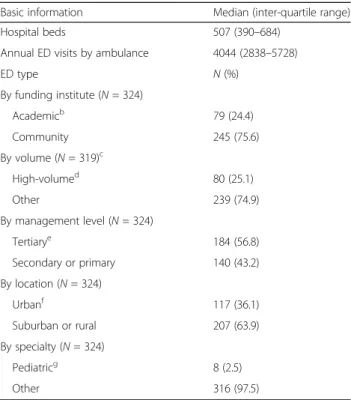
Of the 530 Japanese EDs, 324 returned a completed questionnaire (response rate 61.1%). Table 1 shows the
facility characteristics of the responding EDs. The me- dian number of annual ambulances admissions was 4044 (interquartile range 2838–5728). Of these, 24.4% were academic EDs and 56.8% tertiary EDs.
Table 2 provides data on ED manpower and the spe- cialties of the ED physicians. Two or more staff mem- bers were usually on duty at 76.3% of the responding EDs during the day, and at 55.2% overnight. In-house back-up coverage was always available in 69.4% of the EDs. In Japan, other than physicians specialized in emer- gency medicine, those from various specialties, including general surgery, cardiovascular medicine, intensive care, and anesthesiology, serve as ED practitioners (Table 2).
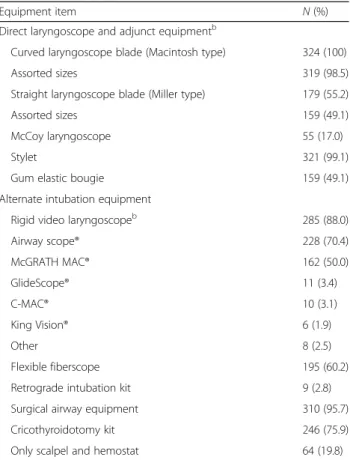
Table 3 summarizes the intubation and alternate intub- ation equipment available in Japanese EDs. Among the EDs that responded, a curved laryngoscope blade was universally available, and nearly all EDs ( n = 310, 95.7%) possessed a surgical airway device, either a cricothyroidot- omy kit (75.9%) or scalpel and hemostat (19.8%).
Table 1
Demographic data of the Japanese emergency departments (EDs) that responded to the survey
aBasic information Median (inter-quartile range)
Hospital beds 507 (390–684)
Annual ED visits by ambulance 4044 (2838–5728)
ED type N(%)
By funding institute (N= 324)
Academicb 79 (24.4)
Community 245 (75.6)
By volume (N= 319)c
High-volumed 80 (25.1)
Other 239 (74.9)
By management level (N= 324)
Tertiarye 184 (56.8)
Secondary or primary 140 (43.2)
By location (N= 324)
Urbanf 117 (36.1)
Suburban or rural 207 (63.9)
By specialty (N= 324)
Pediatricg 8 (2.5)
Other 316 (97.5)
aBased on the replies of 324 of the 530 EDs queried
bDefined as EDs in university-affiliated hospitals
cThere were five missing data
dDefined as EDs in the upper quartile of annual ambulance visits (> 5728)
eDefined as EDs in referral medical centers of regional emergency medical control that are certified by the Japanese Ministry of Health, Labor and Welfare
fDefined using the census grouping criteria by the Statistics Bureau of the Japanese Ministry of Internal Affairs and Communications
gDefined as EDs with a referral resource for critically ill children for communities in nearby regions that are certified by the Japanese Ministry of Health, Labor and Welfare
Table 4 lists the available alternate ventilation equip- ment in the responding EDs. SGA availability was 51.5%.
The performance of a surgical airway in patients with difficult ETI (58.6%) and a lack of familiarity with SGA insertion (39.5%) were the main reasons for the lack of a SGA in the ED.
Dedicated DAM carts were present in 161 (49.7%) EDs and their contents varied (Table 5).
Table 6 lists the drugs available to facilitate ETI in the responding EDs. At least one neuromuscular agent was cited by 222 (68.5%) EDs and at least one opioid by 135 (41.7%) EDs.
Table 7 provides details on the airway teaching pro- grams in Japanese EDs. Diverse DAM training methods are used in the education of ED physicians. An anesthesiology rotation was available in 125 EDs (38.6%).
Information regarding post-intubation care with EtCO
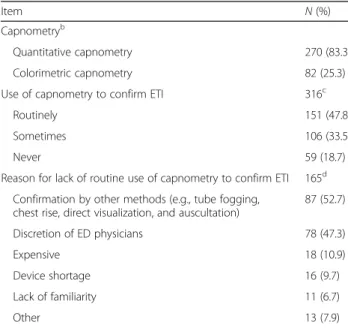
2detection is provided in Table 8. Despite the high availability of capnometry, its routine use for ETI was re- ported by less than half (47.8%) of the EDs. The major reasons for not routinely using capnometry to verify
tube placement were ETI confirmation by other methods, such as tube fogging, chest rise, direct visualization, and auscultation (52.7%), and that its use depended on the discretion of the ED physician (47.3%).
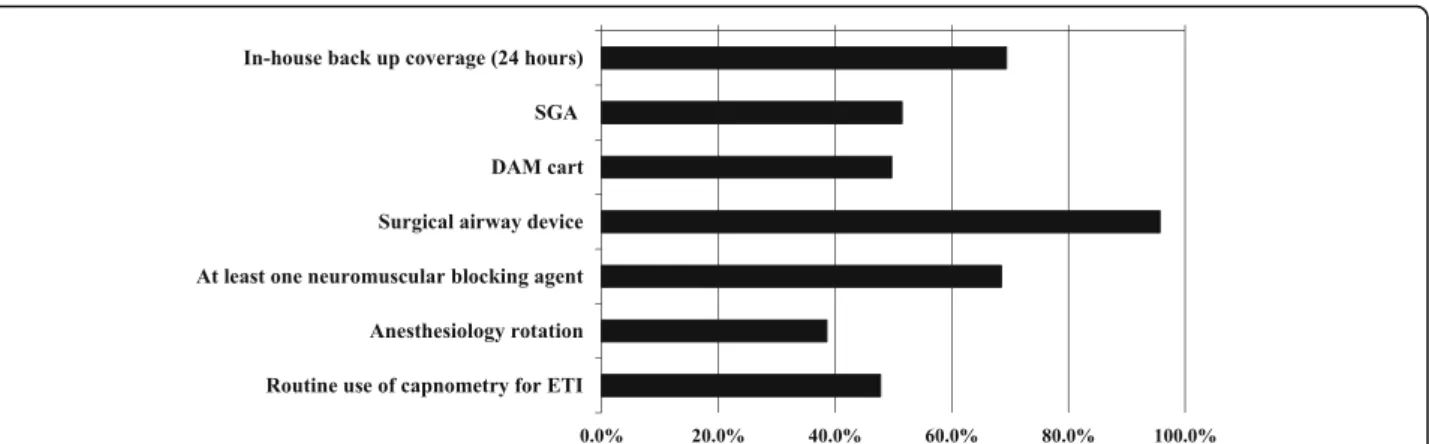
Figure 1 summarizes the attainment rates of the out- comes of interest in this study. According to our defini- tions, back-up staff was always available in 69.4% of the EDs, surgical airway devices in 95.7%, and neuromuscu- lar blocking agents in 68.5%. The availability of SGAs and DAM carts, as well as routine capnometry use to confirm tube placement was approximately 50%. The availability of an anesthesiology rotation for ED physi- cians was low (< 40%).
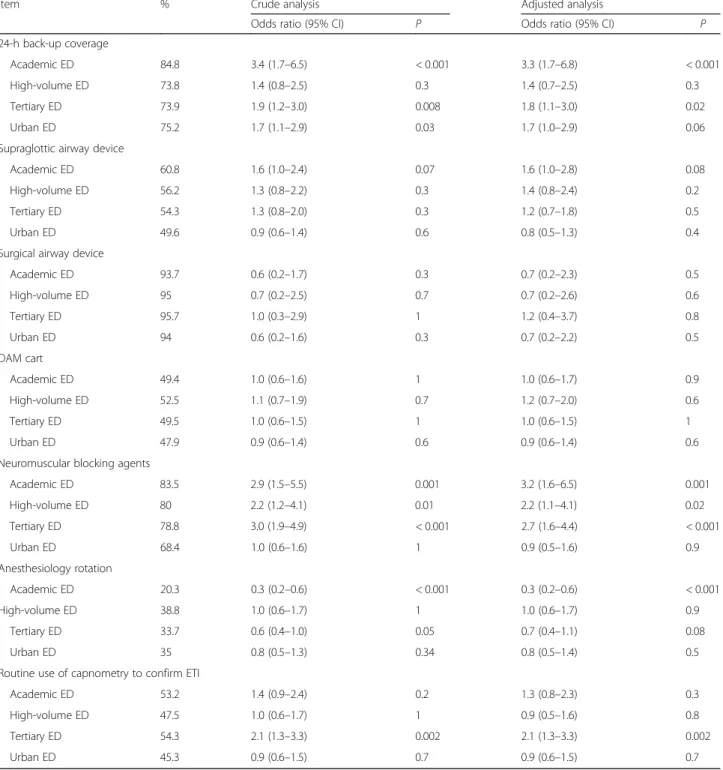
Table 9 shows the associations between the feasibility of the outcomes of interest and the ED type. The avail- ability of 24-h back-up coverage was significantly higher in academic EDs and tertiary EDs in both the crude and adjusted analysis. Similarly, neuromuscular blocking agents were more likely to be present in academic EDs, high-volume EDs, and tertiary EDs; an anesthesiology rotation was significantly less available in academic EDs;
and the rate of routine capnometry use to verify ETI was significantly higher in tertiary EDs in both the crude and
Table 2Number of on-duty emergency department (ED)
physicians and their specialties
aItem N(%)
Number of on-duty ED physicians 317b
A. Day time
a) One 75 (23.7)
b) Two or more 242 (76.3)
B. Overnight
a) One 142 (44.8)
b) Two or more 175 (55.2)
c) In-house back-up coveragecalways available 220 (69.4) Board certification of ED physiciansd N= 3697
a) Emergency medicine 1223 (33.1)
b) General surgery 726 (19.6)
c) Cardiovascular medicine 350 (9.5)
d) Orthopedics 328 (8.9)
e) Anesthesiology 322 (8.7)
f) Intensive care 313 (8.5)
g) Cranial surgery 266 (7.2)
h) Pediatrics 202 (5.5)
i) Respiratory medicine 126 (3.4)
j) Renal medicine 88 (2.4)
k) Cardiovascular surgery 78 (2.1)
l) Other board certification 579 (15.7)
aBased on the replies of 324 of the 530 EDs queried
bThere were seven missing replies
cTwo or more ED physicians are always on duty or in-house experienced back-up coverage (anesthesiology or intensive care medicine) is usually available overnight
dPhysicians may have more than one board certification
Table 3
Intubation equipment and alternate intubation equipment in the Japanese emergency departments (EDs) that responded to the survey
aEquipment item N(%)
Direct laryngoscope and adjunct equipmentb
Curved laryngoscope blade (Macintosh type) 324 (100)
Assorted sizes 319 (98.5)
Straight laryngoscope blade (Miller type) 179 (55.2)
Assorted sizes 159 (49.1)
McCoy laryngoscope 55 (17.0)
Stylet 321 (99.1)
Gum elastic bougie 159 (49.1)
Alternate intubation equipment
Rigid video laryngoscopeb 285 (88.0)
Airway scope® 228 (70.4)
McGRATH MAC® 162 (50.0)
GlideScope® 11 (3.4)
C-MAC® 10 (3.1)
King Vision® 6 (1.9)
Other 8 (2.5)
Flexible fiberscope 195 (60.2)
Retrograde intubation kit 9 (2.8)
Surgical airway equipment 310 (95.7)
Cricothyroidotomy kit 246 (75.9)
Only scalpel and hemostat 64 (19.8)
aBased on the replies of 324 of the 530 EDs queried
bEDs may have more than one of the specified equipment items
adjusted analysis. Multicollinearity was not detected (variance-inflation factor < 1.2 for each explanatory variable of each model), and the Hosmer–Lemeshow test verified the good fit (P > 0.05) of each logistic regression model.
An international comparison of the outcomes of interest in this study is provided in Additional file 2: Table S1.
The differences in characteristics between the respond- ent and non-respondent EDs were compared to assess non-response bias. As shown in Additional file 3: Table S2,
Table 4Alternate ventilation equipment in responded
Japanese emergency departments (EDs)
aEquipment item N(%)
Alternate ventilation equipmentb
Oral airway 278 (85.8)
Nasal airway 313 (96.6)
SGAb 167 (51.5)
I-gel® 102 (31.5)
LMA Classic® 39 (12.0)
LMA ProSeal® 28 (8.6)
Air-Q® 11 (3.4)
Laryngeal tube® 6 (1.9)
LMA Fastrach® 2 (0.6)
LMA Supreme® 2 (0.6)
Others 6 (1.9)
Reason for lack of SGAc N= 157
A surgical airway is performed if ETI is difficult 92 (58.6)
Lack of familiarity 62 (39.5)
Perceived as not useful for emergency cases 29 (18.5)
Expensive 5 (3.2)
Other 38 (24.2)
SGAsupraglottic airway device
aBased on the replies of 324 of the 530 EDs queried
bEDs may have more than one of the specified equipment items
cEDs may have more than one reason
Table 5
Portable storage unit (DAM cart) and its contents available at the responding Japanese emergency departments (EDs)
aItem N(%)
Portable storage unit (DAM cart) 161 (49.7)
Contents of the DAM cart 161
Stylet 145 (90.1)
Direct laryngoscope blades in various designs and sizes 142 (88.2)
Tracheal tubes in assorted sizes 135 (83.9)
Magill forceps 129 (80.1)
Airway (oral/nasal) 127 (78.9)
Bag valve mask 122 (75.8)
Rigid video laryngoscope 107 (66.5)
Surgical airway device 100 (62.1)
SGA 68 (42.2)
Gum elastic bougie 67 (41.6)
Capnometry 51 (31.7)
Yankauer suction tip 39 (24.2)
Sugammadex 8 (5.0)
Other devices 8 (5.0)
DAMdifficult airway management,SGAsupraglottic airway device
aBased on the replies of 324 of the 530 EDs queried
Table 6
Drugs to facilitate ETI and reversal agents available at the responding Japanese emergency departments (EDs)
aItem N(%)
Analgesicsb
At least one opioid 135 (41.7)
Fentanyl 116 (35.8)
Morphine 95 (29.3)
Remifentanil 3 (0.9)
Ketamine 77 (23.8)
Pentazocin 278 (85.8)
Buprenorphine 144 (44.4)
Tramadol 3 (0.9)
Lidocaine 251 (77.5)
Other 7 (2.2)
Sedativesb
At least one sedative 324 (100)
Diazepam 300 (92.6)
Midazolam 293 (90.4)
Propofol 237 (73.1)
Thiopental 153 (47.2)
Dexmedetomidine 83 (25.6)
Haloperidol 163 (50.3)
Droperidol 17 (5.2)
Other 3 (0.9)
Neuromuscular blocking agentsb
At least one neuromuscular blocking agent 222 (68.5)
Rocuronium 187 (57.7)
Vecuronium 72 (22.2)
Pancuronium 2 (0.6)
Succinylcholine 22 (6.8)
Reversal agentsb
Sugammadex 74 (22.8)
Flumazenil 159 (49.1)
Naloxone 50 (15.4)
Neostigmine 38 (11.7)
ETIendotracheal intubation
aBased on the replies of 324 of the 530 EDs queried
bEDs may have more than one drug
respondent EDs were likely to be academic EDs (P = 0.003) and tertiary EDs (P < 0.001).
Discussion
This national survey examined the currently available human, drug, and equipment resources for DAM and the extent of capnometry use in Japanese EDs. Roughly two- thirds of the responding EDs were supplied with neuro- muscular blocking agents; in half of the EDs, SGAs and dedicated DAM carts were available and capnometry was routinely used to verify tube placement. These data sug- gest that airway management practices, including RSI use, performance of a rescue strategy, and post-intubation care, vary in Japanese EDs. This may in part be due to dif- ferences in the airway management education offerings.
Academic, tertiary, and high-volume EDs were likely to be well prepared for DAM.
Among the responding EDs, SGA was available in only 51.5% (Table 4). Therefore, in Japan, SGA is under-used as a rescue ventilation device. The main reason reported for the limited availability of SGAs is that a surgical air- way is typically performed when a difficult airway is en- countered (Table 4). Many Japanese ED physicians may choose to perform a definitive surgical airway rather than rescue ventilation through SGA when patient venti- lation and/or intubation are difficult. Another important cause contributing to the low-level use of SGAs in Japanese EDs is insufficient familiarity with their place- ment (Table 4). Appropriate SGA training for ED physi- cians is limited in Japanese EDs because, other than elective operations, the settings in which patients are ventilated with a SGA are relatively rare and truly emer- gent. This study also revealed the low availability of an anesthesiology rotation for ED physicians (Table 7). As pre- viously noted [61, 62], training in the hospital OR to gain SGA insertion experience and confidence would be benefi- cial for many ED practitioners.
A dedicated DAM cart was present in less than half the EDs and its contents varied considerably (Table 5).
Because airway difficulties are far more likely in the ED [1, 3 – 7] and time is very limited in the airway man- agement of a critically ill patient, every ED should have immediate access to at least one DAM cart, which should have the same contents and layout as that used in the re- spective hospital ’ s OR [14]. Berkow et al. [63] reported that, after the implementation of a comprehensive airway program, including standardized DAM cart preparation, the need for an emergency surgical airway decreased.
Approximately one-third of the responding EDs were not equipped with neuromuscular blocking agents (Table 6), in- dicative of the variable use of RSI across Japanese EDs. In their multicenter observational study of 10 academic and community Japanese EDs, Hasegawa et al. [23] observed a high degree of variation in airway management practices among hospitals, with those using RSI accounting for 0 – 79%. The findings from our cross-sectional study of 324 hospitals support this high degree of variability. We also found a significantly higher availability of neuromuscular blocking agents in academic EDs, high-volume EDs, and tertiary EDs (Table 9). Thus, RSI is more likely to be used in these types of EDs than in community, small-volume, or secondary EDs.
Less than half of the EDs routinely used capnometry for ETI verification (Table 8). The major reasons were the confirmation of ETI by other methods, such as tube fog- ging and auscultation, and that capnometry use was left to the discretion of the ED physician (Table 8). Thus, stand- ard operating procedures for post-intubation care are lacking in many Japanese EDs. Previous studies [14, 16]
Table 7
Airway management teaching programs available at the responding Japanese emergency departments (EDs)
aAirway management teaching programb N(%)
Anesthesiology rotation 125 (38.6)
Surgical airway training using a simulator, an animal model, a cadaver, etc.
99 (30.6)
DAM simulation training 56 (17.3)
Didactic lecture 47 (14.5)
Other program 36 (11.1)
DAMdifficult airway management
aBased on the replies of 324 of the 530 EDs queried
bEDs may have more than one airway management teaching program
Table 8
Current status regarding capnometry use for ETI among the responding Japanese emergency departments (EDs)
aItem N(%)
Capnometryb
Quantitative capnometry 270 (83.3)
Colorimetric capnometry 82 (25.3)
Use of capnometry to confirm ETI 316c
Routinely 151 (47.8)
Sometimes 106 (33.5)
Never 59 (18.7)
Reason for lack of routine use of capnometry to confirm ETI 165d Confirmation by other methods (e.g., tube fogging,
chest rise, direct visualization, and auscultation)
87 (52.7)
Discretion of ED physicians 78 (47.3)
Expensive 18 (10.9)
Device shortage 16 (9.7)
Lack of familiarity 11 (6.7)
Other 13 (7.9)
ETIendotracheal intubation
aBased on the replies of 324 of the 530 EDs queried
bEDs may have both types of capnometry
cThere are eight missing data
dEDs may have more than one reason
showed that the increased use of capnography was the single change with the greatest potential to prevent death from airway complications outside the OR. The further incorporation of ETCO
2confirmation in Japanese EDs would thus improve patient outcomes.
The clinical backgrounds of the ED physicians in our study were highly diverse (Table 2). Therefore, in Japanese EDs, there may be varying levels of airway management expertise. O’Malley et al. [64] referred to this diversity as a multispecialty staffing model.
Our data also revealed differences in the methods used in airway management training for emergency medicine trainees, including OR exposure (Table 7). The diversity of the educational offering in airway management may, at least in part, explain the resource and practice varia- tions with respect to RSI, rescue strategy, and post- intubation care. In Japan, airway management education, including quality and quantity endpoints, has not been standardized because of the absence of bodies that ac- credit the residency program [23]. Our study provides a reference point for DAM education programs available in Japanese EDs and offers the opportunity for the direc- tors of each emergency medicine residency program to reappraise their own education offerings.
Finally, this study found a general trend that academic EDs, high-volume EDs, and tertiary EDs were well pre- pared in terms of their DAM resources, including 24-h back-up coverage and the availability of neuromuscular blocking agents (Table 9). It also showed that capnometry was more likely to be used for ETI verification in tertiary EDs. Previous studies [54, 55] demonstrated that patient outcomes at this type of ED were better than at other types. These findings collectively suggest that better DAM resources and post-intubation care are associated with im- proved patient management. We also determined that an anesthesia rotation was far less commonly available at aca- demic EDs (Table 9), suggesting that community EDs
were the most likely to have flexible airway rotation pro- grams for ED physicians.
Study limitations and advantages
Our study had four major limitations. First, the survey did not include non-JAAM-certified EDs, because a complete list of non-JAAM-certified training facilities was not avail- able. However, it is likely that DAM resources are less available and capnometry is used less often in these hospi- tals because most are not academic EDs, high-volume EDs, or tertiary EDs. Second, the frequencies of difficult airways situations (i.e., cannot ventilate and cannot intubate) were neither determined nor was information obtained on air- way management practices in Japanese EDs. Third, because our questionnaire was self-administered, reporting bias was possible. Fourth, as in any study using questionnaires, this study may be affected by non-response bias. Actual DAM resources and post-intubation care using capnome- try in JAAM-certified EDs may be even poorer because re- spondents of this survey were likely to be academic and tertiary EDs (Additional file 3: Table S2).
In spite of these limitations, this study also had several strengths. First, the response rate was relatively high (324 of 530 surveyed EDs), and the survey assessed various types of EDs, including academic, community, tertiary, urban, and pediatric, located in many geographic areas of Japan. There- fore, our data accurately reflect the current status of ad- vanced airway management across the country. Second, our findings are the first to demonstrate associations be- tween ED type, the availability of neuromuscular blocking agents, and the availability of an anesthesia rotation. Over- all, our study identified areas in need of improvement re- garding DAM resources and post-intubation care. Our survey provides the opportunity for each ED to reappraise its own DAM resources, education, and practice. We be- lieve this quality improvement would be beneficial not only for Japanese EDs but also for EDs in other countries.
Fig. 1Availability of important difficult airway management (DAM) resources and of a clinical anesthesia rotation, as well as the use of capnometry in Japanese emergency departments.ETIendotracheal intubation,SGAsupraglottic airway device
Conclusions
This nationwide cross-sectional study demonstrated wide-ranging differences in airway management re- sources in Japanese EDs. Neuromuscular blocking agents, SGAs, and DAM carts are of limited availability, while the use of capnometry to confirm correct tube
placement is not universal. These data imply that RSI, res- cue strategies, and post-intubation care in Japanese ED also vary and are not standardized. Academic, tertiary, and high-volume EDs were likely to be well prepared for DAM.
We believe this study is a meaningful first approach to improving DAM resources and practice in Japanese EDs.
Table 9
Association between outcomes of interest and emergency department (ED) type
Item % Crude analysis Adjusted analysis
Odds ratio (95% CI) P Odds ratio (95% CI) P
24-h back-up coverage
Academic ED 84.8 3.4 (1.7–6.5) < 0.001 3.3 (1.7–6.8) < 0.001
High-volume ED 73.8 1.4 (0.8–2.5) 0.3 1.4 (0.7–2.5) 0.3
Tertiary ED 73.9 1.9 (1.2–3.0) 0.008 1.8 (1.1–3.0) 0.02
Urban ED 75.2 1.7 (1.1–2.9) 0.03 1.7 (1.0–2.9) 0.06
Supraglottic airway device
Academic ED 60.8 1.6 (1.0–2.4) 0.07 1.6 (1.0–2.8) 0.08
High-volume ED 56.2 1.3 (0.8–2.2) 0.3 1.4 (0.8–2.4) 0.2
Tertiary ED 54.3 1.3 (0.8–2.0) 0.3 1.2 (0.7–1.8) 0.5
Urban ED 49.6 0.9 (0.6–1.4) 0.6 0.8 (0.5–1.3) 0.4
Surgical airway device
Academic ED 93.7 0.6 (0.2–1.7) 0.3 0.7 (0.2–2.3) 0.5
High-volume ED 95 0.7 (0.2–2.5) 0.7 0.7 (0.2–2.6) 0.6
Tertiary ED 95.7 1.0 (0.3–2.9) 1 1.2 (0.4–3.7) 0.8
Urban ED 94 0.6 (0.2–1.6) 0.3 0.7 (0.2–2.2) 0.5
DAM cart
Academic ED 49.4 1.0 (0.6–1.6) 1 1.0 (0.6–1.7) 0.9
High-volume ED 52.5 1.1 (0.7–1.9) 0.7 1.2 (0.7–2.0) 0.6
Tertiary ED 49.5 1.0 (0.6–1.5) 1 1.0 (0.6–1.5) 1
Urban ED 47.9 0.9 (0.6–1.4) 0.6 0.9 (0.6–1.4) 0.6
Neuromuscular blocking agents
Academic ED 83.5 2.9 (1.5–5.5) 0.001 3.2 (1.6–6.5) 0.001
High-volume ED 80 2.2 (1.2–4.1) 0.01 2.2 (1.1–4.1) 0.02
Tertiary ED 78.8 3.0 (1.9–4.9) < 0.001 2.7 (1.6–4.4) < 0.001
Urban ED 68.4 1.0 (0.6–1.6) 1 0.9 (0.5–1.6) 0.9
Anesthesiology rotation
Academic ED 20.3 0.3 (0.2–0.6) < 0.001 0.3 (0.2–0.6) < 0.001
High-volume ED 38.8 1.0 (0.6–1.7) 1 1.0 (0.6–1.7) 0.9
Tertiary ED 33.7 0.6 (0.4–1.0) 0.05 0.7 (0.4–1.1) 0.08
Urban ED 35 0.8 (0.5–1.3) 0.34 0.8 (0.5–1.4) 0.5
Routine use of capnometry to confirm ETI
Academic ED 53.2 1.4 (0.9–2.4) 0.2 1.3 (0.8–2.3) 0.3
High-volume ED 47.5 1.0 (0.6–1.7) 1 0.9 (0.5–1.6) 0.8
Tertiary ED 54.3 2.1 (1.3–3.3) 0.002 2.1 (1.3–3.3) 0.002
Urban ED 45.3 0.9 (0.6–1.5) 0.7 0.9 (0.6–1.5) 0.7
CIconfidence interval,DAMdifficult airway management,ETIendotracheal intubation Academic ED, high-volume ED, and tertiary ED are defined in Table1
Additional files
Additional file 1:Survey of airway management resources in Japanese emergency departments. (DOCX 26 kb)
Additional file 2: Table S1.International comparison of outcomes of interests with the outcome determined in this study. (DOCX 14 kb) Additional file 3: Table S2.Characteristic differences between respondent vs. non-respondent emergency departments (EDs).
(DOCX 13 kb)
Abbreviations
CI:Confidence interval; DAM: Difficult airway management; ED: Emergency department; EtCO2: End-tidal CO2; ETI: Endotracheal intubation; ICU: Intensive care units; JAAM: Japanese Association of Acute Medicine; OR: Operating room; RSI: Rapid sequence intubation; SGA: Supraglottic airway device
Acknowledgements
We thank all of the participating EDs for their earnest and generous cooperation in this project. We also thank Ms. Siho Sato (Emergency and Critical Care Medical Center, Fukushima Medical University Hospital, Fukushima, Japan) and Ms. Kasumi Ouchi (Office for Gender Equality Support, Fukushima Medical University, Fukushima, Japan) for their secretarial assistance.
The authors are grateful to the anonymous reviewers for their valuable suggestions, which greatly improved the scientific merit of the paper.
Finally, we thank Nozomi Ono, M.D. (Department of Psychiatry, Hoshigaoka Hospital, Koriyama, Japan) for her consistent assistance in drafting and reviewing the manuscript.
Funding
This study was solely supported by a divisional fund.
Availability of data and materials Not applicable.
Authors’contributions
YO and KT conceived the study design. All authors contributed to the construction of the questionnaire. KT, KSh, and JS supervised conductance of the survey and data collection. YO, TY, and KSo managed the data and constructed the database. YO performed the statistical analysis. All authors interpreted the survey results and participated in related discussions.
YO drafted the initial manuscript, and all authors contributed substantially to its revision. YO takes primary responsibility for the paper as a whole.
All authors read and approved the final version of the manuscript.
Ethics approval and consent to participate
This study was approved by the Institutional Review Board (IRB) at Fukushima Medical University (no. 2751) on June 27, 2016. The IRB regarded return of the questionnaire as the consent to participate.
Consent for publication Not applicable.
Competing interests
The authors have no competing interests to declare.
Publisher ’ s Note
Springer Nature remains neutral with regard to jurisdictional claims in published maps and institutional affiliations.
Author details
1Emergency and Critical Care Medical Center, Fukushima Medical University Hospital, Fukushima 960-1295, Japan.2Department of Anesthesiology, Ohta General Hospital Foundation, Ohta Nishinouchi Hospital, Koriyama, Japan.
3Fukushima Global Medical Science Center, Fukushima Medical University, Fukushima, Japan.4Department of General and Emergency Medicine, JR Tokyo General Hospital, Tokyo, Japan.
Received: 17 November 2016 Accepted: 7 September 2017
References
1. Soyuncu S, Eken C, Cete Y, Bektas F, Akcimen M. Determination of difficult intubation in the ED. Am J Emerg Med. 2009;27:905–10.
2. Levitan RM, Everett WW, Ochroch EA. Limitations of difficult airway prediction in patients intubated in the emergency department. Ann Emerg Med. 2004;44:307–13.
3. Mort TC. Emergency tracheal intubation: complications associated with repeated laryngoscopic attempts. Anesth Analg. 2004;99:607–13.
4. Hasegawa K, Shigemitsu K, Hagiwara Y, Chiba T, Watase H, Brown CA 3rd, et al. Association between repeated intubation attempts and adverse events in emergency departments: an analysis of a multicenter prospective observational study. Ann Emerg Med. 2012;60:749–54.
5. Martin LD, Mhyre JM, Shanks AM, Tremper KK, Kheterpal S. 3,423 Emergency tracheal intubations at a university hospital: airway outcomes and complications. Anesthesiology. 2011;114:42–8.
6. Reed MJ. Can an airway assessment score predict difficulty at intubation in the emergency department? Emerg Med J. 2005;22:99–102.
7. Walls RM. Brown CA 3rd, Bair AE, Pallin DJ; NEAR II investigators. Emergency airway management: a multi-center report of 8937 emergency department intubations. J Emerg Med. 2011;41:347–54.
8. Adnet F, Borron SW, Racine SX, Clemessy JL, Fournier JL, Plaisance P, et al.
The intubation difficulty scale (IDS): proposal and evaluation of a new score characterizing the complexity of endotracheal intubation. Anesthesiology.
1997;87:1290–7.
9. Norskov AK, Rosenstock CV, Wetterslev J, Astrup G, Afshari A, Lundstrom LH.
Diagnostic accuracy of anaesthesiologists’prediction of difficult airway management in daily clinical practice: a cohort study of 188 064 patients registered in the Danish Anaesthesia Database. Anaesthesia. 2015;70:272–81.
10. Burkle CM, Walsh MT, Harrison BA, Curry TB, Rose SH. Airway management after failure to intubate by direct laryngoscopy: outcomes in a large teaching hospital. Can J Anaesth. 2005;52:634–40.
11. Crosby ET, Cooper RM, Douglas MJ, Doyle DJ, Hung OR, Labrecque P, et al.
The unanticipated difficult airway with recommendations for management.
Can J Anaesth. 1998;45:757–76.
12. Langeron O, Cuvillon P, Ibanez-Esteve C, Lenfant F, Riou B, Le Manach Y.
Prediction of difficult tracheal intubation: time for a paradigm change.
Anesthesiology. 2012;117:1223–33.
13. Lundstrom LH, Moller AM, Rosenstock C, Astrup G, Wetterslev J. High body mass index is a weak predictor for difficult and failed tracheal intubation: a cohort study of 91,332 consecutive patients scheduled for direct laryngoscopy registered in the Danish Anesthesia Database. Anesthesiology.
2009;110:266–74.
14. Cook TM. Woodall N, Harper J, Benger J; Fourth National Audit Project.
Major complications of airway management in the UK: results of the Fourth National Audit Project of the Royal College of Anaesthetists and the Difficult Airway Society. Part 2: intensive care and emergency departments.
Br J Anaesth. 2011;106:632–42.
15. Thomas AN, McGrath BA. Patient safety incidents associated with airway devices in critical care: a review of reports to the UK National Patient Safety Agency. Anaesthesia. 2009;64:358–65.
16. Cook TM, MacDougall-Davis SR. Complications and failure of airway management. Br J Anaesth. 2012;109:i68–85.
17. Mort TC. The incidence and risk factors for cardiac arrest during emergency tracheal intubation: a justification for incorporating the ASA Guidelines in the remote location. J Clin Anesth. 2004;16:508–16.
18. Japanese Society of Anesthesiologists. JSA airway management guideline 2014: to improve the safety of induction of anesthesia. J Anesth.
2014;28:482–93.
19. Apfelbaum JL, Hagberg CA, Caplan RA, Blitt CD, Connis RT, Nickinovich DG, et al. Practice guidelines for management of the difficult airway: an updated report by the American Society of Anesthesiologists Task Force on Management of the Difficult Airway. Anesthesiology. 2013;118:251–70.
20. Henderson JJ, Popat MT, Latto IP, Pearce AC, Society DA. Difficult Airway Society guidelines for management of the unanticipated difficult intubation.
Anaesthesia. 2004;59:675–94.
21. Ono Y, Shinohara K, Goto A, Yano T, Sato L, Miyazaki H, et al. Are prehospital airway management resources compatible with difficult airway algorithms? A
nationwide cross-sectional study of helicopter emergency medical services in Japan. J Anesth. 2016;30:205–14.
22. Ono Y, Tanigawa K, Shinohara K, Yano T, Sorimachi K, Sato L, et al. Difficult airway management resources and capnography use in Japanese intensive care units: a nationwide cross-sectional study. J Anesth. 2016;30:644–52.
23. Hasegawa K, Hagiwara Y, Chiba T, Watase H, Walls RM, Brown DF, et al.
Emergency airway management in Japan: interim analysis of a multi-center prospective observational study. Resuscitation. 2012;83:428–33.
24. Takeda T, Tanigawa K, Tanaka H, Hayashi Y, Goto E, Tanaka K. The assessment of three methods to verify tracheal tube placement in the emergency setting. Resuscitation. 2003;56:153–7.
25. Grmec S. Comparison of three different methods to confirm tracheal tube placement in emergency intubation. Intensive Care Med. 2002;28:701–4.
26. Grmec S, Mally S. Prehospital determination of tracheal tube placement in severe head injury. Emerg Med J. 2004;21:518–20.
27. JAAM website: http://www.jaam.jp/html/shisetsu/senmoni-s.htm, Accessed 15 June 2016 (in Japanese).
28. Morton T, Brady S, Clancy M. Difficult airway equipment in English emergency departments. Anaesthesia. 2000;55:485–8.
29. Levitan RM, Kush S, Hollander JE. Devices for difficult airway management in academic emergency departments: results of a national survey.
Ann Emerg Med. 1999;33:694–8.
30. Walsh K, Cummins F. Difficult airway equipment in departments of emergency medicine in Ireland: results of a national survey. Eur J Anaesthesiol. 2004;21:128–31.
31. Deiorio NM. Continuous end-tidal carbon dioxide monitoring for confirmation of endotracheal tube placement is neither widely available nor consistently applied by emergency physicians. Emerg Med J. 2005;22:490–3.
32. Swaminathan AK, Berkowitz R, Baker A, Spyres M. Do emergency medicine residents receive appropriate video laryngoscopy training? A survey to compare the utilization of video laryngoscopy devices in emergency medicine residency programs and community emergency departments.
J Emerg Med. 2015;48:613–9.
33. Browne A. A lack of anaesthetic clinical attachments for emergency medicine advanced trainees in New Zealand: perceptions of directors of emergency medicine training. N Z Med J. 2015;128:45–9.
34. Langhan ML, Chen L. Current utilization of continuous end-tidal carbon dioxide monitoring in pediatric emergency departments. Pediatr Emerg Care. 2008;24:211–3.
35. Losek JD, Olson LR, Dobson JV, Glaeser PW. Tracheal intubation practice and maintaining skill competency: survey of pediatric emergency department medical directors. Pediatr Emerg Care. 2008;24:294–9.
36. Reeder TJ, Brown CK, Norris DL. Managing the difficult airway: a survey of residency directors and a call for change. J Emerg Med. 2005;28:473–8.
37. Georgiou AP, Gouldson S, Amphlett AM. The use of capnography and the availability of airway equipment on intensive care units in the UK and the Republic of Ireland. Anaesthesia. 2010;65:462–7.
38. Kannan S, Manji M. Survey of use of end-tidal carbon dioxide for confirming tracheal tube placement in intensive care units in the UK. Anaesthesia.
2003;58:476–9.
39. Haviv Y, Ezri T, Boaz M, Ivry S, Gurkan Y, Izakson A. Airway management practices in adult intensive care units in Israel: a national survey. J Clin Monit Comput. 2012;26:415–21.
40. Cumming C, McFadzean J. A survey of the use of capnography for the confirmation of correct placement of tracheal tubes in pediatric intensive care units in the UK. Paediatr Anaesth. 2005;15:591–6.
41. Porhomayon J, El-Solh AA, Nader ND. National survey to assess the content and availability of difficult-airway carts in critical-care units in the United States. J Anesth. 2010;24:811–4.
42. Alakeson N, Flett T, Hunt V, Ramgolam A, Reynolds W, Hartley K, et al.
Difficult airway equipment: a survey of standards across metropolitan Perth.
Anaesth Intensive Care. 2014;42:657–64.
43. Calder A, Hegarty M, Davies K, von Ungern-Sternberg BS. The difficult airway trolley in pediatric anesthesia: an international survey of experience and training. Paediatr Anaesth. 2012;22:1150–4.
44. Goldmann K, Braun U. Airway management practices at German university and university-affiliated teaching hospitals-equipment, techniques and training: results of a nationwide survey. Acta Anaesthesiol Scand.
2006;50:298–305.
45. Wahlen BM, Roewer N, Kranke P. A survey assessing the procurement, storage and preferences of airway management devices by anaesthesia departments in German hospitals. Eur J Anaesthesiol. 2010;27:526–33.
46. Rognas LK, Hansen TM. EMS-physicians’self reported airway management training and expertise: a descriptive study from the Central Region of Denmark. Scand J Trauma Resusc Emerg Med. 2011;19:10.
47. Schmid M, Mang H, Ey K, Schuttler J. Prehospital airway management on rescue helicopters in the United Kingdom. Anaesthesia. 2009;64:625–31.
48. Schmid M, Schuttler J, Ey K, Reichenbach M, Trimmel H, Mang H. Equipment for pre-hospital airway management on Helicopter Emergency mMedical System helicopters in central Europe. Acta Anaesthesiol Scand. 2011;55:583–7.
49. The Japanese Ministry of Health, Labor, and Welfare website: http://www.
mhlw.go.jp/stf/shingi/2r9852000002umg2-att/2r9852000002umiy.pdf, Accessed 21 July 2017 (in Japanese).
50. JAAM website: http://www.jaam.jp/html/shisetsu/qq-center.htm, Accessed 21 July 2017 (in Japanese).
51. The Japanese Ministry of Health, Labor, and Welfare website: http://www.
mhlw.go.jp/file/05-Shingikai-12401000-Hokenkyoku-Soumuka/0000096262.pdf, Accessed 21 July 2017 (in Japanese).
52. Statistics Bureau, The Japanese Ministry of Internal Affairs and Communications website: http://www.stat.go.jp/data/kokusei/2010/users-g/word7.htm, Accessed 21 July 2017 (in Japanese).
53. The Japanese Medical Specialty Board criteria: http://www.japan-senmon-i.jp/, Accessed 21 July 2017 (in Japanese).
54. MacKenzie EJ, Rivara FP, Jurkovich GJ, Nathens AB, Frey KP, Egleston BL, et al. A national evaluation of the effect of trauma-center care on mortality.
N Engl J Med. 2006;26(354):366–78.
55. Minei JP, Fabian TC, Guffey DM, Newgard CD, Bulger EM, Brasel KJ, et al.
Increased trauma center volume is associated with improved survival after severe injury: results of a resuscitation outcomes consortium study. Ann Surg. 2014;260:456–64.
56. Newgard CD, Fu R, Bulger E, Hedges JR, Mann NC, Wright D, et al.
Evaluation of rural vs urban trauma patients served by 9-1-1 emergency medical services. JAMA Surg. 2017;152:11–8.
57. Raatiniemi L, Liisanantti J, Niemi S, Nal H, Ohtonen P, Antikainen H, et al.
Short-term outcome and differences between rural and urban trauma patients treated by mobile intensive care units in northern Finland: a retrospective analysis. Scand J Trauma Resusc Emerg Med. 2015;23:91.
58. De Jong A, Molinari N, Terzi N, Mongardon N, Arnal JM, Guitton C, et al.
Early identification of patients at risk for difficult intubation in the intensive care unit: development and validation of the MACOCHA score in a multicenter cohort study. Am J Respir Crit Care Med. 2013;187:832–9.
59. Breckwoldt J, Klemstein S, Brunne B, Schnitzer L, Arntz HR, Mochmann HC.
Expertise in prehospital endotracheal intubation by emergency medicine physicians–comparing‘proficient performers’and‘experts’. Resuscitation.
2012;83:434–9.
60. Ono Y, Kikuchi H, Hashimoto K, Sasaki T, Ishii J, Tase C, et al. Emergency endotracheal intubation-related adverse events in bronchial asthma exacerbation: can anesthesiologists attenuate the risk? J Anesth.
2015;29:678–85.
61. Sollid SJ, Heltne JK, Soreide E, Lossius HM. Pre-hospital advanced airway management by anaesthesiologists: is there still room for improvement?
Scand J Trauma Resusc Emerg Med. 2008;16:2.
62. Davis DP, Buono C, Ford J, Paulson L, Koenig W, Carrison D. The effectiveness of a novel, algorithm-based difficult airway curriculum for air medical crews using human patient simulators. Prehosp Emerg Care. 2007;11:72–9.
63. Berkow LC, Greenberg RS, Kan KH, Colantuoni E, Mark LJ, Flint PW, et al.
Need for emergency surgical airway reduced by a comprehensive difficult airway program. Anesth Analg. 2009;109:1860–9.
64. O’Malley RN, O’Malley GF, Ochi G. Emergency medicine in Japan.
Ann Emerg Med. 2001;38:441–6.